
Pier Luigi Farnese: The Pope’s Ruthless Son and the Bloody Conspiracy That Destroyed Him
Illegitimate Birth, Renaissance Scandals, Papal Ambition, and the Assassination of the First Duke of Parma and Piacenza
Pier Luigi Farnese (19 November 1503 – 10 September 1547) was an Italian nobleman, military commander, and the first Duke of Parma and Piacenza, ruling the duchy from 1545 until his assassination in 1547. Born in Rome, he was the illegitimate son of Cardinal Alessandro Farnese, who became Pope Paul III in 1534, and Silvia Ruffini. His father’s elevation to the papacy transformed Pier Luigi’s fortunes, allowing him to acquire titles, territories, and extraordinary political influence. He became notorious for his aggressive temperament, military ambitions, harsh treatment of political opponents, and allegations of sexual violence, including the deeply controversial episode involving Bishop Cosimo Gheri of Fano in 1537.
Pier Luigi’s appointment as Duke of Parma and Piacenza in 1545 was one of the most conspicuous examples of papal nepotism in Renaissance Italy. His attempts to strengthen ducal authority antagonized powerful noble families, while his father’s ambitions brought the Farnese dynasty into conflict with Emperor Charles V and the imperial governor of Milan, Ferrante Gonzaga. On 10 September 1547, conspirators led by members of the Piacentine aristocracy murdered Pier Luigi inside the citadel of Piacenza. His body was subsequently displayed to the public, and imperial forces quickly occupied the city. His assassination became a defining episode in the struggle between papal dynastic ambition, Italian aristocratic privilege, and Habsburg power.
The Duke Who Never Saw the Daggers Coming
On 10 September 1547, the first Duke of Parma and Piacenza was approaching the end of a reign that had lasted barely two years. Pier Luigi Farnese had spent those years trying to impose his authority upon a territory filled with resentful nobles, suspicious officials, and families who regarded his rule as an assault upon their ancient privileges. He had surrounded himself with soldiers, strengthened fortifications, and attempted to build the machinery of a powerful territorial state. Yet the greatest danger came from men who belonged to the very aristocratic society he was determined to control.
The conspiracy had been developing among some of Piacenza’s most influential noble families. They had watched the duke impose new obligations, interfere with traditional jurisdictions, and reduce the independence of men accustomed to exercising authority over their own estates. Their resentment was sharpened by the knowledge that powerful figures beyond the duchy also opposed the Farnese. Pier Luigi had enemies inside his court, within the Italian nobility, and among the servants of Emperor Charles V.
The duke’s position appeared formidable, but it rested upon fragile foundations. His father was Pope Paul III, one of the most powerful religious and political figures in Europe, and his family had benefited enormously from papal patronage. Nevertheless, papal authority could not guarantee the obedience of Piacenza’s aristocracy or prevent imperial agents from exploiting discontent. The duchy itself had become a prize in the struggle between Rome and the Habsburg monarchy.
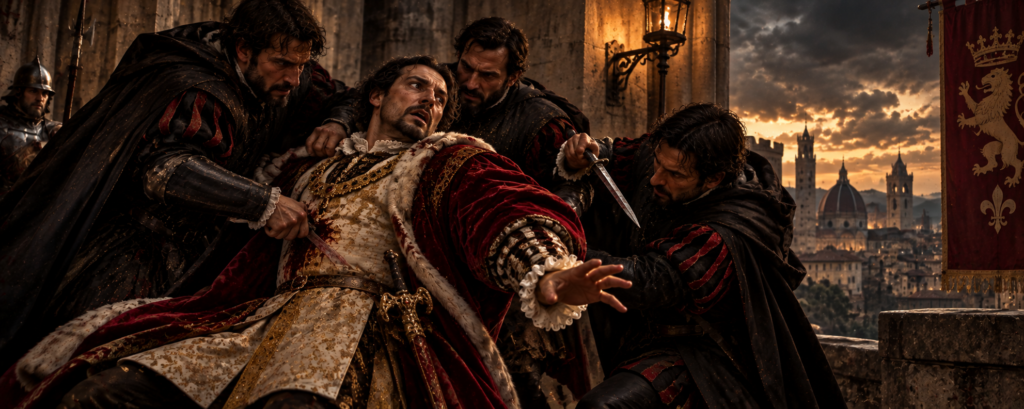
On that September day, conspirators entered the ducal stronghold and attacked Pier Luigi. The assault was swift and decisive, leaving the duke dead before his supporters could organize an effective defense. Contemporary and later accounts differ in some details of the killing, but they agree upon its essential character: a carefully prepared political assassination carried out by members of the local nobility. The duke who had attempted to discipline Piacenza through military power was destroyed inside the very fortress intended to secure his authority.
The murderers did not treat the body with the dignity ordinarily accorded to a reigning prince. Accounts describe Pier Luigi’s corpse being thrown or displayed from the citadel, making his death visible to the city whose obedience he had demanded. The humiliation was politically meaningful because it demonstrated that the duke’s authority had been shattered. The man who had ruled through command, intimidation, and the prestige of the papacy was reduced to a public spectacle.
The consequences followed almost immediately. Imperial forces moved to take possession of Piacenza, revealing that the assassination belonged to a much wider political struggle. The killing was not simply a private act of revenge by offended aristocrats. It helped transfer control of an important Italian city from the Farnese to the Habsburg sphere of influence.
For Pope Paul III, the murder was both a political catastrophe and a devastating family tragedy. The son whom he had elevated from illegitimate birth to princely authority had been cut down by nobles who rejected his government. The duchy intended to secure the Farnese dynasty’s future was suddenly divided and threatened. The pope’s ambitions had helped create the circumstances in which his son became a target.
Pier Luigi’s death exposed the brutality beneath the magnificent surface of Renaissance politics. Princes were created through marriage, patronage, and papal decrees, but their survival depended upon soldiers, alliances, and the willingness of powerful families to accept their authority. A title granted by the pope could make a man a duke, yet it could not necessarily keep him alive. To understand why Pier Luigi Farnese was murdered, it is necessary to return to the extraordinary family that raised him to power.
Born Outside the Rules of the Church
Pier Luigi Farnese was born in Rome on 19 November 1503, at a time when his father was already an important figure within the Catholic Church. Alessandro Farnese had been made a cardinal in 1493 and belonged to a family whose political ambitions extended across central Italy. His relationship with Silvia Ruffini produced several children, including Pier Luigi and his siblings. The existence of these children was hardly compatible with the ideal of clerical celibacy, but it was not unprecedented among powerful Renaissance churchmen.
The contradiction was characteristic of an era in which ecclesiastical office could serve dynastic interests. Cardinals frequently belonged to aristocratic families that expected them to advance the fortunes of relatives through appointments, marriages, and territorial influence. Some senior churchmen maintained relationships and acknowledged children despite the official requirements of clerical life. Such behavior attracted criticism, yet political advantage often outweighed public embarrassment.
Alessandro Farnese possessed considerable advantages. His family had established connections with the papal court, and his sister Giulia Farnese had been closely associated with Pope Alexander VI. Alessandro’s rise within the Church was facilitated by the complex network of relationships surrounding the Borgia papacy. His later career demonstrated remarkable political endurance, allowing him to survive changes in papal leadership and eventually reach the highest office himself.
Pier Luigi grew up knowing that his family possessed wealth and influence but that his own birth carried an irregular status. Illegitimacy did not necessarily prevent advancement among Renaissance elites, particularly when a powerful father could arrange recognition, marriage, and inheritance. Nevertheless, it created complications in a society deeply concerned with lineage and legal standing. The Farnese worked to ensure that Pier Luigi could occupy a respectable position within the aristocratic world.
His upbringing prepared him for a military and political career rather than a life in the Church. He developed an interest in arms, horses, command, and the exercise of personal authority. Unlike his father, whose power depended upon ecclesiastical office and diplomacy, Pier Luigi would build his reputation through military service and the acquisition of territory. His temperament was frequently described by hostile contemporaries as forceful, impulsive, and difficult to restrain.
The young Farnese also entered a society where violence formed an accepted part of aristocratic life. Noble families maintained armed followers, pursued feuds, and defended their privileges through force when political negotiation failed. Military service could provide prestige, income, and opportunities for advancement. Pier Luigi’s later conduct reflected this environment, although the severity of accusations against him went beyond ordinary aristocratic aggression.
His father understood that a successful marriage could strengthen the family’s position. In 1519, Pier Luigi married Gerolama Orsini, a member of one of Rome’s most prominent noble families. The alliance connected the Farnese with a lineage famous for its military traditions and political influence. It also helped establish Pier Luigi as a legitimate participant in the marriage networks of the Italian aristocracy.
The couple eventually had several children, including Alessandro Farnese, who became a cardinal, Ottavio Farnese, who inherited the ducal ambitions of the family, and Orazio Farnese, whose marriage would later strengthen connections with the French monarchy. Their daughter Vittoria also participated in the family’s dynastic strategy through marriage. These children became central to the long-term survival of Farnese power. The family was building a political dynasty even before Alessandro Farnese became pope.
Pier Luigi’s early life therefore combined privilege with ambition. He was the son of a cardinal, the husband of an Orsini noblewoman, and the father of children who could extend the family’s influence into the next generation. Yet his position remained dependent upon the success of his father’s career. When Alessandro Farnese became Pope Paul III in 1534, the possibilities available to Pier Luigi expanded dramatically.
A Cardinal Becomes Pope, and His Son Becomes a Prince
The election of Alessandro Farnese as Pope Paul III on 13 October 1534 transformed the political standing of the entire family. The new pope inherited a Church facing enormous challenges, including the spread of Protestant reform, tensions among European monarchs, and the consequences of decades of Italian warfare. He would eventually convene the Council of Trent, an event of profound importance to Catholic reform. Yet his pontificate also became notorious for the advancement of his relatives.
Nepotism was deeply embedded in Renaissance papal politics. Popes frequently used ecclesiastical offices, marriages, and territorial grants to establish powerful family networks. The papacy was not hereditary, so a pope’s relatives could lose influence after his death unless they possessed independent sources of wealth and political authority. Creating a territorial dynasty offered one way to preserve family power beyond a single pontificate.
Paul III pursued that strategy with determination. He promoted his grandsons Alessandro and Ranuccio Farnese to the cardinalate while they were still very young, demonstrating the extraordinary privileges available to members of the papal family. He also sought secular territories for Pier Luigi, whose ambitions required a political base outside the ecclesiastical hierarchy. The distinction between the interests of the Church and those of the Farnese family became increasingly difficult to maintain.
Pier Luigi received important titles and responsibilities during the early years of his father’s pontificate. He acquired authority over territories associated with the Farnese patrimony and expanded his standing among the princes of central Italy. His elevation was presented through legal and political mechanisms available to the papacy, but the underlying purpose was unmistakable. Paul III intended to establish his son as a territorial ruler.
The strategy attracted criticism because the pope was using resources and authority associated with the Church to benefit his own family. Opponents argued that such policies weakened the moral standing of the papacy at a time when demands for ecclesiastical reform were becoming increasingly urgent. Supporters could reply that strong papal relatives helped defend the independence of the Holy See against powerful monarchs. Both arguments reflected the political realities of sixteenth-century Italy.
Pier Luigi was not simply a passive beneficiary of his father’s generosity. He pursued military opportunities, cultivated relationships with commanders, and sought the resources necessary to support an increasingly ambitious household. His conduct could be aggressive, and his reputation for personal misconduct complicated the pope’s efforts to advance him. Nevertheless, Paul III continued to regard his son’s elevation as essential to the family’s future.
The pope’s determination would eventually bring him into conflict with Emperor Charles V. The emperor controlled extensive territories in Italy and regarded the balance of power in the peninsula as a matter of imperial security. A new Farnese principality positioned between papal and imperial interests could become either a useful ally or a dangerous obstacle. Pier Luigi’s appointment as duke would transform that uncertainty into open rivalry.
For the moment, however, the family appeared to be approaching the height of its power. Paul III possessed the papal throne, his grandsons occupied prestigious ecclesiastical positions, and Pier Luigi was moving toward princely status. The Farnese had risen from an important Italian noble family to a dynasty with European ambitions. The danger was that their success created enemies whose power exceeded their own.
The Soldier Prince and the Brutal World of Italian Warfare
Pier Luigi’s military career unfolded during an era when Italy was repeatedly devastated by conflicts involving France, Spain, the Holy Roman Empire, and competing Italian states. Armies crossed the peninsula in pursuit of dynastic claims and strategic territories. Mercenary commanders served different employers, and military allegiance could change according to opportunity. Warfare was both a profession and a means of political advancement.
The Italian Wars created opportunities for ambitious noblemen who possessed family connections and military experience. Commanders could gain wealth, titles, and influence by serving powerful rulers. Yet the same environment encouraged plunder, coercion, and the brutal treatment of civilian populations. Soldiers frequently depended upon territories they occupied for food, money, and supplies.
Pier Luigi operated within this violent world. His military activities and associations contributed to a reputation for harshness, although individual accusations require examination through contemporary evidence. Hostile chroniclers portrayed him as a man inclined toward intimidation and excessive force. Such descriptions may reflect genuine conduct, political hostility, or a combination of both.
His temperament became important because he later attempted to govern a duchy containing aristocrats who possessed their own armed traditions. A ruler accustomed to military command might expect obedience from nobles who considered themselves political partners rather than subordinates. The methods that proved effective in a military camp could provoke resentment within a city accustomed to negotiated government. Pier Luigi’s experience did not necessarily prepare him for the delicate compromises required in Piacenza.
The Sack of Rome in 1527 provides essential context for the world in which he matured. Imperial troops entered the city and subjected it to extraordinary violence, looting, and destruction. The catastrophe demonstrated how quickly the institutions of Renaissance power could collapse before an uncontrolled army. It also revealed the vulnerability of the papacy to the ambitions of European monarchs.
The event shaped the political calculations of later popes, including Paul III. Maintaining papal independence required diplomacy, fortifications, financial resources, and reliable allies. A powerful Farnese principality could appear to offer additional protection. Yet creating such a state also risked provoking the emperor whose forces had already demonstrated their capacity to threaten Rome.
Pier Luigi’s military identity was therefore both an asset and a liability. He possessed the experience and ambition expected of a Renaissance prince, but his methods could alienate the very subjects he needed to govern. His reputation for personal violence made political reconciliation more difficult. By the time he became duke, his enemies already possessed material with which to portray him as unfit to rule.
The most damaging allegations concerned not ordinary warfare but an episode of alleged sexual violence involving a bishop. That controversy became central to Pier Luigi’s reputation and remains one of the darkest aspects of his biography. It also illustrates the difficulties historians face when examining accusations circulated in a politically hostile environment. The incident cannot responsibly be ignored, but neither should every sensational detail be accepted without qualification.
The Scandal of Fano: A Bishop, an Accusation, and a Ruined Reputation
In 1537, Pier Luigi Farnese became associated with a notorious allegation involving Cosimo Gheri, the young bishop of Fano. According to hostile accounts, Pier Luigi sexually assaulted the bishop during a visit to the city. The episode was subsequently described in increasingly lurid terms by writers critical of the Farnese family. It became one of the principal scandals used to portray Pier Luigi as a man whose power had freed him from ordinary moral restraint.
The allegation is serious and must be distinguished from the embellishments that accumulated around it. Contemporary and near-contemporary sources preserve accusations of sexual violence, but their political context complicates the reconstruction of precisely what occurred. The Farnese had powerful enemies who were eager to damage the reputation of the pope’s son. Nevertheless, the existence of hostile motives does not automatically make the accusation false.
Some accounts describe Gheri as being subjected to an assault so traumatic that it contributed to his death. Other narratives provide different sequences or emphasize the humiliation allegedly inflicted upon him. The relationship between the reported assault and the bishop’s subsequent death cannot be established with the certainty sometimes implied in popular retellings. Historians must therefore separate the allegation itself from claims about its precise circumstances and consequences.
The scandal was especially damaging because the alleged victim was a bishop. An attack upon a member of the episcopate could be interpreted as an offense against both personal dignity and ecclesiastical authority. Pier Luigi’s position as the pope’s son intensified the contradiction. The family that claimed to defend the Church was accused of shielding a man responsible for violating one of its own prelates.
The story circulated in a political environment where sexual accusations were frequently used to discredit powerful figures. Charges involving same-sex conduct carried particular stigma in sixteenth-century Italian society and could be employed as instruments of humiliation. Hostile writers sometimes combined genuine accusations with moralistic exaggeration. This context requires caution without minimizing the seriousness of the reported violence.
Paul III’s continued support for Pier Luigi became another source of criticism. Opponents could portray the pope as a father who valued dynastic ambition above justice and ecclesiastical discipline. Whether Paul III privately believed the allegations, dismissed them, or attempted to contain their consequences is difficult to determine. What is clear is that the controversy did not prevent Pier Luigi’s further political advancement.
The episode contributed to a reputation that followed him into Parma and Piacenza. A ruler already suspected of brutality could expect little goodwill from nobles determined to resist his authority. Stories of sexual misconduct, arbitrary violence, and personal arrogance became part of the political language used against him. His enemies did not need to invent a new image when they could draw upon scandals already associated with his name.
The Fano allegation remains an important warning against treating Renaissance biography as a collection of unquestionable anecdotes. Pier Luigi’s enemies had reasons to portray him as monstrous, while his supporters had reasons to suppress damaging information. The surviving record does not permit every detail to be resolved. A responsible account must acknowledge the accusation, explain its significance, and preserve uncertainty where the evidence demands it.
The Pope Creates a Duchy for His Son
The decisive transformation in Pier Luigi’s career came in 1545, when Pope Paul III established him as Duke of Parma and Piacenza. The two cities occupied strategically important positions in northern Italy, connecting territories and routes that mattered to both papal and imperial policy. Their transfer into a hereditary Farnese duchy was an extraordinary act of dynastic ambition. It also created the conditions for the conflict that would eventually destroy Pier Luigi.
Parma and Piacenza had been associated with papal authority following earlier Italian political settlements. Paul III sought to separate them from direct papal administration and place them under his son’s rule. In exchange, arrangements were made involving other Farnese territories, including Camerino and Nepi, although the political and financial implications were complex. The transaction provoked controversy because it appeared to convert ecclesiastical possessions into a family inheritance.
The pope’s supporters could argue that the arrangement strengthened the papacy by establishing a loyal principality in a strategically important region. A Farnese duke might provide military support and help preserve papal influence against external powers. Critics regarded the creation of the duchy as a blatant example of nepotism. The distinction between the interests of the Church and the ambitions of its ruling family had rarely appeared more visible.
Emperor Charles V had reasons to view the new duchy with suspicion. His possessions in northern Italy included the Duchy of Milan, whose security depended upon control of important routes and neighboring territories. Piacenza lay close to the imperial sphere and possessed considerable strategic value. A strong Farnese ruler could complicate Habsburg military and diplomatic planning.
The emperor’s relationship with Paul III was already strained by competing priorities. Both men had interests in defending Catholic Christianity against Protestant expansion, but they disagreed over aspects of Italian politics and the distribution of power. The pope sought to preserve his independence from imperial domination. Charles wanted to prevent the emergence of a hostile state near Milan.
Pier Luigi entered his new position with the prestige of papal backing but without the deep local loyalties enjoyed by established dynasties. Parma and Piacenza possessed their own traditions, institutions, and powerful aristocratic families. Their elites were not necessarily prepared to accept the authority of a ruler imposed through papal decision. The duchy’s creation solved the Farnese family’s problem of territorial status while creating a new problem of political legitimacy.
The duke responded by attempting to consolidate his authority. He sought control over military resources, administration, fortifications, and the noble families whose independent power threatened the government. Such policies were not unusual among sixteenth-century rulers attempting to create stronger territorial states. Their implementation, however, could be deeply unpopular.
The new duchy also suffered from its divided political geography. Parma and Piacenza possessed different local interests, and their aristocracies did not necessarily respond to Farnese rule in the same way. The duke needed to balance the demands of both cities while defending himself against imperial pressure. His ability to do so would be tested almost immediately.
For Pier Luigi, the title represented the culmination of decades of family ambition. He had become a reigning prince through the extraordinary power of his father. His children could now inherit a recognized territorial state rather than depend entirely upon papal patronage. Yet the same elevation made him a direct obstacle to men who wanted Piacenza restored to a different political order.
Piacenza: A City That Did Not Want Its Duke
Piacenza was not an empty territory waiting to be governed. Its noble families possessed estates, jurisdictions, military traditions, and long-established expectations of political influence. Many had survived earlier changes of government by negotiating privileges and maintaining connections with powerful external patrons. Pier Luigi’s arrival threatened to disrupt that balance.
The duke approached government with a determination to strengthen central authority. He sought to reduce the independence of aristocratic families and bring their resources more firmly under ducal control. Measures affecting fortifications, armed retainers, taxation, and jurisdiction provoked resentment. Nobles accustomed to exercising power within their own territories increasingly regarded him as an enemy.
His policies reflected a broader development in early modern Europe. Rulers were attempting to build stronger states by limiting private warfare, regulating military forces, and expanding administrative control. Such measures could improve security and government efficiency. They also threatened the privileges of aristocrats whose political importance depended upon their ability to act independently.
Pier Luigi’s reputation made the conflict more personal. A ruler known for harshness and scandal could find it difficult to persuade opponents that his reforms served the public good. Noble families interpreted his interventions as deliberate humiliation and domination. The more firmly he asserted his authority, the more intensely they resented him.
The duke also invested in military security. Fortifications and garrisons were intended to protect the duchy from external threats and prevent internal rebellion. Yet the presence of soldiers could deepen local hostility, particularly when residents associated military power with coercion. A fortress might symbolize security to the ruler and oppression to his subjects.
Piacenza’s strategic position increased the stakes. The city was important to the defense of northern Italy and the communications of imperial forces. Ferrante Gonzaga, the imperial governor of Milan, understood its value. The resentment of local nobles offered an opportunity to weaken the Farnese without immediately resorting to open war.
The duke’s opponents therefore possessed potential allies beyond the city. Their grievances could be presented to imperial officials who shared an interest in reducing Farnese influence. The possibility of external support made conspiracy more attractive. Assassination could become not merely an act of revenge but a means of changing the political allegiance of Piacenza.
Pier Luigi appears to have understood that his position was dangerous. His efforts to strengthen defenses suggest awareness of the threats surrounding him. Yet recognizing danger was not the same as identifying the men prepared to act. His government depended upon the cooperation of aristocrats whose loyalty was increasingly doubtful.
The conflict became a struggle over the nature of princely authority. Pier Luigi believed that a duke must command his territory and restrain powerful subjects. His opponents believed that their inherited privileges placed limits upon his power. Neither side was prepared to surrender its position easily.
By 1547, resentment had developed into a conspiracy. The men involved were not impoverished rebels or outsiders seeking a place in government. They belonged to the aristocratic elite whose status the duke had attempted to subordinate. Their determination would prove more dangerous than any open military challenge he had yet faced.
Ferrante Gonzaga and the Shadow of the Emperor
Ferrante Gonzaga was one of the most important figures in the political circumstances surrounding Pier Luigi’s assassination. A member of the powerful Gonzaga family of Mantua, he had established a distinguished career in imperial service. By the 1540s, he governed Milan on behalf of Emperor Charles V. His position placed him at the center of Habsburg strategy in northern Italy.
Gonzaga understood that Piacenza possessed considerable military value. Control of the city could strengthen the imperial position and reduce the threat posed by the new Farnese duchy. Pier Luigi’s attempts to consolidate power therefore conflicted with imperial interests. The duke was not simply an unpopular local ruler; he was a strategic obstacle.
The relationship between Gonzaga and the Piacentine conspirators has been a central subject of historical interpretation. Evidence indicates that imperial interests were closely connected to the plot and that Gonzaga supported or facilitated the political outcome. The precise extent of Charles V’s personal foreknowledge is more difficult to establish. It is important not to treat the emperor’s direct authorization as certain merely because imperial forces benefited from the murder.
Gonzaga’s position offered the conspirators significant advantages. They could hope that an imperial occupation would protect them from retaliation by the Farnese and the papacy. Their rebellion would become part of a larger political realignment rather than an isolated local uprising. External support increased the likelihood that the assassination could produce lasting results.
The emperor’s government also had reasons to avoid an openly aggressive confrontation with Paul III. The pope remained an important figure in Catholic Europe, particularly during the struggle against Protestantism. Direct military action against his son’s duchy could create diplomatic difficulties. A conspiracy originating among local nobles offered a different route to the same strategic objective.
This does not mean that every participant shared identical motives. Piacentine nobles sought relief from ducal authority and the preservation of their privileges. Gonzaga pursued imperial security and territorial advantage. Their interests converged because both wanted Pier Luigi removed from power.
The political environment made such cooperation possible. Italian aristocratic families frequently maintained connections with larger powers, and local disputes could become instruments of international rivalry. A noble conspiracy might appear to be a domestic rebellion while serving the interests of a foreign monarch. The assassination of Pier Luigi belonged to this world of overlapping loyalties.
For Paul III, the danger was particularly bitter. The pope had created the duchy partly to secure the future of his family and preserve influence in northern Italy. His decision placed Pier Luigi in a position where imperial officials regarded him as a threat. The dynastic project intended to protect the Farnese had instead exposed them to powerful enemies.
Gonzaga’s role would become unmistakable after the murder, when imperial forces took control of Piacenza. The speed of the occupation demonstrated that the conspiracy was connected to a wider political plan. The assassins had not merely removed a ruler. They had helped deliver a strategically important city into the imperial sphere.
The Noblemen Who Chose Murder
The conspiracy against Pier Luigi Farnese involved members of Piacenza’s aristocratic elite, including Giovanni Anguissola, who is commonly identified as a leading figure. Other noble families and individuals participated in the planning, reflecting the breadth of hostility toward the duke among certain privileged groups. These were men with estates, connections, and political ambitions of their own. They had much to lose if Pier Luigi succeeded in reducing their independence.
Their grievances were rooted in the duke’s attempts to centralize authority. Restrictions upon private power, military obligations, and interference with traditional jurisdictions threatened their established position. They regarded the new government as an assault upon the social order that had sustained their families. Removing Pier Luigi offered a way to reverse those changes.
The conspirators also understood the risks. Assassinating a reigning duke was an act of extraordinary political violence, and failure could lead to torture, execution, confiscation, and the destruction of entire families. The victim was the son of the pope, making retaliation particularly dangerous. The plot therefore required careful preparation and confidence that powerful allies would support the outcome.
Imperial involvement or encouragement made the plan more plausible. If Piacenza could be transferred quickly into the control of Charles V’s representatives, the conspirators might escape immediate Farnese revenge. The political future of the city could be decided before the pope organized a response. Speed was therefore essential.
The plot also depended upon access to the duke. Pier Luigi had strengthened his military position, but a ruler could not isolate himself completely from the noble society he governed. Officials, courtiers, and aristocrats continued to move within the structures of ducal administration. The conspirators exploited the opportunities created by that environment.
The decision to kill rather than depose him reflected the political circumstances. A living duke could rally supporters, appeal to his father, and seek military assistance. His death would create confusion and remove the central figure around whom Farnese resistance might organize. The conspirators needed a decisive act that would make the transfer of power difficult to reverse.
Their willingness to murder also reveals the limits of Renaissance political loyalty. Aristocrats could swear obedience to a prince while privately negotiating with his enemies. Family survival and privilege often mattered more than abstract loyalty to a government. The duke’s title carried legal authority, but it did not guarantee personal allegiance.
The conspiracy developed in an atmosphere of secrecy, resentment, and expectation. Participants needed to coordinate the killing with the seizure of key positions in the city. The involvement of imperial interests increased the stakes. What began as aristocratic hostility became a plan to overthrow the political settlement created by the pope.
Pier Luigi’s enemies were preparing to strike at the point where his authority seemed strongest. The citadel represented the military foundation of his rule. Killing him there would demonstrate that even his own defenses could not protect him. The attack would be both practical and symbolic.
10 September 1547: Murder Inside the Citadel
On 10 September 1547, the conspiracy reached its violent conclusion. Pier Luigi Farnese was inside the citadel of Piacenza when the attackers moved against him. The stronghold was intended to protect the duke and secure his control over the city. Instead, it became the setting for his assassination.
The conspirators acted with the advantage of preparation. They knew the political environment, possessed connections within the city, and had arranged the attack to exploit the duke’s vulnerability. Accounts differ concerning the precise sequence of movements and the number of wounds inflicted. The essential fact remains that Pier Luigi was attacked and killed by men associated with the Piacentine aristocratic conspiracy.
The murder was not the result of a spontaneous quarrel. It had been planned as part of an effort to overthrow Farnese authority and alter the political allegiance of Piacenza. The attackers needed to prevent the duke from escaping or organizing resistance. Their success depended upon overwhelming him before loyal soldiers could intervene.
The killing was followed by the public humiliation of the body. Chroniclers describe the corpse being thrown or displayed from the citadel, an act that announced the destruction of the duke’s authority. Such treatment was especially shocking because Renaissance princes expected elaborate funerary ceremonies and public demonstrations of respect. The conspirators instead used the body as evidence that the old government had ended.
The display also communicated a message to the population. Pier Luigi had attempted to impose obedience upon Piacenza through ducal power. His corpse now demonstrated that the aristocratic opposition had defeated him. The humiliation was intended to make the political transformation visible and irreversible.
The precise details of the assassination have been embellished in later accounts. Some narratives emphasize particular wounds, gestures, or dramatic exchanges that cannot be independently verified. Such additions should be treated cautiously, especially when they appear in works written to celebrate the conspirators or condemn the duke. The historical significance of the murder does not depend upon invented dialogue or sensational detail.
The immediate aftermath confirmed that the conspiracy had a political objective beyond personal vengeance. Control of Piacenza shifted rapidly, and imperial forces entered the city. The murderers had created the opening necessary for a change of government. The duchy established by Paul III was suddenly fractured.
Pier Luigi died at forty-three years of age, less than two years after receiving his ducal title. His career had carried him from the irregular position of a cardinal’s son to the rank of reigning prince. He had gained power through the ambitions of his father and attempted to secure it through military and administrative authority. His death demonstrated how quickly that power could collapse when aristocratic hostility aligned with international politics.
The assassination was particularly devastating because it occurred in a fortress associated with the duke’s own security. He had tried to protect his authority through soldiers and strongholds, but the decisive threat came from conspiracy. The attack exposed the vulnerability of rulers who depended upon personal loyalty in a politically divided society. Pier Luigi’s military preparations could not compensate for the hatred of men who had access to his world.
The duke’s death was therefore both a murder and a political coup. It eliminated the ruler, humiliated his memory, and opened the way for imperial occupation. The violence inside the citadel changed the balance of power in northern Italy. Its consequences would extend far beyond the streets of Piacenza.
The Body of a Duke and the Humiliation of a Dynasty
The treatment of Pier Luigi’s body became one of the most memorable aspects of the assassination. Accounts describe his corpse being exposed to public view after the killing, with some versions specifying that it was thrown from the citadel. The act was intended to demonstrate that the duke had been stripped of power and dignity. It transformed the private violence of assassination into a public declaration of political victory.
In Renaissance Italy, the bodies of rulers carried symbolic importance. Funerals, monuments, and ceremonial displays reinforced dynastic legitimacy and the continuity of government. Even a dead prince could serve as the center of political loyalty. Public humiliation of a ruler’s corpse therefore attacked the authority of his family as well as his personal reputation.
The conspirators understood that Pier Luigi’s death needed to be unmistakable. Rumors of survival could encourage resistance, while uncertainty might allow loyal officials to maintain the appearance of ducal government. Displaying the body removed such doubts. It announced that the first Duke of Parma and Piacenza could no longer command anyone.
The humiliation also reflected the depth of aristocratic resentment. The duke’s policies had challenged powerful families whose status depended upon honor and inherited privilege. His enemies now subjected him to the kind of public degradation that they believed his government had inflicted upon them. The violence was political, but it also carried an unmistakable element of revenge.
For the Farnese family, the spectacle was a profound insult. Pier Luigi was not merely an individual nobleman but the son of the reigning pope and the founder of a new princely dynasty. His murder threatened the legitimacy of the territories granted to him. The degradation of his body reinforced the impression that the family’s ambitions had been defeated.
The act also exposed the instability of newly created principalities. A dynasty could acquire legal recognition through papal decrees and diplomatic agreements, but public acceptance could not be manufactured so easily. Pier Luigi had possessed the title of duke without securing the loyalty of all his subjects. His death revealed the distance between formal sovereignty and effective political control.
The conspirators may have hoped that the public humiliation would discourage resistance. Yet such acts could also create enduring hatred and strengthen the desire for revenge among surviving relatives. The Farnese were unlikely to forget the manner in which Pier Luigi had been killed. The murder would become a family grievance as well as a territorial dispute.
The body eventually ceased to be the center of the immediate crisis, but the political meaning of its treatment endured. Pier Luigi had been raised to princely dignity through the authority of the papacy. His enemies reduced that dignity to a spectacle of defeat. The contrast captured the fragility of power in an age when titles could be granted by decree and destroyed by daggers.
Imperial Soldiers Enter Piacenza
The assassination was followed by the rapid occupation of Piacenza by imperial forces associated with Ferrante Gonzaga. The speed of the intervention demonstrated the strategic importance of the city and the wider political purpose of the conspiracy. The local aristocrats had removed the duke, but they were not establishing an independent republic. Their actions facilitated the extension of Habsburg authority.
Piacenza’s position made it valuable to the imperial government in Milan. The city controlled important routes and contributed to the security of northern Italian territories. Its occupation reduced the possibility that the Farnese duchy could become a hostile military presence near imperial possessions. Gonzaga had achieved an important strategic objective.
The transfer of control also complicated the political status of the duchy. Parma remained associated with the Farnese, while Piacenza fell under imperial occupation. The territorial state created for Pier Luigi was therefore divided almost immediately after his death. The arrangement threatened the future of the dynasty that Paul III had worked so hard to establish.
The emperor’s position required diplomatic management. Charles V could benefit from the occupation without necessarily accepting personal responsibility for the assassination. His representatives could present the intervention as a response to political instability or a measure necessary for imperial security. The distinction between supporting a conspiracy and exploiting its outcome remained politically useful.
For the pope, such arguments offered little comfort. His son had been murdered, and one of the principal cities granted to him was now in imperial hands. The assassination had converted a family tragedy into a direct challenge to papal policy. Paul III faced the difficult task of responding without provoking a conflict that might endanger the Papal States.
The occupation also revealed the limitations of the conspirators’ independence. They had acted to protect aristocratic privileges, but the outcome placed Piacenza under the authority of a much larger political power. Imperial administration could impose its own demands and priorities. The nobles who had rejected Farnese centralization did not necessarily gain the freedom they imagined.
The murder therefore produced a result characteristic of Italian politics during the Habsburg-Valois rivalry. Local elites attempted to use foreign power against an unpopular ruler, while foreign officials used local grievances to acquire strategic territory. Each side expected to benefit from the arrangement. The ultimate distribution of power depended upon forces much larger than the original conspiracy.
Pier Luigi’s assassination had succeeded in removing him, but it did not settle the future of Parma and Piacenza. His descendants continued to claim the territories, and the papacy remained involved in the dispute. The occupation became part of a prolonged struggle over Farnese sovereignty. The violence of September 1547 was the beginning of another political crisis rather than its conclusion.
Pope Paul III Learns His Son Has Been Murdered
The death of Pier Luigi struck Pope Paul III at the intersection of his personal and political identities. As a father, he had lost the son whose advancement had occupied much of his pontificate. As pope, he had suffered a direct challenge to a territorial settlement established through his authority. The murder threatened both family prestige and papal independence.
Paul III had invested enormous effort in building the Farnese dynasty. He had promoted relatives within the Church, arranged advantageous marriages, and transferred territories to secure a hereditary principality. Pier Luigi’s elevation to the duchy represented the culmination of that strategy. His assassination destroyed the central figure through whom the plan had been implemented.
The pope also faced the humiliation of seeing Piacenza occupied by imperial forces. The city had been granted to his son as part of a political settlement intended to strengthen the Farnese. Its seizure demonstrated that papal decisions could be challenged by military power. The emperor’s representatives had achieved what diplomacy alone might not have secured.
Paul III’s reaction must be understood within the broader conflict between the papacy and the Habsburg monarchy. The pope needed to maintain relations with Charles V because both were involved in the religious and political struggles of Europe. Yet the occupation of Piacenza made cooperation increasingly difficult. The murder intensified tensions that had already complicated their relationship.
The pope’s grief has been described in later accounts with dramatic emphasis, but specific private reactions should not be invented. What can be established is that the assassination profoundly affected the political position of the Farnese family. Paul III sought to preserve the dynasty’s remaining territories and secure the succession of Pier Luigi’s son Ottavio. The family crisis became one of the dominant concerns of his final years.
The situation also exposed divisions within the papal court. Not every cardinal or political adviser supported the use of ecclesiastical resources for Farnese dynastic interests. Some regarded the creation of the duchy as a dangerous departure from the proper responsibilities of the papacy. Pier Luigi’s death strengthened arguments that the policy had been reckless.
The pope nevertheless remained determined to protect his family. The survival of the Farnese principality depended upon preventing the loss of Parma and eventually recovering Piacenza. Ottavio Farnese became central to these efforts. His future would determine whether the murder had permanently destroyed the dynasty’s territorial ambitions.
Paul III died in November 1549, only a little more than two years after his son’s assassination. He did not live to see a complete resolution of the dispute. His pontificate remained important for the Catholic Reformation, particularly because of the opening of the Council of Trent. Yet the tragedy of Pier Luigi’s death cast a shadow over his final years and the dynastic policies for which he was remembered.
Ottavio Farnese and the Struggle to Save the Duchy
Pier Luigi’s death did not end the Farnese family’s claim to Parma and Piacenza. His son Ottavio Farnese became the principal figure responsible for preserving the dynasty’s territorial position. Ottavio had already been drawn into the highest levels of European politics through his marriage to Margaret of Austria, an illegitimate daughter of Emperor Charles V. The marriage created a connection between the Farnese and the very dynasty whose officials had benefited from Pier Luigi’s assassination.
The relationship was politically complicated. Ottavio’s marriage could potentially facilitate compromise with the emperor, but it did not eliminate the dispute over Piacenza. Family alliances among Renaissance rulers frequently coexisted with territorial rivalry. Marriage created opportunities for negotiation without guaranteeing agreement.
Ottavio sought to secure Parma and defend his inheritance against competing claims. His position was difficult because the papacy, the emperor, and local political interests all had reasons to influence the duchy’s future. He needed military resources, diplomatic support, and the ability to survive changes in papal leadership. The death of his father had made the family’s political position more precarious.
The election of Pope Julius III in 1550 introduced new uncertainties. The new pontiff did not necessarily share every dynastic priority of Paul III. Ottavio therefore had to pursue his interests within a changing diplomatic environment. His efforts contributed to further conflict involving France, the emperor, and the papacy.
The War of Parma, fought in the early 1550s, reflected the unresolved tensions created by the Farnese succession. Ottavio sought support from France, while imperial and papal forces pursued their own objectives. The conflict demonstrated that Pier Luigi’s assassination had not removed the strategic importance of the duchy. Instead, it had helped create a prolonged struggle over its control.
Ottavio eventually preserved the family’s position in Parma. The settlement of the wider dispute developed over subsequent years, and Piacenza was ultimately restored to Farnese control in 1556. The recovery demonstrated the resilience of the dynasty. The murder of its founder had delayed but not destroyed its territorial ambitions.
The Farnese would continue to rule Parma and Piacenza for generations. Their court became an important center of political and cultural life, and later members of the family played significant roles in European affairs. The duchy survived long after the death of the pope who had created it. Pier Luigi’s descendants achieved the dynastic continuity that he himself had been unable to secure.
His assassination nevertheless remained a defining moment in the family’s history. It exposed the dangers of imposing a new princely government upon powerful aristocratic communities. It also demonstrated how local grievances could be exploited by larger states. The survival of the Farnese dynasty required diplomatic flexibility that Pier Luigi’s own government had struggled to achieve.
Ottavio’s success created an ironic legacy for his father. Pier Luigi had attempted to establish authority through forceful centralization and military power. His son preserved the dynasty through a combination of political maneuvering, alliances, and persistence. The duchy ultimately endured, but its founder became remembered above all for the violent manner in which his reign ended.
Was Pier Luigi Farnese a Tyrant or a Victim of Political Propaganda?
Pier Luigi Farnese has often been portrayed as one of the most repellent princes of Renaissance Italy. Accounts emphasize his arrogance, sexual misconduct, harsh government, and violent temperament. His assassination is sometimes presented as the inevitable consequence of a life devoted to brutality. Such interpretations reflect elements of his reputation, but they also require careful examination.
The surviving evidence demonstrates that Pier Luigi pursued an aggressive program of political centralization. He attempted to reduce aristocratic independence and strengthen the authority of the duchy. These policies generated genuine hostility among powerful noble families. Yet similar reforms were undertaken by many rulers attempting to consolidate territorial states during the sixteenth century.
The distinction between tyranny and state-building is therefore not always straightforward. Measures that appeared necessary to a ruler could seem oppressive to nobles accustomed to exercising private jurisdiction. Restrictions upon armed retainers might improve public security while diminishing aristocratic power. Taxation and administrative reforms could strengthen government while imposing burdens upon influential families.
Pier Luigi’s personal reputation complicated these conflicts. The allegations surrounding Bishop Cosimo Gheri were especially damaging, and other accounts portrayed the duke as capable of arbitrary violence. Some accusations may reflect genuine misconduct, while others were amplified by political enemies. Historians must distinguish between documented policies, credible allegations, and hostile character assassination.
The conspirators themselves were not necessarily champions of popular liberty. They belonged to privileged families whose political influence was threatened by ducal centralization. Their opposition may have been motivated as much by the defense of aristocratic power as by concern for ordinary citizens. The assassination did not establish a democratic government or eliminate elite domination.
Imperial involvement further complicates the moral picture. The conspiracy served the strategic interests of Charles V’s representatives, who wanted control of Piacenza. The duke’s removal benefited a foreign power seeking to strengthen its position in Italy. The murder therefore cannot be explained solely as a spontaneous revolt against cruelty.
The political circumstances also shaped the accounts that survived. Writers hostile to the Farnese had reasons to emphasize Pier Luigi’s misconduct and present his death as justified. Supporters of the dynasty had reasons to portray him as a legitimate prince murdered through treachery. Both traditions influenced later historical narratives.
A balanced interpretation recognizes that Pier Luigi’s conduct contributed to his unpopularity without treating every hostile allegation as established fact. His government challenged entrenched privileges, and his personal reputation gave opponents additional reasons to despise him. The conspiracy succeeded because local resentment aligned with imperial ambition. His death was therefore the product of both his own policies and the wider political struggle surrounding the duchy.
Pier Luigi was neither an innocent ruler destroyed by inexplicable hatred nor a figure whose assassination can be understood entirely as moral punishment. He was an ambitious Renaissance prince who attempted to establish a powerful state in a hostile environment. His methods created enemies, and those enemies found support from forces capable of exploiting his vulnerability. The result was a political murder whose consequences extended far beyond the question of his personal character.
The Dark Machinery of Renaissance Nepotism
The career of Pier Luigi Farnese illustrates the extraordinary opportunities created by papal nepotism. His father possessed the highest ecclesiastical office in Western Christianity, yet he used that position to advance a hereditary family dynasty. Pier Luigi’s rise depended upon the transformation of papal authority into secular power. The process exposed contradictions that critics of the Renaissance Church had condemned for generations.
The papacy was an elective institution, and its leaders could not pass the office directly to their children. Nevertheless, popes frequently sought to establish lasting family influence through appointments, marriages, and territorial grants. Cardinals could provide political protection, while secular principalities offered hereditary continuity. The Farnese pursued both strategies.
Paul III’s policies were not unique. Earlier popes had promoted relatives and attempted to establish dynastic states, sometimes provoking violent conflict. The Borgia family under Alexander VI provided a particularly famous example. The Farnese inherited a political culture in which ecclesiastical office and family ambition were closely intertwined.
The creation of Parma and Piacenza for Pier Luigi represented one of the most ambitious expressions of that system. It converted territories associated with papal authority into a hereditary principality. The arrangement promised to secure the family’s future after Paul III’s death. It also provoked resistance from those who questioned the legitimacy or strategic consequences of the transfer.
The murder revealed the risks of such policies. A pope could grant titles and territories, but he could not automatically create loyalty among local aristocrats. Nor could he prevent powerful monarchs from challenging arrangements that threatened their interests. The authority of the papacy was formidable, yet it operated within a political world governed by military strength and diplomatic calculation.
The scandal of Pier Luigi’s personal reputation intensified criticism of nepotism. Opponents could argue that a man accused of serious misconduct had been rewarded because he was the pope’s son. His elevation appeared to place family loyalty above moral accountability. Such accusations were especially damaging during an era when the Church faced demands for reform.
Paul III’s pontificate therefore contained a striking contradiction. He played a major role in the institutional beginnings of the Catholic Reformation while simultaneously advancing his relatives through practices associated with Renaissance ecclesiastical corruption. His support for the Council of Trent demonstrated commitment to reform, but his dynastic policies remained controversial. The two aspects of his career existed side by side.
Pier Luigi’s death did not end papal nepotism, but it demonstrated its potential consequences. The creation of a family principality could provoke conflict with aristocrats, neighboring rulers, and international powers. The pope’s personal ambitions could become inseparable from the political security of the Church. A dynasty intended to strengthen papal influence might instead create new vulnerabilities.
The Farnese ultimately succeeded in establishing a lasting territorial state, but the achievement came at a terrible personal cost. Pier Luigi became the victim of the political system that had elevated him. His assassination was a reminder that Renaissance nepotism could create princes more quickly than it could create stable governments. The authority that raised him to power could not protect him from the enemies his rise had produced.
The Conspiracy That Changed Northern Italy
The assassination of Pier Luigi Farnese had consequences that extended beyond the immediate transfer of Piacenza to imperial control. It altered the balance of power among the papacy, the Habsburg monarchy, and the Italian states. The murder demonstrated that the territorial arrangements created by Paul III could be challenged through coordinated local and international action. It also intensified the struggle over the future of the Farnese dynasty.
For Ferrante Gonzaga, the occupation of Piacenza represented a strategic success. The city strengthened the imperial position in northern Italy and reduced the influence of a potentially hostile principality. The operation showed how military governors could exploit local political divisions to advance the interests of larger states. The conspirators provided the opportunity, while imperial forces secured the result.
For the Piacentine nobles, the outcome was more ambiguous. They had removed a duke whose centralizing policies threatened their privileges, but the city came under the authority of another powerful government. Imperial control did not necessarily restore the political independence they desired. Their victory was therefore dependent upon the willingness of Habsburg officials to respect their interests.
For the Farnese, the assassination created a struggle for survival. The family retained claims to the duchy, but its territorial position was weakened. Ottavio Farnese had to navigate conflicts involving the pope, the emperor, and France. The recovery of Piacenza required years of diplomacy and political maneuvering.
The episode also demonstrated the continuing importance of assassination as a political instrument in Renaissance Italy. Conspiracies could remove rulers whose military strength made open rebellion difficult. Yet successful murder did not automatically produce political stability. The outcome depended upon who controlled the army, the treasury, and the institutions of government after the victim’s death.
Pier Luigi’s assassination was distinctive because it combined aristocratic rebellion with imperial strategic interests. The conspirators were not merely attempting to replace one local ruler with another. Their actions helped transfer an important city into a different political sphere. The murder therefore belonged to the history of international rivalry as much as to the history of Italian noble feuds.
The event also exposed the weakness of new dynasties. Established ruling families could draw upon generations of loyalty, marriage alliances, and political habit. Pier Luigi possessed a title created only two years earlier and faced aristocrats who had not accepted his authority. His dependence upon military power could not compensate for the absence of a secure political foundation.
The long-term survival of the Farnese duchy demonstrated that the assassination did not achieve every objective of the duke’s enemies. The family eventually recovered Piacenza and maintained its position for generations. Nevertheless, the murder shaped the conditions under which that survival occurred. It forced the dynasty to confront the limits of papal patronage and the necessity of broader political alliances.
Northern Italy remained a region where local rulers operated under the pressure of great powers. The Habsburg monarchy, France, the papacy, and Italian dynasties continued to compete for influence. Pier Luigi’s death was one episode in that larger struggle, but it revealed its methods with unusual clarity. Political authority could be negotiated through marriage and diplomacy, then overturned in a single afternoon by conspirators carrying weapons.
A Dynasty Built on a Murdered Man
Pier Luigi Farnese’s assassination did not prevent his descendants from becoming one of the important ruling families of early modern Italy. The Duchy of Parma and Piacenza survived, and later Farnese rulers developed a court associated with political influence, military service, and artistic patronage. The family’s position became more secure than it had been during Pier Luigi’s brief reign. His death remained a violent beginning to a dynasty that endured for nearly two centuries.
Ottavio Farnese played the central role in preserving the inheritance. His political maneuvering ensured that Parma remained under Farnese control, while Piacenza was eventually recovered. The dynasty’s survival required compromise and alliances with powers that had once threatened its existence. The political world that destroyed Pier Luigi became the environment in which his descendants learned to operate.
Later members of the family achieved considerable prominence. Alessandro Farnese, Duke of Parma, became one of the most important military commanders in the service of the Spanish Habsburg monarchy during the late sixteenth century. His campaigns in the Netherlands demonstrated the extraordinary reach of the dynasty founded by Pier Luigi. The family that had once been threatened by imperial power eventually produced one of its most celebrated generals.
The Farnese also became important patrons of art and architecture. Their palaces, collections, and cultural projects contributed to the artistic history of Italy. The family’s wealth and prestige allowed later generations to cultivate an image of princely magnificence. Such achievements contrasted sharply with the violence that marked the foundation of their territorial rule.
Pier Luigi’s personal reputation remained difficult to rehabilitate. His brief reign offered fewer opportunities for cultural patronage or institutional achievement than those enjoyed by his descendants. The scandals associated with his life and the brutality of his death dominated later accounts. He became remembered as a violent founder rather than a successful statesman.
The dynasty’s endurance nevertheless complicates the interpretation of his failure. Pier Luigi had sought to establish a hereditary principality, and that objective ultimately survived his assassination. His methods may have contributed to his destruction, but the political structure created through his father’s ambition did not disappear. The family continued to rule territories that he had briefly governed.
The contrast between the founder and his descendants reveals a recurring pattern in dynastic history. The first generation often acquires power through controversial means and faces intense resistance. Later generations benefit from the gradual normalization of hereditary authority. What appears illegitimate or intrusive at the beginning can become accepted through time, diplomacy, and political habit.
Pier Luigi did not live long enough to witness that transformation. He died before the duchy had developed the institutions and loyalties necessary to protect its ruler. His descendants inherited both the opportunity and the danger created by his elevation. The dynasty survived by learning to navigate the political realities that had destroyed him.
The Prince Whose Father Could Give Him Everything Except Safety
Pier Luigi Farnese rose to power through one of the most extraordinary advantages available in Renaissance Italy. His father was a cardinal who became pope, and that elevation transformed the future of the entire family. Through papal patronage, military opportunities, and dynastic arrangements, Pier Luigi acquired the status of a reigning prince. In 1545, he became the first Duke of Parma and Piacenza, establishing the territorial foundation of a dynasty that would survive for generations.
His rise was inseparable from the contradictions of Renaissance papal politics. Paul III sought to reform the Church while advancing his relatives through titles, offices, and territorial grants. The creation of the Farnese duchy represented an ambitious attempt to convert ecclesiastical influence into hereditary secular power. It also provoked hostility from those who believed the pope had sacrificed the interests of the Church to those of his family.
Pier Luigi entered his new duchy determined to establish strong government. He attempted to restrain aristocratic independence, strengthen military defenses, and impose authority upon nobles accustomed to exercising considerable power. Such policies reflected the broader development of territorial states during the sixteenth century. Yet his harsh reputation and aggressive methods made compromise increasingly difficult.
The scandals associated with his personal life further damaged his standing. The allegation involving Bishop Cosimo Gheri became one of the most notorious episodes in his biography, although the surviving accounts require careful treatment because of their political context. His enemies portrayed him as a man whose family connections had placed him beyond accountability. His supporters could defend his legitimate authority without necessarily disproving every accusation against him.
The greatest danger came from the convergence of local resentment and international ambition. Piacentine nobles feared the loss of their privileges, while Ferrante Gonzaga and the imperial government regarded the Farnese duchy as a strategic obstacle. Their interests aligned around the removal of Pier Luigi. The resulting conspiracy was both an aristocratic rebellion and an episode in the struggle for control of northern Italy.
On 10 September 1547, the conspirators attacked the duke inside the citadel of Piacenza. The fortress intended to secure his rule became the place of his death, and the public humiliation of his body announced the collapse of his authority. Imperial forces quickly occupied the city, confirming the wider political significance of the murder. The duke had ruled for less than two years.
For Pope Paul III, the assassination destroyed the son whose elevation had been central to his dynastic ambitions. The murder also exposed the limits of papal power in a world dominated by military force and international rivalry. A pope could create a duke, but he could not guarantee that the duke’s subjects would obey him. Nor could he prevent powerful monarchs from exploiting the resentment of those subjects.
Pier Luigi’s death did not end the Farnese dynasty. His son Ottavio preserved the family’s position in Parma and eventually recovered Piacenza, allowing the duchy to endure. Later generations achieved the political stability and cultural prestige that had eluded its founder. The dynasty survived, but its beginnings remained marked by conspiracy and bloodshed.
The assassination also offers a warning against accepting the claims of either the victim’s supporters or his enemies without examination. Pier Luigi was an ambitious and controversial ruler whose conduct created genuine hostility. His assassins were powerful nobles defending their own interests, and their actions benefited an imperial government seeking strategic advantage. The murder was not a simple triumph of justice over tyranny, nor was it merely the destruction of an innocent prince.
His story belongs to the darker history of Renaissance state-building, when rulers attempted to centralize authority and aristocrats resisted the loss of inherited privileges. It also belongs to the history of papal nepotism, in which the spiritual authority of the Church became entangled with the ambitions of ruling families. Pier Luigi stood at the intersection of those forces. His violent death revealed how dangerous that position could become.
The most haunting irony is that Pier Luigi’s extraordinary advantages helped create the circumstances of his destruction. His father’s position gave him titles, territories, soldiers, and the prestige of the papacy. Those gifts made him powerful, but they also made him a threat to aristocrats and emperors who had no intention of accepting his authority. The higher he rose, the more dangerous his enemies became.
Pier Luigi Farnese was born the illegitimate son of a cardinal and died as the murdered duke of a principality created by his father. Between those two moments, he acquired nearly everything a Renaissance nobleman could desire: rank, wealth, territory, military command, and the promise of a hereditary dynasty. Yet on 10 September 1547, none of those advantages could save him from the men who had decided that his death was worth more than his obedience. The pope had given his son a duchy, but in the end, he could not give him the one thing every ruler needed most: the loyalty of the men standing closest to him.