
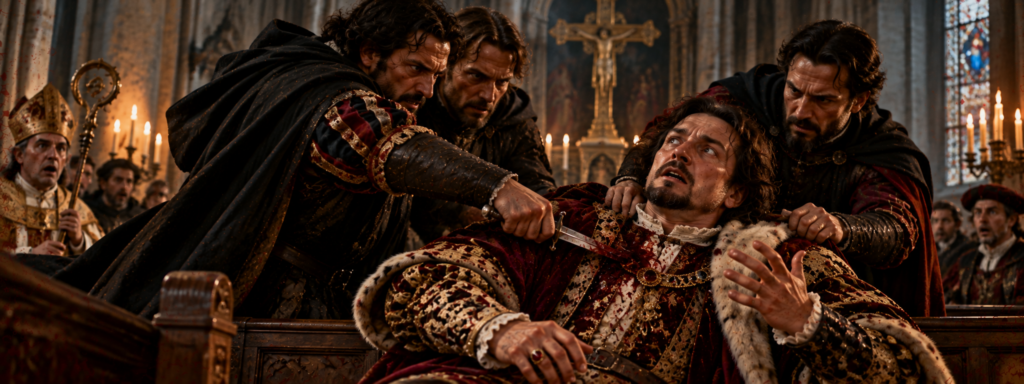
Galeazzo Maria Sforza: The Murderous Duke of Milan Who Was Stabbed to Death in Church
The Cruelty, Scandals, and Dangerous Ambitions of a Renaissance Tyrant—and the Christmas Conspiracy That Ended His Reign in Blood
Galeazzo Maria Sforza (24 January 1444 – 26 December 1476) was Duke of Milan from 1466 until his assassination at the age of thirty-two. The eldest son of Francesco Sforza and Bianca Maria Visconti, he inherited one of Renaissance Italy’s wealthiest and most powerful states, becoming a ruler remembered for his extravagant court, artistic patronage, political ambition, and notorious reputation for cruelty. His government combined administrative sophistication and cultural brilliance with harsh punishments, personal extravagance, and allegations of sexual violence and sadistic behavior, some of which were recorded by hostile contemporaries and require careful interpretation. On 26 December 1476, the feast of Saint Stephen, he was attacked inside the Church of Santo Stefano Maggiore in Milan by three conspirators: Giovanni Andrea Lampugnani, Carlo Visconti, and Gerolamo Olgiati. The assassins, who belonged to prominent Milanese families and moved within the city’s elite political circles, stabbed the duke repeatedly before a shocked congregation. Their hope that the murder would inspire a popular uprising proved disastrously mistaken, and the assassination instead plunged the Sforza dynasty into a dangerous succession crisis.
A Murder Beneath the Eyes of God
On the morning of 26 December 1476, the streets of Milan were filled with the solemn celebrations of Saint Stephen’s Day. Christmas had passed only hours earlier, and the city’s churches were welcoming worshippers for one of the most important feasts in the Christian calendar. Among those expected at the Church of Santo Stefano was Galeazzo Maria Sforza, the thirty-two-year-old Duke of Milan, a man whose wealth and power were matched by an increasingly sinister reputation. He had ruled the duchy for a decade, survived political intrigues, and made himself feared by nobles and ordinary subjects alike, but he was about to encounter enemies who had decided that the only way to remove him was to kill him.
The duke’s arrival was a public occasion, and his presence was hardly inconspicuous. Galeazzo was accustomed to displaying his rank through magnificent clothing, an elaborate household, and the visible privileges of princely authority. He moved through a city that bore the marks of his family’s extraordinary rise, surrounded by the symbols of a dynasty that had transformed military success into hereditary power. Yet beneath the ceremony, resentment had been gathering among men who believed the duke had abused his authority and dishonored the traditions of Milan.
Three of those men were waiting inside the church. Giovanni Andrea Lampugnani came from a distinguished Milanese family and had personal grievances against the duke’s government. Carlo Visconti belonged to the old ruling dynasty whose name still carried enormous prestige in the city, while Gerolamo Olgiati was a younger member of another prominent family. Their reasons for participating in the conspiracy were not identical, but they shared a conviction that Galeazzo’s death could bring political change.
The conspirators had prepared themselves for the attack. Contemporary accounts describe their discussions of classical tyrannicide and the influence of republican ideas that presented the killing of an oppressive ruler as an act of liberation. They had chosen a religious setting where the duke could be approached during a predictable public ceremony. The decision was daring, sacrilegious, and extraordinarily dangerous, particularly because they could not be certain that Milan would support them afterward.
When Galeazzo entered Santo Stefano, the assassins moved toward him. The attack unfolded at close quarters, with the duke struck repeatedly by blades before his attendants could effectively intervene. The precise sequence of wounds varies among surviving accounts, but the central event is unmistakable: the ruler of Milan was murdered inside a church during the feast of its patron saint. His death transformed a religious celebration into one of the most notorious scenes of political violence in Renaissance Italy.
The conspirators had imagined that killing the duke might release the city from tyranny. Instead, the congregation recoiled, the duke’s attendants reacted, and the political uprising they anticipated failed to materialize. Lampugnani was killed almost immediately, while the surviving conspirators were hunted down and punished. The murder did not destroy the Sforza dynasty, although it exposed the fragility of its authority and opened the way for a struggle over the government of Milan.
Galeazzo’s assassination remains especially disturbing because of the contrast between its setting and its violence. A church dedicated to a Christian martyr became the place where aristocratic resentment, personal revenge, and political idealism converged in murder. The duke who had commanded soldiers, courtiers, and officials could not defend himself against three men standing close enough to touch him. His death revealed how quickly Renaissance magnificence could collapse into bloodshed.
The Sforza Dynasty: A Throne Won by the Sword
Galeazzo Maria Sforza was born into a family whose power had been acquired through military ambition rather than ancient royal inheritance. His father, Francesco Sforza, was one of the most successful condottieri of fifteenth-century Italy, a professional military commander whose career transformed him from the leader of hired armies into the ruler of Milan. The Sforza name itself was associated with martial strength, reflecting the family’s origins in the world of Italian mercenary warfare. By the time Galeazzo was born in 1444, his father had become a major political figure whose ambitions extended far beyond the battlefield.
Francesco’s rise depended upon a combination of military ability, calculated alliances, and political opportunity. The Italian peninsula was divided among competing states, including Milan, Venice, Florence, Naples, and the Papal States, each struggling to preserve its position in a shifting balance of power. Condottieri could become indispensable to governments that lacked reliable standing armies, but their loyalty was often tied to contracts, rewards, and personal advantage. Francesco understood that military power could be converted into political authority if the circumstances were favorable.
His marriage to Bianca Maria Visconti was crucial to that transformation. Bianca Maria was the daughter of Filippo Maria Visconti, the last male ruler of the Visconti dynasty in Milan, and her marriage connected Francesco to one of Italy’s most prestigious ruling families. The union strengthened his claim to Milanese authority, although it did not guarantee an uncontested succession. When Filippo Maria died in 1447, Milan entered a period of political upheaval that gave Francesco his opportunity.
The Ambrosian Republic emerged after the duke’s death, reflecting the ambitions of citizens who hoped to escape hereditary princely government. Yet the republic faced severe military and political difficulties, and Francesco gradually positioned himself to seize control. In 1450, he entered Milan and became duke, establishing the Sforza dynasty as the city’s new ruling house. His accession demonstrated how military strength, dynastic marriage, and political calculation could overcome republican aspirations.
Francesco proved a capable ruler. He worked to restore stability after years of conflict, strengthened administrative institutions, and participated in the diplomatic arrangements that helped produce the Peace of Lodi in 1454. The settlement contributed to a period of relative balance among the major Italian states. Milan became an important center of political influence, economic activity, and cultural patronage.
Yet the family’s legitimacy remained vulnerable. The Sforzas were newcomers compared with older ruling houses, and their authority depended upon the ability to command loyalty among Milan’s aristocracy and political institutions. The Visconti name still possessed considerable prestige, while memories of republican government had not entirely disappeared. Francesco’s achievements created a powerful duchy, but they could not erase every source of opposition.
Galeazzo inherited this complicated political legacy. His father had built a state through force and diplomacy, while his mother connected the family to Milan’s previous rulers. The young heir grew up surrounded by wealth, military prestige, and the expectations of dynastic power. Yet he also inherited a city where ambitious nobles remembered that rulers could be made and unmade.
The Childhood of a Renaissance Prince
Galeazzo Maria was born on 24 January 1444 at Fermo, while his father was still pursuing the military and political career that would eventually bring him the duchy of Milan. His childhood unfolded during the final stages of Francesco Sforza’s rise, exposing him to a world in which power depended upon military success and political calculation. He was not born into an ancient hereditary monarchy whose authority had remained unquestioned for centuries. His family was still establishing the foundations of its rule.
As the eldest son, Galeazzo became the principal heir to the Sforza dynasty. His education reflected the expectations placed upon a Renaissance prince, combining instruction in government, diplomacy, military affairs, and the cultural accomplishments associated with elite status. Humanist learning had become an important feature of Italian court life, and rulers increasingly sought to present themselves as cultivated patrons as well as military leaders. Galeazzo would later embrace the magnificence of princely culture with extraordinary enthusiasm.
His mother, Bianca Maria Visconti, played an important role in the government and household of the duchy. She was an experienced political figure whose authority derived from both her Visconti ancestry and her partnership with Francesco. Her correspondence and administrative activity reveal a woman deeply involved in the practical affairs of government. Galeazzo grew up in the presence of a mother who understood the responsibilities of rule and the dangers of political instability.
The relationship between Galeazzo and Bianca Maria would later become strained. Their disagreements reflected differences in temperament, political judgment, and expectations about authority. The young duke’s growing independence after his father’s death created tensions with a mother who had long exercised considerable influence. Later accounts sometimes dramatize these conflicts, but the surviving correspondence demonstrates that their relationship was politically significant.
Galeazzo’s upbringing also introduced him to the extravagant culture of the Italian courts. Clothing, ceremonies, hunting, music, and elaborate entertainments served as visible demonstrations of status. A prince’s magnificence was not merely personal indulgence; it could communicate wealth, authority, and diplomatic importance. Galeazzo absorbed these expectations and eventually carried them to extremes.
His education, however, could not guarantee political wisdom. The qualities that made a successful Renaissance prince included restraint, judgment, and the ability to maintain aristocratic loyalty. Galeazzo possessed intelligence and an appreciation for culture, but his later conduct would provoke hostility among important Milanese families. The difference between princely magnificence and personal tyranny would become central to his reputation.
By the time he reached adulthood, Galeazzo stood to inherit one of Italy’s richest states. His father had created a powerful political structure, and his mother had helped maintain its stability. The young heir possessed advantages that earlier generations of the Sforza family could scarcely have imagined. Yet the authority he inherited would prove far more difficult to preserve than its outward splendor suggested.
A Prince in a World of War and Diplomacy
Before becoming duke, Galeazzo was introduced to the military and diplomatic responsibilities expected of a ruler’s heir. The Italian states maintained a delicate balance of power, and military commitments could change rapidly as alliances shifted. Milan’s position required constant attention to Venice, Florence, Naples, and the political ambitions of the papacy. A future duke needed to understand that even wealthy states could be endangered by miscalculation.
Francesco Sforza’s government relied heavily upon diplomacy. The Peace of Lodi had helped establish a system of alliances intended to prevent any single Italian power from dominating the peninsula. Milan participated in the Italian League, which sought to preserve the political balance among its members. Such arrangements required negotiation, military readiness, and the ability to manage rival interests.
Galeazzo’s early experience included participation in the wider military affairs of Italy and France. The Sforza dynasty maintained connections with the French monarchy, and Milanese forces became involved in conflicts that extended beyond the duchy’s borders. These commitments reflected the international ambitions of the family. They also exposed Galeazzo to the risks associated with military leadership and foreign alliances.
His father’s expectations were demanding. Francesco had achieved power through extraordinary personal ability and expected his successor to preserve the state he had built. The younger Sforza possessed the advantages of inherited authority but had not endured the same struggles that had shaped his father. Their different experiences would influence the contrast between their reputations.
Galeazzo’s position as heir also made him a central figure in marriage diplomacy. A suitable union could strengthen Milan’s alliances and enhance the dynasty’s legitimacy. Negotiations involving powerful European families were therefore part of the political world surrounding him. Marriage was not simply a private arrangement but an instrument of statecraft.
By 1466, Galeazzo was approaching his twenty-second birthday and preparing to assume the responsibilities of government. He possessed the confidence of a prince who had grown up surrounded by privilege and authority. Yet the transition from heir to ruler would test his ability to command obedience. His father’s death would soon place the entire duchy in his hands.
The Death of Francesco Sforza and the Beginning of a Dangerous Reign
Francesco Sforza died on 8 March 1466, leaving Milan to his eldest son. The death of such a powerful ruler created an immediate political challenge because the dynasty had occupied the ducal throne for only sixteen years. Galeazzo inherited a wealthy and influential state, but its stability depended upon the continued cooperation of nobles, officials, and neighboring powers. A disputed succession could have endangered everything Francesco had achieved.
Galeazzo moved to secure his position. His accession was supported by the institutions and political networks established during his father’s reign. The transition did not immediately produce a successful rebellion, demonstrating the strength of the Sforza government. Nevertheless, the new duke needed to establish his authority among men who had served his father for years.
His mother, Bianca Maria, remained an influential figure. She possessed considerable administrative experience and expected to participate in the government of the duchy. Galeazzo, however, was determined to exercise power independently. Their disagreements became an important feature of the early reign.
The young duke’s personality quickly attracted attention. Contemporary observers described his enthusiasm for luxury, ceremony, and elaborate displays of rank. He cultivated a magnificent court and sought to project the image of a powerful Renaissance prince. Such behavior was not unusual among Italian rulers, but Galeazzo’s extravagance became increasingly associated with complaints about his government.
His treatment of officials and nobles also generated resentment. A prince who inherited a strong state could exercise considerable authority over appointments, property disputes, and judicial decisions. Galeazzo was willing to use those powers aggressively. Men who believed they had been treated unjustly could become dangerous enemies.
The duke’s accession therefore contained the seeds of future conflict. He possessed a powerful government and the prestige of the Sforza name, but his authority was not universally loved. His personal conduct could alienate families whose cooperation remained essential. The assassination of 1476 would emerge from this world of aristocratic grievance and political resentment.
The Splendor of Milan: A Court of Music, Gold, and Excess
Galeazzo Maria Sforza became one of the most conspicuous patrons of luxury and courtly culture in Renaissance Italy. His household displayed wealth through magnificent clothing, elaborate ceremonies, expensive furnishings, and a large entourage. The duke understood that princely magnificence could serve political purposes by impressing visitors and demonstrating the resources of Milan. Yet his enthusiasm for display also contributed to his reputation for extravagance.
Music occupied a particularly important place at his court. Galeazzo recruited talented singers and musicians, including performers associated with the Franco-Flemish musical tradition that was becoming influential across Europe. His chapel developed a reputation for musical excellence, reflecting the competition among Renaissance rulers to attract distinguished artists. Patronage of music was both a personal pleasure and a means of enhancing Milan’s prestige.
The duke’s cultural interests extended beyond music. He supported artistic and architectural projects and participated in the broader Renaissance culture of collecting, decoration, and ceremonial display. Milan was already an important center of craftsmanship and artistic production, and the Sforza court contributed to that environment. The wealth of the duchy made such patronage possible.
Galeazzo’s taste for elaborate clothing became especially famous. Contemporary descriptions emphasize costly fabrics, jewels, and garments designed to display his rank. The duke’s appearance at public ceremonies was carefully constructed to communicate magnificence. Such displays could inspire admiration, but they could also provoke criticism from observers who regarded excessive luxury as a sign of vanity.
The financial demands of courtly magnificence were substantial. Maintaining musicians, servants, horses, hunting establishments, and ceremonial households required considerable expenditure. The ducal government possessed sophisticated methods of taxation and revenue collection, but the costs of princely display could generate resentment. Subjects who experienced financial burdens might view the duke’s luxury less favorably than visiting diplomats.
The contrast between cultural brilliance and political brutality became one of the defining features of Galeazzo’s reputation. A ruler capable of appreciating sophisticated music and artistic achievement could also be accused of cruelty toward those who offended him. Renaissance courts were not necessarily gentle places, and patronage of the arts did not guarantee humane government. Galeazzo’s reign illustrates that contradiction with unusual force.
His court therefore embodied both the achievements and dangers of princely power. It attracted talent, displayed wealth, and enhanced Milan’s cultural standing. Yet the same concentration of authority allowed the duke to pursue personal desires with limited restraint. The magnificence that impressed visitors could not conceal the grievances accumulating beneath it.
A Reputation for Cruelty
Galeazzo Maria Sforza’s reputation for cruelty became one of the most enduring features of his historical image. Contemporary and near-contemporary writers accused him of harsh punishments, arbitrary treatment of subjects, and acts of personal violence. Some accounts describe particularly grotesque forms of cruelty, portraying the duke as a ruler who took pleasure in humiliating or tormenting others. These stories contributed to the image of Galeazzo as a Renaissance tyrant.
The evidence, however, requires careful interpretation. Hostile chroniclers and political opponents had strong reasons to emphasize the duke’s worst qualities. Renaissance political writing frequently used accusations of cruelty, sexual misconduct, and moral corruption to condemn unpopular rulers. Such allegations cannot all be accepted uncritically simply because they appear in historical narratives.
Nevertheless, the existence of political grievances against Galeazzo is well established. His government exercised extensive authority over property, appointments, and judicial affairs, and his decisions alienated influential individuals. The men who eventually conspired against him believed they had suffered personal or political injuries. Their resentment was not merely a literary invention.
The duke’s behavior also reflected the dangers of concentrated princely power. Milan possessed administrative institutions, but the ruler retained considerable discretion over important decisions. A noble who lost property or favor might have limited means of obtaining redress. Personal grievances could therefore become political conflicts.
Stories of Galeazzo’s cruelty circulated within a society that was deeply concerned with honor and reputation. Aristocratic families expected recognition of their status and privileges. Public humiliation or arbitrary punishment could create lasting resentment. A duke who disregarded those expectations risked turning powerful men into enemies.
The reputation for cruelty also influenced the conspirators’ political justification. They portrayed Galeazzo as a tyrant whose death would liberate Milan. Such language drew upon classical and Renaissance ideas about the legitimacy of resistance to oppressive rulers. Whether the conspirators acted primarily from idealism or personal revenge remains debated.
The historical challenge is to recognize both the reality of opposition and the limitations of hostile testimony. Galeazzo’s government generated serious resentment, and his reputation for harshness was widespread. Yet the most sensational stories about his private behavior should be identified as allegations rather than treated as independently verified facts. The distinction makes his history more credible without diminishing the darkness of his reign.
The Duke’s Sexual Scandals and the Abuse of Power
Galeazzo’s reputation was damaged not only by accusations of cruelty but also by allegations concerning his sexual conduct. Contemporary and later writers described him as a ruler who pursued women aggressively and abused his position to satisfy personal desires. Some accounts include allegations of sexual violence and coercion. Such claims contributed to the portrayal of the duke as a man who regarded the people around him as subject to his will.
The surviving evidence is uneven. Court gossip, hostile political writing, and retrospective accounts can preserve genuine grievances while also exaggerating or distorting events. It is therefore important to distinguish documented relationships from allegations whose details cannot be independently established. The broader reputation for sexual misconduct is historically significant, but not every sensational story can be treated as proven.
Galeazzo’s position made abuses of power particularly dangerous. As duke, he controlled appointments, rewards, punishments, and access to political influence. Individuals who resisted his wishes could fear consequences extending beyond personal relationships. The imbalance between princely authority and ordinary subjects created conditions in which coercion was possible.
The duke maintained relationships outside his marriage, as was not unusual among Renaissance rulers. His mistress Lucrezia Landriani is particularly important because she was the mother of several of his children, including Caterina Sforza, who would become one of the most remarkable women of Renaissance Italy. Caterina’s later political career demonstrated the continuing influence of Galeazzo’s descendants beyond the immediate succession. The existence of such relationships is better documented than many of the more lurid accusations attached to his name.
Galeazzo’s legitimate marriage to Bona of Savoy also had major political significance. The union connected the Sforza dynasty to an influential European princely house and strengthened Milan’s diplomatic position. Yet the duke’s extramarital relationships complicated the image of dynastic respectability that marriage was intended to project. The contrast between official ceremony and private conduct became a recurring theme in accounts of his court.
Sexual allegations also played a role in Renaissance political rhetoric. A ruler accused of violating the honor of noble families could be portrayed as a tyrant who threatened the social order. Such accusations carried particular force in a society where family reputation and female chastity were closely linked to aristocratic honor. Political enemies could therefore use stories of misconduct to justify resistance.
The conspirators who killed Galeazzo operated within this culture of honor and grievance. Their political language emphasized tyranny, injustice, and the restoration of liberty. Personal injuries and broader moral accusations became intertwined. The result was a political environment in which the duke’s private reputation contributed to the danger surrounding his public authority.
Bianca Maria Visconti: The Mother Who Could Not Control Her Son
Bianca Maria Visconti was one of the most important figures in the early history of the Sforza dynasty. As the daughter of Filippo Maria Visconti and wife of Francesco Sforza, she connected the new ruling family to Milan’s older ducal tradition. Her political experience and administrative ability helped sustain the government during periods of uncertainty. She was far more than a ceremonial duchess.
After Francesco’s death in 1466, Bianca Maria expected to retain an influential role in the government. She had long participated in political correspondence, appointments, and the management of ducal interests. Her experience could have provided valuable guidance to her young son. Galeazzo, however, increasingly asserted his independence.
The disagreements between mother and son became serious. Bianca Maria represented continuity with the political methods of Francesco’s reign, while Galeazzo sought to establish his own authority and courtly identity. Their conflict involved questions of influence, appointments, and the management of government. The surviving correspondence reveals a relationship strained by political tensions.
Bianca Maria eventually withdrew from Milanese political life and died in October 1468. Her death occurred only two years after her husband’s, leaving Galeazzo without the two figures who had created and stabilized the Sforza state. Later accounts sometimes connected her death with suspicions of poisoning or mistreatment. Such allegations are not established facts and should not be presented as proof that Galeazzo murdered his mother.
The rumors nevertheless reveal the hostility surrounding the duke’s reputation. A ruler already accused of cruelty could become the subject of increasingly sinister stories. The death of a politically influential mother provided material for speculation. The historical record does not justify turning that speculation into a confirmed crime.
Bianca Maria’s disappearance from the political scene had important consequences. She had possessed relationships and experience that could help manage aristocratic tensions. Her authority also connected Galeazzo to the Visconti inheritance in a particularly direct way. Without her influence, the young duke exercised greater independence.
The conflict between Galeazzo and his mother therefore illustrates a broader problem of succession. A new ruler may seek to establish personal authority by distancing himself from experienced advisers. Such independence can strengthen the monarchy if accompanied by sound judgment. In Galeazzo’s case, it contributed to the image of a prince unwilling to accept restraint.
Bona of Savoy: Marriage, Dynasty, and the Future of Milan
Galeazzo married Bona of Savoy in 1468, strengthening the Sforza dynasty’s connections with important European princely families. Bona was related to the French royal house through the Savoyard dynasty, making the marriage diplomatically valuable. The union reflected Milan’s ambition to maintain influence beyond the Italian peninsula. It also provided the prospect of legitimate heirs who could secure the succession.
Bona entered a court renowned for magnificence and political complexity. As duchess, she occupied an important ceremonial position and became part of the dynastic structure that supported Galeazzo’s authority. Her marriage was not simply a private relationship but a political alliance. The stability of the Sforza succession depended partly upon the children she would bear.
The couple’s son Gian Galeazzo Maria Sforza was born in 1469. His birth provided the dynasty with a legitimate male heir, reducing the immediate danger of a disputed succession. Additional children strengthened the family’s position. Yet the existence of an heir could not eliminate the political risks associated with the duke’s personal conduct.
Galeazzo’s extramarital relationships remained part of court life. His children by Lucrezia Landriani and other relationships formed a wider network of family connections. Such arrangements were not unusual among Renaissance rulers, but they could create tensions over status, patronage, and inheritance. The legitimate succession remained centered upon Bona’s son.
Bona’s political importance would become far greater after Galeazzo’s death. When the duke was assassinated in 1476, Gian Galeazzo was only seven years old. Bona therefore became central to the regency government established in his name. The widow who had entered Milan through marriage diplomacy would suddenly be responsible for protecting the dynasty.
Her position was precarious. Powerful Sforza relatives possessed ambitions of their own, while Milanese nobles and neighboring states watched the succession closely. A child duke could become the instrument of competing political factions. Bona needed to preserve the authority of her son while navigating the dangerous court politics left behind by her husband.
The marriage therefore had consequences that extended beyond Galeazzo’s lifetime. It provided the legitimate heir who allowed the Sforza dynasty to survive the assassination. Yet it also created a regency vulnerable to manipulation and internal rivalry. The political struggle that followed would demonstrate how fragile hereditary power remained.
The Men Who Hated the Duke
The conspiracy against Galeazzo emerged from the grievances of men who belonged to Milan’s political elite. Giovanni Andrea Lampugnani, Carlo Visconti, and Gerolamo Olgiati were not anonymous criminals acting without connections to the ruling establishment. Their family backgrounds gave them access to the aristocratic world of the duchy. They possessed the social standing necessary to approach the duke during public ceremonies.
Lampugnani was particularly important in the development of the plot. His family had suffered political and property disputes under Sforza rule, and he believed that Galeazzo’s government had treated him unjustly. Such grievances could become deeply personal in Renaissance Italy, where landed wealth and family honor were central to aristocratic identity. Lampugnani’s resentment helped transform opposition into conspiracy.
Carlo Visconti belonged to the family that had ruled Milan before Francesco Sforza seized the duchy in 1450. The Visconti name carried enormous historical prestige, even though the dynasty’s direct male ruling line had ended. Carlo’s participation gave the conspiracy a connection to Milan’s older political order. His motives included grievances against the duke, although the surviving accounts do not establish every detail with equal certainty.
Gerolamo Olgiati was younger and became associated with the ideological language of tyrannicide. His participation reflected the influence of humanist ideas that celebrated classical examples of resistance to oppressive rulers. Renaissance education frequently emphasized Roman history, including the assassination of Julius Caesar and the political struggles of the republic. Such stories could provide a moral vocabulary for men who wished to justify violence against a prince.
The conspirators’ motives were therefore mixed. Personal resentment, aristocratic pride, political ambition, and republican ideals all contributed to the atmosphere surrounding the plot. It would be misleading to portray them as purely selfless liberators or merely private avengers. Their actions emerged from a political culture in which personal honor and public authority were closely connected.
The men also understood the risks. Galeazzo possessed armed guards, loyal officials, and the machinery of ducal justice. An unsuccessful assassination attempt could result in torture, execution, and punishment of associates. The conspirators nevertheless believed that the duke’s death might create an opportunity for political transformation.
Their confidence rested partly upon an assumption that Milanese society was ready to reject Sforza rule. The duke’s reputation for cruelty and extravagance encouraged them to believe that popular resentment could be mobilized. Yet resentment against a ruler did not necessarily mean support for assassination. That distinction would prove fatal to their plans.
Cola Montano and the Language of Tyrannicide
The conspirators’ political imagination was influenced by the humanist culture of Renaissance Milan. One figure associated with their intellectual environment was Cola Montano, a teacher whose ideas drew upon classical republican traditions. His instruction emphasized the moral and political lessons of ancient history, including the dangers of tyranny. Such teaching could encourage young aristocrats to interpret contemporary political grievances through the language of Roman liberty.
The classical world provided powerful examples of political assassination. The killing of Julius Caesar in 44 BCE remained one of the most famous episodes in Roman history, and Renaissance humanists debated the motives and consequences of the conspirators. Some traditions celebrated resistance to tyranny, while others condemned the destruction of legitimate authority. The ambiguity made classical history a potent source of political argument.
For men such as Olgiati, these examples could transform personal resentment into a claim of public duty. Killing an oppressive ruler might be presented as an act intended to restore liberty rather than a private crime. The conspirators’ language reflected this tradition. They believed, or at least claimed, that Galeazzo’s death would benefit Milan.
Yet the analogy with ancient Rome was imperfect. Milan in 1476 was not the Roman Republic, and the Sforza dynasty possessed established institutions, military resources, and supporters. The city’s population did not necessarily share the political ambitions of aristocrats who invoked classical liberty. The conspirators underestimated the difference between literary ideals and practical political conditions.
Cola Montano’s precise responsibility for the assassination remains a matter of historical interpretation. He was associated with the intellectual environment that influenced the conspirators, but the surviving evidence does not justify treating every element of the plot as his personal creation. The men who carried out the murder made their own decisions. Their grievances and ambitions were not reducible to the teachings of a single scholar.
The importance of humanist ideas lies in the way they shaped political justification. Renaissance education could provide language that made violence appear honorable when directed against a ruler labeled a tyrant. Such ideas did not automatically produce assassination, but they could strengthen the convictions of men already inclined toward rebellion. The conspirators found in classical history a model for their ambitions.
Their failure would expose the limits of that model. The assassination of Caesar had not restored the Roman Republic, and the murder of Galeazzo would not produce the liberation of Milan. Political institutions, military power, and public loyalty mattered more than the dramatic symbolism of a single killing. The conspirators would discover this only after the duke was dead.
Planning a Murder in the Heart of Milan
The conspiracy required careful preparation because Galeazzo was surrounded by the protections of princely government. His household included attendants, officials, and armed men whose duty was to preserve his safety. The conspirators needed an opportunity to approach him without provoking immediate suspicion. A public religious ceremony offered such an opportunity.
The feast of Saint Stephen on 26 December provided a predictable occasion for the duke’s attendance at church. Santo Stefano Maggiore was an important religious site in Milan, and the celebration drew members of the city’s elite. The presence of worshippers could conceal the movements of men who intended to attack. The sacred setting also created an atmosphere in which overt violence might seem unlikely.
The conspirators reportedly practiced their attack and prepared themselves to strike quickly. Accounts describe their determination to kill the duke before his guards could intervene. The exact details of their rehearsals vary in the surviving tradition, and some dramatic elements may reflect later literary elaboration. The essential preparation involved coordinating a close-range assault.
The choice of weapons was significant. Short blades could be concealed and used effectively in a crowded interior where larger weapons would be impractical. The conspirators intended to overwhelm the duke through sudden violence. Their plan depended upon speed and surprise rather than a prolonged fight.
The attack also required political confidence. Killing Galeazzo would remove the ruler, but it would not automatically destroy the Sforza government. The conspirators needed supporters willing to act after the assassination. Their apparent expectation of a popular uprising suggests that they believed resentment against the duke was widespread enough to produce immediate change.
That belief was dangerously optimistic. Milan possessed officials, soldiers, and aristocratic families whose interests were tied to the Sforza dynasty. Many people who disliked Galeazzo might still fear the consequences of civil disorder. The conspirators had not secured a reliable coalition capable of taking control of the government.
The plot therefore contained a fatal weakness before the first blade was drawn. It could succeed in killing the duke without succeeding politically. The conspirators concentrated upon the dramatic act of tyrannicide while underestimating the institutions that would survive their victim. Their preparation for murder was more effective than their preparation for revolution.
The Morning of Saint Stephen’s Day
The morning of 26 December 1476 began within the familiar rhythms of religious celebration and ducal ceremony. Milan was observing the feast of Saint Stephen, the first Christian martyr, whose story of death for religious conviction held a central place in Christian tradition. The city’s churches were places of worship, public gathering, and political visibility. Galeazzo’s attendance at Santo Stefano would have been an occasion for subjects to witness the presence of their ruler.
The duke’s household was accustomed to elaborate public appearances. Clothing, attendants, and ceremonial behavior communicated the dignity of princely office. Galeazzo’s taste for luxury made such occasions especially conspicuous. The visual display of authority was part of the political language of Renaissance courts.
Yet the duke’s public presence also created vulnerability. A ruler who appeared among worshippers could be approached by people whose social standing allowed them to enter the same space. The conspirators belonged to prominent families and were not easily distinguishable from other members of the elite. Their proximity to the duke would prove decisive.
The atmosphere inside the church was shaped by religious ritual. Worshippers gathered for the feast, and the sacred setting carried expectations of peace and reverence. The conspirators deliberately chose a moment when violence would violate those expectations. Their decision intensified the moral shock of the assassination.
Galeazzo had reasons to believe that his position remained secure. He controlled a wealthy state, possessed loyal officials, and had ruled for ten years without being overthrown. His enemies had grievances, but the machinery of government remained in his hands. The danger posed by a small group of determined aristocrats was difficult to measure.
The conspirators, meanwhile, had reached the point where retreat would mean abandoning their ambitions. Their preparations were complete, and the duke was expected to enter the church. The success of the plan depended upon a few moments of coordinated action. Once the attack began, there would be no opportunity to negotiate.
The contrast between the religious setting and the intended violence was extraordinary. Saint Stephen’s feast commemorated a martyr killed by a hostile crowd, while the conspirators prepared to create another death within a sacred place. Their political ideals did not prevent them from violating the sanctuary of the church. The morning would become infamous for an act of murder rather than devotion.
December 26, 1476: The Assassination Inside Santo Stefano
Galeazzo Maria Sforza entered the Church of Santo Stefano Maggiore on 26 December 1476, unaware that three men had prepared to kill him. The conspirators positioned themselves where they could approach the duke during the religious gathering. Their social standing and the crowded setting helped them avoid immediate suspicion. The attack began when they moved close enough to strike.
Giovanni Andrea Lampugnani is generally identified as the first attacker. He approached the duke and stabbed him, initiating a sudden assault that left little time for defense. Carlo Visconti and Gerolamo Olgiati joined the attack, striking Galeazzo repeatedly. The duke was overwhelmed before his attendants could prevent the killing.
Contemporary accounts differ over the exact number and placement of the wounds. Some describe numerous dagger thrusts, while others emphasize particular injuries to the body and head. The variations are unsurprising in a violent event witnessed amid confusion and panic. What is certain is that the attack was rapid, coordinated, and fatal.
The church became a scene of chaos. Worshippers recoiled from the violence, attendants attempted to respond, and the conspirators struggled to escape or continue their actions. The sacred setting offered no protection to the duke. His rank, wealth, and authority were powerless against the sudden assault.
Lampugnani was killed almost immediately during the aftermath of the attack. His death prevented him from participating in any political movement that might have followed. The other conspirators attempted to escape, but the expected uprising did not occur. Their plan had succeeded in killing Galeazzo while failing to create the conditions for a change of government.
The duke died at the age of thirty-two. His reign had lasted a little more than ten years, during which he had transformed the court into a center of extraordinary magnificence while accumulating enemies through his conduct and policies. His death was abrupt and public. The ruler who had inspired fear among his subjects was killed in front of worshippers during a religious celebration.
The assassination immediately became one of the most notorious political murders of Renaissance Italy. It combined aristocratic conspiracy, ideological justification, personal grievance, and sacrilegious violence. The church of Santo Stefano became inseparable from the memory of Galeazzo’s death. The murder would shape Milanese politics for years.
The Bloodstained Church and the Failure of Revolution
The conspirators had expected Galeazzo’s death to inspire political change. Their language of tyrannicide suggested that they believed Milanese society would welcome the removal of an oppressive ruler. Yet the reaction inside the church and across the city did not produce the uprising they anticipated. The assassination created shock rather than immediate liberation.
The failure was partly the result of inadequate political preparation. The conspirators had coordinated the killing but had not secured a sufficiently powerful coalition to seize control of Milan. The Sforza government possessed officials, soldiers, and aristocratic supporters capable of responding quickly. Removing the duke did not eliminate those institutions.
The city’s population also had reasons to fear disorder. Milan was a wealthy state whose prosperity depended upon political stability and functioning administration. A sudden collapse of government could invite foreign intervention, factional violence, or economic disruption. Even subjects who resented Galeazzo might prefer continuity to an uncertain revolution.
The murder’s religious setting may also have damaged the conspirators’ cause. Killing a ruler inside a church during a major feast could be interpreted as sacrilege, regardless of political grievances. The act violated expectations about sacred space and public worship. Its moral shock may have discouraged support among people who might otherwise have sympathized with criticism of the duke.
The conspirators’ reliance upon classical examples of tyrannicide proved insufficient. Ancient republican ideals could provide justification for killing a ruler, but they could not guarantee the cooperation of a Renaissance city. Political authority rested upon institutions, military resources, and established loyalties. Those foundations survived Galeazzo’s death.
The assassination therefore exposed the difference between removing a person and overthrowing a government. Galeazzo’s body could be destroyed in moments, but the Sforza dynasty remained intact. His legitimate heir was alive, and the ducal administration could act in his name. The conspirators had underestimated the resilience of the political order they opposed.
Their failure would have terrible consequences. The surviving assassins were hunted down, and the authorities moved to punish those responsible. The dream of liberation gave way to executions and political repression. The murder had not freed Milan from princely rule.
The Death of Giovanni Andrea Lampugnani
Giovanni Andrea Lampugnani, the conspirator most closely associated with the initial attack, did not survive the immediate aftermath. He was killed during the violent confusion that followed Galeazzo’s stabbing. His death ended the career of a man whose personal grievances had helped drive the conspiracy. The political transformation he hoped to inspire never occurred.
Lampugnani’s family background is important to understanding his motives. He belonged to Milan’s aristocratic world and believed that the duke’s government had treated him unjustly. Property disputes and questions of family honor could become powerful sources of resentment in Renaissance politics. His hostility toward Galeazzo was therefore rooted in the social and political relationships of the duchy.
The assassination transformed that resentment into an irreversible act. Lampugnani had crossed the boundary between opposition and murder, attacking the ruler in a public religious setting. His death prevented him from defending his actions or participating in the political aftermath. The authorities and later chroniclers would shape his reputation through their accounts of the conspiracy.
His body became part of the public response to the assassination. Contemporary traditions describe harsh treatment of the dead conspirator, reflecting the desire to condemn the murder and discourage imitation. The precise details vary among sources, and some later accounts emphasize gruesome elements for dramatic effect. The broader purpose of such treatment was to demonstrate that attacks upon princely authority would be punished.
Lampugnani’s death also deprived the conspiracy of one of its principal organizers. The surviving participants were left without the political support they had expected. Their hopes of rallying the city collapsed almost immediately. The assassination had become a failed rebellion.
His fate illustrates the danger of confusing personal determination with political strength. Lampugnani possessed the courage or desperation necessary to attack a powerful ruler, but he lacked the resources required to replace the government. His death came within moments of the duke’s. The two men became victims of the same violent episode, although their positions and responsibilities were very different.
The assassination would preserve Lampugnani’s name in history, but not in the manner he intended. Rather than becoming the celebrated liberator of Milan, he became remembered as one of the men who murdered Galeazzo Maria Sforza. His political cause failed, and the dynasty survived. The bloodshed at Santo Stefano brought him no victory.
Carlo Visconti and the Revenge of an Old Dynasty
Carlo Visconti’s participation gave the conspiracy a connection to Milan’s former ruling family. The Visconti dynasty had governed the city before Francesco Sforza established his authority in 1450. Its name remained associated with ducal power, aristocratic prestige, and the political history of Milan. Carlo’s involvement therefore carried symbolic significance beyond his individual grievances.
The transition from Visconti to Sforza rule had not erased the influence of the older family. Bianca Maria Visconti’s marriage to Francesco provided dynastic legitimacy, but other members of the wider Visconti network retained their own interests. Some may have resented the concentration of authority in the Sforza line. Political grievances could therefore be expressed through the language of family honor and lost privilege.
Carlo’s motives were connected to dissatisfaction with Galeazzo’s government. The surviving accounts describe grievances involving the duke’s treatment of individuals and families, although the precise details are not uniformly preserved. His participation suggests that resentment extended into circles with established aristocratic standing. The conspiracy was not confined to socially marginal opponents.
The murder nevertheless failed to restore Visconti authority. Carlo and his companions had not secured a political arrangement capable of replacing the Sforza dynasty. The legitimate heir remained alive, and the government moved quickly to preserve continuity. The old family name could not by itself create a successful revolution.
Carlo was captured and punished for his role in the assassination. His fate reflected the determination of the authorities to demonstrate that noble birth did not protect those who attacked the duke. The punishment also served as a warning to other aristocratic families considering opposition. The Sforza government needed to establish that the murder would not be rewarded.
The involvement of a Visconti conspirator reveals the unresolved tensions beneath Milan’s dynastic settlement. Francesco Sforza had seized power through military success and marriage, but aristocratic memories of earlier rule persisted. Galeazzo’s conduct aggravated those tensions. His assassination brought them into the open.
Yet the political outcome favored the Sforzas. The dynasty survived, and Carlo’s participation did not produce a restoration of the old ruling house. The conspiracy demonstrated the persistence of aristocratic resentment without proving that the city wanted a different dynasty. The murder failed to translate grievance into government.
Gerolamo Olgiati: The Young Assassin Who Believed He Was a Liberator
Gerolamo Olgiati became one of the most memorable figures in the assassination because of the ideological language associated with his participation. He was younger than some of his fellow conspirators and had been influenced by humanist ideas about tyranny and republican liberty. His involvement reflected the appeal of classical political examples among educated Renaissance elites. He believed, or at least presented himself as believing, that killing Galeazzo could serve a higher political purpose.
Olgiati survived the immediate attack and attempted to escape. The authorities pursued those responsible, and he was eventually captured. His arrest ended any remaining hope that the conspiracy might develop into a successful political movement. The Sforza government retained control of Milan.
The accounts of Olgiati’s final words became particularly famous. Later writers associated him with declarations celebrating courage and the pursuit of liberty, presenting him as a young man who faced death with republican conviction. The precise wording of these statements cannot be verified with complete confidence. Such speeches often acquired literary polish as they passed through historical narratives.
The image of Olgiati as a classical tyrannicide was powerful because Renaissance culture admired examples of courage drawn from ancient history. The assassination of Julius Caesar provided a model for men who believed that killing a ruler could restore freedom. Olgiati’s conduct was interpreted through that tradition. His youth and willingness to die strengthened the dramatic appeal of the story.
Yet his political judgment was deeply flawed. The assassination did not produce the uprising he expected, and Milan did not become a republic. The Sforza dynasty survived through the succession of Galeazzo’s young son. Olgiati’s death therefore became the conclusion of a failed political project.
He was executed after his capture, and accounts of his punishment emphasize the severity of the authorities’ response. The government intended to demonstrate that participation in regicide would bring terrible consequences. The punishment also helped restore the appearance of order after the shocking murder. The surviving conspirator became an example of the fate awaiting those who challenged princely authority through violence.
Olgiati’s story remains historically fascinating because it combines genuine political ideas with disastrous practical decisions. He belonged to a generation educated in classical history and capable of interpreting contemporary government through republican ideals. Yet he mistook the removal of a ruler for the liberation of a state. His conviction could not compensate for the absence of popular and institutional support.
Torture, Execution, and the Restoration of Order
The assassination of Galeazzo Maria Sforza demanded an immediate response from the ducal government. A reigning prince had been murdered in a church, and the authorities needed to demonstrate that the state remained capable of enforcing order. The surviving conspirators were pursued, captured, and punished. The severity of the response reflected both the crime itself and the political danger of allowing the assassination to appear successful.
Renaissance governments frequently used public punishment to communicate authority. Executions could serve as warnings to potential rebels and as demonstrations of the consequences of treason. The punishment of the conspirators belonged to this wider political culture. It was intended to restore confidence in the government after a shocking act of violence.
Accounts of the executions contain gruesome details, including torture and public humiliation. Such descriptions should be treated carefully because chroniclers often emphasized the suffering of condemned criminals to create moral or political lessons. Nevertheless, the authorities’ determination to punish the assassins is well established. The government could not allow the murder of a duke to pass without severe consequences.
The treatment of the conspirators also exposed the limits of their political ideals. They had invoked liberty and resistance to tyranny, but they possessed no army or popular movement capable of protecting them. Once the assassination failed to inspire an uprising, they became isolated fugitives. Their noble backgrounds offered little security.
The executions served the interests of the Sforza regency. By punishing the assassins, the government demonstrated continuity with the murdered duke’s authority. It also reassured supporters that the dynasty remained capable of defending itself. The political message was clear: Galeazzo’s death would not be allowed to become the beginning of a successful rebellion.
Yet the punishments could not erase the grievances that had contributed to the conspiracy. Aristocratic resentment, disputes over property, and dissatisfaction with ducal authority remained part of Milanese politics. The assassination revealed those tensions rather than creating them. The government would need to manage them during the vulnerable minority of the new duke.
The violence of the aftermath therefore mirrored the violence of the murder itself. The conspirators had attempted to destroy princely authority through assassination, and the state responded through exemplary punishment. Both sides understood political power in terms that allowed extreme violence. The church murder became the beginning of another cycle of bloodshed.
The Child Duke and the Widow Who Had to Save Milan
Galeazzo’s death left his legitimate son, Gian Galeazzo Maria Sforza, as heir to the duchy. Born in 1469, the boy was only seven years old when his father was assassinated. His youth created an immediate political vulnerability because he could not exercise government independently. The survival of the dynasty depended upon a regency capable of maintaining aristocratic loyalty and defending the state.
Bona of Savoy, the murdered duke’s widow, became central to the government established in her son’s name. Her position was strengthened by her status as duchess and mother of the legitimate heir. Yet she faced powerful men whose ambitions could threaten her authority. The court that had surrounded Galeazzo was now a dangerous arena of competing interests.
Cicco Simonetta, an experienced official who had served the Sforza dynasty, became an important figure in the regency. His administrative knowledge and loyalty helped preserve continuity after the assassination. The government needed men capable of managing finances, diplomacy, and appointments while protecting the young duke’s position. Simonetta’s influence would become a source of resentment among rival factions.
Galeazzo’s brothers also possessed political ambitions. Among them was Ludovico Sforza, later known as Ludovico il Moro, whose career would transform the future of Milan. The existence of adult male relatives created both opportunities and dangers for the regency. They could support the child duke or seek greater authority for themselves.
The assassination therefore opened a struggle that extended far beyond the fate of the three conspirators. The Sforza dynasty had survived the immediate crisis, but its internal balance of power was unstable. Bona needed to defend her son’s rights against relatives who possessed military and political resources. The future of Milan depended upon the outcome.
The regency initially maintained control, demonstrating that the conspirators had misjudged the resilience of the ducal government. Yet the years that followed were marked by factional conflict and changing alliances. The assassination had removed Galeazzo without resolving the tensions within the ruling family. His death created opportunities for ambitious men who had not participated in the murder.
The child duke became the center of a political struggle he was too young to control. His father’s assassination had placed him upon the throne, but it also exposed him to manipulation. The dynasty survived, yet its future would be shaped by the ambitions of others. Galeazzo’s death had created a succession crisis whose consequences would unfold over decades.
Ludovico il Moro: The Brother Who Would Eventually Seize Power
Among the figures who benefited from the political instability following Galeazzo’s death was his younger brother Ludovico Sforza. Ludovico possessed intelligence, ambition, and a talent for political maneuvering. He had not inherited the ducal title directly, but the minority of his nephew created opportunities to exercise influence. His career would eventually transform him into one of the most powerful rulers in Renaissance Italy.
The years following the assassination were marked by struggles between Bona of Savoy, Cicco Simonetta, and factions associated with the Sforza brothers. Ludovico gradually strengthened his position through alliances and political calculation. The regency’s authority weakened as rival groups competed for control of the young duke. The stability that had followed the immediate suppression of the assassins proved temporary.
In 1480, Ludovico gained effective control of the Milanese government. Bona’s political influence was reduced, and Simonetta was removed from power and executed. The events demonstrated how quickly the internal politics of the dynasty could become ruthless. The assassination of Galeazzo had not ended the struggle for authority; it had created new opportunities for it.
Ludovico initially governed in the name of his nephew, Gian Galeazzo. Yet his personal authority increased, and he eventually assumed the ducal title after the young duke’s death in 1494. The circumstances of Gian Galeazzo’s death have long attracted suspicion, including allegations that Ludovico arranged his poisoning. Such accusations remain disputed and should not be presented as established fact.
Ludovico’s rule became associated with extraordinary cultural patronage. His court attracted artists and intellectuals, including Leonardo da Vinci, whose work contributed to Milan’s Renaissance reputation. Yet his political ambitions also drew the duchy into dangerous international conflicts. The same combination of magnificence and instability that characterized Galeazzo’s reign continued under his brother.
The French invasion of Italy in 1494 transformed the political landscape. Ludovico’s diplomacy and the ambitions of foreign monarchs contributed to the beginning of the Italian Wars. Milan became a central prize in the struggle among European powers. The dynasty that had survived Galeazzo’s assassination would eventually face threats far greater than a conspiracy of three nobles.
The connection between Galeazzo’s murder and Ludovico’s rise is therefore significant. The assassination created a child succession and weakened the direct authority of the ruling duke. Ambitious relatives exploited the resulting instability. The political consequences of the murder extended into the final decades of the fifteenth century.
Caterina Sforza: The Daughter of a Murdered Duke
One of Galeazzo Maria Sforza’s most remarkable children was Caterina Sforza, born in 1463 to his mistress Lucrezia Landriani. Caterina would become famous for her political courage, military resistance, and determination to defend her family’s interests. Her life demonstrates how the consequences of Galeazzo’s reign extended beyond the immediate succession. She belonged to the wider network of Sforza power that shaped Renaissance Italy.
Caterina grew up within the political world of the Milanese court. Her father’s position provided her with access to elite education and marriage opportunities. Although she was born outside Galeazzo’s legitimate marriage, her Sforza ancestry remained politically valuable. Dynastic connections could be used to strengthen alliances even when children were not direct heirs to the throne.
She married Girolamo Riario, a nephew of Pope Sixtus IV, connecting her to the political world of the papacy and central Italy. The marriage placed her in a position of influence in Imola and Forlì. Her later career would be marked by conflicts with rival families and the violent instability of Italian politics. She became one of the most formidable women of her generation.
The assassination of Galeazzo occurred when Caterina was still young. His death altered the political environment in which her future was arranged. The regency and later struggles within the Sforza family influenced the alliances available to her. Her life unfolded in the shadow of the dynasty’s continuing ambitions.
Caterina’s later resistance to enemies became legendary, particularly during the conflicts surrounding Forlì. Contemporary accounts describe her determination and willingness to confront military threats. Some famous stories about her defiance have been embellished by later writers, but her political and military activity is well documented. She became a symbol of the formidable possibilities of female authority in Renaissance Italy.
Her career also illustrates the enduring influence of Galeazzo’s family. Although his assassination ended his personal rule, his descendants continued to participate in major political events. The Sforza name remained associated with power, ambition, and conflict. His death did not erase the dynasty’s presence in Italian history.
Caterina’s story offers a striking contrast to her father’s reputation. Galeazzo became notorious for cruelty and extravagance, while his daughter became celebrated for courage and political determination, although her own rule could also be harsh. Both belonged to a world in which power required force and calculation. Their lives reveal different dimensions of Renaissance princely authority.
The Church of Santo Stefano and the Memory of Murder
The Church of Santo Stefano Maggiore became permanently associated with the assassination of Galeazzo Maria Sforza. The building had been a place of Christian worship long before the duke’s death, but the events of 26 December 1476 gave it a darker historical significance. The murder occurred during a feast dedicated to Saint Stephen, creating a disturbing connection between religious commemoration and political violence. The sacred setting intensified the shock of the assassination.
Churches occupied an important place in the public life of Renaissance cities. They were centers of worship, social gathering, and political ceremony. Rulers attended services to demonstrate piety and legitimacy, while aristocrats used religious occasions to display status. The presence of a duke within a church was therefore both spiritual and political.
The conspirators exploited that overlap. They selected a setting where Galeazzo’s attendance was predictable and where their own presence would not necessarily arouse suspicion. Their social standing allowed them to approach the ruler within a public religious environment. The assassination transformed a ceremony of devotion into an act of regicide.
The violation of sacred space carried moral consequences. Medieval and Renaissance Christians regarded churches as places deserving special reverence, even though violence sometimes occurred within them. Killing a ruler during worship could be condemned as sacrilege regardless of political motives. The conspirators’ claim to be liberators therefore faced a powerful religious objection.
The church also became part of the political memory of the Sforza dynasty. Galeazzo’s death could be presented as evidence of the dangers of treachery and the need for stable government. The authorities had an interest in emphasizing the criminal nature of the assassination. The sacred setting strengthened that interpretation.
Later historians and visitors continued to associate Santo Stefano with the murder. The event became one of the most frequently retold episodes of Milanese Renaissance history. Its dramatic setting made it particularly memorable. The contrast between worship and assassination gave the story a lasting emotional force.
Yet the historical significance of the church extends beyond the violence itself. Santo Stefano was the place where the conspirators’ political hopes collided with reality. They killed the duke but failed to inspire the city. The building became a monument to both the vulnerability of princely power and the failure of aristocratic tyrannicide.
Was Galeazzo Maria Sforza Truly a Tyrant?
The question of whether Galeazzo deserved the label of tyrant has shaped his historical reputation for centuries. Contemporary and later writers accused him of cruelty, sexual misconduct, extravagance, and arbitrary government. The conspirators used such accusations to justify his murder. Yet the term “tyrant” carried political and moral meanings that were often shaped by the interests of those using it.
Renaissance humanists inherited classical ideas about tyranny from Greek and Roman political thought. A tyrant could be understood as a ruler who governed for personal advantage rather than the common good. Such language provided a powerful justification for resistance. It could also be used by aristocrats who resented restrictions upon their own privileges.
Galeazzo’s government certainly generated serious opposition. His decisions concerning property, appointments, and punishment alienated influential families. His reputation for harshness and personal misconduct was widespread. These grievances contributed directly to the conspiracy that ended his life.
At the same time, his reign included administrative continuity, cultural patronage, and diplomatic activity. Milan remained a wealthy and influential state under his government. His support for music and courtly culture contributed to the artistic achievements of Renaissance Italy. These accomplishments do not erase allegations of cruelty, but they complicate a portrait based solely upon moral condemnation.
The most sensational stories about Galeazzo require particular caution. Hostile writers sometimes described grotesque punishments and extreme sexual behavior in ways designed to emphasize his wickedness. Some allegations may reflect genuine abuses, while others may have been exaggerated through political hostility or literary convention. Historical accuracy requires distinguishing documented conduct from accusations that cannot be independently verified.
The conspirators’ motives were also mixed. They invoked liberty and the destruction of tyranny, but personal grievances and aristocratic resentment played important roles. Their decision to kill Galeazzo did not necessarily represent the wishes of the wider Milanese population. The failure of the expected uprising demonstrates the limits of their political support.
Galeazzo’s reputation therefore remains complex. He was a powerful Renaissance prince whose government inspired fear and resentment, but the surviving evidence does not justify accepting every hostile anecdote as fact. His assassination was a deliberate political murder carried out by men who believed they had reasons to hate him. Whether their actions served Milan’s interests is a separate question.
The Assassination That Failed to Liberate Milan
The conspirators’ greatest mistake was assuming that the death of Galeazzo would produce the collapse of Sforza rule. Their political imagination was shaped by classical examples of tyrannicide and the belief that a hated ruler could be removed through a single decisive act. Yet Milan possessed institutions and loyalties that extended beyond the duke’s person. The government survived because the dynasty had a legitimate heir and supporters capable of acting in his name.
The assassination also revealed the difference between aristocratic resentment and popular revolution. Lampugnani, Visconti, and Olgiati belonged to prominent families and had reasons to oppose Galeazzo. Their grievances did not necessarily represent the interests of merchants, artisans, soldiers, or ordinary citizens. The conspirators failed to secure a broad coalition.
The religious setting may have further undermined their cause. Murder inside a church during a major feast could inspire horror even among those who disliked the duke. The act violated expectations about sacred space and public order. Its brutality may have made the conspirators appear more dangerous than the ruler they condemned.
The government responded quickly. The surviving assassins were pursued and punished, while the succession of Gian Galeazzo was preserved. Bona of Savoy and experienced officials maintained continuity. The political machinery of the duchy continued functioning.
The murder nevertheless weakened the dynasty in important ways. A child duke required a regency, and powerful relatives soon competed for influence. Ludovico Sforza eventually gained control of the government and later assumed the ducal title. The assassination therefore contributed to a long period of internal political struggle.
The conspirators did not achieve the republic they imagined. Milan remained under princely government, and the Sforza family continued ruling. The political changes that followed were driven by dynastic rivalry rather than the restoration of civic liberty. The murder altered the succession without transforming the political system.
The episode demonstrates the limitations of assassination as a political strategy. Killing a ruler can remove an individual but cannot automatically create institutions capable of governing afterward. The conspirators had prepared for the first task and neglected the second. Their failure became as historically significant as the murder itself.
The Historical Sources and the Problem of Sensational Stories
The assassination of Galeazzo Maria Sforza is documented in contemporary and near-contemporary accounts, including chronicles, diplomatic correspondence, and later Renaissance historical writing. These sources preserve the names of the conspirators, the date and location of the murder, and the broad political consequences. They also contain dramatic descriptions of the attack and the punishments that followed. Their value is considerable, but they must be read critically.
One important narrative tradition is associated with Bernardino Corio, the Milanese historian whose work provides detailed accounts of the Sforza period. Corio wrote with access to local political memory and traditions, but his narrative also reflects the literary conventions of Renaissance historiography. Dramatic speeches and moral interpretations may not reproduce events exactly as they occurred. His work is therefore valuable without being infallible.
Diplomatic correspondence offers another perspective. Italian courts maintained networks of ambassadors who reported political developments, scandals, and rumors. Such letters can provide evidence close to the events, but they also reflect the information available to particular observers. Reports written during moments of crisis may contain uncertainty or exaggeration.
The most sensational accusations against Galeazzo require special caution. Stories of sadistic punishments and sexual misconduct contributed to his reputation as a tyrant. Some may preserve genuine abuses, while others may reflect hostile propaganda or later embellishment. The existence of a story in a historical source does not automatically establish its truth.
The conspirators’ alleged speeches and final declarations also belong to a literary tradition. Renaissance writers admired dramatic examples of courage, tyranny, and political sacrifice. They sometimes shaped historical events into scenes resembling classical narratives. The precise wording of famous declarations should therefore be treated cautiously.
The core facts of the assassination are far more secure. Galeazzo was killed on 26 December 1476 inside Santo Stefano Maggiore by Lampugnani, Visconti, and Olgiati. The conspirators failed to inspire a successful uprising, and the Sforza dynasty survived through the succession of the duke’s young son. These events form the reliable foundation of the story.
The uncertainty surrounding particular details does not diminish the historical drama. The documented facts are already extraordinary: a powerful duke murdered during a religious feast by men who believed they were liberating their city. The failure of their political ambitions and the violent response of the government add further complexity. The story requires no invented dialogue or exaggerated cruelty to remain compelling.
The Legacy of Galeazzo Maria Sforza
Galeazzo Maria Sforza’s reign occupies an uneasy place in the history of Renaissance Milan. He inherited a wealthy and influential duchy from a father whose military and diplomatic achievements had established the dynasty. His own government maintained the outward magnificence of princely power and contributed to the cultural life of the city. Yet his reputation for cruelty and extravagance overshadowed many of those accomplishments.
His patronage of music was particularly significant. The musicians associated with his court participated in the development of Renaissance musical culture, and Milan became an important center for talented performers. His enthusiasm for artistic magnificence reflected the broader competition among Italian rulers to demonstrate prestige through culture. These achievements survived in historical memory alongside the darker accounts of his conduct.
The assassination of 1476 became the defining event of his life. It transformed a decade of government into a story remembered primarily through conspiracy and murder. The dramatic setting inside Santo Stefano made the event especially memorable. The duke’s death became one of the most famous examples of Renaissance tyrannicide.
The conspirators also acquired a lasting reputation. Lampugnani, Visconti, and Olgiati were remembered as men who killed a ruler they considered oppressive. Their motives have been interpreted through both political idealism and personal revenge. The failure of their uprising complicates any attempt to portray them as successful liberators.
The Sforza dynasty survived the immediate crisis but entered a period of instability. Bona of Savoy attempted to preserve the rights of her son, while Ludovico Sforza eventually gained control of the government. The internal struggles that followed contributed to the political vulnerability of Milan. The assassination therefore had consequences extending far beyond the death of one duke.
Galeazzo’s descendants continued to influence Italian history. Caterina Sforza became famous for her political and military resistance, while the legitimate succession remained entangled in the ambitions of powerful relatives. The family’s fortunes would eventually be shaped by the Italian Wars and the intervention of foreign monarchs. The world Galeazzo inherited from his father would undergo profound transformation.
His legacy is therefore inseparable from the contradictions of Renaissance princely government. Cultural brilliance existed alongside political violence, and artistic patronage did not prevent cruelty or resentment. The duke’s wealth and authority allowed him to command magnificent displays of power. They could not protect him from men who believed his death was necessary.
The Duke Who Brought His Enemies into the House of God
Galeazzo Maria Sforza was born into a dynasty that had risen through military ambition and political calculation. His father, Francesco Sforza, transformed the fortunes of the family by seizing the duchy of Milan in 1450. His mother, Bianca Maria Visconti, connected the new rulers to the city’s older ducal tradition. Together, they created the political inheritance that Galeazzo received in 1466.
The young duke possessed extraordinary advantages. Milan was wealthy, influential, and supported by sophisticated administrative institutions. Its court attracted artists, musicians, and diplomats, while its political position made it one of the principal powers of Renaissance Italy. Galeazzo had the resources necessary to become a celebrated ruler.
His reign nevertheless became associated with fear and resentment. His enthusiasm for luxury produced a magnificent court, but his personal conduct and political decisions alienated influential families. Contemporary writers accused him of cruelty, arbitrary punishment, and sexual misconduct. Some of the most sensational allegations remain uncertain, but the hostility surrounding his government was real.
The duke’s relationship with his mother revealed the tensions within the dynasty. Bianca Maria possessed experience and political influence, but Galeazzo increasingly asserted his independence. Her death in 1468 removed one of the figures most closely associated with the stability of Francesco’s government. The young duke exercised power with fewer restraints.
His marriage to Bona of Savoy strengthened the dynasty and produced a legitimate heir. Yet the existence of a son could not eliminate the dangers created by aristocratic resentment. Powerful families continued to pursue their own interests, and the duke’s reputation encouraged hostility. The political foundations of his rule were less secure than the magnificence of his court suggested.
Among his enemies were Giovanni Andrea Lampugnani, Carlo Visconti, and Gerolamo Olgiati. Their grievances reflected a mixture of personal injuries, aristocratic pride, and political ideas drawn from classical republican traditions. They came to believe that Galeazzo’s death could liberate Milan. Their conviction transformed resentment into conspiracy.
The men chose the feast of Saint Stephen as the moment for their attack. They knew the duke was expected to attend the Church of Santo Stefano Maggiore, where his public presence would allow them to approach him. The religious setting offered an opportunity for surprise. It also ensured that the murder would violate one of the most sacred spaces in the city.
On 26 December 1476, the conspirators struck. Galeazzo was stabbed repeatedly inside the church and died at the age of thirty-two. The attack was rapid, violent, and politically decisive. A ruler who had commanded the resources of one of Italy’s richest states was killed by three men standing close enough to reach him.
The conspirators expected their actions to inspire an uprising. They believed that Milanese resentment against the duke would produce support for political change. Instead, the city did not rise in the manner they anticipated. The Sforza government survived, and the assassins were killed or captured.
Their failure revealed the weakness of their political strategy. They had prepared to murder a ruler but had not secured the support necessary to replace his government. The dynasty possessed a legitimate heir, experienced officials, and powerful supporters. Killing Galeazzo did not destroy those institutions.
The aftermath was brutal. Lampugnani died during the immediate confusion, while the surviving conspirators were hunted down and executed. The authorities used punishment to demonstrate that the assassination would not be rewarded. The dream of liberation ended in another display of political violence.
Galeazzo’s death nevertheless created a dangerous succession crisis. His son Gian Galeazzo was only seven years old, requiring Bona of Savoy to govern through a regency. Powerful Sforza relatives competed for influence, and Ludovico Sforza eventually gained control of the duchy. The assassination altered the balance of power within the dynasty without ending its rule.
The consequences extended into the final decades of the fifteenth century. Ludovico’s ambitions and the involvement of foreign powers helped draw Milan into the conflicts that became the Italian Wars. The political world inherited from Francesco Sforza was transformed by internal rivalry and international intervention. Galeazzo’s murder formed an important part of that longer history.
His reputation remains divided between cultural achievement and allegations of cruelty. He supported music, maintained a magnificent court, and governed a wealthy Renaissance state. Yet his personal conduct inspired hostility among men who believed he had abused his authority. The most sensational stories require caution, but the political resentment that led to his death cannot be dismissed.
The conspirators’ motives are equally complicated. They invoked the language of liberty and tyrannicide, drawing upon classical examples that celebrated resistance to oppressive rulers. Yet personal grievances and aristocratic interests were central to their actions. Their failure to inspire a popular uprising demonstrated that their political ideals did not necessarily represent the wishes of Milan.
The assassination therefore raises difficult questions about power and violence. A ruler who governs harshly may create enemies willing to kill him, but assassination does not automatically produce justice or freedom. The removal of an individual cannot substitute for the creation of stable institutions. Milan learned that lesson through the bloodshed at Santo Stefano.
Galeazzo’s death also reveals the vulnerability hidden beneath Renaissance magnificence. His wealth could purchase jewels, musicians, magnificent clothing, and elaborate ceremonies. His government could command soldiers and punish enemies. Yet none of those resources could guarantee his safety when determined conspirators approached him within a church.
The setting remains the most haunting element of the story. The feast of Saint Stephen should have been a day of religious devotion, but it became the occasion for a carefully planned political murder. The conspirators entered a sacred building with the intention of killing their ruler. Their blades transformed worship into terror.
The duke who had inspired fear among his subjects became the victim of the violence surrounding his own government. His enemies believed they were destroying tyranny, but they failed to create the liberty they imagined. The Sforza dynasty survived, and Milan entered another period of political struggle. The assassination ended Galeazzo’s life without resolving the conflicts that had made him hated.
On the day after Christmas in 1476, Galeazzo Maria Sforza entered the Church of Santo Stefano as one of the most powerful princes in Italy. He left it as a murdered man, his blood staining a sacred place and his dynasty suddenly exposed to the ambitions of those who remained. The conspirators had promised themselves that killing a tyrant would bring freedom, but the only certainty they achieved was death. In Renaissance Milan, the distance between magnificence and murder was no greater than the reach of a dagger.