
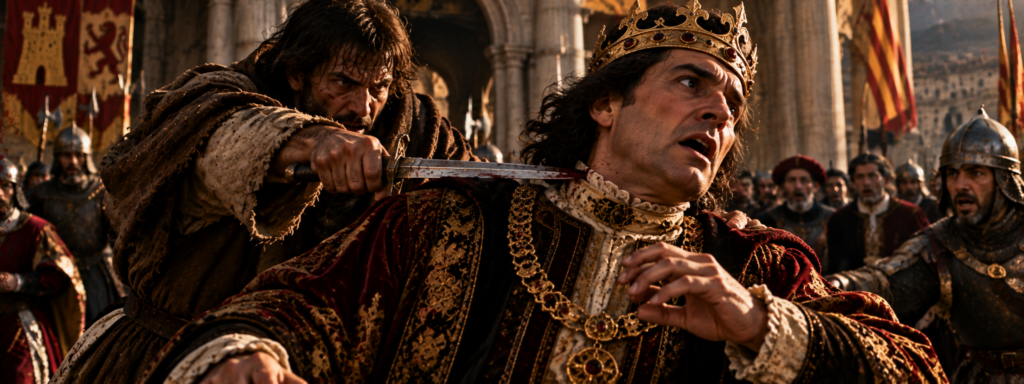
Ferdinand II of Aragon: The Assassin’s Blade That Nearly Killed the Catholic King
Ferdinand II of Aragon (1452–1516) | King of Aragon, 1479–1516 | King of Sicily, 1468–1516 | King of Castile alongside Isabella I, 1474–1504 | Survived an assassination attempt in Barcelona on 7 December 1492 | Attacker: Joan de Canyamars, a Catalan peasant from the Maresme region | Weapon: a sword or heavy bladed weapon aimed at the king’s neck | The attack inflicted a serious wound but failed to kill Ferdinand, reportedly because his clothing or ceremonial neck ornament helped deflect the blow | Canyamars was captured, interrogated, and publicly executed.
The Blade That Almost Changed History
On 7 December 1492, Ferdinand II of Aragon emerged from the royal palace in Barcelona, unaware that a man waiting nearby was about to attempt one of the most consequential political murders in Spanish history. The king had survived decades of dynastic conflict, rebellion, war, and intrigue, and he had recently celebrated the conquest of Granada, the final Muslim-ruled kingdom in the Iberian Peninsula. Alongside his wife, Isabella I of Castile, he stood at the center of a monarchy whose power and ambitions were expanding at an extraordinary pace. Yet on that December afternoon, the future of his dynasty came dangerously close to ending beneath the blade of an obscure Catalan peasant.
The attacker was Joan de Canyamars, a man from the Maresme region of Catalonia whose name would become permanently associated with one of the most shocking assaults upon a European monarch of the late Middle Ages. As Ferdinand passed through the palace precinct, Canyamars approached from behind and struck toward the king’s neck with a bladed weapon. The blow was violent enough to wound Ferdinand seriously, and the royal entourage was thrown into confusion as guards and attendants struggled to understand what had happened. For a terrifying moment, the king who had helped transform the political landscape of Iberia appeared to be at the mercy of a man whose intentions remained obscure.
According to accounts of the attack, Ferdinand survived partly because the blade struck or was deflected by something he wore around his neck. Later retellings frequently identify this protection as a thick gold collar or ceremonial chain, although the precise nature of the object and the degree to which it prevented a fatal injury are not uniformly described in the surviving evidence. The distinction matters because the dramatic image of a golden ornament saving a king has become inseparable from the story. What is certain is that Ferdinand suffered a dangerous wound and survived an attack that could easily have killed him.
The assault was extraordinary not simply because it came so close to succeeding, but because of the political moment in which it occurred. The year 1492 had already become a defining turning point in the history of the Iberian monarchies. Granada had surrendered in January, the expulsion of Jews who refused conversion had been ordered in March, and Christopher Columbus had completed his first Atlantic voyage under Castilian sponsorship. Ferdinand and Isabella were presiding over a period of religious coercion, territorial consolidation, and overseas expansion whose consequences would reach far beyond their lifetimes.
Had Ferdinand died in Barcelona, the political future of Aragon, Castile, and the wider Mediterranean might have developed very differently. His death would have left Isabella to navigate a complicated dynastic landscape without the husband whose military, diplomatic, and administrative abilities had been central to their joint rule. The succession arrangements of the two monarchies were not identical, and their political union remained dependent upon dynastic relationships rather than the existence of a single unified Spanish state. A successful assassination could therefore have produced instability at precisely the moment when the monarchy appeared most triumphant.
The man who attempted the killing did not belong to a rival royal house or a powerful aristocratic faction. Canyamars was generally described as a peasant, and the surviving accounts portray him as a disturbed individual whose motives were difficult to establish. Some sources suggest that he believed himself destined to become king, while others emphasize the uncertainty surrounding his mental condition. His statements were extracted in the aftermath of a violent attack and under circumstances that make their reliability difficult to assess.
The royal response was merciless. Canyamars was captured and subjected to interrogation before being condemned to a public execution of exceptional brutality. His punishment was designed not merely to kill him, but to demonstrate the consequences of attacking a monarch whose authority was regarded as sacred and indispensable to political order. The spectacle became part of the history of royal justice, revealing the terrifying violence that could follow an assault upon the crown.
Ferdinand survived, recovered, and continued ruling for more than two decades. He would outlive Isabella, become involved in the succession struggles of Castile, acquire the kingdom of Naples, and oversee the incorporation of most of Navarre into his monarchy. The man who nearly killed him disappeared into the machinery of royal punishment, but the failed assassination remained a reminder of how vulnerable even the most powerful ruler could be. In a year remembered for conquest and discovery, a single blade had come astonishingly close to changing the course of European history.
A Prince Born Into a Divided Peninsula
Ferdinand was born on 10 March 1452 in Sos, a fortified town in the kingdom of Aragon. His father was John II of Aragon, a politically experienced and often ruthless ruler whose reign was marked by dynastic conflict. His mother was Juana Enríquez, a woman of considerable ambition and influence who worked tirelessly to advance her son’s interests. Ferdinand entered a world in which royal power depended upon family alliances, military strength, and the ability to survive bitter struggles over inheritance.
The Iberian Peninsula of Ferdinand’s childhood was divided among several major political entities. Castile occupied much of the central and western peninsula, while the Crown of Aragon controlled Aragon, Catalonia, Valencia, and important Mediterranean possessions. Portugal remained an independent kingdom with growing Atlantic ambitions, and Granada survived as the last major Muslim-ruled state in Iberia. Navarre occupied a strategically important position between the Pyrenees and neighboring kingdoms.
The Crown of Aragon itself was not a single centralized state. It consisted of territories with distinct laws, institutions, and political traditions, united under a common monarch. The ruler had to negotiate with regional representative assemblies, aristocratic factions, and urban communities whose privileges were deeply entrenched. Royal authority could be extensive, but it was constrained by legal and political arrangements that differed from one territory to another.
Ferdinand’s father, John II, had already become embroiled in bitter dynastic disputes before his younger son’s political career began. The most serious involved Charles, Prince of Viana, John’s son from an earlier marriage. Charles possessed a strong hereditary claim to Navarre through his mother, Blanche I, and his relationship with John deteriorated into open conflict. The dispute divided noble factions and contributed to a wider crisis within the Crown of Aragon.
Charles died in 1461, and rumors circulated that he had been poisoned at the instigation of his stepmother, Juana Enríquez. The accusation was politically explosive, but the available evidence does not establish that Juana arranged his death. His passing nevertheless removed a major obstacle to Ferdinand’s succession and intensified hostility toward John II and his household. The young Ferdinand became increasingly important within a dynasty surrounded by suspicion and rebellion.
The violence and instability of these years shaped Ferdinand’s political education. He grew up amid competing claims, aristocratic resistance, and the constant danger that royal authority could collapse. The experience encouraged a style of kingship characterized by caution, calculation, and a willingness to use force when necessary. By the time he reached adulthood, Ferdinand understood that a crown could be lost through betrayal as easily as through military defeat.
The Catalan Civil War: Ferdinand’s Education in Violence
The Catalan Civil War, which began in 1462, was one of the defining conflicts of Ferdinand’s youth. It emerged from longstanding tensions between John II and political factions in Catalonia, including disputes over royal authority, constitutional privileges, and the treatment of Charles of Viana. The conflict became a prolonged struggle involving local factions and foreign intervention. Ferdinand’s family found itself fighting to preserve its authority over one of the most important territories of the Crown of Aragon.
Juana Enríquez played a prominent role during the early stages of the conflict. She attempted to defend her husband’s interests and secure Ferdinand’s future amid growing hostility. At one point, she and the young prince were besieged in Girona, where their position became dangerously vulnerable. The episode demonstrated how quickly dynastic disputes could place members of the royal family in immediate physical danger.
Ferdinand’s childhood was therefore far removed from the secure ceremonial existence often imagined for princes. He witnessed the consequences of rebellion and learned that political loyalty could not be assumed. Cities, noble families, and regional institutions could resist royal demands with considerable determination. Military force remained essential to maintaining the monarchy.
The war continued for a decade, exhausting resources and deepening divisions within Catalonia. Competing claimants and foreign powers became involved, complicating the struggle. John II eventually emerged victorious, but the conflict left lasting political and economic damage. The monarchy survived, although its authority remained dependent upon negotiation and compromise.
Ferdinand gained practical military and political experience during these years. He learned to operate within a complex environment where force and diplomacy had to be used together. His later reputation as a calculating ruler owed much to this early exposure to instability. The lessons would influence his handling of aristocratic opposition, foreign diplomacy, and the institutions of government.
The civil war also provides important context for the assassination attempt of 1492. Ferdinand returned to Barcelona as a powerful monarch, but the region possessed a recent history of bitter conflict with his dynasty. That background does not prove that Canyamars acted from political resentment, and no reliable evidence establishes a wider conspiracy. It does, however, remind us that royal authority in Catalonia had been contested within living memory.
Isabella of Castile: The Marriage That Changed Iberia
Ferdinand’s marriage to Isabella of Castile in 1469 became one of the most consequential dynastic unions in European history. Isabella was the half-sister of Henry IV of Castile and a claimant to the Castilian succession. Her position was politically sensitive because powerful noble factions disputed the legitimacy and inheritance rights of Henry’s daughter, Joanna. The marriage therefore united two ambitious figures whose futures depended upon navigating dangerous succession struggles.
The wedding took place in Valladolid under circumstances complicated by questions of consent, political opposition, and ecclesiastical authorization. Ferdinand and Isabella were close relatives, requiring a papal dispensation for their marriage. The documentary and diplomatic maneuvering surrounding the union reflected the urgency of their political situation. They proceeded despite the hostility of Henry IV and the risks involved.
The marriage did not immediately unite Castile and Aragon into a single kingdom. Isabella possessed her own claim to Castile, while Ferdinand remained heir to the Crown of Aragon. Their territories retained separate institutions, legal systems, and political identities. The union was dynastic, resting upon the marriage of two rulers rather than the creation of a centralized Spanish state.
When Henry IV died in 1474, Isabella claimed the Castilian throne. Her accession was challenged by supporters of Joanna, leading to a succession war involving Portugal and competing Castilian factions. Ferdinand played a major role in the military and political struggle that followed. The couple eventually secured their position, although the conflict required years of effort.
Ferdinand became king of Aragon in 1479 following the death of his father. The two monarchs now ruled their respective crowns while cooperating closely in matters of diplomacy, warfare, and policy. Their partnership became one of the defining political arrangements of late medieval Europe. It combined the resources of Castile and Aragon without erasing the differences between them.
The relationship between Ferdinand and Isabella was politically effective but not free from tension. Each possessed distinct legal authority and territorial interests, and their cooperation required negotiation. Their marriage also involved the production and protection of heirs whose marriages would shape European dynastic politics. The stability of the partnership was therefore essential to the future of both crowns.
By 1492, Ferdinand and Isabella had become among the most formidable rulers in Europe. Their military victories, administrative reforms, and diplomatic alliances had strengthened their position. Yet their power depended upon the survival of a complicated dynastic structure. The assassination attempt in Barcelona threatened that structure at a moment of apparent triumph.
The Catholic Monarchs: Power, Religion, and Royal Authority
Ferdinand and Isabella became known as the Catholic Monarchs, a title formally granted by Pope Alexander VI in 1496. Their reputation was closely associated with the defense and promotion of Catholic orthodoxy. Religious policy formed an important part of their political program, although it was also intertwined with efforts to strengthen royal authority. The monarchy sought to present itself as a force for order, unity, and Christian legitimacy.
One of the most consequential institutions associated with their reign was the Spanish Inquisition, established under papal authorization in 1478. The tribunal initially focused particularly upon baptized Christians suspected of secretly practicing Judaism. Its activities expanded over time, and its methods included investigation, imprisonment, coercive interrogation, and severe punishment. The institution became an instrument of religious surveillance and royal power.
The monarchy’s religious policies were shaped by the complex history of Christian, Jewish, and Muslim communities in Iberia. For centuries, these populations had lived under changing political conditions, sometimes cooperating and sometimes experiencing persecution. The late fifteenth century brought increasing pressure for religious conformity. The consequences were profound for communities whose identities and traditions did not align with the monarchy’s policies.
Ferdinand’s personal religious convictions cannot be reduced to political calculation, but his use of religious institutions also served practical objectives. The Inquisition operated under a structure that gave the monarchy considerable influence. Religious unity could be presented as a foundation of political stability. The resulting policies strengthened royal authority while imposing severe costs upon targeted populations.
The Catholic Monarchs also pursued administrative reforms intended to improve governance and reduce disorder. They strengthened institutions of royal justice, expanded the use of officials, and sought to restrain certain forms of aristocratic violence. These measures were not uniformly successful, and local privileges continued to limit central authority. Nevertheless, their reign marked an important stage in the consolidation of monarchical power.
The assassination attempt of 1492 occurred within this broader environment. Ferdinand was a ruler whose authority was closely connected to religious legitimacy and the enforcement of royal justice. An attack upon his person could therefore be interpreted as an assault upon the political and moral order of the monarchy. The punishment of Canyamars would reflect that understanding.
Granada Falls: The Triumph of January 1492
The conquest of Granada was one of the greatest achievements of Ferdinand and Isabella’s reign. The Nasrid kingdom had survived for centuries as the last major Muslim-ruled state in Iberia, maintaining its independence through diplomacy, tribute, and military resistance. By the late fifteenth century, internal divisions and sustained pressure from Castilian forces had weakened its position. The Catholic Monarchs launched a prolonged campaign that gradually reduced the kingdom’s territory.
The Granada War lasted from 1482 to 1492. Ferdinand played an important role in directing military operations, coordinating resources, and maintaining pressure upon Nasrid strongholds. Isabella contributed substantially to the organization and financing of the campaign. The war required extensive logistical support and the mobilization of large forces over many years.
The final surrender of Granada took place on 2 January 1492. Muhammad XII, commonly known as Boabdil, relinquished the city to the Catholic Monarchs. The event marked the end of independent Muslim rule in the Iberian Peninsula. It became a central symbol of the monarchy’s religious and political triumph.
The surrender terms initially included protections for the religious and legal rights of Granada’s Muslim inhabitants. Those guarantees would later be undermined by increasingly coercive policies. The conquest therefore did not bring a simple or peaceful conclusion to the peninsula’s religious history. It began a new period of pressure, conversion campaigns, and eventual expulsions.
For Ferdinand, the victory was a major personal and dynastic achievement. It strengthened his prestige and demonstrated the military capabilities of the combined monarchies. The conquest also allowed the rulers to present themselves as champions of Catholic expansion. Their reputation across Europe was enhanced.
Yet the triumph carried an irony that would become apparent in December. Ferdinand had survived years of warfare against fortified cities and organized armies. He had emerged victorious from a campaign that required extraordinary resources and military skill. His life would nearly be ended not by a Nasrid soldier on the battlefield, but by a single man approaching him in Barcelona.
The Expulsion of the Jews: The Darker Side of 1492
In March 1492, Ferdinand and Isabella issued the Alhambra Decree, ordering Jews who refused baptism to leave their territories. The decree was one of the most consequential acts of religious persecution in late medieval Europe. It forced Jewish communities to choose between conversion and exile. Families faced the loss of homes, businesses, property, and longstanding connections to the places where they had lived.
The expulsion was justified by the monarchy through arguments concerning religious conformity and the perceived influence of practicing Jews upon baptized Christians. These claims reflected the religious anxieties and prejudices of the period. They did not diminish the human consequences of the policy. The decree disrupted communities whose histories in Iberia extended back many centuries.
The implementation of the expulsion created widespread hardship. People were forced to arrange departures under severe time pressure, often selling property at disadvantageous prices. Some converted to Christianity, while others sought refuge in Portugal, North Africa, Italy, and the Ottoman world. The dispersal contributed to the development of Sephardic Jewish communities across the Mediterranean and beyond.
Ferdinand’s role in the decree was central. As one of the two monarchs who issued the order, he shared responsibility for the policy and its consequences. His reign combined political achievement with coercive religious measures that inflicted suffering upon large populations. Any account of his power must acknowledge both aspects.
The decree also contributed to the atmosphere of religious control surrounding the monarchy. Ferdinand and Isabella increasingly associated political order with religious conformity. The Inquisition and expulsion policies reinforced the authority of the crown over matters of belief and identity. The monarchy’s triumphs were accompanied by fear and displacement.
The assassination attempt occurred only months after the expulsion. There is no reliable evidence establishing that Canyamars acted in response to the decree or as part of a Jewish or converso conspiracy. Such claims would require documentation that the surviving record does not provide. The chronological proximity is historically significant, but it should not be transformed into an unsupported explanation for the attack.
Columbus Returns From the Edge of the Known World
The year 1492 also witnessed the first Atlantic voyage of Christopher Columbus under the sponsorship of the Catholic Monarchs. Columbus departed in August and reached islands in the Caribbean in October, believing he had approached the lands of Asia. His expedition initiated a new phase of sustained European expansion across the Atlantic. The consequences would include conquest, colonization, forced labor, disease, and profound transformations for Indigenous societies.
Ferdinand and Isabella had agreed to support the expedition after years of negotiation. Their decision reflected the possibility of acquiring wealth, prestige, and strategic advantages through overseas exploration. The voyage was uncertain and risky, and its eventual consequences were not yet understood. At the time of the assassination attempt, Columbus had not returned to Spain with news of his discoveries.
The distinction is important because later narratives sometimes compress the events of 1492 into a single triumphant sequence. Granada had fallen, the expulsion decree had been issued, and Columbus had reached the Caribbean, but the monarchy did not yet know the full outcome of his voyage. Ferdinand’s attack occurred while the expedition was still underway. The future Atlantic empire existed only as a possibility.
Had Ferdinand died in December, the reception of Columbus’s news and the subsequent organization of overseas policy would have taken place under different political circumstances. Isabella would have remained queen of Castile, and the legal basis of Castilian involvement in Atlantic expansion would not automatically have disappeared. Nevertheless, Ferdinand’s absence could have affected diplomacy, succession arrangements, and the monarchy’s broader priorities. The consequences cannot be predicted with certainty.
The attack therefore occurred at a moment when the future was unusually open. The monarchy had achieved a major military victory, imposed sweeping religious policies, and sponsored an expedition whose significance was not yet fully understood. Ferdinand stood at the center of these developments. His death could have altered the political environment in which their consequences unfolded.
The attempted assassination is often overshadowed by the larger events of 1492. Yet its significance becomes clearer when placed beside them. A man with a blade nearly removed one of the principal architects of the political order emerging in Iberia. The failure of that attack allowed Ferdinand to continue shaping events for another twenty-three years.
Barcelona in 1492: A City With a Troubled Political Memory
Barcelona was one of the most important cities of the Crown of Aragon. Its commercial networks extended across the Mediterranean, and its institutions possessed a long tradition of defending local privileges. The city had experienced serious political and economic disruption during the Catalan Civil War. By 1492, recovery was underway, but the memory of conflict remained significant.
Ferdinand’s relationship with Catalonia was shaped by his family’s experiences during the civil war. His father had fought to preserve royal authority against rebellious factions, and the young Ferdinand had witnessed the dangers of political division. As king, he sought to stabilize relations with Catalan institutions while preserving the monarchy’s position. The process required negotiation and attention to local grievances.
The royal presence in Barcelona carried ceremonial and political importance. The city was a major center of government and commerce, and visits by the monarch provided opportunities for audiences, negotiations, and public demonstrations of authority. Royal ceremonies reinforced the relationship between ruler and subjects. They also brought the king into close contact with crowds and individuals who might otherwise remain distant from the court.
The attack occurred in the precinct of the royal palace, traditionally associated with the Palau Reial Major and the Plaça del Rei. The setting was politically significant because it placed the assault at the heart of royal authority in Barcelona. Canyamars did not attack Ferdinand on a remote road or during a military campaign. He struck in a public space associated with the monarchy’s presence in the city.
The exact movements of the king immediately before the attack are described differently in later accounts. Some narratives place him leaving the palace after official business or an audience. Others emphasize the moment when he was descending or passing through the palace entrance. The essential point is that the attacker gained access while Ferdinand was moving through a space where the public could approach him.
The setting reveals the vulnerability of medieval and early modern rulers. Royal palaces possessed guards and controlled spaces, but monarchs were expected to appear before their subjects. Ceremonial accessibility could become a security weakness. Canyamars exploited that weakness with devastating effect.
Joan de Canyamars: The Man Who Tried to Kill a King
Joan de Canyamars was a Catalan peasant associated with the village of Canyamars in the Maresme region, northeast of Barcelona. The surviving accounts provide only limited information about his life before the attack. He was not a prominent nobleman, military commander, or known claimant to the throne. His sudden appearance in the historical record is almost entirely connected to his attempt to kill Ferdinand.
The scarcity of reliable biographical information has encouraged speculation about his motives. Some accounts portray him as mentally disturbed, while others suggest that he possessed grandiose beliefs about his own destiny. The claim that he believed he should become king appears in narratives of the aftermath. Yet these statements must be considered in the context of interrogation and the political need to explain an extraordinary crime.
Canyamars’s social position made the attack particularly shocking. Medieval political violence often involved aristocratic conspiracies, dynastic rivals, or organized rebellions. A peasant who attempted to kill a monarch disrupted expectations about the sources of danger. His action suggested that royal power could be threatened by someone outside the established political elite.
The surviving evidence does not establish that Canyamars acted on behalf of a larger conspiracy. Authorities investigated the attack, and the possibility of accomplices would naturally have been a major concern. Yet the accounts generally present him as acting alone. Claims of hidden political sponsors remain speculative without stronger documentation.
The question of his mental condition is also difficult to resolve. Medieval descriptions of madness, delusion, or irrationality do not correspond neatly to modern psychiatric categories. The sources were written by observers whose understanding of mental illness differed from contemporary medical approaches. It would therefore be inappropriate to assign Canyamars a specific diagnosis.
What can be said is that he approached Ferdinand with a weapon and attempted to inflict a fatal injury. His act was deliberate in the immediate physical sense, but the deeper motives remain uncertain. He became one of the most notorious would-be regicides of the period. His name survived because his attack came astonishingly close to succeeding.
The Attack: A Sword Descends Upon the King’s Neck
On 7 December 1492, Ferdinand was moving through the royal palace precinct in Barcelona when Canyamars approached from behind. The attacker carried a bladed weapon, commonly described as a sword or heavy cutting blade. He struck toward the back of the king’s neck, a vulnerable area where a powerful blow could cause immediate death. The attack was sudden enough to catch the royal entourage off guard.
The location of the wound was especially dangerous. A blade striking the neck could damage major blood vessels, the spinal cord, or the structures supporting the head. Even without penetrating deeply, such an injury could cause severe bleeding and lasting impairment. Medieval medical practitioners had limited means of treating these wounds. Ferdinand’s survival was therefore far from assured.
Accounts describe the blow as powerful and potentially fatal. The king was wounded, and the surrounding attendants reacted with alarm. The attacker was seized before he could escape. The speed of the response prevented further violence, but it did not erase the danger created by the initial strike.
The precise physical sequence is difficult to reconstruct. Later narratives differ in their descriptions of the weapon, the angle of the blow, and the protective object that may have deflected it. Some emphasize a ceremonial collar or chain, while others describe the intervention of clothing or the movement of the king’s body. These variations are typical of accounts that became famous through repeated retelling.
The central fact remains clear. Ferdinand was attacked from behind and seriously wounded in the neck. The assault was an attempt upon his life rather than a symbolic gesture or minor act of violence. Its failure depended upon circumstances that prevented the blade from causing a fatal injury.
The attack also exposed the limitations of royal security. Guards could respond once the blow had been delivered, but they had failed to prevent the attacker from reaching the king. The monarchy’s public ceremonies created moments of vulnerability. Canyamars had exploited one of those moments with a weapon capable of killing a ruler in seconds.
The Golden Collar: Did an Ornament Save Ferdinand’s Life?
One of the most famous details of the assassination attempt is the claim that Ferdinand survived because a thick gold collar or ceremonial chain deflected the attacker’s blade. The image has become central to popular retellings of the event. A symbol of royal wealth and dignity supposedly became an unexpected piece of armor. The ornament that proclaimed Ferdinand’s status may have helped preserve his life.
The tradition is plausible in a general physical sense. A substantial metal object worn around the neck could interfere with the path of a blade or reduce the depth of a wound. The angle of the strike, the king’s movement, and the attacker’s position would also have affected the outcome. A small change in any of these factors could determine whether the injury was survivable.
Yet the precise role of the collar is not uniformly established in the surviving narratives. Some accounts emphasize a chain or ornament, while others attribute the king’s survival to the weapon’s angle or the protective effect of his clothing. The later image of a massive golden collar completely stopping the blade may exaggerate a more complicated event. It should therefore be presented as a reported explanation rather than an unquestioned fact.
The story nevertheless reveals how contemporaries and later writers sought to explain Ferdinand’s survival. A blow directed at the neck seemed so dangerous that some extraordinary circumstance was required to account for the king’s escape. The collar provided a memorable explanation. It also allowed the survival to be interpreted as a sign of providential protection.
Royal ornaments carried symbolic meaning beyond their material value. Gold chains, collars, and ceremonial garments displayed rank and authority. If such an object helped deflect the attack, the symbolism was irresistible. The very insignia of kingship appeared to have protected the king from a would-be regicide.
The historical reality may have been less dramatic but no less remarkable. Ferdinand survived a serious neck wound inflicted by an attacker who had approached from behind. Whether the decisive factor was a collar, clothing, movement, or the imperfect angle of the strike cannot be established with complete certainty. The survival itself remains one of the most striking episodes of his reign.
Blood in the Palace: Panic and the Fear of Regicide
The attack created immediate alarm among Ferdinand’s attendants and the people gathered nearby. A monarch had been struck in a public setting, and the severity of his injury was not immediately clear. The possibility that the king might die would have carried enormous political consequences. Confusion and fear were therefore inevitable.
Royal households were organized around the physical presence of the monarch. Guards, officials, servants, and advisers depended upon the ruler’s authority for their positions and responsibilities. An unexpected attack disrupted that structure. The immediate priority was to secure the king and prevent further violence.
Canyamars was captured at the scene or immediately afterward. The surviving accounts describe a rapid response by those surrounding Ferdinand. The attacker was prevented from escaping, and the authorities gained custody of the man responsible. His capture allowed the monarchy to investigate the assault and determine whether others were involved.
The king’s wound required urgent attention. Contemporary medicine lacked modern surgical techniques, antibiotics, and reliable methods of controlling infection. A serious injury to the neck could remain dangerous long after the initial bleeding had stopped. Ferdinand’s recovery therefore depended upon both the nature of the wound and the care he received.
The attack also raised questions about the security of the royal court. How had an armed man approached the king so closely? Had he received assistance from someone inside the palace? Was the assault part of a wider political conspiracy? These were natural concerns in a monarchy whose history included rebellion and dynastic conflict.
The authorities had strong reasons to investigate thoroughly. A lone attacker was dangerous, but an organized conspiracy could threaten the entire political order. The interrogation of Canyamars therefore served both judicial and security purposes. The monarchy needed to establish whether the danger had ended with his capture.
The King’s Recovery: A Wound That Could Have Killed Him
Ferdinand survived the immediate attack, but his recovery was not guaranteed. Neck wounds were particularly dangerous because of the concentration of vital structures in a relatively small area. Severe bleeding, infection, and damage to nerves or muscles could produce lasting consequences. The fact that the king remained alive after the blow did not mean that the crisis had passed.
The royal household would have been deeply concerned about the possibility of infection. Medieval medical practitioners understood that wounds could deteriorate, even if their explanations differed from modern germ theory. Treatment might involve cleaning, dressings, and attempts to manage bleeding and inflammation. The effectiveness of such measures varied considerably.
Ferdinand’s survival became a matter of public and political importance. News of the attack spread, and the condition of the king would have been closely watched by officials and subjects. His death could have created uncertainty in both Aragon and Castile. The monarchy therefore had strong reasons to communicate reassurance once his recovery became apparent.
The injury also carried symbolic significance. Kings were expected to embody strength, authority, and continuity. A wounded monarch could appear vulnerable at precisely the moment when political stability depended upon confidence in his rule. Ferdinand’s eventual recovery helped restore that confidence. The failed assassination could be presented as evidence that the monarchy had survived a grave threat.
Later accounts sometimes emphasize the miraculous quality of his survival. Such interpretations reflected the religious culture of the period, in which extraordinary escapes from death could be attributed to divine protection. Ferdinand’s status as a Catholic monarch made that explanation especially attractive. Yet the historical record does not require a supernatural explanation for the outcome.
The king recovered sufficiently to continue ruling for more than two decades. His later political career demonstrates that the wound did not permanently remove him from public life. He remained active in diplomacy, warfare, and government. The assassination attempt became a dangerous episode within a much longer reign rather than its conclusion.
The Interrogation of Canyamars: Searching for a Motive
After his capture, Canyamars was interrogated by the authorities. The investigation sought to determine why he had attacked Ferdinand and whether he had accomplices. A successful assassination could have destabilized the monarchy, making the possibility of conspiracy a matter of urgent concern. The authorities therefore had strong incentives to extract an explanation.
Accounts of the interrogation suggest that Canyamars gave statements interpreted as evidence of delusion or mental disturbance. Some narratives report that he believed he was destined to become king. Others emphasize the apparent irrationality of his conduct. These descriptions contributed to the enduring image of the attacker as a disturbed peasant acting alone.
The reliability of such statements is difficult to assess. Interrogation in the late medieval period could involve coercion and torture, especially in cases involving serious crimes against royal authority. Statements obtained under such conditions may reflect fear, confusion, or attempts to satisfy interrogators. They cannot automatically be treated as transparent evidence of motive.
The political context also influenced how the authorities might interpret the attack. A lone disturbed individual presented a different threat from an organized conspiracy involving nobles or foreign powers. Establishing that Canyamars acted alone could help reassure the public. It could also prevent suspicion from spreading through the political community.
The surviving evidence does not securely establish a wider conspiracy. No reliable documentation demonstrates that Canyamars was acting for a rival claimant, a religious group, or an organized political faction. The possibility of hidden motives cannot be completely excluded, but speculation is not evidence. The most cautious conclusion is that the attacker’s deeper intentions remain uncertain.
The case therefore illustrates the difficulty of reconstructing motive in historical assassination attempts. The physical act is well documented, but the thoughts behind it are not. Later writers often supplied explanations that made the event more comprehensible. The historian must distinguish those explanations from facts that can be independently supported.
Madness, Delusion, or Political Desperation?
The portrayal of Canyamars as mentally disturbed has become a central feature of the assassination story. Some accounts describe him as irrational or convinced that he possessed a royal destiny. Such claims may reflect genuine observations of unusual behavior. They may also reflect the assumptions of authorities attempting to explain an attack that seemed socially and politically inexplicable.
Modern psychiatric diagnosis cannot be reliably applied to Canyamars on the basis of these accounts. The surviving descriptions are limited, hostile, and shaped by the circumstances of interrogation. They do not provide the kind of detailed clinical evidence required to identify a specific condition. Terms such as madness or delusion should therefore be understood as historical descriptions rather than medical conclusions.
The possibility of political resentment has also attracted attention. Catalonia had experienced civil war, economic difficulties, and tensions between royal authority and local interests. A peasant might have possessed grievances connected to taxation, property, or social conditions. Yet there is no secure evidence linking Canyamars’s attack to a specific political complaint.
The temptation to construct a hidden conspiracy is understandable because the target was so important. Ferdinand had numerous political enemies, and his policies affected powerful interests across Iberia and the Mediterranean. A successful assassination would have benefited some rivals. But the existence of potential beneficiaries does not establish their involvement.
The simplest explanation supported by the surviving record is that Canyamars acted alone and that his motives were interpreted as disturbed or irrational by contemporaries. Even that conclusion requires caution because the evidence is incomplete. The attacker’s social background and personal history remain obscure. His final act is far better documented than the life that preceded it.
The uncertainty makes the case particularly unsettling. A monarch whose policies affected entire kingdoms was nearly killed by a man whose intentions cannot be confidently reconstructed. The event resists the tidy explanations often imposed upon political violence. It reminds us that history sometimes preserves the consequences of an act while leaving its motives hidden.
The Punishment: A Public Execution of Exceptional Cruelty
The punishment imposed upon Canyamars was extraordinarily brutal. Accounts describe a public execution in Barcelona involving prolonged mutilation before the condemned man was finally killed. The violence was intended to demonstrate the consequences of attacking the king. It was also a public assertion of royal authority after a moment of dangerous vulnerability.
Late medieval justice frequently used spectacular punishments for crimes considered especially threatening to political order. Treason, rebellion, and attacks upon rulers could be punished more severely than ordinary homicide. The condemned person’s body became a means of communicating the power of the state. Public executions were designed to deter others and reinforce obedience.
Descriptions of Canyamars’s punishment vary in their details, but they agree upon its exceptional severity. Later narratives recount that he was paraded through the city and subjected to successive acts of mutilation. The precise sequence should be treated cautiously because some accounts were written with an interest in emphasizing the horror of the spectacle. The central fact remains that he was executed in a manner intended to inflict prolonged suffering.
The punishment also reflected the symbolic status of the monarch. An attack upon Ferdinand was not treated merely as an assault upon an individual. It was regarded as an offense against the crown and the political order it represented. The severity of the response was meant to restore the authority that the assassination attempt had challenged.
The contrast between the attacker and the king was stark. Canyamars was a peasant whose personal history remains largely unknown. Ferdinand was one of the most powerful rulers in Europe. The execution demonstrated the overwhelming force that the monarchy could bring against an individual who threatened its survival.
The spectacle remains one of the darkest aspects of the case. The failed assassination was a violent act, but the punishment that followed was itself an exercise in calculated brutality. It reveals a political culture in which royal justice could become a public performance of suffering. The monarchy survived the attack, but its response exposed the harsh foundations of late medieval authority.
The Spectacle of Royal Justice
Public punishment in late medieval Europe served purposes beyond the removal of criminals. It communicated political messages to spectators and reinforced the authority of rulers. The execution of a would-be regicide was especially significant because the crime challenged the person who embodied the monarchy. The punishment therefore became a demonstration that royal power remained intact.
The streets of Barcelona provided a setting in which the condemned man could be displayed before the population. Such spectacles were designed to attract attention and create a lasting impression. The authorities sought to transform the memory of the attack into a warning against future violence. The body of the condemned became the medium through which that warning was delivered.
The brutality of the punishment also reflected contemporary assumptions about deterrence. Severe suffering was believed to discourage others from committing similar crimes. Whether such spectacles actually prevented political violence is another question. Their immediate function was to display the state’s capacity to punish.
The execution also helped redirect public attention. The assassination attempt had exposed the king’s vulnerability, showing that an armed individual could approach and wound him. The punishment reversed that image by demonstrating the overwhelming power of royal justice. The monarchy could present itself as restored and victorious.
The contrast between Ferdinand’s survival and Canyamars’s destruction became central to the story. The king recovered and continued ruling, while the attacker was subjected to an exceptionally cruel death. The outcome reinforced the hierarchy between ruler and subject. It also allowed the event to be remembered as a failed challenge to legitimate authority.
Modern readers may find the punishment more disturbing than the attempted assassination itself. The deliberate infliction of prolonged suffering reveals the violence embedded within systems of justice that claimed to defend order. The case therefore belongs not only to the history of royal assassination attempts, but also to the history of torture and execution. Its legacy is inseparable from both forms of violence.
The Political Consequences of a Failed Assassination
Ferdinand’s survival prevented an immediate dynastic crisis. His death in 1492 would have removed the reigning king of Aragon and Isabella’s principal political partner. The succession arrangements of the Crown of Aragon would have required careful management, particularly because their children were still young. The political consequences could have been serious.
The monarchy’s power depended upon cooperation between distinct crowns. Castile and Aragon possessed different institutions and political traditions, and their union was maintained through the marriage of Ferdinand and Isabella. A sudden death could have altered the balance between their territories. It might also have encouraged rival factions to challenge existing arrangements.
Ferdinand’s continued presence helped preserve the political partnership that had achieved the conquest of Granada. He remained active in diplomacy and government, using his experience to manage relations with European powers. His survival also allowed him to participate in the organization of policies that followed Columbus’s voyage. The monarchy’s expansion continued under the same leadership.
The failed assassination may also have reinforced concerns about royal security. An attacker had approached the king closely enough to inflict a dangerous wound. The incident demonstrated the risks associated with public appearances and ceremonial accessibility. Although the precise administrative response is not fully documented, the event would naturally have encouraged greater vigilance.
The political importance of the attempt lies partly in what did not happen. Ferdinand did not die, the monarchy did not immediately fragment, and the succession crisis that might have followed was avoided. The rulers continued pursuing their ambitions. The attacker failed to produce the political rupture that a successful regicide might have caused.
Yet the incident remained a reminder that even powerful monarchies could be threatened by sudden violence. Ferdinand had survived war, rebellion, and dynastic intrigue, but none of those experiences could guarantee his safety. The failed assassination exposed the fragility beneath the appearance of royal strength. Its consequences were limited because the king survived, but its potential significance was enormous.
Ferdinand After 1492: The King Who Continued to Shape Europe
Ferdinand’s later reign demonstrated the importance of his survival. He remained a central figure in Iberian and Mediterranean politics for more than two decades after the attack. His diplomatic and military activities helped expand the influence of the Crown of Aragon and strengthen the position of his dynasty. The years following 1492 were among the most consequential of his career.
One of his major objectives was the struggle for influence in Italy. The Italian Wars brought competing European powers into conflict over territories including Naples. Ferdinand pursued Aragonese interests through diplomacy and military intervention. The eventual acquisition of Naples strengthened his Mediterranean position.
The death of Isabella in 1504 created a new political situation in Castile. Their daughter Joanna inherited the Castilian crown, but disputes over authority and governance complicated the succession. Ferdinand became involved in the resulting struggles, including tensions with Joanna’s husband, Philip the Handsome. The political partnership that had defined the Catholic Monarchs’ reign was now replaced by a more uncertain arrangement.
Ferdinand eventually exercised authority in Castile as regent during periods of dynastic instability. His experience and political skill helped him maintain influence despite competing claims. The succession crisis demonstrated how vulnerable the monarchy remained to family conflict. It also revealed the importance of Ferdinand’s continued presence.
In 1512, Ferdinand’s forces invaded and occupied most of the kingdom of Navarre south of the Pyrenees. The conquest expanded his territorial authority and altered the political map of northern Iberia. The incorporation of the conquered territory into the Castilian crown followed in 1515. The campaign was one of the final major achievements of his reign.
Ferdinand died on 23 January 1516, more than twenty-three years after Canyamars had attempted to kill him. His death came after a long career marked by conquest, diplomacy, religious persecution, and dynastic maneuvering. The assassin’s blade had failed to prevent these developments. The survival of the king allowed him to continue shaping European history until the final year of his life.
The Succession That Might Have Been
The assassination attempt invites speculation about what might have happened had Ferdinand died in December 1492. Such counterfactual questions cannot produce certainty, but they can illuminate the political structures that made his survival important. The monarchy was powerful, yet its unity depended upon dynastic relationships. The death of one ruler could have altered those relationships significantly.
Isabella would have remained queen of Castile. Her authority rested upon her own hereditary claim and political achievements, not solely upon her marriage to Ferdinand. The Castilian monarchy would therefore not automatically have collapsed. Nevertheless, she would have lost a partner whose military and diplomatic experience had been central to their joint rule.
The Crown of Aragon would have faced a separate succession. Ferdinand’s heir was his son John, Prince of Asturias and Girona, who was still a teenager in 1492. A minority or youthful succession could have created opportunities for aristocratic factions to seek greater influence. The political traditions of Aragon, Catalonia, and Valencia would have required careful management.
The future marriages of Ferdinand and Isabella’s children were also crucial to European politics. Their daughters and son were used to create alliances with Portugal, England, and the Habsburg dynasty. These arrangements eventually contributed to the emergence of Charles V as ruler of an enormous collection of territories. Ferdinand’s death could have altered the timing or direction of those alliances.
The Italian Wars might also have developed differently. Ferdinand’s diplomacy and military interventions played an important role in the struggle for Naples. Without him, Aragonese policy could have been shaped by different advisers or regents. The consequences for Mediterranean politics are impossible to determine with confidence.
The counterfactual significance of the attack lies in the fragility of dynastic history. A single death could alter succession arrangements, marriages, alliances, and military priorities. Ferdinand’s survival preserved one particular path through those possibilities. The failed assassination therefore reminds us how much historical development can depend upon the survival of individuals at moments of crisis.
Why Canyamars’s Attack Was So Unusual
Assassination attempts against rulers were not unknown in medieval Europe, but the circumstances of Canyamars’s attack were distinctive. The attacker was a peasant rather than a powerful nobleman or organized political conspirator. He struck in a public palace setting rather than during a rebellion or military campaign. His weapon was a blade aimed directly at the king’s neck.
The attack also occurred during a period of extraordinary royal prestige. Ferdinand and Isabella had recently completed the conquest of Granada and were pursuing policies that transformed the political and religious landscape of Iberia. Their authority appeared strong. The assault exposed the vulnerability concealed beneath that strength.
The absence of a clearly established political motive makes the case especially unusual. Many famous assassination attempts can be connected to succession disputes, ideological movements, or personal rivalries. Canyamars’s motives remain obscure. The surviving accounts offer interpretations but not a definitive explanation.
The attacker’s apparent social isolation also complicates the story. A lone individual could approach the monarch and inflict a serious wound without the resources of an organized conspiracy. This challenged assumptions about where threats to royal authority originated. The danger came not from an army or rival court, but from a man whose name had previously carried little political significance.
The punishment was equally distinctive in its severity. The authorities responded with a public execution designed to demonstrate the consequences of attacking the crown. The brutality of the spectacle reflected the symbolic importance of the crime. It also ensured that Canyamars would be remembered as an example of royal justice.
The case therefore combines several elements rarely found together. It involves a powerful monarch, an obscure attacker, a near-fatal wound, an uncertain motive, and an exceptionally cruel punishment. Its historical importance lies not only in the possibility that Ferdinand might have died, but also in what the episode reveals about the relationship between ruler and subject. The assassination attempt exposed both the vulnerability and the violence of late medieval monarchy.
The Making of a Legend: Gold, Blood, and Providence
Over time, the assassination attempt acquired the qualities of a royal legend. The story of the golden collar became particularly memorable because it offered a dramatic explanation for Ferdinand’s survival. A symbol of kingship supposedly became the object that saved the king’s life. The narrative united wealth, power, danger, and providence in a single image.
The story also fitted the religious culture of Ferdinand’s reign. The Catholic Monarchs presented themselves as defenders of the faith, and their victories were often interpreted through providential language. An extraordinary escape from death could therefore be understood as evidence of divine favor. Later writers found the symbolism irresistible.
Yet the historical evidence requires caution. The attack and wound are well established, but the precise role of the collar is less certain. The surviving narratives do not provide a single uncontested physical reconstruction. The familiar image may simplify a more complicated event involving clothing, movement, and the angle of the blow.
The legend also emphasizes the contrast between the king and his attacker. Ferdinand appears as a powerful ruler preserved by an ornament associated with royal dignity. Canyamars appears as an obscure peasant whose violent act fails to overcome the protections of monarchy. The story therefore reinforces the hierarchy it describes.
The punishment of Canyamars contributed to the legend’s darker dimension. His execution transformed the failed assassination into a spectacle of royal vengeance. The contrast between the king’s recovery and the attacker’s destruction became central to the narrative. The monarchy survived, while the would-be regicide was annihilated.
The historian must separate these symbolic elements from the facts. Ferdinand was attacked, seriously wounded, and survived. Canyamars was captured and executed with exceptional cruelty. The golden collar remains a reported detail whose exact role cannot be established beyond doubt. The distinction preserves the drama without sacrificing accuracy.
Why Ferdinand II Belongs Among the Assassinated Rulers & Regicides
Ferdinand II belongs within the Assassinated Rulers & Regicides category as the survivor of a documented assassination attempt against a reigning monarch. On 7 December 1492, Joan de Canyamars attacked him from behind in Barcelona and inflicted a serious wound to his neck. The assault was directed at the king’s person and was capable of causing death. Ferdinand survived, making the case an attempted regicide rather than a completed royal killing.
The attack is historically significant because of Ferdinand’s position. He was king of Aragon and Isabella’s partner in the government of Castile. Together, they had recently completed the conquest of Granada and were pursuing policies that reshaped Iberia. His death could have created a major dynastic crisis.
The case also illustrates the vulnerability of rulers during public appearances. Ferdinand was attacked in the precinct of a royal palace, a setting associated with security and authority. The attacker approached closely enough to strike the king’s neck. The incident demonstrated that ceremonial accessibility could expose monarchs to sudden violence.
The uncertainty surrounding Canyamars’s motive makes the case especially compelling. The surviving accounts portray him as a peasant whose statements were interpreted as disturbed or delusional. No reliable evidence establishes a wider conspiracy. The deeper reasons for his actions remain unresolved.
The punishment of Canyamars adds another dark dimension. He was subjected to an exceptionally brutal public execution intended to demonstrate the consequences of attacking royal authority. The response reveals the violence that could be used to defend the political order. It also places the case within the history of torture and execution.
Ferdinand’s survival allowed him to continue ruling until 1516. His later achievements included major involvement in Italian politics, the acquisition of Naples, and the conquest of most of Navarre south of the Pyrenees. The failed assassination therefore preserved the life of a ruler whose decisions continued to shape European history. The case belongs among the most consequential unsuccessful attacks upon a late medieval monarch.
The King Who Survived the Blade
Ferdinand II of Aragon entered 1492 as one of the most powerful rulers in Europe. Alongside Isabella of Castile, he had helped defeat rival claimants, strengthen royal authority, and complete the conquest of Granada. Their monarchy stood at the center of a period of extraordinary political and religious transformation. The future appeared to belong to rulers whose ambitions extended across Iberia, the Mediterranean, and the Atlantic.
Yet the events of that year also revealed the darker foundations of their power. The expulsion of Jews who refused conversion disrupted communities and forced thousands of people into exile. The Inquisition continued to enforce religious conformity through investigation and punishment. The conquest of Granada brought the end of independent Muslim rule in Iberia but also began a new period of coercion and instability for its inhabitants.
Ferdinand’s authority was therefore formidable but deeply contested in its consequences. His policies affected nobles, towns, religious communities, and neighboring states. He had enemies and rivals, although no reliable evidence connects them to the attack in Barcelona. The monarchy’s power did not eliminate the possibility of sudden violence.
On 7 December 1492, that danger became terrifyingly real. Joan de Canyamars approached the king from behind and struck toward his neck with a bladed weapon. The attack was sudden, violent, and capable of killing him. Ferdinand survived, but the wound was serious enough to make his escape remarkable.
The famous tradition of the golden collar offers a vivid explanation for his survival. According to later accounts, the ornament helped deflect the blade and prevented a fatal injury. The precise physical circumstances remain uncertain, and the story should not be presented as conclusively established. Nevertheless, the image captures the narrow margin between life and death.
The attack also exposed the limitations of royal security. Ferdinand was surrounded by attendants and guards, yet Canyamars reached him closely enough to deliver a dangerous blow. The protections of rank and ceremony failed at the decisive moment. The king’s survival depended upon circumstances that could not have been guaranteed in advance.
Canyamars was captured and interrogated, but his deeper motives remain obscure. Some accounts portray him as mentally disturbed or convinced that he possessed a royal destiny. Such descriptions cannot support a modern psychiatric diagnosis, and the circumstances of interrogation complicate their reliability. The historical record preserves the act more clearly than the mind behind it.
The punishment that followed was exceptionally cruel. Canyamars was publicly executed through a prolonged spectacle of violence intended to demonstrate the consequences of attacking the crown. His suffering became a political message, reinforcing the authority of the monarchy after its vulnerability had been exposed. The response reveals the brutality embedded within late medieval systems of royal justice.
Ferdinand recovered and continued ruling for more than two decades. He remained active in diplomacy, warfare, and government, shaping the political future of Iberia and the Mediterranean. His later career included struggles over Naples, the succession of Castile, and the conquest of most of Navarre south of the Pyrenees. The assassin’s blade had failed to prevent these developments.
The political significance of his survival becomes clearer when considering the alternatives. Had Ferdinand died in 1492, Isabella would have remained queen of Castile, but the Crown of Aragon would have faced a separate succession. Their children were still young, and the dynastic union depended upon complicated legal and political arrangements. A sudden death could have altered alliances, marriages, and the balance of power across Europe.
The consequences cannot be predicted with certainty. History does not provide a second version of events in which Canyamars succeeded. Yet the possibility of a different future reveals how fragile dynastic politics could be. A single successful attack might have changed the circumstances under which the monarchy’s later achievements unfolded.
The assassination attempt is therefore more than a curious episode in Ferdinand’s reign. It exposes the vulnerability of a ruler whose power extended across multiple territories and whose decisions affected entire populations. It also reveals the capacity of royal justice to respond with calculated brutality. The contrast between the king’s survival and the attacker’s destruction is central to the story.
Ferdinand’s reputation has long been shaped by his political achievements. He is remembered for the conquest of Granada, his partnership with Isabella, his role in Mediterranean diplomacy, and the consolidation of dynastic power. His reign also carries the darker legacy of religious persecution and coercive policies. The assassination attempt belongs within that complicated history.
The event reminds us that powerful rulers were not immune to the dangers faced by ordinary people. Ferdinand possessed armies, wealth, titles, and political authority, but none of those advantages could guarantee his safety. A man of modest social standing reached him with a blade and inflicted a wound that might have been fatal. The monarchy’s apparent strength concealed a profound physical vulnerability.
The survival of the king also became a story of providence and royal legitimacy. Later writers could interpret the failed attack as evidence that Ferdinand had been protected for a greater purpose. The golden collar became a symbol of that survival. Yet the historical reality was a dangerous assault whose outcome depended upon physical circumstances rather than any certainty of protection.
Canyamars remains an enigmatic figure. His life before the attack is poorly documented, his motives are uncertain, and his death was shaped by the monarchy’s need to demonstrate authority. He is remembered almost entirely through the violence he attempted and the violence inflicted upon him. His story reveals how little of an obscure individual’s life may survive when it intersects with the history of kings.
Ferdinand, by contrast, continued to dominate European politics until his death in 1516. His survival preserved the political partnership with Isabella for another twelve years and allowed him to pursue ambitions that extended beyond her lifetime. The monarchy continued to expand its influence, and the dynastic arrangements of their descendants would help shape the future Habsburg empire. The failed assassination therefore stands at a point where individual survival and wider historical development intersect.
The year 1492 is remembered for events that transformed the world. Granada fell, Jewish communities were expelled, and Columbus crossed the Atlantic under Castilian sponsorship. These developments are often presented as the defining achievements and tragedies of Ferdinand and Isabella’s reign. Yet in Barcelona, near the end of that same year, a single blade nearly removed one of the principal architects of those transformations.
The attack did not succeed, and history continued along the path shaped by Ferdinand’s survival. His wound healed, his authority endured, and his political career entered another long and consequential phase. Canyamars was destroyed through a punishment intended to erase the challenge he had posed. The monarchy emerged from the crisis with its power intact.
But the memory of the assault remains unsettling because it reveals how close that outcome came to changing. A king who had survived decades of warfare and political intrigue was nearly killed by an obscure peasant outside a palace. The weapon did not need to defeat an army or overthrow a fortress. It needed only to reach the vulnerable flesh beneath a royal collar.
Ferdinand II survived the blade and continued to shape the history of Europe. Joan de Canyamars failed to become a regicide, but his attack exposed the fragile human body beneath the symbols of monarchy. In a year of conquest, religious upheaval, and Atlantic exploration, the future of two powerful crowns briefly depended upon the angle of a sword. The king lived, and the world that followed was shaped by that survival.