
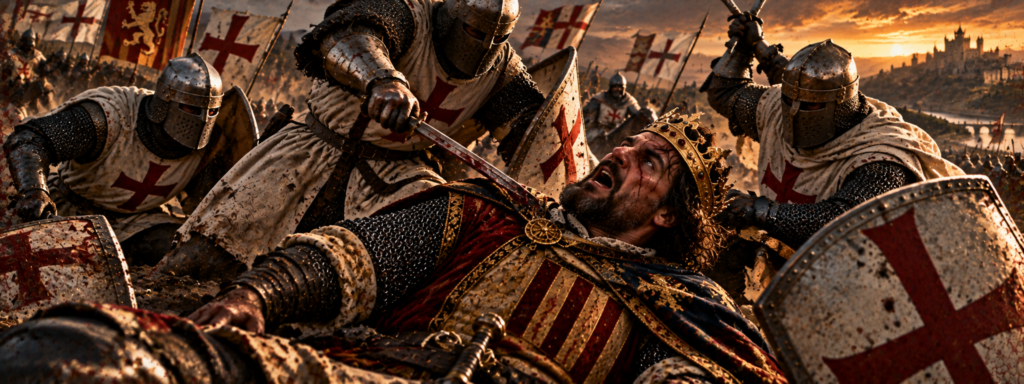
Peter II of Aragon: The Catholic King Slain by Crusaders at the Battle of Muret
Peter II of Aragon (c. 1178–12 September 1213) | King of Aragon and Count of Barcelona, 1196–1213 | Son of Alfonso II of Aragon and Sancha of Castile | Crowned by Pope Innocent III in Rome in 1204 | Victor of the Battle of Las Navas de Tolosa in 1212 | Killed at the Battle of Muret while defending his Occitan allies against the Albigensian Crusade | His death destroyed Aragonese ambitions across much of southern France and left his young son, the future James I, in the custody of the crusader leader Simon de Montfort.
The Catholic King Who Died Fighting a Crusade
On 12 September 1213, a king who had been solemnly crowned by the pope lay dead on a battlefield outside the small town of Muret, south of Toulouse. Peter II of Aragon had crossed the Pyrenees to confront an army of French-led crusaders who claimed to be fighting in defense of the Catholic faith. He had arrived with royal prestige, experienced knights, powerful allies, and the confidence of a monarch who had helped defeat a formidable Muslim army only the previous year. Yet before the day was over, his forces had been shattered, his allies were fleeing, and the king himself had been killed in the violent confusion of a cavalry engagement.
The circumstances were as bitterly ironic as they were politically devastating. Peter was not a heretic, nor had he abandoned Catholicism or formally embraced the religious beliefs condemned by the Church. He was a Catholic monarch whose coronation had been performed under papal authority, and whose participation in the Christian victory at Las Navas de Tolosa had strengthened his reputation as a defender of the faith. Nevertheless, he died fighting against crusaders who had received papal authorization to wage war in southern France. His opponents regarded themselves as soldiers of the Church, while Peter believed he was defending legitimate political rights, dynastic obligations, and territories threatened by an increasingly aggressive crusading movement.
The Battle of Muret became one of the most consequential defeats in medieval Aragonese history. Peter’s death brought an abrupt end to his personal ambitions in Occitania, the culturally rich region of southern France where the rulers of Aragon and Barcelona had cultivated alliances for generations. It exposed the vulnerability of a powerful monarch whose authority depended upon the loyalty and coordination of a coalition of regional lords. It also helped redirect the future of the Crown of Aragon away from continental expansion and toward the Mediterranean world, where his descendants would eventually build a formidable maritime empire.
Later accounts of the battle describe crusader knights concentrating their attack upon Peter and killing him in close combat. Some traditions suggest that he attempted to conceal his identity or that confusion surrounding the royal standard contributed to the fatal encounter. Others emphasize the determination of the crusaders to find and destroy the enemy commander. The precise sequence of events remains disputed, and the surviving narratives do not support every dramatic detail with equal certainty. What is beyond serious doubt is that Peter died fighting at Muret, and that his death turned a dangerous military confrontation into a catastrophe for his supporters.
The king’s final campaign was the culmination of a conflict that had been developing for years. The Albigensian Crusade, launched in 1209, had begun as a papally sanctioned effort to suppress religious dissent in the lands of southern France. Its armies soon became instruments of territorial conquest, displacing established noble families and transferring their possessions to crusader leaders. The violence threatened the political order of Occitania, where Peter possessed important alliances, feudal interests, and family connections.
At the center of the crisis stood Simon de Montfort, the relentless crusader commander whose military successes had transformed him into one of the most feared men in the region. Montfort had risen from a comparatively modest position to become lord of extensive conquered territories. His campaigns were marked by sieges, executions, forced submissions, and the destruction of communities caught between religious persecution and political conquest. By 1213, his expansion had brought him into direct conflict with the king of Aragon.
Peter’s decision to intervene was therefore neither sudden nor inexplicable. He had watched the crusade overturn the political relationships upon which Aragonese influence in southern France depended. He had attempted diplomacy and negotiation, but the crusading movement continued to advance. Eventually, he chose to defend his allies through military force, even though doing so meant confronting men who fought under the banner of the cross.
The decision would cost him his life. It would also leave his young son in the hands of the very commander responsible for the victory at Muret, creating a succession crisis at the heart of the Aragonese monarchy. The child would eventually become James I, one of the most celebrated rulers in the kingdom’s history, but his inheritance began in captivity and political uncertainty. Peter’s death therefore destroyed one royal future while unexpectedly shaping another.
The story of Peter II is not simply the account of a king killed in battle. It is the story of a Catholic monarch trapped between religious authority and political obligation, of a crusade that became a struggle for territory, and of a royal dynasty whose ambitions were transformed by a single afternoon of violence. It is also a reminder that medieval crusading warfare could turn Christian rulers against one another with consequences every bit as devastating as those produced by campaigns against religious outsiders.
A Prince Born Into an Expanding Mediterranean Dynasty
Peter was born around 1178 into the ruling house of Aragon and Barcelona. His father, Alfonso II of Aragon, had inherited a political structure that united the kingdom of Aragon with the County of Barcelona under one ruler. His mother, Sancha of Castile, connected the dynasty to the powerful royal family of Castile. Through both parents, Peter belonged to a network of royal relationships that extended across the Iberian Peninsula and into southern France.
The union of Aragon and Barcelona had transformed the political possibilities of the dynasty. Aragon possessed a strong inland tradition of warfare and territorial expansion along the frontier with Muslim-ruled lands. Barcelona, by contrast, brought Mediterranean commercial connections, maritime interests, and longstanding relationships with the aristocracy of Occitania. Together, these territories created a political entity capable of pursuing ambitions on both sides of the Pyrenees.
The lands ruled by Peter’s family were not a unified state in the modern sense. Aragon and the Catalan counties retained distinct institutions, customs, legal traditions, and political communities. The monarchy depended upon negotiation with nobles, towns, ecclesiastical institutions, and regional elites. Royal power could be formidable, but it was never unlimited.
Peter grew up in a world where dynastic marriages and feudal relationships mattered as much as military conquest. The rulers of Barcelona had long cultivated influence across the Pyrenees through marriages, alliances, and claims to lordship. Their connections extended into Provence, Toulouse, and other parts of southern France. These relationships would eventually become central to Peter’s political ambitions.
The region later known as Occitania was particularly important to the Aragonese dynasty. Its noble families shared linguistic and cultural connections with Catalonia, and political boundaries were often less significant than networks of kinship and lordship. A nobleman might possess estates in several territories while owing obligations to different rulers. Such arrangements created opportunities for expansion but also produced disputes over authority.
Peter inherited these complicated relationships when he became king in 1196. His father had already established Aragonese interests north of the Pyrenees, and Peter was expected to preserve them. The future conflict at Muret therefore had roots extending back long before the Albigensian Crusade. The king’s final campaign would be fought in a region that his dynasty had regarded as part of its political world for generations.
The Crown of Aragon: A Kingdom With Two Frontiers
The Crown of Aragon occupied a strategic position between the Iberian Peninsula and the Mediterranean. To the south lay territories still ruled by Muslim dynasties, offering opportunities for conquest, tribute, and expansion. To the north lay the politically fragmented lands of Occitania, where Aragonese rulers possessed influence through feudal relationships and dynastic alliances. Peter inherited a monarchy whose future could develop in either direction.
The southern frontier remained a major concern throughout his reign. Christian rulers in Iberia competed for territory while also negotiating alliances and truces with Muslim powers. The political situation was complicated by the presence of the Almohad empire, which controlled extensive territories in North Africa and southern Iberia. Its military strength posed a serious challenge to Christian expansion.
The northern frontier presented a different kind of opportunity. Occitania was wealthy, culturally sophisticated, and politically divided among counts, viscounts, bishops, and lesser lords. Its rulers frequently competed for influence, and their alliances could shift rapidly. The Aragonese monarchy sought to strengthen its position within this environment through diplomacy and feudal relationships.
The cultural connections between Catalonia and Occitania were especially significant. The troubadour tradition flourished across the region, celebrating courtly love, aristocratic values, and the prestige of noble households. Courts on both sides of the Pyrenees shared literary tastes and social customs. These connections helped create a sense of aristocratic community that crossed political boundaries.
Yet cultural familiarity did not eliminate political rivalry. The counts of Toulouse, the kings of France, the rulers of Aragon, and numerous lesser nobles competed for authority in southern France. Their relationships were complicated by overlapping claims and obligations. The arrival of a crusading army would intensify these rivalries and transform them into a struggle for survival.
Peter’s reign unfolded against this background of competing opportunities. He sought to preserve his family’s northern interests while maintaining the monarchy’s role in the Iberian struggle against Muslim powers. The two objectives were not necessarily incompatible, but they demanded resources and attention. The Albigensian Crusade would eventually force him to make a choice that placed his northern ambitions above the immediate security of his own person.
Peter’s Coronation: The King Crowned by the Pope
In 1204, Peter traveled to Rome and received a solemn coronation from Pope Innocent III. The ceremony was an extraordinary demonstration of the relationship between the Aragonese monarchy and the papacy. Peter placed his kingship within a framework of papal recognition and religious legitimacy. The event helped establish the reputation that later earned him the epithet “the Catholic.”
The coronation also carried political consequences. Peter acknowledged a special relationship between his crown and the papacy, including obligations that provoked controversy within his territories. The arrangement enhanced his prestige but raised questions about royal independence and financial burdens. His subjects did not necessarily welcome every implication of the ceremony.
Innocent III was one of the most powerful and ambitious popes of the Middle Ages. He believed that the papacy possessed broad authority to intervene in the affairs of Christian rulers when religious or moral questions were involved. His pontificate saw major developments in canon law, crusading ideology, and the assertion of ecclesiastical power. Peter’s coronation placed him within the orbit of this formidable religious authority.
The relationship would later become deeply complicated. Innocent III supported efforts to suppress heresy in southern France, while Peter possessed political interests that increasingly conflicted with the crusaders carrying out that mission. The king could not simply disregard the pope without risking his religious legitimacy. Yet accepting every crusader conquest would threaten the network of allies upon which his northern influence depended.
This contradiction became one of the defining tensions of Peter’s reign. He had publicly demonstrated loyalty to the Church, but the crusade threatened people and territories connected to his monarchy. His religious identity did not erase his obligations as a ruler. The more the crusaders expanded, the more difficult it became to reconcile those responsibilities.
The irony of his eventual death is therefore profound. Peter had received his crown through a ceremony performed by the pope, yet he died fighting an army acting under papal authorization. His fate reveals how crusading ideology could collide with the political interests of Catholic monarchs. It also demonstrates that religious legitimacy offered no guarantee of safety when territorial ambition entered the conflict.
A Troubled Royal Marriage: Peter and Maria of Montpellier
Peter’s marriage to Maria of Montpellier in 1204 was intended to strengthen his political position in southern France. Maria possessed important hereditary rights connected to Montpellier, a prosperous and strategically valuable lordship. Her marriage offered Peter an opportunity to extend his influence within Occitania. Yet the relationship soon became one of the most troubled aspects of his private life.
The marriage was marked by conflict over property, authority, and Peter’s treatment of his wife. Maria’s rights in Montpellier were politically valuable, and disputes arose over their control. Peter sought to use the marriage to advance his interests, while Maria struggled to defend her position. Their disagreements became serious enough to involve ecclesiastical authorities.
Peter attempted to end the marriage, but the papacy refused to grant him the freedom he sought. Maria defended the validity of their union and pursued her claims through legal and religious channels. The dispute exposed the limits of royal authority over marriage when canon law was involved. Even a king could not simply dissolve a marriage without ecclesiastical approval.
The couple’s relationship became the subject of later romanticized traditions, including stories surrounding the conception of their son. Some versions portray Maria as securing access to her husband through an elaborate deception. These accounts are colorful but should not be accepted as straightforward historical fact. They reflect later efforts to explain an unhappy marriage that nevertheless produced a legitimate heir.
Their son James was born in 1208. His birth secured the dynastic succession, although his childhood would be overshadowed by the conflict between his parents and the political crisis surrounding the Albigensian Crusade. Peter’s relationship with Maria remained strained. The marriage that had promised political advantages instead became a source of controversy.
Maria died in Rome in 1213, only months before Peter’s death at Muret. Her final years had been dominated by legal disputes and efforts to protect her rights. The near coincidence of the parents’ deaths left their young son without either parent. The future James I would inherit a kingdom shaken by military defeat and dynastic uncertainty.
Occitania Before the Crusade: A Land of Wealth, Rivalry, and Religious Diversity
Southern France at the beginning of the thirteenth century was a region of remarkable cultural and political complexity. Its towns were prosperous, its aristocratic courts supported poets and musicians, and its noble families maintained relationships extending across the Pyrenees. The region was not a single unified kingdom but a collection of territories governed by counts, viscounts, bishops, and local lords. Their political interests frequently overlapped and collided.
Toulouse was one of the most important centers of power. Its counts possessed extensive territories and considerable influence, although their authority was challenged by powerful vassals and neighboring rulers. The Trencavel family controlled important viscounties including Béziers and Carcassonne. Other lords maintained connections with Aragon, Barcelona, Provence, and the French crown.
The region also contained religious movements that challenged the authority of the Catholic Church. Among them were communities associated with beliefs that later historians commonly group under the label Catharism. Their doctrines and organization remain subjects of scholarly debate, partly because much of the surviving evidence was produced by hostile ecclesiastical investigators. Nevertheless, Church authorities regarded certain forms of religious dissent in the region as a serious threat.
The term “Albigensian” derived from Albi, a town associated in medieval discourse with religious dissent. It became a broad label for the heresy targeted by the crusade, even though the movement was not confined to that town. The Church’s concerns involved theology, ecclesiastical authority, and the ability of local rulers to suppress condemned beliefs. The conflict would eventually extend far beyond the question of religious doctrine.
Occitan noble families often maintained relationships with people accused of heresy without necessarily sharing their beliefs. Political loyalty, family connections, and local custom could complicate efforts to enforce religious conformity. Some lords resisted outside intervention because it threatened their authority. Others were accused of tolerating heresy or failing to suppress it.
These circumstances created an environment in which religious persecution could become a vehicle for political conquest. The papacy sought to eliminate heresy, while northern French nobles saw opportunities to acquire land and prestige. The crusade would bring those objectives together with devastating consequences. Peter’s intervention emerged from this collision between religious policy and territorial ambition.
The Murder That Helped Ignite the Albigensian Crusade
The immediate crisis leading to the Albigensian Crusade intensified after the murder of the papal legate Pierre de Castelnau in January 1208. The legate had been involved in efforts to pressure Raymond VI, Count of Toulouse, into taking stronger action against heresy. Their relationship was marked by hostility and political confrontation. The legate’s death became a decisive event in the escalation toward war.
Raymond VI was widely blamed for creating the circumstances that led to the murder, although direct responsibility for ordering it was not established. Pope Innocent III reacted with anger and renewed calls for action against the count and the religious dissent associated with his territories. The killing provided a powerful justification for a military campaign. The papacy began mobilizing support for a crusade.
The campaign offered spiritual privileges to participants similar to those associated with crusades to the Holy Land. This encouraged nobles and knights from northern France and elsewhere to join. The promise of religious merit was combined with the possibility of acquiring territory from defeated lords. The resulting army possessed both ideological motivation and material incentives.
The crusade began in 1209. Its early campaigns targeted territories associated with the Trencavel family and other rulers accused of tolerating heresy. The violence quickly demonstrated that the expedition would not be limited to theological enforcement. Towns were besieged, populations were displaced, and noble families lost their possessions.
Peter initially attempted to navigate the crisis through diplomacy. His relationships with Occitan lords made the crusade a direct concern, but he also needed to preserve his standing with the papacy. Open opposition to a crusading army would carry serious risks. He therefore sought arrangements that might protect his allies without placing him in direct conflict with the Church.
The crusade’s military successes gradually undermined those efforts. As territories fell to the invaders, Peter’s influence in the region was threatened. The conflict was becoming a struggle over who would rule southern France. The king could no longer treat it as a distant religious campaign.
Béziers: The Massacre That Announced a New Kind of War
In July 1209, the crusading army attacked Béziers, a town associated with the Trencavel territories. The siege ended in a devastating assault and widespread killing. Contemporary accounts describe the destruction of the town and the deaths of large numbers of inhabitants. The precise casualty figures remain uncertain, but the scale of violence shocked later generations.
The massacre became one of the most infamous episodes of the Albigensian Crusade. Later tradition attributed to the papal legate Arnaud Amalric a notorious statement suggesting that God would distinguish the faithful from the heretics among the dead. The wording and circumstances of that remark are disputed, and it should not be treated as an unquestioned eyewitness quotation. The tradition nevertheless reflects the reputation for indiscriminate violence that became attached to the campaign.
The fall of Béziers sent a terrifying message to other communities. Resistance could result in catastrophic destruction, while submission offered no guarantee that local rulers would retain their authority. The crusade was demonstrating its ability to overthrow established political structures. Its military successes encouraged further intervention.
The next major target was Carcassonne, another important Trencavel stronghold. The city surrendered after a siege, and its ruler, Raymond Roger Trencavel, was taken into custody. He died later that year while imprisoned. His death and the loss of his territories became central grievances among those who opposed the crusade.
Simon de Montfort emerged as the principal beneficiary of these conquests. He received control of important territories formerly held by the Trencavels, transforming his political position. His rise threatened the balance of power in Occitania. Peter’s allies were losing land to a commander whose authority rested upon crusading victories.
The events at Béziers and Carcassonne made the conflict personal for many southern nobles. The crusade was no longer an abstract effort to suppress heresy. It was a campaign capable of destroying families, confiscating estates, and overturning longstanding relationships. Peter’s eventual decision to intervene cannot be understood without recognizing the fear created by these early victories.
Simon de Montfort: The Crusader Who Became Peter’s Enemy
Simon de Montfort was one of the most formidable military figures of the Albigensian Crusade. A nobleman from northern France, he had participated in earlier crusading activity before becoming a leading commander in southern France. His reputation rested upon determination, military skill, and uncompromising religious conviction. He also possessed a powerful appetite for territorial authority.
After the conquest of Trencavel lands, Montfort became the ruler of territories that had previously belonged to established Occitan families. His position depended upon continued military success and the support of crusading forces. Local resistance remained strong, and his authority was repeatedly challenged. The conflict therefore became a prolonged struggle for control rather than a brief punitive expedition.
Montfort’s campaigns were marked by sieges, forced submissions, and harsh punishments. The treatment of defeated opponents contributed to his fearsome reputation. His supporters portrayed him as a champion of orthodoxy, while his enemies regarded him as an invader who used religion to justify conquest. Both perspectives were shaped by the intense political and religious divisions of the period.
His rise brought him into conflict with Peter’s interests. The Aragonese monarchy had cultivated relationships with noble families whose lands were now threatened or confiscated. Montfort’s expansion undermined those arrangements. The king faced the possibility that his influence north of the Pyrenees would be permanently destroyed.
The relationship between Peter and Montfort was not always one of open hostility. Diplomatic negotiations and political arrangements occurred during the years preceding Muret. The situation was complicated by the fact that Peter’s son James was placed in Montfort’s custody as part of an earlier proposed marriage arrangement involving Montfort’s family. This extraordinary circumstance would become deeply troubling after the king’s death.
By 1213, the two men represented opposing visions of political authority in Occitania. Montfort sought to consolidate territories conquered under crusading authorization. Peter sought to defend a network of allied lords and preserve Aragonese influence. Their confrontation at Muret would determine the immediate future of the region.
The Child Hostage: James of Aragon in Montfort’s Hands
One of the most disturbing elements of Peter’s final years was the position of his young son James. Born in 1208, the child was the heir to the Aragonese monarchy. Yet he spent part of his early life in the custody of Simon de Montfort, the commander who would eventually defeat and kill his father. The arrangement reflected the dangerous political negotiations surrounding the crusade.
Peter had explored a marriage alliance between James and a daughter of Montfort. Such an arrangement could have created a connection between the Aragonese dynasty and the rising crusader lord. It also offered a possible means of reducing conflict in Occitania. The child was placed in Montfort’s care within this diplomatic context.
The arrangement became increasingly problematic as relations deteriorated. James remained under the control of a man whose military campaigns threatened his father’s allies. The king’s political options were constrained by the presence of his heir in enemy hands. The situation revealed the risks of using children as instruments of dynastic diplomacy.
After Peter’s death, the arrangement became a serious succession crisis. James was the legitimate heir to Aragon, but he was not immediately free to return to his kingdom. Montfort’s custody of the child created an extraordinary imbalance of power. The victor of Muret held the son of the defeated king.
Papal intervention eventually helped secure James’s release. The child returned to Aragon and was placed under the protection of the Knights Templar at Monzón. His early years were marked by regency struggles and the challenges of governing a kingdom whose ruler was still a minor. The death of his father had left him vulnerable at precisely the moment when dynastic continuity was most important.
James would later remember his childhood as a period of hardship and political uncertainty. His eventual achievements as king make the contrast especially striking. The child held by Montfort became one of the greatest conquerors in Aragonese history. Yet his rise began with the catastrophe at Muret.
Las Navas de Tolosa: Peter’s Great Victory Before His Final Defeat
In July 1212, Peter participated in the Battle of Las Navas de Tolosa, one of the most important Christian victories of medieval Iberia. The battle brought together forces led by Alfonso VIII of Castile, Sancho VII of Navarre, and Peter II of Aragon against the Almohad caliph Muhammad al-Nasir. The confrontation followed years of tension between the Christian kingdoms and the Almohad empire. Its outcome altered the balance of power in the peninsula.
Peter’s participation strengthened his reputation as a Catholic monarch committed to the struggle against Muslim rule. His army formed part of a coalition that achieved a decisive victory. The battle was celebrated as a major success for Christian arms. It also demonstrated the ability of rival Iberian rulers to cooperate when their interests aligned.
The victory at Las Navas de Tolosa was particularly important because it occurred only fourteen months before Peter’s death. The king who would fall fighting crusaders had recently participated in a campaign widely understood as a triumph of Christian warfare. His religious credentials were therefore difficult to dismiss. He had not become an enemy of the Church through conversion or rejection of Catholic doctrine.
The contrast also reveals the complexity of medieval crusading politics. A ruler could be celebrated for fighting Muslim armies in Iberia and condemned for resisting a papally authorized campaign against Christians in southern France. The distinction depended upon political and ecclesiastical circumstances rather than a simple measure of personal faith. Peter’s career exposed the tensions within that system.
The victory may also have increased Peter’s confidence in his military abilities. He had participated in a major coalition battle against a powerful opponent and emerged victorious. His prestige among Christian rulers was considerable. Yet the conditions at Muret would be very different from those at Las Navas de Tolosa.
At Muret, Peter would confront a smaller but highly disciplined crusader cavalry force led by an experienced commander. His own army would depend upon cooperation among allies whose military methods and political interests were not identical. The earlier victory offered no guarantee of success. The battlefield would expose weaknesses that royal prestige could not overcome.
Raymond VI of Toulouse: The Count Who Needed a King
Raymond VI, Count of Toulouse, was one of the principal figures targeted by the Albigensian Crusade. His territories occupied a central position in Occitania, and his political authority was threatened by the crusaders’ advance. He had experienced excommunication, pressure from the papacy, and repeated military confrontations. By 1213, his survival depended increasingly upon outside support.
Raymond’s relationship with the Church was complicated by accusations that he tolerated heresy or failed to suppress it effectively. His defenders argued that the crusade had become an instrument of conquest rather than a legitimate religious campaign. The count’s political position deteriorated as Montfort expanded his authority. He needed a powerful ally capable of challenging the crusader commander.
Peter offered that possibility. The Aragonese king possessed military resources, royal prestige, and longstanding interests in southern France. His intervention could transform the conflict from a series of local struggles into a confrontation involving a major monarch. Raymond therefore had strong reasons to seek his protection.
The alliance was not simply an expression of religious sympathy. Peter was defending political relationships that had developed over generations. Raymond’s survival would help preserve the balance of power in Occitania and prevent Montfort from dominating the region. The king’s interests and the count’s needs increasingly converged.
Raymond’s supporters included other southern lords whose territories had been threatened by the crusade. Their coalition represented a broad resistance to the expansion of northern French crusading power. Yet the alliance contained internal tensions. Its leaders differed in status, military experience, and strategic priorities.
These differences would become crucial at Muret. A coalition army could possess substantial numbers but still suffer from poor coordination. The presence of a king did not automatically produce unified command. Peter’s decision to lead the combined forces would place enormous responsibility upon him.
The Road to Muret: Diplomacy Gives Way to War
During the years preceding 1213, Peter attempted to resolve the conflict through negotiation. He sought arrangements that would protect his allies while preserving his relationship with the papacy. The political situation was difficult because the crusade had acquired its own momentum. Montfort’s territorial ambitions could not easily be separated from the religious mission that justified his campaigns.
Peter’s diplomatic efforts included appeals to Pope Innocent III. He argued for moderation and sought to prevent the complete destruction of established Occitan lordships. The pope at times expressed concern about the conduct and territorial ambitions of the crusaders. Yet papal policy remained committed to suppressing heresy, and the situation was complicated by conflicting reports from the region.
The negotiations failed to produce a lasting settlement. Montfort continued to hold conquered territories, while southern nobles remained determined to resist. Peter increasingly concluded that military intervention was necessary. His decision reflected the failure of diplomacy as much as personal ambition.
In 1213, Peter accepted the homage of important Occitan lords, including Raymond VI and other rulers threatened by the crusade. These arrangements strengthened his formal political position north of the Pyrenees. They also increased his responsibility to defend the territories placed under his protection. The king was moving toward direct confrontation with Montfort.
The coalition gathered forces for a campaign against the crusader stronghold of Muret. The town lay near Toulouse and occupied an important strategic position. Its capture would weaken Montfort’s authority and demonstrate that the southern alliance could defeat the crusaders. The campaign therefore carried enormous political significance.
Peter entered the conflict with considerable prestige but also substantial risks. He was fighting against a papally sanctioned military movement, and his own son remained connected to Montfort’s household. His allies depended upon him, but their military coordination was uncertain. The road to Muret had been shaped by years of failed negotiation, territorial conquest, and growing distrust.
The Siege of Muret: A King Arrives With an Army
The allied forces approached Muret in September 1213. Their army included troops associated with Peter, Raymond VI, and other southern lords. Contemporary accounts differ considerably in their estimates of the forces involved, and later numerical claims should be treated with caution. The coalition nevertheless possessed substantial military resources.
Muret was defended by a crusader garrison, and Montfort moved to relieve the town. The approaching confrontation offered both sides an opportunity for a decisive victory. The allies hoped to overwhelm the crusader position and reverse years of territorial losses. Montfort needed to preserve his authority and prevent the collapse of his military reputation.
The battlefield presented serious tactical challenges. The allied army included cavalry and infantry contingents whose coordination was essential. Siege operations also complicated the deployment of forces. An army concentrating upon a fortified town could be vulnerable to an attack from a mobile enemy.
Montfort’s strength lay in his experienced cavalry. His knights had participated in years of campaigning and were accustomed to operating under his command. Their discipline and willingness to undertake aggressive maneuvers gave them an advantage in certain battlefield conditions. The crusader commander understood that he could not simply rely upon numbers.
Peter’s coalition possessed important advantages of its own. The presence of a king provided prestige and could encourage troops to fight with determination. The allied forces also had local knowledge and substantial support in the region. Yet their commanders needed to agree upon a coherent strategy.
The siege created the conditions for a confrontation that would determine the fate of Occitania. Peter had crossed the Pyrenees to defend his allies and challenge the crusade. Montfort had arrived to protect his conquests. Neither side could easily withdraw without serious political consequences.
Simon de Montfort’s Gamble
Montfort faced a dangerous situation at Muret. His enemies possessed a substantial army, and the loss of the town could undermine his authority throughout the region. He needed to prevent the coalition from consolidating its position. A defensive strategy might allow the allies to continue their siege and strengthen their control.
The crusader commander chose an aggressive response. Rather than remaining behind the walls, he organized his cavalry for a decisive attack. The plan depended upon speed, coordination, and the ability to disrupt the enemy before the allied forces could respond effectively. It was a risky decision, but one consistent with Montfort’s military reputation.
The crusader cavalry was organized into separate divisions or squadrons under experienced commanders. Their movements required discipline because an uncontrolled charge could expose them to encirclement. Montfort relied upon the cohesion of his knights. The battle would demonstrate the effectiveness of that approach.
The allied army, by contrast, faced difficulties in coordinating its forces. The presence of multiple commanders created opportunities for disagreement. The relationship between Peter and Raymond VI was politically important, but their military priorities were not necessarily identical. The coalition’s strength depended upon cooperation that could be difficult to maintain under pressure.
Some later narratives emphasize disputes over tactics before the battle. Raymond is sometimes portrayed as favoring a more cautious approach, while Peter preferred a direct confrontation. The precise details of these discussions are difficult to verify. They nevertheless reflect the broader problem of command within a coalition army.
Montfort’s decision transformed the battle into a contest of leadership and cavalry discipline. He could not afford a prolonged engagement that allowed the allies to exploit their numerical advantages. His hope was to strike quickly and destroy the enemy’s cohesion. The gamble would succeed with devastating consequences.
The Battle Begins: Cavalry Against a Royal Coalition
On 12 September 1213, the crusader cavalry emerged to confront the allied forces outside Muret. The engagement developed rapidly, and the surviving accounts describe a series of mounted attacks that disrupted the coalition’s formation. The crusaders relied upon aggressive movement and coordinated charges. Their opponents struggled to maintain cohesion as the battle unfolded.
The fighting was intense and confused. Medieval cavalry engagements involved horses, lances, swords, shields, and the constant danger of being unhorsed or surrounded. Commanders attempted to maintain control while responding to sudden movements and attacks. The noise and dust of battle made communication difficult.
Peter participated personally in the fighting. His presence reflected the expectations of medieval kingship, in which rulers were often expected to demonstrate courage on the battlefield. A monarch who fought alongside his knights could inspire loyalty and strengthen his reputation. Yet personal participation also exposed him to the same physical dangers faced by ordinary combatants.
The crusaders concentrated upon disrupting the allied cavalry. Their disciplined attacks created confusion and weakened the coalition’s ability to respond. Once the mounted forces lost cohesion, the infantry and other contingents became increasingly vulnerable. The battle began to turn against Peter’s army.
The precise sequence of charges differs among the surviving narratives. Some accounts emphasize the actions of particular crusader commanders, while others focus upon the collapse of the allied formation. The essential outcome is clear. Montfort’s cavalry achieved a decisive victory over the forces opposing him.
The battle’s most consequential event was the death of Peter himself. His loss deprived the coalition of its most prestigious leader and transformed a military setback into a political disaster. The king’s death would be remembered as the moment when Aragonese ambitions in Occitania suffered a devastating blow. The details of the fatal encounter, however, remain a matter of historical debate.
The Death of Peter II: A King Surrounded by Enemies
Peter was killed during the fighting at Muret, apparently in the midst of a violent cavalry engagement. Later accounts describe crusader knights attacking the king and striking him down. Some narratives suggest that he was specifically sought out because of his royal status. Others emphasize confusion over his identity and the circumstances in which he was recognized.
One tradition holds that Peter exchanged armor or identifying equipment with another knight, possibly to avoid being singled out. According to versions of this story, the deception failed or contributed to confusion when the crusaders encountered him. The details vary, and the surviving evidence does not allow the episode to be reconstructed with certainty. It should therefore be treated as a narrative tradition rather than an established sequence of events.
Another element of the tradition emphasizes Peter’s declaration of his identity during the fighting. In some accounts, the king attempted to make himself known when the crusaders attacked another man believed to be him. The story portrays Peter as refusing to conceal his royal status. Yet the exact words attributed to him cannot be authenticated, and no invented dialogue is necessary to convey the danger of the moment.
What is certain is that Peter died in close combat while his army was being defeated. The crusader cavalry’s attack destroyed the cohesion of the allied forces, and the king was unable to escape. His death may have occurred during a deliberate attempt to target the enemy commander, but the precise tactical circumstances remain uncertain. The surviving narratives do not support the claim that he was formally executed after capture.
The distinction is important. Peter was killed on the battlefield, not demonstrably subjected to a judicial execution or a separate killing after surrender. The language of assassination may be used broadly to describe the deliberate targeting of a ruler, but the evidence supports a battlefield death during an organized military attack. His killing was politically decisive, but it should not be confused with an execution carried out after the fighting.
The image of the king surrounded by hostile knights remains powerful because it captures the vulnerability of medieval monarchy. Peter possessed a crown, an army, and powerful allies, yet none of those protections could save him once the battle turned against his forces. His death ended the campaign and shattered the coalition’s hopes. The man who had been crowned by the pope died beneath the weapons of crusaders.
Did the Crusaders Deliberately Target the King?
The question of whether Peter was specifically targeted is central to understanding his death. Medieval commanders were valuable targets because their capture or killing could destroy an enemy army’s morale. A king was especially important, since his death could create a succession crisis and undermine political alliances. It would therefore have been strategically rational for Montfort’s knights to seek Peter during the battle.
Some narrative traditions describe the crusaders recognizing or searching for the king. The confusion surrounding royal equipment and identity appears in several later retellings. These stories suggest that Peter’s status was central to the fatal encounter. Yet the precise details vary, and the surviving evidence does not establish a single uncontested reconstruction.
The distinction between deliberate targeting and assassination is also important. A soldier who attacks an enemy king during open battle may be acting within the ordinary objectives of warfare. The act can be intentional without involving deception or a separate murder plot. Peter’s death occurred within a military engagement between opposing armies.
The claim that a squadron of French knights swarmed and executed him therefore requires qualification. Crusader knights did kill Peter during the battle, and some accounts emphasize their efforts to identify or attack him. However, describing the event as an execution risks suggesting that he was captured and deliberately put to death outside combat. The evidence does not securely establish such a scenario.
The more defensible conclusion is that Peter was killed in a cavalry battle in which his royal identity may have made him a particularly important target. His death was not an accidental political event, since the battle itself was a deliberate confrontation between opposing forces. Yet the exact circumstances of the fatal blows remain uncertain. The historical significance lies in the destruction of the king and the consequences that followed.
Peter’s case therefore occupies a complicated position within the history of royal killings. He was a monarch killed by enemies whose military success depended upon defeating his army. The targeting of a king in battle can have consequences resembling those of assassination, but it does not automatically constitute regicide in the narrower sense of unlawful or conspiratorial killing. His death belongs most securely to the history of rulers slain in combat.
The Collapse of the Allied Army
The death of Peter accelerated the collapse of the coalition at Muret. The allied cavalry had already suffered serious disruption, and the loss of the king removed its most prestigious commander. The remaining forces struggled to maintain an organized resistance. The battle became a rout.
The crusader cavalry pursued the defeated troops, inflicting heavy losses. Contemporary accounts describe substantial casualties, although numerical estimates vary and should not be accepted uncritically. The defeated army’s retreat exposed infantry and other contingents to further attack. The destruction extended beyond the immediate mounted engagement.
Raymond VI survived the battle, but his political position was gravely weakened. The coalition that had offered the possibility of reversing Montfort’s conquests had been shattered. Peter’s death deprived the southern lords of a powerful protector. Their prospects became increasingly uncertain.
Montfort’s victory was extraordinary because he had defeated a coalition led by a reigning king. The result strengthened his reputation as a formidable commander and reinforced his authority in the conquered territories. It also demonstrated the effectiveness of disciplined cavalry tactics against a poorly coordinated opponent. The battle became one of the defining military successes of the Albigensian Crusade.
The political consequences were even greater than the military losses. Peter’s death removed the principal external monarch capable of challenging Montfort’s expansion in Occitania. The Aragonese monarchy was forced to confront its own succession crisis. The southern resistance lost a source of legitimacy and military support.
The defeat at Muret therefore transformed the balance of power. The crusaders had not merely defended a town or won a battle. They had killed a king and destroyed the coalition that threatened their conquests. The future of southern France would be shaped by that victory.
The Body of a King: Death, Burial, and Political Memory
Peter’s death created immediate practical and symbolic problems. A king’s body was not simply the remains of an individual; it represented the continuity and dignity of the monarchy. Recovering and burying a ruler carried political and religious significance. The circumstances of Peter’s death made those obligations especially sensitive.
His remains were eventually associated with the royal monastery of Santa Maria de Sigena in Aragon. The monastery had strong connections to the Aragonese dynasty and served as an important religious institution. Burial within such a setting helped preserve the memory of the dead ruler. It also linked his death to the continuity of the royal house.
The defeat at Muret complicated the public memory of Peter. He had died fighting crusaders, a circumstance that could be interpreted differently by supporters and opponents. For his allies, he was a monarch who had defended legitimate political rights against invasion. For crusader supporters, his defeat could be presented as evidence that resistance to the Church’s campaign was misguided.
The religious implications were particularly uncomfortable. Peter had been crowned by the pope and had fought successfully against Muslim forces in Iberia. His death at the hands of crusaders challenged any simple distinction between defenders and enemies of the faith. The event exposed the political contradictions of crusading warfare.
Later Aragonese memory emphasized Peter’s place within the dynasty and the consequences of his death. His son James would eventually become a powerful ruler, and the monarchy would recover from the crisis. Yet Muret remained a symbol of lost opportunities north of the Pyrenees. The king’s burial preserved his dignity, but it could not restore the political world destroyed by his defeat.
The body of Peter II therefore became a reminder of the limits of royal power. He had entered the campaign as a crowned monarch commanding an alliance of noble forces. He left it as a casualty whose kingdom faced uncertainty. The contrast between royal ceremony and battlefield death was stark.
The Child King: James I Inherits a Broken Future
Peter’s death left his son James as the legitimate heir to the Crown of Aragon. The child was only five years old and remained in the custody of Simon de Montfort. His mother, Maria of Montpellier, had died earlier in 1213. The young heir therefore faced the loss of both parents and the danger of political manipulation.
The succession crisis was particularly serious because James was not immediately present in Aragon. Montfort’s custody of the child gave the crusader leader leverage over the defeated dynasty. The situation required intervention from powerful political and religious authorities. The future of the monarchy depended upon securing the heir’s release.
Pope Innocent III eventually ordered arrangements that led to James’s return. The child was placed under the care of the Knights Templar at Monzón, where he spent important years of his upbringing. The Templars provided a setting in which the young king could be protected and educated. Yet the kingdom remained politically unstable during his minority.
Aragonese nobles competed for influence, and the regency period was marked by disputes over authority. The absence of an adult monarch created opportunities for factional rivalry. James inherited a crown whose political institutions required careful management. His childhood was therefore shaped by the consequences of his father’s defeat.
The future king eventually overcame these difficulties and embarked upon a remarkable reign. He conquered Mallorca in 1229 and Valencia in 1238, transforming the territorial and economic position of the Crown of Aragon. His achievements helped redirect the monarchy toward Mediterranean expansion. The dynasty recovered from Muret through a very different set of ambitions.
The contrast between father and son is one of the most striking features of the story. Peter died attempting to preserve Aragonese influence in southern France. James built a new future through conquest in the Mediterranean and eastern Iberia. The defeat at Muret did not destroy the dynasty, but it helped change the direction of its history.
The End of Aragonese Ambitions in Occitania
The Battle of Muret marked a decisive turning point in Aragonese relations with southern France. Peter’s death removed the monarch who had sought to establish a broad political network across Occitania. His allies lost a powerful protector, and the crusaders strengthened their position. The immediate prospects for Aragonese expansion north of the Pyrenees were severely weakened.
The defeat did not instantly eliminate every Aragonese interest in the region. Dynastic claims, feudal relationships, and cultural connections continued to exist. Political influence, however, became increasingly difficult to maintain. The balance of power had shifted toward the crusaders and, eventually, the French monarchy.
The Albigensian Crusade continued after Muret. Montfort remained a dominant military figure until his death during the siege of Toulouse in 1218. The conflict involved further campaigns, shifting alliances, and prolonged resistance. The political settlement of southern France would take years to develop.
The French crown eventually gained increasing authority over territories that had previously enjoyed substantial autonomy. The Treaty of Paris in 1229 imposed major concessions upon Raymond VII of Toulouse and helped strengthen Capetian influence. The process was gradual, but the long-term direction was clear. Southern France was moving toward closer integration with the French monarchy.
For Aragon, the consequences were profound. The monarchy’s northern ambitions became less central as opportunities emerged elsewhere. The conquest of Mediterranean islands and eastern Iberian territories offered new sources of wealth and prestige. The political energy that might once have been directed toward Occitania increasingly moved south and east.
Muret therefore became more than a battlefield defeat. It represented the collapse of a possible political future in which the Crown of Aragon might have exercised far greater influence across southern France. The dynasty survived and prospered, but its path changed. Peter’s death helped close one frontier while his descendants opened another.
The Albigensian Crusade After Peter’s Death
The victory at Muret strengthened the crusading movement but did not bring an immediate end to resistance. Southern lords continued to oppose Montfort, and the conflict remained violent. The crusaders faced the challenge of governing territories whose populations and aristocratic families often resented their authority. Military conquest did not automatically produce political stability.
Montfort’s campaigns continued through sieges and attempts to consolidate control. His reputation remained formidable, but his position was vulnerable to local resistance and changing political circumstances. The death of Peter had removed a major external threat, yet the crusader leader still faced determined opponents. The war remained far from settled.
In 1218, Montfort was killed during the siege of Toulouse. His death was another dramatic example of the vulnerability of powerful commanders in medieval warfare. The man whose cavalry had killed Peter at Muret died while attempting to maintain his conquests. His disappearance weakened the crusading leadership but did not reverse the larger political transformation.
The French monarchy eventually assumed a more direct role in the region. Royal intervention helped consolidate authority over territories affected by the crusade. The conflict became increasingly connected to the expansion of Capetian power. Religious persecution and political conquest continued to reinforce one another.
The suppression of religious dissent also developed through institutional means. Ecclesiastical investigations and later inquisitorial procedures sought to identify and punish beliefs condemned as heretical. The consequences for communities accused of supporting such movements were severe. The crusade’s legacy therefore extended beyond battlefield victories and territorial transfers.
Peter’s death formed part of this larger history. His intervention had represented one of the most serious attempts to resist the crusaders through royal military power. Its failure weakened the political independence of southern France. The consequences shaped the region for generations.
Was Peter Fighting for the Cathars?
Peter’s alliance with Occitan lords during the Albigensian Crusade has sometimes been described as support for the Cathars. That description is misleading if it suggests that the king personally embraced Cathar theology or rejected Catholicism. Peter remained a Catholic monarch whose religious credentials were well established. His intervention was primarily political and dynastic.
The rulers he supported governed territories in which people accused of heresy lived and sometimes enjoyed protection. Their failure or refusal to suppress religious dissent had brought them into conflict with the papacy. Peter defended these rulers because they were his allies and because their destruction threatened his interests. His actions therefore placed him in opposition to the crusade without making him a theological supporter of its targets.
The distinction matters because the Albigensian Crusade combined religious and political objectives. The papacy sought to eliminate heresy, while crusader leaders acquired territory and authority through conquest. Local rulers resisted because their lands and rights were threatened. Their motives could be political even when the conflict was framed in religious terms.
Peter’s position was particularly complicated by his coronation and relationship with Innocent III. He had publicly acknowledged papal authority and participated in a major Christian victory against the Almohads. Yet he believed that the crusade had gone too far in overturning legitimate lordships. His opposition reflected a conflict between different obligations rather than a simple rejection of Catholic identity.
The king’s death therefore exposes the limitations of describing medieval conflicts through rigid religious categories. A Catholic ruler could fight crusaders, and crusaders could kill a Catholic king. Political interests, feudal obligations, and territorial ambitions shaped the conflict as much as religious belief. Muret was a battle between Christians whose disagreements had become irreconcilable.
Peter’s tragedy lies partly in this contradiction. He attempted to defend a political order that the crusade was destroying, but doing so placed him against forces acting under papal authorization. His religious reputation could not protect him from military defeat. The battlefield made no distinction between a king crowned by the pope and the crusaders who killed him.
The Politics of a Royal Death
Peter’s death had consequences far beyond the immediate battlefield. It removed the most powerful leader of the anti-crusader coalition and destroyed the military campaign intended to reverse Montfort’s conquests. It also created a succession crisis in Aragon and weakened the monarchy’s northern influence. The political effects were immediate and long-lasting.
For Montfort, the victory was a triumph of extraordinary importance. He had defeated a coalition led by a reigning king and preserved his position in southern France. The death of Peter eliminated a major opponent. It strengthened the crusader commander’s reputation and helped consolidate his territorial authority.
For Raymond VI and the southern nobility, the defeat was devastating. Their hopes of using Aragonese military power to challenge the crusade had collapsed. The loss of Peter deprived them of a royal protector whose prestige might have influenced negotiations with the papacy. Their struggle continued under far more difficult circumstances.
For Aragon, the death threatened dynastic stability. James was a child, and his custody by Montfort created an extraordinary political problem. The kingdom needed to secure the heir and maintain continuity amid aristocratic rivalry. The succession crisis could have endangered the monarchy’s survival.
For the papacy, the outcome was politically complicated. A Catholic king crowned by Innocent III had died fighting a crusading army. The event demonstrated the dangerous consequences of a campaign whose territorial ambitions had become increasingly difficult to control. The victory advanced the crusaders’ position but also exposed tensions within the Church’s political relationships.
The death of Peter therefore cannot be understood as an isolated battlefield casualty. It altered the balance of power across a large region and reshaped the future of a royal dynasty. His killing became one of the decisive events in the history of the Albigensian Crusade. The consequences extended into the political development of France and the Mediterranean.
Why Peter II Belongs Among the Assassinated Rulers & Regicides
Peter II belongs within the Assassinated Rulers & Regicides category as a monarch deliberately opposed and killed in battle by forces whose victory depended upon destroying his army. His death at Muret on 12 September 1213 was a documented royal killing with profound political consequences. Later narratives suggest that crusader knights specifically sought or recognized him during the fighting. The precise circumstances of the fatal encounter remain disputed.
His case differs from a conventional assassination carried out through conspiracy, poison, or an attack outside battle. Peter was killed during an organized military engagement, and the surviving evidence does not establish that he was captured and executed. The language of regicide can be used broadly to describe the killing of a king, but the narrower historical classification is a royal battlefield death. The distinction should remain clear.
The political significance of his killing is nevertheless enormous. Peter was the principal royal protector of the Occitan coalition opposing the Albigensian Crusade. His death destroyed the immediate military challenge to Montfort and weakened Aragonese influence north of the Pyrenees. It also left his young heir in enemy custody.
The circumstances were especially striking because Peter was a Catholic monarch who had been crowned by the pope. He had participated in the Christian victory at Las Navas de Tolosa only a year earlier. Yet he died fighting an army authorized to wage war in defense of the Church. His death reveals the political contradictions of medieval crusading.
The case also illustrates how the deliberate targeting of rulers could shape the outcome of battles. Killing a monarch could destroy an army’s morale, create a succession crisis, and alter the balance of power. Peter’s death produced all three consequences. The political effects were comparable to those of some assassinations, even though the killing occurred in open combat.
His inclusion in the category is therefore justified as a documented case of a king killed by enemy knights during a decisive battle, with traditions of deliberate targeting surrounding the fatal encounter. It should not be presented as a proven execution or covert assassination. The historical record supports the death, the battlefield circumstances, and the consequences. The exact manner in which the crusaders identified and killed him remains uncertain.
The King Who Died Beneath the Cross
Peter II of Aragon inherited a monarchy whose ambitions extended across the Pyrenees and into the Mediterranean. His dynasty had united Aragon and Barcelona, creating a political structure capable of pursuing expansion in several directions. His family possessed longstanding relationships with the aristocracy of southern France, and those connections formed an important part of his inheritance. The future of the Crown of Aragon appeared to depend upon preserving influence both within Iberia and across the mountains.
His reign began with opportunities and challenges. He sought to strengthen royal authority, cultivate relationships with the papacy, and defend the political interests of his dynasty. His coronation in Rome in 1204 demonstrated the importance he attached to religious legitimacy. The ceremony placed him within a special relationship with Pope Innocent III.
Yet that relationship would become increasingly difficult as the Albigensian Crusade advanced through southern France. The campaign began as an effort to suppress religious dissent, but its military successes transformed the political order of Occitania. Established noble families lost their lands, towns suffered devastating attacks, and crusader leaders acquired extensive territories. The violence threatened the network of alliances upon which Peter’s northern influence depended.
The king attempted diplomacy before committing himself to war. He sought arrangements that might protect his allies while preserving his relationship with the papacy. Those efforts failed as Montfort continued to consolidate his conquests. The conflict eventually forced Peter to choose between accepting the destruction of his political interests and confronting the crusaders directly.
His decision to intervene was shaped by dynastic obligation and territorial ambition. He did not become a Cathar or abandon Catholicism, but he defended rulers whose territories contained communities accused of heresy. His opposition to the crusade was therefore political rather than a simple declaration of religious solidarity. The distinction is essential to understanding the contradictions of his final campaign.
The Battle of Las Navas de Tolosa in 1212 had demonstrated Peter’s commitment to the Christian military struggle in Iberia. He had fought alongside other kings against the Almohad empire and shared in a major victory. His reputation as a Catholic monarch was well established. Yet the following year he would die fighting men who claimed to serve the same faith.
The confrontation at Muret brought together years of political tension, religious persecution, and territorial ambition. Peter led a coalition of Occitan lords against Montfort, hoping to reverse the crusaders’ expansion. The allied army possessed substantial resources but faced difficulties of coordination and command. Montfort relied upon experienced cavalry and an aggressive strategy.
The battle unfolded rapidly. Crusader knights attacked the allied forces, disrupted their formation, and destroyed their ability to maintain organized resistance. Peter participated personally in the fighting, exposing himself to the dangers of close combat. The king was killed as the battle turned decisively against his army.
The precise circumstances of his death remain uncertain. Later narratives describe confusion over his identity and suggest that crusader knights deliberately sought him out. Some traditions involve an exchange of armor or attempts to identify the king during the fighting. These details cannot be reconstructed with complete confidence.
What is certain is that Peter died on the battlefield and that his death transformed the outcome into a political catastrophe. The coalition collapsed, Raymond VI lost his most powerful protector, and Montfort emerged victorious. The crusaders had defeated a reigning monarch whose intervention threatened their conquests. The balance of power in Occitania shifted dramatically.
The king’s death also left his young son James in the custody of the victorious commander. The heir to Aragon was only five years old and had already lost his mother. His father’s defeat placed him in an extraordinary position of vulnerability. The monarchy faced a succession crisis at the very moment when strong leadership was most necessary.
James eventually returned to Aragon and grew into one of the most successful rulers in the kingdom’s history. His conquests of Mallorca and Valencia transformed the Crown of Aragon into a major Mediterranean power. The dynasty recovered from the disaster at Muret, but its ambitions developed in a different direction. The future that Peter had sought in southern France became increasingly remote.
The Albigensian Crusade continued after his death, and the political transformation of Occitania unfolded over subsequent decades. Montfort himself died during the siege of Toulouse in 1218, demonstrating that even victorious commanders remained vulnerable to the violence they unleashed. The French monarchy eventually strengthened its authority over much of the region. The independent political world that Peter had attempted to defend was progressively weakened.
His death therefore belongs to a larger history of religious warfare and political conquest. The crusade was justified through the suppression of heresy, but its consequences included the redistribution of territory and the expansion of royal authority. Peter’s intervention challenged those developments and exposed the conflict between papal authorization and the rights of Catholic rulers. His defeat demonstrated the power of crusading armies to reshape the political map.
The irony of his fate remains extraordinary. Peter had been crowned by the pope, had fought successfully against Muslim forces, and had cultivated a reputation for Catholic devotion. Yet he died beneath the weapons of crusaders who believed they were defending the Church. The battlefield revealed how little protection religious identity could offer when political interests collided.
The story also illustrates the dangers of medieval kingship. Peter’s personal presence gave his army prestige, but it also exposed him to fatal attack. Once the battle turned against his forces, his royal status could not protect him. A crown was no defense against a lance or sword.
His death was not a proven execution after capture, nor does the surviving evidence establish a covert assassination. It was a documented battlefield killing in which his identity may have made him a particularly important target. The distinction matters because the historical record should not be reshaped merely to create a more sensational narrative. The truth of his death is dramatic enough.
Peter’s final campaign was an attempt to preserve a political world that was already under severe pressure. His allies were losing territory, the crusaders were advancing, and diplomacy had failed. He chose to confront Montfort with military force, believing that royal intervention could alter the balance. The decision ended in disaster.
The defeat at Muret destroyed more than an army. It shattered a coalition, weakened Aragonese influence in Occitania, and left a child king facing an uncertain future. It also helped redirect the ambitions of the Crown of Aragon toward territories that would eventually make it a Mediterranean power. The consequences extended far beyond the battlefield.
Peter II remains one of the most striking examples of a Catholic monarch killed during a crusade. His life reveals the complicated relationship between religious authority, dynastic obligation, and territorial ambition. His death demonstrates how easily those forces could turn against one another. The result was a tragedy whose consequences shaped the history of southern France and Aragon for generations.
In the end, Peter’s crown did not save him, his papal coronation did not protect him, and his victory at Las Navas de Tolosa offered no guarantee of survival. He crossed the Pyrenees to defend a network of allies and political rights that he believed were worth fighting for. At Muret, he encountered an army whose commanders were equally determined to preserve their conquests. The collision ended with the king dead and his ambitions broken.
The Catholic king who had fought for the Church in Iberia died fighting its crusaders in Occitania. His enemies won the battlefield, but his dynasty survived and eventually found greatness elsewhere. Muret remained the place where one royal future ended and another began. Peter II of Aragon was remembered not for a crown lost through conspiracy or poison, but for the fatal contradiction of a monarch slain by men who carried the cross.