
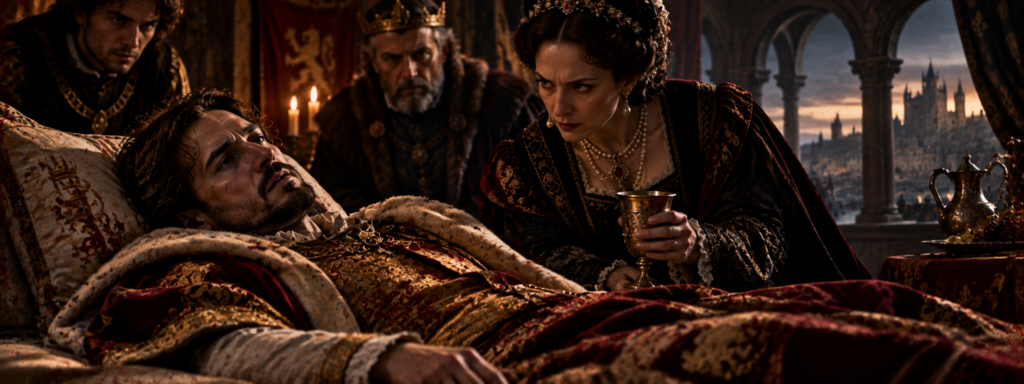
Charles, Prince of Viana: The Betrayed Heir, the Poisoned Prince, and the Stepmother Accused of Murder
Charles, Prince of Viana (29 May 1421 – 23 September 1461) | Prince of Viana and heir to the Kingdom of Navarre | Son of Queen Blanche I of Navarre and King John II of Aragon | Rival claimant to the Navarrese throne after his mother’s death in 1441 | Imprisoned by his father during a bitter dynastic struggle | Died in Barcelona at the age of forty | His sudden death provoked accusations that his stepmother, Juana Enríquez, had poisoned him to advance the succession prospects of her son Ferdinand, the future Ferdinand II of Aragon | The poisoning allegation remains unproven.
A Prince Dies, and a Kingdom Whispers Murder
Barcelona was supposed to be the city where Charles, Prince of Viana, finally recovered the future that had been taken from him. After years of imprisonment, exile, civil war, and humiliation at the hands of his own father, he had become the unlikely hero of a political movement determined to defend his rights. Crowds celebrated him, powerful institutions demanded his recognition, and the king who had repeatedly frustrated his ambitions had been forced into an uneasy accommodation. Yet on 23 September 1461, Charles died in Barcelona at the age of forty, leaving behind a kingdom full of suspicion and a stepmother whose name would become inseparable from allegations of poison.
His death came at an extraordinary moment. Only months earlier, the confrontation between Charles and his father, King John II of Aragon, had brought Catalonia to the brink of open rebellion. Charles had emerged from captivity to a reception that transformed him into a symbol of political liberty, lawful inheritance, and resistance to royal authority. His supporters believed that his long struggle was approaching a decisive turning point, and the agreements forced upon John appeared to offer Charles a more secure political future. Instead, the prince died before those hopes could be fulfilled, and the fragile settlement surrounding him immediately began to unravel.
The suspicion fell upon Juana Enríquez, John’s second wife and the mother of the young Ferdinand. She had compelling political reasons to prefer her own son’s advancement, and she was closely associated with the royal faction that had opposed Charles. Rumors circulated that she had arranged for her stepson to be poisoned, removing the greatest obstacle between Ferdinand and the inheritance of the Crown of Aragon. The accusation was powerful because it appeared to explain a death that was both politically convenient and emotionally devastating to Charles’s supporters.
But political convenience is not proof of murder. Contemporary hostility toward Juana was intense, and the accusation arose in an atmosphere already poisoned by factional conflict, propaganda, and distrust. Charles had experienced illness, physical hardship, and years of emotional and political strain, while the surviving evidence does not establish that poison caused his death. No reliable contemporary investigation identifies a poison, an assassin, or an authenticated order from Juana directing his murder.
The tragedy becomes even darker when the family relationships are examined. Charles was not a rebellious stranger attempting to steal a throne from its lawful ruler. He was the son of a reigning queen, the heir of a kingdom whose succession had been complicated by his father’s determination to retain power. His mother had died when he was still a young man, and the father who might have protected his inheritance instead became his most formidable opponent.
For two decades, Charles found himself trapped in a dynastic struggle that transformed a dispute over inheritance into a civil war. His supporters regarded him as the rightful ruler of Navarre, while John insisted upon retaining the authority he had exercised during his marriage to Queen Blanche. The conflict divided noble families, brought foreign rulers into Navarrese politics, and repeatedly forced Charles into exile or captivity. By the time he died, the struggle had spread far beyond the kingdom of his birth.
The prince’s death also altered the history of Spain. Ferdinand, the son of the woman accused of poisoning Charles, would eventually inherit the Aragonese crown and marry Isabella of Castile. Their dynastic partnership helped create the foundations of the Spanish monarchy that emerged at the end of the fifteenth century. Charles’s disappearance from the succession therefore became one of those events whose consequences extended far beyond the life of the man at its center.
Whether Charles was murdered remains uncertain, but the circumstances that made people believe he had been murdered are painfully clear. His father had imprisoned him, his stepmother had a son whose prospects benefited from his death, and his supporters had spent years watching royal power used against him. When the prince died, many were already prepared to believe the worst. In their eyes, the tragedy was not simply that Charles had lost his inheritance, but that the family entrusted with protecting him might have destroyed him.
Born to Inherit: The Childhood of a Navarrese Prince
Charles was born on 29 May 1421 in Peñafiel, in the Crown of Castile, into one of the most politically connected families in late medieval Iberia. His mother, Blanche, was the daughter of King Charles III of Navarre, while his father, John, belonged to the powerful Trastámara dynasty that ruled Aragon. Through both parents, Charles was linked to royal houses whose ambitions frequently overlapped and collided. His birth placed him near the center of a complicated network of inheritance claims, diplomatic marriages, and rival political interests.
The kingdom of Navarre occupied a strategic position between the larger powers of France, Castile, and Aragon. Although comparatively small, it possessed its own laws, institutions, noble families, and traditions of monarchy. Its rulers had to navigate constant pressure from stronger neighbors, and dynastic marriages were among the most important tools available to them. Charles’s parents had married partly within this wider political environment, linking Navarre to the ambitions of the Aragonese royal family.
Charles’s maternal grandfather, Charles III of Navarre, had worked to strengthen royal authority and maintain the kingdom’s distinctive political institutions. His reign was remembered for courtly culture, diplomacy, and efforts to stabilize the monarchy after earlier conflicts. The title Prince of Viana, created for the heir to Navarre, became an important symbol of the kingdom’s succession. Charles would carry that title throughout his life, even when his actual authority was repeatedly denied.
His mother, Blanche, inherited the Navarrese crown in 1425 after the death of Charles III. Her accession should have provided a clear framework for Charles’s eventual succession. As her eldest surviving son, he stood in the direct line of inheritance. Yet the political arrangements surrounding Blanche’s marriage meant that his father’s role in government was unusually significant.
John exercised royal authority alongside Blanche and became deeply involved in Navarrese affairs. He also maintained extensive interests in Castile and the wider politics of the Trastámara family. His ambitions were not confined to the kingdom that belonged to his wife by hereditary right. That distinction would become crucial after Blanche’s death, when the question of who should rule Navarre could no longer be postponed.
Charles received an education appropriate to a prince expected to govern. He developed interests in literature, history, and the intellectual culture of the courts he inhabited. His later reputation as a cultivated and scholarly figure distinguished him from the more aggressively political image associated with his father. Although later writers sometimes exaggerated this contrast, Charles genuinely participated in the literary and historical culture of his age.
The prince’s early years did not reveal the full scale of the conflict awaiting him. He was the heir of a reigning queen and a member of one of Iberia’s most influential dynasties. His future appeared to lie in the ordinary progression from princely status to kingship. The problem was that his father had no intention of surrendering power simply because the inheritance passed through Blanche.
Blanche I: The Mother Whose Death Changed Everything
Queen Blanche I of Navarre was the central figure through whom Charles possessed his hereditary claim. She had inherited the crown from her father, and her children stood within the established Navarrese succession. Her marriage to John connected the kingdom to the Aragonese royal house, but it did not erase the distinction between her hereditary rights and her husband’s political authority. That distinction became the foundation of the conflict that followed her death.
Blanche died in 1441, leaving Charles approximately twenty years old. Her death created the moment at which his supporters believed he should assume the crown. Yet John retained royal authority and continued to govern Navarre. The resulting dispute was not merely a disagreement between an impatient son and an aging father, but a fundamental argument about inheritance, sovereignty, and the rights of the kingdom.
The situation was complicated by provisions associated with Blanche’s testament. The surviving testamentary tradition included a request that Charles should not assume the royal title without his father’s consent. The precise legal significance of this provision has been debated, especially because it existed alongside Charles’s hereditary rights. John used the arrangement to justify retaining authority, while Charles’s supporters emphasized the succession that passed through his mother.
The distinction between possessing a hereditary claim and exercising royal power became the central problem of Charles’s adult life. John could present himself as the continuing ruler of Navarre, while Charles could argue that the kingdom belonged to him through Blanche. Neither side could easily retreat without surrendering something fundamental. The dispute therefore developed into a contest that involved the political institutions and noble families of Navarre.
Blanche’s death also deprived Charles of the parent whose position had united the family around a recognized succession. While she lived, John and Charles could operate within a political structure centered upon her hereditary crown. After her death, their competing interests became much more difficult to reconcile. The relationship between father and son deteriorated as both sought recognition of their authority.
The tragedy was especially bitter because Charles’s claim did not depend upon overthrowing an unrelated dynasty. He was attempting to inherit from his own mother, while the man resisting him was his father. The conflict transformed the royal household into the center of a national political crisis. Every disagreement between them threatened to divide the kingdom whose future they both claimed to defend.
John II: The Father Who Refused to Let Go
John II of Aragon was one of the most determined and politically formidable rulers of fifteenth-century Iberia. Born into the Trastámara dynasty, he spent much of his career pursuing dynastic interests across several kingdoms. He was ambitious, resilient, and prepared to engage in prolonged struggles to preserve his authority. His political career would eventually demonstrate an extraordinary capacity to survive rebellion, military defeat, and personal adversity.
At the time of Blanche’s death, John was not yet king of Aragon. His elder brother Alfonso V occupied that throne, while John held royal authority in Navarre through his marriage and political position. He also remained involved in Castilian affairs, where members of his family competed for influence. His attention was therefore divided among several political theaters.
John’s refusal to yield Navarre to Charles reflected both personal ambition and a wider understanding of dynastic power. Control of the kingdom provided him with territory, revenue, prestige, and strategic influence. Surrendering it to his son could weaken his own position within the complex politics of Iberia. John was not prepared to make that sacrifice simply because Charles had reached adulthood.
Charles initially exercised authority as lieutenant or governor under arrangements that recognized his father’s superior position. Such compromises allowed the kingdom to function while postponing the underlying succession dispute. They also created frustration because Charles remained unable to enjoy the full royal status he believed was his. The arrangement depended upon cooperation between two men whose political interests increasingly diverged.
John’s involvement in Castilian politics further complicated their relationship. His campaigns and rivalries affected Navarrese resources and alliances, while local nobles resented being drawn into conflicts beyond their kingdom. Charles’s supporters could present their prince as the defender of Navarre’s interests against a father whose ambitions extended elsewhere. The dispute thus acquired a political dimension beyond the immediate succession.
Later portrayals often depict John as an almost monstrous father who sacrificed his son to ambition. The surviving evidence supports a harsh assessment of his determination to retain power, but it does not justify inventing private motives or emotional conversations. He repeatedly opposed Charles, and his decisions contributed directly to the prince’s imprisonment and political suffering. Those actions are sufficiently serious without assuming knowledge of his private thoughts.
The Kingdom Divides: Beaumonts Against Agramonts
The struggle between Charles and John became entangled with a longstanding division among Navarre’s noble families. Two broad aristocratic factions, the Beaumonts and the Agramonts, emerged as major participants in the conflict. Their rivalries involved territorial interests, political influence, and competing relationships with the monarchy. The succession dispute gave these divisions a dynastic focus.
The Beaumont faction generally supported Charles’s claim. Its leading members viewed the prince as the rightful successor to Blanche and a figure through whom they could defend their political interests. Their support provided Charles with military resources and influential allies. It also helped transform his claim from a legal argument into an organized political movement.
The Agramont faction generally aligned with John. Its members supported the continuation of his authority and opposed the ambitions of the Beaumonts. Their rivalry with the prince’s supporters reflected longstanding aristocratic competition as well as loyalty to the king. The conflict therefore cannot be reduced to a simple division between defenders of lawful inheritance and supporters of tyranny.
Both factions possessed their own interests, and their leaders made political calculations that did not always coincide with the ideals later attributed to them. Noble families could use the succession dispute to strengthen their positions, settle local rivalries, and secure offices or lands. The struggle for the crown became inseparable from the struggle for influence within the kingdom. This made compromise more difficult because peace between father and son did not automatically resolve the grievances of their supporters.
The conflict also drew in neighboring powers. Castile and Aragon had strong interests in Navarre’s political future, and foreign support could alter the balance between the factions. The kingdom’s strategic position made it vulnerable to intervention. A dispute that began within the royal family became part of the wider diplomatic and military struggles of Iberia.
For Charles, the factional division was both an advantage and a trap. Without the Beaumonts, he might have lacked the resources to challenge his father. Yet their support also tied his cause to a broader aristocratic conflict that he could not fully control. The prince who sought his inheritance became the symbolic leader of a civil war.
Juana Enríquez: The Stepmother at the Center of the Storm
John married Juana Enríquez in 1447, six years after Blanche’s death. Juana came from one of the most influential noble families of Castile and brought important political connections to the marriage. She was considerably younger than John and entered a household already divided by the unresolved succession. Her arrival introduced a new dynastic interest into a conflict that had previously centered upon John and the children of his first marriage.
Juana was the daughter of Fadrique Enríquez, Admiral of Castile, whose family possessed substantial influence and prestige. Her background made her a valuable political partner for John. The marriage strengthened his connections within Castilian aristocratic politics. It also gave him the prospect of additional children whose inheritance interests might conflict with those of Blanche’s descendants.
In 1452, Juana gave birth to Ferdinand, the future Ferdinand II of Aragon. The birth created a new male heir within John’s household, although Charles remained senior in the succession. Ferdinand’s prospects depended upon the complex rules governing the inheritance of John’s territories and titles. His existence nevertheless intensified suspicion among Charles’s supporters, who feared that Juana would seek to advance her own son.
Juana was not a passive figure in these political struggles. She participated actively in royal affairs and later demonstrated considerable administrative and political ability. Her role became particularly important during the conflicts involving Catalonia, where she acted on behalf of her husband and defended the interests of the royal family. She was capable of making decisions under considerable pressure.
Her political involvement also made her an obvious target for hostility. Supporters of Charles increasingly regarded her as an enemy of their prince, especially when royal decisions threatened his position. The familiar medieval image of the ambitious stepmother offered a powerful framework through which opponents could interpret her actions. The accusation that she had poisoned Charles would later draw strength from this reputation.
Yet it is essential to distinguish Juana’s political ambition from proof of murder. She had clear reasons to protect Ferdinand’s future, and she was aligned with John during the struggle against Charles. Those circumstances explain why suspicion fell upon her after the prince’s death. They do not establish that she arranged his poisoning.
The Battle of Aibar: Father and Son Become Enemies
By 1451, the dispute over Navarre had escalated into open warfare. Charles and his supporters confronted forces loyal to John, turning a dynastic disagreement into a military struggle. The conflict reached a decisive point at the Battle of Aibar on 23 October 1451. The result was a crushing setback for the prince.
John’s forces defeated Charles, who was taken prisoner. The battle demonstrated the military superiority of the royal faction at that moment and exposed the weakness of Charles’s position. His supporters had been unable to secure the throne through armed resistance. The prince now found himself in the custody of the father whose authority he had challenged.
The imprisonment was an extraordinary development in a royal family already torn apart by succession disputes. Charles was not an unrelated rebel captured during an attempted invasion. He was John’s eldest surviving son and the hereditary claimant through Blanche. His captivity transformed the conflict into a personal tragedy as well as a political crisis.
John’s decision to hold Charles reflected his determination to control the succession. A captive prince could not easily lead armies or negotiate independently with foreign rulers. Imprisonment also provided leverage over the Beaumont faction and other supporters. The king could use his son’s release as part of a broader political settlement.
Charles eventually regained his freedom, but the defeat did not resolve the underlying dispute. His claim remained intact in the eyes of his supporters, while John continued to exercise authority. The experience deepened the bitterness between the factions and made reconciliation increasingly difficult. The kingdom remained divided.
The Battle of Aibar marked a turning point because it destroyed any remaining illusion that the conflict could be contained within ordinary family negotiations. Father and son had become military enemies, and the father had imprisoned the son. The prince’s later supporters would remember this humiliation as evidence of the injustice he had endured. It also helped create the atmosphere in which accusations of murder would eventually flourish.
Eleanor and Blanche: The Sisters Caught in the Succession
Charles was not the only child of Queen Blanche I whose future was affected by the struggle with John. His sisters, Blanche and Eleanor, also possessed dynastic interests that complicated the succession. Their positions became increasingly important as the conflict developed. The royal family’s internal divisions extended beyond father and son.
Eleanor married Gaston IV, Count of Foix, creating a powerful connection between Navarre and a major noble house north of the Pyrenees. Her political position became increasingly significant as John sought alternatives to Charles. The interests of the Foix family could be advanced through Eleanor’s claim. This made her an important figure in the wider succession struggle.
Blanche, another daughter of the queen, also became entangled in the politics of inheritance and marriage. Her earlier marriage to Henry, the future Henry IV of Castile, had been annulled. She later found herself in a vulnerable position amid the disputes over Navarre. Her fate would become another troubling episode in the history of the family.
The existence of multiple heirs complicated Juana’s supposed motive for poisoning Charles. Removing him did not automatically place Ferdinand next in line to the Navarrese throne. Eleanor and Blanche possessed their own claims, and the succession to Navarre was distinct from the inheritance of John’s Aragonese territories. The political consequences of Charles’s death therefore require more careful analysis than a simple transfer of all his rights to Ferdinand.
For the Crown of Aragon, however, Charles’s position was particularly significant after John became king in 1458. As John’s eldest son, he stood ahead of Ferdinand in the succession to the Aragonese crown. His death would remove that obstacle. This distinction helps explain why the poisoning accusation focused so heavily upon Ferdinand’s prospects.
The sisters’ experiences also reveal the destructive nature of the dynastic conflict. The children of Blanche I became entangled in rival claims, political marriages, and the ambitions of competing factions. Their family relationships were repeatedly subordinated to struggles over power. Charles’s tragedy was part of a wider pattern in which royal inheritance became a source of suffering rather than security.
The Long Road Into Exile
After his defeat and imprisonment, Charles spent years attempting to recover his position through diplomacy and the support of foreign courts. His political career became increasingly unsettled as he moved among territories where rulers might assist him or use his claim for their own purposes. The prince’s travels reflected both his determination and his vulnerability. Without secure control of Navarre, he depended upon alliances that could change according to wider political circumstances.
Charles sought support in the Crown of Aragon and elsewhere in the western Mediterranean. His relationship with his uncle Alfonso V of Aragon, who ruled from Naples, became important during this period. Alfonso’s position offered the possibility of protection and mediation. Yet the prince’s prospects remained uncertain because the dispute with John involved the interests of the wider Trastámara dynasty.
The court of Naples was an important center of Renaissance culture, and Charles’s presence there contributed to his reputation as a cultivated prince. He pursued literary and historical interests while continuing to seek a political settlement. His writings and patronage reflected an intellectual life that existed alongside his dynastic ambitions. The contrast between scholarship and civil war became a prominent feature of his later image.
Exile also exposed the limits of his power. Foreign rulers could offer hospitality and diplomatic assistance, but they were reluctant to sacrifice their own interests for his cause. Charles’s claim was valuable as a bargaining instrument, and his presence could influence negotiations with John. Yet support did not necessarily translate into military intervention capable of restoring him to Navarre.
The prince’s political difficulties continued after Alfonso V died in 1458. John’s accession to the Aragonese crown transformed the situation because Charles was now heir to a much larger dynastic inheritance. His relationship with his father became relevant not only to Navarre but also to Aragon, Catalonia, Valencia, and other territories of the Crown. The stakes of their conflict increased dramatically.
Charles’s years of wandering contributed to his public image as a wronged heir. He had been defeated, imprisoned, and forced to seek protection beyond the kingdom he believed was his. His literary interests encouraged later writers to portray him as a gentle scholar overwhelmed by a ruthless father. Although that image simplifies a complex political figure, it captures something important about the contrast between his cultivated reputation and the violence surrounding his claim.
1458: John Becomes King of Aragon
The death of Alfonso V in 1458 brought John to the throne of Aragon. The accession transformed him from a ruler whose authority centered upon Navarre into the head of a much larger collection of territories. The Crown of Aragon included kingdoms and principalities with distinct institutions, laws, and political traditions. Governing them required negotiation with powerful representative bodies and regional elites.
Charles’s position changed accordingly. As John’s eldest surviving son, he possessed a strong claim to succeed him in the Aragonese territories. The question of his recognition became increasingly important to political institutions that valued established succession practices. His supporters could now appeal to interests extending beyond Navarre.
John, however, continued to resist arrangements that would give Charles an independent political base. The father-son conflict remained unresolved, and the king’s determination to control the succession created growing concern. Charles’s claim attracted support from those who feared the concentration of royal authority. His cause became connected to broader disputes over the rights of political communities.
Catalonia was especially important in this development. Its institutions possessed traditions of negotiation with the monarchy and were prepared to defend what they regarded as their constitutional privileges. The treatment of Charles became a test of John’s willingness to respect those arrangements. The prince’s personal grievance thus acquired wider political significance.
Juana Enríquez’s position also became more important after John’s accession. As queen consort, she had a direct interest in the future of the Aragonese crown and in the prospects of Ferdinand. Her political influence increased, and her involvement in royal government became more visible. This intensified the suspicion of Charles’s supporters.
The accession of 1458 therefore set the stage for the final crisis. Charles was no longer simply the claimant to Navarre whose father refused to surrender power. He was the senior heir to a larger monarchy whose political institutions could challenge the king’s treatment of him. The conflict was moving toward a confrontation that would shake the entire Crown of Aragon.
The Prince Who Became a Symbol of Catalan Liberty
Charles’s relationship with Catalonia became one of the defining features of his final years. Political leaders in the principality increasingly regarded him as a figure through whom they could resist John’s policies. Their support did not necessarily arise from personal affection alone. It reflected concerns about royal authority, constitutional rights, and the balance of power between the monarchy and Catalan institutions.
The Generalitat and other political bodies possessed established traditions of defending the laws and privileges of Catalonia. They expected the king to govern within a framework of negotiated obligations. John’s handling of Charles appeared to many as evidence that he was willing to disregard those constraints. The prince’s cause therefore became associated with a wider defense of political liberties.
Charles himself benefited from this identification. His long history of conflict with his father made him a natural symbol for those who feared arbitrary royal action. He could be presented as a legitimate heir whose rights had been repeatedly denied. His personal suffering gave emotional force to political arguments that might otherwise have remained abstract.
The movement supporting Charles was not without internal divisions. Catalan politics involved competing social groups, economic interests, and regional rivalries. Some leaders supported the prince because they believed in his hereditary rights, while others saw an opportunity to limit royal power. The coalition was powerful but not necessarily united in its long-term objectives.
The growing confrontation placed John in a difficult position. He needed the cooperation of Catalan institutions to govern effectively, yet he resisted demands that would weaken his control over the succession. Charles’s presence gave his opponents a popular figure around whom to organize. The dispute threatened to become a constitutional crisis.
By 1460, the prince had become far more than a disappointed claimant. He represented a challenge to the king’s authority across the Crown of Aragon. His supporters viewed his recognition as essential to the preservation of lawful government. John’s next decision would transform political tension into open outrage.
The Arrest of 1460: A Father Imprisons His Son Again
In December 1460, John ordered Charles’s arrest while the royal court was at Lleida. The decision shocked many of the prince’s supporters and provoked immediate political consequences. Charles had already endured imprisonment during the Navarrese civil war, and his renewed detention appeared to confirm the king’s determination to prevent him from exercising his rights. The arrest became the catalyst for a major confrontation between John and Catalonia.
The precise circumstances surrounding the arrest involved suspicions about Charles’s political negotiations and possible marriage arrangements. John feared that his son might establish alliances that would strengthen his independent position. The king’s supporters regarded the prince’s activities as dangerous to royal authority. Charles’s defenders saw the arrest as another unjustified attack upon the legitimate heir.
Catalan institutions reacted forcefully. The prince’s detention became a rallying point for those already dissatisfied with John’s government. Political leaders demanded his release and organized resistance to royal policies. The crisis rapidly expanded beyond the immediate question of Charles’s freedom.
The movement was strengthened by the prince’s popularity. His reputation as a cultivated and mistreated heir made him an effective symbol of opposition. Public demonstrations and political mobilization increased pressure upon the king. Charles’s imprisonment had created the very coalition that John feared.
Juana Enríquez became associated with the royal response to the crisis. As John’s wife and Ferdinand’s mother, she was regarded by Charles’s supporters as a defender of the faction opposing their prince. Her political activity reinforced suspicions that she sought to advance her son’s interests. The hostility toward her intensified during the months leading to Charles’s release.
The arrest proved to be a serious political miscalculation. Rather than isolating Charles, it transformed him into the center of a movement capable of challenging royal authority. John was eventually forced to make concessions that he had resisted for years. The prince emerged from captivity with a degree of public support that made his sudden death all the more explosive.
The Triumph of 1461: Charles Returns to Barcelona
Charles was released in early 1461 amid intense political pressure. His arrival in Barcelona was greeted with extraordinary enthusiasm, reflecting both his personal popularity and the strength of the movement supporting him. The prince who had been imprisoned by his father now appeared as a victorious symbol of resistance. His reception marked the high point of his political fortunes.
The celebrations were more than an expression of sympathy for a suffering prince. They demonstrated the ability of Catalan institutions and political groups to force concessions from the monarchy. Charles’s freedom represented a victory for those who believed that John had exceeded his authority. The prince became the public face of that achievement.
The settlement reached in June 1461, commonly known as the Capitulation of Vilafranca, imposed significant restrictions upon John’s ability to govern Catalonia. It also recognized Charles’s important political position and established arrangements intended to protect him from further royal interference. The agreement reflected the strength of the opposition movement. John accepted terms that severely limited his freedom of action.
Charles was recognized as lieutenant-general in Catalonia, giving him an official role within the political structure of the principality. The arrangement appeared to offer him a more secure future than he had enjoyed for many years. His supporters could hope that the prince would eventually inherit the Aragonese crown under conditions favorable to their interests. The settlement also reduced the immediate danger of renewed imprisonment.
Yet the victory remained fragile. John had accepted concessions under pressure, and the underlying conflict between royal authority and Catalan institutions had not disappeared. Juana Enríquez and the royal faction continued to possess political influence. Ferdinand’s future remained an important consideration within the dynasty.
Charles therefore stood at a moment of extraordinary opportunity and danger. He had gained recognition, public support, and a measure of political authority. His father had been forced to retreat, but the royal family remained divided. The prince’s death only a few months later would destroy the settlement’s central figure and reopen every unresolved grievance.
September 1461: The Sudden Illness
During September 1461, Charles became seriously ill in Barcelona. The surviving accounts indicate that his condition deteriorated before his death on 23 September. He was forty years old and had endured years of imprisonment, exile, political stress, and uncertain living conditions. His illness occurred at the very moment when his political fortunes appeared to be improving.
The precise medical cause of his death remains uncertain. Later accounts sometimes refer to pulmonary illness or other natural causes, while the popular tradition emphasized poisoning. The surviving evidence does not provide a sufficiently detailed medical record to establish a definitive diagnosis. Modern attempts to identify the illness must therefore remain cautious.
Charles’s death was sudden in its political consequences, even though the illness itself was not necessarily instantaneous. His supporters had expected him to play a central role in Catalan government and the future succession. Instead, the man around whom they had organized their movement disappeared within months of his release. The shock was intensified by the contrast between his recent triumph and his final decline.
The circumstances encouraged suspicion because Charles had so many political enemies. His father had repeatedly opposed him, and Juana Enríquez had an obvious interest in Ferdinand’s future. The prince’s death removed a major obstacle to the succession arrangements favored by the royal faction. To supporters who already believed he had been persecuted, the coincidence appeared deeply troubling.
Yet the available evidence does not establish that Charles was deliberately poisoned. Illness was common in fifteenth-century cities, and medical knowledge was limited. Even a politically convenient death could have occurred naturally. The distinction between suspicion and proof is essential.
The surviving accounts therefore leave a painful uncertainty. Charles died after years of struggle, at a moment when his supporters believed he was finally approaching political security. The death benefited some of his rivals, but the cause cannot be established with certainty. The mystery would become one of the most enduring accusations in the history of the Trastámara dynasty.
The Poisoning Rumor: A Stepmother Becomes the Suspect
The accusation that Juana Enríquez poisoned Charles emerged in an atmosphere of intense political hostility. She was already regarded by many of his supporters as an enemy of the prince and a defender of Ferdinand’s interests. Her political involvement made her a visible representative of the royal faction. When Charles died, suspicion quickly attached itself to her.
The alleged motive was straightforward. Charles stood ahead of Ferdinand in the succession to the Crown of Aragon, and his recognition as heir had been a central demand of the Catalan opposition. His death removed that obstacle. Juana’s son became the principal male heir of John, making the political benefit of Charles’s disappearance obvious.
The rumor was strengthened by the history of the conflict. John had imprisoned Charles more than once, and the royal family had repeatedly frustrated his ambitions. Juana had been associated with the policies of the king during the final crisis. To Charles’s supporters, the possibility of murder appeared consistent with the persecution he had already endured.
Yet no reliable surviving evidence establishes that Juana administered poison or arranged for someone else to do so. The accusation was never demonstrated through a credible medical or judicial investigation. Later writers repeated the story, sometimes treating political suspicion as if it were established fact. The repetition of an allegation does not make it more reliable.
The stereotype of the wicked stepmother also contributed to the accusation’s appeal. Medieval and early modern narratives frequently portrayed second wives as threats to children from earlier marriages, especially when inheritance was at stake. Juana’s position fitted that familiar pattern. Her political ambition made the story believable to hostile audiences, but it also made her vulnerable to accusations shaped by prejudice.
The historical problem is therefore not whether Juana had a motive. She possessed an obvious dynastic interest in Ferdinand’s advancement. The problem is whether any surviving evidence connects her to a deliberate poisoning. Without such evidence, the allegation remains a politically charged rumor rather than a proven regicide.
A Death Too Convenient to Ignore
Charles’s death transformed the succession to the Crown of Aragon. As John’s eldest son, he had occupied the senior position among the male heirs. His disappearance left Ferdinand as the most important surviving male successor to the Aragonese monarchy. The political consequences were immediate and far-reaching.
For Juana Enríquez, the change strengthened her son’s prospects. Ferdinand was still a child, but his position within the dynasty had improved dramatically. The future that had been uncertain while Charles lived now appeared much more secure. The benefit was substantial enough to encourage suspicion among those who had opposed the royal faction.
For John, the death removed the son whose claims had repeatedly challenged his authority. Yet it also deprived him of a figure whose recognition had become essential to the fragile political settlement in Catalonia. Charles’s supporters did not simply abandon their grievances after his death. The disappearance of their prince created new instability.
For Catalan institutions, the loss was devastating. Charles had become the central figure around whom a powerful opposition movement had organized. His death weakened the settlement reached earlier that year and raised new questions about the future relationship between the principality and the monarchy. The political crisis continued rather than disappearing.
The consequences therefore cannot be understood as an uncomplicated victory for John and Juana. Charles’s death improved Ferdinand’s dynastic position, but it also intensified distrust and contributed to the breakdown of political relations. The royal family gained an heir while losing the possibility of reconciliation through Charles. The resulting conflict would soon become catastrophic.
The convenience of the death remains one of the reasons the poisoning rumor endured. Charles had survived years of political persecution only to die shortly after achieving his greatest triumph. His most obvious dynastic rival benefited, and his stepmother was already deeply unpopular among his supporters. The circumstances were suspicious, but suspicion alone cannot establish murder.
What the Sources Can—and Cannot—Tell Us
The historical evidence surrounding Charles’s death is complicated by the political environment in which it was recorded. Contemporary and near-contemporary accounts were shaped by loyalties to the king, the prince, or the Catalan opposition. Writers did not approach the event as neutral investigators. Their descriptions reflected the conflicts that had divided the Crown of Aragon.
Accounts hostile to Juana emphasized the possibility of poisoning and her interest in Ferdinand’s succession. Such narratives drew upon the widespread belief that Charles had been unjustly treated by his father and stepmother. The accusation fitted the moral structure of the story they wished to tell. A persecuted prince had died, and his enemies appeared to have benefited.
Other accounts did not establish poisoning and left open the possibility of natural illness. The lack of reliable medical evidence prevents a definitive conclusion. No authenticated toxicological examination, credible confession, or documented murder order resolves the question. The surviving record therefore supports uncertainty rather than certainty.
The distinction is especially important because later histories often repeated earlier allegations without adding new evidence. A rumor recorded by one writer could be copied by another and eventually appear to represent a broad historical consensus. The number of repetitions might create the impression of proof. Yet the underlying evidence remained unchanged.
Modern historians generally approach the poisoning allegation with caution. They recognize the political motives that made Juana an obvious suspect while acknowledging the absence of conclusive evidence. The prince’s death may have been natural, and the surviving sources do not allow deliberate poisoning to be established. Any responsible account must preserve that distinction.
The mystery therefore remains unresolved. Charles died in Barcelona on 23 September 1461 after an illness whose precise cause cannot be securely identified. Juana Enríquez was accused of poisoning him, but the accusation was not proven. The political consequences of his death are clear, while the medical and criminal questions remain uncertain.
The Prince Becomes a Martyr
Charles’s death did not end his influence over Catalan politics. Instead, his memory became a powerful symbol for those who had supported him against John. The prince who had been imprisoned and denied his inheritance was transformed into a figure of suffering and injustice. His death gave emotional force to political grievances that had already reached a dangerous intensity.
The public response reflected the extraordinary popularity he had acquired during his final months. His release from captivity had been celebrated as a victory over arbitrary royal authority. His death therefore appeared to many as the destruction of that achievement. Mourning became inseparable from anger.
Charles also acquired a reputation for exceptional virtue in later tradition. His scholarly interests, personal hardships, and conflict with his father encouraged portrayals of him as a wronged and almost saintly prince. Such images could serve political purposes by contrasting his supposed innocence with the alleged cruelty of his opponents. The resulting memory was emotionally powerful but not always historically balanced.
Reports of popular devotion to Charles developed after his death. His supporters treated him as a figure whose suffering carried moral significance, and traditions of miraculous intercession became associated with his memory. The prince’s reputation extended beyond ordinary political mourning. His death was interpreted by some as the fate of a man unjustly persecuted.
The emergence of this cult-like devotion helps explain why the poisoning allegation endured. A prince remembered as innocent and virtuous could easily be imagined as the victim of a wicked conspiracy. The narrative offered a moral explanation for a political tragedy. It also strengthened the identity of those who opposed John.
Yet the transformation of Charles into a martyr complicates the historical record. His political career involved alliances, calculations, and participation in civil war, not merely passive suffering. His supporters had their own interests, and his claim was embedded in complex legal and dynastic disputes. The memory of a saintly victim should not erase the political realities of his life.
The Road to the Catalan Civil War
The death of Charles contributed to the breakdown of relations between John and the Catalan political institutions. The settlement reached earlier in 1461 had depended heavily upon the prince’s position. With Charles gone, the arrangements surrounding the succession and government became increasingly unstable. Distrust between the monarchy and its opponents remained intense.
Juana Enríquez became a central figure in the next stage of the crisis. She acted in the interests of John and Ferdinand, attempting to preserve royal authority amid growing resistance. Her political role made her a focus of hostility among those who had supported Charles. The accusations surrounding his death intensified the atmosphere of suspicion.
In 1462, open civil war broke out in Catalonia. The conflict involved constitutional disputes, social tensions, and the struggle between royal authority and powerful political institutions. Charles’s death was an important part of the background, but it was not the sole cause. The war emerged from a wider crisis that had been developing for years.
The fighting would continue for a decade, bringing devastation to Catalonia and testing John’s determination to retain his crown. Foreign powers became involved, and rival claimants were advanced by opponents of the king. The conflict demonstrated how deeply the relationship between monarchy and principality had deteriorated. The political settlement associated with Charles had failed.
Juana played an active role during the early stages of the war. Her efforts to defend the royal position showed that she was far more than a ceremonial queen. She faced serious danger and political pressure while acting on behalf of her husband and son. Her conduct during the conflict contributed to both admiration among supporters and hostility among opponents.
The civil war also revealed the limitations of the poisoning accusation as a complete explanation for events. Charles’s death intensified distrust, but the political conflict had roots in longstanding disputes over authority and privilege. The struggle would have been serious even without the allegation of murder. His death became a powerful symbol within a crisis that extended beyond one family tragedy.
Ferdinand: The Child Who Inherited the Future
Ferdinand was born in 1452, making him only nine years old when Charles died. His future had been uncertain while his elder half-brother remained alive and politically active. Charles possessed the senior claim to succeed John in the Crown of Aragon, and his recognition had been a major demand of the Catalan opposition. The death of the prince transformed Ferdinand’s dynastic prospects.
Juana Enríquez devoted considerable attention to securing her son’s position. Her political activities during the Catalan crisis reflected the importance she attached to the survival of the royal dynasty. Ferdinand became a central figure in the struggle between John and his opponents. His childhood unfolded amid civil war and political instability.
Ferdinand would later develop into one of the most influential rulers in European history. His marriage to Isabella of Castile in 1469 created a dynastic partnership that brought the crowns of Castile and Aragon under the rule of the same royal couple, while their institutions remained distinct. Their reign reshaped the political history of Iberia. The consequences extended into the Mediterranean, Atlantic, and wider European world.
The contrast between Charles and Ferdinand became one of the most striking features of the family’s history. Charles spent much of his adult life struggling to secure an inheritance that repeatedly eluded him. Ferdinand inherited a stronger dynastic position after his half-brother’s death and eventually achieved extraordinary political success. Their lives followed radically different paths.
It would be misleading, however, to suggest that Charles’s death alone created the later Spanish monarchy. Ferdinand’s rise depended upon many subsequent events, including his marriage, his father’s survival, the outcome of the Catalan Civil War, and the succession struggles in Castile. The political future was not predetermined in September 1461. Charles’s death altered the possibilities, but it did not determine every later development.
The poisoning rumor nevertheless gained lasting significance because Ferdinand’s success made the alleged motive appear even more consequential. If Juana had arranged the death, the crime would have helped clear the way for a ruler whose reign transformed European history. That possibility gives the accusation its dramatic power. Yet the historical record still does not establish that the crime occurred.
John II Outlives the Son He Opposed
John II survived Charles by nearly eighteen years. His long reign continued through the Catalan Civil War and the difficult process of restoring royal authority. The king who had repeatedly opposed his eldest son remained politically active despite age, conflict, and serious personal challenges. His survival contrasted sharply with the death of the prince who had spent so many years seeking recognition.
John’s determination was remarkable. He faced rebellion, foreign intervention, and prolonged warfare while maintaining his claim to the Crown of Aragon. His political resilience helped preserve the dynasty’s position. The eventual settlement of the Catalan conflict allowed him to retain his crown.
Yet his relationship with Charles remained one of the darkest aspects of his reign. He had resisted his son’s hereditary claim to Navarre, defeated him in battle, and imprisoned him. The later crisis in Catalonia had been intensified by another arrest. These actions left a legacy of bitterness that could not be erased by subsequent political success.
The accusation that Juana poisoned Charles also cast a shadow over John’s household. Even without proof of murder, the rumor reflected the depth of public distrust created by the family’s conflicts. A prince who had repeatedly suffered at his father’s hands died at a moment when his political future seemed secure. Many contemporaries found it difficult to accept that the death was merely an unfortunate coincidence.
John’s later achievements therefore existed alongside the memory of his treatment of Charles. He survived the rebellion that followed the prince’s death, but he could not restore the relationship that had been destroyed. His eldest son never inherited the Aragonese crown. The dynasty continued through Ferdinand instead.
The story raises a painful question about the cost of royal ambition. John preserved his authority through years of conflict, but the struggle with Charles divided his family and helped destabilize his territories. Whether or not poison played any role in the prince’s death, the political persecution that preceded it was real. The father outlived the son, but the victory came with consequences that shaped the rest of his reign.
Juana Enríquez: Ambitious Queen or Murderous Stepmother?
Juana Enríquez has often been remembered through the accusation that she poisoned Charles. The allegation fits a familiar historical narrative in which a second wife seeks to remove an older heir in order to advance her own child. Her political ambition and active role in the royal faction made her a plausible suspect to hostile contemporaries. Yet the evidence does not justify treating her as a proven murderer.
Juana was a capable political figure who exercised influence during one of the most difficult periods of John’s reign. She defended the interests of her husband and son, participated in government, and confronted serious opposition. Her actions were often controversial because they affected the balance of power within the Crown of Aragon. Her political importance made her both influential and vulnerable to attack.
Her motive in the alleged poisoning is understandable. Charles stood ahead of Ferdinand in the Aragonese succession, and his death improved her son’s prospects. The prince had also become the symbol of a movement that threatened John’s authority. Removing him would have altered the political landscape.
But the existence of a motive does not establish criminal responsibility. Juana’s opponents had powerful reasons to portray her as dangerous, and the rumor emerged during a period of intense political conflict. The stereotype of the wicked stepmother gave the accusation emotional force. No reliable surviving evidence proves that she ordered or administered poison.
The distinction between political hostility and historical guilt is essential. Juana can be criticized for her role in the dynastic struggle without being convicted of an unproven murder. Her ambition was real, but ambition was common among medieval rulers and their families. The question of poisoning requires evidence that the surviving record does not provide.
Juana died in 1468, seven years after Charles. She did not live to see Ferdinand become king of Aragon or marry Isabella of Castile. Her efforts to secure his future nevertheless contributed to the political circumstances that shaped his rise. The accusation against her remained part of the family’s historical memory, even though it was never conclusively established.
The Lost Kingdom of Navarre
Charles’s struggle began with his claim to Navarre, but his death did not resolve the kingdom’s political problems. The succession remained complicated by the rights of his sisters and the continuing authority of John. The rivalry between noble factions persisted, and the kingdom remained vulnerable to pressure from neighboring powers. The conflict that had shaped Charles’s life continued after his disappearance.
Eleanor, Charles’s sister, eventually became an important figure in the succession. Her marriage into the Foix family connected Navarre to powerful interests north of the Pyrenees. She would briefly become queen of Navarre in 1479 after John’s death. Her reign lasted only a few weeks, demonstrating the continued instability of the dynasty.
The kingdom’s later history would be shaped by struggles involving France, Castile, and Aragon. Navarre remained a contested territory whose independence was repeatedly threatened by larger powers. The dynastic conflicts of the fifteenth century weakened its political position. Charles’s failure to secure the crown formed part of that wider history.
His supporters had believed that he represented the legitimate continuation of Blanche I’s monarchy. They regarded his claim as a defense of Navarre’s hereditary rights against John’s refusal to surrender authority. Yet the civil war divided the kingdom so deeply that no simple restoration was possible. The political damage extended beyond the prince’s lifetime.
The later conquest of much of Navarre by Ferdinand in 1512 added a bitter historical irony. Ferdinand was the son of Juana Enríquez, the woman accused of poisoning Charles. Decades after the prince’s death, the younger half-brother would extend his power into the kingdom that Charles had struggled to inherit. The connection is striking, although it should not be used as retrospective proof of the poisoning allegation.
Charles’s lost inheritance therefore became part of a much larger transformation. The kingdom he had hoped to rule would eventually lose much of its independence. His family conflicts helped weaken the political order that might have defended it. The prince’s personal tragedy was inseparable from the fate of Navarre itself.
The Cult of the Wronged Prince
After his death, Charles became the object of extraordinary admiration among some of his supporters. His reputation as a cultivated and persecuted heir encouraged comparisons with figures of innocence and suffering. Political loyalty blended with religious devotion in ways that reflected the emotional intensity of the conflict. His memory became a powerful symbol of injustice.
Reports of miraculous events associated with Charles contributed to his posthumous reputation. Such traditions were common in medieval societies, particularly when a popular figure died under circumstances regarded as tragic or suspicious. They reflected the beliefs and expectations of the communities that preserved them. They do not provide evidence that Charles was poisoned.
The prince’s scholarly interests also shaped his image. He had written and participated in the literary culture of his time, and later admirers emphasized his intellectual achievements. This reputation distinguished him from the military and political struggles that dominated his life. He became remembered not merely as a claimant to a throne but as a cultured man whose promise had been destroyed.
The contrast with John and Juana became increasingly pronounced in hostile traditions. Charles was portrayed as the innocent victim, while his father and stepmother appeared as ruthless defenders of power. Such narratives offered a clear moral structure that appealed to later readers. They also simplified a conflict involving legal uncertainty, aristocratic rivalry, and competing political institutions.
The cult of the wronged prince helped preserve his name long after the immediate succession dispute had ended. His death remained a symbol of the dangers of dynastic ambition. The allegation of poisoning survived because it fitted the emotional meaning attached to his memory. A natural death seemed almost inadequate to explain a life marked by so much persecution.
Yet the historian must separate memory from evidence. Charles’s suffering was real, and his father’s opposition was well documented. His sudden death had profound political consequences. The claim that Juana murdered him remains unproven, regardless of the devotion inspired by his memory.
Why Charles Belongs Among the Assassinated Rulers & Regicides
Charles, Prince of Viana, belongs within the Assassinated Rulers & Regicides category as a case of suspected royal poisoning rather than a conclusively documented murder. His death in Barcelona on 23 September 1461 provoked accusations that his stepmother, Juana Enríquez, had arranged his poisoning. The alleged motive was to remove the senior heir to the Crown of Aragon and strengthen the succession prospects of her son Ferdinand. The surviving evidence does not establish that poison caused Charles’s death or that Juana was responsible.
The political circumstances made the accusation especially powerful. Charles had spent years fighting his father over the succession to Navarre and had repeatedly suffered imprisonment. He had recently emerged as a symbol of Catalan resistance to royal authority. His death removed the central figure of that movement at a moment when his political position appeared to be improving.
Juana’s role in the royal faction also made her an obvious target for suspicion. She had a direct interest in Ferdinand’s future and was closely associated with John’s opposition to Charles. The prince’s death improved her son’s dynastic prospects. These facts explain the allegation but do not prove it.
The case illustrates how royal deaths could become political weapons even when the cause remained uncertain. Rumors of poisoning offered a compelling explanation for an event that benefited one faction and devastated another. The accusation also reflected the familiar image of the ambitious stepmother who sought to displace children from an earlier marriage. Such narratives could become deeply embedded in historical memory.
Charles’s death had consequences extending far beyond the immediate succession. It contributed to the crisis that preceded the Catalan Civil War and altered the future of the Aragonese dynasty. Ferdinand eventually inherited the crown and became one of the most influential rulers in European history. The disappearance of Charles therefore remains an important turning point, regardless of whether it resulted from natural illness or deliberate murder.
His inclusion in the category requires an explicit qualification. Charles was a royal heir whose death was widely suspected of being an assassination, but the accusation was never conclusively established. His story belongs among disputed royal killings and alleged poisonings rather than proven regicides. Its significance lies in the combination of dynastic rivalry, political persecution, public suspicion, and an unresolved cause of death.
The Prince Who Never Wore His Crown
Charles, Prince of Viana, was born into a family whose marriages and inheritance claims connected the great kingdoms of fifteenth-century Iberia. Through his mother, Blanche I, he possessed a direct hereditary claim to Navarre. Through his father, John II, he stood within the powerful Trastámara dynasty and eventually became the senior heir to the Crown of Aragon. His birth promised a future of royal authority, but the ambitions of his own family transformed that inheritance into a source of conflict.
His mother’s death in 1441 created the crisis that would dominate his adult life. Charles believed that the Navarrese crown should pass to him, while John refused to surrender the authority he had exercised during Blanche’s reign. The dispute divided the kingdom and drew powerful noble factions into opposing camps. What might have been a difficult but manageable succession became a prolonged civil war.
Charles’s defeat at Aibar in 1451 marked the beginning of years of humiliation and uncertainty. His father imprisoned him, and the prince was forced to seek support beyond the kingdom he believed was his. His political fortunes depended upon foreign courts, aristocratic allies, and negotiations that repeatedly failed to secure his inheritance. The struggle transformed him from a royal heir into a symbol of dynastic injustice.
The marriage of John to Juana Enríquez introduced a new element into the conflict. Her son Ferdinand possessed a future that depended upon the succession arrangements of the Aragonese monarchy. Charles remained the senior heir, but Juana had every reason to defend her child’s prospects. The resulting rivalry created an atmosphere in which suspicion could flourish.
John’s accession to the Aragonese crown in 1458 increased the stakes. Charles was now the senior heir to a larger monarchy whose political institutions possessed their own traditions and privileges. Catalan leaders increasingly supported him as a figure through whom they could challenge royal authority. His personal grievance became part of a wider constitutional conflict.
The arrest of Charles in December 1460 transformed that conflict into a crisis. Catalan institutions demanded his release and organized resistance to John’s policies. The prince emerged from captivity in 1461 to an extraordinary public reception. For the first time in years, his supporters believed that his political future might be secure.
The Capitulation of Vilafranca appeared to confirm that hope. John was forced to accept major concessions, and Charles received an important political position in Catalonia. The settlement represented a victory for those who had defended his rights. Yet the peace was fragile, and the royal family remained deeply divided.
Then Charles became ill and died in Barcelona on 23 September 1461. He was forty years old, and his death came only months after the greatest political triumph of his life. The shock was immediate because the prince had become the central figure of a movement that expected him to shape the future of the Crown of Aragon. His disappearance destroyed those expectations.
The accusation against Juana Enríquez emerged from the political circumstances surrounding the death. She had an obvious interest in Ferdinand’s succession, and Charles’s disappearance improved her son’s position. Her association with the royal faction made her deeply unpopular among the prince’s supporters. The rumor of poisoning therefore found an audience already prepared to believe it.
Yet the surviving evidence does not establish that Charles was murdered. No reliable medical record identifies poison as the cause of death, and no authenticated evidence proves that Juana arranged an assassination. The allegation remains a politically charged suspicion rather than a demonstrated crime. The distinction is essential because the consequences of a death cannot establish its cause.
Charles’s supporters nevertheless transformed him into a symbol of suffering and injustice. His scholarly reputation, repeated imprisonment, and final political triumph encouraged an image of a virtuous prince destroyed by the ambitions of others. Reports of devotion and miraculous events contributed to his posthumous memory. The accusation of poisoning became part of that larger narrative.
His death also helped destabilize the political settlement in Catalonia. The tensions between John and the principality continued to intensify, and civil war erupted in 1462. The conflict devastated the region and demonstrated how deeply the relationship between monarchy and political institutions had deteriorated. Charles’s disappearance removed a central figure without resolving the underlying disputes.
Ferdinand’s later success gave the story an even greater historical significance. The younger half-brother who benefited from Charles’s death eventually became king of Aragon and married Isabella of Castile. Their reign transformed the political landscape of Iberia and helped establish the foundations of a powerful monarchy. The contrast between the brothers’ fortunes became one of the most striking ironies of the dynasty.
Charles never lived to see the future that his death helped make possible. He did not inherit the Aragonese crown, and his claim to Navarre remained unfulfilled. The kingdoms that had shaped his life continued through political struggles in which his younger relatives played increasingly important roles. His own ambitions ended in a sickroom in Barcelona.
The question of murder remains unresolved because the surviving evidence cannot support a definitive answer. Charles may have died from natural illness after years of hardship and political strain. He may have been the victim of deliberate poisoning, as his supporters suspected. The available sources do not allow historians to establish the latter explanation as fact.
What is certain is that his family conflict created the conditions in which the accusation became believable. His father had repeatedly imprisoned him, his stepmother had a son whose future improved after his death, and his supporters had watched him suffer through years of dynastic struggle. When Charles died, the political atmosphere was already filled with distrust. The rumor of poison did not emerge from nowhere, but from a history of rivalry and persecution.
The tragedy of Charles, Prince of Viana, therefore lies in more than the uncertainty surrounding his final illness. He was a hereditary heir whose path to power was blocked by his own father, a cultivated prince drawn into civil war, and a popular political figure whose death shattered the hopes of his supporters. His life reveals how royal inheritance could become a struggle in which family bonds offered little protection. The crown that should have defined his future became the source of his destruction.
Nearly every important relationship in Charles’s life was shaped by the succession. His mother gave him the hereditary claim, his father denied him effective possession of it, and his stepmother became the focus of allegations that she had removed him for her own son’s benefit. His sisters were drawn into competing dynastic arrangements, while noble factions used his cause to pursue their political interests. The royal household became a battlefield long before armies confronted one another.
His death also demonstrates the power of historical suspicion. A politically convenient death can become a murder in popular memory even when the evidence remains uncertain. The accusation may preserve genuine contemporary fears, but it can also reflect propaganda, prejudice, and the desire to explain tragedy through deliberate wrongdoing. Charles’s story requires both an understanding of why people suspected murder and a refusal to present that suspicion as proven.
The prince’s memory endured because his life seemed to embody the cruelty of dynastic politics. He had been born to inherit a kingdom, yet spent much of his adulthood seeking recognition of rights that others believed should already have been his. He had endured imprisonment and exile before finally receiving public acclaim. The triumph lasted only months.
In the end, Charles’s fate remains suspended between political history and unresolved mystery. His father’s opposition is documented, his stepmother’s dynastic interest is clear, and his death changed the succession to the Crown of Aragon. The poisoning accusation, however, remains unproven. The distinction does not diminish the tragedy but makes it more historically honest.
Charles, Prince of Viana, died without securing the crown that had shaped his entire life. His younger half-brother would inherit a future of extraordinary power, while Charles became a symbol of lost inheritance and suspected betrayal. Whether poison ended his life or illness claimed him at the moment of his greatest political hope, the result was the same. The prince who had spent twenty years struggling to become king was remembered instead for the crown he never wore and the death that his supporters could never accept as innocent.