
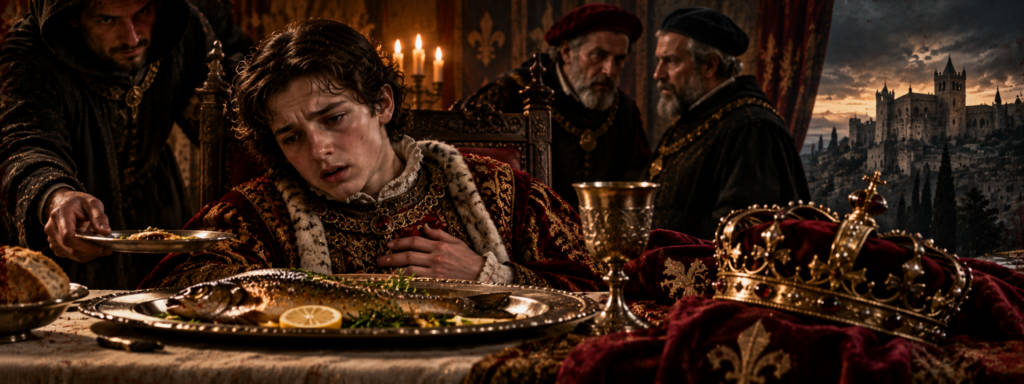
Alfonso of Castile: The Boy King, the Poisoned Trout, and the Mysterious Death That Changed Spain
Alfonso of Castile (15 November 1453 – 5 July 1468) | Prince of Asturias and Infante of Castile | Proclaimed Alfonso XII by rebellious Castilian nobles, 1465–1468 | Son of King John II of Castile and Isabella of Portugal | Younger half-brother of King Henry IV of Castile | Younger brother of the future Isabella I of Castile | Elevated as a rival monarch during a bitter aristocratic rebellion against Henry IV | Died at approximately fourteen years and seven months of age in Cardeñosa, near Ávila | His sudden death was attributed to illness, frequently identified as plague, while persistent rumors accused unnamed enemies of poisoning him, sometimes through a dish of trout | His death ended the rebellion’s attempt to replace Henry IV with a male rival and opened the way for Isabella’s emergence as a contender for the Castilian succession.
The Trout That May Have Killed a King
In the summer of 1468, a fourteen-year-old boy who had been proclaimed king of Castile lay dying in a country already torn apart by rebellion, betrayal, and a bitter struggle for the crown. His name was Alfonso, and for three years powerful noblemen had used him as the living symbol of their campaign to overthrow his older half-brother, King Henry IV. They had placed a crown upon his head, issued commands in his name, and fought battles intended to establish him as the rightful ruler of Castile. Then, just as the struggle for the kingdom seemed destined to continue, Alfonso became suddenly and seriously ill.
His death came on 5 July 1468 at Cardeñosa, near the city of Ávila. The boy who had been called Alfonso XII by his supporters was not yet fifteen, and his political career had barely begun. Some accounts attributed his death to plague or another acute illness, a plausible explanation in an age when infectious disease could strike without warning. Yet the circumstances were suspicious enough to inspire a far more sinister explanation.
According to a persistent tradition, Alfonso had been poisoned. The story became especially memorable because the supposed instrument of murder was not a dagger, a sword, or a cup of poisoned wine, but an ordinary dish of trout. A meal that should have provided nourishment was said to have concealed the substance that ended the young prince’s life.
The image was disturbing because it suggested a murder carried out in the most intimate and unsuspecting circumstances. Alfonso was surrounded by men who claimed to defend his rights, yet his political position made him dangerous to anyone who wished to end the rebellion or redirect the succession. If poison had been placed in his food, the assassin would not have needed to confront the boy openly. The killing could have been accomplished by someone who gained access to his table.
There is, however, an essential distinction between the famous story and what the surviving evidence can establish. Alfonso’s sudden death is historical fact, and allegations of poisoning became part of the accounts surrounding it. The particular story of the trout belongs to a tradition whose details cannot be independently verified. No surviving evidence conclusively demonstrates that poison was administered, identifies a murderer, or proves that the dish itself was responsible for his illness.
The uncertainty has done little to diminish the story’s fascination. Alfonso had become the centerpiece of a political rebellion, and his death removed the young claimant around whom powerful aristocrats had organized their resistance. The timing was extraordinarily consequential. With Alfonso gone, the rebels faced the problem of finding another figure who could challenge Henry IV without destroying their own political position.
The obvious candidate was Alfonso’s older sister, Isabella. She was still a young woman, but she possessed the same royal parentage and had already become deeply involved in the succession crisis. The nobles who had proclaimed Alfonso king now had to decide whether they would support her in the same way. Her response would help determine the future of Castile.
The consequences extended far beyond the death of a royal teenager. Alfonso’s disappearance from the political struggle contributed to the circumstances in which Isabella eventually became queen, married Ferdinand of Aragon, and helped establish one of the most consequential royal partnerships in European history. The boy’s death did not make those later events inevitable, but it removed a rival claimant whose survival might have changed the succession.
The mystery remains because the evidence allows two very different possibilities. Alfonso may have died from a natural illness during a period of political upheaval, with poisoning rumors arising from fear and suspicion. Alternatively, he may have been deliberately murdered by someone who understood the political consequences of removing him. Nearly six centuries later, the trout remains part of the legend, but the identity of any supposed assassin remains unknown.
A Prince Born Into a Troubled Royal Family
Alfonso was born on 15 November 1453, the son of King John II of Castile and his second wife, Isabella of Portugal. His father was nearing the end of a reign marked by aristocratic rivalry, court intrigue, and repeated struggles over the exercise of royal authority. His mother belonged to the Portuguese royal family and had married John II in 1447. Alfonso entered the world as a legitimate son of the Castilian monarchy, but his position was complicated by the existence of an older half-brother.
That half-brother was Henry, the son of John II’s first marriage to Maria of Aragon. Henry was already an adult when Alfonso was born and stood first in the line of succession. Alfonso therefore possessed royal status without being expected to inherit the throne under ordinary circumstances. His future might have involved princely estates, marriage alliances, or a political role supporting his older brother’s monarchy.
The Castilian court, however, was far from an orderly household governed by unquestioned royal authority. Powerful noble families competed for influence, controlled extensive estates, and maintained military resources capable of challenging the crown. The monarchy depended upon their cooperation while frequently attempting to restrict their independence. The resulting tension created a political environment in which even a young prince could become valuable to ambitious factions.
John II’s reign had been dominated for many years by the influence of Álvaro de Luna, the powerful royal favorite whose position provoked intense aristocratic opposition. Luna’s career demonstrated both the opportunities and dangers associated with proximity to the crown. He accumulated extraordinary influence but eventually fell from power and was executed in 1453. His downfall occurred only months before Alfonso’s birth.
The execution of Luna revealed how quickly royal favor could turn into political catastrophe. Noble factions had spent years attempting to weaken him, while the king’s own authority was repeatedly entangled with their disputes. Alfonso was born into a dynasty whose recent history included rebellion, imprisonment, confiscation, and execution. The political instability that would later define his life was already deeply established.
His mother, Isabella of Portugal, had her own place within these struggles. She was associated with the opposition to Luna and became an important figure in the final years of John II’s reign. Her marriage had produced two children, Isabella and Alfonso, who were both legitimate members of the royal family. Their future would depend upon the relationship between their mother’s household and the new king who succeeded their father.
Alfonso’s childhood therefore began within a family divided by different marriages, competing political interests, and an uncertain balance between monarchy and aristocracy. He was not born to lead a rebellion against his brother. That role would be imposed upon him by men who recognized the political value of his royal blood. Before he reached adolescence, he would become the center of a conflict whose consequences he could scarcely have controlled.
The Death of John II and the Rise of Henry IV
John II died in July 1454, when Alfonso was only eight months old. The crown passed to Henry IV, who was approximately twenty-nine and had already spent years navigating the difficult politics of the Castilian court. Henry inherited a monarchy whose authority was weakened by powerful aristocratic factions and a history of internal conflict. His accession initially offered the possibility of greater stability.
For the infant Alfonso and his older sister Isabella, their father’s death changed the structure of the royal household. Their mother became a widowed queen, and the children no longer occupied the immediate household of a reigning father. Their relationship with Henry would determine their position within the new political order. Although they were legitimate royal siblings, they were also potential alternatives around whom dissatisfied nobles might eventually gather.
Henry’s early reign included attempts to manage aristocratic factions and pursue military activity against the Muslim kingdom of Granada. He faced pressure from nobles who expected rewards, offices, and influence in exchange for their support. The king’s ability to satisfy these demands was limited by competing interests. Disappointment among powerful families gradually contributed to renewed opposition.
The political situation became more dangerous as questions arose concerning Henry’s marriage and the succession. His first marriage, to Blanche of Navarre, had been annulled after years without children. The circumstances surrounding the marriage became the subject of embarrassing and politically damaging allegations. Later hostile accounts used these events to attack Henry’s masculinity and fitness to rule.
In 1455, Henry married Joan of Portugal, whose role as queen would become central to the succession crisis. The marriage was intended to strengthen dynastic relationships and provide a legitimate heir. For several years, however, the absence of a child allowed uncertainty to persist. Alfonso remained an important male member of the royal family.
Henry’s difficulties were not simply the result of personal weakness. Castile’s aristocracy contained powerful families accustomed to exercising influence over royal government. Nobles could use questions of marriage, succession, and legitimacy to challenge policies they disliked. The monarchy’s authority therefore remained vulnerable even when the king possessed a recognized hereditary claim.
Alfonso and Isabella were growing up within this unstable political environment. Their lives were shaped by decisions made by older relatives and powerful aristocrats. Neither child could have predicted the exact form of the crisis that would emerge. Yet the circumstances of Henry’s reign gradually transformed them from royal dependents into figures of enormous political importance.
Isabella of Portugal and the Childhood at Arévalo
Following John II’s death, the widowed queen Isabella of Portugal spent much of her later life away from the center of royal government. Her children, Isabella and Alfonso, were associated with her household at Arévalo, where they experienced a childhood very different from the political prominence they would later acquire. Their upbringing included religious instruction and the expectations appropriate to royal children. The surviving evidence provides glimpses of their circumstances but does not permit a complete reconstruction of daily life.
Isabella of Portugal’s later years were marked by serious psychological difficulties described in historical accounts, although retrospective medical diagnoses remain uncertain. Her condition affected the atmosphere of her household and contributed to the vulnerability of her children. Later writers sometimes exaggerated or simplified her difficulties, and the surviving descriptions should be interpreted cautiously. What matters for Alfonso’s story is that his mother was not in a position to dominate Castilian politics on his behalf.
The children were closely connected through their shared upbringing. Isabella was approximately two years older than Alfonso and would later become one of the most important monarchs in European history. Their relationship acquired particular significance after they were drawn into the political struggles surrounding Henry IV. Later accounts portray Isabella as protective of her younger brother, although the private details of their relationship cannot be reconstructed with certainty.
Arévalo offered a degree of separation from the most dangerous intrigues of the royal court, but it did not remove the children from dynastic politics. Their legitimacy and royal ancestry remained important. Noble factions dissatisfied with Henry could regard Alfonso as a possible alternative monarch. Isabella’s position was similarly significant, although medieval political preferences often favored a male claimant.
The siblings’ relatively sheltered childhood could not last indefinitely. As Henry’s reign became increasingly unstable, the political value of his younger relatives grew. Their presence at court could provide the king with greater control over their marriages and alliances. It could also prevent hostile nobles from gaining exclusive access to them.
The movement of the children into the political world of Henry’s court marked a turning point. Alfonso was still very young, but his name was becoming important in discussions about the succession. His future would no longer be determined primarily by his mother’s household. It would be shaped by the ambitions of powerful men who regarded him as a possible king.
Henry IV: The King His Enemies Called Impotent
Henry IV of Castile acquired one of the most damaging reputations of any late medieval Spanish monarch. His enemies accused him of weakness, indecision, sexual inadequacy, and dependence upon favorites. The nickname the Impotent became attached to him in later historical tradition. These accusations were politically powerful because they undermined confidence in his ability to produce a legitimate heir and govern effectively.
The allegations surrounding Henry’s sexuality and reproductive capacity must be treated carefully. They were repeated by hostile chroniclers and political opponents whose interests were served by portraying the king as incapable of fathering a child. The failure of his first marriage to produce offspring became an important element in these attacks. Yet the surviving evidence does not permit a reliable modern medical diagnosis.
Henry’s second marriage to Joan of Portugal initially offered a solution to the succession problem. In 1462, the queen gave birth to a daughter named Joanna. The child was publicly recognized as the king’s daughter, and her birth should have strengthened the monarchy’s future. Instead, she became the center of one of the most bitter legitimacy disputes in Castilian history.
Opponents of Henry claimed that Joanna was not his biological child. They alleged that her father was Beltrán de la Cueva, a royal favorite whose influence had generated aristocratic resentment. The accusation produced the insulting nickname la Beltraneja, by which Joanna became widely known. The claim was politically useful but has never been conclusively established.
The accusation transformed the succession crisis. If Joanna was legitimate, she possessed a strong hereditary claim as Henry’s daughter. If her paternity could be successfully challenged, Alfonso became an attractive alternative for nobles who opposed the king. The controversy therefore created an opportunity for the prince’s political elevation.
Henry’s personal reputation became inseparable from the struggle over royal authority. Noble opponents used allegations about his marriage and daughter to justify demands for changes in government. The king’s supporters defended Joanna’s legitimacy and Henry’s right to determine the succession. The dispute was not merely a scandal about private conduct but a contest over control of the monarchy.
For Alfonso, the consequences were profound. A boy who had once stood behind his older brother in the hereditary order was suddenly presented as a possible replacement for the king’s daughter. The allegations against Henry created the political opening through which Alfonso’s supporters would eventually proclaim him monarch. His childhood was about to be consumed by a conflict that began with questions about another child’s parentage.
Joanna of Castile: The Baby Who Threatened the Nobles
Joanna was born in February 1462, becoming the daughter whom Henry IV publicly acknowledged as his heir. Her arrival should have clarified the succession by providing the reigning king with a direct descendant. Instead, it intensified the ambitions of nobles who feared losing influence under the monarchy. Her legitimacy became the principal target of their attacks.
The accusation involving Beltrán de la Cueva was particularly effective because he was already unpopular among important aristocratic factions. Henry had elevated him to positions of influence, provoking resentment among nobles who believed their own privileges were being threatened. By alleging that Beltrán had fathered Joanna, the opposition could attack both the royal favorite and the succession. The scandal provided a convenient justification for political rebellion.
The surviving evidence does not prove that Joanna was illegitimate. The allegation was promoted by individuals with strong political reasons to discredit her claim. Her mother, Joan of Portugal, also became the subject of hostile gossip that further damaged the royal household’s reputation. These accusations must be understood within the context of factional propaganda.
Alfonso’s importance increased because he offered a male alternative whose parentage was not similarly disputed. He was the legitimate son of John II and Isabella of Portugal, and his royal ancestry was beyond serious question. Noble opponents could therefore present him as a safer choice for the succession. His youth also made him attractive to men who hoped to exercise influence over a new monarch.
The rebels’ interest in Alfonso was not necessarily motivated by concern for his personal welfare. A child king could become dependent upon powerful advisers who controlled access to his court, military resources, and political decisions. Such an arrangement offered aristocrats opportunities that might be unavailable under a more independent ruler. Alfonso’s legitimacy made him useful, while his age made him vulnerable.
The succession dispute thus placed two children at the center of a political struggle conducted by adults. Joanna was accused of illegitimacy before she could defend herself, while Alfonso was promoted as a rival heir before he could exercise independent authority. Their names became weapons in a conflict over power. The consequences would shape the final years of Henry IV’s reign and determine the circumstances of Alfonso’s death.
The Nobles Who Wanted a King They Could Control
By the early 1460s, opposition to Henry IV had become increasingly organized. Powerful aristocrats accused the king of misgovernment, favoritism, and failure to protect the interests of the realm. Their demands included changes in royal administration and restrictions upon the influence of unpopular advisers. The succession dispute provided an additional means of pressuring the crown.
Among the leading figures associated with the opposition were Juan Pacheco, Marquis of Villena, and Alfonso Carrillo, Archbishop of Toledo. Both possessed considerable political influence and participated in the factional struggles that dominated Castile. Their relationships with Henry shifted according to circumstances, and their opposition was shaped by personal ambition as well as political disagreement. They became central figures in the movement to elevate Alfonso.
The rebels could present their demands as an effort to defend the kingdom from misgovernment. They claimed that Henry had allowed unsuitable favorites to exercise excessive influence and had failed to preserve the dignity of the monarchy. Such arguments resonated within a political culture that expected kings to govern with the advice of leading nobles. Yet the opposition also sought offices, estates, and authority for its own members.
Alfonso’s youth made him a particularly useful candidate. He possessed unquestioned legitimate royal birth and could be portrayed as an innocent alternative to a compromised king. At the same time, he lacked the experience and independent power necessary to resist the aristocrats who promoted him. The arrangement offered the rebels a potential monarchy under their influence.
The political crisis intensified as the nobles demanded recognition of Alfonso’s position in the succession. Henry faced pressure to accept arrangements that weakened his daughter’s claim and strengthened that of his younger half-brother. The negotiations reflected the balance of power between the monarchy and its opponents. Agreements could be made, challenged, and abandoned as circumstances changed.
The rebellion was therefore not simply a spontaneous uprising against an unpopular ruler. It emerged from years of aristocratic competition and disputes over the distribution of power. Alfonso became its central symbol because his hereditary position offered a plausible alternative to Henry’s daughter. The prince’s personal wishes were far less important than the political uses to which his name could be put.
By 1465, the confrontation had reached a point where the rebels were prepared to go beyond negotiation. They would no longer merely demand changes in government or succession. They would publicly declare Henry unfit to rule and raise Alfonso as king. The extraordinary ceremony that followed became one of the most humiliating episodes in Castilian royal history.
The Farce of Ávila: The Day the Nobles Executed a King’s Effigy
On 5 June 1465, rebellious Castilian nobles staged a remarkable ceremony near Ávila that became known as the Farce of Ávila. They constructed a platform and displayed an effigy representing King Henry IV. The figure was dressed in royal garments and adorned with symbols of kingship. The rebels intended to demonstrate publicly that they no longer recognized Henry as their sovereign.
The ceremony was a carefully staged act of political theater. Leading nobles removed the effigy’s royal insignia, symbolically stripping Henry of the authority they claimed he had abused. The crown, sword, and other emblems represented the offices and responsibilities of kingship. Their removal dramatized the rebels’ assertion that Henry had forfeited his right to rule.
The proceedings culminated in the symbolic deposition of the king. The effigy was cast down, representing the destruction of Henry’s authority. The ceremony was designed to humiliate him and provide a public justification for rebellion. It also demonstrated the nobles’ willingness to challenge the monarchy through ritual as well as military force.
Alfonso was then proclaimed king by the rebel faction. He was only eleven years old, but his supporters presented him as Alfonso XII of Castile. The number reflected their recognition of earlier kings named Alfonso and their claim that the boy now occupied the royal office. His elevation created a rival monarchy within the kingdom.
The ceremony did not remove Henry from power. He continued to possess supporters, territories, and the legal claim of a reigning king. The rebels’ proclamation created competing centers of authority rather than a universally accepted succession. Castile entered a period in which two rulers claimed the crown.
For Alfonso, the ceremony transformed his position completely. He was no longer merely a prince whose future might involve succession negotiations. He had become the public face of an armed rebellion against his own half-brother. The men who proclaimed him king were now committed to defending that claim through political pressure and warfare.
The Farce of Ávila also revealed the fragility of royal symbolism. The nobles could not physically remove Henry from the throne, so they staged his removal through an effigy. Their actions challenged the idea that hereditary kingship was beyond aristocratic judgment. The spectacle became a lasting symbol of the political disorder that engulfed Castile during Alfonso’s brief reign.
Alfonso XII: A Boy Crowned by Rebels
Alfonso’s proclamation created a remarkable political situation. Henry IV remained the reigning king in the eyes of his supporters, while the rebels recognized Alfonso as their sovereign. The boy’s title depended upon the success of the faction that had elevated him. His authority was therefore real within the territories and institutions controlled by his supporters, but it was not universally accepted.
The rival court developed the outward forms of monarchy. Documents could be issued in Alfonso’s name, and his supporters treated him as the legitimate ruler. Such practices mattered because medieval kingship depended upon public recognition, legal acts, and the exercise of authority. The rebels sought to make their claim more than a symbolic protest.
Alfonso’s youth placed him in a position of dependence. He required advisers to manage political negotiations, military affairs, and relations with powerful nobles. The men who had promoted him possessed their own interests and could attempt to direct his government. The boy’s royal status did not give him complete control over the faction that claimed to serve him.
The rebel monarchy also depended upon military success. Henry retained substantial support, and the kingdom was divided between competing allegiances. Cities, noble families, and regional authorities faced pressure to choose sides. The conflict created opportunities for local rivalries to become entangled with the national succession crisis.
Alfonso’s supporters portrayed him as the lawful alternative to a king whose government they condemned. Their arguments emphasized his legitimate descent from John II and the alleged defects of Henry’s rule. Yet the claim remained controversial because Henry had not died or voluntarily abdicated. The rebellion therefore challenged the established principle of royal succession.
The young prince’s public image was shaped by these competing needs. He had to appear worthy of kingship while remaining dependent upon the nobles who supported him. Ceremonies, documents, and political declarations helped construct the image of a legitimate ruler. The reality was that his position rested upon a fragile coalition.
The years between 1465 and 1468 were therefore extraordinary. Alfonso occupied the role of a king without possessing undisputed control of the kingdom. His supporters fought in his name, while Henry’s government continued to resist. The boy’s life became inseparable from a civil conflict that threatened the stability of Castile.
A Kingdom Divided Between Two Kings
The proclamation of Alfonso produced a struggle over the allegiance of Castilian towns, nobles, and institutions. Henry’s supporters continued to recognize him as king, while the rebel faction treated Alfonso as the lawful sovereign. The resulting division affected government, taxation, military obligations, and local political relationships. Communities could find themselves caught between rival demands.
The conflict was not fought continuously across every region, but it created widespread instability. Noble families used the crisis to pursue local interests, while towns sought to protect their privileges and security. Alliances could shift as military and political circumstances changed. The monarchy’s ability to impose consistent authority was weakened.
The rebels controlled important resources, but Henry retained significant support. Neither side possessed the strength to secure an immediate and decisive victory. Negotiations alternated with military confrontations, reflecting the difficulty of resolving the dispute. Alfonso’s position depended upon the continuing unity of his supporters.
The political language of the conflict was intensely moral. Henry’s enemies accused him of failing in his duties as king, while his supporters condemned the rebels for challenging lawful authority. Both sides claimed to defend the interests of Castile. Such arguments helped justify military action and the seizure of political resources.
Alfonso’s name appeared in the struggle as a symbol of legitimacy. His supporters could claim that they were not rebelling against monarchy itself but replacing an unsuitable ruler with another member of the royal dynasty. This distinction was important because open rebellion against a lawful king carried serious moral and political risks. The boy’s hereditary status offered a way to present the uprising as an act of restoration.
The conflict also affected Isabella’s position. As Alfonso’s sister, she belonged to the same legitimate royal line and possessed her own potential succession claim. Her relationship with the rebel faction was therefore politically significant. Yet she had not been proclaimed monarch in the same way as her younger brother.
The divided kingdom remained unstable throughout Alfonso’s brief reign. His supporters needed victories to strengthen their claim, while Henry sought to preserve his authority and protect his daughter’s succession. The rivalry would eventually produce a major battle near Olmedo. Even that confrontation would fail to resolve the struggle completely.
The Second Battle of Olmedo
In August 1467, the forces supporting Henry IV and those associated with Alfonso confronted one another near Olmedo. The battle became one of the principal military encounters of the succession crisis. Both factions sought to demonstrate that their claimant possessed the strength necessary to rule Castile. The engagement reflected the transformation of political disagreement into armed conflict.
The battle’s outcome was contested, and later accounts differed in their interpretation of success. Neither side achieved the decisive victory necessary to end the rivalry. The political struggle therefore continued despite the military confrontation. The inability to secure a clear settlement revealed the strength and limitations of both factions.
For Alfonso’s supporters, the battle offered an opportunity to establish their young king’s authority through force. A decisive victory might have weakened Henry’s position and encouraged additional nobles to recognize Alfonso. The absence of such an outcome left the rebellion dependent upon continued negotiation and military pressure. The rival monarchy remained vulnerable.
Henry’s government also failed to destroy the opposition. The rebels retained influential supporters and sufficient resources to continue their campaign. The king’s authority remained challenged, and the succession dispute was unresolved. The battle therefore became another stage in a prolonged crisis rather than its conclusion.
The fighting demonstrated the danger of placing a child at the center of aristocratic conflict. Alfonso’s political future depended upon commanders and nobles whose decisions could expose him to military defeat or capture. His personal safety was connected to the fortunes of a faction that he did not fully control. The role of rival king carried risks far beyond ceremonial responsibility.
The struggle after Olmedo remained uncertain. Both sides possessed reasons to continue fighting, but neither could easily impose a settlement. Alfonso’s supporters still regarded him as their monarch, while Henry retained the crown in the territories loyal to him. The conflict seemed likely to continue into another campaigning season.
Then, in the summer of 1468, the political situation changed abruptly. Alfonso became ill and died within a short period. The boy whose name had sustained the rebellion was suddenly gone. The conflict that armies had failed to resolve was transformed by a death whose cause immediately became controversial.
The Final Journey to Cardeñosa
In the summer of 1468, Alfonso was in the region of Ávila, an area closely associated with the rebel movement that had proclaimed him king. His court and supporters continued to operate within the unstable political environment created by the rivalry with Henry IV. The surviving accounts do not permit a complete reconstruction of every movement during his final days. Nevertheless, the location of his death at Cardeñosa is well established.
Cardeñosa was a settlement near Ávila, and its association with Alfonso’s death gave it a lasting place in Castilian history. The prince was still only fourteen, but he had spent approximately three years as the recognized king of the rebel faction. His political position remained uncertain, and the conflict had not reached a final settlement. His death therefore occurred at a particularly consequential moment.
The sources describe a sudden illness that rapidly became fatal. Later accounts frequently identify the cause as plague, while others preserve allegations of poisoning. The speed of the illness contributed to suspicion because a healthy young claimant appeared to have been removed without warning. Yet sudden death from infectious disease was entirely plausible in fifteenth-century Castile.
The circumstances also encouraged political speculation. Alfonso’s death benefited those who wished to end the rebellion centered upon him, but it also created opportunities for factions seeking to redirect the succession. Several individuals and groups might have gained from his disappearance. The existence of possible beneficiaries, however, does not establish that any of them arranged his death.
The surviving evidence provides no reliable medical description sufficient to determine the cause. We cannot reconstruct the full sequence of symptoms or establish whether a particular meal preceded the illness. Later stories supplied dramatic details, including the famous trout. Those details must be separated from the documented fact that Alfonso became ill and died.
The final days of the boy king remain haunting precisely because so little can be established with certainty. He had been elevated by powerful nobles and drawn into a conflict against his own brother. His life was surrounded by political suspicion, yet the immediate cause of his death remains unresolved. Cardeñosa became the setting for a mystery that later generations would interpret through the language of poison and betrayal.
The Plate of Trout: A Royal Meal Turned Into a Murder Weapon
The most famous explanation for Alfonso’s sudden death involves a dish of trout. According to the poisoning tradition, the prince consumed fish that had been deliberately contaminated with a lethal substance. The meal was said to have caused the illness from which he died. The story became memorable because it transformed an ordinary food into the instrument of a possible political assassination.
Poisoning was a familiar fear within medieval courts. Royal households depended upon servants, cooks, attendants, and suppliers who handled food and drink before it reached the ruler. A person with access to these arrangements might theoretically administer poison without approaching the victim openly. The possibility made food-related accusations especially powerful during periods of political conflict.
The trout story fits this wider atmosphere of suspicion. Alfonso was a young claimant whose death could alter the balance of power in Castile. If an enemy wished to eliminate him without risking a public attack, poison offered an apparently discreet method. The narrative therefore supplied a plausible mechanism for murder within the assumptions of the period.
Yet plausibility is not proof. The surviving evidence does not establish that Alfonso’s trout contained poison, identify the substance allegedly used, or demonstrate that the fish caused his illness. The story appears within a tradition shaped by the political importance of his death. Its dramatic appeal may have helped preserve and amplify it.
The detail of the trout also creates an illusion of certainty. A specific food sounds more convincing than a vague allegation that someone may have poisoned the prince. Readers can imagine the meal, the plate, and the unsuspecting boy eating what would become his final food. Such vividness, however, does not make the account medically or historically verifiable.
The poisoning tradition should therefore be understood as an allegation rather than a demonstrated assassination. It may preserve a genuine suspicion expressed by people close to the events, or it may represent a later attempt to explain an unexpected death. Without stronger evidence, the distinction cannot be resolved. The trout remains one of the most memorable details in Alfonso’s story, but it cannot be treated as the proven cause of his death.
Plague or Poison? The Mystery of Alfonso’s Death
The principal explanations for Alfonso’s death have traditionally centered upon natural illness and deliberate poisoning. The natural explanation is frequently described as plague, reflecting the continuing presence of epidemic disease in late medieval Europe. The poisoning explanation emerged from the political circumstances surrounding the boy’s sudden death. Both interpretations have appeared in historical writing, although they do not possess equal evidentiary certainty.
Plague was a serious threat in fifteenth-century Castile. Epidemic disease could strike rapidly and kill individuals who had previously appeared healthy. Royal status offered little protection against infection, particularly in a society without modern understanding of disease transmission. A sudden fatal illness therefore did not require deliberate human intervention.
The term plague in historical accounts also presents difficulties. Medieval writers sometimes used disease terminology differently from modern medical classifications. Without detailed clinical evidence, it is difficult to determine whether Alfonso suffered from bubonic plague, another infectious illness, or a different medical condition. The label should therefore be treated as a traditional explanation rather than a confirmed diagnosis.
Poisoning was likewise difficult to establish. Medieval medical knowledge could not reliably distinguish many toxic effects from symptoms of natural disease. Vomiting, fever, abdominal distress, weakness, and rapid deterioration could occur under several different circumstances. The surviving accounts do not provide the information necessary for a confident retrospective diagnosis.
Political suspicion increased the likelihood that an unexpected death would be interpreted as murder. Alfonso’s disappearance changed the succession crisis, and rival factions had reasons to accuse one another of wrongdoing. The allegation of poison offered a deliberate explanation for an event that otherwise appeared dangerously unpredictable. It also allowed supporters to portray the prince as the victim of treachery rather than disease.
The central historical conclusion is therefore limited but important. Alfonso died suddenly at Cardeñosa on 5 July 1468, and poisoning rumors became associated with his death. The precise cause cannot be established from the surviving evidence. Any account that presents the poisoned trout as a proven murder weapon goes beyond what the sources securely demonstrate.
Who Would Have Wanted Alfonso Dead?
The question of motive has kept the poisoning theory alive for centuries. Alfonso was not an ordinary royal child whose death affected only his immediate family. He was the recognized monarch of a powerful rebel faction and the principal alternative to Henry IV. Removing him would transform the political struggle.
Henry’s supporters had an obvious interest in weakening the rebellion. Alfonso’s claim challenged the king’s authority and threatened the succession of Joanna. His death deprived the rebels of the male claimant around whom they had organized their opposition. It is therefore understandable that suspicion could fall upon individuals loyal to Henry.
Yet political benefit does not establish responsibility. Henry did not automatically regain complete control of the kingdom when Alfonso died, and the succession crisis continued through Isabella. The removal of Alfonso created new political complications as well as opportunities. No reliable evidence demonstrates that Henry ordered his half-brother poisoned.
The rebel faction itself was divided by competing ambitions. Powerful nobles had promoted Alfonso because his youth and legitimacy made him politically useful. Some might have preferred a different arrangement if the boy became less compliant or if negotiations with Henry offered greater advantages. Such possibilities have encouraged speculation about betrayal from within his own supporters.
The difficulty is that these theories rely heavily upon inferred motives rather than documented actions. A nobleman who gained influence after Alfonso’s death was not necessarily involved in causing it. Political factions often adapted rapidly to unexpected events. Their ability to exploit a death does not prove that they arranged it.
Isabella’s position also changed dramatically after her brother died. She became the most important surviving alternative to Joanna within the legitimate line descended from John II. Yet there is no credible basis for accusing her of involvement in Alfonso’s death. Her later success should not be projected backward into an imagined conspiracy.
The mystery therefore contains several possible beneficiaries but no securely identified assassin. The political consequences explain why contemporaries and later writers suspected foul play. They do not provide evidence sufficient to convict anyone. Alfonso’s death remains a suspected political poisoning rather than a demonstrated case of murder.
The Death of a Fourteen-Year-Old King
Alfonso died on 5 July 1468, before reaching his fifteenth birthday. His brief life had already included the death of his father, separation from the central royal household, involvement in a bitter succession dispute, and proclamation as a rival king. He had become the symbol of an aristocratic rebellion while still a child. His death ended a political career that had barely begun.
The immediate consequences were significant. The rebel faction lost the figure whose hereditary claim had justified its attempt to replace Henry IV. The nobles who had proclaimed Alfonso king could no longer continue the same political strategy. They needed to reconsider their relationship with Henry and the future of the succession.
The prince’s death also exposed the vulnerability of a political movement built around a single individual. Alfonso’s legitimacy had provided the rebellion with a powerful argument, but his youth and lack of descendants meant that his claim could not continue through a direct heir. His disappearance forced supporters to choose between compromise and a new candidate. The movement’s future depended upon those decisions.
For Isabella, the loss was both familial and political. Alfonso was her younger brother and had shared her early life within their mother’s household. His death removed the sibling with whom she had been most closely associated during the succession crisis. It also placed her in a position of greater political importance.
The surviving sources do not permit a detailed reconstruction of Isabella’s private grief. Later narratives sometimes portray her as deeply affected by Alfonso’s death, but the exact words and emotions attributed to her should be treated cautiously. What is clear is that her political circumstances changed immediately. She became the obvious candidate for those who wished to continue challenging Joanna’s succession.
The boy’s death therefore created a profound reversal. The rebels had elevated Alfonso because he was a legitimate male prince whose claim could be used against Henry. Now the most important alternative was a young woman whose political judgment would prove more independent than many nobles expected. Alfonso’s disappearance changed not only the identity of the claimant but also the character of the struggle.
The Tomb at Miraflores
Alfonso was buried at the Charterhouse of Miraflores, near Burgos, a religious foundation closely associated with the Castilian royal family. The monastery had been established through the patronage of John II, Alfonso’s father. Its connection with the dynasty made it an appropriate place for the prince’s burial. The site became an important setting for the commemoration of his short life.
The monastery’s royal associations were strengthened through the burial of John II and Isabella of Portugal. Alfonso’s presence connected him to the same dynastic memorial landscape. Religious institutions played a central role in preserving the memory of royal families through prayer, burial, and artistic patronage. His tomb therefore formed part of a wider effort to commemorate the descendants of John II.
The surviving funerary monument associated with Alfonso is an important work of late Gothic sculpture. The elaborate tomb was created within the artistic program developed under Isabella I’s patronage, with Gil de Siloé responsible for major sculptural work at Miraflores. Its craftsmanship reflects the importance attached to the prince’s memory after his death. The monument gives visual permanence to a life that ended before adulthood.
The tomb also illustrates the political significance of royal commemoration. Alfonso had been proclaimed king by a rebel faction, but his status remained contested during his lifetime. His burial and later memorialization placed him within the legitimate royal family without resolving every question surrounding his political title. The monument commemorated a prince whose claim had once divided the kingdom.
Miraflores became a place where the memory of Alfonso could be preserved without the immediate hostility of the civil conflict. The religious setting emphasized dynastic continuity, prayer, and remembrance. His death could be understood within the wider history of John II’s family rather than solely through the rebellion. The tomb therefore offered a different kind of historical narrative from the accusations surrounding his final illness.
The contrast is striking. During his life, Alfonso’s name had been used to justify the symbolic deposition of a reigning king and the mobilization of armed forces. In death, he became the subject of religious commemoration and elaborate artistic patronage. The boy whose political role had been shaped by rebellion was remembered within the solemn surroundings of a royal monastery. His tomb remains one of the most tangible connections to a life otherwise overshadowed by the careers of his siblings.
Isabella Refuses to Become Another Puppet Queen
After Alfonso’s death, rebel nobles turned their attention toward Isabella. She possessed legitimate royal ancestry and could serve as an alternative to Joanna if the latter’s parentage continued to be challenged. Her position made her politically valuable to men who wished to maintain pressure upon Henry IV. Yet Isabella did not simply accept the role that had been imposed upon her younger brother.
The surviving accounts indicate that Isabella declined to be proclaimed queen while Henry remained alive. Her decision reflected an understanding of the dangers associated with open rebellion and the importance of hereditary legitimacy. She could challenge Joanna’s succession without necessarily declaring herself the immediate replacement for a living king. This distinction would become central to her political strategy.
Isabella’s refusal also limited the ability of the rebel nobles to control her. Alfonso had been a child whose authority depended heavily upon the men who elevated him. Isabella was older and increasingly capable of making independent political decisions. Her position therefore complicated the plans of aristocrats who expected another pliable claimant.
The decision did not mean that Isabella abandoned her claim. She remained a potential successor and possessed supporters who regarded Joanna’s legitimacy as doubtful. Her political future depended upon negotiations with Henry and the balance of power among Castilian factions. The succession crisis continued, but its form changed.
The contrast between the siblings became increasingly important in later historical memory. Alfonso had been proclaimed king by rebels and drawn into open conflict with Henry. Isabella pursued recognition through negotiation while preserving the possibility of future succession. Their different circumstances and choices produced different outcomes.
Alfonso’s death therefore helped create the political setting in which Isabella developed her own strategy. She could learn from the failure of the rebellion centered upon her brother without abandoning the claim that made her valuable. Her refusal to become an immediate rival monarch strengthened her position in negotiations. The next major development would come through an agreement with Henry IV.
The Treaty of the Bulls of Guisando
In September 1468, only a few months after Alfonso’s death, Henry IV and Isabella reached an agreement commonly known as the Treaty of the Bulls of Guisando. The settlement recognized Isabella as Henry’s successor under specified conditions. It represented an attempt to end the succession crisis that had divided Castile. The agreement also reflected the political consequences of Alfonso’s disappearance.
The treaty did not simply erase every dispute surrounding Joanna. Her legitimacy remained politically contested, and the settlement’s terms were subject to later disagreement. Henry’s recognition of Isabella provided a temporary solution to the problem created by the rival claims. It also offered the king an opportunity to restore stability without accepting the rebellion’s earlier deposition of his authority.
Isabella’s position was strengthened by the agreement. She could claim recognition as heir without having openly seized the throne during Henry’s lifetime. The settlement therefore provided a more secure basis for her future ambitions than the rebel proclamation had offered Alfonso. Her political judgment helped distinguish her career from that of her younger brother.
The agreement also involved expectations concerning Isabella’s marriage. Royal marriages were central to succession politics because they could create alliances capable of altering the balance of power. Henry wished to retain influence over the choice of husband, while Isabella and her supporters possessed their own preferences. The question would soon produce renewed conflict.
The settlement was therefore fragile. It depended upon cooperation among individuals whose interests remained divided and whose previous agreements had often collapsed. Henry continued to possess supporters who favored Joanna, while Isabella’s position attracted factions seeking influence over the future monarchy. The underlying struggle had not disappeared.
Nevertheless, the treaty marked an important turning point. Alfonso’s death had removed the male claimant proclaimed by the rebels, and Isabella had emerged as the principal alternative. The agreement gave her a recognized place in the succession while preserving Henry’s formal kingship. It transformed the political possibilities available to the young princess.
The events of 1468 therefore connect Alfonso’s mysterious death directly to Isabella’s rise. His disappearance did not automatically make her queen, but it created circumstances in which her claim could be negotiated and recognized. The settlement at Guisando became a crucial stage in that process. The boy’s death had altered the direction of Castilian politics.
The Marriage That Changed the Future of Spain
In 1469, Isabella married Ferdinand, heir to the Crown of Aragon. The marriage became one of the most consequential dynastic unions in European history. It connected the future rulers of Castile and Aragon and established a partnership that would shape the political development of the Iberian Peninsula. The decision also intensified the conflict surrounding Isabella’s succession.
Henry IV opposed aspects of the marriage arrangement and later challenged Isabella’s position as heir. The agreement at Guisando did not survive unchanged, and the succession dispute reopened. Joanna’s claim remained important to those who supported Henry’s chosen line. Castile once again faced the possibility of rival monarchs.
Isabella’s marriage gave her access to powerful political connections. Ferdinand belonged to the Aragonese royal dynasty and possessed experience within the complex politics of the Crown of Aragon. Their partnership strengthened Isabella’s ability to pursue her claim. It also introduced new interests into Castilian affairs.
The marriage did not immediately unite Castile and Aragon into a single centralized state. The two crowns retained distinct institutions, laws, and political traditions. Nevertheless, the dynastic partnership created a foundation for closer cooperation between their rulers. Its long-term consequences would be enormous.
Alfonso’s death forms part of the background to these developments. Had he survived and maintained his position as rival king, Isabella’s political circumstances might have been very different. His existence could have complicated marriage negotiations and succession arrangements. Yet such possibilities remain counterfactual and cannot be treated as inevitable alternatives.
The historical sequence is clear. Alfonso died in 1468, Isabella gained recognition as a possible successor, and she married Ferdinand in 1469. These events helped prepare the circumstances in which she would eventually claim the Castilian throne. The young prince’s death was therefore one important turning point within a larger political transformation.
Henry IV Dies and the Succession Crisis Returns
Henry IV died in December 1474, six years after Alfonso’s death. His passing reopened the dispute over the Castilian succession because Isabella and Joanna possessed competing claims supported by different factions. Isabella moved quickly to establish herself as queen. Her proclamation marked the beginning of a new phase in the struggle for the crown.
Joanna’s supporters continued to defend her legitimacy and hereditary rights. The accusation that she was the daughter of Beltrán de la Cueva remained politically influential, but it had never been conclusively established. Her claim was supported by individuals who regarded Isabella’s succession as illegitimate or politically disadvantageous. The dispute therefore continued to involve the same questions that had elevated Alfonso years earlier.
The conflict developed into the War of the Castilian Succession, involving Castilian factions and foreign powers. Portugal supported Joanna’s claim, while Isabella and Ferdinand defended their position through military and political action. The struggle demonstrated that the succession crisis had not been resolved by Alfonso’s death or the agreement at Guisando. It had merely changed form.
Isabella and Ferdinand eventually secured victory, and the settlement confirmed their position. Joanna’s political ambitions were defeated, and she entered a religious life. The outcome established Isabella’s monarchy and strengthened the partnership with Ferdinand. The succession conflict that had begun during Henry’s reign reached a new settlement.
The events also reveal the continuing importance of Alfonso’s brief political career. The same aristocratic tensions, legitimacy disputes, and rival claims that had produced his proclamation remained active after his death. His disappearance had removed one claimant but not the underlying conflict. The struggle continued through the next generation of political decisions.
By the time Isabella secured the throne, Alfonso had been dead for several years. His name no longer served as the center of an active rebellion, but his death remained a crucial turning point in the succession. The political path that led to Isabella’s reign had passed through the collapse of his rival monarchy. His brief life had become part of the history of one of Europe’s most influential royal transformations.
The Sister Who Became Isabella the Catholic
Isabella I of Castile became one of the most consequential rulers in European history. Her reign, in partnership with Ferdinand of Aragon, was associated with major military, religious, and political developments. The conquest of Granada in 1492 ended the last Muslim-ruled kingdom in Iberia. The same year also witnessed the expulsion of Jews who refused conversion under the royal decree and the sponsorship of Christopher Columbus’s Atlantic voyage.
These events transformed the history of Spain and had consequences extending across Europe and the Atlantic world. Isabella’s government strengthened royal authority and pursued policies that reshaped religious and political life. Her reign also involved coercion, persecution, and the expansion of institutions such as the Spanish Inquisition, established in 1478. The achievements and violence of her monarchy remain subjects of extensive historical study.
Alfonso’s relationship to this later history is indirect but significant. His death removed the young male claimant whom rebel nobles had proclaimed king. Isabella subsequently emerged as the principal alternative to Joanna and developed a political strategy that led to her eventual accession. The sequence connects the prince’s mysterious death with the circumstances of his sister’s rise.
It would be misleading, however, to claim that Alfonso’s death alone created the Spain associated with Isabella and Ferdinand. Their later achievements depended upon numerous military, diplomatic, economic, and political developments. The marriage between the two monarchs and their eventual succession were not predetermined. Alfonso’s disappearance was one important factor among many.
The comparison between the siblings nevertheless remains striking. Alfonso was elevated as a rival king at eleven and died before fifteen, leaving little opportunity to exercise independent authority. Isabella survived the succession crisis, negotiated recognition, and eventually ruled for three decades. Their lives demonstrate how differently members of the same royal family could experience the dangers of dynastic politics.
Alfonso’s death therefore acquired retrospective significance because of his sister’s extraordinary career. He became remembered not only as a mysterious victim of illness or possible poisoning but also as the brother whose disappearance preceded Isabella’s rise. His story occupies a shadowed place beside the more celebrated history of the Catholic Monarchs. The political consequences of his death continued long after his own claim had vanished.
The Poisoning Rumor and the Problem of Historical Evidence
The story of Alfonso’s poisoned trout illustrates the difficulty of investigating suspected royal murders from the fifteenth century. The surviving accounts were written within a political culture shaped by factional rivalry, religious interpretation, and the desire to explain unexpected events. Chroniclers could preserve valuable information while also repeating allegations that served the interests of their patrons. The historian must therefore distinguish documented events from accusations and later narrative embellishments.
Alfonso’s death is securely established. He died suddenly at Cardeñosa on 5 July 1468 while recognized as king by the rebel faction opposing Henry IV. His disappearance immediately altered the political situation and contributed to Isabella’s emergence as a succession candidate. These facts provide the foundation for understanding the case.
The cause of death is less certain. Plague or another acute illness is frequently offered as an explanation, while poisoning rumors became associated with the event. The surviving evidence does not allow a confident medical diagnosis. Nor does it establish the presence of a toxic substance.
The trout story adds a specific mechanism but not necessarily stronger evidence. A detailed anecdote can appear convincing because it supplies a recognizable object and a plausible method. Yet the existence of a vivid tradition does not demonstrate that the event occurred as described. The fish may have been part of an early rumor, a later elaboration, or a genuine but unverified memory.
The absence of a known assassin is equally important. No individual can be securely identified as having administered poison to Alfonso. Political enemies possessed possible motives, but motive alone is insufficient to establish responsibility. The case therefore cannot be presented as a solved assassination.
The uncertainty should not lead to dismissing the historical importance of the rumors. Allegations of poisoning reveal the atmosphere of distrust surrounding Alfonso’s death. They demonstrate that contemporaries or later observers found his sudden disappearance politically suspicious. The rumor itself became part of the historical legacy of the succession crisis.
The most responsible conclusion is that Alfonso’s death remains unexplained in precise medical terms. A natural illness is plausible, and deliberate poisoning cannot be conclusively demonstrated. The traditional trout story should be presented as an allegation rather than a verified murder weapon. The mystery is compelling because the evidence does not provide a final answer.
Why Alfonso Belongs Among the Assassinated Rulers & Regicides
Alfonso of Castile belongs within the Assassinated Rulers & Regicides category as a historically significant case of suspected political poisoning. He was proclaimed king by a powerful rebel faction and died suddenly while his claim remained contested. The circumstances produced allegations that he had been deliberately poisoned, sometimes through a dish of trout. Although murder has not been established, the suspicion became an enduring part of his historical reputation.
His case differs from those of rulers whose assassinations are securely documented. There is no conclusive evidence identifying a poison, an assassin, or a deliberate plot. The traditional explanation of plague or another acute illness remains plausible. The distinction should be made clear because a suspected regicide is not the same as a proven one.
The political circumstances nevertheless make the case especially important. Alfonso’s death removed the young claimant whom rebel nobles had used to challenge Henry IV. His disappearance forced the opposition to reconsider its strategy and contributed to the emergence of Isabella as a potential successor. The death therefore changed the course of the succession crisis.
The story also illustrates the vulnerability of child rulers. Alfonso possessed legitimate royal ancestry but lacked the experience and independent power necessary to control the aristocrats who promoted him. His position depended upon men whose ambitions extended far beyond his personal interests. His sudden death exposed the fragility of a political movement organized around a teenage claimant.
The poisoning rumor reflects the atmosphere of suspicion surrounding medieval courts. Food and drink could become objects of fear when rulers believed that enemies might seek their removal through hidden means. The famous trout provided a vivid explanation for a death that otherwise seemed abrupt and politically convenient. Yet its historical status remains uncertain.
Alfonso’s story therefore belongs in the category with an explicit qualification: he was a rival king whose sudden death inspired persistent allegations of assassination, not a ruler whose murder has been conclusively proved. The case combines dynastic rivalry, aristocratic rebellion, a disputed succession, and a mysterious fatal illness. Its significance lies as much in the political consequences of his death as in the unresolved question of whether anyone caused it deliberately.
The Boy King Who Died Before His Kingdom Could Be Won
Alfonso of Castile was born into a royal family already divided by political ambition and aristocratic rivalry. His father John II had struggled for years to maintain authority over powerful nobles, while his older half-brother Henry inherited a monarchy whose internal tensions remained unresolved. Alfonso was not expected to become king while Henry lived and possessed a recognized heir. Yet the succession crisis transformed the young prince into the central figure of a rebellion.
His childhood was shaped by the death of his father and the relative isolation of his mother’s household. He grew up alongside his sister Isabella, far from the political prominence that would later define both their lives. The children possessed legitimate royal ancestry but limited independent influence. Their value to ambitious nobles increased as Henry’s reign became more unstable.
The birth of Joanna in 1462 should have secured the succession, but allegations concerning her paternity created a new crisis. Henry’s opponents claimed that the child was not his daughter and promoted Alfonso as the legitimate alternative. The accusation served powerful political interests and cannot be accepted as established fact. Nevertheless, it provided the foundation for a rebellion that would divide Castile.
In 1465, the rebels staged the extraordinary Farce of Ávila. They symbolically deposed Henry through an effigy and proclaimed Alfonso king. The ceremony transformed an eleven-year-old prince into the public face of a movement led by powerful aristocrats. His title depended upon their military and political success.
For three years, Alfonso occupied the uncertain position of a rival monarch. His supporters issued documents in his name and fought to establish his authority, while Henry continued to rule through his own supporters. The kingdom was divided by competing claims and shifting allegiances. The young king’s future remained dependent upon forces largely beyond his control.
The conflict reached a major military confrontation at Olmedo in 1467, but the battle failed to produce a decisive settlement. Alfonso’s supporters continued to recognize him as king, and Henry’s government remained challenged. The struggle appeared likely to continue. Then, in the summer of 1468, the boy became suddenly ill.
His death at Cardeñosa on 5 July ended the rebellion’s attempt to replace Henry with a male claimant. Alfonso was only fourteen, and his political career had lasted barely three years. The speed of his illness inspired suspicions that he had been poisoned. Later tradition gave the allegation its most memorable form through the story of a dish of trout.
The accusation remains unproved. The surviving evidence does not establish that Alfonso consumed poisoned fish, identify a toxic substance, or reveal the identity of an assassin. Plague or another acute illness remains a plausible explanation. The precise cause of his death cannot be determined with confidence.
The political consequences, however, are unmistakable. Alfonso’s disappearance forced the rebel nobles to reconsider their strategy and turned attention toward his sister Isabella. She refused to accept immediate proclamation as queen while Henry remained alive and instead pursued recognition as his successor. Her approach created a different path through the succession crisis.
The Treaty of the Bulls of Guisando in September 1468 recognized Isabella’s position under negotiated conditions. Her marriage to Ferdinand of Aragon the following year transformed her political prospects and contributed to renewed disputes with Henry. After Henry’s death in 1474, Isabella claimed the Castilian throne and eventually secured it through war and negotiation. Her reign would become one of the most consequential in European history.
Alfonso’s brief life therefore occupies a remarkable position within the history of Castile. He was proclaimed king but never achieved undisputed control of the kingdom. He became the symbol of a rebellion whose leaders possessed ambitions far beyond his own experience. His death removed him from a struggle that continued through his sister.
The mystery of the trout remains compelling because it offers a sinister explanation for a sudden political reversal. A teenage claimant dies unexpectedly, his supporters lose their chosen monarch, and the succession takes a new direction. Such circumstances naturally invite suspicion. Yet historical investigation must resist the temptation to treat political convenience as proof of murder.
The absence of certainty also reveals the limitations of the surviving record. Alfonso’s final illness occurred in a world without modern medical diagnosis or forensic investigation. Chroniclers interpreted events through the political and religious assumptions of their time. Later writers preserved the poisoning story because it provided a dramatic explanation for an otherwise unexplained death.
The boy’s fate illustrates the dangers faced by royal children in periods of dynastic conflict. Alfonso possessed a legitimate claim through his father, but that claim made him valuable to men who sought to challenge the reigning king. His youth offered little protection from political manipulation. The crown placed upon his head was inseparable from the ambitions of those who supported him.
His death also demonstrates how the disappearance of a single claimant can transform a succession crisis. Alfonso had been promoted because he was a legitimate male prince, but his sudden loss created an opening for Isabella. The resulting developments helped shape the political future of Castile and Aragon. The connection is historically significant even though later events were not inevitable.
At Miraflores, Alfonso’s tomb preserves the memory of a prince whose life ended before he could exercise the authority claimed in his name. The elaborate monument contrasts with the uncertainty surrounding his final days. Stone and sculpture commemorate his royal identity, but they cannot answer the question of how he died. The mystery remains beyond the reach of the memorial.
The story is therefore more than a tale of a possibly poisoned meal. It is the history of a divided monarchy, a rebellion that elevated a child, and a succession crisis that transformed the future of Spain. Alfonso’s death ended one political project and helped create the circumstances for another. The young prince became a turning point in history without living long enough to shape that history himself.
Whether Alfonso died from plague, another sudden illness, or deliberate poisoning remains unresolved. The trout may have been an instrument of murder, or it may have been the detail that gave an uncertain rumor its enduring power. No surviving evidence allows the accusation to become a proven verdict. The most haunting aspect of the case is precisely that uncertainty.
Alfonso of Castile was proclaimed a king at eleven and dead before fifteen, his claim still contested and his future unwritten. The nobles who raised him to the throne survived to negotiate new arrangements, while his sister went on to become one of the most powerful rulers in European history. His own life ended at Cardeñosa, leaving behind a royal title, an elaborate tomb, and a question that has endured for centuries. Somewhere between the possibility of disease and the legend of a poisoned trout lies the truth of how Castile’s boy king died, but history has never been able to recover it.