
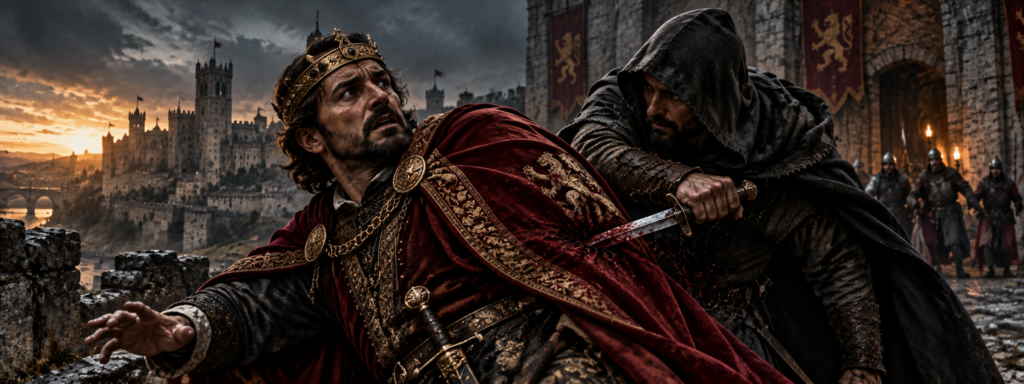
Sancho II of Castile: The King Betrayed and Murdered at the Siege of Zamora
Sancho II of Castile (c. 1036–1072) | King of Castile, 1065–1072 | Briefly ruler of León and Galicia after defeating his brothers | Eldest son of Ferdinand I of León and Sancha of León | Brother of Alfonso VI, García II, Urraca, and Elvira | Known as Sancho the Strong | Associated with the legendary exploits of Rodrigo Díaz de Vivar, later celebrated as El Cid | Besieged Zamora in 1072 while attempting to overcome the resistance of his sister Urraca | Traditionally believed to have been assassinated by Vellido Dolfos, also known as Bellido Dolfos, who allegedly gained his confidence through a false defection | Died on 7 October 1072, according to the commonly accepted chronology | His death ended his campaign to reunite his father’s territories and allowed Alfonso VI to recover the throne of León and acquire Castile.
The Assassin Who Walked Out of Zamora
In October 1072, King Sancho II of Castile was approaching the end of a campaign that had brought him closer than ever to controlling the territories once ruled by his father. He had defeated his brothers, driven one into exile, imprisoned another, and extended his authority over lands that had been divided among the children of Ferdinand I. Only one particularly stubborn obstacle remained: the fortified city of Zamora, where his sister Urraca refused to surrender. Sancho had come to break her resistance, but the siege would end not with the fall of the city, but with the king’s own violent death.
According to the most famous version of the story, a man named Vellido Dolfos emerged from Zamora claiming that he wished to abandon its defenders and serve the Castilian king. He allegedly offered Sancho information about a vulnerable section of the city’s defenses, promising to show him a place where the walls might be breached. The opportunity was tempting because Zamora had resisted the royal army, and a successful assault could bring the campaign to an end. Sancho reportedly accepted the man’s guidance, allowing himself to be drawn away from the protection of his guards.
The supposed defector was not what he appeared to be. Once the king was sufficiently isolated, Vellido allegedly turned upon him and drove a weapon into his body, inflicting a fatal wound. The assassin then escaped toward Zamora, leaving the Castilian army without its commander and the kingdom without its king. A campaign intended to complete Sancho’s conquest of his father’s inheritance had ended in an act of treachery remembered for centuries.
The traditional account contains several details that have become famous in Spanish historical memory. Later versions describe Vellido using the pretense of showing Sancho a weak point in the walls, exploiting the king’s confidence, and fleeing through a gate that became associated with the murder. Some narratives add that the attack occurred when Sancho had withdrawn from his attendants for a private bodily necessity, making him particularly vulnerable. These elements belong to a developed medieval narrative tradition, and they cannot all be treated as independently established facts.
The historical foundation of the story is nevertheless substantial. Sancho II was killed during the siege of Zamora in 1072, and his death abruptly ended a series of successful campaigns against his own family. The assassination became closely associated with Vellido Dolfos, although the precise circumstances of the killing and the role of individual conspirators remain uncertain. Medieval chronicles and later literary traditions transformed the event into a dramatic account of deception, loyalty, and political betrayal.
The murder also created an extraordinary reversal of fortune. Sancho had spent years attempting to reunite the territories divided by his father’s succession arrangements, and he had already overcome most of the resistance to his ambitions. His surviving brother Alfonso, who had been defeated and driven from power, suddenly found the political situation transformed. Within a short time, Alfonso would emerge as ruler of the territories Sancho had fought to control.
The irony was difficult to escape. Sancho had defeated armies, seized kingdoms, and forced members of his own family into submission, but he could not protect himself against a single man who allegedly approached him under the appearance of friendship. His death demonstrated the vulnerability of kingship in a political world where personal loyalty could be as important as military strength. The walls of Zamora remained standing, while the ruler who had come to conquer the city was carried away dead.
Born Into a Dynasty of Conquest and Rivalry
Sancho was born around 1036 into one of the most powerful ruling families in northern Iberia. His father, Ferdinand I, had acquired authority over Castile and León through a combination of inheritance, marriage, and military victory. His mother, Sancha of León, belonged to the Leonese royal dynasty and provided an important source of legitimacy for Ferdinand’s rule. Their children inherited not only substantial political advantages but also the competing claims and ambitions of several territories.
Ferdinand’s rise had been shaped by the violent politics of the early eleventh century. He was a son of Sancho III of Pamplona and Muniadona of Castile, whose family connections linked him to the hereditary Castilian counts. His marriage to Sancha of León strengthened his position within the Leonese political world. After the death of King Bermudo III at the Battle of Tamarón in 1037, Ferdinand became king of León.
The circumstances of Ferdinand’s accession were particularly significant for his eldest son. The new ruler had acquired power through a combination of dynastic legitimacy and military success, establishing a political model in which inheritance and conquest could reinforce one another. His authority extended across territories with distinct traditions and powerful aristocratic families. Maintaining control required military strength, diplomacy, and careful management of regional loyalties.
Sancho grew up in a royal household where warfare was an ordinary part of political life. Christian rulers competed with one another while also confronting the Muslim-ruled territories of al-Andalus. Military campaigns could secure tribute, strengthen royal prestige, and expand political influence. A prince expected to inherit authority needed to demonstrate his ability to command followers and defend his family’s interests.
The surviving sources provide limited information about Sancho’s childhood. His exact birth date remains uncertain, and we cannot reconstruct his education or private relationships in detail. Later chronicles emphasize his military career and conflicts with his siblings rather than his early development. The image that survives is therefore primarily that of an ambitious warrior king.
Sancho’s position as Ferdinand’s eldest son was central to his later claims. In many hereditary traditions, seniority provided a powerful argument for receiving the principal inheritance. Yet medieval succession practices varied, and rulers could distribute territories among several sons. Ferdinand’s eventual decision to divide his possessions would create the conflict that defined Sancho’s reign.
Ferdinand I: The Father Who Built a Powerful Kingdom
Ferdinand I became one of the most influential Christian rulers of eleventh-century Iberia. His authority over León and Castile provided substantial military and political resources, while his dynastic relationships connected him to Pamplona and other important territories. During his reign, the political balance of the peninsula changed as Muslim-ruled al-Andalus remained divided among competing taifa kingdoms. Ferdinand exploited those divisions to strengthen his own position.
The collapse of the Umayyad Caliphate of Córdoba had created numerous independent Muslim principalities. These taifa states competed with one another and sometimes sought assistance from Christian rulers against their rivals. Ferdinand used military pressure and diplomacy to obtain payments and political concessions. The resulting system of tribute, often described through the term parias, became an important source of wealth for northern Christian monarchies.
Military success strengthened Ferdinand’s reputation. His campaigns extended his influence into territories south of the traditional Christian frontier, and he became associated with victories against Muslim rulers. The conquest of Coimbra in 1064 was among the significant achievements of his reign. Such successes enhanced the resources available to his family and reinforced the prestige of the monarchy.
Ferdinand also supported religious institutions and cultivated the image of a Christian ruler. Royal patronage helped connect political authority with monasteries, churches, and the commemoration of dynastic ancestors. León remained an important center of royal ceremony and memory. These religious connections would later shape the burial and remembrance of his children.
Yet Ferdinand’s achievements created a succession problem. His authority extended across territories with different political histories, and he had several children who could claim a share of the inheritance. A settlement intended to preserve family interests could also create rival courts and competing ambitions. The greater the territory divided, the greater the potential consequences of disagreement.
The king’s final arrangements would become one of the most consequential decisions of his reign. Rather than leaving all his territories to Sancho, he distributed authority among his sons and made provisions for his daughters. The arrangement reflected the dynastic practices and political calculations of the period. It also established the conditions for a violent struggle after his death.
The Division That Turned Brothers Into Enemies
Ferdinand I died in December 1065, leaving his children an inheritance that was both impressive and dangerously divided. Sancho received Castile, Alfonso received León, and García received Galicia, together with associated territories and claims. Their sisters Urraca and Elvira received important lordships and interests connected with royal cities and religious institutions. The division created several centers of authority within lands that Ferdinand had governed under a single monarchy.
Sancho’s inheritance of Castile gave him substantial power, but it did not satisfy the ambitions later attributed to him. As the eldest son, he could regard the division as a reduction of what he believed should have been his principal inheritance. Alfonso possessed León, a kingdom with prestigious royal traditions and important religious associations. García controlled Galicia and territories in the western part of the peninsula.
The settlement did not necessarily make war inevitable. Medieval rulers frequently divided territories among heirs, and such arrangements could function when family members accepted their respective positions. The difficulty arose when rival claims, military opportunities, and personal ambitions undermined cooperation. Ferdinand’s sons possessed the resources to challenge one another rather than remain dependent upon a single senior ruler.
Sancho’s claim to greater authority was strengthened by his military reputation. Castile had developed a powerful warrior aristocracy, and its king could command followers accustomed to frontier campaigns. Alfonso also possessed significant resources through León, while García’s western territories had their own aristocratic networks. The brothers therefore inherited not only lands but also competing military establishments.
The division also affected their sisters. Urraca’s association with Zamora gave her a position of political importance, while Elvira was connected with Toro and other interests. Their roles cannot be reduced to passive dependence upon their brothers. Royal women could control property, exercise patronage, and influence dynastic politics through their own networks.
The arrangement established by Ferdinand therefore created a fragile balance. Each child possessed a recognized place within the family settlement, but the territories remained connected by shared history and competing claims. Sancho’s determination to expand his authority would eventually destroy that balance. The conflict began with military rivalry and ended in the murder of the man who had sought to reunite the inheritance.
Sancho the Strong: A King Who Wanted More
Sancho II became king of Castile after his father’s death in 1065. His position was strengthened by the military traditions of the territory and by his status as Ferdinand’s eldest son. He inherited a court whose aristocrats had long played an important role in frontier warfare. His reign would become dominated by the pursuit of authority beyond the lands originally assigned to him.
Later historical tradition remembered Sancho as el Fuerte, or Sancho the Strong. The epithet reflected his reputation as an energetic military ruler whose campaigns brought him repeated victories. It also distinguished him from other members of the dynasty who possessed different political reputations. Such nicknames were shaped by historical memory and should not be mistaken for comprehensive contemporary judgments.
Sancho’s ambitions developed within a political environment where conquest was an accepted means of expanding royal power. Medieval rulers frequently asserted hereditary claims through military campaigns when negotiation failed. Victory could establish authority over territories whose legal status remained disputed. The possession of armed followers was therefore central to the practical exercise of kingship.
The king’s position also depended upon the loyalty of powerful nobles. Aristocrats supplied troops, advised the ruler, and helped administer territories. Their support could make a campaign successful, but their opposition could threaten even a legitimate monarch. Sancho’s ability to command such men contributed to his early victories.
Among the figures later associated with his court was Rodrigo Díaz de Vivar, the warrior who became famous as El Cid. Rodrigo’s historical career began within the political world of Sancho’s reign, and later traditions portrayed him as a prominent military supporter of the Castilian king. The extent of his precise role in individual campaigns is not always clear. Nevertheless, the association became one of the most enduring features of Sancho’s historical reputation.
Sancho’s military ambitions would eventually bring him into direct conflict with his brothers. His attempts to control their territories transformed a divided inheritance into a series of wars. The victories strengthened his authority but also created enemies within his own family. By the time he reached Zamora, his political success had become inseparable from the resentment generated by his conquests.
The War of the Three Brothers
The struggle among Ferdinand’s sons developed through a series of confrontations rather than a single continuous campaign. Sancho, Alfonso, and García possessed competing interests, and their relationships were shaped by shifting alliances. Military conflict offered opportunities to expand authority at the expense of a brother. The resulting wars exposed the instability of the succession settlement.
Sancho’s rivalry with Alfonso became particularly important. León possessed the prestige of an established royal center, and control of the kingdom would greatly strengthen the Castilian ruler’s position. Alfonso had inherited León legitimately under Ferdinand’s arrangements, but that did not prevent Sancho from challenging him. The conflict therefore involved competing interpretations of dynastic rights as well as personal ambition.
García’s position in Galicia was also vulnerable. His western territories were politically significant but exposed to pressure from his brothers. The aristocratic networks of Galicia and the future Portuguese lands added complexity to his rule. Internal opposition and family rivalry weakened his ability to maintain authority.
The brothers’ conflicts unfolded against the wider background of Iberian politics. Christian rulers continued negotiating with and fighting Muslim taifa states, while tribute arrangements provided resources for military campaigns. A king who controlled more territory could command more troops and acquire greater wealth. These incentives made expansion particularly attractive.
The surviving chronicles do not always provide consistent accounts of every military movement. Later writers sometimes organized the conflicts into simplified narratives that emphasized Sancho’s ambition or Alfonso’s eventual triumph. The broad sequence of conquest and displacement is clear, but individual episodes require careful interpretation. The historian must distinguish the established political outcomes from the dramatic details preserved by later tradition.
The wars ultimately transformed the inheritance of Ferdinand I. Sancho emerged as the most successful military claimant, while his brothers lost their positions. Yet victory on the battlefield did not eliminate the political loyalties attached to the defeated rulers. Those loyalties would become especially important when Sancho confronted the resistance of Zamora.
The Battle of Llantada: Brothers Meet in War
One of the early confrontations between Sancho and Alfonso occurred at the Battle of Llantada in 1068. The armies of Castile and León met in a conflict that demonstrated how quickly Ferdinand’s divided inheritance had become a source of warfare. Sancho’s forces emerged victorious, strengthening his military reputation. The battle did not immediately remove Alfonso from the throne, but it intensified the rivalry between the brothers.
The causes of the confrontation remain connected to the broader struggle over territory and royal authority. Sancho sought to strengthen his position relative to León, while Alfonso defended the inheritance assigned to him. The battle was therefore part of a developing contest rather than an isolated dispute. Its outcome encouraged further military pressure.
Later traditions associated the conflict with formal agreements or challenges between the brothers. Some narratives present the battle as an attempt to settle their rivalry through a predetermined military contest. Such details should be treated cautiously because medieval chroniclers sometimes imposed dramatic structures upon complex political events. The essential historical point is that Sancho defeated Alfonso without immediately securing permanent control of León.
The victory increased Sancho’s prestige among his supporters. A king who could defeat a rival monarch in battle demonstrated military effectiveness and strengthened the confidence of his followers. Success could also attract aristocrats who preferred to support the stronger claimant. The result therefore had political consequences beyond the battlefield.
For Alfonso, the defeat was serious but not yet decisive. He retained the throne of León and continued to possess important supporters. The rivalry remained unresolved, leaving open the possibility of another confrontation. The brothers’ relationship had moved beyond political competition into open warfare.
The Battle of Llantada also foreshadowed the pattern that would dominate the following years. Sancho would repeatedly use military force to challenge the territorial settlement created by his father. Each victory brought him closer to reunification but increased the number of people with reasons to oppose him. His eventual death would demonstrate the limits of military success when political resentment remained unresolved.
García of Galicia: The Brother Who Lost His Kingdom
García, the youngest of Ferdinand’s three sons, inherited Galicia and associated western territories. His position was complicated by the political influence of powerful regional aristocrats and the ambitions of his brothers. The western lands possessed their own traditions and noble networks, making effective government difficult. García’s reign became increasingly vulnerable as Sancho and Alfonso pursued their competing interests.
The conflict involving Galicia developed through military pressure and dynastic rivalry. Sancho eventually defeated García and deprived him of effective control over his kingdom. The precise sequence of campaigns and negotiations is not always consistently described in the surviving sources. Nevertheless, García’s displacement formed an important stage in Sancho’s effort to reunite his father’s territories.
García’s loss demonstrated the weakness of the succession settlement. A son who had received a recognized inheritance could be removed by a brother with greater military strength. The formal division of Ferdinand’s possessions offered little protection when one claimant refused to accept its permanence. The conflict also revealed how aristocratic loyalties could shift in response to military success.
The treatment of García after his defeat varied across the political developments of the following years. He experienced displacement and later imprisonment, and his eventual fate would be shaped by Alfonso VI’s rule. His career became an example of the dangers faced by royal brothers whose claims threatened a more powerful monarch. The struggle for the inheritance did not end when Sancho died.
Sancho’s success against García strengthened his position but did not resolve his conflict with Alfonso. León remained the most prestigious prize among the divided territories. Control of Galicia brought additional resources and influence, making further conquest more feasible. The Castilian king was moving steadily toward the reunification he desired.
The defeat of García also carried a warning for the rest of the family. Sancho had demonstrated that he was willing to remove a brother from power in pursuit of greater authority. His sisters could not assume that their own interests would remain untouched. The eventual confrontation at Zamora would develop from this increasingly aggressive dynastic struggle.
Golpejera: The Battle That Destroyed Alfonso’s Reign
The decisive confrontation between Sancho and Alfonso occurred at the Battle of Golpejera in 1072. The battle ended with Sancho’s victory and Alfonso’s loss of the Leonese throne. Later traditions associated the campaign with the military abilities of Rodrigo Díaz de Vivar and other Castilian nobles. The outcome brought Sancho closer than ever to controlling the territories once ruled by Ferdinand I.
The surviving narratives describe a fierce struggle between the brothers’ armies. Some later accounts include dramatic reversals during the battle and emphasize the actions of individual commanders. These details are not all equally secure, but the political result is clear. Alfonso was defeated and removed from power.
Alfonso’s immediate fate involved capture and subsequent exile. He eventually found refuge at the court of al-Mamun, the Muslim ruler of Toledo, whose political interests made him willing to receive the displaced Christian king. The episode illustrates the flexibility of medieval Iberian diplomacy. Christian and Muslim rulers could cooperate when dynastic circumstances made such relationships advantageous.
Sancho’s victory transformed his political position. He had overcome the brother who controlled León and could now claim authority over the principal territories divided by Ferdinand. The reunification of the inheritance appeared within reach. Yet the defeat of Alfonso did not mean that every Leonese aristocrat accepted Sancho willingly.
The conquest created a problem that military victory alone could not solve. Alfonso possessed supporters whose loyalties were connected to his legitimate inheritance and his personal relationships. Some nobles might accept Sancho’s rule, while others could resist or seek opportunities to restore the defeated king. The political consequences of conquest therefore extended beyond the battlefield.
Among those who remained opposed to Sancho was his sister Urraca. Her position at Zamora gave her access to a fortified city capable of resisting an army. She became the central figure in the final challenge to Sancho’s ambitions. The king who had defeated his brothers would now confront a sister who refused to surrender.
Alfonso VI: The Brother Driven Into Exile
Alfonso’s defeat at Golpejera temporarily ended his reign in León. He had inherited the kingdom from Ferdinand I and exercised royal authority for several years, but Sancho’s military success deprived him of his position. His exile placed him outside the territories he had governed. The future of his political career appeared uncertain.
The court of Toledo offered Alfonso a place of refuge. Al-Mamun, the Muslim ruler of the city, possessed interests that extended into the rivalries among Christian monarchs. Supporting or sheltering a displaced king could provide diplomatic advantages. Alfonso’s presence therefore reflected the practical political relationships that existed across religious boundaries.
Later narratives sometimes portray Alfonso’s exile as a period of humiliation and uncertainty. Such descriptions are understandable given the loss of his throne, but the sources do not permit a detailed reconstruction of his private feelings. What can be established is that he remained alive and politically significant. His claim to León had not disappeared simply because Sancho had defeated him.
The exile also complicated Sancho’s position. A displaced ruler with a recognized hereditary claim could become a focus for opposition. Supporters dissatisfied with Sancho might regard Alfonso as a legitimate alternative. The Castilian king therefore faced the challenge of consolidating authority while his defeated brother remained available for restoration.
Urraca’s resistance at Zamora became especially important in this context. Later tradition emphasized her loyalty to Alfonso and her opposition to Sancho’s conquest. Her position created a fortified center of resistance at a moment when Sancho was attempting to complete his control of the inheritance. The conflict between brother and sister would become the setting for the king’s assassination.
Alfonso’s eventual return to power would be one of the most dramatic consequences of Sancho’s death. The brother who had been driven into exile would inherit the political opportunities created by the murder. His restoration would also generate later legends about suspicion, loyalty, and the circumstances of Sancho’s assassination. Those traditions would become closely associated with the figure of El Cid.
Urraca of Zamora: The Sister Who Refused to Surrender
Urraca, daughter of Ferdinand I and Sancha of León, occupied an important position within the royal family. She had received authority and interests associated with Zamora, a fortified city of considerable strategic importance. Her political influence was strengthened by her dynastic status and relationships with powerful nobles. She became one of the central figures in the resistance to Sancho’s attempt to reunite his father’s territories.
Urraca’s position should not be reduced to that of a helpless princess awaiting rescue. Medieval royal women could exercise authority through property, patronage, family connections, and relationships with military leaders. Zamora provided her with a defensible political base. Her refusal to surrender demonstrated that she possessed the resources and support necessary to challenge her brother.
Later chronicles and literary traditions frequently portrayed Urraca as a devoted supporter of Alfonso. Her resistance to Sancho was therefore interpreted as part of a wider effort to preserve or restore Alfonso’s position. The exact motivations of the city’s defenders were probably more complicated, involving local loyalties and political interests as well as family relationships. Nevertheless, Urraca became the symbolic leader of the opposition.
Sancho’s decision to besiege Zamora placed him in direct conflict with his sister. He had already defeated his brothers and acquired control over their territories, but Urraca refused to accept his authority over the city. The confrontation therefore represented the continuation of the family struggle by different means. The king would now attempt to overcome fortified resistance rather than defeat an opposing army in open battle.
The city’s position made the siege difficult. Zamora possessed formidable defenses and occupied an important location near the River Duero. Its walls and fortified approaches gave defenders opportunities to resist a larger attacking force. The king could not simply assume that his previous victories would guarantee a quick surrender.
Urraca’s later reputation was shaped by the events of the siege. She became associated with loyalty, determination, and the defense of a city against a powerful royal army. The assassination of Sancho transformed her resistance into one of the most famous episodes of medieval Castilian and Leonese history. Yet the question of whether she had any involvement in the murder remains unresolved.
Zamora: The Fortress That Defied a King
Zamora occupied a strategically important position in the kingdom of León. Its location near the Duero gave it military and political significance, while its fortifications made it difficult to capture. The city had been shaped by centuries of frontier conflict and royal investment. By Sancho’s reign, it represented a valuable stronghold whose possession could influence control over the surrounding region.
The defenses of Zamora were central to the traditional account of the siege. Fortified walls, towers, and controlled entrances allowed defenders to resist attacks and limit access. A besieging army needed to overcome these obstacles through assault, blockade, negotiation, or the exploitation of a vulnerable point. The difficulty of the task created opportunities for deception.
Sancho’s army arrived with the objective of forcing the city to submit. His previous victories had demonstrated his ability to defeat rival rulers, but a fortified siege presented different challenges. The defenders could remain behind walls rather than risk open battle. The king’s forces had to maintain pressure while searching for an opportunity to breach the defenses.
Medieval sieges could involve considerable suffering. Armies might devastate surrounding lands, interrupt supplies, and place pressure upon civilians as well as soldiers. Defenders faced the possibility of hunger, disease, and eventual assault. The surviving evidence does not permit a detailed reconstruction of every hardship experienced at Zamora in 1072, but the general dangers of siege warfare were substantial.
The city also possessed political importance because it was associated with Urraca. Its resistance represented more than the refusal of a local garrison to surrender. It was a challenge connected to the dynastic conflict that had divided Ferdinand’s children. Sancho’s inability to secure immediate submission demonstrated that his authority remained contested.
The siege therefore became the final stage of the king’s campaign to reunite his father’s inheritance. He had overcome his brothers through military force, but Zamora continued to resist. The traditional account of Vellido Dolfos would transform the city’s defenses into the setting for a fatal deception. The king’s search for a way inside the walls would allegedly lead him outside the protection of his own guards.
Vellido Dolfos: The Man Remembered as the King’s Killer
Vellido Dolfos, also known in later traditions as Bellido Dolfos, became one of the most notorious figures in the story of Sancho’s death. He was remembered as a man connected to Zamora who gained access to the Castilian king through deception. His alleged actions transformed him into a symbol of treachery in later historical and literary accounts. Yet the historical evidence concerning his identity and precise role is less secure than the popular narrative suggests.
The traditional account describes Vellido as leaving the besieged city and approaching Sancho under the pretense of defection. He allegedly claimed that he could reveal a vulnerable section of Zamora’s defenses. The offer appealed directly to the king’s military objective because a successful breach could end the siege. Sancho reportedly accepted the information and allowed Vellido to guide him.
The deception depended upon the appearance of loyalty. A man who abandoned a besieged city might be regarded as a valuable source of intelligence, particularly if he possessed knowledge of its defenses. Such defectors could provide information about gates, walls, supplies, and internal disagreements. Their assistance might allow a besieging army to achieve a victory that had otherwise proved difficult.
Vellido’s alleged plan exploited this possibility. He presented himself as someone willing to betray Zamora, but the betrayal was supposedly directed against Sancho instead. The king’s confidence became the means through which the attacker gained access to him. The story therefore reverses the expected relationship between defector and ruler.
The surviving accounts do not establish whether Vellido acted alone or with the support of others. Later traditions sometimes connect him to the defenders of Zamora and imply that his actions served their political interests. Such associations have encouraged speculation about wider involvement in the assassination. The evidence, however, does not conclusively identify a conspiracy organized by Urraca or other leading figures.
Vellido’s reputation was shaped by the moral judgments of later writers. From a Castilian perspective, he was the assassin who murdered a king through deception. From the perspective of those defending Zamora, the killing could be interpreted as an act that saved the city from conquest. The competing meanings reveal how political loyalty influenced the remembrance of violence.
The False Defection That Led Sancho to His Death
The most famous version of the assassination begins with Vellido approaching Sancho’s camp as a supposed deserter from Zamora. He allegedly claimed to know a place where the city’s defenses could be overcome. The king, frustrated by resistance and eager to complete his campaign, was persuaded to investigate. The opportunity appeared to offer a solution to the problem that had delayed his conquest.
The account presents the king’s decision as a fatal error of judgment. Sancho had defeated experienced military opponents, but he allegedly placed confidence in a man whose loyalty had not been established. The apparent value of the information encouraged him to accept a dangerous situation. The story thus connects the king’s ambition directly to his vulnerability.
Later retellings differ concerning the exact circumstances in which Sancho became separated from his attendants. Some describe the king riding or walking with Vellido toward the walls, while others emphasize a moment when he was alone for a private necessity. These details became part of the dramatic tradition surrounding the assassination. They should not be presented as certain facts because the surviving sources do not provide a consistent contemporary reconstruction.
The central accusation is that Vellido deliberately isolated the king before attacking him. The method avoided the need to confront Sancho’s guards or the royal army directly. It relied upon personal access rather than military strength. The assassination was therefore remembered as a calculated act of deception.
The location near the walls also carried symbolic importance. Sancho had come to find a way into Zamora, but the supposed guide led him toward death instead. The city’s defenses remained intact while the king’s own security failed. The contrast became one of the most memorable features of the story.
Whether every detail occurred as later writers described cannot be established. The historical record supports Sancho’s violent death during the siege, while the elaborate sequence involving a false defection belongs to the developed narrative tradition. The distinction does not diminish the importance of the event. It reveals how medieval writers explained a sudden political catastrophe through a story of betrayal.
The Fatal Stabbing
According to the traditional account, Vellido attacked Sancho after gaining an opportunity to approach him without adequate protection. The weapon is commonly described as a spear or similar pointed implement in some versions, while later popular retellings frequently describe a stabbing with a dagger. The precise weapon and sequence of the attack are not securely established. What the tradition consistently emphasizes is that the king was struck unexpectedly and fatally.
The suddenness of the assault was central to its remembered character. Sancho had not been defeated in a formal battle or captured by an opposing army. He was allegedly killed by a man who had presented himself as a potential ally. The attack therefore represented a personal betrayal rather than a conventional military victory.
The surviving sources do not preserve a reliable medical description of Sancho’s injuries. We cannot determine the exact number of wounds, the direction of the attack, or how long he survived afterward. Later narratives sometimes describe the king’s final moments in dramatic detail, but such scenes should not be treated as documented eyewitness testimony. The historical conclusion is that he died violently during the siege in 1072.
The assassination immediately transformed the political situation. Sancho’s army lost the ruler whose ambition had directed the campaign. His supporters faced the problem of succession while still engaged in a military operation against a fortified city. The defenders of Zamora no longer confronted the same threat.
The murder also destroyed the apparent success of Sancho’s earlier conquests. He had defeated Alfonso, displaced García, and extended his authority over their territories. His death left no direct heir capable of continuing his rule. The political settlement created through military victory therefore became vulnerable to immediate reversal.
The fatal attack became one of the most famous examples of royal assassination in medieval Spanish tradition. Its power lay in the contrast between Sancho’s military strength and his personal vulnerability. The king who had defeated armies was remembered as falling to a single attacker. His death demonstrated that political conquest could be undone by an act of violence outside the battlefield.
The Assassin’s Escape and the Gate of Zamora
Later traditions describe Vellido fleeing toward Zamora immediately after attacking the king. The city’s gates and walls became central to the story of his escape. According to the familiar narrative, he managed to return inside the fortress before Sancho’s followers could capture him. The escape transformed the assassination into a public humiliation for the besieging army.
The gate associated with the tradition became known in later memory as the Portillo de la Traición, or Gate of Treason. The name reflected the interpretation of Vellido’s actions as a betrayal of the king. In modern commemorative usage, the location has also been associated with the name Portillo de la Lealtad, or Gate of Loyalty, emphasizing the perspective of those who defended Zamora. The competing names reveal how the same event can be remembered differently according to political allegiance.
The identification of a particular gate does not establish every detail of the escape. Medieval cities changed over time, and later traditions often attached famous events to recognizable surviving landmarks. The precise route taken by the assassin cannot be reconstructed with certainty. Nevertheless, the association between Vellido’s flight and Zamora’s walls became an enduring part of the story.
The escape also created a problem for Sancho’s followers. The alleged killer had reached a fortified city whose defenders were already resisting the royal army. Capturing him would require either the cooperation of Zamora’s authorities or the successful conquest of the fortress. The death of the king made both possibilities more difficult.
Later narratives describe anger and confusion among the Castilian forces. Such reactions are plausible, but the sources do not provide a complete contemporary record of the army’s immediate response. The political consequences are clearer than the personal emotions of individual soldiers. Sancho’s death deprived the campaign of its central authority.
The gate tradition illustrates the continuing power of the assassination in local memory. For some, Vellido remained the treacherous murderer of a king. For others, his action could be interpreted as an intervention that preserved the city’s independence from Sancho’s conquest. The historical event became a symbol through which later generations debated loyalty, resistance, and political legitimacy.
Did Urraca Order Her Brother’s Murder?
The question of Urraca’s involvement has surrounded the assassination for centuries. She was the principal dynastic figure associated with Zamora’s resistance and possessed an obvious political interest in preventing Sancho from taking the city. The killing removed the military threat directed against her position. These circumstances have encouraged speculation that she may have known about or supported the attack.
The surviving evidence, however, does not establish that Urraca ordered the assassination. Later chronicles and literary traditions developed different interpretations of her relationship with Vellido. Some accounts emphasize her role as a determined defender of Zamora, while others associate the murder with the political interests of the city’s leadership. The existence of a plausible motive does not demonstrate direct involvement.
Urraca’s position was complicated by her relationships with both Sancho and Alfonso. Sancho was her brother and the ruler attempting to seize the city, while Alfonso was another brother whose restoration could benefit from Sancho’s defeat. Her resistance therefore had a dynastic dimension beyond the defense of a single fortress. Nevertheless, the precise calculations guiding her actions remain uncertain.
The accusation of involvement also reflects the tendency of later writers to explain political violence through recognizable personal motives. A king killed while besieging his sister’s city invites speculation about family conspiracy. The narrative becomes more dramatic when the murder is connected to the rivalries among Ferdinand’s children. Yet historical plausibility is not the same as proof.
Urraca’s later reputation was shaped by competing political traditions. She could be celebrated as a courageous defender of Zamora or portrayed as a figure whose resistance contributed to her brother’s death. These interpretations reveal more about the values of later audiences than they necessarily establish about her actions in 1072. A balanced account must preserve the uncertainty.
The safest conclusion is that Urraca led or symbolized the resistance that Sancho sought to overcome, and his death ended the immediate threat to Zamora. Whether she knew of Vellido’s alleged plan cannot be demonstrated from the surviving evidence. Her political interests were closely connected to the outcome, but her personal responsibility remains unproven. The distinction is essential to understanding the assassination without turning suspicion into fact.
Rodrigo Díaz de Vivar: El Cid and the Murdered King
Rodrigo Díaz de Vivar, later celebrated as El Cid, became one of the most famous figures associated with Sancho II’s reign. He belonged to the Castilian military aristocracy and developed his career within the political world of Ferdinand’s sons. Later traditions portrayed him as a loyal supporter of Sancho and an important participant in his campaigns. His association with the king became central to the legendary history of the period.
Rodrigo’s military abilities helped establish his reputation during the conflicts of the late eleventh century. He served powerful rulers and participated in campaigns that brought him into contact with both Christian and Muslim political authorities. His career was shaped by the practical realities of Iberian warfare, where alliances could cross religious and dynastic boundaries. The later heroic image of El Cid developed from this complex historical background.
The traditions surrounding Sancho’s assassination gave Rodrigo a particularly important role. Later stories describe him reacting to the king’s death and becoming involved in the political tensions surrounding Alfonso’s accession. These narratives helped establish the image of Rodrigo as a warrior whose loyalty and personal honor could place him in conflict with royal authority. The details, however, cannot all be verified.
The most famous associated legend concerns the alleged oath demanded of Alfonso VI at Santa Gadea. According to later tradition, Rodrigo required Alfonso to swear that he had not been involved in Sancho’s murder before accepting him as king. The story became a powerful symbol of the tension between loyalty to a murdered ruler and obedience to his successor. Modern historians generally regard the elaborate oath narrative as a later legendary development rather than a securely documented event.
The legend nevertheless reveals the suspicion that surrounded Sancho’s death in later memory. Alfonso benefited directly from his brother’s assassination and returned from exile to acquire the territories Sancho had conquered. Such circumstances provided fertile ground for stories about hidden involvement and public demands for innocence. The oath narrative offered a dramatic means of addressing those suspicions.
Rodrigo’s historical relationship with Alfonso was more complicated than the legend suggests. He served Alfonso after Sancho’s death and later experienced periods of conflict and exile. His career cannot be reduced to permanent hostility toward the new king. The famous stories surrounding El Cid reflect the development of medieval heroic literature as much as the documented political history of the period.
The Legend of Santa Gadea
The alleged oath at Santa Gadea became one of the most memorable episodes associated with the aftermath of Sancho’s assassination. In the traditional story, Alfonso was required to deny involvement in his brother’s murder before being accepted as ruler. Rodrigo Díaz de Vivar was portrayed as the man who demanded the oath, confronting the new king with the suspicions surrounding his accession. The scene became a dramatic expression of aristocratic honor and distrust.
The story’s popularity reflects the political circumstances of 1072. Alfonso had been defeated and driven into exile, while Sancho had acquired control over León. The sudden murder of Sancho transformed Alfonso’s prospects and allowed him to return to power. Later audiences naturally questioned whether the beneficiary of the assassination might have been involved.
The oath narrative provided a way to address those suspicions without necessarily accusing Alfonso directly. By requiring a public denial, the story acknowledged the possibility of wrongdoing while allowing the king to assert his innocence. Rodrigo’s role emphasized the moral authority of a warrior loyal to the murdered ruler. The confrontation also dramatized the tension between royal power and aristocratic independence.
Yet the historical basis of the episode is weak. The elaborate scene belongs to later literary and chronicle traditions rather than securely contemporary evidence. There is no reliable basis for reconstructing the exact words supposedly spoken or the ceremonial details of the oath. The narrative should therefore be treated as legend rather than established fact.
The story also influenced the later image of Alfonso VI. He became associated with the suspicion generated by his brother’s death, even though the surviving evidence does not establish his involvement in the assassination. Political benefit alone cannot prove conspiracy. The distinction between suspicion and evidence is especially important when later literature has made an accusation famous.
The legend of Santa Gadea remains historically significant because it reveals how Sancho’s death continued to shape political memory. The assassination was not forgotten once Alfonso recovered the throne. Instead, it became part of a larger narrative about legitimacy, loyalty, and the obligations of kings. The event acquired a moral significance that extended beyond the immediate succession crisis.
Alfonso VI: The Brother Who Inherited the Dead King’s Conquests
Sancho’s assassination transformed Alfonso’s political future. The brother who had been defeated and driven into exile suddenly possessed an opportunity to recover the territories he had lost. Sancho left no direct heir capable of maintaining his conquests. The political situation therefore shifted rapidly in Alfonso’s favor.
Alfonso returned to power and acquired authority over León and Castile. His position was strengthened by his hereditary claim and by the disappearance of the brother who had defeated him. The restoration also depended upon the recognition and cooperation of powerful aristocrats. Medieval succession required political acceptance as well as dynastic legitimacy.
The transition did not eliminate every problem created by Ferdinand’s divided inheritance. García, the youngest brother, remained a potential claimant whose position could complicate the reunification. Alfonso eventually secured control over Galicia and confined García, who spent much of the remainder of his life imprisoned. The fate of the youngest brother demonstrated that the struggle for power continued after Sancho’s death.
Alfonso’s reign would become one of the most important in medieval Iberian history. He expanded his influence over Christian and Muslim territories and eventually captured Toledo in 1085. The conquest represented a major political and symbolic achievement. His authority extended across lands that had been divided among Ferdinand’s sons.
The contrast with Sancho is striking. Sancho had attempted to reunite the inheritance through military conquest of his brothers, but his assassination prevented him from consolidating the result. Alfonso eventually achieved a similar concentration of authority through the succession that followed the murder. The surviving brother inherited the political opportunity created by the dead king’s campaigns.
This outcome encouraged later speculation about Alfonso’s possible involvement in the assassination. Yet the historical evidence does not establish that he planned or encouraged Vellido’s attack. His restoration can be explained through the succession crisis created by Sancho’s death without assuming a conspiracy. The fact that Alfonso benefited remains politically significant, but it does not prove guilt.
The Body of Sancho II and the Memory of the Dead King
Sancho II’s death created the immediate problem of how to commemorate a ruler whose reign had ended violently. Royal burial was an important political and religious act in medieval Iberia. The treatment of a king’s remains could reinforce dynastic identity and preserve his memory within a religious institution. Sancho’s burial therefore carried significance beyond the practical necessity of interment.
The king was buried at the monastery of San Salvador de Oña, an important religious foundation closely associated with the Castilian ruling dynasty. The monastery had been founded under the patronage of Sancho García, Count of Castile, and maintained strong connections with the region’s aristocratic families. Its association with Sancho II reinforced the connection between the monarchy and Castile’s earlier dynastic traditions. The burial location became an enduring part of his historical memory.
Oña provided a setting in which the king could be commemorated through religious observance. Medieval monasteries preserved the memory of rulers and benefactors through prayers, records, and commemorative practices. Burial within such institutions connected the deceased to the spiritual life of the community. It also strengthened the prestige of the monastery through association with important political figures.
The surviving evidence does not permit a detailed reconstruction of Sancho’s funeral. We cannot identify every participant or describe the ceremonies with certainty. Later accounts may preserve traditions concerning the movement of his body and the reactions of his followers, but they should not be treated as complete eyewitness reports. The burial at Oña remains the most important established element of his commemoration.
The king’s death also became part of the historical identity of Zamora. The city was remembered as the place where Sancho’s attempt to reunite his father’s inheritance came to an end. Local traditions preserved the names of Urraca and Vellido Dolfos, while the gate associated with the assassin’s escape became a recognizable landmark. The memory of the murder therefore survived in both religious and urban settings.
Sancho’s reputation was shaped by the contrast between military success and sudden death. He had defeated his brothers and acquired extensive authority, but he did not survive long enough to establish a stable succession. His burial preserved the memory of a king whose political ambitions remained unfinished. The assassination became the defining event of his reign.
Was Sancho II a Tyrant or a Determined King?
Sancho’s historical reputation has often been influenced by the violence of his campaigns against his siblings. He challenged the inheritance arrangements established by Ferdinand I, defeated his brothers, and attempted to seize the territories they governed. His actions disrupted the political balance of northern Iberia and created serious conflicts within his own family. Later writers therefore had ample material for portraying him as ambitious and ruthless.
Yet the political expectations of eleventh-century kingship complicate a simple judgment. Rulers frequently pursued territorial claims through warfare, and dynastic seniority could provide a basis for challenging divisions of inheritance. Sancho’s belief that he should control a larger share of his father’s territories was not necessarily unusual within his political environment. His methods were violent, but they belonged to a world in which military success was central to royal authority.
His campaigns also demonstrated considerable military effectiveness. He defeated Alfonso at Llantada and Golpejera and overcame García’s position in Galicia. These victories required armed support, strategic planning, and the ability to maintain the loyalty of powerful followers. Sancho was therefore more than an impulsive prince acting without political resources.
Nevertheless, military success did not guarantee stable government. The defeated brothers retained supporters, while Urraca continued resisting at Zamora. Sancho’s conquests created new political obligations and resentments that could not be resolved simply by winning battles. The siege of Zamora demonstrated that opposition remained even after his principal rivals had been removed.
The king’s death also limits any assessment of what he might have achieved. He did not survive long enough to establish a durable administrative settlement across the reunited territories. His reign ended before the political consequences of his conquests could be fully tested. Historians must therefore avoid assuming that his victories would necessarily have produced a stable monarchy.
Sancho was a ruler whose ambitions reflected both the opportunities and dangers of hereditary politics. He sought to reunite territories divided among siblings and used military force to achieve that objective. His successes were substantial, but they generated resistance that culminated in the siege of Zamora. His assassination ended the experiment before its long-term outcome could be known.
The Problem with Medieval Assassination Stories
Sancho’s death is one of the most famous royal assassinations in medieval Spanish history, but its narrative details require careful treatment. The surviving chronicles were written within political and literary traditions that emphasized moral lessons, dynastic legitimacy, and memorable acts of betrayal. Their accounts could preserve genuine historical information while also incorporating later interpretation. The story of Vellido Dolfos developed within this environment.
The central event is well established. Sancho II died violently during the siege of Zamora in 1072, ending his attempt to consolidate authority over his father’s divided territories. His death allowed Alfonso VI to recover power and altered the political balance of northern Iberia. These consequences can be traced through the subsequent history of the monarchy.
The elaborate account of the false defection is less secure. Later narratives describe Vellido offering to reveal a weak point in the walls and drawing the king away from his guards. Some versions add details concerning the weapon, the king’s private movements, and the assassin’s escape. Such elements may preserve genuine memories, but they cannot all be independently verified.
The role of Urraca is also uncertain. Her resistance at Zamora is historically important, and Sancho’s death benefited the defenders of the city. Yet the sources do not establish that she organized the assassination. The same caution applies to Alfonso, whose restoration created later suspicions without providing proof of involvement.
The famous oath at Santa Gadea belongs to a still later layer of tradition. Its dramatic confrontation between Rodrigo Díaz de Vivar and Alfonso VI became central to the legendary history of El Cid. The story reflects concerns about loyalty and legitimacy but cannot be treated as a reliable account of a documented ceremony. Its significance lies primarily in the development of medieval political memory.
The historian must therefore distinguish between the assassination itself and the narrative traditions surrounding it. Sancho’s violent death is a historical fact with major political consequences. The precise circumstances of Vellido’s alleged deception, the involvement of other figures, and the later oath legends remain uncertain. The story is compelling without requiring every dramatic detail to be accepted as fact.
Why Sancho II Belongs Among the Assassinated Rulers & Regicides
Sancho II belongs within the Assassinated Rulers & Regicides category because he was a reigning monarch killed during a military campaign against a fortified city. His death occurred in 1072 while he was attempting to overcome the resistance of Zamora. The traditional account identifies Vellido Dolfos as the assassin and describes a deliberate act of deception that allowed him to approach the king. The killing ended Sancho’s reign and transformed the succession of León and Castile.
The case is particularly significant because Sancho had already achieved major military victories. He had defeated Alfonso, displaced García, and extended his authority over territories divided by Ferdinand I. His assassination prevented him from consolidating those conquests. The sudden death of the ruler changed the political outcome of years of warfare.
The alleged method also makes the case distinctive. Vellido was remembered as pretending to defect and offering military intelligence that could help the king capture Zamora. The promise of a weak point in the walls allegedly drew Sancho away from his guards. The story became a memorable example of how deception could overcome military strength.
The involvement of Sancho’s family adds another layer of political intrigue. His sister Urraca was associated with the defense of Zamora, while Alfonso benefited from the assassination by recovering power. Later traditions raised suspicions about possible involvement by members of the royal family. The surviving evidence does not establish those accusations, but their persistence demonstrates the political significance of the murder.
The case also became closely connected with the legendary history of El Cid. Rodrigo Díaz de Vivar was remembered as a supporter of Sancho, and later stories portrayed him as demanding that Alfonso deny involvement in the assassination. The oath at Santa Gadea became one of the most famous episodes of medieval Spanish literature. Its historical basis remains uncertain, but its cultural influence is substantial.
Sancho’s assassination therefore combines dynastic rivalry, military conquest, aristocratic resistance, alleged deception, and a dramatic succession reversal. It illustrates the vulnerability of a ruler who had defeated armies but remained exposed to personal betrayal. His death reshaped the political future of northern Iberia. Few medieval royal murders produced such immediate consequences or such enduring legends.
The King Who Conquered His Brothers but Could Not Conquer Zamora
Sancho II of Castile inherited a powerful position within one of the most important ruling families of eleventh-century Iberia. His father Ferdinand I had built a monarchy whose territories included Castile and León, while his mother Sancha connected the dynasty to the prestigious Leonese royal line. The inheritance offered extraordinary opportunities for political power. Yet Ferdinand’s decision to divide his possessions among his children created the conflict that would dominate Sancho’s reign.
As the eldest son, Sancho received Castile but pursued authority beyond the territory assigned to him. His military campaigns brought him into conflict with Alfonso of León and García of Galicia. He defeated his rivals and gradually acquired control over much of his father’s former inheritance. By 1072, his ambition to reunite the territories appeared close to success.
The victories came at a considerable cost. Sancho had displaced his brothers and created opposition among those who remained loyal to them. Alfonso was driven into exile, while García lost his political position. The family settlement established by Ferdinand had collapsed into warfare.
Urraca’s resistance at Zamora became the final obstacle. She possessed a fortified city whose defenses allowed her supporters to withstand the Castilian army. Sancho could not complete his conquest without overcoming the resistance associated with his sister. The siege therefore became the decisive confrontation of his final campaign.
According to the traditional account, Vellido Dolfos offered the king a way to achieve victory. He allegedly pretended to defect from Zamora and claimed that he could reveal a vulnerable section of the city’s defenses. Sancho accepted the opportunity and allowed himself to be drawn away from his guards. The promise of conquest became the means through which the assassin approached him.
The attack ended the king’s life. Later traditions describe Vellido striking Sancho unexpectedly and escaping into Zamora. The exact weapon, location, and circumstances remain uncertain, but the violent death of the monarch is historically established. The assassination brought the siege and Sancho’s political ambitions to an abrupt end.
The consequences were immediate. Sancho left no direct heir capable of preserving his conquests, while Alfonso remained alive and possessed a recognized claim to the territories he had lost. The defeated brother returned from exile and acquired authority over León and Castile. The political future that Sancho had attempted to create through warfare passed into the hands of the man he had defeated.
The murder also transformed the reputation of Zamora. The city became associated with resistance against a powerful king and with the alleged deception that caused his death. The gate through which Vellido supposedly escaped became a symbol of treachery for some and loyalty for others. The competing interpretations reveal how historical memory depends upon political allegiance.
Urraca’s role remained controversial. She had resisted Sancho and benefited from the end of the siege, but her involvement in the assassination cannot be established. Alfonso’s restoration likewise encouraged suspicion without proving conspiracy. The surviving evidence does not permit the historian to identify a wider plot with certainty.
The later legends surrounding El Cid added another dimension to the story. Rodrigo Díaz de Vivar became associated with loyalty to the murdered king and with the alleged demand that Alfonso swear his innocence. The oath at Santa Gadea became a celebrated scene in Spanish historical literature. Its power lay in the questions it raised about legitimacy, honor, and the responsibilities of a ruler who inherited power after a suspicious death.
Sancho’s own reputation remains complicated. He was an effective military commander who defeated rival rulers and acquired substantial authority. He was also a king whose ambitions led him into repeated conflict with his siblings. His reign demonstrates how the pursuit of dynastic reunification could produce violence within the ruling family itself.
The assassination exposed the limits of military power. Sancho could command armies and defeat opponents in battle, but his authority depended upon personal loyalty and political acceptance. His victories did not eliminate resistance, and the siege of Zamora demonstrated that fortified opposition could remain dangerous. The king’s death revealed a vulnerability that no battlefield success had removed.
The traditional story of Vellido Dolfos captures that vulnerability with extraordinary simplicity. A man who appeared to offer useful intelligence allegedly persuaded the king to place himself in danger. The promise of a weak point in Zamora’s walls became the pretext for an attack against Sancho himself. The ruler who sought to exploit the city’s defenses was remembered as falling because his own protection failed.
Yet the political consequences were greater than the immediate circumstances of the murder. Alfonso VI emerged from exile to become one of the most important monarchs of medieval Iberia. His later conquest of Toledo and expansion of royal authority transformed the history of the peninsula. Those achievements became possible within a political situation fundamentally altered by Sancho’s death.
The assassination therefore stands at the intersection of family rivalry and historical transformation. Ferdinand’s divided inheritance had produced several competing rulers, and Sancho had attempted to reunite their territories through conquest. His death removed the strongest military claimant and allowed another brother to inherit the result. The struggle for the father’s legacy ended differently from anything Sancho had intended.
The story also demonstrates the enduring power of medieval historical memory. The murder became associated with a named assassin, a fortified city, a determined princess, a displaced king, and the legendary figure of El Cid. Later writers developed these elements into a narrative of betrayal and disputed legitimacy. The resulting tradition remains more detailed than the evidence allows historians to verify.
Sancho II entered the final campaign of his life as a king who had already defeated his principal rivals. He expected to bring Zamora under his authority and complete the reunification of his father’s inheritance. Instead, he died outside the walls of a city that refused to surrender. His political achievements passed to a brother he had driven into exile.
The contrast between his victories and his death explains why the assassination remains so memorable. Sancho had overcome the military strength of his brothers, but the traditional account portrays him as vulnerable to a single man who approached under false pretenses. The king’s ambition brought him to Zamora, while the alleged deception of Vellido Dolfos brought his reign to an end. His death became a reminder that even the most successful conqueror could be defeated by an enemy who did not meet him openly in battle.
In the end, Sancho II never achieved the stable reunification he sought. He conquered territories, defeated royal rivals, and forced his family into submission, but he did not survive to consolidate his authority. The walls of Zamora remained standing as the king’s army confronted the loss of its commander. The brother who had lost everything returned to inherit the political future Sancho had attempted to claim.
Sancho’s story is therefore not simply an account of a king murdered by a supposed defector. It is the history of a divided dynasty, a succession transformed into civil war, and a ruler whose ambition carried him to the edge of complete victory. His assassination ended one political project and made another possible. The man who had fought to possess his father’s kingdoms died before the walls of Zamora, leaving the inheritance he had conquered to the brother he had defeated.