
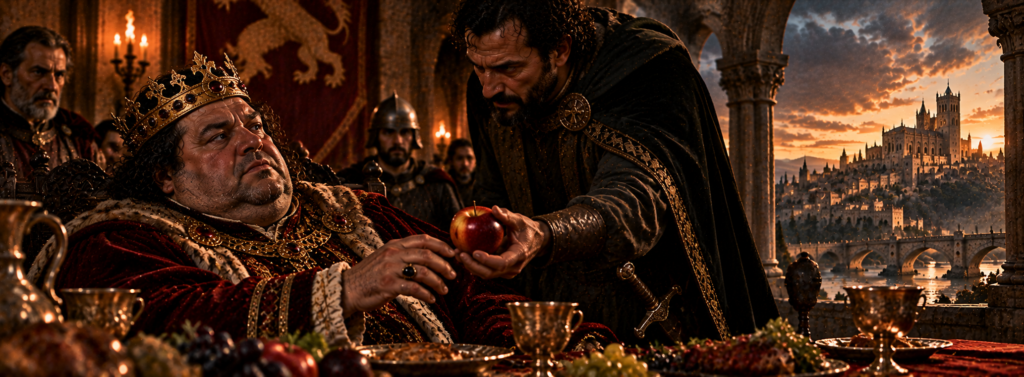
Sancho I the Fat: The King of León Poisoned with an Apple by a Rebellious Count
Sancho I of León (c. 932–966) | King of León, 956–958 and 960–966 | Known as Sancho the Fat or Sancho the Gross | Son of Ramiro II and Queen Urraca Sánchez of Pamplona | Overthrown by rebellious nobles and replaced by Ordoño IV | Restored with assistance from the Umayyad Caliphate of Córdoba | Husband of Teresa Ansúrez and father of Ramiro III | Traditionally believed to have been poisoned with an apple by a rebellious count named Gonzalo | Died in late 966, leaving a young son to inherit a dangerously unstable kingdom.
The Apple That Killed a King
In the closing weeks of 966, Sancho I of León entered the final chapter of a reign that had already included humiliation, betrayal, exile, and an extraordinary return to power. He had survived the loss of his throne, endured the contempt of nobles who considered him unfit to govern, and sought help from the Muslim rulers his predecessors had spent generations fighting. He had even become the subject of one of medieval Europe’s most remarkable medical stories, undergoing treatment for the obesity that had supposedly contributed to his downfall. Yet after surviving all these dangers, the king would reportedly die because he accepted a piece of fruit from a man who had every reason to want him dead.
The traditional account of Sancho’s assassination is deceptively simple. During a campaign against rebellious aristocrats in the western territories of his kingdom, the king encountered a powerful count named Gonzalo, who allegedly offered him an apple containing poison. Sancho accepted the fruit, became gravely ill, and died shortly afterward. The weapon was not a sword or spear, but something so ordinary that it could pass from one man’s hand to another without immediately revealing the danger concealed within it.
The story survives in the chronicle of Sampiro, an important source for the history of tenth-century León. Sampiro identifies the suspected poisoner as a powerful figure named Gonzalo and specifically associates the poison with an apple. Later historians have frequently identified the man as Gonzalo Menéndez, an influential aristocrat whose family dominated territories in the region that would eventually become Portugal. However, the chronicle does not preserve his patronymic, and another contemporary nobleman, Gonzalo Muñoz, has also been proposed as the culprit.
That uncertainty matters because Sancho’s death has often been retold with far more confidence than the evidence permits. The poisoning is an established element of the medieval historical tradition, but the precise identity of the killer remains disputed. The circumstances of the meeting, the preparation of the poison, and the king’s final hours are not described in sufficient detail to reconstruct them with certainty. What survives is the accusation that a rebellious magnate used poisoned fruit to eliminate a monarch who had come to challenge his authority.
The irony was particularly bitter because Sancho had spent much of his life struggling against his own reputation. Known to history as Sancho the Fat, he had been mocked and politically undermined because of his extraordinary size. His enemies had treated his physical condition as evidence that he could not fulfill the duties of kingship. When he finally recovered his throne, he discovered that the nobles who had rejected him were no easier to control than before.
His death exposed the fundamental weakness of the Leonese monarchy during the tenth century. Kings could inherit crowns, command armies, and negotiate with powerful foreign rulers, but their authority depended heavily upon aristocratic cooperation. A count who possessed sufficient regional influence could resist royal commands, challenge military campaigns, and perhaps even arrange the murder of the king himself. Sancho’s fate would demonstrate that recovering a throne was not the same as making it secure.
The poisoning also left behind a dangerous political inheritance. Sancho’s son Ramiro III was still a child, and the kingdom would require a regency at a time when powerful nobles were already challenging royal authority. The death of the father created new opportunities for the very aristocratic factions that had made his reign so difficult. The apple, if Sampiro’s account is accurate, did more than kill a man; it removed an adult ruler from a kingdom whose stability was already fragile.
A Prince Born into a Dynasty of Warriors
Sancho belonged to the royal dynasty that had transformed the old Asturian kingdom into the expanding kingdom of León. His father, Ramiro II, was one of the most formidable Christian rulers of tenth-century Iberia. His mother, Urraca Sánchez, belonged to the royal family of Pamplona, connecting Sancho to another important northern kingdom. Through both parents, the young prince inherited a network of dynastic relationships that could provide political advantages but also expose him to dangerous family rivalries.
Ramiro II had obtained the throne after a series of succession disputes involving his own relatives. His rise had been marked by the removal and blinding of rival claimants, including his brother Alfonso IV and other members of the royal family. Such punishments were intended to eliminate the possibility of further rebellion without necessarily executing the defeated men. The violence demonstrated how seriously rulers regarded competing claims to the crown.
Once established, Ramiro became known for his military campaigns against the Umayyad Caliphate of Córdoba. His most celebrated achievement was the victory at Simancas in 939, when Christian forces defeated an army commanded by Caliph Abd al-Rahman III. The battle became an important symbol of Leonese resistance to the growing power of Córdoba. Ramiro’s reputation rested heavily upon his ability to command armies and defend the kingdom.
Sancho therefore grew up beneath the shadow of a father whose military achievements set a demanding standard. Royal masculinity was closely associated with warfare, leadership, and the ability to appear before armed followers as a capable commander. A prince expected to inherit such responsibilities needed the confidence of the aristocracy. Any perceived weakness could become a political liability.
The surviving sources reveal little about Sancho’s childhood. His exact birth date is uncertain, although he was probably born around the early 930s. We do not know when his weight became a subject of concern or how his family responded to it. Later accounts focus so heavily upon his obesity that much of his early life disappears behind the nickname that would define his historical reputation.
That nickname, however, should not obscure his dynastic position. Sancho was a legitimate royal prince with connections to two powerful Christian ruling families. He possessed the ancestry necessary to claim the throne and could draw upon influential relatives for support. His difficulties would arise not because he lacked royal blood, but because the political world into which he was born demanded more than hereditary legitimacy.
Ramiro II and the Violent Inheritance of León
The kingdom Sancho would eventually inherit had been shaped by decades of warfare and internal conflict. Ramiro II had strengthened its military reputation, but his authority rested upon the defeat of rival members of the dynasty. The monarchy remained vulnerable to succession disputes because several branches of the royal family could claim legitimate descent from earlier kings. Powerful nobles could exploit those competing claims whenever a ruler appeared weak.
The victory at Simancas had enhanced Ramiro’s prestige, but it did not eliminate the political influence of the aristocracy. Counts and regional magnates continued controlling substantial territories and military resources. Their support was essential for campaigns against Muslim forces and for maintaining authority in distant parts of the kingdom. The relationship between king and nobility therefore remained one of negotiation as well as command.
Ramiro’s reign also witnessed the growing importance of Castile. The region had developed as a frontier territory where local military leaders acquired substantial influence. Fernán González, who emerged as the dominant count of Castile, became one of the most powerful aristocrats in the kingdom. His ambitions would later play a major role in the struggles surrounding Sancho’s reign.
Galicia and the western territories presented similar challenges. Powerful families possessed extensive estates, controlled local military resources, and maintained relationships with influential monasteries. Royal authority could be recognized in principle while resisted in practice. A king attempting to enforce obedience in these regions needed more than a hereditary title.
Ramiro’s death in 951 opened another succession. His son Ordoño III became king, but Sancho also possessed ambitions and supporters. The brothers belonged to the same dynasty, yet their political interests were not identical. Their rivalry would help establish the pattern of conflict that dominated Sancho’s career.
The death of a powerful ruler often exposed tensions that had remained contained during his lifetime. Ramiro’s military prestige had helped preserve royal authority, but his sons inherited a political world crowded with ambitious nobles. Their competition created opportunities for aristocrats to influence the succession. Sancho’s eventual rise would therefore be inseparable from the conflicts that followed his father’s death.
The Brother Who Stood Between Sancho and the Crown
Ordoño III succeeded Ramiro II in 951, becoming the recognized king of León. His reign was troubled by opposition from powerful aristocrats and members of his own family. Sancho became associated with factions that challenged his brother’s authority. The rivalry demonstrated that the sons of a successful monarch could quickly turn against one another.
Fernán González played an important role in the political struggles of this period. As count of Castile, he possessed military resources and regional influence that made him a valuable ally or dangerous opponent. His relationships with the Leonese royal family were complicated by marriage alliances and competing political interests. He could support one claimant against another when doing so served his ambitions.
Sancho’s opposition to Ordoño III did not produce an immediate victory. The reigning king retained sufficient support to resist his enemies and preserve the throne. The surviving evidence does not permit every military movement or negotiation to be reconstructed. Nevertheless, the conflict demonstrated that Sancho was politically active before becoming king.
Ordoño III also faced the continuing challenge of Muslim power to the south. The Umayyad government at Córdoba remained capable of launching campaigns against Christian territories. Internal disputes weakened the kingdom’s ability to respond effectively. Royal rivalry therefore carried consequences beyond the immediate struggle for the crown.
When Ordoño III died in 956, Sancho obtained the throne. The succession gave him the position he had previously been unable to secure through opposition to his brother. Yet his accession did not mean that the aristocracy had accepted him without reservation. The powerful men who had influenced earlier struggles remained capable of challenging his authority.
Sancho’s first reign would be remarkably short. Within approximately two years, opposition had grown strong enough to remove him. The king who had finally inherited the crown discovered that possessing it was far easier than retaining it.
The King Whose Body Became a Political Weapon
Sancho’s obesity became one of the most famous features of his reign. Medieval chroniclers and later historians repeatedly associated his extraordinary weight with his political difficulties. He acquired the nickname Sancho the Fat, or Sancho the Gross, which has overshadowed almost every other aspect of his career. The nickname reflected a society in which physical appearance could become a powerful weapon in political conflict.
The surviving accounts suggest that Sancho’s size interfered with activities expected of a medieval ruler. Kings were supposed to command armies, travel between territories, and demonstrate physical authority before their followers. A monarch perceived as incapable of riding or fighting could face criticism from aristocrats accustomed to military leadership. Such perceptions could be exploited by opponents seeking to replace him.
Yet the relationship between Sancho’s weight and his deposition should not be reduced to a simple medical explanation. His enemies possessed political ambitions independent of his physical condition. Fernán González and other powerful nobles had reasons to prefer a ruler more dependent upon their support. Sancho’s obesity provided an additional justification for opposition rather than necessarily being its sole cause.
The medieval descriptions also require caution. We possess no reliable contemporary medical examination establishing Sancho’s exact weight or the full extent of his physical limitations. Later retellings sometimes supply extraordinary figures and dramatic details that cannot be independently verified. The historical evidence supports the conclusion that his obesity was severe and politically significant, but not every popular claim about his condition.
The humiliation must nevertheless have been substantial. A king whose legitimacy depended partly upon martial prestige was being judged through the appearance and capabilities of his body. His opponents could present him as unfit to govern while promoting a rival who better matched aristocratic expectations. The insult became part of a larger struggle over political authority.
Sancho’s body therefore became a battlefield before his enemies ever attempted to poison him. His size was used to question his right to rule, and his later treatment became part of an effort to recover the throne. The connection between his physical condition and political survival would remain central throughout his life. Few medieval monarchs experienced such an intimate relationship between bodily vulnerability and dynastic ambition.
The Rebellion That Drove Sancho from León
By 958, opposition to Sancho had become strong enough to remove him from power. Powerful nobles supported the elevation of Ordoño IV, another member of the royal dynasty. Ordoño possessed a claim through his descent from Alfonso IV and offered the aristocracy an alternative to Sancho. The rebellion demonstrated that hereditary legitimacy alone could not protect a ruler who had lost influential supporters.
Fernán González was among the most important figures associated with the change of government. His support gave the opposition substantial military and political strength. Other nobles also participated in the movement against Sancho. The coalition succeeded in forcing the king from León.
Ordoño IV became known to later history as Ordoño the Bad, a nickname reflecting the unfavorable reputation preserved by subsequent traditions. His accession was not simply a spontaneous popular rejection of Sancho’s obesity. It represented a political victory for aristocratic factions seeking greater influence over the monarchy. Sancho’s physical condition helped provide a convenient explanation for a much broader struggle.
The deposed king faced a dangerous future. He had lost the capital and the support of powerful nobles, while his rival occupied the throne. Remaining within the kingdom without sufficient protection could expose him to capture or further humiliation. His survival depended upon finding allies beyond the immediate reach of his enemies.
Sancho turned toward his relatives in Pamplona. His mother belonged to the Pamplonese royal family, and those connections provided an important source of assistance. The kingdom of Pamplona had its own interests in the political balance of northern Iberia. Supporting Sancho could strengthen its influence over León.
The alliance would lead Sancho toward an extraordinary decision. To recover a Christian throne, he would seek assistance from the Muslim caliph whose armies had fought against his father. The political reversal was striking, but it reflected the practical realities of tenth-century Iberian diplomacy. Religious rivalry did not prevent rulers from cooperating when their interests aligned.
The Road to Pamplona
After his deposition, Sancho found refuge among his maternal relatives. His grandmother Toda Aznárez, the influential queen of Pamplona, played an important role in the efforts to restore him. Toda possessed extensive dynastic connections and considerable political experience. Her intervention would become one of the most memorable aspects of Sancho’s story.
Toda had witnessed decades of rivalry among the Christian kingdoms. She understood that family alliances could influence succession disputes and military campaigns. Sancho’s removal threatened the position of a grandson whose rule connected Pamplona to León. Supporting his restoration therefore served both family loyalty and political strategy.
The deposed king’s physical condition remained a serious concern. Later accounts describe efforts to obtain medical treatment capable of reducing his weight and restoring his mobility. The proposed solution would involve physicians associated with the Umayyad court at Córdoba. The episode became a remarkable example of medical and diplomatic cooperation across religious boundaries.
The decision to seek help from Córdoba was politically delicate. Ramiro II had achieved fame through military victories against the Umayyads, particularly at Simancas. Sancho now needed assistance from the government his father had fought. The contrast could be interpreted as humiliation, but it also demonstrated the flexibility of medieval diplomacy.
The caliphate possessed considerable wealth, military power, and intellectual resources. Its court attracted scholars, physicians, diplomats, and administrators from different religious backgrounds. For a displaced Christian king seeking both treatment and military assistance, Córdoba offered opportunities unavailable elsewhere. The alliance could address his physical condition and political predicament simultaneously.
Sancho’s journey toward restoration therefore began not with an army but with negotiations. His family connections opened the way to diplomatic contact with the caliphate. The outcome would depend upon the willingness of Muslim rulers to support his return. The deposed king was about to become the beneficiary of one of the most unexpected alliances in Leonese history.
The Caliph Who Could Restore a Christian King
Abd al-Rahman III had transformed the Umayyad government of al-Andalus into one of the most powerful states in western Europe. In 929, he proclaimed himself caliph, strengthening the prestige of his dynasty and asserting religious and political authority. His government controlled extensive territories and possessed substantial military resources. Córdoba became a major center of administration, scholarship, and courtly culture.
The caliph had fought against Ramiro II and other Christian rulers, but he also understood the advantages of diplomacy. Rivalries among the northern kingdoms could be exploited to strengthen Umayyad influence. Supporting a displaced claimant might create obligations that benefited Córdoba. Sancho’s appeal therefore offered political opportunities as well as an unusual medical challenge.
Toda’s diplomatic intervention helped arrange contact with the caliphal court. The surviving traditions emphasize her determination to secure assistance for her grandson. Her role demonstrates the influence that royal women could exercise through family networks and negotiation. She was not merely a passive relative accompanying a defeated king.
The caliph’s government could offer military assistance capable of changing the balance of power in León. It also possessed physicians whose knowledge and reputation attracted attention beyond Muslim territories. The combination made Córdoba uniquely valuable to Sancho. His restoration could be presented as a demonstration of Umayyad power.
The arrangement nevertheless carried political costs. A Christian king restored through Muslim military assistance might face criticism from rivals who portrayed him as dependent upon foreign power. The caliph could also demand concessions or diplomatic commitments. Sancho’s return would therefore involve obligations as well as opportunities.
For the deposed monarch, the calculation was straightforward. Without powerful allies, he had little chance of recovering León. His enemies controlled the throne and possessed substantial aristocratic support. Córdoba offered a means of overturning that situation.
Hasdai ibn Shaprut and the Extraordinary Treatment
The medical figure most closely associated with Sancho’s recovery was Hasdai ibn Shaprut, a Jewish physician, scholar, and diplomat who served the Umayyad court. Hasdai occupied an influential position within the caliphal administration and became known for his diplomatic activities. His career illustrates the important roles that Jewish intellectuals could hold in the political and cultural world of tenth-century al-Andalus. His involvement in Sancho’s treatment became one of the most famous episodes associated with the Leonese king.
According to the historical tradition, Sancho underwent a demanding regimen intended to reduce his extraordinary weight. Later retellings describe restrictions on food, the administration of medicinal preparations, exercise, bathing, and other measures. Some versions include the dramatic claim that his mouth was partially sewn to prevent him from eating solid food. Such details should be treated cautiously because the accounts vary and later writers frequently embellished the story.
The central historical claim is that treatment at Córdoba helped Sancho lose weight and recover sufficient mobility to resume political activity. The precise medical methods cannot be established with certainty. Nor can the extraordinary amounts of weight loss sometimes claimed in popular accounts be accepted without qualification. Medieval narratives often used dramatic physical transformations to emphasize the success of celebrated physicians.
Hasdai’s role was not limited to medicine. He operated within a court where diplomacy and political strategy were closely connected. Treating Sancho could strengthen the relationship between the caliphate and the displaced Leonese king. The medical intervention therefore served broader political interests.
For Sancho, the treatment represented an attempt to overcome the weakness his enemies had exploited. His obesity had become a justification for removing him from power. Improving his physical condition could undermine that argument and make him appear more capable of ruling. The transformation was politically significant even if later accounts exaggerated its dramatic effects.
The episode also reveals the complexity of medieval Iberian society. Christian rulers could seek assistance from Muslim governments, while Jewish physicians served influential roles within Islamic courts. Political cooperation crossed religious boundaries when circumstances made it advantageous. Sancho’s restoration would depend upon precisely such an arrangement.
A King Remade for War
Sancho’s reported physical transformation became central to the narrative of his return. The deposed monarch who had been mocked for his weight was now presented as capable of resuming the duties of kingship. The treatment at Córdoba provided a powerful symbolic reversal. His enemies had claimed that his body made him unfit to rule, but he returned with foreign support and renewed political ambition.
The surviving sources do not allow us to determine exactly how much his condition improved. He may have regained mobility and endurance sufficient for travel and public leadership. Later accounts describe more dramatic changes, but those details remain uncertain. The important point is that his physical condition no longer prevented him from pursuing restoration.
The medical treatment also transformed Sancho’s political reputation. His return could be presented as evidence that the objections used to depose him had been overcome. Supporters could argue that the legitimate king was now capable of exercising authority. The narrative gave his restoration a personal dimension beyond the usual struggle between rival claimants.
Yet physical improvement alone could not recover the throne. Sancho still required military support capable of defeating Ordoño IV and the nobles who sustained him. The Umayyad caliphate possessed the resources necessary to influence the outcome. Its intervention would prove decisive.
The restoration therefore depended upon a combination of medicine, diplomacy, and military power. Sancho’s body had become a political problem, but his enemies could not be defeated through treatment alone. The caliphate’s support gave him the means to return. The prince who had been driven into exile was preparing to reclaim his kingdom.
The irony remained striking. Sancho’s father had fought the Umayyads and achieved fame through victory over their armies. Sancho would recover the throne through cooperation with the same political power. The contrast reflected the changing circumstances of the kingdom rather than a simple abandonment of religious identity.
The Return of Sancho I
The campaign to restore Sancho unfolded through the cooperation of Pamplona and Córdoba. The combined political pressure weakened the position of Ordoño IV and his supporters. Sancho gradually recovered territory and authority. By 960, he had regained the throne of León.
Ordoño IV was forced from power and eventually sought refuge beyond the kingdom. His deposition demonstrated that the aristocratic coalition responsible for removing Sancho could itself be defeated. The balance of power had shifted because the exiled king secured stronger external support. The restoration was therefore a diplomatic and military achievement rather than merely a personal triumph.
Sancho’s return was unusual because he had already experienced the humiliation of deposition. Few rulers recovered their thrones after being rejected by powerful nobles. His success demonstrated persistence and the value of dynastic alliances. It also exposed the weakness of Ordoño’s government.
Yet the restoration did not eliminate the aristocratic interests that had caused the original crisis. Powerful counts continued controlling substantial territories and military resources. Their cooperation remained essential for stable government. Sancho now had to rule men who had previously demonstrated their willingness to replace him.
His relationship with Córdoba also created complications. The caliphate had assisted his restoration and could expect diplomatic concessions in return. Christian nobles might resent obligations imposed by a Muslim power. Sancho had recovered the throne but inherited new political pressures.
The second reign would therefore be a struggle to establish authority over a kingdom whose internal divisions remained unresolved. Sancho had overcome the immediate challenge of Ordoño IV. He had not overcome the structural power of the aristocracy. The final years of his life would reveal how dangerous that distinction could become.
The King Who Returned but Never Truly Controlled His Nobles
Sancho’s second reign began in 960 and continued until his death in 966. During these years, he attempted to govern a kingdom marked by powerful regional aristocracies. The monarchy retained considerable prestige, but royal authority was not uniformly enforced throughout its territories. Counts could resist demands, pursue local ambitions, and negotiate with neighboring powers.
Castile remained a particularly important source of tension. Fernán González had already demonstrated his ability to influence royal succession. His regional authority gave him substantial independence in practice. Sancho could not simply assume that recovering the throne had eliminated the count’s political influence.
Galicia and the western territories presented similar challenges. Aristocratic families controlled estates, monasteries, and military resources that strengthened their regional positions. Their relationships with the monarchy could alternate between cooperation and resistance. A king attempting to enforce obedience risked provoking rebellion.
Sancho also faced the consequences of his dependence upon Córdoba. The caliphate had assisted his restoration and remained a powerful neighbor. Diplomatic obligations could create tension between royal policy and aristocratic expectations. The monarchy’s external relationships therefore influenced its internal stability.
The surviving evidence suggests that Sancho struggled to impose consistent authority over his nobles. His reign was not characterized by the same celebrated military achievements associated with his father. Instead, it became increasingly dominated by the problem of aristocratic independence. The conflict would eventually draw him into the western territories.
By 966, the king was confronting opposition serious enough to require direct intervention. He moved against rebellious magnates in the region associated with Galicia and the future Portuguese territories. The campaign would bring him into contact with the man traditionally accused of poisoning him. His attempt to restore royal authority would end in death.
Galicia: The Kingdom’s Dangerous Western Frontier
Galicia occupied a distinctive position within the kingdom of León. Its political importance extended back to the earlier Asturian monarchy, and it possessed influential aristocratic families with extensive regional connections. The territory included important religious institutions and wealthy estates. Its nobles could exercise considerable authority over local communities.
The western territories south of Galicia were also developing powerful aristocratic networks. Families associated with the region between the Minho and Douro rivers controlled lands and maintained relationships with monasteries. Their influence would contribute to the later emergence of Portugal. During Sancho’s reign, however, these territories remained within the wider Leonese political world.
Royal authority depended upon the cooperation of such families. Counts could command military forces, administer territories, and influence ecclesiastical appointments. Their positions made them indispensable to the monarchy. Yet the same resources allowed them to resist royal intervention.
The conflict between Sancho and the western aristocracy reflected these tensions. A king seeking to strengthen central authority might demand obedience, military service, or recognition of royal rights. Regional magnates could regard such demands as threats to their established privileges. Disputes could escalate into armed confrontation.
The surviving sources do not provide a complete account of every grievance that led to the crisis of 966. Later narratives emphasize the rebellion of a count named Gonzalo. They do not preserve all the negotiations or local disputes that preceded the king’s intervention. Nevertheless, the conflict clearly involved resistance to royal authority.
Sancho’s decision to move against the rebellious count placed him in a dangerous position. He was entering a region where powerful local families possessed their own supporters and resources. Military superiority did not necessarily guarantee personal safety. The king would discover that an aristocrat unable or unwilling to defeat him openly might resort to a more discreet method.
Gonzalo Menéndez: The Count Accused of Murder
Gonzalo Menéndez belonged to an influential aristocratic family associated with the western territories of the Leonese kingdom. His family possessed extensive lands and relationships with important monasteries. These connections provided political influence that extended beyond any single royal appointment. He was one of the magnates whose authority helped shape the region that would later become Portugal.
His father, Hermenegildo González, and his mother, Mumadona Dias, belonged to the powerful aristocratic networks of the region. Mumadona was particularly influential and is associated with the foundation of the monastery of Guimarães. The family’s wealth and ecclesiastical patronage strengthened its regional position. Such resources made Gonzalo a significant political figure.
Gonzalo’s career included conflicts with other aristocrats and involvement in regional power struggles. His family relationships connected him to a network of nobles whose interests did not always coincide with those of the king. These circumstances help explain why a confrontation with Sancho could become dangerous. A count with extensive local support was not easily reduced to obedience.
Later tradition identifies Gonzalo Menéndez as the man who poisoned Sancho. The identification is plausible because he was a powerful contemporary nobleman associated with opposition to royal authority. However, the chronicle of Sampiro names a Gonzalo without preserving the patronymic Menéndez. Historians have therefore questioned whether the identification can be considered certain.
Another candidate is Gonzalo Muñoz, also known as Gonzalo Moniz, a count associated with Coimbra. His position in the western territories makes him a possible match for the figure described in the chronicle. The existence of two powerful contemporaries with the same first name complicates the identification. The historical record does not conclusively resolve the question.
The uncertainty should not obscure the political significance of the accusation. Whether the culprit was Gonzalo Menéndez or Gonzalo Muñoz, the tradition presents Sancho as murdered by a powerful aristocrat resisting royal authority. The killing was therefore connected to the struggle between monarchy and regional nobility. It was an act of political violence rather than a random crime.
The Count Who Would Not Submit
The confrontation between Sancho and the rebellious count appears to have developed during the final year of the king’s life. Sancho moved into the western territories to confront aristocratic resistance. The campaign reflected his determination to enforce royal authority over magnates whose independence had become increasingly troublesome. The surviving accounts suggest that the conflict involved military pressure against the count’s lands.
Some later narratives describe the king devastating territory controlled by the rebellious noble. Such actions were common in medieval warfare, when armies could weaken opponents by destroying crops, seizing livestock, and attacking settlements. The objective was often to force submission without requiring a decisive battle. The available evidence does not permit every operation of Sancho’s campaign to be reconstructed.
The count faced a difficult choice. Open resistance against the royal army could lead to military defeat and the loss of estates. Submission might preserve his position but require concessions to the king. The traditional account suggests that the confrontation ended through an act of apparent reconciliation.
According to the story preserved by Sampiro, the count offered the king poisoned fruit. The gesture transformed an ordinary act of hospitality into an instrument of murder. A ruler who believed that his opponent had submitted could be vulnerable to precisely such deception. The danger lay in the appearance of peace.
The sources do not establish whether the count personally prepared the poison or relied upon accomplices. They do not identify the substance used or describe the precise circumstances in which the fruit was offered. Later retellings sometimes add elaborate details about a feast or formal surrender. Those embellishments should not be presented as established fact.
What remains is the accusation that a rebellious aristocrat chose poison rather than open battle. The method allowed the attacker to strike at the king’s person without confronting his military forces directly. If successful, it could remove the central figure directing the campaign. The political consequences would extend far beyond the immediate confrontation.
Castrelo de Miño: The Setting of a Royal Death
The poisoning tradition is associated with Castrelo de Miño, in the Galician region near the Minho River. The area formed part of the western territories where royal authority interacted with powerful aristocratic families. Its monasteries and estates belonged to a political landscape shaped by local patronage. The location therefore fits the broader context of Sancho’s campaign against rebellious magnates.
The monastery associated with the account provides a particularly striking setting. Religious institutions often served as places of hospitality, negotiation, and political gathering. Kings and nobles could meet in or near monasteries while conducting business across their territories. Such settings could offer an appearance of safety even when political tensions remained unresolved.
The surviving evidence does not permit a detailed reconstruction of the meeting. We do not know the precise room in which Sancho received the fruit or whether the encounter occurred during a formal meal. The identities of other people present are not securely preserved. Any elaborate description of the scene would therefore belong to historical fiction rather than documented history.
Nevertheless, the setting adds to the disturbing character of the accusation. A monastery was associated with religious authority and hospitality, while the alleged murder depended upon deception. The contrast between sacred surroundings and political violence made the story especially memorable. It also reflected the reality that monasteries were deeply involved in the political life of medieval kingdoms.
The association with Castrelo de Miño has become an enduring feature of Sancho’s death. Later accounts repeatedly place the poisoning in this region. The precise movements of the king afterward remain less certain. Some traditions suggest that he became ill and attempted to return toward León before dying.
The location therefore marks the point at which Sancho’s final campaign became a fatal crisis. He had entered the western territories to enforce royal authority. Instead, he encountered the act of treachery that the chronicles would remember as his assassination. The king’s attempt to suppress rebellion ended with his own removal from power.
The Poisoned Apple
The apple is the most famous detail in the story of Sancho’s death. Sampiro’s chronicle associates the poison with a piece of fruit, traditionally identified as an apple. The image is memorable because it transforms an ordinary object into a weapon of political murder. A gift that might ordinarily signify hospitality becomes the means of eliminating a king.
The detail also reflects the broader history of poisoning as a method of assassination. Poison could be administered through food or drink without requiring an attacker to confront a victim openly. It was particularly feared in courts where rulers depended upon servants, hosts, and political associates for their daily needs. The possibility of concealed poison made hospitality a potential source of danger.
Yet the exact substance allegedly used against Sancho is unknown. The surviving sources do not identify a plant, mineral, or prepared compound. Nor do they describe symptoms sufficient to establish a modern medical diagnosis. Attempts to identify the poison would therefore be speculative.
The account also does not establish how the fruit was prepared. Later writers sometimes imagine the apple being carefully coated, hollowed out, or otherwise altered. Such details may make the story more vivid, but they are not securely documented. The historical evidence supports the tradition of poisoned fruit without providing a technical reconstruction.
The choice of fruit, if accurately preserved, may have helped conceal the attack. An apple could be offered without attracting the suspicion associated with a weapon. A king accepting food from a supposedly reconciled noble might regard the gesture as ordinary hospitality. The success of the deception would depend upon trust or at least the appearance of trust.
The story became especially memorable because of Sancho’s reputation for obesity. Later retellings sometimes exploit the contrast between a king famous for eating and a piece of food used to kill him. Such interpretations can become mocking or sensationalized. The historical significance lies not in a joke about his weight but in the alleged use of hospitality to conceal political murder.
The Final Illness
According to the poisoning tradition, Sancho became ill after consuming the fruit. The sources do not preserve a detailed medical account of his symptoms. We cannot determine how quickly the poison acted or whether the king immediately suspected deliberate poisoning. The surviving narrative establishes the fatal outcome without providing a reliable clinical description.
Some later accounts suggest that Sancho survived for several days after the encounter. They describe his attempt to return toward León before dying. The precise chronology remains uncertain, and different traditions place emphasis on different locations. The safest conclusion is that he died in late 966 following the alleged poisoning.
The documentary record provides an important chronological framework. Sancho appears in a royal diploma dated 15 November 966, while his son Ramiro III appears as king in a document dated 19 December. These records place the transition of power within a relatively narrow period. They do not establish the exact day of Sancho’s death.
The king was probably still in his early or middle thirties. His reign had been interrupted by deposition and exile, leaving him with only a limited period of effective rule. He had recovered the throne through an extraordinary alliance with Córdoba but never fully subdued the aristocracy. His death ended the possibility that he might eventually consolidate his authority.
The surviving sources do not preserve his final words. They do not establish whether his wife or son was present during his last illness. Nor do they provide a detailed account of the royal household’s reaction. Such scenes are tempting to imagine but cannot responsibly be presented as fact.
The political consequences, however, are clear. Sancho’s death removed an adult monarch at a moment when the kingdom was already troubled by aristocratic resistance. His heir was a child, making a regency necessary. The assassination tradition therefore describes an act with consequences far beyond the death of one ruler.
Was Gonzalo Menéndez Really the Murderer?
The identity of Sancho’s alleged poisoner remains one of the most important uncertainties surrounding his death. Sampiro names a powerful figure called Gonzalo and connects him with the poisoned apple. Later historians frequently identify him as Gonzalo Menéndez. Yet the absence of a patronymic in the chronicle prevents that identification from being considered certain.
Gonzalo Menéndez was a plausible suspect because he possessed extensive authority in the western territories. His family had strong connections with monasteries and regional aristocratic networks. He was involved in political disputes and possessed the resources necessary to resist royal intervention. These circumstances fit the general description of a rebellious count.
However, Gonzalo Muñoz was another influential nobleman active in the same broad political world. He is associated with Coimbra and the territories south of the Douro. Some historians have argued that he better matches the geographical description preserved by Sampiro. The question remains open because the surviving evidence does not conclusively distinguish the two men.
The problem illustrates the danger of treating later identifications as though they were explicit statements from contemporary sources. A chronicler might preserve a first name and title without supplying enough information for modern historians to identify the individual securely. Later genealogical reconstructions can suggest possibilities but do not always establish certainty. Sancho’s alleged murderer belongs to precisely this category.
The accusation also raises questions about motive. A rebellious count facing royal military intervention had obvious reasons to resent Sancho. Removing the king could disrupt the campaign and create opportunities for greater regional independence. Yet the sources do not preserve a confession or detailed explanation of the killer’s intentions.
The historical conclusion must therefore remain cautious. Sancho was traditionally believed to have been poisoned by a count named Gonzalo during a conflict in the western territories. Gonzalo Menéndez is a frequently accepted identification, but it is disputed. The uncertainty does not erase the assassination tradition; it limits how precisely the culprit can be named.
The Problem with Medieval Poisoning Stories
Poisoning was a familiar accusation in medieval political history. Chroniclers frequently attributed sudden or suspicious deaths to concealed poison, particularly when the victim had powerful enemies. Such stories could provide an explanation for an unexpected death while reinforcing moral judgments about political opponents. The accusation was especially effective because poison was associated with secrecy and betrayal.
The death of Sancho fits this broader pattern. He was confronting rebellious aristocrats when he died, and the tradition identifies a count whose interests conflicted with royal authority. The poisoned apple provides a vivid explanation for the king’s sudden disappearance. Yet the surviving evidence does not include the kind of medical or forensic information that would establish poisoning by modern standards.
Sampiro’s chronicle remains an important historical source. His account was written relatively close to the events and reflects traditions circulating within the Leonese political world. It cannot simply be dismissed because the alleged method was dramatic. Nevertheless, the narrative must be evaluated as medieval historical testimony rather than an eyewitness forensic report.
The accusation may preserve a genuine act of political murder. A rebellious noble could plausibly have used poisoned food to eliminate a king who threatened his position. The method was consistent with the dangers of courtly and aristocratic politics. Yet plausibility does not establish every detail.
The apple itself may be an accurate memory or a detail shaped by storytelling traditions. Its presence in Sampiro’s account gives it greater historical weight than a much later invention would possess. Still, the chronicle does not identify the poison or provide a detailed sequence of preparation and administration. The historian must distinguish the recorded tradition from later embellishment.
Sancho’s death is therefore best described as a probable or traditionally reported poisoning rather than a medically verified assassination. The political circumstances support the possibility of deliberate murder. The surviving sources preserve a specific accusation. What they do not provide is complete certainty about the mechanism or identity of the killer.
The Queen Who Was Left Behind
Sancho’s wife was Teresa Ansúrez, a noblewoman connected to an influential aristocratic family. Her father, Ansur Fernández, had held important political positions during the preceding generation. The marriage linked Sancho to powerful noble networks within the kingdom. Such alliances were essential in a political system where royal authority depended heavily upon aristocratic cooperation.
Teresa became queen during Sancho’s reign and was the mother of his heir, Ramiro III. Her position placed her at the center of the royal household and the succession. The surviving evidence provides limited information about her personal role in the political conflicts of the period. Nevertheless, her family connections remained significant after Sancho’s death.
The poisoning left Teresa with a young son whose inheritance was vulnerable. A child king could not personally command armies or manage the kingdom’s powerful aristocrats. Regency arrangements were therefore necessary to preserve royal authority. The situation created opportunities for nobles to increase their influence.
Teresa’s relationship with other members of the royal family became important during the minority of Ramiro III. The king’s aunt Elvira Ramírez emerged as a central figure in the regency. Elvira possessed religious authority and strong dynastic connections. Her position helped provide continuity after the sudden death of Sancho.
The surviving sources do not describe Teresa’s emotional response to her husband’s death. They do not preserve private conversations or detailed accounts of mourning. Her experience must therefore be understood through the political circumstances rather than invented personal scenes. She belonged to a royal household abruptly deprived of its adult ruler.
The assassination tradition thus affected more than the king himself. It left a queen facing uncertainty and a child inheriting a contested political position. The aristocratic conflicts that had troubled Sancho’s reign did not disappear with his death. They became part of the inheritance passed to his son.
Ramiro III: A Child Inherits a Poisoned Throne
Ramiro III succeeded his father in 966 while still a young child. His accession preserved the hereditary line, but it did not provide the kingdom with an experienced adult ruler. The monarchy required a regency capable of managing aristocratic factions and external threats. The circumstances made the succession particularly vulnerable.
Elvira Ramírez, Sancho’s sister and Ramiro’s aunt, became an important figure in the regency. She had entered religious life and possessed considerable prestige within the royal family. Her involvement demonstrated the political influence that royal women could exercise during periods of minority rule. The regency sought to preserve continuity after the sudden death of the king.
Yet the problems inherited from Sancho remained unresolved. Powerful nobles in Galicia, Castile, and the western territories continued pursuing regional interests. The monarchy depended upon their cooperation but could not always enforce obedience. A child king was particularly exposed to such pressures.
The kingdom also faced external dangers. Muslim military power remained substantial, while new threats would emerge along the Atlantic coast. Viking attacks affected parts of Galicia during the later tenth century, adding another challenge to regional security. The regency had to confront these dangers while maintaining internal political unity.
Ramiro’s reign would eventually become troubled by aristocratic opposition and competing claims to authority. His inability to maintain universal support contributed to later political crises. The instability reflected problems that had existed during his father’s lifetime. Sancho’s death did not create every weakness of the monarchy, but it removed a ruler who might have attempted to address them.
The poisoned apple therefore became part of a larger dynastic tragedy. A king who had fought to recover his throne left it to a child. The aristocrats who had resisted him remained powerful. The monarchy entered another period in which royal authority depended upon fragile political relationships.
The Count Who May Have Outlived His Victim
If Gonzalo Menéndez was indeed the poisoner, he survived the king whose death he allegedly caused. His later career continued within the aristocratic politics of the western territories. He remained associated with powerful family networks and regional disputes. The surviving evidence does not establish that he was punished for Sancho’s death.
This apparent absence of punishment is striking but should not be exaggerated. The historical record is incomplete, and the uncertainty surrounding the killer’s identity complicates any assessment of consequences. We cannot assume that no investigation or political response occurred merely because the sources do not describe one. Nevertheless, the alleged assassin was not remembered as a man immediately executed for regicide.
Gonzalo Menéndez continued to appear in the political world of the late tenth century. His family remained influential in the territories that would later become Portugal. The survival of such aristocratic power demonstrates the limitations of royal authority. Powerful magnates could remain central to regional government even when their relationships with the monarchy were troubled.
The later career of Gonzalo Muñoz also complicates the story. Because the identity of the poisoner is disputed, it is impossible to attach the consequences of the alleged murder securely to one man. Historical narratives that confidently describe Gonzalo Menéndez escaping punishment may therefore go beyond the evidence. The uncertainty must remain visible.
The broader political implication is nevertheless clear. Sancho’s death occurred within a kingdom where regional aristocrats possessed substantial autonomy. A powerful count could resist the king and maintain influence through local networks. The monarchy lacked the administrative reach of a centralized modern state.
The assassination tradition therefore reflects a world in which royal authority could be challenged from within. The king possessed a crown, but the count possessed land, followers, and regional influence. Their conflict ended with the king’s death. Whether the culprit was Gonzalo Menéndez or Gonzalo Muñoz, the story exposes the dangerous imbalance between royal ambition and aristocratic power.
The Monastery and the Memory of the Dead King
Sancho’s death became associated with the monastery of Castrelo de Miño. Later traditions describe his initial burial in the region before his remains were transferred to León. The movement of royal remains was not unusual in medieval kingdoms, where burial sites could reinforce dynastic memory. Religious institutions played an important role in preserving the identities of deceased rulers.
The royal burial traditions of León were closely connected with churches and monasteries supported by the dynasty. Sancho’s family had maintained relationships with religious communities through patronage and donations. Such institutions offered places where royal memory could be preserved through liturgy and commemoration. The burial of a king therefore possessed political as well as religious significance.
Sancho is associated with the church of San Salvador de Palat del Rey in León. Later traditions connect the remains of several Leonese monarchs with this royal religious setting. Subsequent transfers complicated the history of individual burials. The precise identification of surviving remains cannot always be established with certainty.
The king’s memory was also shaped by his religious patronage. In 966, he is associated with the foundation or establishment of the monastery of San Pelayo in León. The institution was connected with the cult of the young Christian martyr Pelagius of Córdoba. Its development reflected the relationship between royal authority and religious commemoration.
Such patronage complicates the simplified image of Sancho as merely an obese ruler dependent upon Muslim assistance. He participated in the religious and institutional life of his kingdom. His government supported ecclesiastical foundations and maintained relationships with important religious communities. These activities formed part of ordinary royal responsibility.
Yet his death overshadowed much of that record. The poisoned apple became more memorable than administrative decisions or religious patronage. The nickname Sancho the Fat further narrowed his historical identity. The result was a ruler whose complex career became reduced to two striking images: the treatment that helped him recover his throne and the fruit that supposedly killed him.
The Irony of Sancho’s Two Great Medical Stories
Sancho’s historical reputation is dominated by two extraordinary episodes involving his body. The first concerns his obesity and the treatment he received through the assistance of the Umayyad court. The second concerns the poisoning that allegedly caused his death. Together, they create a narrative in which the king’s physical condition repeatedly intersects with political survival.
The treatment at Córdoba was intended to restore his ability to govern. His enemies had used his size to question his fitness for kingship, and the medical intervention helped undermine that criticism. The caliphate’s support then enabled him to recover the throne. His body became the means through which political legitimacy was challenged and partially restored.
The poisoning tradition reverses that pattern. A king who had undergone extraordinary treatment to regain power was allegedly killed through the consumption of ordinary food. The method exploited the vulnerability of the human body rather than the strength of an opposing army. The contrast made the story especially memorable.
Yet the two episodes should not be interpreted as evidence of some inevitable connection between Sancho’s weight and his death. Poisoning was a political method used against rulers regardless of their physical condition. The alleged killer’s motive was connected to rebellion and aristocratic resistance. Sancho’s obesity was not the cause of the assassination.
Later writers sometimes emphasize the irony in ways that trivialize the king’s suffering. Such retellings can reduce a complex political career to a joke about eating. A more historically responsible interpretation recognizes that Sancho faced repeated challenges because of the interaction between bodily vulnerability and political ambition. His enemies exploited whatever weaknesses could serve their purposes.
The medical stories therefore reveal the cruelty of his political environment. His size became a justification for deposition, while his later death was attributed to concealed poison. In both cases, the king’s body became central to struggles over power. The tragedy lies in the way personal vulnerability could be manipulated by political enemies.
The Kingdom That Could Not Control Its Counts
Sancho’s death illustrates the continuing tension between royal authority and aristocratic independence in tenth-century León. The monarchy possessed a recognized dynasty and considerable military prestige. Yet powerful counts controlled territories and resources that made them difficult to subordinate. Their cooperation was necessary for effective government.
Fernán González had already demonstrated the influence of the Castilian aristocracy. His support for rival claimants contributed to Sancho’s deposition. The king recovered the throne only after securing assistance from powerful external allies. The episode revealed that royal legitimacy could be overcome by aristocratic coalitions.
The western magnates presented similar challenges. Families associated with Galicia and the future Portuguese territories maintained extensive estates and regional networks. Their influence allowed them to resist royal intervention. Sancho’s final campaign emerged from this struggle over authority.
The alleged poisoning represents an extreme form of aristocratic resistance. Rather than merely refusing obedience or supporting another claimant, the count was accused of murdering the king. The act, if accurately recorded, removed the central figure attempting to enforce royal control. It also created a minority succession that could increase aristocratic influence.
The monarchy’s weakness was not unique to León. Early medieval kingdoms throughout Europe faced similar problems when regional nobles possessed substantial military and economic resources. Kings depended upon aristocratic cooperation while fearing the ambitions of their most powerful subjects. Political stability required constant negotiation.
Sancho’s reign demonstrates what could happen when those relationships failed. He was deposed, restored through foreign assistance, and eventually killed during a confrontation with rebellious nobles. His experiences reveal a monarchy struggling to transform hereditary prestige into effective authority. The poisoned apple became a symbol of that failure.
Was Sancho a Weak King?
Sancho’s reputation has often been shaped by hostile judgments concerning his obesity and political difficulties. His deposition in 958 appears to support the image of a ruler unable to control his nobles. His dependence upon Córdoba further contributed to accusations of weakness. Yet such interpretations overlook the persistence and political skill required to recover his throne.
The restoration of 960 was a significant achievement. Sancho secured support from Pamplona and the Umayyad caliphate, overcame his rival, and returned to León. Few deposed rulers successfully regained power after losing the confidence of influential aristocrats. His success demonstrates that he was capable of pursuing complex diplomatic strategies.
His physical condition also should not be equated automatically with political incompetence. Medieval rulers could govern through advisers, military commanders, and administrative officials. Personal participation in warfare was important, but it was not the only foundation of kingship. The surviving evidence does not justify reducing Sancho’s abilities to his weight.
Nevertheless, his reign was marked by serious political limitations. Powerful nobles repeatedly challenged his authority, and he struggled to impose obedience across the kingdom. His reliance upon external assistance created additional complications. The final campaign against rebellious magnates ended in his death.
A balanced assessment must recognize both achievement and failure. Sancho recovered a throne that many rulers would have lost permanently. He maintained power for several years afterward and preserved the succession for his son. Yet he could not overcome the aristocratic divisions that threatened the monarchy.
His historical significance lies partly in this contradiction. He was neither simply a helpless victim nor an exceptionally successful ruler. He was a king whose political career reflected the unstable conditions of tenth-century Iberia. His extraordinary restoration and violent death reveal both the possibilities and limitations of royal power.
Poison as a Weapon Against Kings
The alleged assassination of Sancho belongs to a long history of rulers killed through concealed poison. Poisoning offered advantages to conspirators who lacked the military strength to confront a monarch openly. It could be administered through food, drink, or other substances without immediately revealing the attack. The method was particularly feared because it exploited ordinary acts of trust.
Royal courts were environments in which powerful people depended upon others for their daily needs. Servants prepared meals, hosts offered hospitality, and political associates shared food during negotiations. These relationships created opportunities for deception. A ruler could protect himself against armed enemies while remaining vulnerable to someone who appeared friendly.
The poisoned apple associated with Sancho’s death illustrates this danger. The alleged killer did not need to defeat the royal army or seize the capital. He needed access to the king and an opportunity to offer food. The method transformed hospitality into a weapon.
The historical tradition also emphasizes the connection between poison and betrayal. An open attack might be understood as warfare, while poisoning suggested deliberate deception. Medieval chroniclers often portrayed poisoners as particularly treacherous because their victims could not easily defend themselves. The accusation carried moral condemnation as well as political significance.
Yet the secrecy of poisoning also created problems for historical certainty. Without reliable medical evidence, sudden deaths could be attributed to poison even when the cause was unknown. Political enemies might be accused because they possessed plausible motives. The historian must therefore evaluate poisoning stories carefully.
Sancho’s case contains both a specific medieval accusation and a credible political context. He died while confronting rebellious aristocrats, and the chronicle identifies a count who allegedly administered poison through fruit. The story is plausible and historically significant. Its details nevertheless remain dependent upon the surviving narrative tradition.
Why Sancho I Belongs Among the Assassinated Rulers & Regicides
Sancho I belongs within the Assassinated Rulers & Regicides category because medieval historical tradition identifies his death as a deliberate poisoning carried out by a rebellious aristocrat. The alleged attack occurred in 966 during a conflict over royal authority in the western territories of the kingdom. Sampiro’s chronicle preserves the accusation and associates the poison with an apple. The killing removed a reigning monarch and left a child to inherit the throne.
The case is particularly notable because Sancho had already survived deposition and exile. His enemies had removed him from power in 958, but he recovered the throne with assistance from Pamplona and Córdoba. His restoration demonstrated unusual political persistence. The later poisoning ended a reign that had already survived one major crisis.
The identity of the alleged assassin remains disputed. Gonzalo Menéndez is frequently named, but the chronicle does not provide his patronymic. Gonzalo Muñoz has also been proposed as the culprit. The uncertainty should be acknowledged rather than concealed.
The alleged method adds another distinctive element. A piece of fruit became the instrument of political murder, demonstrating how ordinary hospitality could conceal lethal intent. The sources do not identify the poison or provide a detailed account of its preparation. The apple remains a powerful image because it appears in the medieval tradition, not because every detail can be independently verified.
The political consequences were substantial. Sancho’s son Ramiro III inherited the kingdom while still a child, requiring a regency. Powerful nobles continued exercising considerable regional authority. The king’s death therefore intensified the vulnerability of an already unstable monarchy.
Sancho’s story combines dynastic rivalry, aristocratic rebellion, medical history, cross-cultural diplomacy, restoration, and alleged assassination. It demonstrates that a monarch could overcome extraordinary obstacles yet remain vulnerable to a single act of betrayal. The poisoned apple became the final symbol of a reign repeatedly threatened by the ambitions of powerful men. His death belongs among the most memorable examples of suspected royal poisoning in medieval Iberia.
The King Who Survived Everything Except an Apple
Sancho I of León lived in a political world where kingship offered prestige without guaranteeing security. He belonged to a powerful dynasty whose rulers had expanded Christian authority across northern Iberia. His father Ramiro II had achieved military fame through victories against the Umayyad caliphate. Yet the kingdom remained divided by aristocratic ambitions that no single ruler had fully overcome.
Sancho inherited both the advantages and dangers of that world. His royal ancestry gave him a claim to the throne, but his physical condition became a weapon in the hands of his enemies. Powerful nobles questioned his ability to govern and supported an alternative ruler. In 958, he lost the crown.
The deposition might have ended his political career. Instead, Sancho sought assistance from his relatives in Pamplona and from the Umayyad government at Córdoba. The resulting alliance brought together Christian and Muslim political interests in an extraordinary effort to restore a displaced king. His return demonstrated that religious rivalry did not prevent practical cooperation.
The medical treatment associated with Hasdai ibn Shaprut became central to the story. Sancho reportedly underwent a demanding regimen intended to reduce his weight and restore his mobility. Later accounts embellished the details, but the broader tradition reflects the importance of his physical transformation. The king who had been mocked as unfit to rule returned to reclaim his throne.
In 960, Sancho succeeded. Ordoño IV was displaced, and the former king recovered León. The restoration represented a remarkable reversal of fortune. It also demonstrated the importance of foreign support in the kingdom’s internal politics.
Yet Sancho’s victory did not eliminate the powerful nobles who had helped destroy his first reign. Counts in Castile, Galicia, and the western territories continued exercising substantial regional authority. Their interests did not always coincide with those of the monarchy. The king remained dependent upon men whose loyalty could not be assumed.
The final years of his reign were therefore marked by continuing political tension. Sancho attempted to strengthen royal authority and confront rebellious magnates. His efforts eventually brought him into the western territories. There he encountered the conflict that would end his life.
According to Sampiro, a powerful count named Gonzalo offered the king poisoned fruit. The traditional identification of the culprit as Gonzalo Menéndez remains disputed because another contemporary count, Gonzalo Muñoz, may fit the description. The sources do not preserve the exact preparation of the poison or the circumstances of the meeting. They nevertheless record a deliberate act of treachery directed against the reigning monarch.
The apple became the most memorable element of the story. It was an ordinary object associated with hospitality rather than warfare. Its alleged use as a weapon transformed a gesture of apparent peace into an act of murder. The contrast made the assassination especially unsettling.
Sancho’s death occurred in late 966, probably between the middle of November and the middle of December. The documentary record establishes the transition to his son Ramiro III within that period. The precise day remains uncertain. The king was still a relatively young man whose political career had already included extraordinary reversals.
His death left behind a vulnerable succession. Ramiro III was a child, and the kingdom required a regency. The aristocratic factions that had troubled Sancho remained powerful. The monarchy entered another period of political uncertainty.
The poisoning tradition therefore represents more than a dramatic anecdote. It reflects the struggle between royal authority and regional aristocratic power. A count who resisted the king could allegedly eliminate him through deception rather than open battle. The consequences affected the entire kingdom.
Sancho’s reputation has often been reduced to his nickname and the extraordinary medical treatment he received at Córdoba. Yet his career deserves a more serious assessment. He was a ruler who survived deposition, negotiated powerful alliances, recovered his throne, and attempted to govern a divided kingdom. His failures were real, but so were his achievements.
The uncertainty surrounding his alleged assassin also deserves recognition. Medieval chroniclers preserved accusations that later historians attempted to connect with identifiable individuals. The name Gonzalo Menéndez became firmly associated with the poisoning, but the evidence does not establish that identification beyond dispute. A responsible account must preserve the distinction between tradition and certainty.
The same caution applies to the poison itself. Sampiro’s account gives the apple a genuine place in the historical tradition. Yet the precise substance and circumstances cannot be reconstructed. The story remains compelling without invented details.
Sancho’s death illustrates the vulnerability of kings who depended upon aristocratic cooperation. He could command armies and negotiate with caliphs, but he could not ensure the loyalty of every powerful count. His restoration demonstrated the strength of his political connections. His alleged assassination demonstrated their limits.
There is a particularly bitter contrast between the two defining episodes of his life. At Córdoba, medical treatment helped restore the king’s physical capacity and political future. In the western territories of his own kingdom, poisoned food allegedly destroyed both. The body that had been central to his restoration became the means of his death.
Yet the most important lesson of Sancho’s story concerns power rather than medicine. His enemies had first removed him through aristocratic rebellion, and he had recovered through foreign assistance. The second challenge ended differently because the alleged attack was directed against his life. The crown could be reclaimed after deposition, but not after death.
The assassination also reveals how a single act could transform the political future of a kingdom. Sancho’s death placed a child upon the throne and increased the importance of regency government. Powerful nobles continued influencing events, while the monarchy struggled to maintain authority. The consequences extended far beyond the king’s final illness.
Sancho I was not simply the obese monarch of popular legend. He was a dynastic survivor who navigated some of the most complicated political relationships of tenth-century Iberia. His career involved Christian royal rivalries, Muslim military assistance, Jewish medical expertise, aristocratic rebellion, and the constant struggle to preserve royal legitimacy. Few rulers of his age experienced such extraordinary reversals.
In the end, however, his enemies did not need to defeat him in a great battle. According to the tradition preserved by Sampiro, a rebellious count needed only an opportunity to offer him poisoned fruit. The king who had survived humiliation, exile, and the loss of his throne was finally overcome by an act of concealed violence. His death left behind a child king, an unstable monarchy, and one of medieval Spain’s most haunting stories of political betrayal.
The image of the poisoned apple has endured because it captures the insecurity of royal power with extraordinary simplicity. Sancho could recover a kingdom through diplomacy and military assistance, but he could not make every nobleman loyal. He could overcome the physical condition that had helped destroy his first reign, but he could not protect himself against every form of deception. The man who had once been considered too weak to rule proved strong enough to regain his crown, only to discover that the most dangerous weapon in his kingdom might be something offered to him as a gift.