
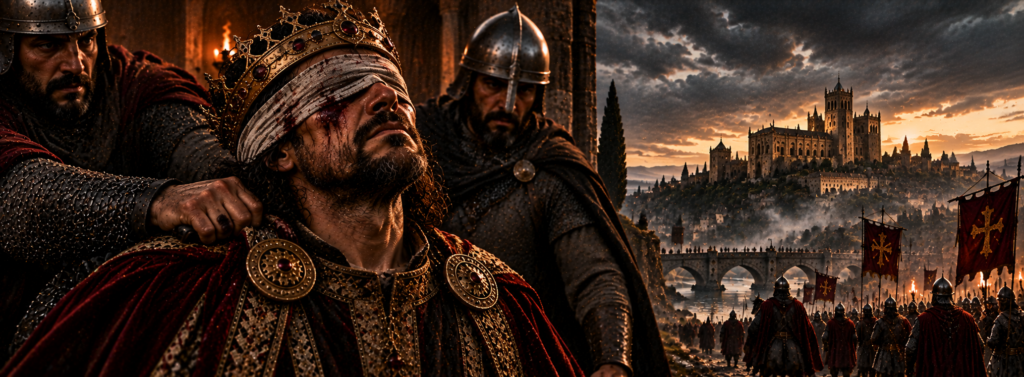
Alfonso Fróilaz: The Forgotten King of León Blinded and Imprisoned by His Own Cousins
Alfonso Fróilaz (died after 932, exact date unknown) | King of León, approximately 925–926 | Continued to exercise royal authority in parts of Asturias until 932 | Son of Fruela II and grandson of Alfonso III the Great | Known in later tradition as Alfonso the Hunchback | Overthrown during a dynastic struggle against his cousins | Captured and blinded on the orders of Ramiro II | Confined to a monastery, where his subsequent fate becomes uncertain.
The King Whose Family Took His Crown, His Sight, and His Freedom
In the violent world of tenth-century León, losing a throne did not necessarily mean losing a claim to it. A defeated king could retreat into the mountains, gather supporters, and wait for another opportunity to recover what his enemies had taken. For Alfonso Fróilaz, that possibility would eventually become a sentence of permanent darkness. His cousins could deprive him of the capital and force him from the center of government, but as long as he remained alive and capable of ruling, he represented a danger that could not easily be ignored.
Alfonso inherited the throne in 925 following the death of his father, Fruela II, at a moment when the kingdom was already divided by competing dynastic ambitions. His cousins, the sons of the previous king Ordoño II, believed that their own claims had been unjustly displaced. They challenged Alfonso’s succession, fought for control of the kingdom, and eventually forced him from León. What followed was not a straightforward defeat followed by an immediate execution, but a prolonged struggle in which the displaced king continued to exercise authority in parts of the old Asturian heartland.
The final reckoning came several years later, during the reign of Ramiro II. By approximately 932, Ramiro had emerged as the dominant ruler and was determined to eliminate the possibility of further rebellion. Alfonso Fróilaz, his brothers, and another former king were captured and subjected to a punishment intended to make their political restoration almost impossible. They were blinded and confined to a monastery, their royal blood offering no protection against the cruelty of their own family.
The chroniclers preserve the mutilation but leave much of Alfonso’s subsequent life in darkness. His precise date of death is unknown, and the evidence does not justify describing him as murdered or executed during the succession struggle of 925. The distinction matters because his actual fate reveals something equally disturbing about medieval politics. His enemies did not need to kill him immediately to destroy his future.
Alfonso’s story is particularly unsettling because the men responsible were not foreign conquerors. They were his cousins, descendants of the same royal family and heirs to the same political traditions. Their struggle emerged from a dynasty that had spent generations expanding Christian royal authority across northern Iberia. The family’s greatest danger came not from the Muslim armies to the south, but from rival branches of its own bloodline.
His downfall also exposes the precarious nature of early medieval kingship. A monarch might inherit the throne legitimately, command regional loyalties, and appear in official documents as a reigning sovereign. Yet none of those advantages guaranteed that his authority would survive the ambitions of powerful relatives. Alfonso would discover that the title of king could become a dangerous burden long after the crown itself had been lost.
A Kingdom Built Between Mountains and War
The kingdom Alfonso inherited had its origins in the mountainous regions of northern Iberia. Following the Muslim conquest of much of the peninsula in the early eighth century, Christian political authority survived and developed in Asturias. Over succeeding generations, its rulers expanded their influence southward and established relationships with communities beyond the original mountain strongholds. By the tenth century, the monarchy governed a much larger and more complicated political world.
The expansion brought wealth, territory, and military opportunities, but it also created new sources of conflict. Powerful aristocratic families controlled lands and maintained relationships with monasteries, bishops, and military followers. Regional identities remained important, particularly in Asturias, Galicia, and the lands surrounding León. A king who controlled one region did not necessarily command unquestioned obedience throughout the others.
León gradually emerged as the principal political center of the expanding monarchy. Its position offered strategic advantages and symbolized the movement of royal power beyond the old Asturian heartland. Yet the transfer of political importance did not erase the prestige of Asturias. The mountainous north remained a place where members of the royal family could find support when conflicts developed elsewhere.
The kingdom also faced continuing pressure from al-Andalus. Muslim rulers based in Córdoba possessed substantial resources and periodically launched military campaigns against the Christian kingdoms. Christian monarchs responded through warfare, diplomacy, fortification, and alliances with neighboring rulers. These external struggles required political cooperation at precisely the moment when dynastic rivalries threatened to divide the kingdom.
The monarchy’s internal structure made succession particularly dangerous. Royal authority was hereditary in important respects, but succession did not always follow a simple rule of primogeniture. Brothers, sons, nephews, and cousins could all possess claims supported by ancestry and political precedent. When a ruler died, competing branches of the family might regard the throne as an inheritance unjustly denied to them.
Alfonso Fróilaz would become a victim of those unresolved traditions. His father had obtained authority after the death of his brother, even though that brother left sons who could claim the succession. Alfonso then inherited the same disputed position. The family conflict that destroyed his reign had been developing long before he became king.
Alfonso III and the Dynasty That Divided Itself
Alfonso’s grandfather was Alfonso III, remembered as Alfonso the Great, one of the most important rulers of the Asturian kingdom. His reign, extending from the ninth into the early tenth century, witnessed significant territorial expansion and the strengthening of royal authority. He confronted Muslim forces, supported settlement in frontier regions, and cultivated the prestige of Christian kingship. His achievements helped create the political foundations inherited by his descendants.
Yet Alfonso III’s final years were marked by conflict within his own family. His sons became involved in opposition to his authority, and the resulting crisis ended his reign in 910. The precise sequence of events remains complicated, but the outcome was a division of power among his sons. The dynasty that had expanded the kingdom now divided its territories among competing royal heirs.
García I obtained authority in León, while Ordoño II ruled Galicia and Fruela II retained Asturias. The arrangement reflected the continuing importance of regional political identities. It also demonstrated that the royal inheritance could be divided rather than transferred intact to a single successor. Such divisions created opportunities for future disputes whenever one branch attempted to reunite the kingdom.
The three brothers belonged to the same family, but their political interests were not identical. Each possessed regional supporters and relationships with influential aristocrats. Their authority depended partly upon the territories they controlled and the military resources available to them. The monarchy remained connected through blood while becoming politically fragmented.
The division of 910 therefore established the background to Alfonso Fróilaz’s later difficulties. His father Fruela had obtained Asturias as part of the family settlement. His uncle Ordoño had acquired Galicia and later became king in León. Their descendants would eventually compete over the right to govern the reunited kingdom.
The struggle was not simply a personal quarrel between ambitious princes. It reflected uncertainty about whether the monarchy should be divided among royal relatives or concentrated under a single ruler. Both arrangements had precedents, and both could be defended through appeals to family tradition. Alfonso’s downfall emerged from that ambiguity.
Fruela II: The Father Who Left a Dangerous Inheritance
Fruela II initially ruled Asturias following the division of Alfonso III’s territories. He belonged to the generation of royal sons who had benefited from their father’s removal. His authority was therefore rooted in a political settlement created through family conflict. The precedent would later complicate the position of his own son.
When García I died in 914, Ordoño II emerged as the dominant ruler in León. Ordoño pursued military campaigns against Muslim territories and strengthened the monarchy’s position. His reign continued until 924, when his death created another succession crisis. The question was whether his sons would inherit the kingdom or whether his surviving brother Fruela would take power.
Fruela II succeeded Ordoño II in León. His accession reunited authority that had previously been divided among the brothers. Yet Ordoño had left sons who could reasonably regard themselves as heirs to their father’s position. Fruela’s succession therefore displaced another branch of the dynasty.
The circumstances of Fruela’s accession remain incompletely documented. The surviving evidence does not permit a detailed reconstruction of every negotiation or military maneuver that brought him to power. Nevertheless, his success demonstrates that a surviving brother could prevail over the sons of a deceased king. That precedent was politically important but potentially unstable.
Fruela’s reign in León was brief. He died in 925, probably after little more than a year as ruler of the reunited kingdom. His death reopened the question of succession before the political consequences of his accession had been fully resolved. His son Alfonso now faced the cousins whose claims had been displaced.
The inheritance was therefore poisoned by an unresolved family dispute. Alfonso could claim the throne as the son of the reigning king. His cousins could argue that their father’s line had possessed a prior right to the kingdom. Both claims drew upon recognizable dynastic traditions, making conflict increasingly likely.
The Young Alfonso and the Problem of His Identity
Alfonso Fróilaz remains one of the more obscure rulers of early medieval León. His date of birth is unknown, and the surviving sources provide little reliable information about his childhood. His mother has sometimes been identified as Nunilo Jimena, although the evidence for Fruela II’s marital relationships is disputed. The details of Alfonso’s upbringing cannot be reconstructed with confidence.
He belonged to the Astur-Leonese royal dynasty and was a grandson of Alfonso III. His father Fruela II had ruled Asturias before succeeding to León. Alfonso therefore possessed a recognizable hereditary claim to royal authority. His accession was not the sudden appearance of an unrelated usurper.
Later tradition sometimes calls him Alfonso the Hunchback. The nickname appears in historical writing, but its precise origin and reliability are uncertain. It should not be treated as proof of a documented medical condition or used to invent details about his appearance. Medieval nicknames could emerge from hostile descriptions, later traditions, or attempts to distinguish rulers with similar names.
The distinction between Alfonso Fróilaz and Alfonso IV is especially important. Both men belonged to the same dynasty, both possessed claims to León, and both experienced deposition and mutilation. Their overlapping careers have created confusion in later chronicles and modern summaries. Some accounts combine events belonging to the two men.
Alfonso Fróilaz was the son of Fruela II. Alfonso IV was the son of Ordoño II and therefore Alfonso Fróilaz’s cousin. Their rivalry was central to the succession struggle that followed Fruela’s death. Later, both would become victims of Ramiro II’s determination to secure his throne.
The confusion has sometimes obscured Alfonso Fróilaz’s independent political career. He was not merely a failed claimant who disappeared immediately after losing León. Documentary evidence suggests that he continued exercising royal authority in Asturias for several years. His story therefore extends well beyond the succession crisis of 925.
The Death of Fruela II and the Opening of the Succession Crisis
Fruela II died in 925, leaving the monarchy without an uncontested successor. Alfonso Fróilaz inherited his father’s claim and appears to have succeeded him as king. Yet the sons of Ordoño II remained powerful rivals. The succession became a contest between two branches of the same royal family.
The principal challengers were Sancho Ordóñez, Alfonso Ordóñez, and Ramiro Ordóñez. They were the sons of Ordoño II and cousins of Alfonso Fróilaz. Their father had ruled León before Fruela II, giving them a strong dynastic argument. They could present Alfonso’s succession as the continuation of an earlier displacement.
Each cousin possessed potential sources of support. Sancho had important connections in Galicia, while Alfonso Ordóñez benefited from relationships with the rulers of Pamplona. Ramiro developed influence in the western territories associated with the future Portuguese region. These networks gave the brothers political resources beyond their hereditary claims.
Alfonso Fróilaz also possessed supporters, particularly in Asturias. His father’s earlier rule had established relationships within the old Asturian heartland. Such loyalties could provide a refuge if he lost control of León. The kingdom’s regional divisions therefore shaped the coming conflict.
The surviving sources do not provide a complete narrative of the opening stages of the struggle. Some later accounts simplify the events into a rapid overthrow followed by a division of the kingdom. Documentary evidence suggests a more complicated process involving overlapping claims and shifting territorial authority. The chronology remains debated in several details.
What is clear is that Alfonso’s succession did not produce a stable monarchy. His cousins refused to accept his authority throughout the kingdom. Their opposition escalated into armed conflict and political maneuvering. The crown inherited from Fruela became the object of a family struggle.
Three Cousins Against One King
The three sons of Ordoño II possessed a considerable advantage because their claims could be supported by different regional aristocratic networks. Sancho was associated with Galicia, where powerful noble families had long influenced royal politics. Alfonso Ordóñez possessed connections with Pamplona through marriage. Ramiro had interests in the western territories south of Galicia.
Their opposition was not necessarily perfectly coordinated from the beginning. The brothers also competed among themselves, and their ambitions could conflict. The succession crisis therefore involved more than a simple alliance of three princes against one king. It was a struggle in which several men sought authority over different parts of the kingdom.
Alfonso Fróilaz initially occupied the position of reigning monarch. His claim rested upon succession from Fruela II, who had ruled the reunited kingdom. Yet the sons of Ordoño II could appeal to their father’s earlier reign. The legitimacy of each branch depended partly upon which succession precedent supporters considered decisive.
The conflict unfolded in a political environment where aristocratic backing mattered enormously. A claimant who secured the support of influential families could gain control of cities and territories. Military followers could determine whether a king retained his position or was forced into retreat. Royal ancestry provided a claim, but practical power determined its effectiveness.
The struggle also exposed the weakness of a monarchy divided among regional centers. León, Galicia, Asturias, and the western frontier possessed different political interests. A prince could lose one territory while retaining authority elsewhere. This made the conflict difficult to resolve through a single decisive confrontation.
Alfonso’s cousins eventually gained the advantage. Their supporters were sufficiently powerful to displace him from León. Yet the victory did not immediately eliminate his political position. He would continue to appear in the historical record as a ruler associated with Asturias.
The Struggle for León
León was the principal prize in the succession conflict. Its political importance had grown during the reigns of García I and Ordoño II, making possession of the city a powerful symbol of royal authority. A claimant who controlled León could present himself as the dominant ruler of the kingdom. Losing it could reduce a king to a regional position.
Alfonso Fróilaz appears to have held the throne briefly after his father’s death. His cousins challenged that succession, and the struggle eventually forced him from the capital. Alfonso Ordóñez emerged as the ruler conventionally known as Alfonso IV. The transition is generally placed in 925–926, although the exact chronology remains debated.
The surviving sources do not preserve a detailed account of the fighting around León. We cannot identify every battlefield, reconstruct the movements of the opposing armies, or describe the precise circumstances of Alfonso Fróilaz’s departure. Later narratives sometimes compress the conflict into a straightforward military defeat. The documentary evidence suggests that the political situation was more complicated.
Alfonso IV’s accession did not immediately settle the rivalries among the sons of Ordoño II. Sancho also possessed ambitions and support, particularly in Galicia. The brothers had to negotiate or fight over their respective positions. The struggle therefore continued even after Alfonso Fróilaz lost the central throne.
For the displaced king, the loss of León was devastating but not necessarily final. He retained connections in Asturias and could still claim royal authority. The political traditions of the kingdom allowed rulers to exercise power in different regions. His removal from the capital did not automatically erase his status.
This distinction would become crucial to his later fate. Alfonso remained a potential rival because he had not been completely eliminated from political life. His continued existence complicated the position of those who had replaced him. The conflict would eventually end not through a peaceful settlement but through deliberate mutilation.
The Kingdom Divided Among Rivals
After the initial struggle, the territories of the monarchy were associated with different members of Ordoño II’s family. Alfonso IV held León, while Sancho Ordóñez exercised royal authority in Galicia. Ramiro became associated with the western territories around Coimbra and the region that would later develop into Portugal. The arrangement reflected both family negotiation and the realities of regional power.
The precise constitutional relationship between these rulers remains debated. Medieval documents sometimes describe more than one member of the dynasty as king. Such terminology does not always mean that each governed a completely independent kingdom. Royal titles could reflect personal dignity, delegated authority, or regional political arrangements.
The division nevertheless demonstrates the continuing importance of family claims. The sons of Ordoño II did not simply replace Alfonso Fróilaz with a single uncontested ruler. They distributed authority among themselves while preserving their own ambitions. The monarchy remained vulnerable to further disputes.
Alfonso Fróilaz occupied an unusual position within this arrangement. Although displaced from León, he continued exercising authority in Asturias. His survival suggests that the victorious cousins either could not eliminate his regional support or found it politically useful to tolerate him temporarily. The surviving evidence does not establish a single explanation.
The arrangement was inherently unstable. Several men possessed royal titles or claims, while regional aristocrats could support different branches of the family. The possibility of renewed conflict remained present. Any change in the balance of power could encourage another claimant to seek greater authority.
For Alfonso Fróilaz, the division provided a temporary reprieve. He had lost the central throne but retained a political existence. His cousins had not yet destroyed his ability to rule. That possibility would survive until the violent events of 932.
Asturias: The Refuge of a Displaced King
Asturias possessed special significance for Alfonso Fróilaz because it had been the principal territory ruled by his father before 924. The region retained the prestige of the monarchy’s earlier history. Its mountainous geography also made it a difficult area for rivals to dominate completely. A displaced claimant could find support among local aristocrats and communities with established loyalties.
After losing León, Alfonso appears to have continued exercising royal authority in parts of Asturias. His position was not necessarily equivalent to control over the entire former kingdom. Nevertheless, surviving documents indicate that he remained recognized as king in certain territories. This evidence challenges the simplified claim that his political career ended in 925 or 926.
A charter dated 16 March 927, associated with the monastery of Santa María del Puerto near Santoña, refers to Alfonso Fróilaz as the reigning king. Other documentary evidence has been interpreted as supporting his continued authority. Such records are valuable because they provide evidence independent of later narrative chronicles. They show how royal power could persist regionally after a ruler lost the principal capital.
The documents must still be interpreted carefully. Medieval charters can contain chronological problems, later alterations, and ambiguous references to rulers with similar names. Alfonso Fróilaz is particularly difficult to distinguish from Alfonso IV in some contexts. Historians therefore compare documents, regnal years, and regional circumstances to identify the ruler intended.
Despite these difficulties, the broader conclusion is persuasive. Alfonso Fróilaz remained politically relevant after his initial deposition. He was not simply executed by his cousins in 925. His continuing authority helps explain why he later became a target of Ramiro II.
The mountains that offered refuge also prolonged his danger. As long as Alfonso possessed supporters and a royal title, he could become the center of another rebellion. His cousins might tolerate that possibility temporarily, but it remained a threat to the stability of the monarchy. The eventual decision to blind him emerged from this unresolved struggle.
Alfonso IV and the Fragility of Victory
Alfonso IV gained the throne of León after the displacement of Alfonso Fróilaz. He was a son of Ordoño II and therefore belonged to the branch of the dynasty that had challenged Fruela II’s succession. His accession represented a victory for that branch, but it did not eliminate the family’s internal rivalries. The new king had to manage relationships with his brothers and other royal claimants.
His position was strengthened by marriage connections with Pamplona. Alfonso IV married Onneca Sánchez, a daughter of Sancho Garcés I of Pamplona. The alliance connected him to a powerful neighboring royal family. Such relationships could provide military support and enhance political legitimacy.
Yet the kingdom remained divided by regional interests. Sancho Ordóñez continued ruling Galicia, while Ramiro possessed influence in the western territories. Alfonso Fróilaz retained a position in Asturias. The existence of several royal figures made political cooperation essential but difficult.
Alfonso IV’s reign also demonstrates how quickly victory could become vulnerability. He had benefited from the overthrow of his cousin, yet his own authority would eventually be challenged by his brother Ramiro. The same family politics that brought him to power later destroyed his reign. The crown remained a dangerous possession.
The surviving evidence suggests that Alfonso IV’s relationship with his brothers changed over time. Sancho’s death in 929 altered the political balance, while Ramiro’s influence continued growing. Alfonso IV eventually withdrew from kingship, apparently entering religious life. The circumstances of that decision remain debated.
His abdication created another succession crisis. Ramiro became king, but Alfonso IV later attempted to recover power. The struggle would bring together several members of the dynasty whose claims threatened the new ruler. Alfonso Fróilaz would be among those caught in the final reckoning.
The Rise of Ramiro II
Ramiro II was one of the most formidable rulers produced by the Astur-Leonese dynasty. He was a son of Ordoño II and brother of Alfonso IV. His political career developed during the succession struggles that followed Fruela II’s death. By the early 930s, he had acquired the authority necessary to become king of León.
Ramiro’s rise occurred within a family already divided by years of rivalry. His brothers had exercised authority in different regions, while Alfonso Fróilaz remained associated with Asturias. The monarchy had experienced repeated disputes over succession and territorial control. Ramiro inherited a political situation in which rival royal claimants could threaten his position.
His accession followed Alfonso IV’s withdrawal from kingship. The surviving accounts differ over the precise circumstances of the abdication and the degree of pressure involved. Some traditions emphasize Alfonso’s decision to enter religious life, while others suggest political tensions contributed to his removal. The uncertainty reflects the limited and sometimes contradictory evidence.
Whatever the circumstances, Ramiro became king and sought to consolidate his authority. His position required the cooperation of powerful nobles and military commanders. He also faced the continuing threat from al-Andalus, where the Umayyad government possessed substantial military resources. Internal instability could weaken the kingdom at a dangerous moment.
The greatest immediate threat came from members of his own family. Alfonso IV apparently regretted his withdrawal and attempted to recover the throne. Alfonso Fróilaz and his brothers remained potential rivals with their own claims. Ramiro faced the possibility that several branches of the dynasty might unite against him.
His response would be ruthless. Rather than merely defeating his opponents and allowing them to retain regional authority, he sought to eliminate their capacity to challenge him again. The resulting punishment became one of the most notorious episodes of royal mutilation in early medieval Iberia. Alfonso Fróilaz would lose his sight and his freedom.
The Failed Return of Alfonso IV
Alfonso IV’s withdrawal from kingship did not bring lasting peace. After entering religious life, he apparently attempted to return to political power. His decision threatened the authority of Ramiro II, who had succeeded him. The struggle reopened the family conflicts that had destabilized the monarchy for years.
The surviving sources do not provide a complete account of Alfonso IV’s motives. He may have regretted surrendering power or believed that his brother had failed to respect an earlier agreement. Supporters may also have encouraged him to reclaim the throne. The available evidence does not allow one explanation to be established with certainty.
His attempt to recover power brought renewed military and political conflict. Ramiro responded by defeating the challenge and taking measures against the men who threatened his reign. The crisis extended beyond the former king himself. Other royal relatives, including Alfonso Fróilaz, became targets of the new ruler’s determination to secure authority.
The relationship between Alfonso IV’s rebellion and Alfonso Fróilaz’s final downfall remains difficult to reconstruct in detail. The surviving narratives associate the punishment of several royal relatives with Ramiro’s consolidation of power. They do not preserve every negotiation or military encounter preceding the arrests. Nevertheless, the broader sequence is clear.
Ramiro faced a dynasty crowded with men who possessed plausible claims to kingship. Some had already ruled, while others retained regional supporters. Allowing them to remain politically active created opportunities for future rebellion. The king therefore chose a punishment intended to remove their ability to govern.
The result was a campaign of deliberate mutilation. Alfonso IV, Alfonso Fróilaz, and other royal relatives were blinded. The violence marked the end of their political ambitions. It also demonstrated the lengths to which Ramiro was willing to go to preserve his throne.
The Blinding of the Royal Cousins
Around 932, Ramiro II ordered the blinding of several members of his own family. The victims included Alfonso IV, Alfonso Fróilaz, and Alfonso Fróilaz’s brothers Ordoño and Ramiro. The surviving tradition describes the punishment as a coordinated act intended to eliminate rival claimants. The episode became one of the most disturbing examples of dynastic violence in the kingdom’s history.
The historian Sampiro preserves an account of the events, while the Muslim historian Ibn Hayyan also provides evidence concerning the political struggle and punishment. Their testimony is important because it connects the mutilation to the consolidation of Ramiro’s authority. The sources do not preserve every physical detail of the procedure. They establish the blinding without allowing a responsible reconstruction of the instruments or exact circumstances.
The punishment was politically calculated. A blinded royal claimant could remain alive while being deprived of the physical capacity traditionally associated with effective kingship. Such mutilation made restoration more difficult and could discourage supporters from attempting another rebellion. It offered a means of neutralizing rivals without necessarily executing them.
For Alfonso Fróilaz, the punishment ended years of uncertain political survival. He had inherited the throne in 925, lost León to his cousins, and continued exercising authority in Asturias. His existence had remained a challenge to the dominant branch of the dynasty. Ramiro’s order destroyed the possibility of his return to active kingship.
The violence was particularly shocking because it involved multiple members of the royal family. These were not foreign prisoners captured in battle. They were descendants of Alfonso III, connected by blood to the king who ordered their punishment. Their shared ancestry made the act an extraordinary example of family conflict.
The blinding also demonstrated that Ramiro’s authority was now strong enough to impose severe punishment upon royal rivals. Earlier compromises had allowed different family members to retain regional positions. The new king rejected that arrangement. His consolidation of power required the destruction of competing claims.
Why Blinding Was a Political Weapon
Blinding possessed a particular significance in medieval struggles for power. It could remove a claimant from political life while avoiding the immediate consequences of execution. The punishment was intended to make the victim incapable of exercising the military and ceremonial responsibilities associated with kingship. It also provided a permanent visible or functional reminder of defeat.
The practice was known in several medieval political traditions, particularly within the Eastern Roman Empire. Byzantine rulers and usurpers sometimes used blinding to neutralize rivals whose survival might otherwise threaten the throne. The punishment could be combined with imprisonment, exile, or confinement in a monastery. Its political purpose was to destroy the victim’s prospects for restoration.
In the kingdom of León, Ramiro’s decision reflected similar concerns. Alfonso Fróilaz had already demonstrated that losing the capital did not necessarily eliminate a royal claim. He had continued exercising authority in Asturias after his initial deposition. The king therefore faced a rival whose political existence had survived an earlier defeat.
Blinding offered a more permanent solution. A mutilated claimant could still possess royal ancestry, but his ability to command armies and perform public royal duties was severely compromised. Supporters might find it more difficult to present him as a viable alternative. The punishment therefore attacked the practical foundations of kingship.
The precise legal implications should not be exaggerated. The surviving evidence does not establish a universally enforced rule declaring that every blinded person was automatically incapable of holding royal office. Political circumstances and social expectations varied across medieval societies. Nevertheless, mutilation was clearly used to weaken or eliminate claims to authority.
For Alfonso, the punishment represented the destruction of his future. He had already lost the central throne and much of his political influence. Now he lost his sight and was placed under religious confinement. The possibility of another restoration was effectively extinguished.
A Monastery Instead of a Grave
After the blinding, Alfonso Fróilaz and other royal relatives were confined to a monastery. The institution is generally identified as Ruiforco, associated with the region of León. Monastic confinement offered a way to remove political rivals from public life without necessarily killing them. It combined physical isolation with the appearance of religious withdrawal.
The practice was not unusual in medieval politics. Deposed rulers and defeated claimants could be forced into religious institutions, where their movements and contacts were restricted. Such confinement reduced their ability to organize rebellion. It also allowed victorious rulers to present the removal of rivals as something other than outright execution.
For Alfonso Fróilaz, the monastery marked the end of his political career. He had once inherited the throne of León and continued exercising authority in Asturias. Now he was blind and dependent upon the arrangements imposed by his victorious cousin. His royal title no longer provided practical power.
The surviving sources do not describe his daily life in confinement. We do not know the conditions of his accommodation, the treatment he received, or whether he maintained contact with relatives. The historical record becomes increasingly silent after the punishment. His subsequent experience cannot be reconstructed through invented scenes of suffering.
The uncertainty extends to his death. Alfonso is known to have survived the succession crisis of 925, and the evidence places his final political defeat around 932. His exact date of death is not securely established. Claims that he was executed in 925 or murdered during the initial struggle are therefore inaccurate.
His fate remains tragic without such embellishment. He lost the crown, his regional authority, his sight, and his freedom. His enemies had removed the possibility of meaningful political restoration. The monastery became the final known setting of a royal career destroyed by family rivalry.
The Brothers Who Shared His Fate
Alfonso Fróilaz was not the only son of Fruela II caught in the succession struggles. His brothers Ordoño and Ramiro also possessed royal ancestry and potential claims to authority. Their existence complicated the political situation because they represented additional members of the displaced branch of the dynasty. Even if Alfonso himself were neutralized, his brothers might become alternative candidates.
The surviving accounts associate them with the punishment ordered by Ramiro II. They were captured and blinded along with Alfonso and other royal relatives. The coordinated nature of the punishment suggests that the king sought to eliminate an entire network of potential rivals. The objective extended beyond a single rebellious individual.
The brothers’ earlier political careers are poorly documented. We do not possess detailed biographies describing their military activities, marriages, or relationships with regional aristocrats. Their importance emerges primarily from their ancestry and their involvement in the final crisis. The absence of information should not be mistaken for evidence that they played no political role.
Their mutilation demonstrates how royal blood could become a liability. Descendants of Alfonso III possessed claims that might attract supporters during periods of instability. The same ancestry that gave them prestige also made them dangerous to a ruler seeking exclusive authority. Ramiro’s response was to destroy their capacity to challenge him.
The punishment also reveals the limits of family loyalty in medieval kingship. These men were cousins of the reigning monarch, connected through the same grandfather. Yet their shared ancestry did not protect them from mutilation. Political security outweighed kinship.
The fate of Alfonso’s brothers deepens the tragedy of his own downfall. He was not an isolated victim removed from power because of a personal quarrel. He belonged to a branch of the dynasty that was systematically neutralized. The blinding marked the destruction of a family faction.
The Two Alfonsos: A Historical Confusion
One of the greatest difficulties in reconstructing Alfonso Fróilaz’s life is the confusion between him and Alfonso IV. Both belonged to the same dynasty, both ruled or claimed authority in León, and both were blinded during the reign of Ramiro II. Later chroniclers sometimes combined their careers or failed to distinguish them clearly. This has contributed to contradictory modern summaries.
Alfonso Fróilaz was the son of Fruela II. He inherited the throne after his father’s death in 925 and was displaced by his cousins. Alfonso IV was the son of Ordoño II and one of the cousins who challenged him. Their political careers therefore began on opposing sides of the same succession struggle.
The confusion becomes more complicated because Alfonso IV later lost his own throne. After withdrawing into religious life, he attempted to recover power from his brother Ramiro II. His failure led to blinding and confinement. Alfonso Fróilaz suffered a similar punishment during the same period.
Some later traditions merge details from the two men. References to a blinded king named Alfonso can therefore be difficult to interpret without additional context. Genealogical information and documentary evidence are essential for distinguishing them. The problem illustrates the limitations of medieval historical records.
The confusion has also affected accounts of their deaths. Alfonso IV is generally associated with death in 933, while Alfonso Fróilaz’s final years remain uncertain. Assigning the same death date or circumstances to both men can produce misleading narratives. The historian must resist the temptation to simplify the evidence.
For Alfonso Fróilaz, the result has been a partial disappearance from popular history. His cousin became the better-known Alfonso IV, while the earlier king often appears without a regnal number. His independent reign and subsequent regional authority are easily overlooked. The blinding of both men further obscures their separate identities.
The Forgotten King Without a Number
Alfonso Fróilaz occupies an unusual position in the lists of Leonese monarchs. Although he inherited the throne after Fruela II, he is often omitted from conventional regnal numbering. The name Alfonso IV is generally assigned to his cousin, the son of Ordoño II. This creates the impression that Alfonso Fróilaz was merely an unsuccessful claimant rather than a ruler who exercised royal authority.
The historical evidence suggests a more complicated reality. Alfonso appears in royal lists and documentary traditions associated with the kingdom. His succession after Fruela II is supported by early historical material. His continued recognition in Asturias further demonstrates that his political career cannot be dismissed entirely.
The omission reflects the way later historians organized the monarchy’s succession. Rulers who held power briefly or governed disputed territories could be excluded from simplified lists. Victorious dynasties also influenced which claimants were remembered as legitimate kings. The numbering of monarchs is therefore not always a neutral record of political reality.
Alfonso’s case is particularly revealing because his cousin ultimately became the recognized ruler of León. The victorious branch of the family dominated subsequent political developments. Alfonso Fróilaz’s reign became a brief interruption in the conventional sequence. His later authority in Asturias received even less attention.
The nickname the Hunchback has sometimes become more memorable than his actual political career. Yet the nickname tells us little about his government or the reasons for his downfall. His importance lies in the succession crisis, his continued regional kingship, and the mutilation that ended his ambitions. Those events reveal much more about the monarchy than an uncertain physical description.
His historical obscurity is therefore part of the story. A man who once inherited the throne could later disappear from simplified royal lists. His rivals controlled the political future, while chroniclers preserved only fragments of his life. The loss of his crown was followed by the gradual erosion of his place in historical memory.
The Civil War That Exposed the Dynasty’s Weakness
The struggle surrounding Alfonso Fróilaz demonstrates the instability created by competing hereditary claims. The descendants of Alfonso III possessed several branches capable of producing royal candidates. Each could appeal to family tradition and earlier political arrangements. The absence of a consistently enforced succession system made conflict difficult to avoid.
The division of the kingdom in 910 had created regional centers of royal authority. García, Ordoño, and Fruela governed different territories before later events reunited much of the monarchy. Their descendants inherited the consequences of those arrangements. The succession crisis of 925 reopened disputes that had never been fully resolved.
Regional aristocrats played an important role in the conflict. Powerful families in Galicia, Asturias, León, and the western territories could support different claimants. Their interests were not always identical to those of the royal family. A prince who secured their backing could challenge a rival with a strong hereditary claim.
The neighboring kingdom of Pamplona also influenced the balance of power. Marriage alliances connected Leonese princes with the Pamplonese royal family. Such relationships could provide military assistance and strengthen claims to authority. The succession struggle therefore extended beyond the immediate borders of León.
The result was a monarchy repeatedly divided by internal competition. Alfonso Fróilaz lost the central throne but retained authority in Asturias. His cousins divided territories among themselves and later fought over their own succession. The instability continued until Ramiro II imposed a more decisive settlement.
That settlement was achieved through violence. The blinding of rival claimants eliminated immediate threats but revealed the severity of the political problem. The monarchy could not rely solely upon hereditary legitimacy or family agreement. It ultimately depended upon the ability of a ruler to defeat and neutralize competitors.
Ramiro II and the Price of Stability
Ramiro II emerged from the succession struggles as a powerful monarch. His reign would become associated with military campaigns against al-Andalus and the strengthening of Leonese authority. He achieved victories that enhanced his reputation and demonstrated the kingdom’s capacity to confront external enemies. Yet his rise was inseparable from the violence inflicted upon his own relatives.
The blinding of Alfonso Fróilaz and the other claimants helped secure Ramiro’s position. By removing men who possessed alternative claims, he reduced the immediate danger of renewed dynastic rebellion. The punishment was brutal, but it served a recognizable political purpose. It allowed the king to concentrate authority after years of instability.
The moral implications are difficult to separate from the political calculations. Ramiro’s later military achievements did not erase the suffering inflicted upon his cousins. Nor does the political usefulness of the punishment make it less cruel. The episode demonstrates how medieval rulers could pursue stability through acts that modern readers recognize as deliberate brutality.
The surviving sources do not provide a complete account of how Ramiro justified his actions. He may have regarded the rival claimants as rebels whose continued existence threatened the kingdom. He may also have sought to intimidate aristocrats who supported them. The precise reasoning remains uncertain.
What is clear is that the punishment ended the political careers of several royal relatives. Alfonso IV, Alfonso Fróilaz, and the brothers of the latter were removed from active competition. The monarchy passed into a period dominated by Ramiro’s authority. The immediate succession crisis was resolved through the destruction of rival claimants.
The episode therefore presents a disturbing question about the relationship between stability and violence. Ramiro’s government benefited from the elimination of competing royal branches. Yet the methods used to achieve that outcome reveal the insecurity of the political system. Peace was purchased through mutilation and confinement.
The Silence Surrounding Alfonso’s Death
The surviving evidence does not establish when Alfonso Fróilaz died. He was alive during the political struggles that culminated in his blinding around 932. Afterward, the historical record becomes fragmentary. His final years cannot be reconstructed with confidence.
This uncertainty is important because some summaries describe him as executed or murdered during the succession crisis of 925. Such claims confuse his initial deposition with the later punishment imposed by Ramiro II. The evidence indicates that he survived the first struggle and continued exercising authority in Asturias. He was therefore not killed immediately after losing León.
Nor is there secure evidence that he was formally executed after being blinded. The principal tradition describes mutilation and monastic confinement. It does not establish a subsequent assassination. His death may have occurred during confinement, but the date and circumstances remain unknown.
The distinction between blinding and execution is historically significant. Medieval rulers sometimes used mutilation precisely because it allowed them to neutralize rivals without killing them. A blinded claimant could be confined under supervision and deprived of political influence. The punishment could serve as a permanent alternative to death.
Alfonso’s fate fits that pattern. His enemies destroyed his ability to return to power while leaving his subsequent life largely unrecorded. The absence of a known execution does not make the outcome less severe. His political identity had been systematically dismantled.
The historian must therefore resist the temptation to invent a dramatic death scene. There is no reliable basis for describing Alfonso being beheaded, stabbed, or murdered by a particular cousin. The documented violence lies in his capture, blinding, and confinement. Those events are sufficient to make his story one of the darkest episodes of Leonese succession politics.
A King Destroyed Without Being Killed
Alfonso Fróilaz’s downfall illustrates how a ruler could be politically destroyed without immediate execution. He lost León in 925–926 but retained enough authority to remain dangerous. His continued recognition in Asturias meant that his claim survived the initial defeat. Only the later intervention of Ramiro II ended that possibility.
The punishment attacked the foundations of his royal identity. Kingship involved public authority, military leadership, and the ability to command followers. Blinding severely compromised those functions. Monastic confinement then removed him from the political networks through which he might have organized resistance.
The combination was devastating. Alfonso had inherited a crown from his father and belonged to a dynasty that had ruled northern Iberia for generations. He had survived one succession crisis and continued exercising authority in a reduced territory. His final defeat deprived him of the possibility of recovery.
The surviving record offers little insight into his personal response. We do not know whether he resisted capture, attempted negotiation, or accepted the punishment in silence. Such details belong to the realm of speculation. The historical tragedy does not require them.
His story also reveals the limits of royal kinship. The men who destroyed his political future were descendants of the same grandfather. Their competing claims arose from earlier divisions within the family. The dynasty’s internal structure produced the conflict that eventually mutilated its members.
The result was a form of political extinction. Alfonso remained a royal descendant, but his ability to exercise kingship had been destroyed. His name survived in chronicles and documents, while his independent political career ended. The crown passed permanently beyond his reach.
The Wider World of Tenth-Century León
The succession crisis occurred during a period when the Christian kingdoms of northern Iberia faced major external challenges. The Umayyad government of Córdoba had become increasingly powerful under Abd al-Rahman III. His rule strengthened the political and military resources of al-Andalus. Christian rulers needed effective leadership to resist campaigns and defend frontier territories.
Internal dynastic conflict could weaken that resistance. Armies and aristocratic resources devoted to succession struggles were unavailable for campaigns against external enemies. Regional divisions complicated coordination. A kingdom consumed by family rivalry risked losing strategic opportunities.
The reign of Ramiro II would later demonstrate the importance of military unity. He became associated with significant victories against Muslim forces, including the famous battle of Simancas in 939. Those achievements strengthened his reputation and the monarchy’s position. Yet they followed the violent consolidation of his authority.
Alfonso Fróilaz’s career therefore belongs to a broader transformation of the kingdom. The monarchy was moving from the older Asturian political world toward a more centralized Leonese state. Regional loyalties remained powerful, and succession disputes repeatedly threatened unity. The struggle between Alfonso and his cousins reflected those tensions.
The conflict also demonstrates the importance of aristocratic support. Royal blood alone could not guarantee possession of the throne. A claimant needed relationships with military leaders, landholding families, and neighboring rulers. The success of Alfonso’s cousins depended partly upon their ability to mobilize those networks.
The monarchy’s survival required balancing hereditary legitimacy with political reality. Alfonso inherited a recognized claim but could not maintain control of the central kingdom. His cousins gained power but continued competing among themselves. Ramiro eventually imposed a settlement through force.
The Cruel Logic of Dynastic Politics
The violence inflicted upon Alfonso Fróilaz was not an isolated act of personal cruelty detached from political circumstances. It emerged from a succession system that allowed several royal relatives to possess plausible claims. Each claimant could attract supporters and threaten the authority of the others. The resulting instability encouraged increasingly severe measures.
Alfonso’s initial survival demonstrated why defeated kings remained dangerous. Losing León did not eliminate his authority in Asturias. He continued appearing in documents as a ruler and retained a political identity. His cousins could not simply assume that his defeat had ended the dispute.
Ramiro II eventually chose to remove that uncertainty. By blinding Alfonso and other royal relatives, he reduced the possibility of future restoration attempts. The punishment was intended to make their political exclusion permanent. It transformed a disputed succession into a settlement enforced through bodily violence.
The decision also reveals the fear that rival claimants inspired. A king secure in his authority might tolerate defeated relatives under supervision. A ruler who feared renewed rebellion could regard their continued political capacity as unacceptable. Ramiro’s actions suggest that he considered the threat serious enough to justify mutilation.
Yet the punishment created its own moral burden. The victims were members of the royal family, and their suffering became part of the historical record. Later generations could remember Ramiro’s achievements while also confronting the brutality of his consolidation. The monarchy’s stability rested partly upon the destruction of men who shared its bloodline.
Alfonso’s story therefore illustrates the darker side of hereditary rule. Royal ancestry could provide a claim to power, but it could also make a person dangerous to relatives who already possessed the throne. The same bloodline that elevated him eventually exposed him to mutilation. His family became both the source of his authority and the instrument of his downfall.
Why Alfonso Fróilaz Matters to the History of Royal Violence
Alfonso Fróilaz does not belong among securely documented assassinated rulers because his murder has not been established. His story is better understood as a case of violent deposition, dynastic mutilation, and political imprisonment. Nevertheless, it belongs closely to the wider history of regicide and the destruction of royal claimants. The same struggles that produced assassinations also produced punishments designed to eliminate rivals without killing them.
His career is especially important because he survived an initial deposition. The succession crisis of 925–926 forced him from León, but it did not immediately destroy his political position. He continued exercising authority in Asturias. His survival demonstrates that medieval kingship could persist in regional forms even after the loss of the principal capital.
The later blinding reveals the determination of Ramiro II to end that possibility. Alfonso and other royal relatives were subjected to a punishment intended to remove them permanently from political competition. Their confinement transformed them from active claimants into powerless members of the dynasty. The violence was calculated rather than accidental.
The case also exposes the danger of confusing similarly named rulers. Alfonso Fróilaz and Alfonso IV were cousins whose careers became entangled in the same succession struggles. Both were eventually blinded. Their overlapping histories have encouraged inaccurate claims about their deaths and reigns.
Alfonso’s story therefore requires careful historical treatment. He was a king, a displaced claimant, a regional ruler, and finally a victim of dynastic mutilation. His exact death remains unknown. The absence of a documented assassination should not obscure the severity of what happened to him.
His life offers a powerful example of how medieval rulers could destroy political opponents while preserving their lives. The punishment inflicted upon Alfonso was intended to make restoration impossible. It removed the practical meaning of his royal title. The result was a fate that could be as politically final as execution.
The King Who Disappeared into Darkness
Alfonso Fróilaz inherited a crown already poisoned by family rivalry. His grandfather Alfonso III had expanded the kingdom and strengthened royal authority, but his final years ended in conflict among his sons. The division of power that followed created competing branches of the dynasty. Alfonso’s father Fruela II eventually reunited much of the monarchy, only to leave behind a disputed succession.
When Fruela died in 925, Alfonso inherited his claim. Yet his cousins, the sons of Ordoño II, regarded the throne as an inheritance that should have belonged to their own branch of the family. They challenged his authority and eventually forced him from León. The young monarchy became the setting for another struggle among royal relatives.
Alfonso’s defeat did not immediately end his career. He retained supporters in Asturias and continued exercising royal authority in parts of the old Asturian heartland. Documentary evidence indicates that he remained politically relevant after losing the central throne. His survival complicated the claims of the victorious cousins.
The kingdom meanwhile remained divided by competing ambitions. Alfonso IV gained León, Sancho Ordóñez ruled Galicia, and Ramiro developed authority in the western territories. Their arrangements did not eliminate rivalry. The same family politics that destroyed Alfonso Fróilaz’s central reign later threatened the men who replaced him.
Ramiro II eventually emerged as the dominant ruler. His accession followed Alfonso IV’s withdrawal from kingship, but the former king later attempted to recover power. The resulting crisis brought several royal relatives into opposition to Ramiro. Alfonso Fróilaz was among those whose continued existence threatened the new monarch’s security.
The response was devastating. Around 932, Ramiro ordered the blinding of Alfonso Fróilaz, Alfonso IV, and other members of the royal family. The punishment was intended to destroy their ability to reclaim political authority. Their shared ancestry offered no protection.
Alfonso’s blinding marked the final collapse of his royal ambitions. He had survived the loss of León and continued exercising authority in Asturias, but the mutilation made another restoration far more difficult. His subsequent confinement in a monastery removed him from the political world. The king who had once inherited the throne disappeared from active government.
The surviving sources do not tell us exactly when he died. They do not establish that he was executed in 925 or murdered after his final defeat. His last years remain uncertain. The historian must leave that uncertainty intact rather than inventing a death scene.
Yet the absence of a documented execution does not diminish the tragedy. Alfonso lost his throne, his political independence, his sight, and his freedom. His cousins destroyed the future that his royal ancestry had once promised. The punishment was designed to make his removal permanent.
His story also reveals the fragility of hereditary legitimacy. Alfonso possessed a recognized claim through his father, but his cousins possessed competing claims through their own father. Neither branch could rely solely upon ancestry to secure authority. Military power and aristocratic support determined the outcome.
The conflict demonstrates how royal families could become their own greatest enemies. The descendants of Alfonso III inherited a kingdom strengthened by conquest and political expansion. Instead of preserving unity, they repeatedly divided authority and fought over succession. Their rivalries culminated in the mutilation of men who shared the same bloodline.
Alfonso’s historical obscurity adds another dimension to his downfall. He is frequently omitted from conventional regnal numbering, while his cousin became known as Alfonso IV. Their overlapping careers created confusion that has persisted in later accounts. The defeated king lost not only political power but also much of his independent place in historical memory.
The documents that preserve his name therefore possess unusual importance. They demonstrate that he was more than a failed claimant briefly displaced in 925. He continued exercising royal authority after losing León. His political career survived long enough to become a renewed threat to his cousins.
That survival helps explain the severity of his final punishment. Ramiro II had reason to fear a rival who had already demonstrated the ability to retain regional support after defeat. Blinding offered a way to eliminate the possibility of another restoration. Monastic confinement completed the process.
The result was a form of political destruction that did not require immediate murder. Alfonso remained a member of the royal family, but his ability to exercise kingship had been deliberately removed. His body became the means through which his enemies secured their authority. The violence transformed a living claimant into a powerless prisoner.
His fate also complicates the familiar distinction between assassinated rulers and deposed monarchs. Some kings were killed outright, while others were mutilated and confined so that they could never rule again. The political objectives could be remarkably similar. Both methods sought to eliminate a rival claim to power.
Alfonso Fróilaz belongs to the second category. His documented fate was blinding and imprisonment, not a securely established assassination. Yet his story is no less revealing about the cruelty of medieval succession politics. It demonstrates how a royal family could destroy one of its own members without leaving a record of his death.
In the end, Alfonso’s tragedy was not that he lacked royal blood or a plausible claim to the throne. He possessed both, and for a time he exercised genuine authority. His downfall came because his cousins possessed competing ambitions and eventually the power to enforce them. The dynasty that gave him a crown also produced the men who took away his sight.
The final image preserved by history is therefore not an executioner standing over a murdered king. It is a defeated royal claimant, blinded and confined, whose name gradually disappears from the surviving record. His enemies had taken the throne years earlier, but only the mutilation of 932 made his political destruction complete. Alfonso Fróilaz survived long enough to discover that in the struggle for a medieval crown, losing one’s life was not the only way to lose everything.