
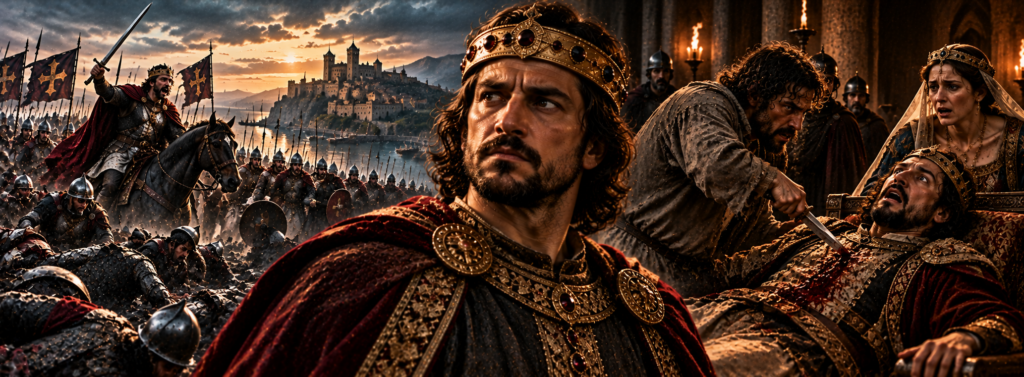
Amalaric: The Visigothic King Betrayed by His Marriage and Murdered in Barcelona
Amalaric (c. 502–531) | King of the Visigoths, traditionally dated 511–531, with independent rule beginning around 526 | Son of Alaric II and Theodegotha | Grandson of Theodoric the Great | Survived the destruction of his father’s kingdom at the Battle of Vouillé | Displaced as a child by his illegitimate half-brother Gesalec | Restored under the protection of the Ostrogothic monarchy | Married the Frankish princess Clotilde, daughter of Clovis I | Accused of abusing his wife because of her Catholic faith | Defeated by his brother-in-law Childebert I during a Frankish invasion | Killed at Barcelona in 531 under disputed circumstances | Succeeded by the powerful Ostrogothic commander Theudis.
The King Who Could Not Escape Barcelona
By the time Amalaric fled toward Barcelona in 531, the kingdom he had inherited was collapsing around him for the second time in his life. His army had been defeated, his Frankish brother-in-law had invaded his territory, and the marriage intended to protect his throne had instead helped bring an enemy army across the frontier. The young Visigothic king had spent much of his childhood under the protection of one of the most powerful rulers in Europe, but that protection was gone. Now, with his enemies closing in and his own authority unraveling, Amalaric faced the same terrible possibility that had destroyed his father: losing both his kingdom and his life to the Franks.
What happened next remains one of the more frustrating mysteries of early Visigothic history. According to one tradition, Amalaric was killed by a Frankish soldier while attempting to escape from Barcelona. Other accounts place greater emphasis upon internal Gothic hostility, suggesting that his own followers or political enemies may have been responsible for his death. The surviving sources agree that his reign ended violently in 531, but they do not allow us to identify his killer with complete confidence.
The uncertainty has encouraged generations of speculation. Was Amalaric murdered by men loyal to his brother-in-law, Childebert I, who had invaded the kingdom under the pretext of defending his sister? Did disgruntled Visigothic soldiers turn against their defeated king, deciding that he had become too weak to protect them? Or did powerful men within the kingdom seize the opportunity to remove a ruler whose death would open the throne to someone more capable of commanding their loyalty?
The questions become even more disturbing when the circumstances of Amalaric’s marriage are considered. His wife, Clotilde, was a Frankish princess whose father had killed Amalaric’s father at the Battle of Vouillé in 507. The marriage was intended to bridge one of the bloodiest rivalries in western Europe, yet later accounts describe a household poisoned by religious hostility, humiliation, and alleged physical abuse. When Clotilde’s brother Childebert marched against the Visigoths, the conflict became both a dynastic war and a deeply personal confrontation.
Amalaric’s death therefore cannot be understood as an isolated assassination. It was the culmination of a lifetime spent struggling with the consequences of his father’s defeat, the ambitions of his powerful grandfather, the rivalry between Franks and Visigoths, and the dangerous politics of royal marriage. He had been born into a dynasty that once ruled much of southern Gaul, only to inherit a kingdom increasingly confined to Hispania. His final defeat marked another stage in that transformation.
There is a particularly cruel symmetry in his story. As a child, Amalaric had survived the battle that killed his father and the succession crisis that threatened to deprive him of his inheritance. As an adult, he married into the family responsible for that catastrophe, apparently hoping to secure peace through kinship. Instead, the same Frankish dynasty returned to destroy his reign, and the king who had spent his life trying to preserve his father’s legacy died in the city where his authority finally collapsed.
The Last Heir of a Powerful Dynasty
Amalaric was born around the beginning of the sixth century, probably about 502, into one of the most powerful royal families in western Europe. His father, Alaric II, ruled the Visigothic kingdom from Toulouse, controlling extensive territories across southwestern Gaul and much of Hispania. His mother, Theodegotha, belonged to the prestigious Amal dynasty of the Ostrogoths. Through her, Amalaric was the grandson of Theodoric the Great, the formidable ruler who governed Italy after the collapse of Western Roman imperial authority.
The marriage between Alaric II and Theodegotha had been arranged within a wider network of diplomatic alliances. Theodoric the Great understood that the kingdoms emerging from the ruins of the Western Roman Empire could not survive indefinitely through warfare alone. Dynastic marriages offered a means of creating obligations between rulers who might otherwise become enemies. By marrying his daughter to Alaric, Theodoric strengthened relations between the Ostrogoths of Italy and the Visigoths of Gaul and Hispania.
For the young Amalaric, this ancestry provided an extraordinary political inheritance. He was connected to two major Gothic royal houses and possessed a legitimate claim to one of the largest kingdoms in western Europe. His father’s territories included wealthy Roman cities, agricultural regions, important Mediterranean routes, and populations accustomed to centuries of imperial government. The kingdom was not simply a collection of wandering warriors but an established state built upon Roman institutions and Gothic military power.
Yet the appearance of strength concealed growing danger. To the north, the Frankish king Clovis I was expanding his authority across Gaul. His victories over rival rulers had transformed the Franks into a formidable military power. His conversion to Nicene Christianity also strengthened his relationship with influential Catholic bishops, many of whom lived under rulers who followed Arian Christianity.
The religious differences between the Franks and Visigoths were politically important, although they did not explain every conflict between them. Clovis wanted territory, prestige, and strategic advantage, while Alaric II needed to defend a kingdom that had become increasingly vulnerable. Religion could provide a powerful justification for war, but conquest also offered enormous material rewards. The collision between the two kingdoms was therefore driven by overlapping ambitions.
Amalaric was still a small child when that rivalry destroyed the world into which he had been born. The kingdom of Toulouse appeared powerful, but its future depended upon the outcome of a single campaign. When Alaric II marched against Clovis in 507, he carried with him the survival of his dynasty. His death would transform Amalaric from a royal child into the center of a dangerous succession struggle.
The Battle That Killed His Father
The Battle of Vouillé in 507 was one of the decisive military disasters of early medieval western Europe. Alaric II led the Visigothic army against Clovis near Poitiers, hoping to halt Frankish expansion into Aquitaine. The battle ended in a crushing Visigothic defeat, and Alaric was killed during the fighting. Gregory of Tours later claimed that Clovis personally killed the Visigothic king, although the precise circumstances cannot be independently confirmed.
The consequences were immediate and devastating. Frankish forces advanced into the Visigothic heartland, capturing Toulouse and much of the royal treasure. Cities and territories that had belonged to the Visigoths for generations passed into Frankish hands. The kingdom’s political center was shattered, forcing its surviving rulers to look increasingly toward Septimania and Hispania.
For Amalaric, the defeat created a personal and political catastrophe. His father was dead, his kingdom was under attack, and he was too young to command an army or negotiate with powerful nobles. His legitimate birth gave him a strong hereditary claim, but legitimacy alone could not protect him. The men responsible for defending the remaining kingdom needed a ruler capable of exercising authority immediately.
That problem opened the way for Amalaric’s older half-brother Gesalec. Gesalec was an illegitimate son of Alaric II, but he was old enough to lead warriors during the emergency. The Visigothic elite elevated him to the throne, placing immediate military necessity ahead of the younger prince’s hereditary claim. The decision created a rivalry that would shape Amalaric’s childhood.
Gesalec’s accession is often described as usurpation, although the situation was more complicated than a straightforward theft of an uncontested inheritance. Visigothic kingship did not operate according to an inflexible system of primogeniture. Royal blood mattered, but aristocratic recognition and military leadership were also essential. During a catastrophic invasion, choosing an adult prince rather than a child could appear politically necessary.
Nevertheless, Amalaric remained a dangerous alternative claimant. His legitimate descent from Alaric II gave him one advantage over Gesalec, while his connection to Theodoric the Great gave him another. The Ostrogothic king possessed the military resources necessary to intervene on his grandson’s behalf. Gesalec had inherited a collapsing kingdom, but Amalaric had inherited a grandfather powerful enough to change its future.
A Child Between Two Kings
Theodoric the Great had spent years constructing a network of royal marriages intended to stabilize relations among the successor kingdoms of the former Western Roman Empire. His daughters and female relatives were married into ruling families across the western Mediterranean. These connections gave him influence far beyond Italy and allowed him to intervene in disputes while presenting himself as the defender of legitimate dynastic interests. Amalaric’s position offered precisely such an opportunity.
Theodoric had strong reasons to oppose the complete destruction of the Visigothic kingdom. If Clovis conquered all the remaining Gothic territories in Gaul, Frankish power would expand dangerously close to Ostrogothic interests. The loss of Septimania could also threaten communications between Italy, southern Gaul, and Hispania. Protecting Amalaric therefore served both family loyalty and strategic necessity.
Ostrogothic armies intervened in the struggle, preventing the Franks and Burgundians from swallowing the remaining Visigothic territories. Theodoric’s forces helped preserve Septimania and established substantial influence over the Visigothic kingdom. Gesalec eventually lost his position and fled into exile. Amalaric’s claim prevailed, but the young prince remained dependent upon his grandfather’s protection.
This arrangement created an unusual political situation. Amalaric was the legitimate Visigothic heir, yet the effective power behind his throne belonged to the Ostrogothic ruler in Italy. Theodoric controlled armies, appointed officials, and supervised the administration of the surviving kingdom. The young prince possessed royal status without enjoying full independence.
The arrangement was not necessarily intended as permanent annexation. Theodoric could present his authority as guardianship exercised on behalf of his grandson. Yet the practical distinction between protection and domination was often difficult to maintain. The Visigothic kingdom remained politically distinct, but its government depended heavily upon Ostrogothic military strength.
Amalaric therefore grew up in a world where his royal identity was both protected and constrained. His grandfather had preserved his inheritance, but that preservation came at the price of independence. The child whose legitimacy had justified intervention would eventually have to establish himself as a ruler in his own right. Until then, the crown remained closely connected to Theodoric’s authority.
The Fall of Gesalec
Gesalec’s reign had begun in the desperate aftermath of Vouillé, but it became increasingly difficult to defend. He lost important territories, retreated from Narbonne, and struggled to maintain the loyalty of powerful Gothic nobles. His military failures weakened the argument that had originally justified choosing him over Amalaric. The adult prince who had supposedly been better equipped to save the kingdom appeared unable to halt its collapse.
Theodoric’s intervention changed the political balance decisively. Ostrogothic commanders achieved successes that Gesalec had failed to secure, demonstrating that Amalaric’s grandfather could defend the kingdom more effectively than its reigning monarch. The nobles who had accepted Gesalec during the emergency now had an alternative. They could support the legitimate child while relying upon Ostrogothic armies for protection.
Gesalec was eventually driven from power and fled to the Vandal kingdom in North Africa. There he received assistance from King Thrasamund, who provided resources that helped him attempt a restoration. Gesalec returned to Hispania and gathered supporters, proving that his claim had not disappeared simply because he had been deposed. The conflict continued until he was defeated near Barcelona.
After his final defeat, Gesalec fled northward and was overtaken and killed near the Durance River. The precise date and circumstances of his death remain uncertain, but the political outcome was unmistakable. Amalaric no longer faced a living adult half-brother who could challenge his inheritance. The rival claimant had been eliminated.
The episode offered a grim lesson about royal power. A deposed king could remain dangerous as long as he lived, because dissatisfied nobles and foreign rulers might support his return. Gesalec had demonstrated that danger by escaping into exile and raising another army. His death removed a threat that military defeat alone had failed to extinguish.
Amalaric benefited from the elimination of his rival, but he also inherited the political system that had made such violence possible. The Visigothic throne could be contested through military force, aristocratic alliances, and foreign intervention. His legitimate birth did not guarantee that future opponents would respect his authority. The young king would eventually discover that the same forces which destroyed Gesalec could also destroy him.
The Grandfather Who Ruled in His Name
Theodoric the Great remained the dominant figure in Visigothic affairs for much of Amalaric’s youth. His influence extended across the Pyrenees, where Ostrogothic officials helped administer the territories preserved after Vouillé. The arrangement provided military security during a period when the kingdom remained vulnerable to Frankish expansion. It also allowed Theodoric to maintain a powerful position in the western Mediterranean.
One of the most important men associated with this administration was Theudis, an Ostrogothic commander who had served Theodoric and acquired extensive influence in Hispania. Theudis built a personal military following and strengthened his position through marriage to a wealthy local woman. His resources eventually made him extraordinarily difficult to remove. Although he remained formally connected to Theodoric’s authority, he increasingly possessed an independent political foundation.
For Amalaric, men such as Theudis represented both protection and potential danger. They helped maintain order while he was too young to rule independently, but their authority did not automatically disappear when he reached adulthood. Military commanders who controlled soldiers, land, and aristocratic relationships could become powerful rivals. The king would eventually have to govern alongside men who had exercised power before he possessed it himself.
Theodoric’s broader political ambitions also shaped Amalaric’s future. The Ostrogothic ruler wanted stability among the western kingdoms, partly because prolonged conflict could threaten his own position in Italy. Dynastic marriage remained one of his preferred diplomatic instruments. The same strategy that had connected Alaric II to the Ostrogoths would eventually connect Amalaric to the Franks.
The irony was considerable. Amalaric’s father had been killed fighting Clovis, yet the surviving Visigothic kingdom could not ignore the political power of Clovis’s sons. Marriage into the Frankish royal family offered a possible way to reduce hostility and protect the remaining Gothic territories. It also meant placing a member of the enemy dynasty at the center of the Visigothic court.
Theodoric died in 526, removing the strongest protector Amalaric had ever possessed. The young king now faced the difficult task of exercising authority without the grandfather whose military power had preserved his inheritance. The Ostrogothic kingdom entered its own period of political uncertainty, limiting its ability to dominate Visigothic affairs as before. Amalaric’s independence increased, but so did his exposure to danger.
A Kingdom Without Its Protector
The death of Theodoric the Great transformed the political landscape of western Europe. His Ostrogothic kingdom passed to his young grandson Athalaric, with Amalasuntha exercising authority as regent. The new government faced internal aristocratic tensions and the enormous challenge of maintaining the political system Theodoric had built. Its ability to supervise distant Visigothic territories was inevitably more limited.
Amalaric could now rule with greater independence, although the precise stages through which Ostrogothic authority was withdrawn remain complicated. The Visigothic kingdom retained important territories in Hispania and Septimania, but it no longer enjoyed the same degree of protection from a powerful Italian monarch. The young king needed to establish his own political relationships. His marriage to a Frankish princess became one of the most consequential decisions of his reign.
The political logic was understandable. The Franks had already demonstrated their ability to destroy Visigothic armies and seize territory. A marriage alliance with the family of Clovis might reduce the danger of another invasion. It could also help stabilize the frontier between Frankish Gaul and the remaining Visigothic possessions.
Yet the proposed union carried extraordinary emotional and dynastic baggage. Clovis had been responsible for the victory that killed Alaric II and shattered the old Visigothic kingdom. His sons had inherited both his political ambitions and the territories taken from the Goths. Amalaric would be marrying into the family whose success had defined the greatest tragedy of his childhood.
Royal marriages frequently required rulers to set aside personal hostility for political advantage. The families involved might have fought wars, killed relatives, and seized territory, yet marriage could transform former enemies into brothers-in-law. The arrangement was supposed to create obligations strong enough to discourage further conflict. In Amalaric’s case, those obligations would eventually become another reason for war.
The princess chosen for him was Clotilde, a daughter of Clovis I and Queen Clotilde. She belonged to the Merovingian dynasty and was a sister of Childebert I, one of the Frankish kings who ruled after their father’s death. Her marriage placed her at the center of a political relationship already burdened by decades of violence. The union was intended to reconcile two royal houses, but the differences between them would prove difficult to contain.
The Frankish Princess Who Crossed the Frontier
Clotilde entered the Visigothic kingdom as a royal bride whose marriage carried enormous diplomatic significance. She was not simply a young woman joining another household. Her presence represented a political agreement between rival dynasties, and her treatment could affect relations between entire kingdoms. The marriage linked Amalaric to the family that had conquered his father’s territories.
Gregory of Tours records that Amalaric requested the princess in marriage and that her brothers agreed to the arrangement. The Frankish court reportedly sent her with valuable gifts, reflecting the importance of the alliance. Such exchanges were not merely displays of generosity. They reinforced the dignity of the bride and the political expectations surrounding the marriage.
The precise date of the wedding is not entirely secure, although it belongs to the period when Amalaric was moving toward independent rule. The marriage was probably intended to stabilize relations after the death of Theodoric the Great. Both sides had reasons to avoid unnecessary warfare, even if neither had abandoned its territorial ambitions. A dynastic connection offered a practical means of reducing immediate hostility.
Clotilde’s personal experience is much harder to reconstruct. We do not possess letters in which she describes her feelings about the marriage, her husband, or her new court. The surviving narrative comes largely through later writers whose political and religious perspectives shaped their accounts. Her story must therefore be approached with care.
What can be established is that she entered a royal household whose religious traditions differed from her own. Clotilde was a Nicene Christian, while Amalaric belonged to the Arian Christian tradition followed by the Visigothic royal dynasty. The distinction was not a minor theological detail in the sixth century. Religious identity influenced political loyalties, relationships with bishops, and the legitimacy rulers claimed for themselves.
The marriage placed these differences directly inside the royal household. Amalaric and Clotilde were expected to represent cooperation between their kingdoms while belonging to rival Christian traditions. Their personal relationship therefore carried implications far beyond the palace. If the marriage failed, its collapse could become a justification for renewed war.
Two Christian Faiths, One Dangerous Marriage
The religious conflict associated with Amalaric and Clotilde requires some explanation because it is often oversimplified. Both were Christians, but they belonged to communities divided over the nature of Christ and the relationship between the Father and the Son. The Visigothic monarchy followed Arian Christianity, while the Frankish royal family adhered to Nicene Christianity. These differences had become deeply connected to political identity.
Among the Roman populations of Hispania and southern Gaul, Nicene Christianity remained influential through bishops, churches, and established religious institutions. The Gothic ruling elite, however, generally maintained Arian traditions inherited from earlier generations. The distinction did not mean that every Gothic warrior was Arian or every Roman subject was Nicene, but it created a visible division between royal and provincial religious communities. Rulers had to manage that division carefully.
Clovis’s conversion to Nicene Christianity had strengthened his relationship with many bishops in Gaul. Later Frankish writers interpreted his victories over Arian rulers through a religious framework, portraying the expansion of Frankish power as favorable to orthodox Christianity. Such narratives could turn military conquest into a story of divine approval. They also shaped how conflicts involving Arian kings were remembered.
Gregory of Tours approached Amalaric’s marriage from precisely this perspective. His account presents Clotilde as a faithful Catholic woman mistreated by an Arian husband. The religious contrast is central to his explanation of the conflict. Amalaric’s behavior becomes evidence of the cruelty associated with religious error, while the Frankish intervention appears as the defense of a persecuted princess.
This does not mean the allegations should automatically be dismissed. Religious persecution within royal households was possible, and political marriages could expose women to serious mistreatment. Yet Gregory’s account was written within a particular moral and dynastic tradition. His portrayal should be evaluated as historical testimony shaped by strong convictions rather than accepted as a complete and impartial account.
The marriage therefore became a dangerous meeting point between domestic conflict and international politics. If Amalaric mistreated Clotilde, her brothers possessed both a family grievance and a religious justification for intervention. If the allegations were exaggerated or politically exploited, they still offered a persuasive public explanation for a campaign that might also serve Frankish territorial ambitions. Either way, the king’s household had become a potential battlefield.
The Allegations Against Amalaric
Gregory of Tours provides the most memorable account of the alleged abuse suffered by Clotilde. He claims that Amalaric mistreated his wife because she refused to abandon her Catholic faith. According to Gregory, the king subjected her to humiliating treatment and physical violence. The narrative presents her as a woman whose religious devotion brought her into direct conflict with her husband.
One of the most striking details concerns the king’s alleged use of filth or refuse to humiliate Clotilde when she attended Catholic worship. Gregory describes her suffering indignities intended to discourage her religious practices. The account is deliberately disturbing, emphasizing the contrast between the princess’s piety and her husband’s cruelty. It is also the sort of vivid moral episode that requires careful scrutiny because it serves the historian’s broader religious argument.
Gregory further reports that Clotilde sent evidence of her injuries to her brother Childebert. In the surviving tradition, the gesture demonstrates the seriousness of her suffering and the desperation of her appeal. It also provides the immediate explanation for Childebert’s decision to intervene militarily. The king of the Franks was supposedly responding to the mistreatment of his sister.
The account has sometimes been retold with elaborate descriptions of secret messages, dramatic confrontations, and repeated palace scenes. Most such details go beyond what the surviving evidence establishes. We do not know the full sequence of events inside the marriage or the frequency of any alleged assaults. Nor can we reconstruct private conversations between Amalaric and Clotilde.
The central allegation nevertheless remains historically important. A near-contemporary Frankish tradition accused Amalaric of abusing his wife because of her religious beliefs. That accusation became closely associated with the invasion that ended his reign. Whether it was the principal cause of the war or one justification among several, it shaped the political meaning of his downfall.
Amalaric’s own explanation has not survived. We do not possess a Visigothic account presenting his defense against Gregory’s allegations. The imbalance in the evidence makes it difficult to separate domestic reality from political propaganda. It also means that the historian must resist both uncritical acceptance and automatic dismissal.
A Princess Becomes a Political Weapon
Clotilde’s position illustrates the vulnerability of royal women in diplomatic marriages. Her marriage was intended to create peace between two dynasties, but her identity remained tied to the family into which she had been born. She could serve as a symbol of reconciliation while also becoming the focus of accusations capable of destroying that reconciliation. Her personal welfare and political significance were inseparable.
If Gregory’s account reflects genuine abuse, Clotilde faced a particularly difficult situation. She was living in a foreign royal household where her husband’s authority was substantial and her religious identity differed from that of the ruling dynasty. Her brothers possessed the power to intervene, but intervention could mean war. Seeking protection might therefore place her at the center of a conflict involving thousands of soldiers.
If the allegations were politically exaggerated, the situation remains troubling for different reasons. Her marriage could still be used to justify territorial aggression or dynastic rivalry. A princess’s suffering, real or alleged, could become a powerful public argument for war. The political value of her identity made it difficult for her story to remain private.
Childebert had reasons to respond forcefully. He was the son of Clovis, whose victories had already transformed Frankish power in Gaul. A successful campaign against Amalaric could strengthen his prestige and potentially extend his influence southward. Defending his sister also offered a justification that combined family honor with religious solidarity.
The surviving evidence does not allow us to determine how Childebert weighed these motives. He may have been genuinely outraged by reports of his sister’s treatment while also recognizing the political advantages of intervention. Medieval rulers did not necessarily separate personal grievances from territorial ambition. The two could reinforce one another.
Amalaric therefore faced a dangerous opponent whose invasion could be presented as both a family obligation and a religious cause. The marriage that was supposed to restrain Frankish aggression had supplied a reason for renewed conflict. The young king was about to discover that becoming a brother-in-law to the Franks had not made him safe from their armies.
Childebert Marches Against His Brother-in-Law
In 531, Childebert I launched a military campaign against Amalaric. The Frankish king crossed into Visigothic territory and confronted the forces of his brother-in-law. The surviving sources provide only limited details about the campaign, but they agree that the Visigothic king suffered a serious defeat. The conflict rapidly became a crisis threatening the survival of his reign.
Childebert’s invasion was not the first Frankish attack upon the Visigoths. His father had destroyed Alaric II’s army at Vouillé, while later Frankish rulers continued seeking opportunities to expand their power. The difference was that this campaign could be justified through the alleged mistreatment of a royal sister. The family connection gave the war a particularly bitter character.
Amalaric had inherited a kingdom still recovering from the losses of 507. Although the Visigoths retained substantial territories in Hispania, they no longer possessed the same resources and strategic position they had enjoyed under his father. Their surviving possessions in Gaul were vulnerable to attack, while internal political relationships remained complicated. The king needed a successful defense to preserve his authority.
Instead, the campaign ended in defeat. The exact location and sequence of the principal fighting are not described consistently enough to permit a detailed battlefield reconstruction. Some traditions emphasize the Frankish advance toward Barcelona, while others focus upon the king’s subsequent flight and death. What matters is that Amalaric’s military position collapsed.
The defeat carried consequences beyond the immediate loss of soldiers. In a political system where royal authority depended heavily upon military credibility, a king who failed to defend his territory could rapidly lose aristocratic support. Commanders might begin considering alternative rulers, especially if a powerful military figure already possessed the resources necessary to take control. Amalaric had grown up watching such calculations destroy his half-brother Gesalec.
The young king now faced a similar danger. His enemies were advancing, his marriage had failed, and the military prestige necessary to sustain his authority was slipping away. The defeat did not merely threaten his territory. It threatened the political relationships upon which his kingship depended.
Barcelona: The City of His Final Days
Barcelona occupied an important position in the Visigothic kingdom during the early sixth century. The city had already played a significant role during the reigns of Athaulf and Gesalec, and it remained associated with royal government after the loss of Toulouse. Its location near the Mediterranean and the routes connecting Hispania with southern Gaul made it strategically valuable. For Amalaric, it became the setting of his final political catastrophe.
After his defeat by Childebert, Amalaric retreated toward Barcelona. The city offered the possibility of shelter, access to resources, and perhaps an opportunity to escape by sea. Yet the surviving accounts suggest that the king’s position had deteriorated beyond recovery. He was no longer directing a successful defense of his kingdom but attempting to survive the consequences of defeat.
The details of his final movements differ among the sources. Gregory of Tours describes a king attempting to flee and being killed by an enemy soldier. Other traditions place greater emphasis upon the role of Visigothic opposition or internal betrayal. The exact circumstances remain uncertain, but Barcelona is consistently associated with the final crisis.
The city’s importance gives the episode a haunting historical symmetry. Athaulf had been murdered in Barcelona in 415, and Gesalec had suffered defeat near the city during his failed attempt to reclaim the throne. Amalaric now faced his own violent end in the same political landscape. Barcelona had become a recurring setting for the destruction of Visigothic kings.
It would be misleading, however, to imagine the city as a single fixed royal capital in the later medieval sense. Visigothic government remained relatively mobile, and different cities served political functions at different times. Toledo would eventually become the dominant royal center, but that development was still unfolding. Barcelona’s importance in Amalaric’s death reflects the geography of the kingdom during a period of transition.
The king’s final movements also reveal how far Visigothic power had shifted since his father’s reign. Alaric II had ruled from Toulouse and commanded territories extending deep into Gaul. Amalaric died in Hispania while attempting to escape another Frankish victory. The political center of his dynasty had moved south, but the danger from the north had followed it.
The Murder of Amalaric
The circumstances of Amalaric’s death are disputed, and the differences between the surviving accounts should not be concealed. Gregory of Tours describes the king attempting to escape after his defeat, only to be killed by an enemy soldier. In this version, his death occurs directly within the aftermath of the Frankish campaign. The murderer is associated with the invading forces rather than identified as a Visigothic conspirator.
Other historical traditions suggest that Amalaric was killed by his own men or by political enemies within the kingdom. Such accounts place greater emphasis upon internal discontent and the instability of Visigothic kingship. A defeated monarch could become vulnerable to followers who no longer believed he could protect their interests. The distinction between foreign assassination and internal betrayal therefore remains central to the mystery.
The sources do not provide enough information to establish that Childebert personally ordered a covert assassination. He certainly led the invasion that precipitated Amalaric’s downfall, and his military campaign created the circumstances in which the king was killed. That does not prove he employed secret agents to murder his brother-in-law. The claim remains a possibility rather than a demonstrated fact.
Similarly, the suggestion that disgruntled Visigothic soldiers killed Amalaric is historically plausible but cannot be reconstructed in detail. We do not know the names of the alleged killers, their commanders, or the specific grievances that may have motivated them. It is possible that the king’s defeat destroyed the loyalty of men who had previously supported him. Yet possibility should not be confused with proof.
The death itself was politically decisive. Amalaric was killed in 531, ending the legitimate line of Alaric II that had survived the disaster of Vouillé. His marriage to Clotilde had failed to preserve peace, and the kingdom once again faced a dangerous succession crisis. The young king who had been protected for years by Theodoric the Great died without that protection.
The precise weapon, final words, and immediate circumstances of the killing are not securely preserved. Any elaborate description of assassins entering a chamber, soldiers surrounding the king, or a desperate confrontation at a particular doorway would therefore be invented. The historical evidence is sufficiently dramatic without such additions. A reigning monarch had been defeated by his brother-in-law and killed while his authority was collapsing.
Was It Murder by the Franks or Betrayal by His Own Men?
The competing explanations for Amalaric’s death reveal how difficult it can be to reconstruct political violence from fragmentary early medieval sources. Gregory of Tours wrote from a Frankish and Catholic perspective, while Gothic traditions approached the conflict from different political and dynastic assumptions. Neither perspective can be treated as automatically neutral. Each preserves valuable information while reflecting the interests and beliefs of its author.
If a Frankish soldier killed Amalaric during his attempted escape, the death may have occurred as part of the immediate violence following military defeat. The distinction between assassination and killing during pursuit can become blurred when a defeated ruler is deliberately targeted. Amalaric was not an ordinary fleeing soldier. His death removed the leader of the opposing kingdom and ended the campaign’s central political threat.
If Visigothic soldiers killed him, the event would fit a recurring pattern of royal betrayal. The Visigothic monarchy had experienced multiple assassinations in which rulers were removed by men within their own political community. Military defeat could make such action more likely because nobles might decide that preserving the kingdom required replacing an unsuccessful king. Amalaric’s death would then represent the convergence of foreign invasion and domestic political collapse.
A third possibility is that internal enemies exploited the Frankish victory without acting directly under Childebert’s orders. Political conspirators could benefit from the confusion of war, especially if a powerful alternative candidate was available. Theudis, the former Ostrogothic commander, possessed considerable military influence and eventually succeeded Amalaric. His position makes him relevant to the political aftermath, but it does not prove that he arranged the killing.
The surviving evidence therefore supports a cautious conclusion. Amalaric died violently at Barcelona in 531 after defeat by Childebert’s forces. The identity and allegiance of the person responsible remain disputed. The political circumstances created opportunities for both foreign enemies and internal rivals.
The uncertainty is not a weakness in the story. It reveals the reality of a kingdom where military defeat, dynastic rivalry, and aristocratic ambition could become almost impossible to separate. Amalaric’s final moments occurred at the intersection of all three. Whether the fatal blow came from an invading soldier or a disloyal follower, the king had lost the protection necessary to survive.
Theudis and the Throne Left Behind
The death of Amalaric created an immediate opportunity for Theudis. The Ostrogothic commander had spent years building wealth, military influence, and political relationships within Hispania. He had served under Theodoric the Great and possessed experience governing the kingdom during Amalaric’s minority. By 531, he was among the most powerful men capable of claiming royal authority.
Theudis became king after Amalaric’s death, beginning a reign that would last until 548. His accession marked the end of the immediate dynastic succession from Alaric II through Amalaric. The Visigothic throne passed to a ruler whose claim rested primarily upon military power and aristocratic support rather than direct descent from the previous king. The transition reflected the flexibility and danger of Visigothic kingship.
It is tempting to interpret Theudis’s accession as evidence that he had orchestrated Amalaric’s murder. He possessed the resources to benefit from the king’s death, and his rise was politically convenient. Yet the surviving sources do not establish his responsibility. A man may profit from a violent succession without having arranged the violence.
Theudis’s position had been developing for decades. His wealthy marriage had helped him maintain a substantial personal military following, while his administrative experience made him familiar with the kingdom’s political institutions. He was therefore a plausible successor even without a proven conspiracy. The collapse of Amalaric’s reign created an opening that he was well equipped to exploit.
His accession also demonstrates how little protection hereditary legitimacy could provide once military authority failed. Amalaric had possessed the bloodline that justified Theodoric’s intervention after Vouillé. He had been protected as the rightful heir against his older half-brother. Yet when he died, the kingdom did not preserve the throne for another member of his immediate family.
Instead, power passed to the strongest available political figure. Theudis would prove capable of maintaining the kingdom for seventeen years, although he too would eventually be assassinated. The Visigothic monarchy continued, but its succession remained vulnerable to violence. Amalaric’s death was another chapter in that pattern.
The Fate of Clotilde
Clotilde’s fate adds another tragic dimension to the story. According to Gregory of Tours, Childebert recovered his sister after defeating Amalaric. She began the journey back toward Frankish territory, apparently escaping the marriage that had brought her into the Visigothic kingdom. Yet she did not survive to enjoy a long return to her family.
Gregory reports that Clotilde died during the journey home. Her body was brought back to Paris and buried in the church associated with the royal family, near her father Clovis. The account presents her death as the sorrowful conclusion to a marriage marked by religious persecution and political conflict. The princess whose suffering supposedly provoked the invasion died before she could fully resume life among her relatives.
The circumstances of her death are not described in enough detail to establish a precise medical cause. There is no reliable basis for claiming that Amalaric murdered her, that Childebert arranged her death, or that she was deliberately poisoned. Later dramatic retellings sometimes introduce such possibilities, but they are not supported by the surviving evidence. Her death should remain a tragedy without being transformed into an invented murder mystery.
Clotilde’s story also illustrates how royal women could become symbols within political narratives. Gregory portrays her as a faithful Christian persecuted by an Arian husband and rescued by her brother. That interpretation reflects the religious values of his historical writing. Her individual personality and private experiences remain largely hidden behind the political and moral meaning attached to her marriage.
The result was devastating for both royal houses. Amalaric was dead, Clotilde was dead, and the marriage that had been intended to preserve peace had ended in war. The Franks had once again demonstrated their military superiority over the Visigoths. The surviving Gothic kingdom had lost another ruler during a conflict with the family of Clovis.
There is a bitter irony in the sequence. Clotilde had been sent into the Visigothic kingdom as a symbol of reconciliation between former enemies. Her marriage became associated with persecution, invasion, and the violent death of her husband. Her own death during the return journey completed a dynastic disaster that neither family could easily forget.
The Religious Story and the Political Reality
The conflict between Amalaric and Childebert has often been presented as a straightforward struggle between an Arian persecutor and a Catholic defender. Gregory of Tours strongly encourages that interpretation through his account of Clotilde’s suffering. The story fits a wider pattern in which Frankish victories over Arian rulers are associated with divine favor. Yet the political realities were more complicated.
The Franks had substantial territorial interests in southern Gaul and Hispania. Their earlier victory at Vouillé had transformed the balance of power, and further expansion remained attractive. Childebert’s campaign against Amalaric could strengthen his prestige while weakening a neighboring kingdom. The alleged mistreatment of Clotilde provided a powerful justification for an invasion that also served strategic interests.
Amalaric’s religious identity likewise should not be treated as a complete explanation for his political decisions. He belonged to the Arian tradition of the Visigothic royal house, but his kingdom contained large Nicene Christian populations. Successful government required some degree of cooperation with local bishops and Roman aristocrats. A ruler who persecuted every Catholic subject would have faced enormous practical difficulties.
The allegations concerning Clotilde may therefore reflect a particular domestic conflict rather than a universal policy of religious persecution. Gregory’s account emphasizes her suffering, but it does not provide a comprehensive picture of Amalaric’s treatment of all Nicene Christians. The distinction matters because personal cruelty and systematic religious policy are not identical. A king could mistreat his wife without conducting a kingdom-wide persecution.
The surviving sources also leave open the possibility that political hostility intensified the religious conflict within the marriage. Amalaric had reason to distrust the Franks, whose victories had destroyed his father’s kingdom. Clotilde remained connected to the dynasty responsible for that defeat. Their religious differences may have reinforced tensions already rooted in family history and international politics.
None of these considerations excuses the alleged abuse if it occurred. They simply prevent the marriage from being reduced to a single theological disagreement. The conflict involved religion, dynastic memory, political ambition, and the unequal power relations of a royal household. Its collapse became catastrophic because each of those elements could turn a domestic grievance into a reason for war.
The Kingdom That Survived Its King
Amalaric’s death did not destroy the Visigothic kingdom, but it marked another stage in its transformation. The old Toulouse-centered monarchy had already disappeared after Vouillé. The surviving state was increasingly rooted in Hispania, where its rulers would eventually establish a powerful kingdom centered on Toledo. Amalaric lived during the difficult transition between those political worlds.
His reign illustrates the limitations of dynastic legitimacy during that transition. He possessed a strong hereditary claim and the support of Theodoric the Great, yet those advantages depended upon changing military circumstances. Once his grandfather died, Amalaric had to govern without the same level of external protection. His marriage to Clotilde was an attempt to create a new foundation for security.
The strategy failed disastrously. Instead of preventing Frankish aggression, the marriage became associated with the invasion that ended his reign. The king who had survived the destruction of his father’s kingdom was unable to prevent another Frankish victory. His death demonstrated that the political settlement created after Vouillé remained fragile.
Theudis’s accession offered a different model of kingship. He was a military commander whose authority rested upon wealth, armed followers, and administrative experience. His success suggests that the Visigothic elite valued practical leadership as much as hereditary continuity. The kingdom survived by transferring power to a man capable of defending it.
Yet that solution did not eliminate the underlying instability. Theudis was assassinated in 548, and his successor Theudigisel was murdered the following year. The Visigothic monarchy continued experiencing violent succession struggles long after Amalaric’s death. His fate was therefore part of a broader pattern rather than an isolated disaster.
The kingdom would eventually develop stronger institutions and a more established royal center, but the process took generations. Amalaric belonged to an earlier period when the monarchy was still searching for stability after the loss of its Gallic heartland. His reign ended before that search produced a durable political order. He became another casualty of the kingdom’s difficult transformation.
A Family History Written in Blood
The violence surrounding Amalaric’s life becomes even more striking when viewed through his family history. His father Alaric II was killed fighting Clovis at Vouillé in 507. His illegitimate half-brother Gesalec was deposed and later killed after attempting to reclaim the throne. His grandfather Theodoric the Great preserved his inheritance through military intervention and political domination.
Amalaric’s marriage then connected him directly to the family responsible for his father’s death. Clotilde was a daughter of Clovis, making Childebert both Amalaric’s brother-in-law and the son of his father’s conqueror. The arrangement transformed an old military rivalry into a relationship of kinship. Yet the connection failed to prevent another war.
The repetition is almost cruel in its symmetry. Clovis defeated Alaric II and helped destroy the old Visigothic kingdom. Childebert defeated Alaric’s son and helped bring about the end of his reign. Two generations of the same royal families became linked through military disaster.
The circumstances were not identical, and the differences matter. Alaric II died during a major battle, while Amalaric was killed after defeat under circumstances that remain disputed. The political structure of the Visigothic kingdom had also changed substantially between 507 and 531. Nevertheless, the connection between the two deaths would have been difficult for contemporaries to ignore.
Amalaric had spent his childhood living with the consequences of his father’s defeat. His adult reign ended in another confrontation with the same dynasty. The marriage intended to prevent that outcome instead became part of the explanation for it. His life appears almost enclosed by the conflict between Franks and Visigoths.
This pattern also demonstrates how royal marriages could fail to overcome inherited hostility. A wedding might create formal obligations, but it could not erase memories of conquest, territorial disputes, or religious differences. When those tensions resurfaced, the family relationship could make the conflict more personal rather than less dangerous. Amalaric’s marriage became a bridge between rival kingdoms that collapsed under the weight of their history.
The King Who Lost His Protectors
One of the most important themes in Amalaric’s life is his dependence upon powerful protectors. As a child, he could not defend his inheritance against Gesalec or the Franks. Theodoric the Great intervened on his behalf, preserving the remaining Visigothic kingdom and ensuring that the legitimate heir survived. Amalaric’s kingship was therefore closely connected to the authority of another monarch.
That protection came at a price. Theodoric exercised substantial influence over Visigothic affairs, and officials such as Theudis accumulated power during the period of Ostrogothic supervision. Amalaric inherited a kingdom in which military authority had been distributed among men who did not necessarily depend upon his personal favor. Becoming an independent king required him to navigate relationships established before he was old enough to govern.
Theodoric’s death removed the strongest guarantee of Amalaric’s security. The young king gained independence but lost the protection of a ruler whose armies had repeatedly restrained Frankish expansion. He needed new diplomatic arrangements to compensate for that loss. His marriage to Clotilde can be understood partly within this context.
The marriage was an attempt to transform a dangerous enemy into a family connection. Childebert would become his brother-in-law, and the relationship might discourage renewed aggression. Yet the alliance depended upon the stability of a marriage whose internal tensions became politically explosive. Amalaric exchanged one form of protection for another that proved far less reliable.
His final defeat revealed the weakness of that strategy. The Frankish family connection did not prevent invasion, while the powerful military figures within his own kingdom were unable or unwilling to preserve his reign. The king who had survived childhood through external protection died after that protection disappeared. His legitimacy remained intact until the end, but legitimacy could not save him.
There is an important distinction between being recognized as the rightful ruler and possessing the power necessary to remain one. Amalaric had the former through his ancestry and the political settlement created by Theodoric. He lost the latter when Childebert defeated his forces and his authority collapsed. The final killing made that loss irreversible.
Why Amalaric Belongs Among the Assassinated Rulers & Regicides
Amalaric belongs in the Assassinated Rulers & Regicides category because his death occurred through deliberate violence during the collapse of his reign. He was not a ruler who died peacefully after surrendering power or retiring from public life. He was killed at Barcelona in 531 following defeat by a foreign army. The precise identity of his killer remains disputed, but the political context is unmistakable.
His case is particularly interesting because the murder cannot be separated from a royal marriage. The conflict with Childebert was connected to allegations that Amalaric had abused Clotilde because of her Catholic faith. Whether those allegations were the principal cause of the invasion or one justification among several, they shaped the circumstances of his downfall. A domestic conflict became a dynastic war, and the war ended with the king’s death.
The uncertainty surrounding the killing also illustrates the limitations of early medieval historical evidence. Gregory of Tours presents one explanation, while other traditions emphasize different circumstances. We cannot confidently identify a specific assassin or prove that Childebert ordered a covert murder. Nor can we establish that Theudis arranged the killing simply because he became king afterward.
The distinction between assassination and killing during pursuit is therefore important. If Amalaric was deliberately killed by a Frankish soldier while fleeing, his death may be understood as the targeted elimination of a defeated monarch. If his own soldiers murdered him, the event represents internal regicide following military failure. Both interpretations belong within the broader history of political killings of rulers.
His death also reflects the dangerous nature of Visigothic succession. The kingdom had repeatedly experienced violent transfers of power, and Amalaric’s legitimate birth did not protect him from the consequences of defeat. Once his military authority collapsed, his position became vulnerable to enemies both inside and outside the kingdom. The crown offered prestige but no guarantee of survival.
Amalaric’s story therefore combines several of the most compelling elements of royal political violence: dynastic rivalry, disputed succession, religious hostility, allegations of domestic abuse, foreign invasion, military defeat, and an unresolved murder. The identity of the man who delivered the fatal blow may never be known. The forces that made the killing possible, however, are visible throughout his life.
The Crown That Could Not Save Him
Amalaric was born into a kingdom that appeared powerful enough to endure for generations. His father ruled from Toulouse over extensive territories in Gaul and Hispania, while his mother connected him to the prestigious Ostrogothic dynasty of Theodoric the Great. His ancestry offered a strong claim to royal authority and placed him within one of the most influential families in western Europe. Yet before he was old enough to understand the full meaning of his inheritance, the world that sustained it had been shattered.
The Battle of Vouillé in 507 destroyed the political order into which Amalaric had been born. His father Alaric II was killed, Toulouse fell, and the Visigoths lost much of their Gallic territory. The kingdom survived only by retreating southward and accepting the protection of powerful allies. Amalaric inherited not the flourishing realm his father had possessed before the battle, but a wounded monarchy struggling to preserve its remaining territories.
His childhood was shaped by the succession crisis that followed. His older half-brother Gesalec became king because the Visigoths needed an adult military leader during an emergency. Amalaric possessed the stronger hereditary claim, but he lacked the power to enforce it. Theodoric the Great intervened on his behalf, eventually ensuring that the legitimate heir prevailed.
The victory came at the cost of independence. Amalaric grew up under the influence of his grandfather, whose armies and officials exercised extensive authority over the surviving Visigothic kingdom. The arrangement protected him from rivals while delaying his ability to rule entirely on his own terms. His position depended upon the continued strength of another monarch.
When Theodoric died in 526, Amalaric faced a new political reality. He could exercise greater independence, but the military protection that had preserved his inheritance was no longer guaranteed. The Franks remained powerful, and the Visigothic kingdom had not recovered the territories lost at Vouillé. The young king needed a strategy for surviving without the grandfather who had dominated his political world.
His marriage to Clotilde offered one possible answer. She was a daughter of Clovis, the Frankish ruler whose victory had killed Amalaric’s father. By marrying into that dynasty, Amalaric could attempt to transform inherited hostility into a relationship of kinship. The arrangement was politically logical even if it carried painful historical associations.
Yet royal marriages could create new dangers as easily as they resolved old ones. Clotilde belonged to the Nicene Christian tradition of the Frankish royal family, while Amalaric followed the Arian Christianity of the Visigothic monarchy. Their religious differences became central to the later accounts of their marriage. Gregory of Tours portrays Clotilde as a woman persecuted by her husband because she refused to abandon her faith.
The allegations are disturbing, but the surviving evidence is incomplete. Gregory describes humiliating treatment and physical abuse, presenting the princess’s suffering as the immediate cause of her brother’s intervention. His account deserves attention because it preserves an important early tradition. It also requires scrutiny because his religious and dynastic loyalties shaped the way he interpreted events.
Amalaric’s own perspective has disappeared. We do not possess his explanation of the marriage, his response to the allegations, or a detailed Visigothic account of the domestic conflict. The absence of his voice does not disprove the accusations. It does mean that the surviving narrative is heavily influenced by the perspective of his enemies.
Childebert’s invasion in 531 transformed the marriage crisis into a military catastrophe. The Frankish king crossed into Visigothic territory and defeated his brother-in-law’s forces. The campaign repeated the central tragedy of Amalaric’s childhood: another member of the family of Clovis had overcome the Visigothic king. Once again, the survival of the monarchy depended upon what happened after a Frankish victory.
Amalaric retreated toward Barcelona, where his reign reached its violent conclusion. The city had already witnessed some of the darkest episodes in early Visigothic political history. Athaulf had been assassinated there, and Gesalec had suffered defeat nearby during his failed restoration attempt. Amalaric now entered the same historical landscape as a defeated king whose authority was rapidly disappearing.
The circumstances of his death remain disputed. Gregory of Tours associates the killing with a Frankish soldier during the king’s attempted escape. Other traditions emphasize the possibility of internal betrayal by Visigothic opponents. The surviving evidence does not permit a definitive choice between these explanations.
This uncertainty has sometimes encouraged elaborate stories of conspiracy. Childebert is imagined ordering secret agents to murder his brother-in-law, while Theudis is occasionally treated as the hidden beneficiary who must therefore have arranged the killing. Such interpretations may appear dramatically satisfying, but they exceed what the evidence establishes. Political advantage does not prove responsibility for murder.
Theudis certainly benefited from the collapse of Amalaric’s reign. He had spent years building military influence and political connections in Hispania, and he possessed the resources necessary to become king. After Amalaric’s death, he succeeded to the throne and established a reign lasting approximately seventeen years. The transition ended the immediate dynastic succession from Alaric II through his legitimate son.
Yet the accession of Theudis should not obscure the tragedy of the king he replaced. Amalaric had survived the destruction of his father’s kingdom, the challenge of an older half-brother, and years of dependence upon his grandfather’s authority. He had finally become an independent ruler, only to see his diplomatic strategy collapse into war. His reign ended before he could establish a lasting political settlement.
Clotilde’s fate deepened the disaster. According to Gregory, she was recovered by her brother but died during the journey back toward Frankish territory. The princess whose marriage was intended to preserve peace did not survive the conflict that destroyed it. Her death ensured that the episode ended in tragedy for both sides of the royal alliance.
The marriage therefore failed in almost every way that mattered politically. It did not prevent Frankish invasion, did not create lasting cooperation between the dynasties, and did not protect the lives of the royal couple. Instead, it became associated with allegations of cruelty, religious conflict, military defeat, and death. The attempt to reconcile two hostile royal houses had produced another chapter in their violent rivalry.
Amalaric’s story also reveals the limitations of hereditary legitimacy. He had possessed the stronger claim against Gesalec because he was the legitimate son of Alaric II. Theodoric the Great had used that claim to justify intervention and establish his grandson as king. Yet the same legitimacy became almost meaningless once Amalaric lost the military power necessary to defend it.
A crown could establish authority, but it could not guarantee obedience. A royal marriage could create diplomatic obligations, but it could not prevent war when those obligations collapsed. A powerful grandfather could preserve an inheritance, but he could not protect his grandson forever. Amalaric’s life demonstrated the fragility of every advantage upon which his kingship depended.
His death also marked a turning point in the history of the Visigothic kingdom. The old royal line associated with Toulouse and the catastrophic defeat at Vouillé gave way to a ruler whose authority rested upon military strength rather than direct hereditary succession. The kingdom continued moving toward its future in Hispania. Amalaric did not live to see that future take shape.
The violence surrounding his death was part of a broader pattern. Visigothic kings repeatedly faced assassination, deposition, and betrayal by powerful nobles or military commanders. Theudis himself would eventually be murdered, and his successor Theudigisel would die violently soon afterward. Amalaric’s death therefore belonged to a political system in which royal authority remained deeply insecure.
Yet his story is distinctive because of the way family relationships became instruments of destruction. His father was killed by Clovis, and Amalaric was defeated by Clovis’s son. His marriage to Clovis’s daughter was intended to bridge the hostility between the dynasties. Instead, the relationship helped create the circumstances of his final catastrophe.
The repetition gives his life an almost tragic structure, but it should not be mistaken for destiny. Amalaric made political choices within circumstances shaped by earlier generations. His marriage was not inevitably doomed, and the invasion of 531 was not predetermined by the Battle of Vouillé. The catastrophe resulted from decisions, rivalries, and conflicts whose full details are only partially preserved.
The most unsettling feature of his death is the uncertainty surrounding the final betrayal. If a Frankish soldier killed him, Amalaric died at the hands of the dynasty that had already destroyed his father’s kingdom. If his own men murdered him, he died because the military community upon which his authority depended had abandoned him. Either possibility reveals the collapse of the protections that had sustained his reign.
There is no need to invent a final speech or a dramatic confrontation to make the scene compelling. The historical facts already contain enough darkness. A king who had survived childhood through the intervention of a powerful grandfather was defeated by his wife’s brother and killed while attempting to escape. His marriage had become a political disaster, his army had failed, and his kingdom was passing into other hands.
Amalaric’s final moments remain hidden behind the fragmentary testimony of early medieval historians. We do not know precisely who struck him, what weapon was used, or whether he understood that his reign was beyond recovery. We cannot reconstruct the last conversation he had with his followers or identify the thoughts that occupied him as his enemies closed in. Those silences should remain part of the story.
What survives is the larger tragedy of a ruler who spent his life trying to preserve an inheritance already damaged before he could claim it. Amalaric was born into the powerful kingdom of Toulouse, grew up amid its destruction, and became king under the protection of the grandfather who had saved its remnants. He sought peace through marriage with the family responsible for his father’s defeat. The strategy failed, and the same dynasty returned to destroy his reign.
His death at Barcelona in 531 brought the immediate line of Alaric II to an end. The kingdom survived, but the young king whose legitimacy had once justified a major Ostrogothic intervention was gone. Theudis took the throne, and the Visigoths continued their long transformation into a kingdom centered increasingly upon Hispania. History moved forward without the ruler who had spent his life trying to recover the security of the past.
Amalaric remains a haunting figure because his story is shaped by losses he inherited rather than created. He did not choose the Battle of Vouillé, the death of his father, or the succession crisis that followed. Yet every major decision of his adult life was influenced by those events. Even his marriage was an attempt to manage the political consequences of a defeat suffered when he was a child.
In the end, the royal blood that made him legitimate could not save him, the marriage that promised peace brought war, and the city that offered refuge became the setting of his death. Whether he was killed by Frankish enemies or betrayed by his own followers, Amalaric died because the political world supporting his kingship had collapsed. His murder remains unresolved in its details but unmistakable in its consequences. The boy who survived the destruction of his father’s kingdom became the king who could not survive its enemies a second time.