
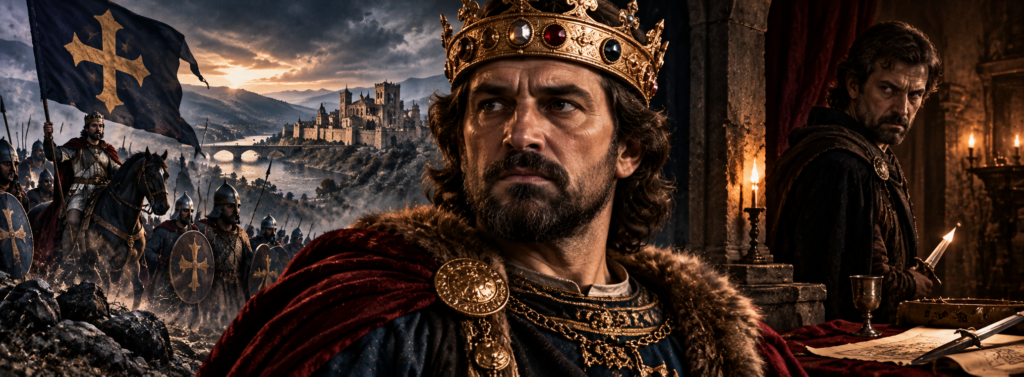
Theodoric II: The Visigothic King Murdered by His Brother for a Throne
Theodoric II (d. 466) | King of the Visigoths, 453–466 | Son of the Visigothic king Theodoric I | Brother and successor of Thorismund | Came to power after Thorismund was assassinated in 453 | Ruled from the Visigothic royal center at Toulouse | Intervened repeatedly in the collapsing politics of the Western Roman Empire | Helped install Avitus as Western Roman emperor in 455 | Expanded Visigothic influence in Hispania through campaigns against the Suebi | Defeated the Suevic king Rechiar in 456 and participated in the destruction of his power | Maintained a complicated relationship with Roman generals and emperors as imperial authority disintegrated | Described by Sidonius Apollinaris in an unusually detailed contemporary portrait | Murdered in 466 | Ancient sources identify his younger brother Euric as the man responsible for or behind his death | Euric immediately succeeded him as king | His assassination continued a brutal pattern of dynastic violence within the Visigothic royal house and opened the way for one of the most powerful reigns in Visigothic history.
A King Dies in Toulouse
Sometime in 466, inside a Visigothic kingdom that had grown increasingly powerful as Roman authority collapsed around it, King Theodoric II was murdered. He had ruled for approximately thirteen years, commanded armies across Gaul and Hispania, made and abandoned alliances with Roman emperors, destroyed the power of rival kings, and helped transform the Visigoths from imperial auxiliaries into one of the dominant forces of the western Mediterranean. None of those achievements protected him from the danger that had already consumed another member of his family. The enemy who brought down Theodoric was not a Roman general or a Suevic warlord, but his own younger brother, Euric.
The surviving sources do not provide a detailed scene of the assassination. There is no reliable account describing the room in which Theodoric died, the weapon that struck him, the exact hour of the murder, or the words exchanged between the brothers before the killing. Later storytelling can easily fill that silence with daggers, conspiratorial whispers, armed retainers, and dramatic confrontations, but doing so would turn possibility into fiction. What the sources do preserve is the politically decisive fact that Theodoric was killed and that Euric succeeded him, with contemporary or near-contemporary testimony explicitly associating Euric with his brother’s death.
The murder was shocking, but it was not unprecedented within the family. Theodoric himself had become king after the violent removal of his elder brother Thorismund in 453, and surviving evidence connects Theodoric and another brother, Frederic, with that earlier overthrow. Thirteen years later, the same brutal logic returned. A royal house that had learned to settle succession disputes through assassination produced another murdered king.
There was a terrible symmetry to the story. Theodoric had benefited from the death of one brother and eventually fell because of another. Euric seized the throne and went on to become one of the most successful Visigothic rulers of the fifth century, expanding his kingdom dramatically while Western Roman power approached extinction. The assassination therefore did more than remove a king; it transferred control of a rapidly emerging post-Roman power to the man who would accelerate its independence.
Theodoric II lived at the moment when the Roman West was coming apart, but the world around him was not yet simply “medieval.” Roman emperors still reigned in Italy, Roman aristocrats still wrote elegant Latin poetry, imperial titles still mattered, and barbarian kings still negotiated with an empire whose prestige survived even as its power diminished. Theodoric operated inside that unstable political landscape with considerable skill. His murder reveals how dangerous kingship could become when imperial institutions weakened and dynastic power increasingly depended upon personal loyalty, military support, and the ability to survive one’s own relatives.
The Visigoths in a Dying Roman World
To understand Theodoric’s rise, it is necessary to abandon the familiar image of Rome suddenly collapsing and being replaced overnight by barbarian kingdoms. The fifth-century West was far messier than that. Roman institutions, aristocratic families, military commands, Germanic federate armies, regional rulers, bishops, and competing emperors existed alongside one another in constantly changing relationships. The Visigoths were both outsiders to the Roman political tradition and deeply entangled within it.
Their settlement in southwestern Gaul had developed from arrangements with the Western Roman government earlier in the century. By the reign of Theodoric’s father, Theodoric I, the Visigoths possessed a powerful territorial base centered on Toulouse. They were formally connected to Rome through treaty relationships, but their kings increasingly pursued policies based upon Visigothic interests rather than unquestioning imperial obedience. The distinction between Roman ally and independent kingdom was becoming progressively harder to define.
Theodoric I had ruled during decades of enormous instability. Vandals established themselves in North Africa, Suebi carved out a kingdom in northwestern Hispania, Burgundians expanded their position in Gaul, and Roman generals struggled to maintain imperial authority. The Huns under Attila added another terrifying force to the political landscape. Every alliance could become temporary because the balance of power shifted constantly.
The Visigoths were not merely destructive invaders occupying Roman territory. Their ruling elite adopted and interacted with Roman institutions, administrators, landowners, and cultural traditions. The kingdom depended upon populations who remained overwhelmingly Roman in language and legal culture. A successful Visigothic king therefore had to command warriors while also governing a complex society inherited from the empire.
Religion added another division. The Visigothic ruling elite generally followed the form of Christianity traditionally described as Arian, while most of the Roman population in their territories adhered to Nicene Christianity. The theological distinction could become politically important, although relations were not defined by continuous religious warfare. Kings had to manage communities whose identities did not neatly align.
Theodoric II inherited all of these tensions. His reign would demonstrate how effectively a Visigothic king could exploit Roman weakness without entirely abandoning Roman political forms. Before he could inherit anything, however, his family had to survive Attila.
Theodoric I and the Shadow of Attila
Theodoric II was one of several sons of Theodoric I. The exact details of his childhood are poorly documented, which is unsurprising for a fifth-century prince whose importance became obvious only later. He grew up within a royal household surrounded by military politics and negotiations with Rome. His father was constructing a dynasty in a world where dynasties were rarely secure.
In 451, Attila the Hun invaded Gaul. The campaign created an extraordinary coalition of forces opposed to him, including Roman troops commanded by the powerful general Flavius Aetius and Visigoths led by Theodoric I. The confrontation culminated in the Battle of the Catalaunian Plains, also known as the Battle of Châlons, although the precise location and tactical details remain debated. It became one of the most famous battles of late antiquity.
Theodoric I was killed during the fighting. Ancient accounts disagree about exactly how he died, with one tradition suggesting that he was thrown from his horse and trampled while another attributed his death to an enemy weapon. The uncertainty is a useful reminder that even major events could be recorded inconsistently. What mattered politically was that the Visigoths had suddenly lost their king during an enormous battle.
His son Thorismund was elevated to the kingship. According to the surviving narratives, Thorismund was already an important military figure and had participated in the fighting against the Huns. The succession appears to have occurred rapidly, probably because an army in the field could not remain without leadership. Theodoric II now became the brother of a reigning king rather than the immediate ruler himself.
Thorismund’s reign would be brief. Within approximately two years, he was dead. The circumstances of that death would cast a long shadow over Theodoric’s own fate.
The First Murder Between Brothers
Thorismund ruled from 451 until 453. The surviving sources portray tensions between him and his brothers, particularly Theodoric and Frederic. Jordanes, writing approximately a century later and drawing upon earlier material, states that Thorismund was killed through the treachery of his brothers. Other evidence supports the basic conclusion that his death was a dynastic assassination rather than a natural succession.
The precise motives remain less certain. Later narratives can tempt historians to construct elaborate explanations involving policy disagreements over Rome, personal jealousy, or competing military factions. Some of those possibilities are plausible, but the evidence does not allow a detailed reconstruction of the conspiracy. What can be said securely is that Theodoric benefited directly from his elder brother’s death.
Theodoric succeeded Thorismund as king in 453. His accession therefore carried the stain of fratricidal politics from the beginning. Whether he personally struck a blow is not known, and it would be misleading to describe the physical act without evidence. Political responsibility for the overthrow, however, is difficult to separate from his immediate accession and the testimony connecting the brothers to the killing.
This was not merely a private family tragedy. Visigothic kingship was not governed by an automatic system of primogeniture in which the eldest son inherited without challenge. Royal blood, military reputation, aristocratic support, and political strength all mattered. A king who failed to control his relatives could discover that his brothers were also his rivals.
Theodoric learned one of the darkest lessons of fifth-century kingship through Thorismund’s death. A crown could be taken from a brother if sufficient support existed to make the murder politically successful. Thirteen years later, Euric would apply the same lesson to him. Theodoric’s reign was born in fratricide and would eventually end the same way.
The King at Toulouse
Toulouse served as the political center of the Visigothic kingdom during Theodoric’s reign. The city was not a crude barbarian encampment but an old Roman urban center with administrative traditions, Christian institutions, aristocratic residences, and connections to the wider Mediterranean world. From there, the king presided over a realm stretching across substantial parts of southwestern Gaul. His court brought Gothic military power into constant contact with Roman political culture.
One of the most valuable descriptions of Theodoric comes from Sidonius Apollinaris, the Gallo-Roman aristocrat, poet, politician, and later bishop. Sidonius knew the Visigothic court and produced a detailed literary portrait of the king. As with all elite literary descriptions, it was shaped by rhetorical conventions and the author’s purposes. Nevertheless, it provides an extraordinary glimpse of how Theodoric appeared to an educated Roman contemporary.
Sidonius described a physically impressive ruler with carefully maintained habits and a disciplined daily routine. The king attended religious observances, received petitioners, conducted business, ate with a degree of restraint, and participated in recreation. He appears in the portrait not as a wild barbarian chief but as a monarch whose court had absorbed many Roman expectations of civilized rulership. The description itself reveals how much Roman and Gothic political worlds had already begun to overlap.
Theodoric could also operate within Roman diplomatic culture. He maintained relationships with aristocrats, imperial officials, and military commanders. His court became a place where Roman political figures might seek support. The Visigothic king was increasingly capable of influencing who ruled the Western Empire itself.
That influence would become dramatically visible in 455. Rome was entering another succession crisis. Theodoric would help elevate a Roman aristocrat to the imperial throne, demonstrating that the king at Toulouse had become powerful enough to participate directly in the making of emperors.
The Murder of Valentinian III
The Western Roman Empire descended into another political crisis in 455 when Emperor Valentinian III personally killed the powerful general Aetius. The decision removed the man who had dominated western imperial politics for years. Valentinian reportedly feared Aetius’s power, but murdering him destroyed one of the remaining pillars of imperial military authority. The emperor would not survive long afterward.
In March 455, Valentinian himself was assassinated. His killer was connected to men who had served Aetius, while the senator Petronius Maximus emerged as the principal political beneficiary. Maximus seized the imperial throne. His reign lasted only a few months.
The Vandals under King Geiseric then sailed from North Africa toward Italy. Panic spread through Rome, and Maximus attempted to flee. He was killed by a mob in May 455 before the Vandals entered the city. Rome was subsequently subjected to a famous sack that lasted approximately two weeks.
The western imperial throne was once again vacant. In Gaul, a Gallo-Roman aristocrat named Eparchius Avitus emerged as a candidate. Avitus had extensive connections with the Visigothic court and had previously served in important Roman offices. Theodoric II strongly supported him.
The relationship between Avitus and Theodoric reveals how far the balance of power had shifted. A Roman emperor now needed the backing of a Visigothic king to make a credible claim to the throne. Theodoric was still formally interacting with the Roman imperial system. In practical terms, however, he was becoming one of the men capable of determining its leadership.
Theodoric the Emperor-Maker
Avitus was proclaimed emperor in Gaul in 455 with Visigothic support. Theodoric’s role in his elevation was significant, although the process involved Roman aristocrats and military interests as well. The new emperor represented a political alliance between Gallo-Roman elites and Visigothic power. For Theodoric, the arrangement promised influence within imperial politics without requiring him to claim the Roman throne himself.
Theodoric’s support was not merely ceremonial. Visigothic military strength gave Avitus an important foundation. The emperor eventually traveled to Italy, where he attempted to establish his government. His position remained fragile because powerful Roman military figures, particularly Ricimer and Majorian, were developing their own ambitions.
While Avitus struggled in Italy, Theodoric turned his attention toward Hispania. The Suevic kingdom had expanded aggressively under King Rechiar. Suevic attacks threatened Roman interests and destabilized territories in which the Visigoths also had strategic ambitions. Theodoric now had both opportunity and justification to intervene.
His campaign against the Suebi would become one of the major military achievements of his reign. It would also reveal the ambiguity of Visigothic expansion. Theodoric could claim to be acting in support of Roman imperial authority while simultaneously extending his own kingdom’s influence. The difference between serving Rome and replacing Rome was becoming increasingly thin.
Avitus’s dependence upon Visigothic support made that ambiguity even more obvious. Theodoric was technically the king of a people still connected to the empire by treaty. Yet an emperor had risen with his assistance. The subordinate ally was becoming a kingmaker.
Rechiar and the War in Hispania
Rechiar, king of the Suebi, was himself connected to the Visigothic royal family through marriage. He had married a daughter of Theodoric I, making him Theodoric II’s brother-in-law. Dynastic marriage did not prevent conflict. In the politics of late antiquity, family connections could coexist with territorial rivalry and war.
The Suebi controlled a kingdom centered in Gallaecia in northwestern Hispania. Under Rechiar, they expanded their activities into neighboring territories. Roman authority in the peninsula had weakened severely, creating opportunities for regional powers. Theodoric could not ignore a rival kingdom growing stronger to the south of his Gallic base.
In 456, Theodoric led a major Visigothic campaign into Hispania. He crossed the Pyrenees and confronted Rechiar’s forces. The decisive battle occurred near the river Órbigo, not far from Astorga. The Suevic army was defeated.
Rechiar fled after the battle. Theodoric’s forces advanced into the Suevic kingdom and captured Braga, an important political center. Sources describe violence and plunder during the campaign, although the precise scale should not be exaggerated beyond the evidence. Late antique warfare routinely exposed civilian populations to looting, displacement, and killing.
Rechiar was eventually captured. He was executed in December 456, effectively destroying the political order he had built. Theodoric had defeated and killed a fellow king who was also connected to his family by marriage.
The victory transformed Visigothic influence in Hispania. The Suevic kingdom did not disappear permanently, but it fractured and entered a period of instability. Theodoric had demonstrated that his armies could operate far beyond Toulouse. The Visigothic kingdom was becoming an expansionist power.
Theodoric and the Blood of Kings
The execution of Rechiar adds another dark layer to Theodoric’s reign. The king who had risen after his brother’s assassination now ordered or presided over the elimination of a defeated royal relative. Political violence was not exceptional within his world. It was one of the tools through which kingdoms expanded and dynasties survived.
Rechiar’s death also illustrates the weakness of royal status without military power. A king might possess lineage, title, and followers, but defeat could strip those protections away quickly. Theodoric understood this reality because his own dynasty had already experienced violent succession. Kingship offered immense authority without guaranteeing personal safety.
The Visigothic campaign in Hispania was officially compatible with the interests of Emperor Avitus. Rechiar had challenged imperial authority, and Theodoric could present his intervention as enforcement of Roman order. Yet the territorial consequences strengthened the Visigoths more than the emperor. Every successful campaign increased Theodoric’s independence.
The relationship between Visigothic and Roman power therefore contained a fundamental contradiction. Theodoric benefited from imperial legitimacy while simultaneously taking advantage of imperial weakness. Rome could authorize actions that it no longer possessed the military strength to undertake itself. The Visigoths performed them and gained the practical rewards.
This pattern would continue throughout the reign. Theodoric did not simply declare complete independence and sever every connection with Rome. He maneuvered within the crumbling imperial structure, supporting some emperors and opposing others. His kingdom grew while the empire shrank.
The strategy was effective, but it depended upon constant political adjustment. Roman emperors changed rapidly, generals seized power, alliances collapsed, and former friends became enemies. Theodoric survived this world for thirteen years. His greatest danger would ultimately come from inside his own dynasty.
Avitus Falls
While Theodoric campaigned in Hispania, Emperor Avitus’s position in Italy deteriorated. The emperor faced financial problems, political hostility, and opposition from powerful military commanders. Ricimer, a Germanic general who would become the dominant power behind several western emperors, turned against him. Majorian also emerged as an important figure.
In 456, Avitus was defeated. He was forced to abdicate and was reportedly made bishop of Piacenza, although the exact circumstances of his death soon afterward remain uncertain. Some sources suggest he died while attempting to return to Gaul. The emperor whom Theodoric had helped elevate had lasted little more than a year.
The fall of Avitus changed Theodoric’s relationship with the imperial government. Majorian eventually became emperor in 457, backed by Ricimer. Unlike some of the weak rulers who surrounded him, Majorian proved energetic and militarily ambitious. He attempted to restore imperial authority in Gaul and Hispania.
Theodoric could no longer assume that Roman weakness would leave him free to expand without resistance. Majorian campaigned in Gaul and forced the Visigoths back toward a more subordinate relationship. Roman military power, although diminished, was not yet dead. Theodoric had to accommodate the new emperor.
This reversal demonstrates that his expansion was neither effortless nor inevitable. The Visigoths possessed considerable strength, but they still operated within a competitive political environment. A capable Roman emperor could temporarily restrain them. Theodoric’s skill lay partly in surviving these shifts without losing his throne.
Majorian’s own success would prove temporary. In 461, he was overthrown and killed after returning from an unsuccessful expedition against the Vandals. Ricimer once again became the dominant political force in Italy. The Western Empire entered another cycle of weakness that Theodoric could exploit.
Rome’s Emperors Keep Dying
Theodoric’s reign coincided with one of the most chaotic periods in Western Roman imperial history. Valentinian III was assassinated in 455, Petronius Maximus was killed only months later, Avitus was overthrown, and Majorian was executed in 461. Emperors were increasingly dependent upon generals whose military forces determined whether they could remain in power. The imperial title retained enormous prestige while the office itself became dangerously fragile.
Ricimer emerged as the most powerful military figure in Italy. Because his background and religious identity made direct assumption of the imperial title politically difficult, he exercised influence through emperors he helped elevate. Libius Severus became emperor after Majorian’s death. His authority was not universally recognized.
For Theodoric, this instability created opportunities. The Visigothic kingdom could negotiate with Roman factions, expand territorially, and present itself as either ally or opponent depending upon circumstances. The king at Toulouse possessed something increasingly rare in the western Mediterranean: a relatively stable military base. Roman politicians needed such power even when they feared it.
Theodoric nevertheless remained connected to Roman culture and aristocratic networks. His court included men who understood Latin political traditions, and Gallo-Roman elites continued to operate within Visigothic territory. The emerging kingdom was not built by simply expelling or replacing the Roman population. It grew through a complicated process of accommodation, domination, and institutional adaptation.
The instability of the empire may also have influenced Visigothic succession politics. When external institutions cannot guarantee order, control of the army and royal household becomes even more important. A disputed succession could not be settled by appealing to a stable imperial authority. Brothers with armed supporters could settle it themselves.
That was precisely how Theodoric had obtained his crown. It was also how he would lose it.
Frederic, the King’s Brother and General
Theodoric’s brother Frederic played an important role during the reign. He appears in the sources as a significant military commander and political figure. Like Theodoric, he had been associated with the overthrow of Thorismund. The brothers therefore shared both blood and a history of dynastic violence.
Frederic led Visigothic forces in several campaigns. In 458, he fought in Hispania, where Visigothic intervention continued after the defeat of Rechiar. He also became involved in conflicts in Gaul. His military importance made him one of the strongest figures within the royal family.
In 463, Frederic confronted forces associated with the Roman commander Aegidius near Orléans. Aegidius had remained loyal to Majorian and opposed Ricimer’s political order after the emperor’s death. The battle ended disastrously for the Visigoths. Frederic was killed.
His death removed one of Theodoric’s most powerful brothers. It may also have altered the internal balance within the royal family. Euric, another younger brother, remained. The surviving evidence does not allow historians to trace precisely how Euric’s influence developed during these years.
It would be tempting to imagine Theodoric becoming increasingly suspicious after Frederic’s death, surrounded by relatives who had already demonstrated that brothers could kill brothers. No source securely records such private fears. What can be said is that the dynasty possessed recent experience of fratricidal succession. Euric would soon make that history repeat itself.
Theodoric’s Court Through Roman Eyes
Sidonius Apollinaris’s portrait of Theodoric remains one of the most vivid surviving descriptions of any fifth-century Germanic king. Sidonius was no neutral modern observer, and his writing followed classical literary conventions. Even so, his account provides details that help strip away later stereotypes about “barbarian” kings. Theodoric appears disciplined, physically impressive, socially controlled, and accustomed to formal rulership.
The king’s daily routine included religious observance and public business. Petitioners could approach him, and he devoted time to administrative matters. Meals were described as orderly rather than excessively luxurious. Recreational activities, including games and hunting-related pursuits, formed part of courtly life.
Sidonius also described Theodoric’s physical appearance in flattering detail. The king was presented as well proportioned and commanding, with carefully observed features and dignified bearing. Such descriptions served literary purposes and should not be treated like a photograph. They nevertheless demonstrate that Roman aristocrats could portray a Visigothic ruler according to standards traditionally applied to civilized elites.
The court itself combined Gothic and Roman elements. Military followers surrounded the king, but Roman officials, diplomats, and aristocrats also interacted with him. Latin remained essential to administration and diplomacy. Theodoric’s kingdom depended upon a population shaped by centuries of Roman government.
This cultural mixture is important because Theodoric’s assassination is sometimes imagined through a crude barbarian stereotype. The murder did not occur in a world devoid of institutions or political sophistication. It happened within a royal court capable of diplomacy, administration, literary patronage, and strategic calculation. Sophistication did not make dynastic violence disappear.
If anything, political complexity could make assassination more useful. A successful conspirator needed not merely to kill a king but to ensure that military and aristocratic elites accepted the replacement. Euric apparently succeeded at both tasks. The speed of his accession suggests that the murder was politically effective, whatever the exact mechanics behind it.
The Expansion of Visigothic Ambition
During the later years of Theodoric’s reign, the Visigoths continued expanding their influence. Roman authority in Gaul was increasingly fragmented among imperial officials, regional military commanders, and emerging Germanic kingdoms. Theodoric could exploit rivalries between these powers. His kingdom was becoming less dependent upon formal imperial approval.
The death of Majorian in 461 was particularly significant. Majorian had demonstrated that a determined emperor could still challenge Visigothic expansion. His removal by Ricimer weakened imperial resistance. The rulers who followed possessed less capacity to restore direct Roman control over Gaul.
Theodoric nevertheless faced setbacks. Frederic’s death near Orléans showed that Roman military forces remained capable of defeating Visigothic armies. Aegidius and other regional commanders maintained independent power. The political map of Gaul remained fluid.
Theodoric also continued intervention in Hispania, where Suevic politics had fractured after Rechiar’s death. Visigothic forces operated there in ways that expanded Toulouse’s influence. The peninsula would become increasingly important to the future of the Visigothic kingdom. Under Euric and later rulers, that connection would deepen.
By the middle of the 460s, Theodoric had transformed the position he inherited in 453. He was no longer merely a king dependent upon Roman recognition. He was the ruler of a major territorial power capable of shaping imperial politics. Yet the very success of the monarchy made possession of the throne more valuable.
A weak crown attracts fewer rivals than a powerful one. By expanding the kingdom, Theodoric may have increased the prize available to whoever could replace him. In 466, Euric made his move.
Euric: The Brother Waiting in the Shadows
Euric was another son of Theodoric I and therefore brother to Thorismund, Theodoric II, and Frederic. His early career is less well documented than his later reign. Before 466, he does not dominate the surviving narrative. After that year, he becomes one of the most important Visigothic kings.
Ancient sources leave little doubt that Theodoric’s death was connected to Euric. Hydatius, a contemporary chronicler in Hispania, recorded that Theodoric died and was succeeded by his brother Euric, associating the succession with fraternal violence. Jordanes later stated more explicitly that Euric came to the throne after killing his brother. Although the exact details differ in surviving traditions, the basic conclusion of fratricide is strong.
What the sources do not preserve is an intimate explanation of motive. Euric clearly gained the crown, which provides an obvious political incentive. Whether he acted because of an immediate dispute, a long-standing rivalry, fear for his own position, pressure from aristocratic supporters, or simple ambition cannot be reconstructed with certainty. Historians should resist converting the absence of evidence into psychological certainty.
The structure of Visigothic kingship itself created opportunities for rivalry. Succession did not automatically pass from father to eldest son under a rigid hereditary system. Powerful adult brothers could present themselves as viable rulers. Military and aristocratic support could determine which member of the dynasty survived.
Euric also belonged to a family in which fratricide had already worked. Theodoric had replaced Thorismund after the elder brother was killed. A precedent had been established. The political lesson was impossible to miss.
Theodoric had helped prove that a brother’s death could open the road to Toulouse. Euric now followed that road.
The Murder of Theodoric II
Theodoric II died in 466 after approximately thirteen years as king. The surviving sources identify Euric as responsible for the killing or directly associate him with the fratricidal seizure of power. Beyond that, the details become frustratingly sparse. No trustworthy contemporary narrative provides a cinematic account of the assassination itself.
We do not know whether Theodoric was killed personally by Euric or by men acting for him. We do not know whether the murder occurred during a formal confrontation, inside a royal residence, during a council, or in some other setting. We do not know whether Theodoric suspected the conspiracy. Claims about those details should therefore be treated as later imagination unless supported by evidence.
What matters is the political outcome. Theodoric was dead, and Euric became king immediately afterward. There is no evidence of a prolonged succession war comparable to some later Visigothic conflicts. The transfer of power appears to have been successful.
That success suggests that Euric possessed substantial support among important Visigothic elites. Assassinating a king is only the first stage of a coup; surviving the aftermath requires acceptance by soldiers, aristocrats, officials, and regional commanders. Euric evidently secured enough of that support to rule. His subsequent reign lasted nearly two decades.
Theodoric’s murder therefore cannot be dismissed as an isolated family quarrel. It was a political assassination that transferred control of an expanding kingdom. The victim was a reigning monarch, and the beneficiary was the brother who replaced him. By any meaningful definition, it belongs among the most consequential acts of regicide within early Visigothic history.
The grim symmetry remained unavoidable. Theodoric had reached the throne after Thorismund’s murder. Euric reached it after Theodoric’s. The dynasty had turned fratricide into a method of succession.
Did Euric Kill Him with His Own Hands?
Later retellings sometimes describe Euric as personally murdering Theodoric. The language of some ancient sources can support the broad statement that Euric killed his brother, but this does not necessarily establish that he physically delivered the fatal blow. Ancient writers frequently attributed a politically ordered killing directly to the ruler responsible. The distinction between personally wielding a weapon and arranging an assassination is therefore important.
There is no reliable surviving description of Euric entering Theodoric’s chamber and stabbing him. There is likewise no secure evidence for poisoning, strangulation, or any other specific method. Illustrations and popular histories may choose a dramatic scene because visual storytelling demands one. Historical prose should be more cautious.
What is secure is Euric’s responsibility for the violent succession. Theodoric did not die peacefully and happen to leave the throne to his brother. The sources connect the death and accession directly. Euric’s reign began through the elimination of the reigning king.
The lack of detail is itself characteristic of early medieval and late antique political history. Chroniclers often recorded the fact of a ruler’s death in only a few words. Events that must have involved days or weeks of conspiracy could survive as a single sentence. Modern readers are left staring into the gaps.
Those gaps should create caution rather than permission to invent. The reality was already dramatic enough. A reigning king was murdered by or at the instigation of his younger brother, who immediately took his crown. Nothing fictional needs to be added.
The Brother Who Profited
Euric’s subsequent career makes the assassination even more significant. He proved to be an exceptionally capable ruler. During his reign from 466 to 484, the Visigothic kingdom expanded dramatically in both Gaul and Hispania. He took advantage of the final collapse of Western Roman imperial authority and increasingly behaved as a fully independent sovereign.
Under Euric, Visigothic forces captured additional Roman territories, including important regions of southern and central Gaul. His influence in Hispania also expanded. By the time of his death, the kingdom was one of the dominant powers of the post-Roman West. Toulouse stood at the center of a realm far larger than the one Theodoric had inherited.
Euric is also associated with the codification of Visigothic law. The so-called Code of Euric survives only incompletely and remains the subject of scholarly discussion, but it represents an important stage in the development of written Visigothic legal tradition. His reign therefore combined military expansion with institutional development. The fratricide who seized the throne was not merely a violent usurper; he became a successful state builder.
That success may have influenced how later generations remembered the murder. Victorious rulers often acquire narratives that emphasize achievement over the bloodshed of their accession. Theodoric became the brother who came before Euric rather than the central figure in his own right. The killer’s accomplishments overshadowed the victim’s reign.
Yet Theodoric had laid much of the groundwork Euric exploited. He had expanded Visigothic power in Hispania, intervened in Roman imperial politics, and strengthened the kingdom’s position during the disintegration of the Western Empire. Euric inherited a formidable political structure. He then pushed it much further.
The assassination therefore marks both an ending and a transition. Theodoric’s death closed one phase of Visigothic engagement with Rome. Euric’s accession accelerated the movement toward open independence.
Rome Disappears from the West
Only ten years after Theodoric’s murder, the conventional end of the Western Roman Empire occurred. In 476, the military commander Odoacer deposed the young emperor Romulus Augustulus in Italy. The event did not feel to contemporaries like the sudden disappearance of an entire civilization, and Julius Nepos continued to claim the western imperial title from Dalmatia until his death in 480. Nevertheless, 476 became the traditional date marking the end of the Western Empire.
Euric had already anticipated this transformation. He treated weakening imperial authority as an opportunity to expand. The old fiction that Visigothic kings ruled primarily as federate partners of Rome became increasingly irrelevant. A new political order was emerging from the empire’s remains.
Theodoric had lived in the transitional world before that final break. He still supported emperors, negotiated through imperial frameworks, and sometimes acted under the language of Roman legitimacy. Yet his own power demonstrated how hollow those frameworks were becoming. A Visigothic king could help create an emperor because emperors increasingly needed barbarian kings.
His assassination therefore occurred during a profound transfer of political authority. The Roman state was losing the capacity to control succession, territory, and military power in the West. Regional kings were becoming sovereign rulers whether or not they immediately used that language. Dynastic violence within their courts now had consequences for entire provinces.
When Euric killed Theodoric, Rome could not intervene to determine the Visigothic succession. There was no imperial army marching to Toulouse to punish the murderer and restore a lawful heir. The kingdom settled the matter internally. The imperial world was already giving way to the world of successor kingdoms.
Theodoric’s death belongs to that transformation. His murder was not simply the violent end of one man. It was an episode in the creation of post-Roman Europe.
The Curse of Visigothic Kingship
Visigothic history became notorious for violent royal successions. Later kings would be deposed, blinded, tonsured, imprisoned, or killed by rivals. Medieval writers sometimes treated the instability as almost characteristic of the monarchy. Modern historians have occasionally referred to the pattern as the “Visigothic morbus,” or Visigothic disease, though the phrase itself comes from later polemical tradition and should not be treated as a literal diagnosis of the political system.
The structural problem was real. Visigothic kingship remained elective or at least dependent upon aristocratic recognition rather than developing a consistently secure father-to-son hereditary succession. Powerful nobles and royal relatives could therefore become kingmakers or candidates themselves. A ruler who alienated important factions risked removal.
Theodoric’s family demonstrates the danger vividly. Theodoric I died in battle and was succeeded by Thorismund. Thorismund was then murdered, allowing Theodoric II to become king. Theodoric II was later murdered by Euric.
Three brothers occupied the throne in succession, and two of those transfers involved fratricidal violence. The pattern cannot be explained by some inherent cultural tendency toward murder. It emerged from a political structure in which royal legitimacy was flexible and military support mattered enormously. Ambitious relatives had both motive and opportunity.
Theodoric’s own participation in Thorismund’s downfall makes his fate especially striking, but it should not be transformed into a morality tale about supernatural justice. History does not operate according to poetic punishment. Euric killed him because political conditions made seizure of the throne possible, not because some invisible force demanded revenge.
Even so, contemporaries and later readers could hardly miss the symmetry. The man who rose after one brother’s assassination eventually became the victim of another. In the brutal politics of Toulouse, the method that created a king also destroyed him.
Was Theodoric a Romanized Barbarian?
The language traditionally used to describe rulers such as Theodoric can obscure more than it explains. Calling him a “Romanized barbarian” assumes two completely separate worlds, one civilized and Roman and the other barbaric and Germanic. By the fifth century, the relationship was far more complicated. Visigothic elites had interacted with the Roman Empire for generations.
Theodoric’s court reflected this mixture. Roman aristocrats could visit and describe him, Roman diplomatic practices shaped his foreign relations, and Roman administrative traditions continued within his territories. The king ruled populations whose daily lives remained deeply influenced by Roman law, language, religion, and economic structures. His kingdom developed from within the imperial world rather than outside it.
At the same time, Theodoric maintained a distinct Gothic royal identity. His military strength depended heavily upon Visigothic elites, and his dynasty possessed its own traditions of authority. Religious differences separated the Arian Gothic ruling class from much of the Nicene Roman population. The kingdom was neither simply Roman nor simply foreign.
This hybrid political culture helped make the Visigoths successful. They could use Roman institutions without being controlled by the Roman emperor. They could negotiate with aristocrats while commanding their own armies. They could claim legitimacy from both Gothic kingship and imperial relationships.
Theodoric embodied this transitional world particularly well. He could support a Roman emperor one year and expand at Roman expense the next. He could appear in Sidonius’s literary portrait as a sophisticated ruler while presiding over a dynasty marked by fratricide. None of these features was contradictory within the politics of the age.
His murder should therefore not be read as evidence that barbarian kingship was inherently primitive. Roman imperial politics of the same century contained assassinations, coups, executions, and betrayals on an equally spectacular scale. Valentinian III, Petronius Maximus, Majorian, and other emperors discovered that Roman titles offered no immunity from political murder. Theodoric’s court was violent because fifth-century power itself was violent.
Theodoric and the Men He Helped Destroy
Theodoric’s thirteen-year reign intersected with a remarkable series of ruined rulers. Thorismund died so that Theodoric could become king. Rechiar was defeated, captured, and executed after challenging Visigothic power. Avitus rose with Theodoric’s support and then fell before Roman military rivals.
Majorian temporarily checked Visigothic expansion before being overthrown and killed by Ricimer. Frederic died in battle against Aegidius. Other Suevic rulers fought for control of the fragmented kingdom in Hispania. The political landscape surrounding Theodoric was filled with men whose power disappeared suddenly.
This environment encouraged rulers to think in immediate strategic terms. Alliances were valuable only while they remained useful. Family relationships did not guarantee loyalty. Imperial recognition mattered until military reality contradicted it.
Theodoric appears to have navigated this world effectively for most of his reign. He survived changing emperors and shifting Roman alliances. He expanded into Hispania and maintained control of his Gallic kingdom. His court attracted enough respect that a Roman aristocrat such as Sidonius could describe it in detail.
His fatal weakness was the same one that had destroyed Thorismund: the royal family itself contained alternative claimants. Euric did not need to conquer Toulouse from outside. He was already inside the dynasty. Theodoric’s blood gave his brother the legitimacy necessary to replace him.
The most dangerous rival to a king is sometimes the person whose claim looks almost exactly like his own. Euric possessed the same father, the same royal lineage, and access to the same political world. Theodoric could defeat foreign kings, but he could not survive his brother.
What We Do Not Know
The scarcity of evidence surrounding Theodoric’s death creates a temptation to embellish. A modern narrative naturally wants to know whether Euric confronted his brother face-to-face, whether guards were bribed, whether aristocrats planned the coup, and whether Theodoric died knowing who had betrayed him. The sources do not provide reliable answers. Historical storytelling becomes strongest when it acknowledges those limits rather than disguising them.
We also do not know exactly how long the conspiracy developed. Euric may have prepared his move carefully, or the killing may have emerged from a more immediate political crisis. There is insufficient evidence to determine whether Theodoric had already alienated important Gothic nobles. The successful succession indicates support for Euric, but the reasons for that support remain obscure.
Nor can we reconstruct Theodoric’s private relationship with Euric. They were brothers within a family already damaged by political murder, but blood relationship alone tells us nothing about affection, resentment, or fear. Later knowledge of the assassination can make every earlier interaction appear sinister. That is hindsight rather than evidence.
Even the physical circumstances of the murder remain unknown. No responsible account should confidently place Theodoric in a banquet hall, bedchamber, council chamber, or hunting camp unless evidence emerges to support that setting. The most dramatic details are precisely the ones history has lost. The silence must remain visible.
What survives is enough to establish the essential story. Theodoric II, king of the Visigoths, was violently removed in 466. His brother Euric was responsible and took the throne. The political consequences were enormous.
Sometimes history preserves the motive and loses the murder scene. In Theodoric’s case, ambition is visible through the succession even while the final moments remain hidden. The darkness surrounding his death is not a flaw in the story; it is part of what makes the assassination so haunting.
The Kingdom Euric Inherited
Euric inherited a kingdom far stronger than the one Theodoric had taken over in 453. Visigothic influence extended deeply into Hispania, while Toulouse remained the center of a powerful Gallic realm. Roman authority was fractured, and no western emperor possessed the resources necessary to restore the political order of earlier centuries. The new king had extraordinary opportunities.
He exploited them aggressively. Euric expanded into territories that had remained under Roman or semi-independent control. Cities and regions across Gaul came under Visigothic authority. His armies pressed the kingdom toward its greatest territorial extent before the later Frankish conquests.
In Hispania, Visigothic power also increased. The Suebi survived in the northwest, but much of the peninsula became increasingly subject to Visigothic intervention and control. The kingdom was developing the geographical foundations of the later Visigothic state centered in Spain. The process would continue long after Euric’s death.
The timing of his accession was therefore exceptionally favorable. Western imperial authority was entering its final decade. Ricimer’s dominance in Italy continued until his death in 472, followed by further rapid changes of emperor. By 476, the western imperial throne effectively disappeared.
Euric did not create the collapse of Rome, but he understood how to exploit it. Theodoric had already demonstrated the strategy. The difference was that Euric pushed beyond his brother’s cautious engagement with imperial politics toward much clearer independence.
The murdered king thus became an unwilling bridge between two phases of Visigothic history. Theodoric had strengthened the kingdom within the Roman system. Euric inherited that strength and increasingly moved beyond the system altogether.
The Brother Theodoric Had Once Been
There is one final parallel that cannot be ignored. In 453, Thorismund was king and Theodoric was the ambitious brother connected with his removal. In 466, Theodoric was king and Euric occupied the position of the ambitious brother. The roles had reversed almost perfectly.
This does not prove that the two assassinations unfolded in identical ways. The sources do not provide enough detail to reconstruct either conspiracy completely. Different factions, grievances, and circumstances may have shaped each event. Historical symmetry should not be mistaken for exact repetition.
Yet the political logic was undeniably similar. In both cases, a brother possessed enough royal legitimacy to replace the reigning king. In both cases, violence resolved the succession. In both cases, the new king survived the immediate consequences.
Theodoric therefore lived under a system whose dangers he understood from personal experience. He knew that brothers could become rivals because he had benefited from precisely such a rivalry. Whether he ever considered the possibility that Euric might imitate him is unknown. No source gives access to that private fear.
The result nevertheless carries the force of tragedy without requiring invention. Theodoric’s accession had demonstrated that fratricide could succeed. His own death confirmed the lesson. The crown at Toulouse passed through blood because blood was one of the few mechanisms powerful enough to settle a contested claim.
Euric would rule successfully until his natural death in 484. The brother who murdered a king proved better at avoiding assassination than the brother he replaced. Political morality and political survival did not necessarily coincide.
Why Theodoric II Belongs Among the Assassinated Rulers
Theodoric II fits the Assassinated Rulers & Regicides category in the most direct possible sense. He was a reigning king deliberately killed so that another claimant could seize his throne. His death was not an accident, battlefield casualty, or later legend attached to an uncertain disappearance. The ancient tradition explicitly connects his brother Euric with the killing and succession.
His case is especially valuable because it illuminates a type of regicide that appears repeatedly across history: dynastic assassination from within the ruling family. Kings often faced dangers from external enemies, but relatives could be more threatening because they possessed their own claims to legitimacy. A brother did not need to invent a reason why he belonged near the throne. His blood already provided one.
Theodoric’s story also complicates the familiar division between Rome and the so-called barbarian kingdoms. His assassination occurred while Roman imperial institutions still existed in the West, yet those institutions had little ability to determine events inside the Visigothic monarchy. Power had shifted toward regional kings. Their family struggles now shaped the political future of former Roman provinces.
The murder further demonstrates how rapidly successful violence could become legitimate government. Euric did not spend the remainder of his life hiding as a criminal. He became king, expanded the realm, issued laws, negotiated with other powers, and died after a long reign. The assassination was absorbed into the political order it created.
That reality can feel uncomfortable because modern expectations encourage a sharp division between crime and government. Fifth-century politics often blurred that boundary. A successful coup could become a dynasty, and a murdered king could quickly become a predecessor rather than an unresolved victim. Power had its own way of legitimizing the survivor.
Theodoric was both perpetrator and victim within that system. His story therefore resists simple moral categories. He helped seize a throne through his brother’s death and later lost the same throne through another brother’s ambition. The cycle of dynastic violence consumed one generation of his family after another.
The Throne That Brothers Bought with Blood
Theodoric II ruled during the twilight of Roman power in the West, when ancient institutions still stood but could no longer reliably control the political world around them. Emperors continued to issue laws, aristocrats continued to write in the language of classical civilization, and Roman titles retained enormous prestige. Yet armies increasingly answered to generals and kings whose authority rested upon forces outside traditional imperial structures. Toulouse was becoming one of the centers of that new world.
Theodoric had not inherited his throne peacefully. His father died fighting Attila, and his elder brother Thorismund became king amid the crisis that followed. Within two years, Thorismund was dead, and Theodoric emerged as his successor. The surviving evidence connects Theodoric and Frederic with the violent change of power, leaving the beginning of his reign inseparable from fratricide.
Once king, Theodoric proved far more than a temporary usurper. He built relationships with Roman aristocrats, strengthened Visigothic authority, and demonstrated that Toulouse could influence imperial politics. His support helped elevate Avitus to the western imperial throne. A king once nominally subordinate to Rome had become powerful enough to help choose a Roman emperor.
His armies also transformed the political landscape of Hispania. Rechiar’s Suevic kingdom challenged the balance of power, and Theodoric responded with invasion. The Suevic king was defeated, captured, and executed, while Visigothic influence spread deeper into the peninsula. Theodoric was helping construct a kingdom that would outlive the Western Roman Empire itself.
He also survived repeated changes in Roman leadership. Avitus fell, Majorian rose, Majorian was killed, and Ricimer dominated imperial politics from behind the throne. Theodoric adjusted his policies as circumstances changed, sometimes cooperating with Roman authorities and sometimes exploiting their weakness. His ability to maneuver through this chaos was one of the defining features of his reign.
The king described by Sidonius was not a crude destroyer standing outside Roman civilization. He presided over a sophisticated court where Gothic military traditions and Roman political culture met. Petitioners approached him, diplomats negotiated with him, aristocrats observed him, and officials helped administer his territories. The emerging Visigothic kingdom was becoming a state rather than merely a migrating army.
None of that stability could solve the problem inside his own family. The Visigothic crown remained vulnerable because royal brothers could become alternative kings. Theodoric knew this better than almost anyone alive. He had become king through precisely that vulnerability.
Frederic’s death in battle removed one powerful brother, but Euric remained. The sources tell us frustratingly little about the relationship between Theodoric and Euric before 466. We cannot know what conversations passed between them, what suspicions developed, or how many men knew that a conspiracy was forming. The evidence does not permit us to turn the palace at Toulouse into a stage for invented drama.
The final act is nevertheless unmistakable. Theodoric was killed, and Euric took the throne. Ancient testimony identifies the succession as fratricidal. A younger brother had eliminated the reigning king.
There is no need to invent a dagger flashing beneath torchlight or a final accusation spoken between dying brothers. The documented facts are darker because they are real. A royal family that had already used assassination to settle one succession used it again. The method had become part of the dynasty’s political memory.
Theodoric’s death also exposes the fragility hidden beneath royal power. He could command armies across Gaul and Hispania, influence Roman emperors, destroy rival kingdoms, and receive powerful aristocrats at his court. Yet none of those things guaranteed that the men nearest to him would remain loyal. A kingdom could be formidable while its king remained personally vulnerable.
Euric understood the opportunity. By killing or arranging the killing of Theodoric, he did not merely eliminate a brother. He acquired control of one of the strongest political powers emerging from the ruins of Roman Gaul. The prize was immense.
The new king then demonstrated that his ambition was matched by ability. Euric expanded the Visigothic realm across large areas of Gaul and Hispania. He strengthened royal independence and became associated with important legal developments. His reign helped transform the Visigothic kingdom into one of the great successor states of the western Mediterranean.
This success did not make the murder less significant. It made it more so. A political assassination had transferred a kingdom at precisely the moment when that kingdom was poised for dramatic expansion. The history of post-Roman Europe was shaped, in part, by a brother’s decision to remove another brother.
There is a temptation to see poetic justice in Theodoric’s fate. He had benefited from Thorismund’s assassination, and he later died through Euric’s ambition. The symmetry is undeniable, but history should not be forced into a moral system it does not possess. Theodoric was not killed by fate avenging Thorismund; he was killed because the structure of power allowed another claimant to do what he himself had once done.
That distinction makes the story more unsettling rather than less. There was no supernatural curse upon the dynasty. There was a political culture in which royal legitimacy remained contested, armed support determined survival, and assassination could successfully transfer sovereignty. Brothers killed brothers because doing so sometimes worked.
The Roman Empire had once claimed the authority to regulate kings beyond its frontiers and commanders within its provinces. By 466, that authority was fading rapidly. When Theodoric died, no emperor could simply dictate who should rule the Visigoths. Euric’s successful seizure of power was itself evidence of how far the political world had changed.
Ten years later, the western imperial throne disappeared. The kingdoms that Rome had once attempted to control remained. The Visigoths would continue ruling territories in Gaul and Hispania for centuries, adapting Roman law, governing Roman populations, fighting rival kingdoms, and developing institutions of their own.
Theodoric stood near the center of that transformation but did not live to see its most dramatic conclusion. He had helped weaken the distinction between Roman ally and independent king. Euric would push beyond it. The murdered brother prepared a kingdom that his murderer inherited.
For the Assassinated Rulers & Regicides category, Theodoric’s story offers something more than another bloody succession. It shows how assassination can become an instrument of state formation. The death of a king did not destroy the Visigothic realm; it changed the man directing its expansion.
It also shows why family could be more dangerous than foreign enemies. Theodoric faced Huns, Suebi, Roman generals, rival emperors, and unstable alliances throughout his political life. He survived all of them. The threat that finally ended his reign shared his father and his royal blood.
That is the darkest irony of Theodoric II’s life. He lived in an age when the greatest empire Western Europe had known was disintegrating around him, yet the force that destroyed him was intimate rather than imperial. Rome did not bring him down, nor did a rival kingdom defeat him in battle. His own dynasty consumed him.
Theodoric had once stood where Euric stood: the brother outside the throne, close enough to reach it if the reigning king disappeared. In 453, that position had made Theodoric a king. In 466, it made him a victim. The crown had not changed its rules merely because he was now the man wearing it.
Euric survived and prospered, which was perhaps the most brutal confirmation possible that the political calculation had succeeded. There was no immediate restoration of Theodoric’s line and no surviving record of a great movement demanding vengeance for the murdered king. The kingdom accepted the new reality. Success hardened assassination into succession.
Theodoric II therefore deserves to be remembered not merely as the predecessor of the more famous Euric, but as a major ruler of the collapsing Roman West in his own right. He helped make emperors, broke the power of kings, expanded Visigothic influence, and presided over a court where Roman and Gothic worlds were already merging. His thirteen-year reign helped prepare the political landscape that would emerge after Rome’s western emperors vanished.
Yet the ending strips away every appearance of security. A king could command provinces and still fail to command his own family. A palace could contain a government and a conspiracy at the same time. A brother could be both a prince of the royal house and the man waiting to replace its ruler.
In 466, Theodoric’s reign ended in blood, and Euric took his place. The exact scene has disappeared from history, leaving no trustworthy record of the weapon, the room, or the king’s final moments. What remains is colder and more consequential: one brother died, another inherited his power, and the kingdom continued as though murder itself had become a legitimate road to the throne.
Theodoric II had helped establish that road when Thorismund fell. Thirteen years later, Euric walked it over Theodoric’s body. In the fading light of the Roman West, the Visigothic throne passed once again from brother to brother, and once again blood marked the succession.