
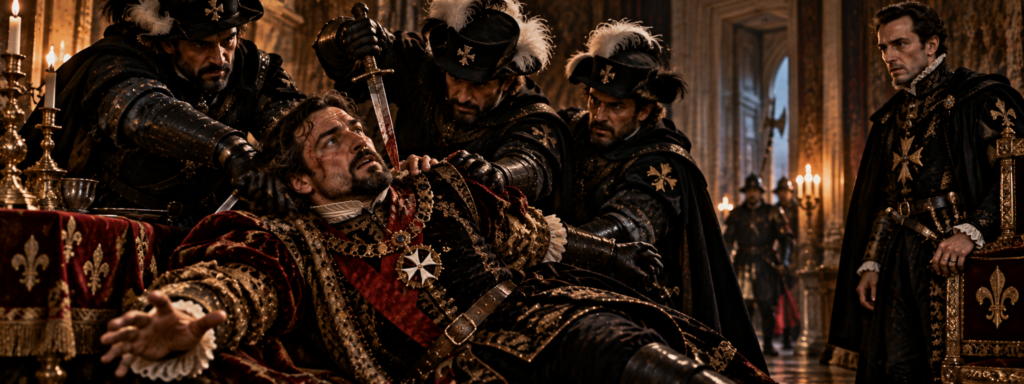
Henri I, Duke of Guise: The Scarred Prince Murdered by His King at Blois
Henri I, Duke of Guise (1550–1588) | Known as Henri le Balafré, “the Scarred” | Son of François, Duke of Guise, and Anna d’Este | One of the most powerful Catholic princes of the French Wars of Religion | Closely associated with the killing of Admiral Gaspard de Coligny during the opening of the Saint Bartholomew’s Day Massacre | Celebrated military commander and immensely popular figure among militant French Catholics | Dominant aristocratic leader of the Catholic League | Opponent of the Protestant Henri of Navarre’s succession to the French throne | Defied Henri III by entering Paris in 1588 and emerged triumphant after the Day of the Barricades drove the king from his capital | Appointed lieutenant-general of the kingdom after forcing major concessions from the crown | Suspected by Henri III of plotting to dominate, depose, or perhaps replace him, although a definite plan by Guise to seize the crown for himself has never been securely established | Summoned into the royal apartments at the Château de Blois on December 23, 1588 | Attacked and killed by members of Henri III’s elite bodyguard, the Forty-Five, acting on the king’s orders | His brother Louis II, Cardinal of Guise, was killed the following day | Guise’s assassination radicalized the Catholic League and helped destroy what remained of Henri III’s authority among militant Catholics | Henri III was himself assassinated less than eight months later.
The Doors Close at Blois
By December 1588, Henri I, Duke of Guise, had become something almost as dangerous as a king: a man who could command the devotion of crowds, dictate terms to the monarchy, and make the reigning sovereign feel like a prisoner inside his own kingdom. France had been torn apart by decades of religious war, royal authority had weakened, and Guise stood at the head of the militant Catholic movement that claimed to defend the faith against Protestantism and royal compromise. King Henri III had already been driven from Paris after the Day of the Barricades, forced into humiliating concessions, and compelled to watch his rival emerge stronger than ever. At the Château de Blois, the king finally decided that the political contest would not be settled by another treaty.
On the morning of December 23, Guise was summoned into the king’s private apartments. He had reportedly received warnings that his life was in danger, yet he remained at Blois, whether from confidence, fatalism, disbelief, or a calculation that the king would not dare murder one of the greatest princes in France. Inside the royal apartments waited members of Henri III’s elite bodyguard, the Forty-Five. The king himself did not strike the blows, but the killing took place on his command and within the intimate space of his own residence.
When Guise entered, the guards attacked. Contemporary accounts differ over the precise sequence, the words spoken, and the number of wounds, but there is no serious dispute over the central fact: the Duke of Guise was stabbed and cut down by men serving the king. The prince who had survived battlefields, assassination attempts, and years of civil war died only a short distance from the monarch whose authority he had helped reduce almost to impotence. His body was then treated not as that of a triumphant Catholic champion but as the remains of a political enemy whom the crown wanted erased.
The violence continued after the duke was dead. Guise’s brother Louis II, Cardinal of Guise, was detained and killed the following day, while other members and supporters of the family were arrested as Henri III attempted to break the political machine that had nearly overwhelmed him. Instead, the assassinations detonated across Catholic France, where Guise rapidly became a martyr and the king was denounced as a tyrant. The crown had eliminated two brothers but had not eliminated the movement that followed them.
Within eight months, Henri III himself would be stabbed by a Dominican friar associated with the militant Catholic atmosphere of the League, leaving the Valois dynasty without a surviving male king. It is tempting to describe that murder as straightforward revenge ordered by Guise’s surviving relatives, but the evidence for a direct command from the Guise leadership is not secure. What is clear is that the assassination at Blois helped radicalize the political and religious environment in which the king’s own murder became imaginable. Blois was therefore not the moment the monarchy recovered control; it was the moment a frightened crown answered political rebellion with assassination and discovered that killing a rival could be easier than surviving his ghost.
The House of Guise
Henri was born on December 31, 1550, into one of the most formidable noble families in sixteenth-century France. His father, François, Duke of Guise, was a celebrated soldier whose military reputation and leadership of the Catholic party made him one of the most powerful men of the reigns of Henri II and François II. His mother, Anna d’Este, connected the family to the ruling house of Ferrara and, through her mother Renée of France, to the French royal dynasty itself. Henri therefore grew up in a household where dynastic prestige, Catholic militancy, military glory, and political ambition were inseparable.
The Guises were a cadet branch of the House of Lorraine and had risen rapidly within France. To enemies, their Lorraine origins could be used to portray them as outsiders seeking to dominate the kingdom. To supporters, their lineage, military service, and uncompromising Catholic identity made them natural defenders of France. Their ascent created resentment among older princely families who disliked seeing the Guises accumulate offices, wealth, military commands, and influence around the throne.
François de Guise became a national hero after the defense of Metz and especially the recapture of Calais from England in 1558. During the brief reign of François II, the marriage of the young king to Mary, Queen of Scots, whose mother was François’s sister Mary of Guise, placed the family exceptionally close to the center of government. François and his brother Charles, Cardinal of Lorraine, exercised enormous influence. Their enemies increasingly regarded Guise power as a threat to the political balance of the monarchy.
Religious division magnified these rivalries. The spread of Calvinism created a substantial French Protestant minority known as the Huguenots, while Catholics disagreed over how aggressively Protestantism should be suppressed. Political disputes became religious disputes, and religious disputes became dynastic ones. The Guise family positioned itself firmly at the militant Catholic end of this increasingly dangerous spectrum.
Henri inherited not only his father’s title but a family mythology. The Guises were warriors for Catholic France, enemies of heresy, and princes accustomed to standing close to the throne. That mythology would give Henri extraordinary political power as France descended deeper into religious war. It would also help convince a king that the duke might someday reach for power that belonged only to the crown.
A Father Assassinated
Henri’s childhood was marked by violence at the highest level of politics. In February 1563, during the siege of Orléans, François, Duke of Guise, was shot by the Protestant Jean de Poltrot de Méré. François lingered for several days before dying, leaving twelve-year-old Henri to inherit both the title and the enormous expectations attached to it. The murder became one of the defining events of the younger duke’s life.
Poltrot’s interrogation produced accusations against the Huguenot leader Admiral Gaspard de Coligny, though the reliability of statements extracted during the investigation and the exact extent of Coligny’s responsibility remain disputed. The Guise family nevertheless came to hold Coligny responsible for François’s death. A personal blood feud became intertwined with the religious wars. Henri grew toward adulthood in an environment where assassination was not an abstract political possibility but part of his family’s history.
His father’s death accelerated Henri’s symbolic importance. The family possessed other powerful adult figures, but the young duke represented continuity with a man many Catholics remembered as a hero. Supporters could see in him the heir to a murdered defender of the faith. Enemies saw the continuation of a dynasty already considered dangerously powerful.
This background matters because Henri’s later career unfolded within a culture of retaliatory violence. Nobles maintained armed followings, religious enemies described one another in apocalyptic terms, and political killings could be defended as acts of necessity. France repeatedly attempted peace settlements, only to return to war as massacres and assassinations destroyed trust. Henri would eventually become both participant and victim in that system.
The Wars of Religion
The French Wars of Religion began in 1562 and would continue, with interruptions, for more than three decades. The conflict cannot be reduced to Catholics against Protestants because aristocratic rivalry, regional interests, royal succession, foreign intervention, taxation, and personal ambition all shaped the wars. Religion, however, was not merely a convenient excuse for political competition. Belief mattered profoundly to participants on both sides.
The monarchy attempted repeatedly to preserve authority by alternating repression, negotiation, and limited toleration. Catherine de’ Medici, mother of Charles IX and later Henri III, became central to these efforts. Her reputation would later be blackened by accusations of almost limitless Machiavellian intrigue and poison, many of which were exaggerated or unsupported. In reality, she governed within an almost impossible environment in which every compromise could be denounced as betrayal.
Henri of Guise matured into a military leader during these wars. He fought against Huguenot forces and built a reputation for personal courage, connecting him directly to the memory of his father. For Catholic supporters, the younger Guise increasingly looked like the natural champion of their cause. His aristocratic lineage and battlefield reputation gave him a political appeal that went far beyond court office.
His face eventually carried a visible reminder of battle. At the Battle of Dormans in 1575, Henri was wounded in the face by a firearm, leaving a prominent scar. The injury contributed to his nickname le Balafré, “the Scarred.” Far from damaging his reputation, the scar became part of the warrior image that made him so compelling to supporters.
Guise was therefore becoming something the monarchy could not easily manufacture: a charismatic prince with his own independent popularity. Kings possessed sacred legitimacy, hereditary authority, and the machinery of government, but charisma could belong to someone else. In a stable monarchy that distinction might have been manageable. In a kingdom fractured by civil war and uncertain succession, it could become lethal.
The Shadow of Saint Bartholomew
No account of Henri’s rise can avoid the Saint Bartholomew’s Day Massacre of 1572. Thousands of Huguenots had come to Paris for the marriage of the Protestant Henri of Navarre to Marguerite de Valois, sister of King Charles IX. The wedding was intended partly as an act of reconciliation between religious factions. Instead, it became the setting for one of the most infamous explosions of religious violence in European history.
An assassination attempt against Admiral Coligny on August 22 wounded but did not kill him. Suspicion fell heavily upon the Guise faction, though precise responsibility for the shooting remains debated. Two days later, royal authorities decided to eliminate leading Huguenot figures amid fears of retaliation or conspiracy. The targeted killings rapidly expanded into a much larger massacre in Paris and then into violence elsewhere in France.
Henri of Guise personally participated in the operation against Coligny. Men associated with Guise reached the admiral’s lodging, killed him, and threw his body from a window. Later narratives contain dramatic details about Guise’s reaction to the corpse, but hostile and partisan embellishment makes caution necessary. What is secure is that the Guise party was deeply involved in Coligny’s killing.
The massacre became a defining trauma of the Wars of Religion. Catholic militants celebrated the destruction of supposed heretical enemies, while Protestants remembered the event as proof that royal promises could conceal extermination. Henri’s association with Coligny’s death strengthened his standing among uncompromising Catholics. It simultaneously made him a hated figure among Huguenots.
The monarchy’s own responsibility for the massacre remains central and cannot be shifted simply onto Guise. Charles IX and his council authorized the initial elimination of Huguenot leaders, while the wider massacre expanded far beyond that targeted operation. Catherine de’ Medici’s role has been fiercely debated and often sensationalized. Guise was a major participant, but Saint Bartholomew was not his private massacre.
For Henri, the episode reinforced a political identity built upon Catholic militancy and family vengeance. Coligny, whom the Guises associated with François’s assassination, was dead. The cycle of killing had produced another corpse and another grievance. France was no closer to peace.
Henri III and the Duke Who Would Eclipse Him
Henri III became king of France in 1574 after the death of his brother Charles IX. He had previously been elected king of the Polish-Lithuanian Commonwealth but returned to France to claim the Valois crown. Intelligent, politically experienced, deeply religious in his own distinctive way, and capable of decisive action, Henri III has often been caricatured by hostile contemporaries and later writers. His reign deserves considerably more nuance than the traditional image of a frivolous or decadent weakling.
The king nevertheless faced structural problems that would have challenged almost any ruler. The crown was financially strained, religious factions remained armed, noble families commanded private networks, and the succession became increasingly uncertain. Henri III’s marriage to Louise of Lorraine produced no children. As the years passed, the identity and religion of the heir became a national crisis.
Guise and the king initially maintained a relationship that could include cooperation. Both were Catholic aristocrats, and Guise served the crown militarily. Yet their political positions gradually diverged as Henri III sought room for compromise while Guise increasingly represented uncompromising Catholic resistance. Personal rivalry compounded political disagreement.
Guise possessed the martial popularity Henri III struggled to command. Crowds admired the scarred duke as a defender of the faith, while his network extended through nobles, clergy, urban elites, and militant organizations. Henri III could not ignore a subject who inspired such loyalty, and Guise could not ignore a king whose authority remained legally supreme. Their relationship gradually became a contest between royal legitimacy and popular-confessional power.
The Succession Crisis
The political situation changed dramatically after the death of François, Duke of Anjou, the king’s younger brother, in 1584. Henri III had no children, and Anjou’s death left Henri of Navarre as heir presumptive under the principles governing the French succession. Navarre was a Bourbon prince descended in the male line from the Capetian dynasty. He was also Protestant.
For militant Catholics, the prospect of a Huguenot inheriting the throne was intolerable. Religion and succession suddenly became inseparable. If Henri III died without a son, France might pass to a man many Catholics considered a heretic. The crisis revitalized the Catholic League and gave it an immediate political purpose.
Henri of Guise emerged as the League’s most important aristocratic leader. The movement included nobles, clergy, urban organizations, and popular activists united by the determination to prevent Protestant succession. Guise’s family prestige and military reputation made him an ideal champion. He became the most visible political face of militant Catholic resistance.
The League also received support from Philip II of Spain. Spanish involvement reflected both religious commitment and strategic interest, since Philip wanted to prevent a Protestant France while weakening political forces hostile to Habsburg power. Foreign support made the League more formidable. It also exposed Guise and his allies to accusations that they served Spanish interests rather than France.
The Treaty of Joinville in 1584 linked the Guise-led Catholic faction with Spain and promoted Cardinal Charles de Bourbon as an alternative Catholic successor. The cardinal was an older Bourbon and a Catholic, but his succession would have required setting aside Henri of Navarre’s stronger dynastic claim. The treaty revealed how far religious politics were reshaping ideas of legitimacy. Preventing a Protestant king had become more important to the League than following the ordinary line of succession.
Whether Henri of Guise himself already intended to become king is another question. Enemies would increasingly accuse him of royal ambition, and his behavior eventually gave Henri III genuine reasons to fear him. Yet a clear, documented plan in which Guise intended simply to depose the Valois king and crown himself is much harder to prove. Suspicion was politically powerful even where evidence remained uncertain.
The Catholic League
The League was not a single centralized organization obedient to Guise in every respect. It contained aristocratic leaders, urban leagues, clerical activists, preachers, municipal politicians, and local networks with their own priorities. Paris developed an especially radical political culture. Guise could lead and inspire the movement without completely controlling it.
The League demanded severe measures against Protestantism and opposed recognition of Henri of Navarre as heir. Henri III found himself under pressure from both militant Catholics and Huguenot forces. Attempts at compromise risked alienating the League, while concessions to the League threatened the monarchy’s independence. The king was being squeezed between rival confessional armies.
In 1585, Henri III was forced into policies that effectively revoked previous toleration of Protestant worship and reopened full-scale war. The conflict became known as the War of the Three Henries: Henri III of France, Henri of Guise, and Henri of Navarre. The memorable name captures the personalization of a struggle that was actually much broader. It also demonstrates how closely Guise’s political stature had approached that of the two royal Henries.
Guise’s military successes strengthened his standing further. In 1587 he defeated German Protestant mercenaries at Vimory and Auneau, enhancing his reputation as the Catholic defender of France. Henri III, whose own authority was already fragile, had to watch his subject receive the glory. Every victory made the contrast between the scarred warrior and the embattled king more politically dangerous.
Guise did not need a crown to rival a king because every procession, sermon, battlefield victory, and cheer from Paris increased his independent authority. Henri III possessed legal sovereignty, but Guise increasingly possessed something harder to control: a popular following convinced that religion stood above obedience to royal policy. Once a subject could claim a higher moral cause than the king, traditional hierarchy became unstable. The succession crisis transformed that instability into an existential struggle.
A King Surrounded by Enemies
Henri III attempted to maintain control through court politics, royal favorites, administrative appointments, and carefully balanced alliances. His intimate circle became another target for hostile propaganda. The king’s mignons, or favorites, were portrayed by enemies as effeminate, corrupt, sexually immoral, and wastefully extravagant. Much of this rhetoric served political purposes and should not be treated as neutral description.
The contrast with Guise was devastatingly effective. Henri III could be mocked as a strange, overrefined court king surrounded by favorites, while Guise appeared as the scarred soldier riding into battle for Catholicism. This contrast was partly manufactured, but politics depends upon perception. Guise’s public persona fit the crisis better.
Paris became increasingly hostile to the king. Militant preachers denounced royal policies from pulpits, and League organizations strengthened their control of neighborhoods. The Sixteen, representing the sixteen quarters of Paris, developed into a powerful radical network. Royal authority within the capital became dangerously uncertain.
Henri III understood that Guise’s arrival in Paris could trigger a confrontation. He therefore ordered, or at minimum clearly warned, the duke not to enter the city in May 1588. Guise came anyway, openly defying the king’s wishes. The decision was an extraordinary challenge to royal authority.
The people of Paris welcomed him enthusiastically. Crowds surrounded the duke, and his popularity became visible in a way the king could not ignore. Henri III now confronted the nightmare every monarch fears: a subject entering the capital against royal wishes and being greeted as a savior. The struggle had moved beyond rivalry at court.
The Day of the Barricades
Tension exploded on May 12, 1588, in the event remembered as the Day of the Barricades. Royal troops had been introduced into Paris as Henri III attempted to regain control. Parisians responded by erecting barricades throughout the streets. Chains, carts, barrels, paving stones, timber, and household materials transformed neighborhoods into defensive positions.
The uprising demonstrated the organizational strength of the League. Royal forces found movement through the city increasingly difficult. Armed citizens and militants occupied strategic streets, and violence threatened to erupt on a massive scale. The king’s authority appeared to dissolve neighborhood by neighborhood.
Guise moved through the crisis as both leader and mediator. His supporters controlled much of the city, but he also intervened to prevent or limit attacks on royal troops in some places. This allowed him to appear simultaneously powerful and responsible. The king looked increasingly helpless.
Henri III fled Paris the following day. The symbolism was catastrophic because Paris was not merely another city; it was the political, economic, and symbolic center of the kingdom. The anointed king of France had been driven from his capital while the Duke of Guise remained amid triumphant supporters. Whatever Guise’s private intentions, the political reality now looked dangerously close to a transfer of power.
The king never forgot the humiliation. A monarch forced to flee his own capital by supporters of a subject had suffered an injury deeper than ordinary military defeat. Henri III now had personal as well as political reasons to fear Guise. The duke’s greatest triumph had simultaneously made him far more likely to be killed.
The League celebrated its strength, but victory contained a hidden danger. Guise had demonstrated exactly why the king might decide ordinary political methods could no longer restrain him. From Henri’s perspective, the duke had crossed from troublesome prince into existential threat. The question was no longer simply how to defeat Guise politically, but whether the monarchy could survive while he remained alive.
The Edict of Union
After the Day of the Barricades, Henri III was forced into humiliating concessions. The Edict of Union, issued in July 1588, committed the king firmly to the Catholic cause and effectively excluded a heretic from succession. Henri of Navarre’s position as heir was thereby attacked directly. Guise and the League had forced royal policy sharply in their direction.
Henri of Guise received the office of lieutenant-general of the kingdom, an extraordinary enhancement of his formal position. His brother Louis, Cardinal of Guise, remained an influential figure within the militant Catholic movement. The family appeared closer than ever to dominating royal government. To observers, the monarchy seemed increasingly subordinate to the League.
The king outwardly accepted the new arrangement. Inwardly, his resentment and fear deepened because the concessions had not restored his freedom of action. They had demonstrated that Guise could compel the crown to surrender. Every concession risked encouraging another demand.
The Estates-General was summoned to meet at Blois later that year. Guise expected the assembly to consolidate Catholic policy and perhaps further weaken Navarre’s claim. League influence among the deputies was substantial. Henri III entered the meeting surrounded by political enemies and under intense pressure.
Rumors multiplied that Guise intended to force the king into a monastery, depose him, or even take the crown. Other reports suggested plans for further coercion rather than literal usurpation. The surviving evidence does not permit every accusation to be accepted at face value. Political rumor flourished precisely because trust had almost completely disappeared.
What mattered is that Henri III believed, or at least came to act as though he believed, that Guise represented an immediate threat to his throne and possibly his life. In a political culture already saturated with assassination, that belief could become sufficient evidence for action. The king began planning a solution that required no vote from the Estates-General. Guise would be removed in a way from which there could be no political recovery.
Was Guise Trying to Become King?
The accusation that Guise intended to seize the crown has followed him for centuries, but the evidence demands caution. His popularity, defiance of royal commands, leadership of the League, military power, domination of Paris, and willingness to dictate royal policy made the suspicion entirely plausible to contemporaries. His family’s claimed Carolingian ancestry could also be invoked in political speculation about alternative royal legitimacy. Such genealogical arguments possessed explosive potential in an age obsessed with dynastic right.
Yet ambition must be distinguished from a concrete plan. Guise clearly wanted enormous influence over royal policy and sought to prevent Henri of Navarre from succeeding. He was willing to pressure Henri III aggressively and accepted offices that placed him near the summit of government. None of this by itself proves that he had finalized a scheme to depose Henri and crown himself.
The League itself did not officially rally around Guise as a straightforward replacement monarch. Cardinal Charles de Bourbon offered a more dynastically defensible Catholic alternative to Navarre. Guise could dominate politics while preserving a nominally legitimate Bourbon or Valois framework. Becoming king personally might have fractured the coalition that made him powerful.
Henri III, however, could not afford to judge danger with the detachment available to later historians. He had been driven from Paris and forced into the Edict of Union. Guise had ignored royal commands, possessed an independent military following, and enjoyed extraordinary popularity. The king had reason to fear that another confrontation could end with his deposition, captivity, or death.
The crucial historical point is therefore not that Guise can be proven to have planned a coronation, because he cannot. It is that the monarchy had reached a stage where Henri III believed a subject’s continued existence might be incompatible with royal survival. Once the king reached that conclusion, assassination became thinkable. Suspicion took the place that judicial proof would normally occupy.
Blois
The Château de Blois provided an appropriately magnificent setting for the final confrontation. The Estates-General assembled there in 1588 amid intense political tension. Representatives of the clergy, nobility, and Third Estate debated questions inseparable from religion, succession, taxation, and royal authority. League influence made the gathering particularly dangerous for Henri III.
Guise attended despite warnings and despite the obvious hostility between himself and the king. His confidence has fascinated historians because he was hardly unaware of the danger surrounding him. Perhaps he believed Henri III lacked the nerve to move openly against him, or perhaps he trusted his political strength and the presence of supporters within the Estates. Retreat may also have seemed more dangerous than remaining.
Warnings reportedly reached him that the king intended violence. Later accounts naturally dramatized these warnings because foreknowledge makes a famous death appear more tragic. The precise wording and frequency of such messages are difficult to establish. There is nevertheless good reason to believe Guise understood that the situation at Blois was dangerous.
He stayed, and this may have been the greatest miscalculation of his career. Guise had become accustomed to winning confrontations with the crown. The Day of the Barricades had demonstrated that Henri III could be forced to retreat. Previous royal weakness may have encouraged the duke to underestimate how far humiliation had changed the king’s calculations.
Henri III no longer intended merely to survive another political defeat. Guise’s political machine was too powerful to confront safely in the streets, while arresting him publicly risked an immediate uprising. The king therefore selected a battlefield where Guise’s greatest advantages would be useless. Inside the royal apartments, there would be no Parisian crowd.
The Forty-Five
Henri III’s elite bodyguard known as the Forty-Five played the central role in the assassination. The group consisted largely of lesser nobles, many from Gascony and other regions, whose fortunes depended heavily upon royal favor. Their relative lack of independent political power made personal loyalty to the king particularly valuable. Henri could rely upon them in a way he could not necessarily rely upon grandees with their own factional interests.
The king’s decision to use his own guards emphasized the personal nature of the operation. This was not a judicial arrest followed by prosecution. Guise was too powerful for a conventional process to feel safe. Henri wanted the duke dead before his supporters could react.
Preparations were made within the royal apartments. Members of the Forty-Five were positioned where they could overwhelm Guise after he entered. The confined interior space neutralized the duke’s political following and prevented a rescue. The same man who commanded crowds in Paris would be isolated behind palace doors.
The plan depended upon Guise obeying a royal summons. Despite all his defiance, he remained a subject of the king and a prince participating in royal government. Refusing to enter the king’s apartments would itself have been an extraordinary act. Henri exploited the residual rituals of monarchy that Guise had spent years challenging.
The bodyguards understood that they were about to kill one of France’s greatest nobles. Their safety depended upon the king’s authority surviving the act. If the League prevailed afterward, they could expect little mercy. The assassination therefore bound them completely to Henri III.
On December 23, the trap was ready. Guise received the summons and moved through the château toward the king’s apartments. The most popular Catholic prince in France was entering a space where popularity meant nothing. Armed men were waiting behind the royal doors.
December 23, 1588
The morning at Blois was cold, and later narratives filled the hours before the assassination with ominous details. Guise attended council and moved through the château according to the routines of court life. He could not have known exactly which doorway separated political danger from physical attack. The palace itself remained outwardly ordered.
Henri III stayed apart from the actual killing. This was assassination by royal command rather than personal combat. The king had decided upon Guise’s death, but the Forty-Five would perform it. That distance allowed Henri to preserve the physical dignity of kingship while exercising its most violent power.
Guise was directed through the royal apartments toward the king’s private chamber. Once separated from the larger court and his own supporters, he was vulnerable. Members of the Forty-Five closed around him. The attack began before he could effectively escape.
Accounts describe Guise resisting fiercely despite being surprised. He was a large, experienced soldier who had survived years of warfare, and later narratives emphasized the struggle. He received repeated sword and dagger wounds as the guards overwhelmed him. Whether every dramatic detail preserved by later writers is accurate cannot be known, but the killing was plainly violent and sustained.
Guise finally collapsed. The scarred face that had become a symbol of Catholic militancy now belonged to a corpse inside the king’s residence. The political giant who had driven Henri III from Paris had been reduced to a body on the floor. Royal authority had become lethal precisely because political authority had become so weak.
There is a grim paradox in the setting. Henri III could not safely command Guise in Paris, but he could command a handful of armed men behind a closed door. The French monarchy still possessed enormous ceremonial and personal power while losing its ability to impose political obedience across the kingdom. At Blois, the crown contracted to the dimensions of a killing chamber and proved brutally effective within it.
The King Looks Upon His Enemy
One of the most famous traditions surrounding the assassination describes Henri III approaching or viewing Guise’s corpse afterward and commenting upon the duke’s impressive physical size. Versions of the alleged remark vary, and memorable quotations attached to dramatic historical deaths should always be treated cautiously. The story nevertheless captures how contemporaries understood the relationship between the two men. Guise had seemed physically and politically enormous while alive.
Henri ordered further measures immediately. The assassination was not meant to be an isolated act of revenge. It was the opening move in an attempt to destroy the Guise political network. Arrests followed among League leaders and members of the family.
The duke’s body presented another problem. A public funeral could transform Guise into a martyr and provide supporters with a physical focus for mourning. The crown therefore had strong reasons to prevent elaborate public commemoration. Accounts indicate that his remains were secretly disposed of after being burned, though details of the process vary among sources.
The treatment of the corpse reflected political fear. Henri had killed Guise but remained afraid of what Guise could become after death. A tomb could attract pilgrims, preachers, and political demonstrations. Destroying or concealing the remains was an attempt to deny the League a shrine.
The strategy failed in the most important sense because martyrs do not require bodies when a movement already possesses a story. Guise’s death instantly became evidence that the king had murdered the champion of Catholic France. The body could disappear without weakening the legend. Henri III had removed his enemy from the world and simultaneously made him more useful to his supporters.
The Cardinal of Guise
Louis II, Cardinal of Guise, was Henri’s younger brother and an important figure in the Catholic League. His clerical status made violence against him especially explosive. Killing a duke could be presented as eliminating a rebellious subject. Killing a cardinal introduced another layer of sacrilege and ecclesiastical outrage.
The cardinal was arrested after Henri’s assassination. On December 24, the following day, he too was killed on royal orders. The precise circumstances differed from those of his brother, but the political intention was unmistakable. Henri III wanted the leadership of the Guise faction broken before it could respond.
Other family members and League figures were detained where the king could reach them. Most importantly, Charles, Duke of Mayenne, another brother of Henri of Guise, remained beyond the king’s grasp. Mayenne possessed military experience, family prestige, and every reason to seek vengeance. The Guise political network therefore retained a leader.
The killing of the cardinal dramatically worsened the king’s position with militant Catholics. Henri III had already been accused of tolerating heresy and betraying the Catholic cause. Now he had ordered the death of a prince of the Church. League propagandists could portray the king himself as an enemy of Catholicism.
Pope Sixtus V reacted with serious concern and anger, although papal politics were more complicated than League propaganda suggested. Henri’s actions created grave ecclesiastical difficulties and contributed to his isolation. The king had attempted to decapitate the League. Instead, he supplied it with two martyrs in twenty-four hours.
Paris Hears the News
News of Guise’s death reached a city that had adored him. Parisian League supporters reacted with fury. The duke who had entered the capital to popular acclaim only months earlier had been killed by the king he had humiliated. Militant preachers turned the assassination into proof that Henri III was a tyrant and enemy of Catholicism.
The king’s legitimacy began to collapse among radical Catholics. Henri III had always faced criticism, but killing Guise transformed opposition into something more dangerous. League propagandists could now argue that obedience to the king was no longer morally required. Some went further and treated resistance as a religious duty.
Images and narratives of Guise as martyr circulated. His death could be compared to biblical or Christian examples of righteous men murdered by wicked rulers. Political theology once again became a weapon. Grief could be converted into mobilization.
The Parisian government aligned firmly with the League. Henri III had lost practical control of his capital before Blois, but after the assassination the break became deeper. The king could no longer imagine returning simply through negotiation. Military force and new alliances would be necessary.
This created one of the greatest ironies of the assassination. Henri killed Guise because the duke had become too powerful, but Guise’s death made the League even more uncompromising and the king even more isolated. The threat changed shape rather than disappearing. The crown had cut off one head of the movement and discovered that the movement had many.
Charles, Duke of Mayenne
Leadership of the aristocratic League increasingly passed to Charles, Duke of Mayenne, younger brother of the murdered Henri. Mayenne lacked some of Henri’s charisma, but he possessed military experience and dynastic legitimacy within the Guise family. He had every reason to avenge his brothers. The civil war continued under new leadership.
Mayenne’s emergence demonstrated the fundamental flaw in Henri III’s strategy. Political families were networks, not individuals. Killing one duke did not eliminate brothers, cousins, clients, soldiers, priests, urban organizations, or foreign allies. The House of Guise remained formidable.
The League also had independent structures capable of operating without a single charismatic leader. Parisian radicals did not require Mayenne’s permission for every action. Clerical propaganda continued, municipal organizations remained active, and Spanish support remained available. Guise had been the movement’s greatest aristocratic symbol rather than its sole source of life.
Henri III therefore faced a stronger need for military assistance precisely after eliminating the man he believed threatened his throne. His Catholic credentials had been shattered among League supporters. Moderate Catholics might still support the monarchy, but the king needed a major ally capable of providing troops. Only one obvious candidate possessed both a dynastic claim and a powerful army.
That man was Henri of Navarre. The Catholic League existed largely to prevent him from inheriting France. Guise’s assassination now pushed Henri III toward the very Protestant prince his murdered rival had spent years trying to exclude.
Blois Drives the King Toward Navarre
Henri III’s alliance with Henri of Navarre was one of the most remarkable reversals of the Wars of Religion. The Catholic king who had spent years fighting the Protestant heir now needed him against the Catholic League. Political survival overrode confessional hostility. The two Henries moved toward cooperation in 1589.
For League propagandists, the alliance confirmed every accusation they had made. Henri III had murdered the Catholic champion and his cardinal brother, then joined forces with a Protestant. The sequence could be presented as proof that the king had betrayed the faith. Radical preachers intensified their denunciations.
For Henri III, however, the alliance was rational. Navarre was legally the heir presumptive under traditional succession principles and commanded significant military forces. The League threatened both men for different reasons. Cooperation offered the best chance of retaking Paris and restoring royal authority.
The alliance also revealed how profoundly Guise’s death had altered the political map. While alive, Guise had forced Henri III into concessions against Navarre. Dead, he indirectly drove the king into Navarre’s arms. The assassination produced almost the opposite strategic alignment from the one the League desired.
Royal and Huguenot forces began cooperating and moved toward Paris, placing the League capital under increasing pressure. Henri III appeared to have survived the immediate consequences of Blois after all. If the campaign succeeded, the king might restore himself with Navarre’s help. Then another assassin entered the story, and this one wore the habit of a Dominican friar.
Jacques Clément
Jacques Clément was a young Dominican friar associated with the intense Catholic atmosphere surrounding the League. In the summer of 1589, he gained access to Henri III’s camp at Saint-Cloud by claiming to carry important information or letters. Religious status and the promise of intelligence helped him approach the king. The security failure would prove fatal.
On August 1, Clément was admitted to Henri III. During the encounter, he drew a knife and stabbed the king in the abdomen. Guards immediately killed the assassin. Henri initially survived the attack and remained conscious long enough to address the succession.
The wound proved fatal. Henri III died on August 2, 1589, at the age of thirty-seven. He had outlived Henri of Guise by little more than seven months. The king who had arranged an assassination within his private apartments had himself been assassinated during a private audience.
It is tempting to describe Henri III’s death as direct revenge ordered by the Guise family. The evidence does not justify such certainty. Clément acted within a militant League environment that had demonized the king, and Guise’s assassination formed a crucial part of that radicalization. Whether a specific senior League or Guise leader directly ordered the attack remains less secure.
Politically, however, the connection was unmistakable. Blois helped create the atmosphere in which Henri III could be represented as a tyrant whose death was legitimate. The king had used assassination to save his throne. Months later, assassination ended his reign and the male royal line of the Valois dynasty.
The Crown Passes to the Man Guise Tried to Stop
Henri III’s death produced the outcome the Catholic League had spent years attempting to prevent. Under traditional dynastic succession, Henri of Navarre became King Henri IV of France. A Protestant Bourbon now claimed the crown. Guise’s campaign against that possibility had failed in the most dramatic way imaginable.
Henri IV did not immediately control the entire kingdom. The League continued resistance, Paris rejected him, Spain intervened, and years of warfare followed. Cardinal Charles de Bourbon was proclaimed Charles X by League supporters, although he was in royalist custody and died in 1590. The succession crisis remained violent.
Henri IV eventually converted to Catholicism in 1593. The famous phrase “Paris is well worth a Mass” is traditionally attributed to him but is not securely documented as something he actually said. His conversion removed one of the League’s strongest arguments. Paris opened to him in 1594.
The new king gradually defeated or reconciled his opponents. Mayenne eventually submitted, Spanish intervention failed to prevent Bourbon consolidation, and the Edict of Nantes in 1598 granted limited protections to Huguenots while maintaining Catholicism as the dominant religion of the kingdom. France finally moved toward a measure of stability after decades of religious warfare. The political order Guise had fought to create never emerged.
Henri of Guise had devoted the final years of his life to preventing a Protestant Bourbon succession. His death helped set in motion events that placed that very Bourbon on the throne. History rarely offers a cleaner example of political violence producing the opposite of its intended result. Guise did not live to see it, and neither did Henri III.
Was Henri III Justified?
The question of whether Henri III was justified in killing Guise has divided observers since 1588. From the king’s perspective, the threat was extraordinary. Guise had entered Paris against royal wishes, benefited from an uprising that drove the king from his capital, forced major political concessions, and commanded a movement capable of challenging royal authority. Henri could reasonably fear deposition or worse.
Conventional arrest presented obvious risks. Guise possessed supporters at court, within the Estates-General, throughout the nobility, and across Catholic France. Attempting to arrest him publicly could trigger armed resistance. A trial might become a political spectacle the crown could not control.
Yet assassination carried equally grave problems. Guise had not been convicted of treason through a judicial process. Henri acted as sovereign, accuser, and executioner. Killing the duke inside royal apartments turned the intimacy and security of royal access into a weapon.
The murder of Cardinal Guise the next day made the decision even more politically explosive. The king had moved beyond eliminating one supposed conspirator into an attempt to decapitate an entire faction through extrajudicial violence. This allowed opponents to depict him as tyrannical. The language Henri might have used against Guise could now be used against him.
From a purely tactical perspective, the assassination succeeded because Guise died and could never again lead another Day of the Barricades. From a strategic perspective, the result was disastrous because the League survived, Paris became more hostile, and Henri was driven toward alliance with Navarre. The distinction between tactical success and strategic failure is central to the story. Henri III solved the problem of Guise the man while intensifying the problem of Guise the martyr.
The Women Around Guise
Henri’s political life was shaped not only by male soldiers and clerics but by powerful women within the Guise dynasty. His mother, Anna d’Este, had already endured the assassination of her first husband, François. She now saw her son murdered on royal orders. Her family experience encompassed two generations of political killing.
Henri married Catherine of Cleves in 1570. The marriage connected him to another important noble lineage and produced numerous children. Catherine survived her husband by decades and defended the interests of their family. Dynastic politics ensured that Guise influence did not die with Henri.
His sister Catherine-Marie de Lorraine, Duchess of Montpensier, became one of the most famous and militant League figures. Hostile stories portrayed her celebrating Henri III’s downfall and encouraging radical opposition. Some anecdotes about her are difficult to verify, but her political hostility toward the king was real. The Guise family included women who actively participated in factional politics rather than merely observing it.
The family’s collective identity strengthened after Blois. Henri and Cardinal Louis could be remembered as murdered brothers, while surviving relatives carried the grievance forward. Anna d’Este pursued efforts to condemn the assassination. The royal act therefore became a dynastic wound.
This helps explain why killing great nobles was so politically dangerous. A prince was never merely an individual. He belonged to a web of marriages, children, siblings, clients, dependents, and inherited loyalties. Henri III killed one man in a chamber and created enemies across generations.
The Scarred Duke Becomes a Martyr
Guise’s physical appearance had long supported his political mythology. The scar acquired at Dormans marked him as a warrior who had shed blood fighting enemies of Catholic France. His assassination allowed that martial image to merge with martyrdom. The scarred soldier had now been murdered by his own king.
League propaganda exploited the symbolism. Henri III could be represented as a tyrant or persecutor, while Guise became a righteous defender betrayed by corrupt power. Religious imagery made political vengeance appear sacred. Sermons could turn grief into mobilization.
This martyr image should not be confused with neutral biography. Guise had participated in ruthless religious conflict and was associated with the killing of Coligny. His faction had helped destabilize royal government. He was not simply an innocent Catholic noble murdered because of his faith.
Yet martyrdom rarely depends upon complete innocence. It depends upon a community believing the victim died for a cause larger than himself. Guise’s supporters believed he had defended Catholic France against heresy and weak monarchy. Blois gave them a death capable of confirming that story.
Henri III therefore lost control of Guise’s meaning the moment the duke died. The king controlled the guards, chamber, and disposal of the body. He could not control sermons preached in Paris or stories repeated among League supporters. The assassination created an image more durable than the corpse.
The Question of Royal Ambition
Later histories have often described Guise as a man reaching for the crown. The idea is understandable because his behavior increasingly resembled that of an alternative ruler. He commanded troops, negotiated with foreign powers, dictated religious policy, controlled popular support in Paris, and accepted the office of lieutenant-general. The king’s fear was not imaginary.
Genealogical arguments could also support fantasies of Guise kingship. The House of Lorraine claimed Carolingian ancestry, and political writers could manipulate ancient descent to challenge reigning dynasties. In an age when succession had become a religious crisis, alternative genealogies possessed explosive potential. Rumors of Guise royal ambition therefore circulated in a receptive environment.
Nevertheless, historians should resist turning possibility into proven conspiracy. No indisputable evidence establishes a finalized Guise plan to murder or depose Henri III and immediately crown himself. His political objectives may have centered upon controlling the monarchy rather than replacing it. A king dominated by Guise could serve the duke’s interests more safely than a controversial Guise usurpation.
Henri III did not have the luxury of certainty. He had watched Guise defy him, take Paris politically, and force the Edict of Union. Waiting for documentary proof of a coup might have meant waiting until he was already imprisoned. Fear therefore became part of political evidence.
This is what makes the assassination historically fascinating. Henri may have killed Guise to prevent a conspiracy that was less developed than he imagined, or he may have eliminated a rival who would eventually have destroyed him. The surviving evidence cannot settle that counterfactual. What can be settled is the method: the king chose secret preparation, armed guards, and sudden killing rather than arrest and trial.
The Forty-Five and the Machinery of Royal Violence
The Forty-Five have sometimes acquired an almost legendary aura because of their role at Blois. Popular retellings can make them resemble a secret assassination squad existing primarily for the purpose of killing Guise. Their actual role was broader: they were an elite body of gentlemen attached closely to Henri III and valued for personal loyalty. The assassination made them infamous.
Their social position mattered. Great nobles possessed independent estates, family alliances, and political ambitions that could compete with the crown. Lesser gentlemen dependent upon royal patronage had stronger incentives for direct personal loyalty. Henri III built a protective circle precisely because he could not trust every prince surrounding him.
At Blois, that system became offensive rather than defensive. The guards were used to eliminate a subject too powerful for ordinary arrest. Royal household organization became an instrument of assassination. The intimacy of the setting made the act particularly shocking.
The killing also revealed the paradox of Henri III’s monarchy. He was weak enough politically to fear arresting Guise openly but strong enough personally to have him killed within the royal apartments. The crown could not reliably command Paris, yet it could command several armed men standing behind a door. State power had contracted to the dimensions of a chamber.
That contraction explains both the effectiveness and the failure of the assassination. Within the château, Henri controlled almost everything necessary for the plot. Outside it, he controlled far less. The Forty-Five could kill Guise, but they could not make Paris accept the killing.
A Dynasty Approaching Its End
Henri III’s lack of children haunted every stage of the conflict. Had the king possessed a healthy Catholic son, the League would have had far less leverage over succession. Henri of Navarre’s Protestantism became politically explosive because there was no direct Valois heir. Biology therefore shaped the crisis as powerfully as ideology.
The Valois dynasty had ruled France since 1328. By the 1580s, its male line was narrowing toward extinction. François II, Charles IX, and Henri III had all inherited in succession, but none left a surviving legitimate son capable of continuing the line. The monarchy’s future increasingly depended upon the Bourbon branch.
Guise exploited the succession crisis but did not create it. His Catholic League could mobilize fear of a Protestant king because that possibility was real. Henri III’s attempts to preserve Navarre’s legal rights while defending Catholic monarchy satisfied neither extreme. The king stood between dynastic law and confessional politics.
The assassination at Blois therefore occurred within a monarchy terrified of what would happen after Henri III’s death. Guise threatened the king in the present, while Navarre threatened the League’s vision of the future. Every faction believed time was running out. Such environments reward extreme solutions.
Within months, time did run out. Henri III’s assassination ended the Valois male line. The succession passed to the Bourbon whom Guise had tried to exclude. The entire struggle had revolved around preventing that outcome, yet political violence helped bring it about.
Blois and the Failure of Assassination
Political assassination often promises simplicity. Remove the dangerous individual, and the crisis will supposedly become manageable. Henri III’s decision at Blois followed this seductive logic. Guise was the charismatic center of the League, so killing Guise might break the League.
Instead, organizations rarely disappear when their grievances remain. Paris still feared Protestant succession, Spain still had strategic interests, clergy still preached militant Catholicism, and Guise relatives still possessed armies and titles. The assassination also created new grievances among people who might otherwise have accepted political compromise. Violence narrowed the king’s options rather than expanding them.
His alliance with Navarre became both necessary and inflammatory. It offered military survival while validating League propaganda. The king became more dependent upon the man his enemies called a heretic. Every strategic step after Blois carried the shadow of the assassination.
The eventual murder of Henri III completed the failure. The king killed Guise because he feared losing his throne, yet he lost his life and dynasty months later. Guise’s supporters failed as well because the Bourbon succession they opposed occurred immediately upon Henri’s death. No faction obtained what it wanted.
Guise was dead, Henri III was dead, the Valois dynasty was finished, and France remained at war. Assassination had simplified nothing except the list of living protagonists. The political problems that produced the murders survived both victims. France would need a different kind of settlement.
Why Henri of Guise Belongs Among the Assassinated Rulers and Regicides
Henri of Guise was not king, but by 1588 he exercised power on a scale that made him an alternative center of authority within France. He led the most formidable Catholic faction, commanded armies, enjoyed extraordinary popularity in Paris, and forced the monarchy into major concessions. His appointment as lieutenant-general formalized some of that power. Describing him as merely another nobleman would badly understate his political position.
His death was unmistakably a state-directed political assassination. The reigning king personally decided that Guise should be eliminated and used his elite bodyguards to carry out the killing. There was no conventional trial establishing the duke’s alleged conspiracy. Royal command substituted for judicial process.
The assassination also belongs beside regicides because it directly contributed to the political atmosphere surrounding one. Henri III’s murder in 1589 cannot responsibly be reduced to a simple, centrally ordered Guise revenge plot, but the radical Catholic reaction to Blois formed a crucial part of the environment in which Jacques Clément attacked the king. Political assassination generated a culture receptive to counter-assassination. The victim’s faction transformed the sovereign into the next supposed tyrant.
Guise’s story also intersects directly with dynastic succession. His movement sought to prevent Henri of Navarre from becoming king. His assassination destabilized Henri III so severely that the king allied with Navarre. Henri III’s subsequent assassination then made Navarre king.
Few political deaths contain such vicious irony. Guise died because Henri III feared that he might take or control the crown. The killing helped ensure that the crown passed instead to the man Guise had devoted himself to excluding. The assassination solved the king’s immediate problem while helping create an entirely new dynasty.
The King, the Duke, and the Locked Door
Henri of Guise had spent his life learning that power could exist outside a crown. His father had been one of France’s greatest soldiers, his family had stood beside kings, and his Catholic identity gave him access to loyalties no royal decree could simply command. By the 1580s, Henri had inherited and expanded that political capital. He did not need to be king to make a king afraid.
The scar across his face became part of the image. Guise looked like the soldier France’s militant Catholics wanted: wounded in battle, uncompromising in religion, magnificent in public, and seemingly fearless before enemies. His popularity was not invented by propaganda. It was real enough to help drive Henri III from Paris.
That was the moment the rivalry became almost impossible to resolve. On the Day of the Barricades, the monarchy suffered a humiliation that no subsequent title or reconciliation could erase. Guise remained in the capital while the king fled. The symbolism was devastating.
Henri III eventually conceded the Edict of Union and elevated Guise to lieutenant-general. Outwardly, the duke had won. Inwardly, he had made himself intolerable to the man whose authority he had broken. Victory in Paris carried within it the seed of Blois.
The Estates-General gathered the rivals beneath one roof. The assembly gave Guise another arena in which to demonstrate political strength, while the king watched a movement he no longer trusted press closer around him. Rumors of deposition and usurpation multiplied. Whether those rumors described a genuine plan or the king’s worst fears remains uncertain.
Perhaps Guise truly intended eventually to dominate the crown beyond recovery. Perhaps he imagined himself king, or perhaps he intended only to force Henri III permanently into League policy while preserving the Valois monarchy in name. The evidence cannot turn those possibilities into certainty. Henri III did not wait for certainty.
He chose the Forty-Five. Loyal gentlemen could accomplish what councils, edicts, and negotiations had failed to accomplish. They could make Guise disappear before the duke’s supporters understood what was happening. The king transformed his household into an assassination machine.
On December 23, 1588, Henri of Guise entered the royal apartments at Blois. Whatever warnings he had received, he still behaved as though there remained some boundary the king would not cross. Perhaps his repeated victories over Henri III had made royal weakness seem permanent. Perhaps he simply understood that refusing a royal summons carried dangers of its own.
The guards proved otherwise. Steel appeared at close range, and Guise found himself trapped among men prepared specifically to kill him. He resisted, but courage mattered little in a confined room against multiple attackers. The warrior who had survived years of civil conflict finally encountered a battlefield designed to deny him every advantage.
The Scarred Duke fell. The man who could fill Parisian streets with supporters died where those supporters could not reach him. The king had finally found a place in France where Guise’s popularity was useless. It was only a few rooms wide.
Then came the cardinal. Louis of Guise was killed the next day, turning the attack on one political rival into an attempt to decapitate an entire family faction. Henri III may have hoped terror would paralyze the League. Instead, outrage energized it.
Paris did not suddenly rediscover obedience to the crown. The city turned Guise into a martyr, preachers condemned the king, and League leaders reorganized under surviving members of the family. Henri III had destroyed Guise’s body but enlarged his symbolic power. Every accusation that the king was hostile to Catholicism could now point toward Blois.
The king’s political room narrowed. To fight the League, he needed Henri of Navarre. The Catholic monarch therefore allied with the Protestant heir whose succession Guise had fought to prevent. The irony was merciless.
Guise had pushed the king toward policies intended to exclude Navarre. Guise’s death pushed the king toward Navarre himself. Assassination had reversed the political alignment the murdered duke had spent years creating. The dead man’s greatest enemy became the king’s indispensable ally.
Then Jacques Clément approached Henri III at Saint-Cloud. The friar entered with the privileges of religious identity and the promise of information. Like Guise at Blois, the king admitted a man into close physical proximity because political life still depended upon personal audiences. The intimacy of power again became its vulnerability.
The knife entered Henri III’s abdomen. The assassin was killed immediately, but the king followed him into death the next day. France now had no Valois king.
The crown passed by dynastic right to Henri of Navarre, who became Henri IV. The man the League had been created to exclude was suddenly king because the king Guise had fought was dead. Years of warfare would still be required before Henri IV could secure the kingdom, but the succession itself had occurred.
Guise therefore lost after death in the most profound political sense. His assassination did not preserve a permanently Catholic Valois succession because no such succession existed. It did not destroy Navarre, and it did not produce a Guise monarchy. It helped create circumstances in which Bourbon succession became unavoidable.
Yet Henri III hardly won. He killed the rival who had humiliated him and regained a brief freedom of action. Less than eight months later, he was dying from an assassin’s wound. The throne he had killed to protect passed immediately to the man his Catholic enemies rejected.
The two men had spent years treating one another as obstacles. Guise believed royal policy could be forced into obedience to militant Catholicism. Henri eventually believed Guise could be removed by killing him. Both underestimated how much political power would survive the death of an individual.
Guise left brothers, children, followers, preachers, soldiers, urban organizations, and a martyr’s reputation. Henri III left a crown that passed to the very heir his enemies had tried to exclude. Neither man controlled what followed. Their deaths liberated forces larger than either of them.
The story therefore refuses the satisfying simplicity of poetic justice. Guise had participated in the violent politics of the Wars of Religion and was closely associated with the killing of Coligny. Henri III had genuine reason to fear him. Neither fact converts the assassination at Blois into a judicial proceeding.
Guise was summoned into a private royal space and killed by guards acting on the king’s orders. He was not convicted in a public treason trial. The sovereign had replaced legal judgment with an ambush. That distinction is essential to understanding why the assassination was so politically destructive.
France was already drowning in the belief that dangerous enemies could be eliminated outside ordinary law. Catholics had killed Protestants in the name of faith, Protestants had killed Catholics in the name of survival, nobles had pursued vendettas, and crowds had massacred prisoners. Assassination and massacre had become recurring instruments of factional politics. Blois brought that logic directly into the king’s private chamber.
Henri III decided that the monarchy could be saved by doing secretly what it could not safely do openly. The royal apartments became an execution ground without a trial. For a few minutes, the plan worked perfectly. Guise entered alive and never emerged as a political rival.
The result was not restored monarchy but accelerated collapse. Guise’s death radicalized the League, and the League’s hatred helped create the atmosphere surrounding Henri III’s assassination. Henri III’s death produced Henri IV. Henri IV’s accession eventually produced a new political settlement very different from the future Guise had fought to impose.
The House of Guise survived. The Catholic League survived for years, and Catholicism remained overwhelmingly dominant in France. Yet Henri of Guise never wore a crown. Whether he truly intended to remains uncertain.
What is certain is that Henri III feared the possibility enough to kill him. That fear is perhaps the most revealing measure of Guise’s power. Kings do not usually arrange the secret murder of subjects they consider harmless. Henri III looked at the scarred duke and saw a man who had already taken Paris politically and might someday take everything else.
So the king created a room in which popularity could not enter. He placed loyal blades behind palace doors and summoned the rival who had made him flee his capital. Guise came because he remained confident enough, ambitious enough, or trapped enough by the rituals of politics to obey.
The doors closed. The Forty-Five attacked, and when they were finished, the greatest Catholic prince in France lay dead inside the residence of the king he had challenged. Outside those walls, almost nothing had been settled.
Paris still hated the king. Navarre still stood next in the legitimate line of succession, Spain still intervened, the League still possessed armies, and the Wars of Religion continued. Only Guise was gone. For Henri III, that must briefly have looked like victory.
Less than eight months later, the king was gone too. The locked chamber at Blois had protected Henri III from Guise for a morning, but it could not protect him from the political world the assassination unleashed. A knife at Saint-Cloud completed the cycle begun by the blades at Blois.
The king had feared that Henri of Guise might take his crown. Guise died without ever doing so. Instead, both men disappeared, the Valois dynasty ended, and the crown passed to Henri of Navarre.
In the end, the most powerful thing Guise left behind was not an army, an office, or a claim to the throne. It was the memory of a murdered prince whose followers believed their king had become a tyrant. Henri III had silenced the Scarred Duke behind closed doors, but outside them his death spoke louder than he ever had in life.
That was the terrible failure of Blois. The king killed the man he could no longer control, only to discover that the dead were even harder to command.