
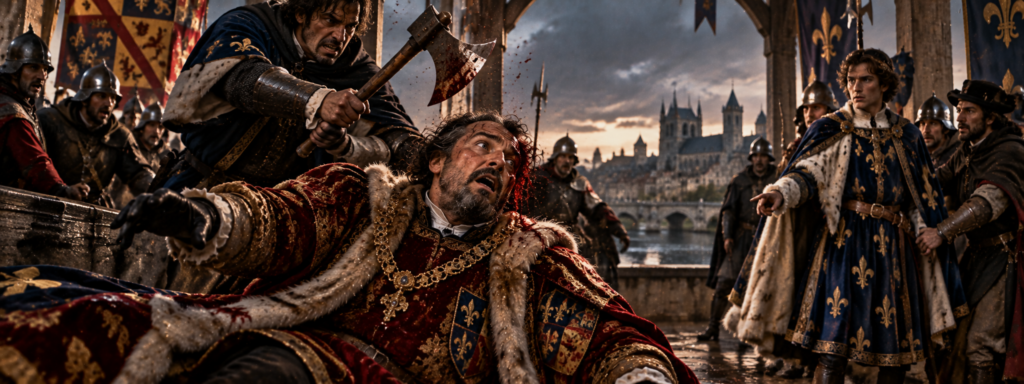
John the Fearless: The Murderer of Orléans Who Was Hacked to Death at Montereau
John the Fearless, Duke of Burgundy (1371–1419) | Son of Philip the Bold and Margaret III of Flanders | Duke of Burgundy from 1404 until his death | Captured after the disastrous Crusade of Nicopolis in 1396 | One of the most powerful princes in France during the recurring mental illness of Charles VI | Bitter rival of Louis I, Duke of Orléans | Ordered Louis’s assassination in Paris in 1407 and subsequently defended the killing as legitimate tyrannicide | Leader of the Burgundian faction during the Armagnac-Burgundian Civil War | Cultivated substantial support in Paris and regained control of the capital in 1418 | Presided over a France increasingly devastated by factional bloodshed and the English conquests of Henry V | Attempted negotiations with the Dauphin Charles as the English threat intensified | Met the Dauphin on the fortified bridge at Montereau on September 10, 1419 | Killed during the meeting by men belonging to the Dauphin’s party, with Tanneguy du Chastel traditionally associated with the first blow | Whether the future Charles VII personally planned, authorized, or knew in advance that John would be killed remains disputed | John’s murder drove his son Philip the Good toward alliance with England and helped create the political circumstances leading to the Treaty of Troyes in 1420.
The Duke Who Walked Onto a Bridge
On September 10, 1419, John the Fearless, Duke of Burgundy, approached a bridge over the River Yonne at Montereau with every reason to be suspicious. He had spent much of his adult life navigating a political world in which promises could conceal traps, reconciliations could precede murders, and blood relationships offered no protection against betrayal. Twelve years earlier, John himself had ordered the assassination of his cousin Louis, Duke of Orléans, after the two men had publicly demonstrated reconciliation. Now John was preparing to meet Louis’s political heir, the Dauphin Charles, inside a specially constructed enclosure on a bridge.
France was collapsing around them. Henry V of England had exploited the country’s civil divisions, destroyed a major French army at Agincourt, conquered much of Normandy, and threatened to reduce the Valois monarchy to a shadow of what it had been. King Charles VI remained alive but suffered from recurring mental illness that had crippled effective royal leadership for decades. If Burgundy and the Dauphin could not reach an agreement, there was a genuine danger that their mutual hatred would hand France to the English.
The bridge at Montereau was supposed to provide a controlled environment for negotiation. Barriers and gates limited the number of armed followers who could accompany each prince, creating the appearance of security. John entered the enclosure with a small group of attendants and approached the young Dauphin. What happened next would become one of the most consequential political murders of the Hundred Years’ War.
An argument or confrontation erupted, although surviving accounts disagree sharply over the exact words, gestures, and sequence of events. Men belonging to the Dauphin’s party drew weapons. Tanneguy du Chastel, one of Charles’s most devoted supporters, was later prominently associated with the attack, while Jean Louvet and other Dauphinist figures were also accused of involvement in the conspiracy surrounding John’s death. Within moments, the Duke of Burgundy was being struck with swords and an axe.
One blow reportedly smashed into John’s face or head, leaving a terrible wound that became central to later descriptions of the assassination. Other weapons followed as Burgundian attendants attempted to react inside the confined enclosure. John the Fearless, one of the richest and most formidable princes in Europe, collapsed at the feet of men representing the heir to the French throne. The duke who had once arranged the murder of a cousin after reconciliation had now been killed during a reconciliation meeting himself.
The symmetry was almost too perfect for later chroniclers to resist. Louis of Orléans had been ambushed in 1407 by killers acting on John’s orders, and his body had been hacked apart in a Paris street. Twelve years later, John entered a supposedly protected meeting with the Dauphin and died beneath the weapons of Louis’s political allies. Medieval France had discovered the most dangerous law of political assassination: once murder becomes an accepted instrument of government, the man who introduces it may eventually discover that his enemies have learned the same lesson.
Born Into the House That Was Building an Empire
John was born on May 28, 1371, at Dijon, the eldest son of Philip the Bold, Duke of Burgundy, and Margaret of Flanders. His father was a younger son of King John II of France and had received Burgundy as an appanage, establishing the Valois-Burgundian dynasty that would become one of the great political powers of fifteenth-century Europe. His mother brought enormous territorial possibilities through her inheritance in Flanders and the Low Countries. John therefore grew up not merely as another French prince but as heir to a political structure stretching across some of the wealthiest regions of western Europe.
The Burgundian state was unusual because its territories were scattered rather than forming a single compact kingdom. Burgundy itself lay within the French political world, while Flanders and other northern possessions connected the dynasty to prosperous commercial cities whose interests could differ sharply from those of the French crown. Trade with England was particularly important to the Flemish economy. Any Burgundian ruler therefore had to balance French dynastic loyalties against economic and territorial interests that did not always point in the same direction.
John’s marriage strengthened that dynastic network. In 1385 he married Margaret of Bavaria as part of the celebrated double marriage at Cambrai, while his sister Margaret married William of Bavaria. The unions connected Burgundy to the Wittelsbach territories of the Low Countries and reflected Philip the Bold’s determination to expand Burgundian influence through marriage as well as warfare. John inherited a political culture in which family strategy could redraw maps.
His father carefully constructed a magnificent princely court that rivaled royal households in wealth and ceremony. Burgundy became famous for display, elaborate clothing, precious objects, feasts, religious patronage, and an aristocratic culture designed to advertise power. Yet the magnificence concealed hard political calculation. Philip understood that prestige could attract loyalty just as effectively as armies.
John grew up within this world of splendor and ruthless competition. He learned that a great prince needed money, alliances, military retainers, urban support, and constant access to royal politics. He also inherited his father’s involvement in the government of France. That inheritance would eventually place him on a collision course with Louis of Orléans.
Before that rivalry consumed him, however, John acquired the name by which history remembers him. He earned it during a military disaster far from France.
Nicopolis and the Making of “the Fearless”
In 1396, John participated in the crusading expedition that culminated in the Battle of Nicopolis. A large coalition of French, Burgundian, Hungarian, and other Christian forces advanced against the Ottoman Empire under Sultan Bayezid I. The expedition attracted some of the most prestigious knights in western Europe. Confidence among the French contingent was dangerously high.
The battle became a catastrophe. Disagreements over strategy, aggressive charges, and the strength of the Ottoman army contributed to the destruction of the crusading force. Many Christian soldiers were killed, and numerous high-ranking nobles were captured. John was among the prisoners.
His conduct during the campaign helped establish his reputation for courage. The epithet “Fearless,” or Sans Peur, became attached to him and would remain one of the most famous political nicknames of the medieval period. It suggested a prince who did not shrink from danger. Later events would give the name a darker resonance.
John survived captivity and was eventually ransomed. His return enhanced his standing as a warrior prince despite the defeat itself. Medieval aristocratic culture could transform participation in a disastrous crusade into evidence of personal valor, particularly when a nobleman had endured battle and imprisonment. Nicopolis therefore strengthened John’s identity even as it exposed the limits of knightly confidence.
The experience may also have reinforced his understanding that political survival required pragmatism rather than romantic ideals. John had seen magnificent knights slaughtered because courage alone did not guarantee victory. Whether Nicopolis directly shaped his later ruthlessness cannot be demonstrated. What is clear is that the man who returned from Ottoman captivity would become a politician capable of extraordinary calculated violence.
His next great battlefield would not be in the Balkans. It would be the French royal court, where the king’s mental illness had created a struggle no less dangerous than open war. John’s most formidable enemy there was his own cousin.
A Mad King and a Kingdom Without a Master
Charles VI had suffered his first major episode of mental disturbance in 1392. His illness recurred throughout the remainder of his reign, sometimes leaving him unable to recognize relatives, understand his position, or participate meaningfully in government. At other times he recovered enough to exercise royal authority. The unpredictable cycle made stable government extraordinarily difficult.
France did not possess a straightforward mechanism for replacing a living but intermittently incapacitated king. Charles remained the sacred and legitimate monarch even when he could not rule. His wife, Isabeau of Bavaria, possessed political influence, while the royal princes competed for positions around the throne. Whoever controlled access to Charles during his lucid periods could potentially shape policy.
Philip the Bold had been one of the dominant figures in government. Louis, Duke of Orléans, Charles VI’s younger brother, increasingly emerged as his principal rival. Louis possessed the advantage of being the king’s only surviving brother and therefore enjoyed a uniquely close dynastic position. He was wealthy, ambitious, politically active, and determined to influence royal policy.
When Philip died in 1404, John inherited Burgundy and the rivalry with Louis. The transition intensified the conflict because John lacked some of his father’s experience and established authority while urgently needing access to royal resources. Louis already possessed substantial influence. Neither man was inclined to surrender.
Their struggle involved far more than personal dislike. It concerned control of appointments, taxation, foreign policy, the royal treasury, the king’s household, and the political future of France. Burgundian interests in Flanders encouraged policies different from some of those favored by Orléans. Every disagreement became magnified by the absence of a consistently capable king.
John and Louis were first cousins. They belonged to the same extended royal family and repeatedly participated in ceremonies of reconciliation. Their kinship did not moderate their rivalry. Instead, it placed each man close enough to the other to understand exactly how dangerous his cousin could become.
Louis of Orléans: The Rival John Could Not Defeat
Louis was an easy man for Burgundian propagandists to attack. He lived magnificently, sought extensive revenues, pursued territorial ambitions, and was associated with unpopular taxation. His political relationship with Queen Isabeau generated rumors that the two were lovers, although reliable evidence does not establish an adulterous affair. Other enemies accused Louis and his wife Valentina Visconti of sorcery and sinister Italian intrigues.
John cultivated a contrasting public image. He presented himself as an opponent of excessive taxation and a defender of reform. This approach proved particularly effective in Paris, where resentment against financial burdens could be directed toward Louis and his supporters. Burgundy gradually built an urban political constituency as well as an aristocratic one.
The reality was less morally tidy than the propaganda suggested. John was not a humble reformer battling a uniquely greedy aristocrat. He was himself one of the wealthiest princes in Europe, maintaining an expensive court and pursuing extensive dynastic ambitions. Both cousins wanted access to the resources of the French monarchy.
By 1405, their rivalry had become openly dangerous. Armed supporters maneuvered around Paris, and disputes emerged over custody of the royal family and control of the dauphin. Each faction accused the other of attempting to seize the government. France was approaching civil conflict.
Repeated negotiations produced temporary settlements. Medieval aristocratic politics depended heavily upon oaths, ceremonies, and public reconciliations intended to contain feuds. John and Louis participated in such gestures. The outward performance of peace, however, did not eliminate their mutual fear.
John eventually decided that politics could not remove Louis securely enough. He chose assassination. It was the decision that would define both his career and his death.
The Murder in the Rue Vieille du Temple
On November 23, 1407, Louis left Queen Isabeau’s residence at the Hôtel Barbette in Paris. He traveled with a relatively small escort through the streets of the capital. Armed men connected with John the Fearless waited along his route. The attack had been planned rather than arising from a chance encounter.
The assassins fell upon Louis near the Rue Vieille du Temple. He was knocked or pulled from his mount and repeatedly attacked with swords, axes, and other weapons. His injuries were catastrophic, including terrible wounds to the head and limbs. An attendant attempting to defend him was also killed.
John initially joined other princes in outward expressions of shock and mourning. Suspicion quickly moved toward his household, however, and the deception became impossible to maintain. John admitted responsibility to members of the royal family and withdrew from Paris. The king’s cousin had openly acknowledged arranging the murder of the king’s brother.
This admission did not end John’s political career. He possessed territories, soldiers, wealth, and enough support to resist straightforward punishment. Rather than permanently fleeing, he prepared a political and intellectual defense. Louis, John claimed, had deserved to die.
The theologian Jean Petit provided the most famous justification in 1408. Petit depicted Louis as a tyrant whose actions threatened the king and kingdom, arguing that his destruction could therefore be understood as legitimate tyrannicide. Accusations involving corruption, treason, sorcery, sexual misconduct, and plots against Charles VI were assembled into an extraordinary indictment.
The argument transformed the murder from something John denied into something he demanded the right to defend. Louis had never received a trial at which those charges could be tested. John had privately decided upon guilt, arranged the execution, and then supplied the legal and theological justification afterward. The precedent was chilling.
When Murder Becomes Political Theory
John’s defense mattered because it attacked the distinction between political rivalry and legitimate execution. If Louis had simply been a dangerous opponent, arranging his murder was an obvious crime. If Louis could be redefined as a tyrant, however, John could portray himself as a defender of France. Language became essential to laundering political violence.
Jean Petit’s argument provoked controversy among theologians and political thinkers. The University of Paris became involved in debates surrounding the doctrine, while Louis’s supporters challenged the legitimacy of the justification. The dispute continued for years. A nighttime assassination had become an argument about the moral limits of resistance to tyranny.
John benefited politically from the fact that many people genuinely disliked Louis. Criticism of Orléans was not entirely fabricated. His taxation, expenditure, and political ambitions had created real resentment. Propaganda works most effectively when it attaches exaggeration to recognizable grievances.
Yet John’s theory contained an obvious danger. If a powerful prince could declare a rival tyrannical and then kill him without judicial process, any political opponent might be treated similarly. The murderer effectively appointed himself judge. Personal power replaced law.
The long-term consequences would become brutally ironic. John had helped normalize the idea that extreme political threats might justify extrajudicial killing. Twelve years later, men surrounding the Dauphin would view John himself as an enemy whose removal could solve a political crisis. The doctrine of necessity had no reason to stop with Louis.
For the moment, however, John survived. He had eliminated his greatest rival and escaped immediate punishment. What he could not eliminate was the murdered man’s family.
The Armagnacs Rise From Louis’s Blood
Louis’s widow, Valentina Visconti, demanded justice for her husband’s murder. She died in December 1408 without seeing John punished. Her children inherited both the Orléans estates and the political grievance created by the assassination. The family could not simply accept that their father’s killer had justified himself and returned to power.
Louis’s eldest surviving son, Charles of Orléans, eventually married Bonne of Armagnac. Her father, Bernard VII, Count of Armagnac, became a powerful leader of the anti-Burgundian coalition. From this alliance emerged the name by which John’s opponents would become known: the Armagnacs. The feud between Orléans and Burgundy had evolved into the Armagnac-Burgundian Civil War.
Both factions claimed to defend the monarchy. Both used violence, propaganda, political intimidation, and military force. Neither possessed a monopoly on brutality. Charles VI’s illness prevented the crown from consistently controlling either side.
Paris became one of the principal prizes. John cultivated support among urban groups hostile to taxation and the Armagnac political establishment. His ability to present Burgundy as the party of reform gave him advantages beyond traditional aristocratic patronage. Popular politics became entangled with dynastic conflict.
The Cabochien uprising of 1413 demonstrated both the power and danger of Burgundian urban support. Radical elements associated with the Burgundian faction seized influence in Paris and targeted political opponents. Violence and intimidation alarmed many citizens. The movement eventually overreached, helping the Armagnacs regain control.
John had killed Louis to remove a rival. Instead, the assassination created a faction whose identity was partly built around avenging him. The duke had destroyed one man and produced an organized political enemy.
France Tears Itself Apart
The civil war became increasingly vicious. Towns and territories changed hands, aristocratic households mobilized armed retainers, and political allegiance could determine whether a person was promoted, imprisoned, dispossessed, or killed. The king remained the theoretical center of authority while factions fought over the right to govern in his name. France possessed a monarchy without reliable monarchical control.
John’s Burgundian territories gave him enormous resources, but they also required careful attention to economic interests. Flanders remained commercially connected with England. Burgundy therefore had reasons to avoid policies that permanently destroyed Anglo-Flemish trade. The Armagnacs could accuse John of placing private territorial interests above France.
Burgundian propaganda answered with accusations that the Armagnacs had corrupted government and imposed oppressive taxation. Each faction portrayed the other as the true enemy of the kingdom. The language of patriotism became increasingly detached from the practical consequences of factional behavior. France weakened while its princes argued over who was saving it.
The English monarchy observed this fragmentation with obvious interest. Henry IV had faced his own political problems, but his son Henry V inherited the English throne in 1413 with ambitious plans. He revived English claims in France and prepared for war. French division offered an opportunity that no English king could ignore.
John and the Armagnacs both understood the English threat. Understanding it did not make reconciliation easy. The murder of Louis had created a level of distrust that strategic necessity could not readily overcome.
The consequences arrived in 1415. Henry V invaded Normandy. France’s internal political disease was about to meet a highly organized foreign army.
Agincourt and the Price of Division
Henry V’s campaign culminated at Agincourt on October 25, 1415. The French army suffered a catastrophic defeat, losing large numbers of nobles and military leaders. The battle became one of the most famous English victories of the Hundred Years’ War. For France, it was another disaster layered upon civil conflict.
John the Fearless did not personally fight at Agincourt. His position regarding participation was complicated by the Burgundian-Armagnac struggle, although members of his extended family and Burgundian-affiliated nobles were involved. Two of his brothers, Anthony of Brabant and Philip of Nevers, died in the battle. The victory therefore carried personal consequences for the Burgundian dynasty.
Charles of Orléans, son of the man John had murdered, was captured. He would remain a prisoner in England for approximately twenty-five years. The young duke who might have personally led the Orléans cause was removed from French politics for a generation. His captivity became one of the many strange consequences of the interconnected civil and international wars.
Agincourt did not result simply from French factionalism. Henry’s leadership, English tactics, terrain, command decisions, and other military factors mattered enormously. Yet political division undeniably impaired France’s ability to respond coherently to English aggression. A kingdom fighting itself was poorly positioned to fight an external enemy.
John could claim that the Armagnacs bore responsibility for national weakness. The Armagnacs could point toward Burgundy’s refusal to cooperate fully. Both accusations contained elements of truth. Neither changed the battlefield.
Henry V continued his campaigns after Agincourt. Normandy increasingly fell under English control. As the territorial losses mounted, the need for Burgundian-Dauphinist reconciliation became more urgent.
The Dauphin Charles Enters the Struggle
The future Charles VII was born in 1403, the eleventh child and fifth son of Charles VI and Isabeau of Bavaria. Several older brothers died young, gradually moving Charles closer to the succession. By 1417, after the death of his brother John, Charles became Dauphin of France. He inherited not merely a title but a political catastrophe.
Charles was still a teenager. The Armagnac faction dominated his political environment, and powerful advisers surrounded him. Among them were men with deeply personal and political reasons to hate Burgundy. John’s responsibility for Louis of Orléans’s murder had never been forgotten.
Bernard VII of Armagnac exercised enormous power during this period. His regime in Paris became associated with severe repression against Burgundian opponents. The conflict had moved far beyond the original generation. Louis was dead, but men continued killing one another over the political world his assassination had created.
The Dauphin became the focus of the anti-Burgundian government. His youth makes it difficult to determine precisely how much independent control he exercised over every decision made by his entourage. Later Burgundian narratives naturally sought to place responsibility upon him for John’s murder. Dauphinist accounts had equal reason to distance him from it.
This uncertainty would become crucial at Montereau. Charles was physically present when John was killed. His followers committed the killing. Those facts are secure. Whether the sixteen-year-old Dauphin had ordered or knowingly approved an assassination in advance is much less certain.
Before Montereau, however, Paris itself underwent another eruption of bloodshed. John the Fearless was about to achieve one of his greatest political victories. It would also deepen the hatred that followed him to the bridge.
Burgundy Takes Paris
In 1418, Burgundian supporters succeeded in gaining control of Paris. The city had endured years of factional tension, and dissatisfaction with Armagnac rule created opportunities for John’s supporters. On the night of May 28–29, Burgundian forces entered the capital with assistance from sympathizers inside. The political balance changed almost overnight.
The takeover unleashed violence. Armagnac prisoners and suspected supporters became targets. In June, mobs carried out massacres in Parisian prisons, killing numerous prisoners associated with the opposing faction. Bernard VII, Count of Armagnac, was among those murdered.
The scale and disorder of the killings demonstrated how far factional hatred had spread beyond princely control. John benefited politically from the destruction of his opponents, but it would be misleading to assume that he personally directed every killing committed by Burgundian mobs. Urban violence possessed its own momentum. Nevertheless, the massacres became inseparable from the reputation of Burgundian rule.
The Dauphin escaped Paris. Tanneguy du Chastel played a famous role in getting the young prince away from the capital before Burgundian control became complete. Charles established himself elsewhere and continued resistance. France now had rival centers of royal authority.
John had achieved what Louis of Orléans had once competed to prevent: Burgundian domination of Paris and access to Charles VI. Yet the victory was incomplete because the heir to the throne remained outside his control. The Dauphin’s survival guaranteed that the political struggle would continue.
Meanwhile, Henry V was advancing. The English conquest made the French civil war increasingly absurd from the perspective of national survival. Burgundy and the Dauphin could destroy one another, but the likely beneficiary would be England.
Henry V Tightens the Noose
Henry’s conquest of Normandy accelerated after Agincourt. Caen fell in 1417, Rouen in January 1419, and other strongholds followed. The English king was no longer conducting a spectacular raid. He was building a durable territorial conquest.
Rouen’s fall was especially alarming. The great Norman city had endured a severe siege before capitulating. English control now extended across much of Normandy. Paris itself faced a strategic threat. The possibility that Henry might become master of France no longer looked fantastical.
John attempted to maneuver between competing pressures. His relationship with England had always been complicated by Flemish economic interests and Burgundian political ambitions. He could negotiate with Henry while also claiming loyalty to France. Such flexibility was useful until circumstances demanded a definitive choice.
The Dauphin faced a similar dilemma. He needed Burgundy if France was to present a united front against England. Yet many of his supporters regarded John as a murderer, traitor, and mortal enemy. They had seen Burgundian forces take Paris and Armagnac leaders slaughtered. Reconciliation required swallowing years of blood.
Negotiations nevertheless began. The English threat was simply too severe to ignore. Meetings between John and the Dauphin attempted to establish a working agreement. Each side publicly recognized the need for peace.
The problem was trust. John had once reconciled with Louis of Orléans shortly before arranging his murder. Everyone around the Dauphin knew that history. John, in turn, knew that Louis’s former supporters had powerful reasons to avenge him.
The Meetings Before Montereau
John and the Dauphin met during the summer of 1419 as attempts at reconciliation intensified. Agreements were discussed and public gestures made. The princes needed to demonstrate that they could overcome factional hostility in the face of English conquest. Yet neither side was prepared to make itself defenseless.
A meeting at Pouilly-le-Fort in July appeared to produce an agreement. The participants pledged peace and cooperation. The symbolic importance was enormous. Burgundy and the Dauphinist government seemed finally capable of turning away from civil war.
Suspicion persisted beneath the ceremonies. John had built his career upon calculated political maneuvering, and his enemies had no reason to assume he had suddenly become harmless. Burgundian advisers likewise worried that the Dauphin’s entourage included men who wanted revenge for Louis of Orléans and the events in Paris. Every promise could be interpreted as a possible trap.
Additional negotiations failed to create genuine confidence. The strategic situation continued deteriorating as English power expanded. A further meeting was arranged at Montereau, a location associated with the Dauphin’s sphere of influence. The bridge across the Yonne offered a setting where physical access could supposedly be controlled.
A fortified enclosure was constructed on the bridge. Barriers separated the approaches, and each side was to enter with only a limited number of attendants. The arrangement itself reveals how little trust existed. Men who genuinely believed themselves safe did not require barricades in the middle of a bridge.
John nevertheless agreed to attend. His advisers reportedly expressed concern, and later Burgundian tradition emphasized warnings he ignored. Whether every dramatic warning preserved in subsequent narratives occurred exactly as described is uncertain. The basic danger, however, would have been obvious to everyone.
September 10, 1419
John approached Montereau on September 10. The meeting was not taking place on neutral ground in any modern diplomatic sense. The Dauphin’s forces controlled the surrounding strategic environment. John therefore entered knowing that his safety depended heavily upon the agreed procedures and the good faith of the other side.
The bridge enclosure was designed to limit armed entourages. John crossed into it with a small number of companions, while Charles waited with his own supporters. Among the Dauphin’s men were Tanneguy du Chastel and other figures fiercely hostile to Burgundy. Their presence would later become central to accusations that the meeting had been planned as an assassination.
John and Charles came face to face. Chroniclers preserve different versions of what followed, often shaped by political allegiance. Some portray John behaving arrogantly toward the Dauphin. Others depict the Burgundian duke as the victim of an entirely prearranged trap.
One famous element concerns John’s gesture toward the Dauphin, whether kneeling, bowing, or placing a hand near his sword as he rose. A hostile observer could interpret movement toward a weapon as threatening. A supporter could interpret the same movement as ordinary. The precise choreography cannot be reconstructed with confidence.
Words were exchanged, and tension suddenly became violence. Someone shouted or acted, weapons were drawn, and the carefully designed peace enclosure became a killing ground. Whatever diplomatic purpose the bridge had possessed disappeared in seconds.
John the Fearless had spent years surviving war, captivity, riots, factional conflict, and political assassination plots. At Montereau, his luck ended. Men standing only a few feet away turned their weapons upon him.
The Axe Blow
Tanneguy du Chastel is traditionally credited in many accounts with striking the first major blow, often described as an axe blow to John’s face or head. Other men joined the attack with swords. John’s companions were too few and too constrained by the enclosure to protect him effectively. The duke fell beneath repeated blows.
The surviving descriptions of his wounds are grim. His skull or face was badly damaged, and later examination of remains attributed to him reinforced traditions of severe head injury. Medieval accounts vary over exactly who delivered each strike. The general manner of death, however, is not seriously disputed.
Several Burgundian attendants were killed, wounded, or captured during the confrontation. The bridge enclosure that had been constructed to provide security instead restricted movement. Once violence began, escape was difficult. The physical design of the peace meeting helped make the attack lethal.
John died at approximately forty-eight years of age. The man called Fearless had survived Ottoman captivity and decades of French political warfare only to die during negotiations with a teenager surrounded by hostile advisers. His body bore the kind of wounds that left little room for euphemism. This was not an accidental death during a scuffle in which one unfortunate strike proved fatal.
Yet calling it straightforwardly a “revenge hit ordered by Charles VII” goes beyond what the evidence securely establishes. Men deeply connected to the Dauphin and hostile to Burgundy killed John, and revenge for Louis of Orléans was unquestionably part of the political background. Whether Charles himself entered the enclosure knowing that John was to be murdered remains disputed. The distinction matters because responsibility for the physical killing and responsibility for premeditated authorization are not necessarily identical.
Burgundy had no interest in making such distinctions. From the moment John fell, his supporters treated the assassination as the treacherous murder of their duke by the Dauphin’s party. Politically, Charles would bear the consequences whether he had planned the killing or not.
Did Charles VII Order the Murder?
The future Charles VII was sixteen years old at the time of Montereau. He was present during the killing and surrounded by advisers who had powerful motives to eliminate John. This makes attempts to portray him as completely detached from the event difficult to sustain. It does not, however, prove that he personally designed the assassination.
The strongest accusations came from Burgundian sources and political opponents. For them, establishing Charles’s guilt served an obvious purpose. If the Dauphin had murdered John during a sworn peace meeting, Philip the Good could reject Charles as a legitimate political partner. Alliance with England could then be presented as a response to treachery rather than opportunism.
Dauphinist accounts had the opposite incentive. They could characterize the violence as a sudden reaction to threatening behavior by John or place primary responsibility upon individual members of Charles’s entourage. This would preserve the Dauphin’s honor while acknowledging an event that could not be denied. The competing narratives were political weapons.
Modern historians have therefore remained cautious. Some regard the assassination as likely premeditated by leading Dauphinist advisers, whether or not Charles knew the full plan. Others emphasize the possibility that a tense encounter suddenly erupted into violence. Absolute certainty is impossible from the surviving evidence.
Tanneguy du Chastel, Jean Louvet, and other men close to the Dauphin have frequently been associated with planning or executing the killing. Their hostility toward John was neither secret nor difficult to understand. Louis of Orléans’s murder, Burgundian domination of Paris, and the massacre of Armagnac leaders had created abundant motives. Montereau brought those enemies within weapon’s reach of the man they blamed.
Charles could never escape the shadow of the event. Decades later, political reconciliation with Burgundy required him to address responsibility for Montereau. Whether innocent, complicit, or deliberately kept ignorant by his advisers, he inherited the political debt created on the bridge.
The Ghost of Louis of Orléans
No interpretation of John’s death can ignore Louis of Orléans. The murder of 1407 had transformed French politics and created a culture of vengeance that remained alive twelve years later. Several men around the Dauphin belonged to the political world shaped by the anti-Burgundian reaction. John’s own history made trust almost impossible.
The resemblance between the two killings was striking. Louis and John had publicly reconciled before Louis was ambushed. John and the Dauphin were engaged in reconciliation when John was killed. Both victims were attacked by multiple armed men rather than challenged openly.
Louis had been struck down in a Paris street. John was struck down on a bridge. Both suffered horrific wounds from axes and swords. Neither received anything resembling a judicial process.
There was also a deeper irony. John had justified Louis’s killing on the grounds that extraordinary political danger could make private violence legitimate. He had helped introduce tyrannicide into the political vocabulary of the conflict. His enemies could now regard John himself as the obstacle whose removal was necessary.
This does not prove that the men at Montereau consciously followed Jean Petit’s arguments. They did not need to. The political culture created after 1407 had already demonstrated that assassination could be followed by justification. Once that threshold had been crossed, the second crossing became easier.
John’s corpse therefore stood in an uncomfortable relationship to Louis’s. He was unquestionably the victim of political assassination. He was also the man who had helped make political assassination a central instrument of the French civil war. History rarely produces symmetry this brutal.
Philip the Good Inherits a Murder
John’s son Philip became Duke of Burgundy immediately upon his father’s death. Known to history as Philip the Good, he would become one of the most powerful rulers in fifteenth-century Europe. At Montereau, however, he inherited something more immediate than titles and territories. He inherited a murdered father.
Philip was unlikely to view debates over Charles’s precise foreknowledge with scholarly detachment. His father had entered a meeting with the Dauphin and emerged dead at the hands of the Dauphin’s men. That was enough. Burgundy now possessed its own grievance as emotionally potent as the Orléans grievance John had created in 1407.
The political consequences were immediate and enormous. Philip moved toward closer cooperation with Henry V of England. Burgundy’s relationship with England had always been shaped by trade and strategic calculation, but John’s murder supplied a powerful personal and political reason to reject the Dauphin. Revenge and diplomacy aligned.
This shift dramatically strengthened Henry’s position. The English king was already militarily successful. Burgundian cooperation offered access to political legitimacy within France and weakened the Dauphin’s claim to represent a united kingdom. Charles was increasingly isolated.
Queen Isabeau and the government surrounding Charles VI also operated within this transformed landscape. Negotiations produced an agreement that would have seemed almost unimaginable earlier in the war. The French crown would recognize an English king as heir.
Less than a year after John’s blood stained the bridge at Montereau, the Treaty of Troyes was signed. The assassination had not merely killed a duke. It had helped change the proposed succession to the kingdom of France.
The Treaty of Troyes
The Treaty of Troyes was concluded in May 1420. Henry V married Catherine of Valois, daughter of Charles VI and Isabeau of Bavaria. Henry was recognized as regent and heir to Charles VI, while the Dauphin Charles was excluded from the succession under the treaty’s political framework. The agreement represented a staggering triumph for England.
John’s murder was not the sole cause of the treaty. Henry’s military victories, the weakness of Charles VI’s government, years of civil war, Burgundian interests, and the political position of Queen Isabeau all contributed. Nevertheless, Montereau profoundly altered the calculations of Philip the Good. Cooperation with the Dauphin became far less attractive after the killing of Philip’s father.
The Burgundian alliance gave the Anglo-French settlement greater credibility than Henry could have achieved through conquest alone. Burgundy controlled extensive territories and possessed enormous political influence. Philip’s participation helped portray the Dauphin as an isolated rebel rather than the unquestioned heir. John’s death had therefore damaged Charles far beyond the immediate scandal.
When Henry V and Charles VI both died in 1422, the succession crisis became reality. The infant Henry VI was recognized as king of France by the Anglo-Burgundian side. The Dauphin proclaimed himself Charles VII. France effectively possessed rival monarchies.
The kingdom John had once claimed to protect from Louis of Orléans was now divided between competing kings and foreign occupation. It would take years of warfare, political reconstruction, and shifting alliances for Charles VII to reverse the disaster. Joan of Arc would eventually become the most famous figure in that recovery.
John never saw Troyes, the dual monarchy, Joan, or the eventual French resurgence. He died at the moment his choices were producing some of their greatest consequences. His son inherited the task of deciding what those consequences would mean.
The Body of the Fearless Duke
John’s remains were initially buried at Montereau. His death immediately acquired the characteristics of political martyrdom within Burgundian memory. The terrible wounds became physical evidence of Dauphinist treachery. The bridge itself became a symbol.
His body was later transferred to the Burgundian dynastic burial place at the Champmol charterhouse near Dijon. There he joined the elaborate memorial culture created by the Valois dukes. Burgundian funerary art emphasized princely magnificence, dynastic continuity, and religious devotion. Death could be transformed into political memory.
Accounts of John’s skull and injuries have attracted later attention because they appear consistent with traditions of a devastating weapon strike to the head. Care is still necessary when connecting later physical observations to precise medieval narrative details. The evidence supports a violent death involving severe cranial trauma without allowing historians to reconstruct every movement on the bridge. The axe blow remains one of the best-known features of the assassination.
Burgundian memory did not dwell upon the irony of Louis of Orléans. It emphasized John’s status as victim. Just as the Orléans faction had transformed Louis into a symbol after 1407, Burgundy transformed John into one after 1419. Political murder once again produced a dead man more useful to his faction than he might have been alive.
Philip the Good had every reason to preserve that memory. His father’s assassination justified hostility toward Charles VII and strengthened Burgundian claims of moral injury. Montereau became a grievance that could be invoked in diplomacy for years. A corpse had become negotiating leverage.
This is one of the recurring patterns of medieval political assassination. The killer may remove a person but cannot control ownership of the victim’s memory. John had learned this after killing Louis. His son now demonstrated it after John’s own death.
The Duke Who Had Ruled Paris
John’s political achievements should not disappear behind the drama of his death. He had become extraordinarily powerful within France. His faction cultivated deep support in Paris, and in 1418 Burgundian forces successfully regained control of the capital. For a time, John stood near the center of royal government.
His authority was never equivalent to being king or permanent regent. Charles VI remained monarch, and political power was distributed among members of the royal family, councillors, factions, and territorial princes. John nevertheless exercised influence approaching that of a ruler within the fractured political environment. His control of Paris gave him access to the symbolic heart of the monarchy.
He also governed an expanding Burgundian inheritance whose wealth gave him independence from ordinary royal patronage. Burgundy was becoming a state within and across states, combining French duchies with economically dynamic northern territories. John’s successors would expand this structure dramatically. The Burgundian court would become one of the most magnificent in Europe.
John therefore possessed alternatives to murder that less powerful men did not. He had armies, wealth, diplomatic connections, and political support. His decision to assassinate Louis was not the desperate act of a powerless victim. It was a strategic choice by one of Europe’s greatest princes.
That fact makes his death more significant. John had demonstrated that even immense power could not guarantee security once political violence escaped institutional restraint. The same system that allowed him to kill Louis eventually allowed his enemies to reach him. Power could arrange an assassination but could not make assassination safe.
By 1419, the man who had once taken Paris could not safely cross a bridge to meet a sixteen-year-old prince. That is perhaps the clearest measure of how completely French political trust had collapsed.
Was John the Fearless a Traitor?
John’s enemies repeatedly portrayed him as a traitor to France because of his willingness to negotiate with England and prioritize Burgundian interests. The accusation is understandable but requires context. Medieval princes did not necessarily conceive of political loyalty in the same centralized national terms that later generations would impose upon them. John was simultaneously a French prince, Duke of Burgundy, ruler of territories with distinct economic interests, and head of a dynasty pursuing its own survival.
His policies nevertheless had consequences for France as a whole. By maintaining the civil conflict while Henry V conquered Normandy, John contributed to the weakness of French resistance. His rivalry with the Armagnacs consumed resources and attention that might otherwise have been directed against England. His political calculations could therefore appear disastrous from the perspective of the French monarchy.
The Armagnacs were not innocent of the same problem. Their determination to defeat Burgundy also perpetuated civil war during English invasion. Each faction insisted that unity required the other side’s submission. Neither could accept a compromise that seemed to threaten its own survival.
John’s negotiations with Henry should therefore be understood as both dynastic pragmatism and a source of legitimate suspicion. He was willing to communicate with England when doing so strengthened his position. He was also capable of negotiating with the Dauphin when the strategic situation demanded it. His overriding objective was Burgundian power and security.
Whether that makes him a traitor depends partly upon the political standards applied. It certainly makes him something other than a straightforward French patriot. John claimed to protect the kingdom while repeatedly making decisions shaped by the interests of Burgundy. His opponents did much the same from their own positions.
The tragedy is that factional survival repeatedly took priority over collective survival. Henry V did not need the French princes to love England. He needed them to hate one another more. For much of John’s career, they obliged him.
The Reputation of a Ruthless Prince
John’s nickname has helped shape his historical image. “The Fearless” sounds heroic, evoking the crusader who survived Nicopolis and the prince who confronted danger without hesitation. His political career complicates that heroic picture. Courage and ruthlessness often existed comfortably within the same medieval aristocratic ideal.
He was capable of sophisticated diplomacy and political organization. His cultivation of Parisian support showed a keen understanding of urban grievances. His propaganda against Louis of Orléans demonstrated an ability to turn moral accusations into political weapons. John was far more than a violent warlord.
Yet murder remains central to his reputation because he deliberately chose it. Louis’s assassination was not committed in battle or during an uncontrolled riot. John arranged the elimination of his cousin and then publicly justified it. That decision poisoned French politics for years.
His own death has sometimes encouraged narratives of poetic justice. The temptation is obvious. A murderer who ordered a cousin hacked apart after reconciliation was himself hacked apart during reconciliation. Few historical deaths offer such apparently perfect narrative symmetry.
History, however, is not a morality play. John’s killers were not agents of cosmic justice, and Montereau did not heal France. His assassination intensified the crisis, drove Burgundy toward England, and contributed to the Treaty of Troyes. Revenge may have satisfied some men on the bridge, but it harmed the political cause they supposedly served.
That is precisely what makes the symmetry meaningful. Louis’s murder was disastrous because political assassination did not solve the underlying conflict. John’s murder repeated the same mistake. Each faction believed killing the enemy could remove the problem, and each killing created a larger problem.
Charles VII and the Burden of Montereau
Charles VII eventually became one of the most consequential kings in French history. His reign witnessed the recovery of royal authority, the campaigns associated with Joan of Arc, the reconquest of much of France, and the effective end of the Hundred Years’ War. Yet Montereau remained attached to his reputation. Burgundy did not forget.
Charles’s early political position after 1419 was precarious. The Treaty of Troyes excluded him from the succession recognized by the Anglo-Burgundian coalition. His enemies could portray him as responsible for the murder of John the Fearless. The accusation weakened his moral position as well as his diplomatic options.
Over time, strategic circumstances changed. Philip the Good’s relationship with England deteriorated, while Charles VII’s monarchy became more viable. Both sides eventually recognized that the feud inherited from their fathers’ generation no longer served their interests. Negotiations culminated in the Treaty of Arras in 1435.
The settlement required Charles to make significant gestures concerning John’s murder. He expressed regret and agreed to measures of expiation and commemoration, while individuals associated with the assassination remained politically sensitive. These concessions did not amount to a simple confession that Charles had personally ordered the killing. They reflected the diplomatic necessity of addressing Burgundy’s grievance.
Arras transformed the war. Philip withdrew from the English alliance, depriving England of one of its most important partners in France. Charles could increasingly focus upon reconquest. The reconciliation that Louis and John had failed to achieve was finally accomplished by the next generation.
It had taken sixteen years after Montereau and twenty-eight years after Louis’s assassination. Thousands of people had suffered in the meantime. The delay demonstrated the extraordinary cost of turning political rivalry into inherited blood feud.
Philip the Good and the Revenge John Never Saw
Philip the Good did not avenge his father by immediately killing Charles VII. His revenge was more politically sophisticated. He aligned Burgundy with England, isolated the Dauphin, and helped construct an alternative political order. For a time, that strategy threatened to destroy Charles’s claim entirely.
Philip also expanded Burgundian power dramatically. His court became famous for magnificence, ceremony, art, and chivalric culture. Territories in the Low Countries increased the dynasty’s wealth. Burgundy reached heights John had never fully achieved.
Yet Philip ultimately abandoned the English alliance. By 1435, political realities had changed enough to make reconciliation with Charles advantageous. This decision illustrates the difference between personal grievance and dynastic strategy. Revenge could shape policy, but it did not have to govern forever.
The Treaty of Arras helped end the cycle initiated by Louis’s murder. It did not erase the memory of either assassination. Burgundian chroniclers continued to condemn Montereau, while French royal history eventually integrated Charles VII’s recovery into a national narrative. Competing memories survived alongside political reconciliation.
John’s descendants and successors therefore accomplished what John himself had failed to do: they eventually recognized that permanent factional war was unsustainable. The lesson arrived only after enormous damage. Burgundy had helped England nearly dismember France before deciding that cooperation with the Valois monarchy better served its interests.
The dead duke could not revise his strategy. His son could. That flexibility became one reason Philip survived and prospered for decades.
The Politics of Revenge
Calling John’s death a revenge killing captures an important truth but can become misleading if treated as the whole explanation. Revenge for Louis of Orléans undoubtedly formed part of the emotional and political environment surrounding the assassination. Many Dauphinist leaders had lived through years of Burgundian violence. The massacres of 1418 added newer grievances.
Yet the men around Charles also had immediate strategic concerns. They feared John’s influence over the king, his control of Paris, and his negotiations with England. A genuine reconciliation might have strengthened France, but it might also have allowed Burgundy to dominate the inexperienced Dauphin. Eliminating John could therefore appear politically useful as well as personally satisfying.
This combination is typical of political assassination. Private hatred and public strategy reinforce one another until killers can convince themselves that revenge is necessity. The target becomes both enemy and obstacle. Murder then appears to solve several problems simultaneously.
Montereau proved the illusion. John’s death removed him from the political board, but Philip the Good inherited Burgundy immediately. The new duke was younger, angry, powerful, and even more willing to cooperate with England. The strategic problem did not disappear.
If the killing was premeditated as a political calculation, it was therefore a spectacular miscalculation. If it erupted spontaneously from tension and hostility, its consequences were no less severe. Either way, France paid the price.
Revenge can kill a man. It cannot dictate what his heir will do next. John had discovered that truth after Louis’s death, and Charles’s faction discovered it after John’s.
Murder on a Bridge
The setting at Montereau has given the assassination an almost theatrical quality. Bridges are places of passage, connecting territories that would otherwise remain divided. The meeting was intended to connect two political worlds separated by years of hatred. Instead, the bridge became the place where reconciliation collapsed.
The barriers erected for security added another layer of irony. They were designed to control access and prevent armed confrontation. Once fighting began, however, the same enclosure restricted movement and escape. A defensive structure became part of the trap.
John’s decision to enter demonstrated either considerable confidence or considerable desperation. He knew the Dauphin’s entourage contained enemies. He also knew France could not easily survive continued division while Henry V advanced. Refusing all negotiation carried its own danger.
The nickname “Fearless” naturally colors interpretations of the scene. It is tempting to imagine John consciously proving his courage by entering despite warnings. The surviving evidence does not allow access to his private thoughts. Political necessity may have mattered more than personal bravado.
What can be said is that John knowingly accepted risk. He crossed into a controlled meeting space with men whose relatives, allies, and political patrons had suffered because of his actions. He relied upon diplomatic assurances despite having once violated the spirit of reconciliation himself. The gamble failed.
The bridge at Montereau therefore became the final stage of John’s political career. He had spent decades crossing between loyalty and self-interest, reform and ambition, negotiation and violence. On September 10, 1419, there was no crossing back.
The Assassination That Nearly Cost Charles a Kingdom
Few political murders demonstrate unintended consequences more clearly. The Dauphin’s party removed one of Charles’s most dangerous domestic rivals. In immediate terms, Burgundy lost its experienced duke. Yet the assassination pushed John’s successor directly toward Charles’s greatest foreign enemy.
Henry V could scarcely have asked for a better outcome. Philip the Good now possessed a deeply personal reason to oppose the Dauphin. English military strength and Burgundian political influence could be combined. Charles’s enemies gained a powerful narrative portraying him as a treacherous murderer.
The Treaty of Troyes followed within months. Charles was excluded from the succession recognized by his parents’ government and the Burgundian faction. Henry V stood poised to unite the crowns of England and France upon Charles VI’s death. Only Henry’s unexpectedly early death in 1422 prevented him from personally becoming king of France.
Even then, the Anglo-Burgundian alliance remained formidable. The infant Henry VI inherited the English claim, and the Duke of Bedford governed effectively in France on his behalf. Charles VII’s survival was far from assured. Montereau had helped create the diplomatic structure threatening to destroy him.
The eventual French recovery can make this danger seem less serious in retrospect. That is a mistake. In the early 1420s, Charles controlled only part of the kingdom and faced enemies with enormous resources. His ultimate victory was not inevitable.
If his advisers had planned John’s murder to strengthen his position, they nearly achieved the opposite. The axe that killed Burgundy came dangerously close to helping England win France.
The Man Behind the Monster
John’s political crimes should not flatten him into a caricature. He was a husband, father, territorial ruler, patron, crusader, administrator, and product of an extraordinarily competitive aristocratic culture. He possessed genuine political talents. His ability to maintain support despite the murder of Louis demonstrates considerable skill.
He also lived in a world where violence among elites was hardly unusual. Feuds, private warfare, judicial brutality, and armed political pressure formed part of late medieval life. Understanding that context prevents the mistake of treating John as uniquely alien to his age. It does not require excusing his decisions.
The murder of Louis remained exceptional because of the victim’s status and the deliberate political planning behind it. John did not kill in sudden anger. He authorized men to ambush the king’s brother and then constructed an ideological defense. That combination of calculation and justification makes the case especially revealing.
His treatment of popular politics was similarly sophisticated. John understood that princely competition could be framed in terms ordinary Parisians cared about, particularly taxation and corruption. He presented Burgundy as reformist even while pursuing dynastic advantage. This ability helped him repeatedly return to influence.
John was therefore dangerous not because he was irrational but because he was rational within a destructive political system. He calculated risks, cultivated constituencies, and pursued identifiable objectives. Political violence became one of the tools available to him.
That makes Montereau more unsettling. The same logic could be used against him. His enemies could calculate that France would be safer, the Dauphin stronger, or old wrongs avenged if John simply ceased to exist.
Was His Death Justice?
It is easy to see why John’s enemies believed he deserved punishment. He had admitted responsibility for Louis of Orléans’s assassination. His actions contributed to years of civil war. His faction’s seizure of Paris had been followed by horrifying violence against Armagnac prisoners.
A lawful prosecution of John, however difficult politically, would have been fundamentally different from killing him during a diplomatic meeting. At Montereau there was no trial, verdict, or formal sentence. Armed men decided the outcome. The method closely resembled the extrajudicial violence John himself had defended.
Calling the killing justice therefore risks accepting the very logic that had helped destroy French politics. If John’s murder of Louis was wrong because one prince privately appointed himself judge over another, repeating the process did not become lawful merely because the victim was now John. Revenge can mirror injustice without correcting it.
At the same time, describing John as an innocent diplomatic victim would erase the history that brought him onto the bridge. He had personally contributed to the destruction of political trust. His earlier assassination of Louis made every later reconciliation suspect. Men around the Dauphin had reason to fear him.
The moral complexity lies precisely there. John was a victim at Montereau and a perpetrator in 1407. Those identities do not cancel one another. A murderer can himself be murdered.
His death therefore belongs among the most compelling cases in the history of political assassination because it refuses a simple division between villain and victim. John created part of the violent world that ultimately consumed him. That fact explains his death without making it legitimate.
Why John the Fearless Belongs Among the Assassinated Rulers and Regicides
John was never king of France, but he governed territories of immense wealth and exercised enormous political authority within the French kingdom. As Duke of Burgundy, he headed a princely state whose power rivaled that of monarchies. During Charles VI’s illness, he competed directly for control of royal government. His domination of Paris placed him near the center of power.
His assassination was unmistakably political. He was not killed by a robber, private servant, or random enemy. He died during negotiations with the heir to the French throne at the hands of men belonging to that heir’s party. The attack immediately transformed national diplomacy.
The question of Charles VII’s personal responsibility makes the case even more fascinating. The physical perpetrators belonged to his entourage, but historians cannot securely prove that Charles personally ordered the murder beforehand. This uncertainty should be preserved rather than converted into certainty for dramatic effect. The documented facts are dramatic enough.
John’s death also fits the category because it demonstrates the relationship between assassination and rulership. Removing him altered alliances, succession politics, military strategy, and the fate of the French monarchy. The consequences extended far beyond Burgundy. Within a year, France had accepted a treaty recognizing Henry V as heir to Charles VI.
Finally, the case forms an extraordinary companion to the murder of Louis of Orléans. John was both assassin and assassination victim. He helped normalize political murder and then died by political murder.
Few lives demonstrate the cycle more clearly. The man who ordered blood spilled in a Paris street eventually left his own blood on a bridge.
The Axe at Montereau
John the Fearless spent much of his life behaving as though political danger could be mastered through courage, calculation, wealth, and force. He survived the catastrophe of Nicopolis, endured captivity, inherited one of Europe’s richest principalities, competed for control of France, survived civil war, and repeatedly returned from political crises that might have destroyed a weaker man. His nickname seemed appropriate. Fear did not appear to govern him.
Yet fear surrounded almost everything he did. He feared Louis of Orléans would exclude Burgundy from royal government. Louis’s supporters feared John would dominate the king. Parisians feared taxation, aristocrats feared rival factions, and both Burgundians and Armagnacs feared that surrendering power meant destruction.
In 1407, John answered fear with assassination. He arranged for armed men to wait for Louis in the streets of Paris. They dragged or knocked the king’s brother down and attacked him until survival was impossible. John then attempted to turn the killing into an act of political virtue.
That decision changed France. Louis’s family demanded vengeance, the anti-Burgundian coalition hardened, and the Armagnac-Burgundian conflict deepened. John had removed his cousin but had not removed the reasons people followed him.
Instead, Louis became a martyr to his faction. The dead duke’s children inherited his lands, allies inherited his cause, and enemies inherited his grievance. John discovered that assassination can make a political opponent physically silent while making his memory deafening.
The civil war intensified. Paris became a battlefield of political allegiance. Governments changed, prisons filled, mobs killed, and rival princes claimed to speak for a king who could not consistently speak for himself.
Then England returned in force. Henry V found France divided and took advantage. Agincourt destroyed much of the French aristocratic army, and the conquest of Normandy followed.
Still Burgundy and the Armagnacs struggled against one another. Each could see the English danger. Neither trusted the other enough to end the internal war.
John eventually regained Paris. His supporters entered the city in 1418, and the Armagnac regime collapsed. Bernard VII of Armagnac was murdered amid the violence that followed.
The young Dauphin escaped. Around him gathered men who had every reason to hate John. Some remembered Louis of Orléans, while others had survived the newer violence of the Burgundian ascendancy.
By 1419, Henry V’s advance forced an uncomfortable reality upon both sides. If Burgundy and the Dauphin continued fighting, England might take everything. Negotiation became necessary precisely because trust had become almost impossible.
John agreed to meet Charles. The setting was a bridge, a structure built to connect opposite banks. Barriers were erected upon it because neither faction trusted the other enough to meet without physical safeguards.
That detail alone tells the story of France in 1419. Reconciliation required a fortified enclosure. Peace needed gates.
John crossed them on September 10. He approached the Dauphin with only a limited number of attendants. Around Charles stood men who regarded Burgundy as an enemy responsible for years of bloodshed.
Something went wrong almost immediately. Words became gestures, gestures became accusations, and weapons appeared. The exact sequence would be argued over because both factions needed a different story.
Then the axe came down. A weapon struck John in the head or face with devastating force. Swords followed.
The man called Fearless fell. His attendants could not save him. The barriers intended to make negotiation safe offered little protection once the men inside them began killing one another.
John’s enemies had accomplished in moments what years of war had failed to achieve. Burgundy’s leader was dead. The Dauphin no longer had to negotiate with him.
If revenge for Louis helped motivate the killers, the symmetry must have seemed irresistible. Louis had been hacked down after reconciliation. John had now been hacked down during reconciliation.
Yet history did not reward the symmetry. France did not suddenly unite behind Charles. Burgundy did not disappear.
John had a son. Philip the Good inherited the duchy, its armies, its wealth, its alliances, and its hatred. The same mistake John had made after murdering Louis was immediately repeated by the men who killed John: they confused eliminating a leader with eliminating a political force.
Philip turned toward England. Henry V gained the alliance he needed to transform military conquest into a revolutionary dynastic settlement. The Treaty of Troyes followed in 1420.
Charles VI agreed to recognize Henry as his heir. Catherine of Valois married the English king. The Dauphin was excluded.
The future Charles VII had survived Montereau. Politically, however, the murder on the bridge helped push him toward the edge of ruin. The man whose followers had killed one of his greatest enemies now faced an alliance between that enemy’s son and the most dangerous foreign king France had confronted in generations.
This was the legacy of assassination. Louis’s murder had strengthened John temporarily and damaged France. John’s murder weakened Burgundy temporarily and damaged the Dauphin.
Neither killing solved the conflict it was supposed to solve. Each produced heirs. Each produced propaganda.
Each produced another demand for revenge. Political murder had become an inheritance passed from one generation to another.
John the Fearless therefore occupies an unusual place among history’s assassinated rulers and princes. He was not merely a victim. He had once been the architect of almost the same kind of crime.
That does not mean he deserved what happened at Montereau. History does not become justice simply because events possess symmetry. John’s killers had no lawful authority to execute him on a bridge.
But his earlier choices made the bridge possible. He had demonstrated that reconciliation could conceal assassination. He had demonstrated that political rivals could be killed first and condemned afterward.
He had demonstrated that murder could be defended as necessity. Twelve years later, he encountered men capable of reaching the same conclusion about him.
Whether Charles VII knew beforehand remains one of the uncertainties that should remain uncertain. The young Dauphin was there. His men carried out the killing.
His political enemies held him responsible. His later career never entirely escaped the stain. Yet the evidence does not permit us to turn suspicion into documented command.
The responsibility of Tanneguy du Chastel and other Dauphinist participants is far less abstract. Their weapons ended John’s life. Whatever precise words triggered the violence, the meeting became an assassination scene.
John’s skull carried the evidence. Burgundy carried the grievance. France carried the consequences.
Years later, Charles VII and Philip the Good finally accomplished what their predecessors had failed to do. They reconciled at Arras in 1435. Burgundy abandoned the English alliance, and France began moving more decisively toward recovery.
It had taken nearly three decades from Louis’s murder to break the cycle. During those years, France had endured civil war, massacre, invasion, occupation, disputed succession, and the threat of permanent partition. Thousands of people who had nothing to do with the original quarrel paid for it.
John never saw that reconciliation. He never saw Charles VII recover Paris, reform his armies, or drive England from most of its French possessions. He never saw Philip the Good build Burgundy into an even greater power.
His story ended on the bridge. A prince who had spent his career manipulating the divisions of France finally entered a space where those divisions became physically inescapable.
Behind him lay Burgundy. Ahead stood the Dauphin.
Around them stood armed men carrying twelve years of grievances. Beneath them flowed the Yonne.
The bridge was supposed to connect two enemies because France could no longer afford their hatred. Instead, it became the place where hatred proved stronger than necessity. A political settlement that might have changed the course of the Hundred Years’ War ended beneath the swing of an axe.
John the Fearless had once believed that Louis of Orléans stood between Burgundy and security. He removed Louis and discovered that murder created enemies faster than it destroyed them. His own killers would learn the same lesson.
There is something profoundly unsettling in the repetition. Louis trusted reconciliation and died. John later trusted reconciliation and died.
Louis’s murderer justified the killing as necessary for France. John’s enemies could likewise convince themselves that Burgundy was the obstacle preventing France from surviving. In both cases, the supposedly necessary death made the national crisis worse.
That is why John’s assassination matters beyond the brutality of the scene. It demonstrates the political bankruptcy of revenge disguised as strategy. It shows what happens when powerful men decide that institutions are too inconvenient and opponents too dangerous to be allowed to live.
The first murder destroys a person. The second destroys trust.
After that, every handshake can conceal a weapon. Every negotiation can become an ambush.
Every reconciliation requires barricades. John the Fearless helped create that France.
At Montereau, he entered it himself. The duke who had ordered another prince hacked to death after a reconciliation stepped onto a bridge to make peace with that prince’s political heirs.
Minutes later, he was lying dead beneath their weapons. The axe had ended the life of John the Fearless, but it had not ended the feud he helped create.
It merely handed the feud to his son, and France would bleed for it again.