
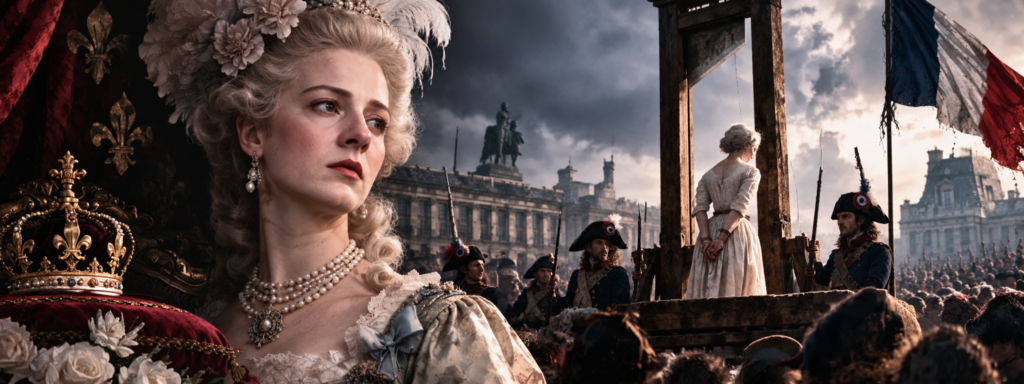
Marie Antoinette: The Hated Queen, the Lies That Destroyed Her, and the Guillotine That Ended Her Life
Marie Antoinette (1755–1793) | Archduchess of Austria | Queen consort of France, 1774–1792 | Daughter of Empress Maria Theresa and Emperor Francis I | Wife of Louis XVI | Mother of four children, including the future Louis XVII | An influential political adviser to her husband, particularly during the French Revolution, although never formally a co-ruler | Accused of extravagance, foreign loyalties, sexual misconduct, and conspiring against the French nation | Falsely implicated in the Affair of the Diamond Necklace | Associated with the failed royal escape to Varennes in 1791 | Imprisoned after the overthrow of the monarchy in August 1792 | Widowed when Louis XVI was executed on January 21, 1793 | Separated from her surviving children | Tried by the Revolutionary Tribunal in October 1793 | Condemned for political offenses including conspiracy against the security of the French state | Executed by guillotine at the Place de la Révolution in Paris on October 16, 1793, aged thirty-seven.
The Queen Who Rode to Her Death in an Open Cart
On the morning of October 16, 1793, a woman who had once been the most extravagantly dressed queen in Europe was taken from a Paris prison and placed inside an ordinary executioner’s cart. Her hair had been cut short, her clothing was plain, and her hands were bound as she began the journey through streets filled with people who had spent years hearing that she was responsible for nearly everything wrong with France. She was no longer surrounded by courtiers, ladies-in-waiting, or guards whose duty was to protect her. Instead, she traveled under armed escort toward the guillotine, where the revolutionary government intended to end her life before a public audience.
The prisoner was Marie Antoinette, widow of Louis XVI and former queen of France. She had been born an Austrian archduchess, married into the Bourbon dynasty as a teenager, and spent much of her adult life inside the extraordinary world of Versailles. For years, she had been accused of bankrupting the kingdom, corrupting the court, betraying France to Austria, and manipulating a weak husband into disastrous political decisions. Some accusations reflected genuine political actions, while others were exaggerations, deliberate falsehoods, or grotesque inventions circulated by people who had never met her.
By the time she reached the scaffold, the distinction between those accusations scarcely mattered to the authorities who had condemned her. France was at war, the Revolution was consuming its enemies, and the former queen had become one of the most recognizable symbols of the monarchy the Republic had destroyed. Her husband had been executed nine months earlier, her surviving children remained imprisoned, and her closest relatives were scattered across Europe. The woman who had once occupied the magnificent apartments of Versailles had been reduced to a condemned prisoner whose death was scheduled as an act of revolutionary justice.
Her execution was not the work of a secret assassin or a palace conspirator. It was an official killing authorized by the Revolutionary Tribunal and carried out by the French Republic, making her death one of the most notorious examples of revolutionary regicide. Yet the proceedings that sent her to the guillotine exposed far more than the political hostility directed against a former sovereign. They revealed how completely Marie Antoinette’s public identity had been transformed into a weapon, and how accusations about her nationality, sexuality, motherhood, and supposed extravagance became inseparable from the case against her.
The final journey through Paris represented an astonishing reversal of fortune. In 1770, the young Austrian princess had entered France amid elaborate celebrations, intended to embody friendship between two powerful European dynasties. Twenty-three years later, the same country watched her travel toward execution as a supposed enemy of the nation. Between those two journeys lay a failed marriage that eventually became a close family partnership, four children, relentless scandal, financial crisis, revolution, war, imprisonment, and betrayal. Marie Antoinette’s story was not simply the fall of a queen but the destruction of a woman whose public image had become almost impossible to separate from the political hatred surrounding her.
An Austrian Princess Born Into Power
Maria Antonia Josepha Johanna was born on November 2, 1755, at the Hofburg Palace in Vienna. She was the fifteenth child of Empress Maria Theresa and Emperor Francis I, members of the Habsburg dynasty that ruled an extensive collection of European territories. Her childhood unfolded within one of the continent’s most powerful royal families, where marriage was understood as an instrument of diplomacy. The children of Maria Theresa were not merely sons and daughters but potential alliances through which Austria could strengthen its position in European politics.
Maria Antonia grew up in a household that combined affection, religious discipline, music, ceremony, and constant political calculation. Her mother was a formidable ruler who personally supervised important aspects of her children’s upbringing, although the demands of government limited the time she could devote to each one. The young archduchess enjoyed music, dancing, theatrical performances, and social activities, displaying a lively temperament that later attracted admiration and criticism alike. She was less enthusiastic about formal academic study, and her education did not initially prepare her particularly well for the complicated political environment she would eventually enter.
The Austrian court differed from Versailles in important ways. Maria Theresa maintained an atmosphere that, although undeniably royal, could be less rigidly ceremonial than the French court established under Louis XIV. Family life played a visible role in the imperial household, and the children were encouraged to participate in music and entertainment. Maria Antonia therefore grew up accustomed to aristocratic privilege but not fully prepared for the relentless public scrutiny imposed upon the French royal family.
Her future changed because of a diplomatic transformation that had begun before her birth. Austria and France had spent generations as rivals, but their governments formed an alliance during the diplomatic realignment of the 1750s. A marriage between the Habsburg and Bourbon dynasties offered a way to reinforce that partnership. Maria Antonia became the chosen bride for Louis-Auguste, grandson of Louis XV and heir to the French throne.
The arrangement was politically valuable but personally demanding. The prospective bride would be required to leave her family, abandon much of her Austrian identity in public, and become a representative of French royal interests. Her marriage was expected to produce heirs and strengthen relations between governments whose populations had long regarded one another with suspicion. At fourteen, she was preparing to enter a world in which almost every personal decision could acquire political significance.
The Bride Who Was Expected to Become French
In April 1770, Maria Antonia was married by proxy in Vienna before beginning her journey to France. The ceremony represented the formal beginning of a marriage negotiated between governments rather than a union arising from personal choice. She traveled west accompanied by attendants, ceremonial possessions, and the expectations of the Habsburg court. Her destination was Versailles, where she would become the wife of the future Louis XVI.
At the frontier, the young princess underwent a symbolic transformation. In a carefully staged ceremony, she exchanged the Austrian elements of her household and appearance for those appropriate to her new position in France. The ritual was intended to demonstrate that she had left one royal family to become part of another. From that point forward, she was publicly known as Marie Antoinette.
The symbolism was powerful, but it could not erase her origins. French courtiers understood that she remained the daughter of the Austrian empress, and many regarded the alliance with Austria as politically undesirable. Hostility toward Austrian influence had deep roots in French political culture. Marie Antoinette entered Versailles carrying suspicions that would follow her for the rest of her life.
Her formal wedding to Louis-Auguste took place at Versailles on May 16, 1770. The bride was fourteen, while the groom was fifteen, and neither possessed much experience of marriage or political responsibility. The celebrations were magnificent, but they also concealed considerable uncertainty about the couple’s compatibility. Their union had been designed to serve dynastic interests, and personal happiness was expected to develop afterward.
The festivities surrounding the marriage included a disastrous public celebration in Paris. On May 30, a crowd gathered to enjoy fireworks and illuminations, but panic and congestion resulted in numerous deaths. The tragedy became associated with the wedding celebrations, although the young couple bore no personal responsibility for the disaster. In retrospect, later writers sometimes treated the event as an ominous beginning to a doomed marriage.
At Versailles, Marie Antoinette discovered that becoming French involved far more than changing her name. She was expected to observe elaborate rules governing dress, meals, ceremonies, visits, and even the most intimate aspects of daily life. Senior courtiers closely watched her conduct, while rival factions attempted to influence her relationships. The young dauphine soon learned that royal privilege could coexist with a remarkable lack of personal freedom.
Versailles: A Palace Built on Ceremony and Resentment
Versailles was designed to display the power and magnificence of the French monarchy. Its galleries, gardens, fountains, and ceremonial apartments projected an image of almost unlimited royal authority. Yet the palace was also a political arena in which courtiers competed for access, appointments, favors, and influence. For a young foreign princess, it could be an intimidating environment.
Marie Antoinette disliked some of the court’s most elaborate customs. The ceremonies surrounding dressing, dining, and public appearances could seem absurdly restrictive to someone accustomed to a somewhat different royal upbringing. She preferred informal companionship, music, dancing, and private entertainments. Those preferences were understandable, but they also created enemies among courtiers who depended upon traditional etiquette for their social importance.
Her relationship with Madame du Barry, the influential mistress of Louis XV, became an early political difficulty. Marie Antoinette initially avoided acknowledging du Barry, partly because of pressure from court factions hostile to the king’s mistress. The resulting dispute embarrassed the French court and concerned Maria Theresa, who feared that her daughter was jeopardizing diplomatic interests over a matter of etiquette. Eventually, Marie Antoinette was persuaded to make a limited public acknowledgment.
The episode revealed how little control the young dauphine possessed over her own social conduct. A seemingly minor exchange between two women became entangled with royal authority, Austrian diplomacy, and factional rivalry. Marie Antoinette’s refusal was interpreted by some as principled and by others as childish obstinacy. She was learning that Versailles could transform personal dislikes into international complications.
Her growing circle of companions also attracted criticism. She formed close friendships with women such as the Princesse de Lamballe and, later, the Duchesse de Polignac. These relationships offered emotional relief from court life, but they also created opportunities for accusations of favoritism. Courtiers excluded from her private circle increasingly portrayed her friendships as evidence that she was careless with influence and patronage.
A Marriage That Became a Public Humiliation
Marie Antoinette’s marriage initially failed to produce children, creating one of the most persistent sources of anxiety in her early life. The couple did not consummate their marriage for several years, and the delay attracted intense attention from the Austrian and French courts. Maria Theresa repeatedly expressed concern about the situation, while diplomats reported upon matters that would ordinarily have remained private. The pressure was especially severe because producing an heir was considered one of the principal duties of a royal wife.
Later accounts often claimed that Louis suffered from a particular physical condition requiring surgery. The surviving evidence does not establish that explanation conclusively, and the frequently repeated story of a corrective operation remains disputed. Inexperience, anxiety, personal awkwardness, and possible physical difficulties have all been suggested. Historians cannot confidently reduce the problem to a single cause.
The marriage difficulties became particularly humiliating for Marie Antoinette because responsibility for producing children was often placed upon her. Her mother feared that a childless marriage could weaken Austria’s diplomatic position. French courtiers speculated about the couple’s private relationship, and hostile observers found opportunities to mock both husband and wife. The young queen’s personal life was becoming public property.
In 1777, Marie Antoinette’s brother, Emperor Joseph II, visited France and discussed the marriage with the couple. His intervention appears to have contributed to an improvement in their relationship, although the precise reasons remain uncertain. The marriage was eventually consummated, and Marie Antoinette became pregnant. The long-awaited birth of a child would temporarily strengthen her position.
Their first daughter, Marie-Thérèse Charlotte, was born in December 1778. A son, Louis-Joseph, followed in October 1781, securing the succession. Two more children were born: Louis-Charles in 1785 and Sophie-Béatrice in 1786. The queen’s role as a mother became increasingly important to her private identity.
The marriage itself developed beyond the awkwardness of its early years. Louis and Marie Antoinette never became an idealized romantic couple in the conventional sense, but they formed a partnership shaped by shared family responsibilities and growing political danger. Marie Antoinette became more protective of her husband as the monarchy weakened. Their relationship would eventually be tested under circumstances far more terrible than the embarrassment of their early marriage.
The Young Queen Who Wanted to Escape Versailles
When Louis XV died in May 1774, Marie Antoinette became queen of France at eighteen. Her husband was only nineteen, and both suddenly occupied positions of immense political and ceremonial importance. The accession initially inspired optimism among people who hoped the young couple would bring renewal to the monarchy. Marie Antoinette’s beauty, youth, and lively personality attracted considerable public interest.
The new queen, however, remained uncomfortable with the formal demands of court life. She sought relief through private gatherings, music, theatrical performances, fashionable clothing, and carefully chosen companions. Her enthusiasm for entertainment was not unusual among aristocratic women of her generation. What made it politically dangerous was the scale of her visibility and the resentment already surrounding the royal court.
Marie Antoinette became particularly associated with the Petit Trianon, a small palace within the grounds of Versailles that Louis XVI placed at her disposal. She transformed it into a private retreat where she could escape some of the ceremonial obligations of the main palace. Access was restricted, and she preferred to entertain a relatively small circle of friends. Courtiers excluded from the retreat interpreted that exclusivity as an insult.
The queen’s desire for privacy therefore created a paradox. She attempted to escape the constant scrutiny of Versailles by establishing a more intimate environment. Yet the secrecy surrounding her private gatherings encouraged rumors about what occurred there. The less outsiders knew, the more easily hostile writers could invent scandalous explanations.
Her retreat eventually included the Hameau de la Reine, a picturesque collection of rustic buildings designed to evoke an idealized rural landscape. The project reflected fashionable eighteenth-century interests in pastoral life and the aesthetics of nature. It also became a convenient target for critics who portrayed the queen as pretending to be a peasant while real peasants struggled to survive. The image was politically damaging even though it distorted the actual purpose and operation of the estate.
The Queen of Fashion and the Cost of Being Seen
Marie Antoinette’s clothing became one of the most recognizable features of her public identity. She embraced elaborate hairstyles, luxurious fabrics, fashionable accessories, and changing styles that attracted attention throughout Europe. Her dressmaker Rose Bertin became closely associated with the queen’s wardrobe and helped establish new fashions. The queen’s appearance could influence aristocratic tastes far beyond France.
Her spending was substantial, and criticism of royal luxury was not entirely invented. Marie Antoinette sometimes accumulated debts through clothing, entertainment, and personal expenditure. She also supported favorites whose positions and privileges could provoke resentment. These choices were politically unwise during a period when the monarchy faced mounting financial difficulties.
Nevertheless, the claim that Marie Antoinette personally bankrupted France is historically indefensible. The monarchy’s fiscal crisis resulted primarily from structural weaknesses in taxation, accumulated borrowing, military expenditure, and the cost of servicing debt. The American War of Independence placed particularly heavy demands upon royal finances. Even eliminating the queen’s personal expenses would not have resolved the government’s underlying financial problems.
The distinction mattered little to pamphleteers. A jeweled necklace or elaborate hairstyle offered a more memorable symbol of waste than the complicated workings of royal finance. Marie Antoinette became a visible target for anger directed at an economic system that ordinary people found increasingly oppressive. Her appearance allowed critics to turn abstract financial grievances into personal accusations.
The queen also became associated with an extraordinary variety of sexual rumors. Hostile pamphlets portrayed her as promiscuous, corrupt, and engaged in relationships with courtiers of both sexes. These accusations often reflected misogyny, political hostility, and the conventions of scandal literature rather than reliable evidence. They helped establish an image of Marie Antoinette as morally dangerous long before the Revolution placed her life in jeopardy.
The Affair of the Diamond Necklace
In 1785, Marie Antoinette’s reputation suffered one of its most damaging blows through a scandal in which she was not a willing participant. The Affair of the Diamond Necklace involved an extraordinarily expensive piece of jewelry, a disgraced aristocratic woman, forged correspondence, and a cardinal eager to regain royal favor. The deception became a public sensation because it appeared to confirm existing suspicions about the queen’s extravagance. Its consequences were far more damaging than the actual facts justified.
The necklace had originally been created for Madame du Barry, the former mistress of Louis XV, but the king died before the purchase was completed. The jewelers were left with an expensive piece that proved difficult to sell. Marie Antoinette declined opportunities to acquire it. Nevertheless, the necklace became the center of a fraud designed to exploit the belief that the queen secretly desired it.
Jeanne de Valois-Saint-Rémy, known as the Comtesse de La Motte, persuaded Cardinal de Rohan that she possessed influence with Marie Antoinette. Through forged letters and staged encounters, she convinced him that the queen wished to obtain the necklace discreetly. A woman resembling Marie Antoinette was even recruited to impersonate her during a nighttime meeting. Rohan believed he was acting on behalf of the queen when he arranged the purchase.
The necklace was obtained and broken apart, with the jewels dispersed through criminal channels. When the jewelers sought payment, the deception began to unravel. The scandal exposed the elaborate fraud, but it also brought Marie Antoinette’s name into an embarrassing public investigation. The queen had neither ordered the necklace nor participated in the scheme.
The trial became a political disaster for the monarchy. Rohan was acquitted of criminal wrongdoing, while Jeanne de La Motte was convicted and punished. Many members of the public nevertheless interpreted the proceedings as evidence of royal corruption. The queen’s innocence did not prevent the affair from strengthening hostility toward her.
The scandal demonstrated the extraordinary weakness of Marie Antoinette’s public reputation. Evidence that should have cleared her instead became another opportunity for suspicion. Her enemies could portray her as secretly involved, while sympathizers struggled to counter the accumulated force of hostile rumor. The queen had become a figure whom many people were prepared to condemn regardless of the facts.
The Infamous Lie About Bread and Cake
Few historical figures have been associated with a quotation as famous or as misleading as the claim that Marie Antoinette told hungry people to eat cake when they lacked bread. The story has become a shorthand expression for aristocratic indifference and royal extravagance. It appears repeatedly in popular accounts of the French Revolution, often presented as though it were a documented remark. There is no credible evidence that Marie Antoinette ever said it.
The anecdote appeared in versions circulating before Marie Antoinette became queen. Jean-Jacques Rousseau included a similar story in his autobiographical writings, referring to an unnamed great princess. The chronology makes it highly implausible that he was describing Marie Antoinette, who was still a child when the relevant material was written. The phrase was later attached to her because it matched the public image created by hostile propaganda.
The translation also contributes to misunderstanding. The French expression traditionally rendered as cake refers to brioche, a rich bread containing ingredients that made it more expensive than ordinary bread. The anecdote was intended to illustrate a privileged person’s ignorance of poverty. Its historical importance lies in what it reveals about attitudes toward aristocratic luxury rather than in any authenticated statement by the queen.
Marie Antoinette was capable of recognizing suffering and supported charitable activities, although her understanding of ordinary hardship was inevitably limited by her upbringing. Her private correspondence and conduct do not support the simplistic image of a woman who delighted in the starvation of her subjects. That does not mean she understood the full depth of France’s economic problems. It means that a famous accusation should not be treated as evidence when its attribution is unsupported.
The survival of the story demonstrates how effectively political mythology can overwhelm historical fact. Marie Antoinette became so closely associated with extravagance that the quotation seemed believable even without proof. Generations repeated it because it offered a simple explanation for a complicated revolution. The real queen disappeared behind a sentence she almost certainly never spoke.
The Children Who Changed Her Life
Motherhood transformed Marie Antoinette’s private priorities. After years of anxiety over her childless marriage, the births of her children brought both personal happiness and greater security within the dynasty. She became closely involved in their upbringing by the standards of royal motherhood. Her correspondence and surviving accounts reveal genuine affection and concern for their welfare.
Her first daughter, Marie-Thérèse Charlotte, was born in December 1778. The birth was celebrated, although the absence of a male heir meant that succession anxieties remained. Louis-Joseph’s arrival in 1781 finally provided the monarchy with a dauphin. His birth strengthened the queen’s position and temporarily reduced one of the pressures that had dominated her early marriage.
Louis-Charles was born in 1785, followed by Sophie-Béatrice in 1786. The queen now had four children, and family life became increasingly important to her. Yet the happiness was fragile because childhood illness remained a serious danger even within the royal household. Wealth and medical attention could not guarantee survival.
Sophie-Béatrice died in June 1787, before reaching her first birthday. The loss devastated Marie Antoinette, who had already endured considerable emotional strain. Two years later, Louis-Joseph died in June 1789 after a prolonged illness. His death occurred during the opening stages of the Revolution, when the monarchy was already facing an unprecedented political crisis.
The timing was particularly cruel. While France debated representation and sovereignty, the royal family was mourning the loss of the child expected to inherit the throne. Marie Antoinette’s private grief unfolded alongside the collapse of the political world surrounding her. The surviving son, Louis-Charles, became the new dauphin.
The queen’s attachment to her children would later become one of the most painful aspects of her imprisonment. The Revolution did not merely strip her of political status. It separated her from the family relationships that had become central to her life. The final months of her existence would be dominated by fear for the children she could no longer protect.
The Austrian Woman France Refused to Trust
Marie Antoinette’s Austrian identity remained politically dangerous throughout her life in France. Although she had been married into the Bourbon dynasty as a teenager, hostile observers continued to portray her as an outsider. The derogatory nickname l’Autrichienne carried political and sometimes obscene implications in contemporary attacks. It suggested that she belonged to a foreign power rather than to the nation she represented as queen.
Her mother, Maria Theresa, maintained a strong interest in French politics and expected her daughter to support Austrian diplomatic objectives where possible. Austrian ambassadors also attempted to use Marie Antoinette’s position to influence the French court. The queen sometimes intervened in political discussions, although her influence varied considerably. Her efforts were not always successful, and she could be criticized by Austrian officials for failing to achieve their objectives.
The relationship between her family origins and political loyalties became increasingly complicated after Maria Theresa’s death in 1780. Marie Antoinette remained emotionally attached to her Habsburg relatives, including her brothers Joseph II and Leopold II. Those relationships were ordinary within European dynastic politics, where royal marriages routinely connected competing states. Yet they became suspicious when France entered revolutionary conflict with Austria.
The queen’s nationality also made her a convenient target for broader resentment toward foreign influence. Critics accused her of manipulating Louis XVI on behalf of Vienna, even when the evidence for particular claims was weak. The idea that France was being governed by an Austrian woman became a recurring theme in hostile pamphlets. It transformed diplomatic relationships into accusations of national betrayal.
This hostility had consequences beyond reputation. As the Revolution developed, Marie Antoinette increasingly feared that her family connections would be interpreted as proof of treason. Her correspondence with foreign relatives and intermediaries eventually provided genuine grounds for revolutionary suspicion. The distinction between earlier xenophobic slander and later political activity is essential to understanding her downfall.
A Queen Who Became More Political as the Monarchy Weakened
Marie Antoinette was never formally a co-ruler of France. Under the Bourbon monarchy, sovereign authority belonged to Louis XVI, and the queen possessed no independent constitutional right to govern. Her influence operated through personal access, family relationships, court networks, and political persuasion. Nevertheless, her role became increasingly significant as the monarchy entered crisis.
During the early years of the reign, Marie Antoinette generally preferred social life to sustained political engagement. She could intervene on behalf of friends or support particular appointments, but she was not consistently directing government policy. Her influence sometimes irritated ministers who regarded her interventions as disruptive. The stereotype of a queen secretly controlling every decision exaggerates her actual authority.
The situation changed during the late 1780s. As the financial crisis intensified and Louis struggled to manage competing political demands, Marie Antoinette became more involved in discussions about government. She supported some ministers and opposed others, sometimes encouraging policies intended to preserve royal authority. Her political judgments were shaped by her upbringing and her conviction that monarchy was essential to legitimate government.
The Revolution increased her involvement further. Louis’s hesitation and the growing hostility toward the royal family encouraged her to take a more active role in seeking allies and influencing strategy. She became involved in secret political communications and efforts to protect the monarchy. Her actions would later form part of the case against her.
Marie Antoinette’s political influence was therefore real but neither absolute nor constant. She could advise, persuade, obstruct, and organize, but she could not simply command the French state. Her power depended upon Louis, the changing political situation, and the willingness of others to cooperate. Treating her as an all-powerful foreign manipulator obscures the limitations under which she operated.
The Financial Crisis That Destroyed Versailles
By the late 1780s, the French monarchy faced a financial crisis that threatened its ability to govern. Decades of borrowing, military expenditure, and inefficient taxation had produced a dangerous imbalance between revenue and obligations. The American War of Independence had added substantially to the burden. Attempts to reform taxation encountered resistance from privileged groups determined to preserve exemptions and established rights.
Marie Antoinette became a convenient symbol of the crisis. Her clothing, jewelry, entertainments, and private retreats were highly visible, while the technical details of government finance were not. Pamphleteers could present her spending as the explanation for national debt, even though the figures did not support that conclusion. The queen’s personal reputation became entangled with structural problems she had not created.
The monarchy’s difficulties nevertheless exposed the political consequences of royal luxury. Ordinary people facing rising bread prices could reasonably resent the enormous social distance between their lives and the court. Marie Antoinette’s attempts to establish a more informal private existence did little to reduce that resentment. Her retreat into exclusive circles sometimes reinforced the impression that Versailles was indifferent to public hardship.
The financial crisis forced Louis XVI to summon the Estates-General in 1789. The decision was intended to address taxation and government revenue, but it opened a broader confrontation over representation and political authority. Marie Antoinette watched the crisis develop while dealing with the illness and death of her eldest son. Her private world and the monarchy’s public world were collapsing together.
The Revolution Arrives at the Palace Gates
The meeting of the Estates-General in May 1789 marked the beginning of a political transformation that neither Louis nor Marie Antoinette fully controlled. Representatives of the Third Estate challenged the traditional voting system and declared themselves the National Assembly. The Tennis Court Oath asserted the determination to establish a constitution. The monarchy’s authority was now being challenged through institutions that claimed to represent the nation.
The storming of the Bastille on July 14 demonstrated that the conflict had moved beyond parliamentary debate. Parisian crowds seized the fortress, and revolutionary violence became a central feature of the crisis. The royal family received news of events that exposed the vulnerability of established authority. Versailles could no longer assume that distance from the capital provided security.
Marie Antoinette reacted with alarm to the increasingly radical demands directed against the monarchy. She feared that concessions would encourage further challenges rather than restore stability. Her instincts often favored firmness, although she also participated in discussions about compromise. The contradiction reflected the uncertainty facing royalists who did not know whether the Revolution could be contained.
The queen’s unpopularity made the situation especially dangerous. Revolutionary crowds and pamphleteers often directed their anger toward her personally, portraying her as the force encouraging Louis to resist reform. The king could sometimes be represented as weak or misled, while the queen was depicted as malicious and calculating. This division allowed critics to preserve a degree of sympathy for Louis while making Marie Antoinette the embodiment of royal opposition.
Her position became increasingly isolated. Court factions disagreed about how to respond, foreign relatives offered uncertain support, and the political authority of the monarchy continued to weaken. Marie Antoinette had entered France as a symbol of dynastic reconciliation. By 1789, she was becoming a symbol of everything revolutionaries believed threatened their movement.
October 1789: The Women Who Came for the Queen
The October Days of 1789 brought the Revolution directly into the royal residence. On October 5, crowds from Paris, prominently including women demanding bread, marched toward Versailles. Their anger reflected food shortages, political suspicion, and frustration with the monarchy’s response to the crisis. The demonstration quickly became a confrontation over the royal family’s relationship with the capital.
The crowd reached Versailles, where tensions continued into the night. During the early hours of October 6, protesters entered parts of the palace, and violence erupted. Royal guards were killed, and Marie Antoinette narrowly escaped danger when intruders approached her apartments. The queen fled toward the king’s rooms while the palace struggled to restore order.
The attack became one of the most frightening experiences of her life. The private spaces that had once seemed protected by royal ceremony were suddenly vulnerable to armed crowds. The deaths of guards demonstrated that the threat was not merely symbolic. Marie Antoinette could no longer assume that her position would protect her from physical violence.
The royal family eventually appeared before the crowd, and Louis agreed to return to Paris. Marie Antoinette also appeared publicly, accompanied at one point by her children, in an attempt to calm the situation. The scene became a powerful symbol of the monarchy’s submission to popular pressure. The queen who had once presided over Versailles was now dependent upon the goodwill of crowds gathered outside its windows.
The family traveled to Paris and took up residence in the Tuileries Palace. Officially, the move could be presented as reconciliation between king and people. In practice, it placed the royal household under close observation and sharply restricted its freedom. Marie Antoinette understood that Versailles, the world she had known for nearly twenty years, was effectively lost.
The Prisoners Who Still Wore Crowns
Life at the Tuileries was a strange mixture of royal ceremony and captivity. Louis remained king, and Marie Antoinette retained her title, but their movements were increasingly constrained. Revolutionary authorities and the National Guard watched the palace, while political decisions unfolded under pressure from Paris. The family continued aspects of court life without possessing the security or authority that had once supported them.
Marie Antoinette attempted to maintain ordinary routines for her children. Lessons, religious observance, and family activities offered some structure amid the uncertainty. Yet the children could not be shielded completely from the political crisis. Their parents’ anxiety and the presence of guards made the change in circumstances impossible to ignore.
The queen’s political role became more active during this period. She communicated with royalist advisers and sought ways to preserve or recover the monarchy’s authority. Her efforts involved both constitutional possibilities and plans that could provide the royal family with greater freedom. She increasingly viewed the Revolution as a threat to the dynasty’s survival.
Her distrust of revolutionary leaders was not entirely irrational. The violence at Versailles had demonstrated that crowds could threaten the royal family directly, and the monarchy’s authority was being dismantled through political measures. Yet her resistance also strengthened the suspicions of those who believed she intended to reverse the Revolution. The royal family became trapped in a cycle of fear and mistrust.
The Tuileries therefore represented a dangerous halfway position. The monarchy had not been abolished, but its rulers no longer possessed genuine freedom of action. Revolutionary politicians hoped to establish constitutional government, while the queen sought means of protecting dynastic authority. The possibility of compromise remained, but it was steadily narrowing.
Mirabeau and the Secret Effort to Save the Monarchy
Marie Antoinette became involved in efforts to establish contact with Honoré Gabriel Riqueti, Comte de Mirabeau, one of the Revolution’s most influential political figures. Mirabeau supported constitutional monarchy and believed that a stable settlement required cooperation between the crown and representative institutions. He also maintained secret communications with the royal court. His public reputation and private dealings would later become a major scandal.
Mirabeau recognized that the monarchy’s survival depended upon accepting significant reforms. He advised the court on political strategy and attempted to develop plans that might restore confidence in royal government. Marie Antoinette was initially suspicious of him because of his revolutionary reputation. Nevertheless, she came to recognize his potential value as an intermediary.
Their contacts reflected the queen’s willingness to explore political solutions when she believed they might protect the dynasty. She was not simply demanding a return to every feature of absolute monarchy. At the same time, she remained deeply concerned about the erosion of royal authority. Her approach combined tactical flexibility with strong attachment to traditional principles.
Mirabeau died in April 1791, removing one of the few prominent revolutionary figures capable of mediating between the monarchy and the Assembly. His death weakened the prospects for a negotiated settlement. The later discovery of evidence concerning his secret royal connections damaged his posthumous reputation. It also strengthened revolutionary suspicions about the court’s hidden political activities.
For Marie Antoinette, the loss of Mirabeau contributed to the growing belief that the royal family needed to escape its confinement. Political negotiation had produced limited results, and the monarchy remained under increasing pressure. The queen’s attention turned toward a plan that would become one of the most disastrous decisions of the Revolution. The attempt to leave Paris would permanently damage the credibility of constitutional monarchy.
Axel von Fersen: The Man Behind the Queen’s Most Dangerous Friendship
Count Hans Axel von Fersen, a Swedish aristocrat, occupied an important place in Marie Antoinette’s personal and political life. The two had known one another before the Revolution, and their relationship developed into a close attachment. Fersen became a trusted confidant who assisted the royal family during the crisis. His loyalty to Marie Antoinette continued long after the monarchy’s position had become desperate.
The nature of their relationship has generated enormous speculation. Some historians and biographers have argued that they were lovers, while others have emphasized the limits of the surviving evidence. Their correspondence reveals deep affection and emotional intimacy, but it does not establish every detail of their private relationship. Claims about a physical affair should therefore be presented as disputed rather than proven.
The uncertainty has not prevented later writers from turning Fersen into the central romantic figure of Marie Antoinette’s life. The image of a devoted foreign count attempting to rescue a doomed queen possesses obvious dramatic appeal. Yet their relationship also had serious political dimensions. Fersen participated in efforts to help the royal family escape revolutionary control.
He played a significant role in organizing the attempted flight from Paris in June 1791. His involvement included logistical preparations and assistance during the initial stages of the escape. The plan depended upon secrecy, coordination, and the ability to move the royal family through territory where loyal forces could provide protection. Its failure would transform Marie Antoinette’s political situation.
Fersen’s attachment to the queen continued after the disaster. He remained involved in royalist efforts and communications intended to assist the monarchy. His later life was marked by political service and controversy, and he died violently in Stockholm in 1810 after being attacked by a crowd. His fate added another tragic episode to the history of people associated with Marie Antoinette.
The Flight to Varennes: The Escape That Became a Trap
During the night of June 20–21, 1791, Louis XVI, Marie Antoinette, their children, and selected attendants left the Tuileries in disguise. The royal family intended to travel eastward toward Montmédy, where loyal military forces might provide greater security. The plan was designed to free the king from the constraints imposed upon him in Paris. Marie Antoinette was deeply involved in the preparations.
The escape was complicated by the size of the traveling party and the arrangements required to move them discreetly. The family used a large carriage, and delays accumulated along the route. Coordination with military detachments proved difficult, while the possibility of recognition increased with every stop. The plan demanded precision that the travelers could not maintain.
The king was recognized during the journey, and the royal party was eventually stopped at Varennes. The capture ended the attempt before the family could reach safety. Revolutionary authorities were informed, and the royal prisoners were ordered to return to Paris. The escape that was supposed to restore their freedom instead exposed their intentions to the entire nation.
For Marie Antoinette, the return was humiliating and frightening. Crowds watched the family travel back toward the capital, and the atmosphere reflected anger at what many considered an attempted betrayal. The queen’s Austrian identity intensified suspicion that the escape formed part of a wider foreign conspiracy. Her political reputation suffered a blow from which it never recovered.
The Flight to Varennes also destroyed much of the trust necessary for constitutional monarchy. Louis had publicly accepted revolutionary arrangements while secretly attempting to escape their restrictions. Marie Antoinette had helped organize the plan, making it difficult to portray her as a passive observer. The failed escape became one of the strongest arguments used by those who believed the monarchy could no longer be trusted.
The Queen’s Secret Letters and the Question of Treason
After Varennes, Marie Antoinette continued participating in confidential political correspondence. She communicated through intermediaries with foreign relatives, royalist supporters, and figures involved in attempts to preserve the monarchy. Her letters reveal the desperation of a woman who believed her family faced increasing danger. They also demonstrate that she was actively involved in political efforts directed against important aspects of the Revolution.
The correspondence with Fersen is especially significant. Surviving letters, including passages affected by deliberate censorship or later redaction, reveal both personal attachment and political concerns. Modern examination has helped recover portions of the correspondence, although not every uncertainty has been resolved. The letters provide evidence of a close relationship without eliminating all debate about its intimate character.
Marie Antoinette also communicated with members of the Habsburg family and individuals associated with foreign courts. These contacts became increasingly dangerous as relations between France and Austria deteriorated. What might once have been ordinary dynastic communication acquired a different meaning during revolutionary war. The queen’s attempts to secure assistance could be interpreted as placing the interests of her family above those of the French nation.
There is substantial evidence that Marie Antoinette opposed the Revolution’s radical direction and sought outside support for the monarchy. She was not merely the innocent victim of invented political accusations. Yet the surviving evidence must still be evaluated carefully, because hostile prosecutors often combined genuine actions with exaggeration and speculation. Her political conduct does not validate the obscene rumors and personal slanders that circulated alongside it.
The distinction is essential to understanding her trial. Marie Antoinette had engaged in secret political activity that revolutionaries could reasonably regard as threatening. She had also been subjected to years of false accusations that distorted her public identity. By 1793, those two histories had become inseparable in the minds of many of her enemies.
The Constitutional Monarchy That Could Not Survive
In September 1791, Louis XVI accepted the new French constitution, creating a constitutional monarchy that limited royal authority. The settlement represented an attempt to preserve the dynasty while establishing government based upon law and representative institutions. Marie Antoinette remained deeply skeptical of the arrangement. She feared that the monarchy had surrendered too much authority and that revolutionary demands would continue.
Her political correspondence reflected that distrust. She sought advice from individuals who might help strengthen the monarchy’s position, including figures associated with constitutional compromise. Antoine Barnave, a prominent revolutionary politician, became involved in confidential discussions with the royal court. These contacts demonstrated that Marie Antoinette was willing to explore different strategies, even while remaining hostile to much of the Revolution.
The constitutional settlement faced serious obstacles. Louis’s attempted escape had damaged public confidence, while revolutionary factions disagreed about the future of monarchy. Religious disputes, economic hardship, and fears of foreign intervention continued to destabilize France. The king and queen were increasingly regarded as unreliable partners.
Marie Antoinette’s position became especially difficult because she was blamed for encouraging royal resistance. Her enemies portrayed Louis as weak and the queen as the true architect of opposition to the Revolution. The characterization exaggerated her authority but reflected the growing importance of her political advice. She had become more influential at precisely the moment when royal influence was becoming dangerous.
The monarchy survived formally for less than a year after the constitution took effect. War and political radicalization soon overwhelmed the fragile settlement. Marie Antoinette’s efforts to protect the dynasty increasingly appeared to revolutionaries as evidence of conspiracy. The queen who had once been criticized for caring too little about politics was now accused of directing a campaign against the nation.
War With Austria: The Queen Becomes the Enemy
France declared war on Austria in April 1792, transforming Marie Antoinette’s family connections into an immediate political liability. Her brother Leopold II had died earlier that year, and the Habsburg monarchy was now ruled by her nephew Francis II. The conflict placed France at war with the dynasty into which she had been born. Every contact with Austrian representatives became potentially incriminating.
The queen feared for the monarchy’s survival and hoped that foreign pressure might force revolutionary leaders to moderate their demands. Her political communications reflected the belief that the royal family needed assistance from outside France. Some information passed through royalist networks was highly sensitive, and her contacts with foreign powers provided genuine grounds for suspicion. The queen’s actions therefore cannot be dismissed as merely the inventions of hostile pamphleteers.
At the same time, revolutionary propaganda greatly exaggerated her personal control over events. She did not command Austrian armies or possess independent authority to direct French military policy. The political decisions of foreign governments reflected their own interests as well as dynastic concerns. Portraying Marie Antoinette as the sole author of international conflict simplified a much more complicated situation.
Military setbacks intensified fears that France was being betrayed from within. Revolutionary leaders accused aristocrats, officers, clergy, and royal sympathizers of conspiring with foreign enemies. Marie Antoinette became an obvious target because of her Austrian birth and documented opposition to the Revolution. The atmosphere increasingly encouraged the belief that the royal family was dangerous to national security.
The queen’s position was now almost impossible to defend publicly. Her foreign relatives were associated with the armies threatening France, while her secret political activities undermined claims of complete loyalty to the constitutional order. Even people who had once supported monarchy began questioning whether the royal family could remain in power. The Revolution was moving toward a confrontation that would end the dynasty’s reign.
August 10, 1792: The Palace Becomes a Battlefield
On August 10, 1792, revolutionary forces attacked the Tuileries Palace. The insurrection brought together armed militants, Parisian sections, and volunteers who demanded decisive action against the monarchy. The palace was defended in part by Swiss Guards, whose loyalty to the royal household placed them directly in the path of the uprising. The resulting fighting produced extensive bloodshed.
Marie Antoinette initially hoped that the palace could be defended. She understood that abandoning the royal residence would represent a devastating political defeat. Louis, however, faced the danger that continued resistance might produce an even greater massacre. The family eventually sought refuge with the Legislative Assembly.
The fighting continued after their departure. Many Swiss Guards were killed during the assault or in the violence that followed, and the palace was overrun. The destruction demonstrated that the monarchy could no longer protect itself through its traditional institutions. The royal family’s political position collapsed within hours.
Marie Antoinette had now lost the last remnants of royal security. The family was placed under guard, and Louis was suspended from his constitutional functions. The National Convention would soon abolish monarchy altogether. The queen’s title remained part of her identity, but it no longer carried effective authority.
The events of August 10 also intensified hostility toward the royal family. Revolutionaries interpreted the palace’s defense as evidence that the monarchy was prepared to use violence against the people. Royalists viewed the insurrection as an attack upon legitimate authority. Marie Antoinette became a prisoner in a conflict where both sides increasingly regarded compromise as impossible.
The Temple: A Royal Family Behind Prison Walls
The royal family was imprisoned in the Temple complex in Paris, a former medieval fortress adapted for confinement. Louis, Marie Antoinette, their surviving children, and Madame Élisabeth entered a world of guards, inspections, restricted movement, and constant uncertainty. Their daily lives were controlled by revolutionary authorities. The contrast with Versailles was almost unimaginable.
The family attempted to preserve ordinary routines. Louis read and taught his son, while Marie Antoinette devoted attention to the children and household activities. Religious observance remained important, although access to clergy and religious practices was increasingly restricted. These routines provided a fragile sense of continuity within captivity.
The prison also exposed the family to political hostility. Guards and officials varied in their treatment of the prisoners, and rumors circulated about possible escape attempts. The authorities feared that royalists might try to rescue the former monarch. Security measures therefore became increasingly severe.
Marie Antoinette’s relationship with her children offered both comfort and anxiety. She could still care for them directly, but she knew that their future depended upon the decisions of a government hostile to hereditary monarchy. The children had become political symbols simply because of their birth. Their mother could no longer guarantee their safety.
The Temple marked the beginning of the final destruction of the royal family. Louis would be removed for trial and execution, leaving Marie Antoinette a widow. The surviving children would later be separated from her. The prison transformed the queen’s private fears into a succession of irreversible losses.
The Trial and Execution of Louis XVI
In December 1792, Louis XVI appeared before the National Convention to answer accusations of conspiring against public liberty and the security of the state. The proceedings examined his conduct during the Revolution, including the Flight to Varennes, secret political communications, and resistance to revolutionary measures. His defenders challenged the legal basis of the trial and argued that the former king should not be condemned under the proposed standards. The Convention nevertheless found him guilty.
The question of punishment divided the deputies. Some argued that the Republic could not survive while the former king remained alive, because foreign powers and domestic royalists might use him as a rallying point. Others supported imprisonment, exile, or delay. The Convention ultimately voted for death.
Louis was executed by guillotine on January 21, 1793. His death transformed Marie Antoinette from an imprisoned queen into the widow of a man condemned by the Republic. She was not permitted to attend the execution, and her knowledge of events came through the authorities and information reaching the prison. The loss was devastating for the family.
The execution also intensified the danger facing Marie Antoinette. The government had demonstrated that royal birth offered no protection from capital punishment. The former queen remained a symbol of the destroyed monarchy and a potential focus of royalist loyalty. Her Austrian identity made her position even more precarious during the continuing war.
Royalists now regarded the imprisoned Louis-Charles as Louis XVII. The Republic did not recognize his claim, but the boy’s existence preserved the possibility of dynastic restoration. Marie Antoinette understood that her children remained politically significant. The death of their father had not ended the danger surrounding them.
The Widow Who Had Nothing Left to Offer
After Louis’s execution, Marie Antoinette remained imprisoned with her children and Madame Élisabeth. Her position was increasingly isolated, and her prospects depended upon political decisions made far beyond the prison walls. Foreign governments could protest or threaten, but they had not prevented her husband’s death. The queen had little reason to believe that her own life was secure.
Her physical condition deteriorated during captivity. Accounts describe increasing weakness, illness, and the effects of prolonged anxiety. The precise nature of every medical problem cannot be established, but her health was clearly affected by imprisonment. She was approaching thirty-eight, yet the suffering of the preceding years had visibly changed her appearance.
Marie Antoinette also faced uncertainty about whether the Republic intended to use her as a bargaining instrument. Some political figures considered the possibility of exchanging royal prisoners for French captives held abroad. Such arrangements were complicated by war, factional rivalry, and hostility toward the monarchy. No successful exchange secured her release.
The queen’s situation became more desperate as revolutionary politics radicalized. The government faced foreign armies, internal rebellion, and intense suspicion of conspiracy. Royal prisoners were increasingly viewed as potential threats rather than merely defeated political figures. Marie Antoinette’s survival depended upon a regime that had already executed her husband.
Her greatest concern remained her children. She had lost two children before the Revolution and now feared losing the remaining two through imprisonment or separation. The emotional burden was intensified by her inability to control their treatment. The woman once accused of caring only for luxury was now struggling to preserve the last fragments of her family.
The Son Taken From His Mother
In July 1793, revolutionary authorities ordered that Louis-Charles be separated from Marie Antoinette. The boy was eight years old and had become the focus of royalist claims that he was the rightful king of France. His political significance made him particularly vulnerable. The authorities believed that separating him from his mother would reduce the influence of royalist ideas and strengthen control over his upbringing.
The removal was one of the most devastating events of Marie Antoinette’s captivity. She resisted the separation and pleaded for her son, but the order was enforced. The boy was placed under the supervision of Antoine Simon, a shoemaker associated with the revolutionary movement, and his wife. The circumstances of his confinement became increasingly harsh.
Later royalist accounts sometimes embellished particular details of the child’s treatment, and individual stories require careful examination. Nevertheless, the broad record establishes that Louis-Charles suffered severely during his imprisonment. He was separated from his family, subjected to political pressure, and eventually endured conditions that contributed to his physical deterioration. His death in 1795 would become another tragedy associated with the destruction of the Bourbon family.
Marie Antoinette could no longer see her son freely. She remained imprisoned with her daughter and Madame Élisabeth for a short time, but the separation had already shattered the family. The authorities possessed control over the child whom royalists regarded as Louis XVII. His mother had no effective means of protecting him.
The loss became especially cruel during the queen’s trial. Prosecutors would use allegations involving her son to attack her moral character. The child who had been taken from her became an instrument in the proceedings that would condemn her. The accusations exposed the depths to which revolutionary hostility could descend.
The Conciergerie: The Queen’s Final Prison
On August 2, 1793, Marie Antoinette was transferred from the Temple to the Conciergerie prison. The building formed part of the former royal palace complex on the Île de la Cité and had become closely associated with revolutionary detention. Prisoners held there often awaited trial before the Revolutionary Tribunal. For many, the transfer represented the final stage before execution.
Marie Antoinette was separated from her daughter and Madame Élisabeth. She entered the Conciergerie under heavy guard and was confined in conditions far removed from royal comfort. Her room was watched closely, and privacy was severely restricted. The authorities regarded her as an exceptionally important prisoner.
The physical environment was oppressive. The prison contained damp spaces, limited comforts, and constant reminders that prisoners could be summoned for trial or execution. Marie Antoinette’s health was already weakened, and the new confinement intensified her isolation. She had lost the companionship of every surviving member of her immediate family.
Her identity remained politically dangerous even inside prison. Royalists continued hoping for her rescue, while revolutionary authorities feared conspiracies involving sympathizers and guards. The queen became the subject of schemes that were sometimes genuine and sometimes exaggerated. The possibility of escape increased the authorities’ determination to maintain strict control.
The Conciergerie was also a place where the symbolic reversal of monarchy became especially visible. Marie Antoinette had once lived in royal apartments surrounded by servants and ceremonial privilege. Now she occupied a guarded room in a building used to confine enemies of the Republic. Her former status made her more closely watched, not more protected.
The Carnation Plot and the Last Hope of Escape
During her imprisonment at the Conciergerie, Marie Antoinette became associated with an attempted escape commonly remembered as the Carnation Plot. The scheme involved the royalist Alexandre Gonsse de Rougeville, who gained access to the queen and attempted to communicate secretly with her. A carnation was reportedly used to conceal a message. The episode became one of the final dramatic efforts to remove her from revolutionary custody.
The details of the plot are complicated by conflicting accounts and later embellishment. Rougeville’s role is well established, but the precise actions of every participant remain uncertain. The plan depended upon cooperation from individuals connected with the prison. It ultimately failed, and the authorities tightened security.
The failed attempt reinforced the government’s fears that the queen remained a focus of royalist conspiracy. Even imprisoned, she could attract supporters willing to risk their lives to secure her release. That possibility strengthened the argument among radicals that keeping her alive was dangerous. Her existence continued to possess political significance.
For Marie Antoinette, the failure removed another possible path to survival. She remained under guard while the Revolutionary Tribunal prepared to bring her to trial. The Republic was increasingly determined to eliminate figures associated with counterrevolution. The former queen’s fate was becoming difficult to separate from the radicalization of revolutionary justice.
The Revolutionary Tribunal Prepares Its Case
Marie Antoinette’s trial began in October 1793 before the Revolutionary Tribunal. The court had been established to prosecute individuals accused of threatening the Revolution. Its proceedings occurred during a period of intense political repression, when accusations of counterrevolutionary activity could lead rapidly to execution. The former queen entered a judicial environment profoundly hostile to her.
The prosecution was led by Antoine Quentin Fouquier-Tinville, the public prosecutor of the Revolutionary Tribunal. He presented Marie Antoinette as a dangerous enemy of France whose actions had contributed to conspiracy, political betrayal, and the destruction of national security. The charges drew upon her Austrian connections, political correspondence, alleged financial misconduct, and supposed involvement in counterrevolutionary activities. The proceedings also included accusations designed to destroy her personal reputation.
Marie Antoinette was defended by lawyers including Claude-François Chauveau-Lagarde and Guillaume Alexandre Tronson du Coudray. They faced severe limitations in preparing a defense, including restricted time and access to evidence. The political atmosphere made the task extraordinarily dangerous. Defending a former queen could itself attract suspicion.
The trial was not a neutral examination of a private citizen’s alleged offenses. Marie Antoinette had already become a symbol of monarchy, foreign influence, and counterrevolution in revolutionary propaganda. The government was determined to demonstrate its authority over enemies of the Republic. Her conviction was highly likely before the proceedings began.
Nevertheless, the trial contained moments that exposed the weakness of particular accusations. Witnesses repeated claims drawn from rumor, political hostility, and personal animosity. Some allegations concerned genuine political actions, while others were unsupported or grotesquely distorted. The mixture revealed how revolutionary justice could become entangled with propaganda.
The Charges: Treason, Conspiracy, and the Destruction of France
The prosecution accused Marie Antoinette of participating in conspiracies against the French nation. Her correspondence with foreign powers and royalist supporters formed an important part of the political case. The authorities argued that she had sought to undermine the Revolution and assist enemies of France. Her Austrian birth made those accusations especially potent.
Some elements of the case rested upon genuine political conduct. Marie Antoinette had participated in efforts to preserve the monarchy, supported the Flight to Varennes, and maintained confidential contacts with individuals outside revolutionary institutions. Her correspondence demonstrated opposition to the Revolution’s radical direction. Those actions gave prosecutors material that could be interpreted as threatening national security.
Other allegations were far less reliable. The queen was accused of extravagant spending and financial wrongdoing on a scale that ignored the actual causes of France’s fiscal crisis. Hostile witnesses repeated claims about her personal conduct that had circulated in scandal literature for years. The prosecution treated political reputation as though it were evidence.
The distinction between opposition to the Revolution and criminal treason was also contested. Marie Antoinette believed she was defending the legitimate monarchy and protecting her family. Revolutionary authorities regarded those efforts as conspiracies against the nation. The conflict reflected incompatible understandings of political legitimacy.
The trial therefore involved more than determining whether particular letters had been written or meetings had occurred. It asked whether a former queen could be condemned for attempting to preserve a political order that the Republic had abolished. The prosecution’s answer was emphatically affirmative. Marie Antoinette’s defenders had little opportunity to challenge the political assumptions underlying the case.
The Most Vicious Accusation of All
One of the most notorious moments of Marie Antoinette’s trial involved allegations concerning her young son. Jacques-René Hébert, a radical journalist and revolutionary figure, introduced accusations that the queen had engaged in incestuous conduct with Louis-Charles. The claim arose in the context of the child’s separation from his mother and the pressure placed upon him during captivity. It was a grotesque allegation unsupported by credible evidence.
The accusation was designed to destroy Marie Antoinette’s moral standing. Revolutionary propaganda had long portrayed her as sexually corrupt, and the trial extended those themes into an attack upon her motherhood. The claim was particularly cruel because the child involved had been forcibly removed from her care. It transformed the queen’s greatest personal anguish into a weapon against her.
Marie Antoinette initially did not respond directly to the accusation. When pressed, she rejected it and appealed to the mothers present, emphasizing the horror of such a charge. Contemporary accounts describe the moment as emotionally powerful, and even some observers hostile to the queen were disturbed by the allegation. The precise wording preserved in later accounts varies, but the substance of her rejection is well established.
The episode revealed how far the proceedings had moved beyond ordinary political accusation. The prosecution was willing to introduce a claim that attacked the defendant through her relationship with her child. The allegation did not establish treason or prove any genuine offense. Its purpose was to degrade the woman standing before the tribunal.
The reaction also demonstrated that Marie Antoinette had not entirely lost the ability to influence those watching her. Her response exposed the cruelty of the accusation and briefly shifted attention from political hostility to maternal suffering. Yet the moment could not alter the broader direction of the trial. The revolutionary government remained determined to condemn her.
A Queen on Trial for Being a Woman
Marie Antoinette’s trial differed from that of Louis XVI in important ways. Louis had been judged primarily as a former sovereign whose political actions allegedly endangered the Republic. Marie Antoinette faced similar political accusations, but her identity as a woman, wife, mother, and foreign-born queen became central to the prosecution’s rhetoric. Her personal reputation was treated as evidence of political danger.
The sexual accusations reflected a long tradition of attacking powerful women through allegations of immorality. Marie Antoinette had been portrayed as promiscuous, manipulative, and incapable of proper feminine conduct. Such accusations allowed political opponents to suggest that her influence over Louis was unnatural or corrupt. The trial brought these themes into the courtroom.
Her spending and friendships were also interpreted through gendered expectations. Activities that might have been dismissed as ordinary aristocratic behavior in a male courtier became evidence of moral failure when associated with the queen. Her private retreat at Trianon was portrayed as secrecy, while her political involvement was described as manipulation. She was condemned for exercising influence and criticized for the frivolity supposedly associated with avoiding politics.
The prosecution’s treatment of her motherhood was especially revealing. The accusation involving Louis-Charles sought to destroy the one aspect of her identity that might have generated sympathy. It attempted to transform maternal affection into evidence of depravity. The cruelty of the allegation reflected the intensity of the hatred directed against her.
Marie Antoinette was not innocent of every political action alleged against her. Her secret correspondence and efforts to secure support for the monarchy were genuine. Yet the trial repeatedly blurred the distinction between political conduct and personal slander. The result was a proceeding in which the former queen was judged not only for what she had done but for the monstrous identity her enemies had constructed around her.
The Verdict That Had Become Inevitable
The trial continued through October 14 and 15, 1793. Witnesses were examined, accusations were presented, and Marie Antoinette attempted to defend herself against the charges. The proceedings occurred in an atmosphere where the Republic’s political survival was invoked to justify severe punishment. The former queen had little realistic prospect of acquittal.
The Revolutionary Tribunal ultimately found her guilty of the principal political accusations. She was condemned to death, and the sentence was to be carried out rapidly. The verdict reflected the government’s determination to eliminate a figure regarded as a dangerous symbol of counterrevolution. It also demonstrated that the execution of Louis XVI had not exhausted revolutionary hostility toward the royal family.
Marie Antoinette received the sentence with a composure noted in several accounts. Her conduct during the trial and final hours became central to later royalist portrayals of her courage. The surviving descriptions were shaped by the political sympathies of witnesses, but they consistently suggest that she did not collapse publicly under the verdict. She understood that the final stage of her life had begun.
The sentence left little time for preparation. Unlike the elaborate legal proceedings that had preceded Louis’s execution, Marie Antoinette’s trial moved rapidly toward death. She returned to her prison cell knowing that she would soon be taken to the scaffold. The queen who had once occupied Versailles was now waiting for the executioner’s summons.
The Last Letter to Madame Élisabeth
After her condemnation, Marie Antoinette wrote a final letter addressed to Madame Élisabeth, the sister of Louis XVI. The letter was intended for a woman who had shared the royal family’s captivity and remained deeply attached to the children. It became one of the most important personal documents associated with the queen’s final hours. Its contents reveal concern for her family, religious faith, and an attempt to face death with composure.
Marie Antoinette expressed grief at leaving her children and urged that they be guided toward forgiveness rather than vengeance. She also rejected the accusations that had attacked her moral character. The letter reflected her desire to preserve her identity as a mother and Christian woman at the moment when the state had condemned her. It was a private response to a public catastrophe.
The letter was not delivered to Madame Élisabeth at the time. Revolutionary authorities retained it, and its later history became part of the documentation surrounding the royal family’s imprisonment. Madame Élisabeth herself was executed in May 1794. The intended recipient therefore did not survive the Revolution’s violence.
The document is especially moving because it reveals how little Marie Antoinette could still control. She could not protect her children, reverse the verdict, or communicate freely with her surviving relatives. Her final letter was an attempt to leave instructions and affection behind. It represented one of the few remaining acts of personal agency available to her.
Royalist writers later treated the letter as evidence of extraordinary virtue. Its emotional power is undeniable, but it should not be used to erase the political complexities of her life. Marie Antoinette had made consequential decisions that contributed to revolutionary suspicion. She was also a mother facing execution while separated from her children.
The Final Night in the Conciergerie
Marie Antoinette spent her final night in the Conciergerie after learning that she would be executed. Her physical condition was weakened, and the strain of the trial had added to months of imprisonment. She had little privacy and remained under close observation. The surroundings offered none of the comfort or ceremony that had once defined her life.
Accounts of her final hours vary in detail. Some emphasize prayer and religious reflection, while others describe attempts to rest or prepare herself for the execution. The exact sequence cannot be reconstructed with complete certainty. What is clear is that she faced death without the companionship of her family.
The queen’s hair was cut short in preparation for the guillotine. This practical measure also carried a powerful symbolic meaning because Marie Antoinette had once been famous for elaborate hairstyles that required extraordinary attention and expense. The woman whose appearance had influenced European fashion was now being prepared for execution. Her body was treated according to the procedures imposed upon condemned prisoners.
She was dressed in plain clothing, traditionally described as white, although the precise details of her final appearance differ among accounts. Her hands were bound, and she was placed under the authority of the executioner and his assistants. The transformation from queen to prisoner was complete. The remaining journey would take her through Paris to the Place de la Révolution.
October 16, 1793: The Journey Through a Hostile City
Marie Antoinette was taken from the Conciergerie on the morning of October 16. Unlike Louis XVI, who had traveled to execution in a closed carriage, she was transported in an open cart. The arrangement exposed her to the gaze of the crowds gathered along the route. It also emphasized the government’s determination to treat her as an ordinary condemned prisoner rather than a former sovereign.
The journey carried her through streets filled with spectators, soldiers, and revolutionary symbols. Some people shouted insults, while others watched silently. The reactions were not necessarily uniform, and later accounts sometimes exaggerated either the hostility or the sympathy of the crowd. The spectacle nevertheless placed the former queen at the center of public attention for the final time.
Marie Antoinette’s appearance contrasted sharply with the image that had made her famous. Her hair was short, her clothing plain, and her face marked by the effects of imprisonment. The elaborate jewels and gowns associated with Versailles had disappeared. The woman who had once been criticized for extravagance now possessed almost nothing.
The route through Paris also symbolized the transformation of her relationship with France. She had entered the country in 1770 as a celebrated bride intended to strengthen international alliances. She had become queen in 1774 amid expectations of renewal. By 1793, she was being displayed as a condemned enemy of the Republic.
The journey ended at the Place de la Révolution, where the guillotine stood ready. The square had once been associated with royal magnificence and the statue of Louis XV. Revolutionary authorities had transformed it into a place of public execution. Marie Antoinette was about to die in the same square where her husband had been killed nine months earlier.
The Guillotine and the Death of Marie Antoinette
The executioner Charles-Henri Sanson supervised Marie Antoinette’s execution. His family had long served as official executioners in Paris, and he had already carried out the sentence against Louis XVI. The guillotine was designed to provide a swift method of decapitation. Its use against the former queen reflected the revolutionary principle that rank should not determine the method of punishment.
Marie Antoinette was brought onto the scaffold and prepared for execution. Later accounts describe her accidentally stepping on the executioner’s foot and apologizing, a detail that has become one of the most famous anecdotes about her final moments. The story is widely repeated, but the precise wording and circumstances depend upon accounts that should be treated cautiously. It is safer to regard the anecdote as part of the historical tradition surrounding her death rather than as an independently verified transcript.
The execution proceeded shortly after midday, commonly recorded at approximately twelve fifteen. Marie Antoinette was positioned beneath the blade, and the guillotine fell. Her head was severed, ending the life of the former queen at thirty-seven. The executioner displayed the head to the crowd, completing the public ritual of punishment.
The scene carried enormous political significance. The Republic had already executed Louis XVI, but Marie Antoinette remained a powerful symbol of the old monarchy and its foreign alliances. Her death removed another figure around whom royalist hopes could gather. It also demonstrated that the revolutionary government would not spare women of royal birth.
Marie Antoinette’s body was buried in the cemetery of the Madeleine, where Louis had also been interred. The burial lacked the elaborate ceremonies traditionally associated with French queens. Revolutionary authorities had little interest in preserving the dignity of the dynasty they had overthrown. Her remains would later become part of the struggle over royal memory.
The Queen Who Died Without Seeing Her Children Again
Marie Antoinette’s execution left her surviving children without either parent. Marie-Thérèse Charlotte remained imprisoned, while Louis-Charles was held separately under revolutionary supervision. Neither child was permitted a final meeting with their mother. The separation was one of the most devastating consequences of the royal family’s captivity.
Louis-Charles continued to suffer in the Temple. His conditions deteriorated, and he died in June 1795 at the age of ten. Royalists had regarded him as Louis XVII after his father’s execution, but he never exercised sovereign authority. His death ended the direct male line of Louis XVI.
Marie-Thérèse survived. She was eventually released in December 1795 and later married Louis-Antoine, Duke of Angoulême. Her life remained deeply shaped by the destruction of her family. She became an important figure in Bourbon royalist circles and carried the memory of her parents into the nineteenth century.
Madame Élisabeth, the sister-in-law to whom Marie Antoinette had addressed her final letter, was executed in May 1794. Her death further reduced the number of close family members who survived the Revolution. The royal household that had once occupied Versailles had been almost completely destroyed. Its surviving members became living reminders of the violence that accompanied the monarchy’s collapse.
The fate of the children complicates any attempt to portray the Revolution’s treatment of the royal family solely as punishment for political wrongdoing. Marie-Thérèse and Louis-Charles had not directed royal policy or organized conspiracies. Their suffering resulted from the political significance attached to their birth. The destruction of monarchy extended into the lives of children who had possessed no meaningful power.
Was Marie Antoinette Really Guilty of Treason?
Marie Antoinette’s political conduct cannot be separated from the crisis that destroyed the monarchy. She opposed important revolutionary reforms, supported the attempted escape to Varennes, and maintained secret communications with foreign relatives and royalist allies. Her correspondence demonstrates that she sought assistance in preserving or restoring royal authority. Those actions provided genuine grounds for revolutionary suspicion.
Yet the legal and moral interpretation of her conduct remains complicated. Marie Antoinette believed that she was defending the legitimate monarchy and protecting her family from revolutionary violence. The Republic regarded those efforts as threats to national security. The two positions rested upon incompatible understandings of sovereignty and political obligation.
Her trial did not provide a careful separation between documented political activity and hostile rumor. The prosecution relied upon accusations of conspiracy while also introducing claims about her sexuality, motherhood, and personal morality. Some allegations were demonstrably false or unsupported. The incest accusation involving her son was particularly grotesque.
The question of whether she deserved execution is therefore distinct from the question of whether she opposed the Revolution. Her political resistance was real, but the Revolutionary Tribunal operated in an atmosphere where acquittal was highly unlikely. The proceedings were shaped by war, fear, and ideological hostility. Her death served political purposes extending beyond punishment for specific acts.
A balanced historical judgment must acknowledge both sides of that reality. Marie Antoinette was not simply an innocent woman who had never engaged in political intrigue. She was also not the monstrous traitor portrayed by revolutionary propaganda. Her execution resulted from genuine political conflict intensified by years of slander and the radicalization of revolutionary justice.
The Woman Behind the Monster
Marie Antoinette’s public image was constructed through decades of admiration, criticism, scandal, and political propaganda. As a young dauphine, she was celebrated for her beauty and charm. As queen, she became associated with fashion, entertainment, and exclusive social circles. During the Revolution, she was transformed into a symbol of corruption and foreign betrayal.
The image of the frivolous queen contained elements of truth. Marie Antoinette enjoyed luxury, spent heavily, and sometimes displayed poor political judgment. Her favoritism could provoke resentment, and her attempts to escape court etiquette sometimes created new scandals. These weaknesses contributed to the deterioration of her reputation.
Yet the caricature ignored other aspects of her life. She was devoted to her children, capable of affection and loyalty, and increasingly serious about politics as the monarchy weakened. Her private correspondence reveals fear, determination, and concern for her family. The woman who emerged during captivity was far more complex than the figure mocked in revolutionary pamphlets.
Her political influence also changed over time. She was not an all-powerful adviser controlling Louis XVI from the beginning of his reign. Her involvement increased as the monarchy entered crisis and the king struggled to respond effectively. By the final years, she had become an important participant in royalist strategy.
The tragedy of Marie Antoinette lies partly in the impossibility of separating her actions from the mythology surrounding her. Genuine political mistakes were magnified by hostile propaganda, while false accusations became accepted as common knowledge. Her enemies did not need to invent every criticism because some of her conduct was genuinely controversial. They needed only to transform a flawed human being into an embodiment of national evil.
The Queen’s Reputation After Death
Marie Antoinette’s execution did not end the struggle over her memory. Royalists quickly portrayed her as a martyr who had suffered unjustly at the hands of revolutionary fanatics. Her courage during trial and execution became central to this image. The final letter to Madame Élisabeth was treated as evidence of Christian virtue and maternal devotion.
Republican accounts often emphasized her political opposition to the Revolution. She was remembered as a foreign-born queen who had attempted to undermine the nation and preserve aristocratic privilege. Her death could be presented as necessary justice against a dangerous enemy. These interpretations reflected the continuing conflict over the meaning of the Revolution.
The Bourbon Restoration brought a dramatic reversal. In 1815, the remains of Louis XVI and Marie Antoinette were recovered and transferred to the royal necropolis at Saint-Denis. The ceremony restored them symbolically to the dynasty that the Revolution had overthrown. Their reburial became an act of political remembrance as well as religious commemoration.
Later generations continued reshaping Marie Antoinette’s image. Romantic writers emphasized her beauty, suffering, and tragic love stories, while political historians examined her influence and mistakes. Popular culture often returned to the contrast between Versailles luxury and revolutionary imprisonment. The queen became a figure through whom people explored the dangers of privilege, the cruelty of political violence, and the fragility of power.
The historical Marie Antoinette remains more complicated than any single portrayal. She was neither the entirely innocent victim imagined by some royalists nor the depraved foreign conspirator described by revolutionary propaganda. She was a woman raised for dynastic politics who struggled to adapt when the political world around her collapsed. Her execution transformed that complicated life into one of the most enduring tragedies of the French Revolution.
Why Marie Antoinette Belongs Among the Regicides
Marie Antoinette’s execution occupies an important place in the history of regicide because it demonstrates how revolutionary governments could extend political punishment to royal consorts. She had never been the sovereign ruler of France, and her authority had always depended upon her position as queen. Nevertheless, she exercised political influence and became closely associated with the monarchy’s resistance to revolutionary change. The Republic regarded her as a dangerous representative of the defeated dynasty.
Her death differed from the assassination of a reigning monarch by a lone attacker. She was tried, condemned, and executed through the institutions of revolutionary government. The killing was public and intended to demonstrate the authority of the Republic. It was therefore an act of state-sanctioned regicide directed against a former queen consort.
The execution also revealed how gender shaped political violence. Marie Antoinette was accused not only of conspiring against France but of violating expectations surrounding femininity, marriage, and motherhood. Her sexual reputation became part of the prosecution’s attack, while her relationship with her son was exploited through a grotesque allegation. The trial demonstrated that a powerful woman’s personal identity could become a weapon in political conflict.
Her Austrian birth further distinguished her case. Revolutionary leaders portrayed her as a foreign enemy who had infiltrated the French monarchy through marriage. The accusation drew upon genuine international tensions but also exploited longstanding hostility toward Austria. Her nationality became inseparable from the charge that she had betrayed France.
The execution did not eliminate the political influence of her memory. Royalists continued invoking her suffering, while republicans debated the necessity and morality of revolutionary punishment. Her death became a symbol of the Revolution’s capacity to destroy even the most privileged members of society. It also exposed the human cost of political struggles that treated entire families as embodiments of hostile institutions.
The Queen Who Became the Revolution’s Most Hated Woman
Marie Antoinette entered France in 1770 as a fourteen-year-old Austrian princess whose marriage was intended to strengthen peace between rival dynasties. She arrived surrounded by ceremony, expectations, and the enormous responsibilities attached to royal birth. Her future appeared secure within the powerful Bourbon monarchy. Nothing in the celebrations surrounding her arrival suggested that she would one day be taken through Paris in an executioner’s cart.
Her early life at Versailles was marked by privilege but also by intense scrutiny. She struggled with court etiquette, political rivalries, and the humiliating difficulties of her marriage. Her Austrian origins made her vulnerable to suspicion, while her youthful enthusiasm for entertainment attracted criticism. The same qualities that initially made her charming could become liabilities in a court where every gesture carried political meaning.
As queen, Marie Antoinette sought privacy and companionship within the rigid world of Versailles. She surrounded herself with friends, embraced fashionable clothing, and developed retreats where she could escape ceremonial obligations. Those choices provided personal relief but also created resentment among excluded courtiers. Her private life became a source of public speculation.
The Affair of the Diamond Necklace demonstrated how thoroughly her reputation had been damaged. She was not responsible for the fraud, yet the scandal strengthened the belief that she was extravagant and corrupt. Hostile pamphlets transformed her into a figure of sexual immorality and political manipulation. The public increasingly accepted accusations that had little foundation in evidence.
Her financial reputation became especially destructive as France approached crisis. The monarchy faced enormous debt, inefficient taxation, and mounting pressure for reform. Marie Antoinette’s spending offered a visible target for anger, even though it did not cause the government’s fiscal collapse. The image of a queen surrounded by luxury became inseparable from the suffering of people struggling to afford bread.
The Revolution transformed that resentment into political danger. Marie Antoinette watched the authority of her husband weaken as representative institutions challenged the foundations of monarchy. She feared that concessions would encourage further demands and that the dynasty might not survive. Her political involvement increased as the crisis deepened.
The October Days of 1789 brought the danger directly into her home. Crowds entered Versailles, royal guards were killed, and the queen narrowly escaped violence. The family was forced to relocate to Paris, where their movements were increasingly restricted. The palace that had symbolized Bourbon power could no longer protect its occupants.
At the Tuileries, Marie Antoinette became more deeply involved in efforts to preserve the monarchy. She communicated with political advisers, explored constitutional possibilities, and sought assistance from trusted supporters. Her relationship with Axel von Fersen became especially important during this period. The Swedish count helped organize the attempted escape that would destroy much of the monarchy’s remaining credibility.
The Flight to Varennes in June 1791 was a catastrophe. The royal family was recognized, stopped, and returned to Paris under guard. Revolutionaries interpreted the escape as evidence that Louis and Marie Antoinette could not be trusted. The possibility of a stable constitutional monarchy became increasingly remote.
Marie Antoinette continued seeking ways to protect the dynasty. Her correspondence with foreign relatives and royalist allies reflected genuine political resistance to the Revolution. These activities provided grounds for suspicion, especially after France entered war with Austria. Her enemies used them to reinforce the image of a foreign queen conspiring against the nation.
The insurrection of August 10, 1792, ended the monarchy’s effective existence. The Tuileries became a battlefield, the Swiss Guards suffered devastating losses, and the royal family was placed under guard. Marie Antoinette had lost the last remnants of political security. The Republic would soon replace the monarchy altogether.
Imprisonment transformed her life. The family attempted to preserve ordinary routines within the Temple, but their future depended entirely upon revolutionary authorities. Louis was removed for trial and condemned to death. His execution in January 1793 left Marie Antoinette a widow and made her own survival increasingly uncertain.
The separation from her children was even more devastating. Her son Louis-Charles was taken from her in July 1793, and she was later transferred to the Conciergerie without her daughter. The woman who had once been accused of caring only for luxury now faced the possibility of dying without seeing her children again. Her political identity had become inseparable from private suffering.
The trial in October 1793 exposed the full force of the hatred directed against her. Prosecutors accused her of conspiracy, foreign betrayal, financial misconduct, and moral depravity. Some accusations concerned genuine political actions, while others relied upon rumor and propaganda. The proceedings blurred the distinction between treason and personal vilification.
The allegation involving her son was the most vicious example. Revolutionary witnesses introduced a claim of incest that lacked credible evidence and attacked the queen through her motherhood. Marie Antoinette rejected the accusation and appealed to the mothers present. The moment revealed the cruelty of a prosecution willing to exploit a child’s suffering to destroy his mother.
The verdict was death. Marie Antoinette returned to the Conciergerie knowing that the government had decided to execute her. She wrote a final letter to Madame Élisabeth, expressing concern for her children and attempting to leave them a message of forgiveness. The letter became one of the last personal acts available to her.
On October 16, she was taken through Paris in an open cart. Her hair had been cut short, her clothing was plain, and the symbols of royal privilege had disappeared. The crowds watched as the former queen traveled toward the Place de la Révolution. The journey reversed the triumphal arrival she had made in France twenty-three years earlier.
At the scaffold, Marie Antoinette faced the same machine that had killed her husband. The guillotine represented revolutionary claims of equality before the law, but it also became a symbol of the Republic’s determination to eliminate its enemies. The former queen was placed beneath the blade and executed. Her life ended at thirty-seven.
The execution did not settle the Revolution’s conflicts. France remained at war, internal rebellion continued, and revolutionary violence intensified. The death of Marie Antoinette removed a powerful royalist symbol but did not destroy loyalty to the Bourbon dynasty. Her memory became another weapon in the struggle over France’s future.
Royalists transformed her into a martyr, emphasizing her suffering, courage, and maternal devotion. Republicans remembered her as a foreign-born opponent of revolutionary liberty. Later generations romanticized her friendships, questioned her political decisions, and returned repeatedly to the contrast between Versailles and the guillotine. The historical woman became almost inseparable from the competing myths surrounding her.
Yet Marie Antoinette’s life cannot be reduced to either innocence or guilt. She made political decisions that contributed to revolutionary suspicion and sometimes misjudged the forces threatening the monarchy. She also endured years of false accusations, personal humiliation, imprisonment, and separation from her children. Her execution was the final act in a struggle that had transformed a flawed queen into a symbol of national hatred.
The most haunting aspect of her story is the distance between the young girl who entered France and the condemned woman who left the Conciergerie. One had been welcomed as a promise of dynastic peace, while the other was displayed as an enemy of the nation. Between them stood decades of political failure, scandal, revolution, and suffering. The transformation reveals how quickly public admiration can become hostility when a society begins searching for someone to blame.
Marie Antoinette did not cause the French Revolution by buying dresses, building retreats, or enjoying aristocratic entertainments. The monarchy’s collapse resulted from structural financial problems, political resistance, economic hardship, and the failure of institutions to adapt. Her personal choices sometimes worsened her position, but they cannot explain the destruction of the Bourbon monarchy. The popular image of a queen who bankrupted France obscures far more than it reveals.
Nor was she simply a passive victim of events. Her political correspondence and involvement in royalist strategy demonstrate that she actively resisted important revolutionary changes. She sought assistance from foreign connections and supported efforts to preserve royal authority. Those actions became increasingly dangerous as France moved toward war and republican government.
The tragedy lies in the collision between those political actions and the monstrous public identity created around her. Genuine opposition to the Revolution became entangled with accusations of sexual corruption, financial ruin, and even abuse of her own child. The prosecution used the accumulated hatred surrounding her to reinforce the case for execution. The distinction between documented conduct and propaganda became almost impossible to recover within the courtroom.
Her death also revealed the vulnerability of royal women during revolutionary upheaval. Marie Antoinette had never possessed the sovereign authority of Louis XVI, yet she became one of the most hated figures associated with his reign. Her influence was exaggerated into domination, her friendships into scandal, and her motherhood into a target for accusation. The Revolution condemned her not only as a political opponent but as a woman whose very identity had been made suspicious.
The executioner’s cart carried more than a former queen through Paris that October morning. It carried the accumulated fears, resentments, and political fantasies that had surrounded Marie Antoinette for years. The crowd saw a woman whose name had become synonymous with everything critics despised about the old regime. The real person beneath that reputation was far more complicated than the figure they had been taught to hate.
By the time she reached the scaffold, Marie Antoinette had lost her husband, her freedom, her political position, and access to her children. She had been stripped of the elaborate clothing and ceremonial privileges that once defined her public appearance. The woman who had entered Versailles as a teenage bride now faced death without the protection of the dynasty she had married. Her final moments belonged not to royal ceremony but to revolutionary punishment.
The guillotine fell, and the Republic completed another act of state-sanctioned regicide. The execution demonstrated that royal birth and former political influence offered no protection against revolutionary authority. It also revealed how thoroughly political conflict could consume the personal lives of those caught within it. Marie Antoinette’s death became one of the defining tragedies of the French Revolution.
More than two centuries later, her name still evokes images of towering hairstyles, glittering jewels, secret letters, prison walls, and the guillotine. Those images contain fragments of historical reality, but they also reflect generations of invention and political interpretation. The queen who was accused of every imaginable excess remains difficult to separate from the mythology that helped destroy her. Understanding her life requires looking beyond both the glamour of Versailles and the hatred of the revolutionary courtroom.
Marie Antoinette was born into a dynasty that believed marriage could secure political stability. She became queen of a monarchy struggling beneath debts and institutions it could no longer reform. She resisted a Revolution that threatened her family and ultimately destroyed the political world she knew. Her execution ended her life but ensured that her story would remain inseparable from the history of revolutionary France.
On October 16, 1793, the woman once celebrated as the future of the Bourbon dynasty died beneath the guillotine. The Republic had condemned a former queen, but it had also executed a mother whose children remained imprisoned and a widow whose husband had died on the same scaffold. Her death did not erase the monarchy’s failures or the Revolution’s legitimate grievances. It left behind a more troubling question about how easily a society can transform a human being into a symbol so hated that her destruction begins to seem necessary.
The blade ended Marie Antoinette’s life, but it could not settle the argument over who she had been. Her enemies had called her a monster, her supporters remembered her as a martyr, and later generations turned her into an icon of lost royal splendor. Somewhere between those competing images stands the historical woman: privileged, flawed, politically involved, fiercely attached to her children, and ultimately powerless before the government that condemned her. The queen who had once seemed to possess everything died with almost nothing, leaving behind a story in which the most devastating loss was not her crown but the family she would never see again.