
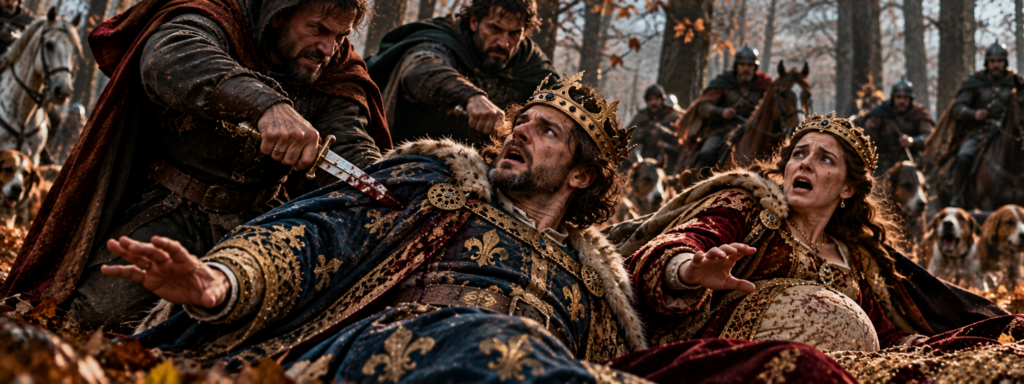
Childeric II: The Young Frankish King Murdered With His Pregnant Queen
Childeric II (c. 653–675) | Merovingian king | Son of Clovis II and Balthild | King of Austrasia from 662 | Briefly ruler over most of the Frankish kingdoms after 673 | Husband of Bilichild, daughter of Sigebert III | Assassinated in 675 during a noble conspiracy traditionally associated with Bodilo | Bilichild, reportedly pregnant, was killed with him | Their young son Dagobert was also murdered according to important early accounts | The killings shattered Childeric’s attempt to reunite the Frankish kingdoms and plunged the realm back into political upheaval
A Royal Hunt That Ended in Blood
In 675, Childeric II appeared to possess what generations of Merovingian kings had fought, betrayed, and killed one another to obtain. Still only in his early twenties, he had risen from the kingship of Austrasia to authority over a much larger Frankish realm after the overthrow and death of his brother Chlothar III. The rival king Theuderic III had been displaced, powerful nobles had accepted Childeric, and for a brief moment the fragmented kingdoms inherited from Clovis seemed to have been drawn together beneath a single young ruler. Yet Merovingian unity was rarely as secure as it looked, and Childeric’s rapid rise had created enemies among exactly the aristocrats whose cooperation he needed most.
Before the year was over, the king was dead. So was his wife Bilichild, a Merovingian princess in her own right and, according to an important early source, pregnant when she was killed. Their young son Dagobert was also slain in at least one account of the massacre, transforming the assassination from the removal of an unpopular king into something approaching the destruction of an immediate royal household. The violence did not unfold on a battlefield between rival armies but in connection with a royal hunt, where conspirators were able to reach the king away from the strongest protections of court.
At the center of the story stands a Frankish noble commonly called Bodilo. Childeric had allegedly ordered him bound to a post and beaten for an offense, an exceptionally humiliating punishment for a man of aristocratic status. Bodilo survived the beating, but according to the surviving narrative tradition, he did not forgive it. He joined other powerful men hostile to the king, and Childeric’s punishment of one noble became part of a wider conspiracy against his rule.
The resulting attack was more than an act of private revenge. Childeric’s increasingly forceful government had alarmed aristocrats who feared that the young king was disregarding the political customs that restrained royal authority. Men who had helped elevate him could also help destroy him, and some apparently decided that assassination offered the surest way to stop a king they no longer trusted. When they struck, they did not merely remove Childeric from the throne; they killed Bilichild as well and, according to some evidence, eliminated at least one of their children.
The murder has sometimes been retold as a straightforward story: an arrogant king has a noble beaten, the noble takes revenge during a hunt, and the tyrant dies for his cruelty. The surviving evidence is less tidy. Our principal narratives were written in a political culture deeply concerned with the balance between kings and aristocrats, and they do not provide the kind of precise investigative detail a modern historian would want. Bodilo’s involvement is an important part of the tradition, but the assassination was almost certainly larger than one angry man settling a personal score.
Childeric II was killed because royal authority had collided with aristocratic power. His treatment of Bodilo may have provided the most personal grievance, but the conspiracy emerged from a much deeper political crisis. The young king had attempted to rule a realm that powerful men had helped give him, and he discovered too late that those same men believed they possessed the right to determine how he ruled it.
Born Into a Dynasty Already Losing Control
Childeric II was born around 653 into the Merovingian dynasty, the family that had ruled the Franks since the age of Clovis I. By the middle of the seventh century, however, the nature of Merovingian kingship had changed considerably. The dynasty still possessed enormous symbolic importance, and legitimate royal blood remained essential to political authority, but kings increasingly governed alongside powerful aristocratic families whose control of land, offices, monasteries, military followings, and regional networks could not easily be ignored. A Merovingian king might wear the crown, but he could not rule effectively without men whose own power sometimes rivaled the practical authority of the monarchy.
Childeric’s father was Clovis II, king of Neustria and Burgundy, and his mother was Balthild, one of the most remarkable queens of the seventh century. Balthild’s origins remain partly obscured by later hagiographical tradition, but she appears to have entered the Frankish world from comparatively humble circumstances before becoming Clovis II’s wife. After her husband’s death, she exercised considerable authority as queen mother and regent. Her later religious reputation eventually overshadowed the political struggles surrounding her sons, but she had been deeply involved in preserving their dynasty.
Clovis II and Balthild had three sons who became kings: Chlothar III, Childeric II, and Theuderic III. Their existence gave the dynasty heirs but also recreated one of the oldest Merovingian problems. Multiple royal sons could preserve the family if one died, yet they also provided different aristocratic factions with different princes around whom to organize. A child king was particularly useful to powerful magnates because he possessed legitimate blood without necessarily possessing independent political strength.
When Clovis II died, Chlothar III inherited the Neustrian-Burgundian kingdom under Balthild’s influence. Childeric was still a child, but events in Austrasia soon created a throne for him as well. The eastern Frankish kingdom had developed its own powerful aristocracy, and its magnates were determined to preserve a degree of political independence from Neustria. They needed a Merovingian king who could embody that independence.
Childeric became their solution.
His elevation was not simply the beginning of a young prince’s personal career. It was part of a larger struggle over who controlled kingship itself. The aristocrats who placed Childeric on the Austrasian throne expected him to rule within a political framework they could influence, and that expectation would follow him throughout his life.
Years later, when Childeric attempted to exercise power more aggressively, the same underlying question would return with murderous force. Did a king rule because aristocrats accepted him, or did aristocrats obey because he was king? Childeric II would discover that seventh-century Frankish politics had no peaceful answer.
Austrasia Demands a King
The immediate circumstances behind Childeric’s rise involved the death of Sigebert III, king of Austrasia. Sigebert had ruled a kingdom whose aristocracy was increasingly conscious of its own regional identity and interests. When he died in 656, the succession became deeply controversial. His young son Dagobert II should have been the obvious heir, but powerful forces intervened.
Grimoald, the Austrasian mayor of the palace, attempted one of the boldest political maneuvers of the Merovingian age. Dagobert II was removed from the kingdom and sent into exile, while Grimoald’s own son was elevated under the royal name Childebert. The precise details and chronology remain debated, but the essential point is clear: an aristocratic family attempted to replace the Merovingian heir with one of its own. The experiment ultimately failed.
Austrasian nobles still wanted a king distinct from the ruler governing Neustria and Burgundy. Childeric, younger brother of Chlothar III, provided a compromise that preserved Merovingian legitimacy while satisfying regional demands. Around 662, he was installed as king of Austrasia. Because he was still very young, real political authority initially rested heavily with the aristocrats around him.
Among the most important figures in this arrangement was Wulfoald, who became mayor of the palace in Austrasia. The mayoralty had evolved from a household office into one of the most powerful positions in Frankish government. A capable mayor could control access to the king, direct administration, coordinate aristocratic support, and influence military affairs. The relationship between king and mayor could therefore determine whether a reign remained stable.
Childeric’s position was strengthened through marriage. He married Bilichild, daughter of Sigebert III and therefore a princess of the Austrasian Merovingian line. This union deserves more attention than it often receives because it gave Childeric an additional connection to the kingdom he had been brought in to rule. He was not merely a Neustrian prince imposed upon Austrasia; through Bilichild, his household became linked directly with Sigebert’s dynasty.
The marriage also demonstrates how closely intertwined the Merovingian branches had become. Childeric and Bilichild were related, a circumstance that would attract ecclesiastical criticism. Such marriages were politically useful precisely because they concentrated claims within the royal family. In dynastic terms, Bilichild strengthened Childeric’s legitimacy in Austrasia.
She would eventually share his fate.
For more than a decade, however, Childeric’s Austrasian kingship survived. The child king grew into adulthood, and with adulthood came the possibility that he might cease being the manageable royal figure aristocrats had originally wanted. That transformation—from useful prince to independent ruler—would become one of the central dangers of his reign.
Bilichild: The Queen Who Died Beside Him
Bilichild occupies a frustrating place in the historical record. She was born into one of the most important families in western Europe, married a king, became queen of Austrasia, and later stood beside Childeric when his authority expanded across much of the Frankish realm. Yet the surviving sources tell us very little about her personality or political activity. Her importance has been overshadowed by the dramatic circumstances of her death.
She was the daughter of Sigebert III and Chimnechild. Through her father, she belonged to the Austrasian Merovingian line and was closely connected to Dagobert II, the prince removed from the kingdom during Grimoald’s attempted dynastic coup. Her marriage to Childeric therefore united two branches of the royal family. It strengthened the legitimacy of a king whose original claim in Austrasia depended heavily upon aristocratic selection.
The union was controversial because of their kinship. Bishop Leodegar of Autun, one of the most powerful churchmen of the period, reportedly criticized the marriage on canonical grounds. This disagreement later became entangled with larger political conflicts involving Childeric, Leodegar, and competing aristocratic factions. Religious objections could not easily be separated from political ones in a world where bishops were major landholders and royal advisers.
Bilichild bore Childeric children, although reconstructing the family precisely is difficult. A son named Dagobert is mentioned in connection with the assassination, while another son, Chilperic, appears to have survived and may later have become the Merovingian king Chilperic II. The identification of the later king with Childeric’s son is widely accepted but not entirely beyond scholarly discussion. The dynasty’s confused politics and repeated use of the same royal names make certainty difficult.
The most haunting detail concerning Bilichild comes from the Liber Historiae Francorum, composed decades after the assassination. It states that she was pregnant when she was killed. If accurate, the conspirators did not merely murder a king and queen but also destroyed an unborn royal child. The detail transforms the attack into an especially ruthless dynastic act.
Yet even here caution is required. The source was not written at the moment of the assassination, and later narrative traditions could emphasize brutality for moral or political effect. We should not invent details about Bilichild’s pregnancy, her final moments, or her reactions during the attack. The responsible conclusion is narrower: an important early source explicitly remembered her as pregnant when she was murdered.
Whatever her private role in Childeric’s government, Bilichild was not an incidental casualty. Her royal blood mattered, and killing her helped destroy a powerful dynastic partnership. The assassins struck at both halves of a royal marriage that connected Neustrian and Austrasian branches of the Merovingian house.
In a dynasty obsessed with inheritance, Bilichild’s death mattered almost as much as Childeric’s.
A Kingdom Governed by Powerful Men
To understand why Childeric was murdered, it is necessary to understand the aristocratic world surrounding him. By the seventh century, Frankish politics depended heavily upon networks of great families whose wealth stretched across multiple regions. These nobles controlled estates, patronized monasteries, occupied bishoprics, commanded armed followers, and competed for royal offices. Their cooperation could make a king powerful, while their collective hostility could make his position almost impossible.
The mayor of the palace became particularly important within this system. Originally connected with management of the royal household, the office developed into a central political position. Different kingdoms could possess different mayors, and rival aristocratic factions competed fiercely to control the appointment. The history of later Merovingian kings cannot be understood without recognizing how powerful these officials became.
In Neustria, one of the most formidable political figures was Ebroin. He served as mayor of the palace under Chlothar III and pursued policies that generated intense hostility among sections of the aristocracy. Ebroin’s enemies accused him of excluding nobles from influence and concentrating authority among his own supporters. Whether every accusation was fair is less important than the fact that resentment against him became politically explosive.
Austrasia had its own aristocratic establishment, including Wulfoald. Childeric’s kingship there was therefore embedded within a regional political network distinct from the Neustrian faction surrounding Ebroin. When circumstances eventually brought Childeric into Neustria, these competing networks collided. The young king suddenly stood at the center of a struggle much larger than his original Austrasian realm.
Bishops were equally important. Men such as Leodegar of Autun were not simply religious officials preaching from the margins of politics. They came from aristocratic families, controlled substantial resources, advised kings, and participated directly in disputes over royal government. Exiling or humiliating a bishop could therefore alienate an entire network of powerful supporters.
Childeric grew up surrounded by men accustomed to influencing kings. As a child, this arrangement posed little immediate problem because he could not govern independently. As an adult, however, he began exercising authority in ways some of those same men considered unacceptable. The political partnership between crown and aristocracy became a contest over boundaries.
Bodilo’s beating would eventually symbolize that contest. A king believed he possessed the authority to punish a noble. The noble and his allies believed the king had crossed a line.
The result would be regicide.
The Death of Chlothar III and the Struggle for Neustria
The political landscape changed dramatically in 673 when Childeric’s brother Chlothar III died. Chlothar had ruled Neustria and Burgundy, and his death reopened the question of succession. Theuderic III, another brother, was elevated with the support of Ebroin. To Ebroin’s opponents, however, this succession threatened to preserve exactly the political order they wanted to destroy.
A group of Neustrian and Burgundian magnates rebelled against Ebroin’s dominance. Rather than accept Theuderic, they turned to Childeric II, already king in Austrasia. Their invitation gave Childeric an extraordinary opportunity. He could move beyond his eastern kingdom and establish authority over much of the Frankish realm.
Childeric accepted.
Theuderic III was deposed and tonsured, while Ebroin was removed from office and forced into monastic confinement. Tonsure carried profound political significance in the Merovingian world because royal legitimacy was closely associated with the dynasty’s distinctive long hair. Cutting a prince’s hair could symbolically disqualify him from kingship, while placing a political opponent in a monastery removed him from ordinary aristocratic life without necessarily requiring execution.
For Childeric, the events of 673 represented an astonishing triumph. He had begun as a child king installed by Austrasian nobles and now became the dominant Merovingian ruler across a much wider territory. The political fragmentation that had characterized the Frankish kingdoms appeared, temporarily, to have been overcome. His authority stretched farther than it ever had before.
Yet the circumstances of his victory contained the seeds of his destruction. Childeric had not conquered Neustria through an overwhelming military campaign. He had been invited by aristocrats who wanted him to replace a political regime they disliked. Those men expected something in return.
According to later accounts, conditions were attached to Childeric’s acceptance. He was expected to respect regional customs and avoid imposing officials from one kingdom upon another. Whether every detail of these reported agreements can be reconstructed precisely is uncertain, but the larger political expectation is credible. The nobles who elevated Childeric wanted a king who would govern with them rather than over them.
Childeric apparently had different ideas.
Within roughly two years, the coalition that had carried him to power had begun to fracture. The king who seemed to have reunited the Franks was discovering that ruling a larger kingdom meant satisfying aristocratic factions whose interests were often incompatible. Every attempt to assert royal independence risked alienating the people who had placed the crown within his reach.
The Dangerous Triumph of a Young King
Childeric’s rapid rise may have changed his relationship with the aristocracy. As king of Austrasia, he had governed within a relatively familiar political network dominated by Wulfoald and other eastern magnates. After 673, he inherited a far more complicated collection of interests. Neustrian and Burgundian nobles had helped him seize power, but they did not necessarily accept Austrasian influence at court.
The king was still young. He had spent much of his life surrounded by powerful men who expected to manage royal government, and adulthood offered him the opportunity to prove that he was more than their instrument. A ruler who had been selected because others considered him useful could easily become determined to demonstrate independence. That determination could look like strength from the throne and tyranny from the aristocratic hall.
Our sources portray Childeric as increasingly harsh. The Liber Historiae Francorum in particular presents him as behaving recklessly toward Frankish nobles and violating the political expectations under which he had been accepted. This account was written later and reflects its own political assumptions, so its characterization cannot be accepted uncritically. Nevertheless, the assassination itself demonstrates that serious aristocratic hostility existed.
One of Childeric’s most consequential disputes involved Leodegar of Autun. Leodegar had been influential in the coalition that brought Childeric into Neustria, but relations between bishop and king deteriorated. The bishop criticized aspects of royal behavior, including the king’s marriage within prohibited degrees of kinship. Eventually Leodegar was removed from influence and sent into monastic confinement.
This was politically dangerous. Leodegar was not an isolated cleric whom Childeric could silence without consequences. He belonged to an extensive aristocratic network, and his humiliation could be interpreted as an attack upon the interests of his relatives and allies. A king attempting to reduce one powerful opponent might therefore create many others.
Other nobles had their own grievances. Childeric’s government increasingly appeared to some as arbitrary and disrespectful of established privilege. The young king may have believed he was asserting legitimate royal authority after years of aristocratic domination. His opponents believed he was breaking the political bargain that had given him Neustria.
Then came Bodilo.
The punishment inflicted upon him turned political resentment into personal vengeance.
Bodilo: The Noble Who Would Not Forget
Bodilo is remembered almost entirely because of the role attributed to him in Childeric’s assassination. Compared with kings, queens, bishops, and mayors of the palace, relatively little is securely known about his wider career. The surviving narrative identifies him as a Frankish noble who incurred the king’s anger. What happened next became one of the most famous examples of aristocratic humiliation in Merovingian history.
Childeric ordered Bodilo bound to a post and beaten. The precise offense that provoked the punishment is not securely preserved in a form that allows us to reconstruct the dispute confidently. What mattered politically was not simply that Bodilo suffered physical pain. A nobleman had been subjected to a punishment that publicly degraded his status.
Early medieval aristocratic politics rested heavily upon honor, rank, family reputation, and reciprocal obligation. Violence between elites was not unusual, but the form violence took mattered. To bind and beat a noble could communicate that the king regarded him not as a powerful political partner but as a subordinate who could be physically disciplined. For a man whose identity depended upon elite status, such humiliation could be intolerable.
The punishment also frightened other aristocrats. If Childeric could have Bodilo tied up and flogged, what prevented him from treating other nobles similarly? The issue therefore expanded beyond one man’s injured pride. Bodilo’s body became evidence of what royal authority might do when unconstrained.
Later narrative tradition presents the beating as the immediate catalyst for revenge. Bodilo joined forces with other dissatisfied magnates, commonly including Amalbert and Ingobert in accounts of the conspiracy. The exact composition of the group and the roles of individual conspirators are not equally secure across all surviving sources. What emerges clearly is a coordinated aristocratic plot rather than a spontaneous attack by a lone man.
Bodilo had the most memorable motive because it was personal. Childeric had ordered him humiliated, and Bodilo survived long enough to retaliate. Yet focusing exclusively upon revenge risks missing the political significance of the conspiracy. Other nobles who had not been beaten were willing to participate.
That fact tells us the assassination was about more than Bodilo.
The beating supplied the wound.
Childeric’s style of government supplied the coalition.
Royal Authority Versus Frankish Liberty
Later accounts frame the conflict in language suggesting that Childeric violated the liberties or customary expectations of the Franks. Such language should be approached carefully because it can easily be misunderstood through modern political concepts. Seventh-century Frankish nobles were not defending democracy or equal rights. They were defending aristocratic privilege and the expectation that kings would govern through consultation with powerful men.
Merovingian monarchy was strong in symbolic terms but negotiated in practice. Kings possessed sacred prestige, controlled treasure, appointed officials, commanded armies, issued judgments, and distributed patronage. Yet they relied upon magnates to enforce decisions across distant regions. A ruler who alienated too many of those men could discover that royal commands were only as powerful as the people willing to carry them out.
Childeric’s mistake may have been believing that his expanded kingship gave him greater freedom than it actually did. After 673, he stood above Austrasia, Neustria, and Burgundy in a way few contemporary Merovingian rulers had managed. From his perspective, this could justify stronger central authority. From the aristocratic perspective, it made the king more dangerous.
The political culture expected reciprocity. Nobles offered military support, administrative service, and loyalty; kings rewarded them with offices, land, protection, and access. When either side believed the other had violated that relationship, conflict followed. Childeric’s punishment of Bodilo symbolized a monarchy no longer treating aristocrats as partners.
The conspirators could therefore imagine themselves as defending legitimate political order rather than committing simple murder. This does not make the assassination morally justified. It explains how elite violence could be rationalized within a society where removing a king was an extreme but imaginable response to perceived tyranny.
The same tension would continue long after Childeric’s death. Merovingian kings increasingly depended upon aristocratic families whose power eventually eclipsed their own. The mayors of the palace would become so dominant that one of those families, the Carolingians, ultimately replaced the Merovingian dynasty altogether. Childeric’s assassination was therefore an early and violent manifestation of a structural problem that would eventually destroy his house.
The king wanted to rule.
The aristocrats wanted to determine the terms of that rule.
Neither side possessed a peaceful institution capable of resolving the dispute.
The Conspiracy Takes Shape
The precise moment when the conspirators decided Childeric had to die is unknown. Bodilo’s beating provides the most vivid catalyst, but political conspiracies rarely emerge from a single grievance alone. By 675, Childeric had alienated men across several factions. The coalition that had elevated him two years earlier was breaking apart.
Amalbert and Ingobert are associated with Bodilo in later accounts of the plot. Their presence reinforces the interpretation that the assassination involved aristocratic coordination rather than solitary revenge. These men needed enough confidence in one another to contemplate killing a Merovingian king, an act that could lead to catastrophic retaliation if it failed. Conspiracy required secrecy, trust, and access.
They also needed opportunity. Childeric at court would have been surrounded by officials, servants, guards, clerics, petitioners, and members of his household. An attack in a formal royal setting could quickly become a battle between conspirators and loyal retainers. A hunt offered different conditions.
Royal hunting expeditions moved kings beyond the most secure spaces of palace life. The ruler remained accompanied, but the party could spread across woodland and countryside. Riders separated, attendants moved between groups, and the predictable hierarchy of a hall gave way to a more fluid environment. A conspirator who already belonged to the aristocratic world around the king might approach without immediately appearing suspicious.
The traditional account places Childeric’s assassination during such a hunt. Some retellings provide extremely detailed scenery and sequences, but the surviving evidence does not justify reconstructing every movement. We should not invent a dramatic chase through the forest or pretend to know exactly when Childeric realized he was betrayed. What can be said is that the conspirators exploited a setting associated with hunting and succeeded in reaching the royal family.
The plan was extraordinarily dangerous. If Childeric escaped, the conspirators could expect little mercy. Bodilo had already experienced the king’s willingness to inflict humiliating punishment. Attempted regicide would likely bring far worse consequences.
They acted anyway.
Whatever fear Childeric inspired had become less powerful than the desire to remove him.
The Hunt of 675
The location of Childeric’s death is traditionally associated with the forest of Livry, although the geographical details supplied by later tradition should not be treated with absolute certainty. The important point is that the assassination occurred away from the ordinary security of a royal palace and in connection with hunting. Childeric was accompanied by Bilichild, and members of the royal household were present. The conspirators found their opportunity there.
The attack was successful and apparently overwhelming. Childeric was killed, ending a reign that had expanded dramatically only two years earlier. Bilichild was also murdered. The violence therefore extended immediately beyond the king himself.
The killing of Bilichild is especially revealing. If the conspirators wanted only to punish Childeric personally for mistreating Bodilo, there was no obvious need to kill his wife. Bilichild’s death makes greater sense within a dynastic and political attack. She was a queen, a Merovingian princess, and a potential source of legitimacy for surviving children.
According to the Liber Historiae Francorum, Bilichild was pregnant. If that report is accurate, the assassins killed not only the queen but an unborn member of the dynasty. The source also records the killing of the royal couple’s young son Dagobert. Such violence suggests a determination to prevent the immediate household from becoming the center of resistance or vengeance.
The precise manner in which each victim was killed is not securely described enough to justify elaborate reconstruction. Later retellings sometimes transform the scene into a cinematic massacre, complete with dialogue, desperate flight, and carefully staged blows. Those details should be resisted unless explicitly supported by a reliable source. The historical event is horrifying without embellishment.
A young king was attacked by nobles from the political class upon which his government depended. His queen died beside him, and at least one child was reportedly killed as well. A royal family that had briefly represented the reunification of the Frankish kingdoms was torn apart in a single episode.
Childeric had punished Bodilo as though royal authority placed the noble completely beneath him.
Bodilo and his allies answered by demonstrating the opposite extreme.
They killed the king.
The Murder of a Pregnant Queen
Bilichild’s death gives Childeric’s assassination an especially dark character. Regicides often focus violence upon the ruler because removing the king is sufficient to create a political transformation. Killing the king’s wife, particularly when she is herself of royal blood, suggests broader objectives or an attack conducted with little concern for dynastic boundaries. If she was visibly pregnant, the brutality becomes even more disturbing.
We should nevertheless distinguish what is securely attested from what later imagination supplies. The statement that Bilichild was pregnant comes from an early medieval narrative source rather than contemporary medical evidence. We do not know how advanced the pregnancy was, whether the conspirators knew about it, or whether her condition affected their decision. Any attempt to describe her protecting her unborn child or pleading with attackers would be invention.
Her political importance is easier to establish. Bilichild connected Childeric to the Austrasian royal line of Sigebert III. If Childeric died but she survived with children, she could potentially serve as a focus for loyalists attempting to preserve his political settlement. Queen mothers had repeatedly demonstrated their ability to exercise power in Merovingian history.
Childeric’s own mother Balthild provided an obvious example. After Clovis II’s death, she had played a major role in government while her sons were young. Fredegund and Brunhild in the previous century had shown even more dramatically how widowed queens could preserve dynastic claims and dominate politics. Leaving Bilichild alive therefore meant leaving behind a potentially formidable political actor.
Her death may consequently have been strategic rather than incidental. This cannot be proved, but the political logic is stronger than the idea that she happened accidentally to be caught in the attack. The conspirators were attacking a royal household, not merely a solitary man. Killing Bilichild weakened the possibility of immediate dynastic resistance.
The reported murder of young Dagobert reinforces that interpretation. A child could not avenge his father immediately, but he could grow into a king around whom loyalists gathered. Eliminating him reduced that danger. If Bilichild was pregnant, the unborn child represented another future claimant.
The massacre therefore reached forward in time. The conspirators were not simply destroying Childeric’s present authority. Whether deliberately or through indiscriminate violence, they were destroying possible futures in which his immediate family restored it.
For Bilichild, the tragedy is compounded by the silence of the sources. We know her royal lineage, marriage, motherhood, and violent death, but almost nothing of the woman herself. History preserved the political value of her blood more clearly than her personality.
Her final appearance is as a queen dying beside a murdered husband.
What Happened to Their Children?
The fate of Childeric and Bilichild’s children is complicated by the fragmentary and sometimes contradictory evidence. A son named Dagobert is said to have been killed with them. This child should not be confused with Dagobert II, Bilichild’s brother, whose own turbulent career would continue after Childeric’s assassination. Repeated royal names make Merovingian genealogy especially easy to muddle.
Another son appears to have survived. He is commonly identified as the future Chilperic II, who would emerge decades later after having spent much of his life in the church under the name Daniel. If this identification is correct, the assassins failed to eliminate Childeric’s entire male line. One child escaped the destruction that consumed his parents and brother.
The future Chilperic II would eventually become king in 715, roughly forty years after Childeric’s murder. By then the political world had changed dramatically. The mayors of the palace, especially the rising Carolingian family, had acquired enormous power. Merovingian kings remained symbolically important, but the dynasty’s independent political strength had declined.
The survival of a son therefore adds another layer of irony to the assassination. The conspirators killed Childeric, Bilichild, and reportedly Dagobert, yet they may have left alive a child who would eventually wear the crown. Dynastic blood could disappear from politics for decades and then suddenly become useful again when aristocratic factions required a legitimate king.
The uncertainty surrounding the children also warns against treating medieval genealogies as perfectly documented family trees. Chroniclers were interested in succession and political legitimacy rather than recording every birth with modern precision. Children who died young could disappear almost entirely from the record. Others might emerge later under different names or ecclesiastical identities.
What can be said confidently is that Childeric’s immediate family suffered catastrophic violence in 675. The assassination was not a clean transfer of power from one adult king to another. It shattered a household and reopened the entire question of who should rule the Frankish kingdoms.
That question would be answered almost immediately.
The man Childeric had displaced was still alive.
The Return of Theuderic III
Childeric’s death created a royal vacancy, but the Merovingian dynasty still contained alternatives. Theuderic III, the brother Childeric had displaced in 673, had not been executed. Instead, he had been tonsured and confined, a method of political neutralization that depended upon the assumption that removing a prince from ordinary royal life would keep him from returning. Childeric’s assassination shattered that assumption.
Theuderic was restored to kingship in Neustria and Burgundy. The speed with which this occurred demonstrates the practical advantage of preserving defeated princes rather than killing them. A Merovingian who seemed politically finished could become useful again the moment circumstances changed. Royal blood retained value even when its owner had been humiliated.
Ebroin also returned. The powerful mayor whom Childeric’s supporters had forced into monastic confinement escaped and reentered political life. His comeback would unleash another round of conflict as he sought revenge against enemies who had removed him. The assassination therefore reopened political struggles Childeric’s accession had temporarily suppressed.
Wulfoald, closely associated with Childeric’s Austrasian government, was suddenly endangered. The political faction that had prospered under the murdered king could not assume it would survive his death. Some fled, others changed allegiance, and the kingdoms once again fractured along regional and aristocratic lines. The unity achieved in 673 vanished almost immediately.
Austrasia eventually turned again toward Dagobert II, the exiled son of Sigebert III. His restoration around 676 or 677 created another independent Merovingian kingship in the east. The exact sequence remains complicated, but the broader result is unmistakable. Childeric’s attempt to hold the Frankish realms together did not survive him.
The conspirators had therefore succeeded in removing the king but created a political vacuum filled by older rivalries. Theuderic returned, Ebroin returned, Dagobert II returned, and aristocratic factions resumed their struggles. Childeric’s murder solved the immediate problem of his government while destabilizing the broader realm.
This pattern appears repeatedly in the history of regicide. Killing a ruler is much easier than controlling what follows. The assassin can determine that a king will die.
He cannot determine how everyone else will react.
Bodilo and his allies removed Childeric.
They did not create lasting peace.
Leodegar, Ebroin, and the Violence That Followed
One of the most important consequences of Childeric’s assassination was the renewed conflict between Leodegar of Autun and Ebroin. Both men had already been central figures in the political struggles surrounding the succession of 673. Childeric had eventually turned against Leodegar and sent him into confinement, while Ebroin had been removed when Childeric displaced Theuderic. With the king dead, both men reentered the political arena.
The conflict became savage. Ebroin recovered influence and pursued opponents who had helped overthrow him. Leodegar became one of his principal targets. The bishop was captured, mutilated, and eventually executed after a prolonged political struggle.
Leodegar’s later cult as a martyr shaped the way some of these events were remembered. Hagiographical sources naturally presented his enemies in dark terms and emphasized his suffering. Such texts are valuable but must be read with awareness of their religious purpose. Political history and saintly biography became intertwined.
The brutality inflicted upon Leodegar demonstrates that Childeric’s assassination did not end elite violence. It accelerated it. Removing the king weakened the temporary political settlement and allowed rival factions to pursue old grievances with renewed intensity. Bodilo’s revenge therefore belonged to a broader cycle rather than serving as its conclusion.
Ebroin himself would eventually be assassinated around 680 or 681. According to tradition, a noble named Ermenfred killed him after another dispute. Once again, political conflict ended through personal violence. The pattern was becoming almost routine.
Kings punished nobles, nobles killed kings, mayors persecuted bishops, rivals assassinated mayors, and new kings were installed to legitimize whichever coalition temporarily prevailed. The institutions of government continued, but the individuals controlling them could change with terrifying speed. Childeric’s death was one of the most spectacular episodes in this environment, not an isolated breakdown of order.
The seventh-century Frankish world was not permanently anarchic. Laws, churches, monasteries, courts, taxation, diplomacy, and local government continued functioning. Yet at the highest levels, political competition could become lethal because there were few reliable mechanisms for removing a ruler or minister peacefully once cooperation collapsed.
Childeric’s assassins chose the most final mechanism available.
Others followed their example.
Was Childeric Really a Tyrant?
The sources hostile to Childeric portray his later government as increasingly oppressive. His treatment of Bodilo provides tangible evidence that he could use humiliating violence against an aristocrat. His conflict with Leodegar demonstrates his willingness to remove a powerful bishop who challenged him. These actions certainly contributed to his downfall.
Yet the label of tyrant requires context. Childeric inherited a political system in which aristocrats routinely manipulated royal succession, deposed kings, confined rivals in monasteries, and competed violently for the mayoralty. He had personally been placed on the Austrasian throne because magnates wanted a king who suited their interests. Later, Neustrian nobles invited him to overthrow his brother because they wanted Ebroin removed.
From Childeric’s perspective, asserting stronger royal authority may have seemed entirely reasonable. A king repeatedly selected and constrained by aristocrats could conclude that monarchy had become hostage to private factions. Punishing nobles and removing hostile advisers could therefore appear as attempts to restore royal government rather than expressions of irrational cruelty. We cannot know precisely how Childeric understood his own policies, but the structural conflict is obvious.
The aristocratic sources naturally viewed the matter differently. Great nobles believed their rank entitled them to consultation and protection from arbitrary humiliation. They did not consider themselves ordinary subjects whom a king could treat however he wished. Childeric’s beating of Bodilo therefore represented a dangerous violation of elite expectations.
Both interpretations can contain elements of truth. Childeric may genuinely have become harsher as his power expanded, while aristocrats may simultaneously have resisted any monarchy strong enough to reduce their privileges. Political conflict often emerges not because one side possesses all legitimacy but because competing groups hold incompatible ideas about legitimate authority.
The assassination itself should not be treated as proof that Childeric deserved to die. Successful rebels frequently describe the ruler they kill as a tyrant because doing so justifies rebellion. The surviving narrative may preserve genuine grievances while also reflecting the perspective of the social class that defeated him.
Childeric’s reign was short enough that we cannot observe how his government might have developed. He was barely into adulthood when murdered. A ruler killed at roughly twenty-two never had the opportunity to become either the mature monarch his supporters might have hoped for or the established tyrant his enemies feared.
His political identity froze at the moment of crisis.
History remembers the punishment of Bodilo because Bodilo lived long enough to answer it.
The Problem With the Sources
Childeric II lived during one of the more difficult periods of Merovingian history to reconstruct. Unlike the age of Chilperic I and Sigebert I, we do not possess a contemporary narrative historian comparable to Gregory of Tours describing events in extraordinary detail. Gregory died in 594, decades before Childeric II was born. Later historians therefore depend upon chronicles, saints’ lives, charters, genealogical evidence, and narratives written after the events.
The Liber Historiae Francorum, composed in the early eighth century, is particularly important for Childeric’s assassination. It preserves the story of Bodilo’s punishment, the aristocratic conspiracy, the murder of Childeric and Bilichild, and the queen’s pregnancy. Yet it was written roughly half a century after the killings. Its author also viewed Frankish politics through a particular Neustrian perspective.
The Life of Saint Leodegar and related hagiographical traditions provide additional information. These sources illuminate the conflict involving Childeric, Leodegar, Ebroin, and the aristocracy. Their purpose, however, was not to produce detached political history. They aimed to demonstrate Leodegar’s sanctity and suffering.
Later chronicles added further details, sometimes harmonizing or embellishing earlier accounts. This is how early medieval assassinations can acquire increasingly elaborate narratives over time. A basic report of conspiracy becomes a detailed forest ambush; political motives become private conversations; victims receive final speeches no contemporary witness recorded. Responsible historical storytelling must resist that accumulation.
The central facts remain reasonably secure. Childeric II became king of Austrasia, expanded his authority after 673, alienated powerful nobles, and was assassinated in 675. Bilichild was killed with him, and Bodilo was remembered as a leading participant in the conspiracy. The murder produced immediate political upheaval.
Other details deserve different levels of confidence. Bilichild’s pregnancy is important but comes through later narrative evidence. The exact sequence of the attack is uncertain. The precise role of every named conspirator cannot be reconstructed with complete confidence.
This does not make the story unusable. It makes careful language essential. Medieval history becomes more compelling, not less, when readers understand where the evidence ends and later imagination begins.
Childeric’s death needs no invented dialogue.
The surviving facts are dark enough.
A Dynasty That Could Be Killed but Not Easily Replaced
The conspirators murdered a Merovingian king, but they did not attempt to abolish Merovingian kingship. This distinction is crucial. Bodilo and his allies were not revolutionaries trying to create a republic or establish a completely new political order. They opposed Childeric personally and politically while continuing to operate within a system that required a Merovingian ruler.
Theuderic III’s restoration proves the point. After killing one king, the political elite simply returned another member of the same family to the throne. Royal blood retained a legitimacy that aristocratic power had not yet replaced. Magnates could dominate kings, but they still needed kings.
This paradox defined late Merovingian politics. The dynasty became increasingly dependent upon aristocratic factions, yet those factions continued to depend upon the dynasty’s symbolic authority. A mayor of the palace might wield more practical power than the king beside him, but he could not simply declare himself king without confronting deeply rooted expectations about legitimate rule. That transformation would take generations.
Childeric’s assassination therefore weakened an individual monarch without immediately weakening the institution of Merovingian kingship. The conspirators treated regicide as a method of correcting government rather than abolishing monarchy. A bad king could be removed and replaced with a more acceptable relative. From the aristocratic perspective, the dynasty functioned almost as a reservoir of legitimate candidates.
This arrangement was inherently unstable. A king raised because he seemed manageable could grow independent. Aristocrats who felt excluded could then rally around another prince. Deposition, tonsure, exile, monastic confinement, and assassination became tools for regulating royal power.
Childeric experienced nearly the full cycle. He was installed as a child because Austrasian nobles needed him. He was elevated over a larger kingdom because Neustrian nobles needed him. He was killed when nobles decided they no longer did.
His blood made him indispensable.
His personality did not make him safe.
That distinction explains much of the tragedy.
The Long Shadow of the Mayors of the Palace
Childeric’s death belongs to the history of the rise of the mayors of the palace. During the following decades, aristocratic families holding this office would increasingly dominate Frankish politics. The Merovingian kings did not immediately become powerless ceremonial figures, as older historical stereotypes sometimes suggest, but the balance of authority was shifting. Kings depended ever more heavily upon officials capable of mobilizing aristocratic support.
In Austrasia, the family that would eventually become the Carolingians was rising. Pepin of Herstal emerged as a dominant figure by the end of the seventh century. His descendants, including Charles Martel and Pepin the Short, would transform control of the mayoralty into effective rule over the Frankish world. In 751, Pepin would finally replace the Merovingian dynasty altogether.
The political logic behind that transformation can already be seen in Childeric’s reign. Aristocrats selected kings, constrained kings, removed kings, and restored kings according to factional necessity. The monarchy still mattered profoundly, but the ability to control access to the throne increasingly mattered just as much. The officeholder who commanded the aristocratic network could become more powerful than the royal figure he served.
Childeric attempted to resist that trend by exercising authority personally. His punishment of Bodilo, conflict with Leodegar, and broader disputes with magnates can be interpreted as efforts to assert royal supremacy. Whether his methods were wise is another question. He responded to aristocratic power with coercion and discovered that coercion could unite his enemies.
His assassination therefore represents more than the fall of an unpopular young king. It marks a stage in the long struggle between Merovingian monarchy and the aristocratic political structures developing around it. Childeric lost that struggle in the most literal possible way.
The conspirators did not know that a Carolingian dynasty would eventually replace his descendants. They were acting within the immediate politics of 675, not planning the eighth century. Yet their willingness to kill a king reveals how far aristocratic confidence had already grown.
A century earlier, powerful nobles had certainly influenced kings.
By Childeric’s time, they could decide that a king himself was disposable.
The Hunt as a Place of Vulnerability
Childeric was not the first ruler to discover that hunting could create danger, nor would he be the last. The royal hunt carried symbolic importance because it displayed courage, horsemanship, weapon skill, and mastery over landscape and animals. It was an elite activity through which rulers performed martial identity outside formal warfare. Yet the same mobility that made hunting attractive also created security problems.
A palace organized space around the king. Doors, chambers, guards, ceremonial access, and household routines controlled who could approach. A hunting party necessarily disrupted those boundaries. Riders moved through woods and fields, servants dispersed, and aristocrats carrying weapons were present because weapons belonged naturally to the activity.
For a conspirator, this environment offered obvious advantages. Approaching an armed king inside a hall could immediately expose hostile intent. Approaching him during a hunt might not. Weapons, horses, and rapid movement were already part of the scene.
The setting also offered opportunities for isolation. A king did not need to become completely separated from his entourage to become vulnerable. He only needed to be surrounded by the wrong people at the right moment. Aristocratic conspirators who normally possessed legitimate access to him could exploit familiarity.
This makes Childeric’s murder different from an attack by an outsider breaking through palace defenses. The danger appears to have come from within the political class around him. Bodilo was not a foreign invader. He belonged to the same aristocratic society whose support sustained the monarchy.
The hunt therefore becomes almost symbolic of Childeric’s larger political problem. He was safest when royal institutions created distance between himself and powerful men. Yet he could not rule without remaining close to those men. The aristocrats who rode beside the king were simultaneously his companions, officers, advisers, and potential enemies.
No wall could solve that problem.
Childeric’s greatest vulnerability was not physical isolation.
It was political intimacy.
Revenge and Regicide
Bodilo’s story is compelling because it compresses enormous political conflict into a recognizable human emotion: humiliation followed by revenge. A noble is beaten by a king, survives, gathers allies, and kills the man responsible. The sequence feels almost timeless. It could belong to a tragedy, saga, or revenge drama.
Yet regicide transforms private vengeance into public catastrophe. If Bodilo had killed another noble who insulted him, the consequences might have remained within a network of families. Killing Childeric removed the political center of several kingdoms. Personal injury therefore became an event affecting the entire Frankish world.
This overlap between private and public motives was common in early medieval politics because government itself was deeply personal. Offices were held by individuals connected through kinship and patronage. Loyalty depended upon relationships rather than impersonal institutions alone. An insult to one aristocrat could mobilize relatives and allies.
Childeric’s punishment of Bodilo may therefore have been politically reckless even if legally defensible. A king who humiliated a great man did not punish one isolated individual. He risked offending everyone whose status was tied to that man’s honor. Bodilo’s resentment could spread through an aristocratic network already dissatisfied with royal government.
The conspiracy demonstrates the limits of fear as a political tool. Childeric may have intended the beating to discourage defiance. Instead, it showed his opponents what might happen if they remained passive. A punishment designed to establish authority helped create the coalition that destroyed it.
There is a grim lesson in that reversal. Violence can compel obedience while simultaneously generating the desire for revenge. The stronger the humiliation, the more dangerous the memory may become.
Bodilo remembered.
His allies listened.
The king eventually paid with his life.
Did Bodilo Personally Kill Childeric?
Popular retellings often describe Bodilo straightforwardly as the man who killed Childeric II. This is understandable because he is the most famous named conspirator and possesses the clearest personal motive. Yet the surviving evidence is better suited to identifying him as a leading participant in the conspiracy than reconstructing with certainty whose weapon physically killed the king. The distinction matters.
Multiple conspirators were involved. If Childeric, Bilichild, and Dagobert were attacked together, several assailants may have participated directly in the killings. Without a detailed eyewitness account, assigning each death to a particular hand would be speculative. Medieval sources often identify the leader of a conspiracy as responsible for a killing even when another participant delivered the fatal blow.
For the purposes of political responsibility, Bodilo’s role remains substantial. The tradition directly connects his humiliation with the conspiracy. He did not need personally to strike every victim in order to be implicated in the regicide. Organizing, enabling, or participating in the attack would be enough.
This is particularly important for Bilichild. There is no secure evidence allowing us to say Bodilo personally killed the pregnant queen. Such claims sometimes appear because later summaries compress the entire massacre into “Bodilo killed Childeric and his family.” The evidence supports collective responsibility more comfortably than individual reconstruction.
The same caution applies to young Dagobert. His reported death belongs to the broader attack upon the royal household. We cannot responsibly stage the murder victim by victim or assign specific attackers to each one. Doing so would transform sparse evidence into historical fiction.
Bodilo therefore remains central without needing to become a lone assassin. In fact, understanding the conspiracy as collective makes the event more historically significant. One angry noble can commit murder.
A group of aristocrats killing their king represents a political judgment.
That is what made Childeric’s death a regicide rather than merely a personal revenge killing.
What the Assassination Revealed About Merovingian Kingship
Childeric’s murder exposed a fundamental contradiction at the heart of later Merovingian monarchy. Kings remained essential because legitimate rule was still tied to the dynasty. Yet individual kings increasingly depended upon aristocratic acceptance. This created a system in which the crown was sacred while the man wearing it could become expendable.
Theuderic III illustrates the contradiction perfectly. Childeric’s supporters had deposed and tonsured him, apparently removing him from kingship. Two years later, Childeric was dead and Theuderic was useful again. The same political class that manipulated one brother could restore another.
Royal identity therefore functioned almost independently of royal control. Merovingian blood gave princes political value even when they lacked armies or offices. Aristocrats competed to place suitable members of the family on thrones because a legitimate king strengthened their own government. The king remained necessary even when he was not dominant.
Childeric attempted to reverse this relationship. His behavior suggests a ruler unwilling to remain simply the figurehead of the coalition that elevated him. He punished opponents, removed Leodegar, and acted with a confidence that frightened men accustomed to negotiating royal authority. The more independent he became, the less useful he appeared to those who had supported him.
His assassination was therefore both a personal tragedy and a constitutional crisis in the broadest sense. There was no written constitution defining how much power king and aristocracy possessed. Political boundaries were established through custom, negotiation, precedent, and force. When negotiation failed, violence settled the argument.
Bodilo’s beating represented the king’s answer.
The conspiracy represented the aristocracy’s answer.
Neither answer produced stability.
The cycle would continue until a different dynasty eventually transformed the political order.
The Forgotten Queen and the Famous Revenge
Historical memory has treated Childeric and Bilichild unevenly. Childeric survives as the king whose arrogance provoked assassination, while Bodilo survives as the humiliated noble who took revenge. Bilichild often appears only as an additional victim, sometimes reduced to the phrase “his pregnant wife.” That treatment obscures her dynastic importance.
She was not simply standing beside her husband when political violence unexpectedly reached her. Bilichild belonged to the royal family independently of Childeric. Her father had been king of Austrasia, her brother Dagobert II possessed a claim to the same kingdom, and her children carried multiple lines of Merovingian legitimacy. Her survival could have mattered enormously after Childeric’s death.
The decision or willingness to kill her therefore deserves attention. It suggests that the conspirators understood queenship as politically dangerous. A widowed Bilichild might have rallied supporters, protected her sons, or appealed to her brother’s faction. Early medieval queens repeatedly demonstrated precisely this kind of political capacity.
If she was pregnant, the assassination becomes even more explicitly dynastic. The unborn child could have been male or female; we do not know. Either way, another member of the royal house died before birth if the report is accurate. The killers were destroying a family’s future as well as its present.
Bilichild’s silence in the sources makes it impossible to recover her thoughts. We do not know what she thought of Childeric’s policies, whether she advised him politically, or how she related to the Austrasian aristocracy from which her father’s kingship had emerged. We cannot transform absence into imagined personality.
What we can do is restore her importance to the story. Childeric’s assassination was also the assassination of a queen. The regicide at the hunt was a royal massacre.
Bodilo’s revenge may have begun with his own humiliation.
It ended with the blood of people who had never ordered his beating.
That expansion from grievance to family destruction is one of the darkest features of the event.
A Young King Who Never Grew Old Enough to Change
Childeric II was probably only around twenty-two when he died. His youth is easy to overlook because the political events surrounding him were so substantial. He had already been king for more than a decade, but much of that reign began during childhood. His period of genuinely independent adult government was comparatively brief.
This matters when judging his character. The harsh king described in the sources may represent a young ruler testing the boundaries of authority after years of aristocratic supervision. He may have become more moderate with experience. He may equally have become more authoritarian.
We will never know.
Kings who survive into middle age leave patterns from which historians can judge long-term political style. Childeric left a crisis. His most famous actions belong to the final years when he suddenly acquired enormous authority and faced resistance from powerful men. The assassination froze his reputation at its most contentious moment.
His age also changes the emotional texture of Bilichild’s death. They were a young royal couple with children and another reportedly expected. Whatever political conflicts surrounded them, their household represented a future that seemed likely to extend for decades. Instead, almost everything collapsed in one attack.
The assassins may have considered Childeric dangerously ambitious precisely because he was young. A twenty-two-year-old king with authority over multiple kingdoms potentially had decades in which to strengthen royal control. If he was already willing to beat nobles and exile bishops, opponents might fear what he would become after ten or twenty more years.
Removing him early therefore had strategic logic. A mature political regime had not yet solidified around him. His children were too young to succeed effectively, and his displaced brother remained available as an alternative king. The moment was favorable for conspirators.
Childeric’s youth was therefore both a source of potential power and vulnerability. He had time enough ahead of him to frighten enemies but not enough experience behind him to make his position secure.
The hunt of 675 ended that possibility.
He would never become the ruler either his supporters or enemies imagined.
The Grave at Saint-Germain-des-Prés
Childeric and Bilichild were buried at the church of Saint-Germain-des-Prés in Paris. Their burial placed the murdered royal couple within an important sacred institution closely associated with Merovingian kingship. Whatever accusations had been made against Childeric during his life, death restored the ceremonial dignity appropriate to a king. The assassins could destroy his government but could not erase his dynastic identity.
The burial of husband and wife together also preserved a relationship the assassins had violently ended. Medieval royal tombs were political monuments as well as places of mourning. They connected dynasties to churches, saints, ancestors, and sacred memory. Even defeated rulers could acquire posthumous dignity through burial.
Later discoveries associated with their graves contributed to antiquarian interest in the couple, although the history of Merovingian tombs and their identifications can be complicated. The physical remains of early medieval rulers have often been disturbed, moved, misidentified, or interpreted through later traditions. Archaeological claims should therefore be handled with the same caution as narrative ones.
What matters symbolically is that Childeric’s story did not end in the hunting ground. His body was brought back into the Christian and royal order from which assassination had violently removed him. Bilichild, too, was remembered as queen rather than merely as a casualty. Burial transformed murdered bodies back into members of a dynasty.
Bodilo received no comparable place in royal memory. His name survived because of the violence he helped unleash, not because a dynasty celebrated him. The victim retained the greater ceremonial legacy even though the assassin had won the immediate confrontation.
This is a recurring paradox of regicide. Killing a king can destroy his power while strengthening his place in memory. Violent death creates stories that ordinary reigns often lack.
Childeric ruled briefly over a reunited Frankish realm.
His murder became more famous than his government.
From Childeric II to the End of the Merovingians
The dynasty survived Childeric’s assassination for another seventy-five years, but the political forces visible during his reign continued growing. Mayors of the palace became increasingly powerful, while kings often struggled to exercise authority independently. Aristocratic families learned to control the machinery of government without immediately abandoning Merovingian legitimacy. The crown remained useful even as royal autonomy weakened.
The Carolingian family ultimately mastered this arrangement. Pepin of Herstal established dominance after the Battle of Tertry in 687. His son Charles Martel governed the Frankish realm without becoming king, demonstrating just how far practical authority could separate from royal title. Charles’s son Pepin the Short finally decided that possessing power without kingship was no longer necessary.
In 751, the last Merovingian king, Childeric III, was deposed and tonsured. The resemblance to earlier political removals is striking. Cutting royal hair and sending a king into religious confinement had long served as a way to neutralize Merovingian claimants. This time, however, there would be no restoration.
Pepin became king, inaugurating the Carolingian dynasty. The family that produced Charlemagne replaced the house of Clovis. A political transformation that had taken generations was finally complete.
Childeric II’s assassination should not be treated as the direct cause of that eventual fall. Seventy-five years separated the events, and numerous developments intervened. Yet his death illustrates the structural weakness that made the later transition possible. Aristocrats had learned that kings could be selected, constrained, removed, and replaced.
Childeric tried to resist being managed.
His opponents killed him.
Theuderic returned.
The institution survived, but the precedent remained.
A dynasty can survive many murdered kings and still be weakened by the political assumptions those murders reveal. Childeric’s death demonstrated that Merovingian blood made a man eligible to rule but did not guarantee that powerful men would allow him to do so on his own terms.
Regicide as Political Correction
The conspirators probably did not think of themselves using the modern category of “regicide.” Their actions belonged to a political culture with its own assumptions about loyalty, tyranny, vengeance, and legitimate resistance. Nevertheless, they knowingly participated in the killing of an anointed Merovingian king. The act represented one of the most extreme forms of political intervention available.
Later narratives tend to justify the murder by emphasizing Childeric’s mistreatment of the Franks. This framing matters because assassins and their supporters rarely describe themselves as criminals. They present violence as necessary correction. A king who violated accepted norms could be portrayed as having forfeited the loyalty normally owed to him.
Bodilo’s beating fit perfectly within that justification. It supplied a vivid example of royal excess that readers could understand. The king had humiliated a Frankish noble in a manner considered intolerable, and the noble retaliated. Childeric’s death could therefore be narrated as the consequence of his own behavior.
Yet this moral structure may simplify a much more complicated political struggle. Aristocrats who opposed Childeric had their own ambitions. Removing the king allowed them to reshape offices, restore allies, and weaken rival factions. Claims about liberty and tyranny could coexist comfortably with self-interest.
The murder of Bilichild and Dagobert also complicates any heroic interpretation of the conspirators. Whatever grievance Bodilo possessed against Childeric, the queen and child were not responsible for his beating. Their deaths reveal how quickly political “correction” could become dynastic slaughter. Once violence began, innocence offered little protection.
This is why Childeric belongs firmly within the history of assassinated rulers and regicides. His death was not simply a revenge killing between two men. It was a deliberate attack upon royal authority carried out by members of the political elite. The conspirators used murder to change government.
They succeeded in killing the ruler.
Whether that constitutes political success is far less clear.
The realm descended into another cycle of factional conflict almost immediately.
What Can We Actually Say About Bodilo?
Bodilo has acquired an almost legendary clarity in popular retellings. He is the noble beaten by the arrogant king, the avenger who waits for his opportunity, and the assassin who strikes during a hunt. This version is memorable because it gives Childeric’s death a beginning, motive, and conclusion. Real evidence leaves more rough edges.
We can reasonably accept that Bodilo was a Frankish noble associated with the conspiracy against Childeric. The tradition connecting his severe punishment to his hostility toward the king is early enough to deserve serious consideration. His grievance fits the wider political conflict between Childeric and the aristocracy. He was not inserted randomly into the story centuries later.
What we cannot securely reconstruct is every stage of his planning. We do not know the exact conversations between Bodilo and other conspirators. We do not know how long he planned revenge or whether political concerns outweighed personal hatred. We do not know whose hand delivered the fatal wound to Childeric.
Nor should Bodilo be transformed into a champion of ordinary Frankish freedom. He was a noble defending an aristocratic political order. The liberties at stake primarily concerned powerful men’s right to status, consultation, and protection from arbitrary royal treatment. Peasants and ordinary laborers did not suddenly gain political rights because Childeric died.
Bodilo’s story nevertheless reveals something profound about the limits of monarchy. Childeric possessed the legal and physical ability to have a noble beaten. What he lacked was the ability to erase the social consequences of doing so. Royal commands could control bodies more easily than memories.
The king had Bodilo tied down.
He could not keep him tied forever.
Once free, the humiliated noble remained part of a powerful aristocratic network. Childeric had created an enemy who possessed both motive and access.
That combination proved fatal.
Why the Story Matters
Childeric II is not among the most famous Merovingian kings. He lacks the enormous historical reputation of Clovis I, the scandalous notoriety of Chilperic I and Fredegund, or the later significance of rulers associated with the rise of the Carolingians. His reign is short, complicated, and poorly documented. Yet his assassination illuminates the transformation of Frankish monarchy with unusual clarity.
He began as a child selected by aristocrats. He became an adult king who attempted to exercise greater authority. He was then invited by another group of aristocrats to replace a rival regime. Finally, when his rule no longer suited powerful men, aristocrats killed him.
Few careers demonstrate the changing balance between dynasty and nobility more starkly. Childeric possessed royal blood at every stage, but blood alone never determined his political strength. His kingship expanded or contracted according to the coalitions surrounding him. The crown gave legitimacy while aristocratic support gave practical power.
His murder also reveals the danger of humiliation in an honor-based political culture. Bodilo’s punishment was not forgotten when the beating ended. The king may have regarded it as a completed act of discipline. Bodilo apparently regarded it as a debt.
The killing of Bilichild broadens the story beyond masculine revenge. A queen with independent dynastic importance died because political violence rarely respects the neat boundaries historians use to categorize it. Her reported pregnancy makes the episode even darker, while the murder of young Dagobert shows how readily fear of future claimants could extend violence toward children.
Finally, the aftermath demonstrates the limitations of assassination as a political solution. Childeric’s enemies removed him, but they did not create stable government. Theuderic and Ebroin returned, Leodegar’s faction remained embroiled in conflict, Austrasia separated again, and the cycle of violence continued.
A dead king solved one problem.
His absence created many others.
The King Who Punished a Noble and Lost Everything
Childeric II entered history as a child whose royal blood made him useful to powerful men. Austrasian aristocrats needed a Merovingian king after the failure of Grimoald’s dynastic experiment, and Childeric provided the legitimacy they required. He grew up surrounded by magnates who understood monarchy as something they could influence, negotiate with, and, when necessary, redirect. From the beginning, his crown belonged to a political world in which kingship was hereditary in theory but heavily dependent upon aristocratic acceptance in practice.
For years, that arrangement worked. Childeric ruled Austrasia with Wulfoald and married Bilichild, whose descent from Sigebert III strengthened his connection to the eastern kingdom. Their marriage united important Merovingian claims and produced children capable of extending the dynasty into another generation. The young royal household seemed positioned for a long future.
Then Chlothar III died, and Childeric’s world expanded dramatically. Neustrian and Burgundian nobles opposed to Ebroin rejected Theuderic III and invited Childeric to take power. The young Austrasian king suddenly found himself ruling across much of the Frankish world. At roughly twenty years old, he had achieved a level of territorial authority that generations of his relatives had struggled to secure.
That triumph was deceptive. The men who invited Childeric believed they had helped create his wider kingship and therefore expected influence over the government that followed. Childeric, increasingly conscious of his own royal authority, was not content to remain their instrument. The coalition that had lifted him above his brother began to crack almost as soon as victory was secured.
His conflict with Leodegar demonstrated the danger. A bishop who had once helped Childeric rise became an opponent and was removed. Other nobles became alarmed by the king’s increasingly forceful behavior. Political partnership was giving way to mutual suspicion.
Then Childeric ordered Bodilo beaten.
The punishment has survived because it encapsulated the entire conflict in one brutal scene. A Merovingian king believed he could bind a Frankish noble and have him physically chastised. Bodilo experienced not merely pain but public degradation, the destruction of the honor upon which aristocratic identity depended. Childeric intended to demonstrate royal supremacy, but the beating demonstrated something else to the king’s enemies: any of them could be next.
Bodilo survived, and survival gave humiliation time to become revenge. He found allies among men already dissatisfied with Childeric’s government. Their grievances were not identical, but they converged upon a single conclusion. The king had become too dangerous to tolerate.
The conspiracy that followed was therefore both personal and political. Bodilo had reason to hate Childeric as a man. Other nobles had reason to fear Childeric as a king. Together, those motives created a coalition capable of contemplating an act that would have meant death for every participant if it failed.
They waited for an opportunity associated with the royal hunt. Away from the rigid security of court, Childeric moved through a world populated by armed aristocrats whose presence was entirely normal. The men around him belonged to the same elite society that sustained his throne. One or more of them now intended to destroy it.
The surviving sources do not allow us to reconstruct the final attack blow by blow, and there is no need to invent what they do not tell us. We cannot responsibly supply Childeric with dramatic last words, imagine Bilichild’s screams, or describe Bodilo personally driving a weapon into the king. Historical restraint does not weaken the scene. The known facts are already horrifying.
Childeric was killed. Bilichild was killed with him. An important early source remembered her as pregnant at the time.
Their young son Dagobert was also reportedly murdered. If the account is accurate, the assassins destroyed three generations at once: the reigning king, his queen, a living child, and an unborn member of the dynasty. What began with political opposition to Childeric had become an attack upon a royal family.
Bilichild’s death is particularly important because she could have become the center of resistance after her husband’s murder. Merovingian history had repeatedly demonstrated the political strength of widowed queens. Fredegund had protected Chlothar II after Chilperic I’s assassination, Brunhild had fought for the descendants of Sigebert I, and Balthild had exercised authority after Clovis II’s death. A surviving Bilichild might have done something similar.
Killing her therefore removed more than Childeric’s wife. It eliminated a Merovingian princess with her own dynastic legitimacy and connections to Austrasia. If the conspirators deliberately targeted her for that reason, the massacre was calculated with chilling political logic. If they did not, their violence still achieved the same result.
The irony is that the assassins could destroy people more easily than they could destroy political problems. Childeric’s death did not produce stability. Theuderic III returned from the political grave into which his brother’s supporters had attempted to place him, while Ebroin escaped confinement and resumed his struggle for power. Austrasia eventually received another king, and old aristocratic conflicts reignited.
Leodegar would suffer mutilation and death. Ebroin would eventually be assassinated himself. Rival factions continued using violence to settle disputes that royal institutions could not contain. Childeric’s murder therefore became another chapter in the cycle rather than its conclusion.
For Bodilo, the assassination may have satisfied a personal debt. The king who had humiliated him was dead. Yet revenge on that scale could never remain personal, because killing a king reshaped the lives of thousands of people who had no part in the original quarrel. A private wound had become a public crisis.
Childeric’s fate also exposes the fundamental weakness of Merovingian kingship in the later seventh century. The dynasty remained indispensable, but individual kings were becoming increasingly dependent upon powerful aristocratic networks. Nobles could not yet comfortably rule without Merovingian legitimacy. They could, however, replace one Merovingian with another.
This made kings simultaneously sacred and disposable. The bloodline mattered more than the individual. If Childeric became unacceptable, Theuderic could be restored. If another king failed, another relative could potentially be found.
Childeric seems to have understood the danger of aristocratic dominance but chosen methods that intensified it. Punishment could compel obedience from one man, yet excessive punishment frightened everyone who imagined themselves in that man’s place. Removing a bishop could silence one critic, yet it could mobilize the bishop’s relatives and allies. Royal strength exercised without political restraint could produce royal isolation.
His youth makes the tragedy sharper. Childeric was not an aging despot at the end of a forty-year reign. He was a young man whose adult government had barely begun. He had spent childhood being governed through others and had only recently acquired the opportunity to discover what kind of king he might become.
Perhaps he would have matured into a more careful ruler. Perhaps he would have become more authoritarian and provoked an even larger rebellion. Perhaps he might have maintained the unity of the Frankish kingdoms and delayed the political fragmentation that followed.
None of those possibilities can be known.
The conspirators ended them all.
Bilichild’s unrealized future disappeared with his. She might have become one of the formidable Merovingian queen mothers whose careers shaped the dynasty. Instead, her historical identity is compressed into lineage, marriage, motherhood, and murder. Even the pregnancy that makes her death so haunting tells us more about what was destroyed than about who she had been.
Their grave preserved what politics had shattered. Childeric and Bilichild were remembered together as king and queen after the conspiracy had stripped them of every earthly form of power. The aristocrats who killed them could dictate events for a moment, but they could not remove the royal couple from dynastic memory. Their victims became part of the history of the dynasty long after the immediate political quarrel had faded.
Bodilo’s name survived too, but in a very different way. He is remembered because the king tried to humiliate him and failed to understand what that humiliation could produce. The beating that was supposed to demonstrate Bodilo’s powerlessness became the beginning of the story that made him historically unforgettable. The victim of royal punishment became a participant in royal murder.
Yet Bodilo should not be romanticized. Whatever Childeric had done to him, the assassination was not a heroic duel in which an oppressed man confronted a tyrant alone. It was a conspiracy among powerful elites, and its violence consumed people who had not inflicted Bodilo’s punishment. Bilichild and Dagobert paid for a political struggle they did not create.
That distinction is essential when placing Childeric II among assassinated rulers and regicides. His death was simultaneously revenge, aristocratic rebellion, dynastic violence, and political assassination. No single motive captures the entire event. Bodilo’s grievance explains why one conspirator wanted blood, but the participation of others reveals why the king had become vulnerable.
Childeric had confused the possession of royal authority with the possession of uncontested power. His crown allowed him to order a noble beaten. It did not prevent that noble from having relatives, friends, allies, weapons, and memory. The monarchy could issue punishment, but it could not erase the political networks through which revenge became possible.
The assassination of 675 therefore carries a darker lesson than the simple idea that cruelty eventually returns upon the cruel. Childeric was not killed by some impersonal force of justice. He was killed because political institutions had failed badly enough that powerful men considered murder a practical form of government. The king responded to opposition with coercion, and the aristocracy responded to coercion with assassination.
Neither side created a stable settlement.
What survived was the cycle.
Within decades, mayors of the palace would become more powerful still. Within a century, the Merovingian dynasty itself would disappear from the throne. Childeric II did not cause that transformation, and his assassination did not make the Carolingians inevitable. Yet his fate revealed the political conditions that would eventually make such a change possible.
A king could possess ancient blood and still depend upon aristocrats.
A king could rule several kingdoms and still be unable to control the men standing nearest to him.
A king could punish a noble in public and discover that humiliation was not the same thing as submission.
In 675, those contradictions followed Childeric beyond the palace and into the dangerous intimacy of the royal hunt. Somewhere among the armed men who belonged naturally in his company were conspirators who had decided that his reign would not continue. They did not challenge him in an open war or summon him before a tribunal. They chose a moment when proximity mattered more than ceremony.
When the violence ended, Childeric was dead, Bilichild was dead, and their child Dagobert was reportedly dead beside the ruined future of their household. The king who had briefly reunited much of the Frankish realm had been unable to protect even the people closest to him. His authority vanished faster than it had been assembled.
The conspirators survived the immediate act, but the political world they hoped to correct remained violent and unstable. Theuderic returned, Ebroin returned, rivalries resumed, and other powerful men eventually met violent deaths of their own. Killing Childeric had removed a ruler without curing the political disease that made regicide imaginable.
That is what makes his assassination more than an early medieval revenge story. Childeric II died at the precise point where personal honor, royal authority, aristocratic privilege, family ambition, and political violence collided. Bodilo’s humiliation gave the conspiracy a human face, but the kingdom itself supplied the conditions that allowed revenge to become regicide.
Childeric had risen because powerful men believed they could use a king. He fell when powerful men believed the king was using his power against them. Between those two judgments lay almost his entire political career.
The final irony is merciless. Childeric II had briefly achieved something generations of Merovingians repeatedly sought: authority stretching across the divided Frankish kingdoms. He possessed royal blood, a dynastically valuable marriage, young heirs, and the possibility of decades of rule ahead of him. From a distance, his monarchy could have looked stronger than it had ever been.
But the crown rested upon relationships already poisoned by fear and humiliation. The king had enemies close enough to ride beside him, close enough to know when he was vulnerable, and close enough to strike when the opportunity arrived. No foreign army breached his kingdom, and no rival monarch defeated him in battle. The threat was already inside the political world that sustained his throne.
A few years earlier, Childeric had been the prince aristocrats summoned to solve their political crisis. In 675, aristocrats decided that Childeric himself had become the crisis. They solved it with murder, and in doing so revealed how fragile Merovingian kingship had become.
The young king, his pregnant queen, and their child disappeared into the violence of a dynasty that would continue for another generation before slowly surrendering real authority to the great families around it. Bodilo achieved his revenge, but the instability survived him. The crown passed to another Merovingian, the factions reorganized, and the struggle continued.
What remained in memory was the terrible reversal at the heart of Childeric’s story. A king had ordered a noble bound and beaten to demonstrate that royal power could reach even the proudest aristocrat. The noble survived long enough to answer that demonstration with one of his own.
Childeric II could command that Bodilo be tied to a post.
He could not command what Bodilo remembered afterward.
And when the reckoning finally came, the king discovered that the most dangerous man in his realm was not necessarily the rival who possessed another throne. It was the humiliated noble who had once been helpless before him, who walked away carrying the memory of the blows, and who eventually found enough powerful men willing to turn that memory into murder.