
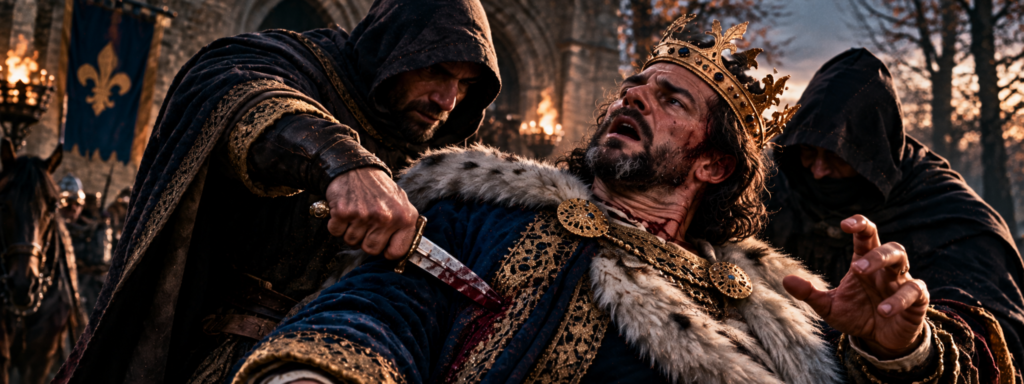
Chilperic I: The Merovingian King Murdered in the Shadows After a Hunt
Chilperic I (c. 539–584) | Merovingian king, r. 561–584 | Son of Chlothar I | Ruler of a western Frankish kingdom later associated with Neustria | Husband of Galswintha and later Fredegund | Brother and bitter rival of Sigebert I | Condemned by Gregory of Tours as “the Nero and Herod of our time” | Survived decades of dynastic warfare, rebellion, disease, and palace intrigue | Assassinated at Chelles in September 584 after returning from a hunt | His killer and the person, if anyone, who ordered the murder remain unknown
The King Who Returned From the Hunt
Chilperic I had survived almost everything the Merovingian world could throw at a king. He had fought his own brothers, watched sons die, crushed rebellion, escaped political ruin, quarreled with bishops, survived epidemics, and ruled beside one of the most feared queens in early medieval history. Nine years earlier, his brother Sigebert had stood on the verge of destroying him, only to be murdered at the moment of triumph by assassins whom Gregory of Tours said had been sent by Chilperic’s wife, Fredegund. Chilperic had learned one of the most important lessons of sixth-century Frankish politics from that astonishing reversal: armies could win kingdoms, but two men with concealed weapons could change history faster.
In September 584, that lesson returned for him. Chilperic was staying at the royal estate of Chelles, east of Paris, when he went hunting and later returned to his residence. There was no known rebellion unfolding around him, no enemy army breaking through his defenses, and no indication that the king believed he was approaching the final moments of his life. Somewhere near the royal residence, however, an assassin was close enough to strike.
Gregory of Tours records the murder with chilling directness. Chilperic was attacked as he returned from the hunt and stabbed, with one wound reportedly delivered beneath the armpit and another into the abdomen. The injuries were catastrophic, and the king died before the machinery of royal power surrounding him could save him. The man who had ruled for more than twenty years, accumulated treasure, commanded armies, judged bishops, punished nobles, and fought other kings was reduced in moments to a mortally wounded body.
Then the assassin disappeared from reliable history. Gregory does not securely identify the murderer, and no surviving contemporary evidence provides a convincing answer as to who ordered the attack. Later suspicion would fall upon Fredegund, Chilperic’s formidable queen; Brunhild, widow of his murdered brother Sigebert; hostile aristocrats; political rivals; and unnamed enemies created during a long and often brutal reign. Yet after more than fourteen centuries, the most important fact about the assassination remains the most frustrating one: we know Chilperic was murdered, but we do not know who murdered him.
That uncertainty makes his death more compelling rather than less. Chilperic had accumulated so many grievances around himself that almost every direction offers a plausible enemy. His family had been tearing itself apart for decades, his fiscal policies had created resentment, his wars had devastated communities, his household had become entangled in allegations of murder, and his confrontations with bishops and nobles had left powerful people with reasons to fear him. When the knife finally reached him, it emerged from a political world already saturated with blood.
The irony would have been difficult for any contemporary to miss. Chilperic had survived in 575 because someone else had assassinated his brother. In 584, someone performed the same service for one of Chilperic’s own enemies, although history has never discovered which one. The king who had benefited so spectacularly from assassination had finally become its victim.
Born Into the House of Clovis
Chilperic was born around 539 into a dynasty that had already demonstrated how closely kingship and violence could coexist. His grandfather was Clovis I, the Frankish king whose conquests had transformed a regional monarchy into the dominant power across much of Gaul. Clovis’s conversion to Catholic Christianity became one of the defining stories of Frankish royal identity, but his political career was hardly a gentle march toward Christian monarchy. Gregory of Tours himself preserved stories in which Clovis encouraged betrayal, eliminated rival Frankish kings, absorbed their kingdoms, and emerged increasingly powerful as competing dynasties disappeared.
Chilperic’s father, Chlothar I, inherited that world. When Clovis died in 511, his territories were divided among his sons, producing several Frankish kingdoms ruled by men who were brothers but also competitors. They sometimes cooperated against common enemies, sometimes fought one another, and repeatedly inherited or seized territory when deaths altered the dynastic balance. Chlothar eventually survived his brothers and reunited much of the Frankish realm under his authority.
That unity died with him in 561. Chlothar’s surviving sons—Charibert, Guntram, Sigebert, and Chilperic—divided the kingdom among themselves, creating another generation of competing Merovingian rulers. The resulting territories were not neat modern states with permanent borders, but collections of cities, estates, fiscal rights, military resources, and political loyalties that could be redistributed as circumstances changed. Every royal death therefore carried the possibility of territorial gain for surviving relatives.
Chilperic initially received a western share centered around Soissons. Over time, his kingdom became associated with the region historians conventionally call Neustria, while Sigebert’s eastern kingdom became known as Austrasia and Guntram ruled Burgundy. Charibert possessed territories centered upon Paris until his death in 567, after which his lands were divided among his surviving brothers. The political map therefore remained fluid throughout Chilperic’s reign.
Chilperic did not enter this system as a passive ruler content with whatever inheritance had been assigned to him. Gregory portrays him attempting to seize additional treasure and territory immediately after his father’s death, an early indication of the ambition that would characterize his career. Although Gregory’s hostility toward Chilperic requires caution when assessing motives and details, the larger pattern is clear enough. Chilperic wanted power, and he was willing to challenge his brothers to obtain more of it.
That ambition did not make him uniquely monstrous by Merovingian standards. The political structure itself encouraged rivalry because every brother possessed royal blood and every kingdom represented a potential inheritance. A ruler who failed to defend his interests could watch territory, treasure, and followers migrate toward a stronger relative. Kingship was therefore a family institution built upon competition among family members.
Chilperic would spend the rest of his life navigating that contradiction. His brothers were simultaneously relatives, diplomatic partners, military rivals, and potential heirs to his kingdom if he died without a secure successor. None became more dangerous than Sigebert I. Their struggle would eventually pull wives, sons, bishops, nobles, servants, and entire regions into one of the most destructive dynastic feuds of the sixth century.
Two Brothers and Two Visigothic Sisters
Sigebert strengthened his position through marriage to Brunhild, daughter of the Visigothic king Athanagild. Brunhild came from an established royal dynasty and brought considerable prestige to the Austrasian court. Gregory of Tours admired her intelligence, appearance, and conduct, presenting the marriage as an impressive union between powerful royal houses. For Chilperic, watching his brother acquire such a distinguished wife may have highlighted the political limitations of his own domestic situation.
Chilperic had already been married to Audovera, with whom he had several children, and he was also involved with Fredegund. The precise chronology of Chilperic’s relationships is not always easy to reconstruct because the surviving narratives are shaped heavily by Gregory’s hostility toward Fredegund. What is clear is that Fredegund rose from a comparatively humble position within the royal household to become extraordinarily influential. Her eventual elevation to queenship would become inseparable from one of the darkest episodes of Chilperic’s reign.
Seeking a marriage comparable to Sigebert’s, Chilperic turned toward Brunhild’s sister Galswintha. She was another daughter of Athanagild and therefore offered an alliance with the Visigothic monarchy as well as the prestige of royal birth. According to Gregory, Chilperic promised that he would abandon his other women if Galswintha agreed to marry him. The Visigothic princess traveled north and became queen.
The marriage quickly deteriorated. Gregory claims that Chilperic resumed or continued his relationship with Fredegund, leaving Galswintha humiliated and miserable. Galswintha reportedly asked to return home and was willing to surrender the property she had brought into the marriage if Chilperic would simply allow her to leave. Whether Gregory knew her private thoughts with the certainty his narrative suggests cannot be established, but the marriage appears to have become deeply unhappy.
Galswintha never returned to Spain. Around 568, she was found dead in her bed, apparently strangled. Gregory explicitly accused Chilperic of ordering her murder, but no independent judicial record survives that can establish his responsibility to modern evidentiary standards.
What happened afterward ensured that suspicion would cling to the king. Fredegund returned to prominence and ultimately became Chilperic’s queen. To Brunhild, the sequence must have been devastating regardless of whether every accusation later attached to Chilperic and Fredegund was true: her sister had married Chilperic, suffered an unhappy marriage, died violently, and been replaced by the woman at the center of the marital conflict. Personal grief and dynastic politics had become impossible to separate.
Galswintha’s death would haunt the Merovingian kingdoms for decades. Disputes over her marriage property created territorial consequences, while Brunhild’s desire to defend her sister’s interests intensified the hostility between the royal households. Chilperic and Sigebert had already been rivals. Now their queens had reasons to regard the conflict as something much more personal.
Fredegund and the Dangerous Royal Household
Fredegund became one of the most notorious women of the early Middle Ages. Gregory of Tours repeatedly associated her with assassination, conspiracy, manipulation, cruelty, and revenge, creating a portrait so vivid that later chroniclers expanded it into something approaching legend. She has often been depicted as an almost uniquely murderous queen, capable of eliminating anyone who threatened her position or her children. Yet because so much of her reputation comes through hostile sources, individual accusations must be evaluated rather than accepted automatically.
What cannot reasonably be doubted is that Fredegund became politically powerful. She was not simply Chilperic’s companion or a decorative figure at court. She bore royal children, participated in dynastic struggles, cultivated supporters, and later demonstrated remarkable political skill in preserving the inheritance of her surviving son. Her influence continued after Chilperic’s death, proving that her authority did not depend entirely upon his presence.
Her position was also extraordinarily dangerous. Chilperic had sons from his earlier relationship with Audovera, and those princes possessed claims that could threaten any children Fredegund produced. Other queens, bishops, aristocrats, servants, and members of rival Merovingian branches moved through a political environment in which accusations could lead to imprisonment or death. The royal household functioned simultaneously as a family residence and one of the most dangerous political arenas in Frankish Gaul.
Gregory portrays Fredegund as meeting threats with ruthless efficiency. Some of the killings attributed to her are supported more strongly than others, and later tradition undoubtedly embellished her reputation. Nevertheless, she clearly possessed political instincts sharpened by an environment in which losing influence could have fatal consequences. Survival at a Merovingian court required more than charm.
Her relationship with Chilperic therefore cannot be reduced to the simple image of a dominant king and obedient queen. Their interests often overlapped, especially where the survival of their children was concerned, but each possessed political interests of their own. Fredegund could act independently, and Chilperic did not necessarily control every decision associated with her faction. This distinction becomes particularly important when considering the king’s assassination.
Fredegund’s violent reputation made her an obvious suspect almost from the perspective of later historians. If she could arrange the murder of Sigebert, why not Chilperic? Yet historical guilt cannot be established through character alone. A person believed capable of murder is not automatically responsible for every unexplained death occurring nearby.
Indeed, Chilperic’s survival offered Fredegund significant protection. While he lived, she was queen beside an adult king with armies, treasure, and royal authority. His assassination left her responsible for an infant son in a kingdom surrounded by rival Merovingian rulers. If she ordered his murder, she deliberately exchanged a powerful husband for an extremely dangerous political gamble.
That does not make her innocent. It does, however, mean that any accusation requires evidence stronger than her reputation. In Chilperic’s case, that evidence has never been found.
The War That Nearly Destroyed Chilperic
The death of Galswintha intensified the rivalry between Chilperic and Sigebert. Brunhild’s family had suffered a violent loss, disputes continued over Galswintha’s property, and the competing kings sought opportunities to strengthen their positions. Guntram, their brother and ruler of Burgundy, repeatedly attempted to mediate or balance conflicts among the family. His interventions could interrupt warfare but could not eliminate the ambitions driving it.
Civil war erupted repeatedly across the Frankish kingdoms. Armies moved through territories whose inhabitants had little influence over the royal quarrel, while cities changed hands and nobles reconsidered their loyalties according to military circumstances. The conflict was not a private feud fought within palace walls. Ordinary communities paid for Merovingian dynastic competition through taxation, requisition, destruction, and violence.
Chilperic used his sons as commanders, extending royal authority through the next generation. This was politically logical but personally dangerous. A prince commanding armies gained military experience and followers, but he also became exposed to capture, death, and the possibility of developing ambitions independent of his father. The Merovingian family repeatedly discovered that sons could become political assets one year and threats the next.
In 575, Chilperic’s position deteriorated catastrophically. His son Theudebert was killed while fighting forces associated with Sigebert. Sigebert then advanced into Chilperic’s territory and attracted support from nobles who increasingly believed the Austrasian king would emerge victorious. Chilperic withdrew toward Tournai as his political position began collapsing around him.
Sigebert appeared to have won. Men who had previously served Chilperic shifted allegiance and acclaimed his brother. Had Sigebert consolidated that support, Chilperic might have lost his kingdom entirely and perhaps his life as well. The rivalry between the brothers seemed ready to end with Chilperic’s destruction.
Instead, Sigebert was assassinated.
Gregory says Fredegund sent two men to kill him. The assassins reportedly approached Sigebert armed with weapons coated in poison and struck him while he was surrounded by men celebrating his victory. Sigebert died, and the attackers were themselves killed.
The political effect was immediate. Sigebert’s adult authority vanished, leaving his young son Childebert II as heir. The coalition gathering around him fragmented, and Chilperic suddenly possessed the opportunity to recover from a defeat that had seemed irreversible.
Assassination had saved his crown.
The experience should have demonstrated with terrifying clarity how fragile royal power really was. Sigebert had armies, nobles, supporters, and momentum, but none of those things mattered once two attackers reached his body. Chilperic survived because his brother could be physically killed faster than a kingdom could be politically secured. Nine years later, someone would apply the same lesson to Chilperic himself.
Gregory of Tours and the “Nero of Our Time”
Much of what survives about Chilperic comes from Gregory of Tours, and that creates both an extraordinary opportunity and a serious problem. Gregory lived during Chilperic’s reign, interacted with the royal court, knew many of the people involved, and recorded events with a level of detail unavailable for most sixth-century rulers. Without him, enormous portions of Merovingian political history would be nearly invisible. Yet Gregory was also personally hostile toward Chilperic.
His most famous judgment came after the king’s death. Gregory described Chilperic as the “Nero and Herod of our time,” invoking two figures who represented tyranny, persecution, and murderous kingship within Christian historical imagination. This was not an affectionate nickname or neutral contemporary title. It was a moral condemnation written by a bishop who believed Chilperic had repeatedly violated the standards of proper Christian rulership.
Gregory accused the king of greed, cruelty, unjust taxation, hostility toward churches, arbitrary punishment, and arrogance. He criticized Chilperic’s theological ideas and mocked his attempts at poetry. At moments, the bishop’s dislike becomes so obvious that Chilperic appears almost as a literary villain constructed to demonstrate what bad kingship looked like. Modern readers therefore have to distinguish between the events Gregory records and the moral framework through which he interprets them.
This does not mean Chilperic was secretly benevolent. His reign included brutal warfare, harsh treatment of political opponents, aggressive taxation, dynastic conflict, and a court repeatedly associated with violent deaths. There is no need to rehabilitate him into an enlightened ruler in order to recognize that Gregory had biases. A king can be genuinely ruthless while still being portrayed unfairly in particular episodes.
The most interesting evidence is sometimes the material Gregory preserves despite his hostility. Chilperic was intellectually curious. He wrote poetry, debated theology, proposed modifications to the Latin alphabet, and concerned himself with administrative questions. Gregory mocked these interests, but the very act of mocking them confirms that they existed.
Chilperic therefore emerges as something more complicated than the “Nero” label suggests. He could be brutal and curious, suspicious and intellectually ambitious, politically ruthless and interested in religious doctrine. Those qualities are not contradictory. Human beings, including violent rulers, rarely fit neatly into a single moral category.
Gregory’s hostility is especially important when discussing Chilperic’s assassination. The bishop was perfectly willing to condemn the king and queen when he believed they were guilty of wrongdoing. Yet even Gregory could not confidently tell his readers who had arranged Chilperic’s murder. That uncertainty should make modern claims of certainty even more suspect.
The Bishop on Trial
Gregory’s relationship with Chilperic was not merely an abstract disagreement between historian and king. The bishop himself became entangled in the dangerous politics of the royal court. At one point, Gregory faced accusations connected with scandalous rumors concerning Queen Fredegund. The episode placed him personally at risk and inevitably shaped his relationship with Chilperic.
The accusations involved claims that Fredegund had committed adultery with Bishop Bertram of Bordeaux. Such allegations were politically explosive because they did more than insult a queen’s morality. If accepted, they could cast doubt upon the legitimacy of royal children and therefore threaten the succession. Chilperic had powerful reasons to treat the rumor as a political matter rather than harmless gossip.
Gregory denied responsibility for spreading the allegation. He was brought before an ecclesiastical gathering and ultimately cleared himself through an oath. The experience demonstrated how quickly words could become dangerous in the Merovingian world. A bishop who later shaped the historical memory of Chilperic had once stood before the king defending himself against accusations that could have destroyed his career.
This personal involvement matters when reading Gregory’s later condemnation. He was not an outside observer studying Chilperic from a safe distance. He had experienced the king’s court as a participant, negotiator, critic, and potential victim. His judgments were formed inside the political environment he described.
At the same time, Gregory’s proximity gives his narrative enormous value. He knew how royal politics operated and had access to people who witnessed major events. His account cannot simply be dismissed because he disliked Chilperic. The correct approach is to use his evidence critically, separating information that can be reasonably accepted from rhetorical judgments that require caution.
The trial also illustrates the atmosphere surrounding the royal household. Rumors concerning sex, paternity, treason, and loyalty could have enormous political consequences. Servants and clerics might carry information between factions, while a private accusation could become a public crisis. Chilperic ruled inside a world where suspicion was not paranoia without cause but an everyday feature of politics.
By 584, he had accumulated enemies through nearly every part of that system. Bishops had clashed with him, nobles had feared him, rival royals had fought him, princes had rebelled, and families had suffered because of his decisions. When an assassin finally reached him, the pool of potential motives was enormous. The mystery of his death begins with the simple fact that too many people had reasons to want him gone.
Merovech and the Son Who Chose the Enemy
Chilperic’s son Merovech created one of the most extraordinary crises of his reign. After Sigebert’s assassination, Brunhild temporarily fell under Chilperic’s control. She was the widow of his greatest rival, the sister of the murdered Galswintha, and mother of the young Austrasian king Childebert II. Any political relationship involving her was therefore potentially explosive.
Merovech married her.
The union brought together Chilperic’s son and Sigebert’s widow, creating a political combination that threatened the king from inside his own family. The marriage was also canonically problematic because of the relationship between the parties, but its political significance was even more dangerous. Brunhild possessed royal prestige and connections in Austrasia, while Merovech possessed Merovingian blood and a possible claim within his father’s kingdom.
Chilperic reacted as a ruler confronting potential rebellion. Merovech was eventually separated from Brunhild and became increasingly alienated from his father. He sought sanctuary, moved among supporters, and became a fugitive whose existence threatened to attract opposition to the king. What may have begun as a marriage crisis evolved into open dynastic conflict.
Merovech’s end was grim. According to Gregory, when the prince found himself trapped and feared capture, he asked a trusted companion to kill him. The exact circumstances remain filtered through Gregory’s account, but Merovech died without reconciling with his father. Another royal son had disappeared into the violence consuming the dynasty.
The episode deepened the atmosphere of suspicion around Chilperic. Supporters of Merovech had reasons to resent the king, while Brunhild’s faction had acquired another grievance. Bishops who assisted the prince could become targets of royal anger. Every attempt to suppress rebellion created additional people with motives for revenge.
Merovech’s story also reveals how little family relationships guaranteed loyalty. A son could ally with his father’s enemy. A widow could marry her dead husband’s nephew. A king could pursue his own child as a political threat.
The Merovingian household was not merely dysfunctional in the modern sense. It was structurally dangerous because royal blood gave family members political value. Affection might exist, but power was always present beside it.
Chilperic’s assassination would eventually expose that danger from the opposite direction. The king had spent years worrying that his sons or relatives might threaten him politically. In the end, the person who killed him did not need a throne.
The assassin needed only access.
Clovis, the Other Doomed Son
Another of Chilperic’s sons, Clovis, became entangled in the struggles surrounding Fredegund and the succession. Several of Fredegund’s children died young, apparently during outbreaks of disease. Their deaths were emotionally devastating and politically dangerous because they reduced the number of heirs through whom the queen could preserve her position. Clovis, as an older son of Chilperic by Audovera, consequently became more significant.
Gregory describes accusations that Clovis had been involved in magical practices connected with the deaths of Fredegund’s children. In the bishop’s account, the charges were part of a campaign orchestrated against the prince. Clovis was imprisoned and eventually killed, adding another violent death to Chilperic’s family. The precise degree of responsibility belonging to Chilperic, Fredegund, or individual officials is difficult to reconstruct with certainty.
The episode strengthened later interpretations of Fredegund as a queen systematically eliminating rival heirs. Such a motive is understandable because any surviving son from Chilperic’s earlier relationships could compete with her own children. Yet motives should not be confused with proof. Gregory’s hostility toward Fredegund requires the same caution applied to his hostility toward Chilperic.
What is indisputable is the cumulative effect. Theudebert had died in war, Merovech had died amid rebellion, and Clovis was killed after accusations at court. Chilperic’s older sons were disappearing one after another. The dynasty that should have provided security was becoming increasingly fragile.
Eventually, the succession centered upon a new child born to Fredegund: Chlothar. He was still an infant when Chilperic was assassinated. The king’s death therefore created exactly the kind of succession crisis that powerful royal families feared most. There was an heir, but he was far too young to defend his inheritance personally.
This context is important when evaluating Fredegund as a suspect in her husband’s murder. Chilperic’s death placed her infant son in immediate danger. Had the Neustrian aristocracy abandoned the child or had Guntram refused protection, Chlothar could have lost everything. Fredegund would have gambled her own future on circumstances she could not fully control.
That possibility cannot be ruled out absolutely. Political murder often involves enormous risks. Yet it makes the simplistic image of Fredegund killing Chilperic merely because she was murderous by nature historically unsatisfactory.
Her reputation gives us suspicion.
It does not give us evidence.
Disease Inside the Palace
The deaths of Chilperic and Fredegund’s young children reveal another source of instability that had nothing to do with assassination. Disease moved through sixth-century communities with little respect for status. Royal palaces could provide better food and shelter than ordinary households, but they could not offer protection from infections that contemporary medicine barely understood. A prince could die as easily from illness as from a dagger.
Gregory describes the deaths of royal children during an epidemic with unusual emotional intensity. Fredegund appears genuinely devastated, and Chilperic himself was affected by the loss. Whatever else can be said about their political behavior, the grief of parents watching children die should not be reduced to a convenient literary device. Royal families experienced private suffering even when that suffering carried public consequences.
Those consequences were considerable. Every dead son changed the succession. A surviving prince from an earlier marriage became more threatening when Fredegund’s sons died, while the birth of another child could alter alliances throughout the court. The mortality of children therefore shaped politics as surely as battles did.
Gregory connects one period of family tragedy with Chilperic’s taxation policies. According to his account, the king and queen came to believe that the deaths of their children might represent divine punishment for oppressive taxes. Chilperic reportedly ordered tax documents destroyed. Gregory may have shaped the episode to illustrate divine judgment, but it nevertheless suggests that the king could interpret personal catastrophe through a religious lens.
This complicates the caricature of Chilperic as entirely indifferent to suffering. A ruler capable of harshness could also experience grief, fear divine punishment, and reconsider policy. Such moments do not erase the darker elements of his reign. They simply remind us that historical people are rarely as consistent as the moral portraits constructed around them.
The repeated deaths within the household also intensified fear. If disease could remove princes without warning, the survival of every remaining child became more important. If accusations of magic or conspiracy followed those deaths, grief could easily become political paranoia.
By the final year of Chilperic’s reign, his family had been reduced and reshaped by decades of war, disease, rebellion, and violence. The birth of Chlothar offered renewed hope. Months later, the infant lost his father to an assassin.
A King Who Wanted to Rewrite the Alphabet
Chilperic’s intellectual interests form one of the strangest contrasts with the brutality associated with his reign. He attempted to write Latin poetry, an activity Gregory treated with open contempt. The bishop complained about Chilperic’s meter and literary ability, making the king’s creative ambitions another target of ridicule. Yet behind the mockery stands a remarkable fact: this warrior king spent time composing verse.
He also proposed changes to the Latin alphabet. Chilperic apparently believed that additional letters were necessary to represent sounds not adequately expressed by the existing script. He ordered that the new characters be taught and incorporated into manuscripts. The reform failed to survive, but the attempt reveals a ruler interested in language and literacy.
Chilperic’s theological curiosity created even more conflict. He developed ideas concerning the Trinity and attempted to discuss or promote them among bishops. Gregory strongly rejected the king’s formulation, regarding it as doctrinally incorrect. Their disagreement became another arena in which royal authority collided with episcopal expertise.
These episodes have sometimes been treated as evidence that Chilperic was foolish or pretentious. Gregory certainly wanted his readers to see them that way. A different reading is possible without idealizing the king: Chilperic was intellectually restless and unusually willing to involve himself in subjects beyond warfare and administration. His ideas may have been poor, but the curiosity behind them was genuine.
None of this makes him benevolent. Educated or cultured rulers can be ruthless, and history offers countless examples of people who combined artistic or intellectual interests with political violence. Chilperic’s poetry does not cancel Galswintha’s death, the wars against Sigebert, or the suffering caused by his policies. It does, however, prevent us from reducing him to a one-dimensional barbarian.
The same king who sent armies against relatives could argue about theology. The ruler Gregory accused of greed could attempt linguistic reform. The man who inspired fear could apparently care deeply about how Latin represented spoken sounds.
This complexity matters because assassination often simplifies its victims. Once Chilperic becomes merely “the Nero of his age,” his murder can seem like the inevitable punishment of a villain. The historical reality is less satisfying and therefore more interesting.
Someone killed a complicated king for reasons we still cannot prove.
Taxes, Treasure, and Resentment
Gregory’s complaints about Chilperic repeatedly return to money. The king enforced taxation aggressively and sought revenue from territories under his authority. To a bishop concerned with church property and the welfare of communities, such policies could appear predatory. Gregory presents Chilperic as obsessed with accumulating treasure.
Royal finance, however, was essential to Merovingian power. Kings needed wealth to maintain households, reward warriors, negotiate alliances, support churches, finance armies, and distribute gifts to followers. A ruler who could not reward supporters risked watching them transfer loyalty to another king. Treasure was not simply personal luxury; it was one of the principal mechanisms through which early medieval politics functioned.
Chilperic inherited fiscal practices ultimately rooted in the Roman administration of Gaul. Taxation therefore did not represent some entirely new form of oppression invented by a greedy Frankish king. Yet the continuation or intensification of assessments could create serious resentment, especially when communities believed demands were excessive or officials behaved abusively. Gregory’s complaints should be read within that tension.
Fiscal policy could also create enemies outside the glamorous world of royal feuds. Landowners facing confiscation, officials punished for irregularities, communities burdened by assessments, and nobles losing property all had reasons to resent a king. These grievances rarely produce the dramatic narratives associated with queens and assassins, but they could be politically dangerous.
Chilperic’s desire for treasure also influenced relations with the church. Ecclesiastical institutions possessed substantial property, and bishops were powerful local figures. Attempts to assert royal claims over wealth could therefore become political confrontations disguised as disputes over law or morality. Gregory’s own position as a bishop inevitably shaped his interpretation of such conflicts.
There is no evidence connecting a specific fiscal grievance to the assassination at Chelles. Nevertheless, the broader resentment matters. Chilperic’s enemies were not limited to Brunhild and the Austrasian royal family. His methods of government could create hostility among people who had never met Sigebert or cared about Galswintha.
When historians ask who wanted Chilperic dead, the answer is therefore uncomfortable in its breadth. Rival queens had motives, hostile nobles had motives, defeated princes had supporters, and ordinary political grievances could become personal vendettas. The assassin emerged from a kingdom where resentment had many sources.
The knife may have belonged to dynastic politics.
It may also have belonged to someone whose grievance never entered a chronicle.
Rigunth and the Wedding Procession
In the months surrounding Chilperic’s death, the king was arranging an important marriage for his daughter Rigunth. She was intended to marry Reccared, son of the Visigothic king Leovigild. The match would have linked Chilperic’s family to the powerful Visigothic monarchy and revived the kind of international alliance once represented by his disastrous marriage to Galswintha. This time, Chilperic was sending a daughter south rather than receiving a Visigothic bride.
Rigunth departed with an enormous entourage and considerable treasure. Gregory describes the expedition in language emphasizing its extravagance, including wagons, servants, valuables, and provisions. The procession represented royal wealth on the move and demonstrated Chilperic’s ability to support a marriage alliance of international importance. It also created opportunities for abuse and resentment as the entourage traveled through the kingdom.
Then news arrived that Chilperic had been murdered. The political authority holding the expedition together vanished immediately. Members of Rigunth’s entourage began abandoning or plundering the enterprise, and the planned marriage ultimately collapsed. What had begun as a display of dynastic confidence became another casualty of the assassination.
The episode demonstrates how much depended upon the physical survival of a king. Diplomatic agreements might be negotiated across kingdoms, treasure might be assembled, and royal children might be sent hundreds of miles to marry strangers. Yet if the ruler guaranteeing those arrangements died, the entire structure could disintegrate before a replacement authority emerged.
Rigunth’s failed marriage also illustrates the reach of Chilperic’s murder. The assassin struck at Chelles, but the consequences traveled along roads toward the Visigothic kingdom. Servants, nobles, soldiers, and diplomats suddenly had to reconsider obligations that had seemed secure days earlier.
For Rigunth herself, the murder transformed her future. She did not become the Visigothic royal bride envisioned by her father. Instead, she returned to a political world in which her mother was fighting to preserve the throne for an infant brother.
The assassination therefore did more than end Chilperic’s reign. It destroyed plans already in motion and changed the lives of people far beyond the immediate scene of the murder. A few seconds of violence at Chelles unraveled months or years of diplomacy.
September 584: The Last Hunt
Chilperic’s assassination is generally dated to September 584. He was at Chelles, a royal estate east of Paris, and had gone hunting. Hunting was an important part of aristocratic and royal culture, combining recreation, physical skill, elite sociability, and displays of martial identity. For a king accustomed to warfare, the hunt also reinforced the image of the ruler as an active warrior rather than a sedentary administrator.
The activity required movement beyond the most controlled spaces of royal residence. Horses, dogs, attendants, weapons, servants, and companions created a mobile environment in which the king could be surrounded by people without every individual being scrutinized as closely as someone entering a formal audience chamber. That does not mean Chilperic was unguarded. It means royal activity inevitably created moments when security became less predictable.
Gregory tells us that Chilperic returned from the hunt and was attacked. The killer got close enough to strike him at least twice, with wounds described beneath the arm and in the abdomen. Such an attack required proximity and determination. Whether the assassin was already known to members of the household, concealed nearby, or simply exploited confusion cannot be established.
We should resist the temptation to decorate the scene with details the sources do not provide. There is no reliable basis for describing the weather, the exact lighting, the assassin’s clothing, the king’s final words, or a dramatic confrontation before the attack. Such details belong to historical fiction unless supported by evidence. The documented core is already dramatic enough.
A king returned from hunting.
An attacker reached him.
The king was stabbed and died.
What followed was confusion rather than revelation. No surviving source gives us a securely identified killer standing over the body. There is no preserved confession explaining the motive. No faction publicly announced that it had eliminated Chilperic and claimed his kingdom.
Instead, the murder produced one of the enduring mysteries of Merovingian history.
The Intimacy of the Murder
Royal assassination is often imagined through grand conspiracy, but the physical reality of Chilperic’s death was brutally intimate. A sword swung on a battlefield can kill without the attacker even knowing the victim personally. A dagger or short blade used at close range requires the murderer to enter the victim’s immediate physical space. Chilperic’s killer came close enough to overcome whatever distance normally separated a king from ordinary men.
The wounds described by Gregory suggest an attack intended to kill quickly. A strike beneath the arm could penetrate a vulnerable area not protected as effectively by clothing or armor, while an abdominal wound could cause devastating internal injury. Chilperic was returning from a hunt rather than fighting in battle, so there is no reason to assume he wore substantial armor. The assassin therefore encountered a king in a comparatively vulnerable moment.
The successful approach raises questions that cannot be answered. Did the killer belong to the royal household or hunting party? Did someone deliberately reduce Chilperic’s protection? Did the assassin know the king’s routine well enough to wait for an opportunity?
Every answer remains speculative. Access does not automatically prove an elaborate conspiracy because royal estates contained numerous servants, officials, guards, petitioners, craftsmen, clerics, and visitors. A determined individual might exploit ordinary movement without possessing powerful accomplices. Conversely, an insider could have made the attack much easier.
The absence of a known killer makes every detail feel suspicious. Yet suspicion must not be mistaken for evidence. Historical mysteries are often distorted when modern writers fill gaps with whatever scenario appears most cinematic. Chilperic’s assassination does not need invention to remain disturbing.
The important fact is that royal power failed at the most basic level. Chilperic could command men across a kingdom but could not prevent one attacker from entering striking distance. Once the blade reached him, his armies were useless.
The contrast between political power and physical vulnerability lies at the heart of regicide. A king may rule thousands of people, but his body remains singular. If that body is destroyed, authority instantly becomes an inheritance problem.
At Chelles, the kingdom survived.
The king did not.
Was Fredegund Behind the Murder?
Fredegund is inevitably the first name raised when Chilperic’s assassination is discussed. Her reputation for political violence is formidable, and Gregory associates her directly with Sigebert’s murder. Later traditions also accused her of numerous other killings, some more credible than others. A queen already remembered as an assassin naturally attracts suspicion when her husband dies violently.
Various motives have been proposed. Some later narratives connected the assassination with alleged adultery, suggesting Chilperic discovered or was about to discover a relationship involving Fredegund and another man. Others imagined that the queen feared repudiation, punishment, or declining influence. These stories transform the murder into a domestic conspiracy in which the dangerous queen eliminates the husband who has become a threat.
The problem is evidence. Gregory does not securely accuse Fredegund of arranging Chilperic’s murder. This is significant because he had no obvious desire to protect her reputation. He blamed or suspected her in connection with other killings and repeatedly depicted her as dangerous.
If Gregory possessed convincing evidence that Fredegund had murdered her own husband, the omission would be difficult to explain. It remains possible that rumors existed without satisfying him, or that information never reached him. Yet modern writers should not claim certainty where the hostile contemporary source itself does not.
Fredegund also had substantial political reasons to keep Chilperic alive. Their surviving son Chlothar was an infant. While Chilperic lived, the child’s future rested behind an adult king with established authority. Once Chilperic died, Chlothar became vulnerable to rival kings, ambitious nobles, and doubts concerning his legitimacy.
Fredegund herself became vulnerable as well. A queen consort possessed influence through her husband, but a widowed queen with an infant heir had to persuade powerful men to preserve both her position and her son’s inheritance. Failure could result in forced confinement, loss of treasure, political disappearance, or death. Chilperic’s assassination therefore created immediate dangers rather than obvious security for her.
None of these arguments proves Fredegund innocent. A person fearing imminent danger might accept even greater political risks to survive. We simply do not possess reliable evidence that such a crisis existed immediately before Chilperic’s death.
Fredegund remains a plausible suspect because of her political history and because later tradition repeatedly connected her with murder. She is not a proven mastermind. The distinction is essential.
Was Brunhild Taking Revenge?
Brunhild possessed one of the strongest imaginable personal motives for wanting Chilperic dead. Her sister Galswintha had died violently after marrying him, and Gregory directly blamed Chilperic for the murder. Brunhild’s husband Sigebert had then spent years fighting Chilperic before being assassinated by men Gregory said were sent by Fredegund. The Neustrian royal couple therefore stood at the center of two catastrophes that had devastated Brunhild’s family.
Political motives accompanied personal ones. Brunhild’s son Childebert II ruled Austrasia and had inherited his father’s rivalry with Chilperic’s kingdom. Removing Chilperic could weaken Neustria at a moment when its surviving male heir was an infant. An Austrasian faction therefore had obvious reasons to consider assassination strategically useful.
Revenge would also fit the violent logic of the feud. If Fredegund had arranged Sigebert’s murder, killing Chilperic could be seen as retaliation against the household that had destroyed Brunhild’s husband. The symmetry is so compelling that it almost writes the story by itself. That is precisely why caution is necessary.
No surviving contemporary evidence securely links Brunhild to the assassin at Chelles. Gregory, who was generally more sympathetic toward her than toward Fredegund, does not provide a convincing chain of responsibility. There is no preserved order, confession, payment, or testimony establishing that Brunhild arranged the attack.
Austrasian politics were also more complicated than the will of one queen. Childebert II was growing older, powerful aristocrats possessed their own agendas, and factions within the kingdom did not always agree with Brunhild. An attack benefiting Austrasia would not necessarily have originated with her personally.
Brunhild therefore belongs among the suspects because motive and opportunity at the broader political level cannot be ignored. Yet her case remains circumstantial. The murder of her sister and husband gave her reasons for hatred, but hatred is not proof of assassination.
The historical record allows us to say that Brunhild may have benefited from Chilperic’s death. It does not allow us to say that she caused it.
The Aristocrats Who Had Reasons to Hate Him
Another possibility is that Chilperic was killed because powerful men within his own kingdom had grown tired of him. Merovingian aristocrats controlled estates, military followers, local offices, and networks extending across royal borders. They were not bureaucrats who simply obeyed whichever king occupied the throne. Their cooperation was essential to effective rule.
Chilperic’s taxation, confiscations, prosecutions, and political suspicions could therefore create dangerous enemies. A noble who feared losing property or life might decide that removing the king was safer than waiting for royal punishment. Groups of magnates had also demonstrated their willingness to transfer loyalty when military circumstances changed. During Sigebert’s advance in 575, some had abandoned Chilperic when they believed his brother would win.
The king recovered after Sigebert’s assassination, but recovered authority does not necessarily erase resentment. Men who had changed allegiance might fear punishment. Others might dislike the influence of Fredegund or oppose particular officials. Still others could resent the growing power of royal taxation.
An aristocratic conspiracy would help explain how an assassin obtained access to Chilperic. A powerful insider could provide information about the king’s movements or reduce security at a crucial moment. Yet no surviving source identifies such a conspiracy. The theory remains plausible precisely because elite involvement was possible, not because evidence proves it.
The lack of an obvious political takeover afterward also complicates the idea. If a faction of Neustrian nobles killed Chilperic intending to seize control, they did not immediately produce an adult replacement king. Instead, Fredegund maneuvered to preserve Chlothar’s inheritance under Guntram’s protection. Whatever plans the assassin may have had, the aftermath did not reveal them clearly.
It is possible that the murder served a narrower purpose. A noble facing punishment might want Chilperic dead without caring who inherited. Revenge can motivate assassination as effectively as ambition. Removing a threatening king may itself have been the objective.
This possibility widens the mystery rather than narrowing it. Chilperic’s reign had created many aristocratic grievances, and Gregory does not preserve enough information to evaluate them individually. Somewhere among those forgotten disputes could lie the explanation.
If so, the name of the person who ordered the murder may have vanished because Gregory never knew it.
Could the Assassin Have Acted Alone?
The grandeur surrounding kings often encourages historians and storytellers to assume that their assassinations must involve equally grand conspiracies. Yet an individual grievance can produce political consequences far beyond anything the killer intended. Chilperic had ruled for more than twenty years and had harmed, punished, defeated, or humiliated many people. One of them may simply have wanted revenge.
A personal enemy could have emerged from almost any part of his reign. Relatives of executed men, supporters of dead princes, disgraced servants, dispossessed landowners, soldiers punished by royal officials, or families harmed by warfare all had potential grievances. Most would never appear by name in Gregory’s narrative. Chronicles naturally concentrate on elites whose identities mattered to political storytelling.
The attack itself does not require a large organization. The assassin needed information about Chilperic’s whereabouts and an opportunity to approach him. Those requirements might be satisfied through familiarity with the estate or hunting party rather than a kingdom-wide conspiracy. Once close enough, the actual murder could be carried out in seconds.
This theory also fits the confused aftermath. No faction immediately stepped forward to claim responsibility. No adult pretender appeared at Chelles ready to seize the throne. Fredegund instead scrambled to protect her infant son while Guntram became the crucial external guarantor of the succession.
An individual assassin could still have been hired by someone else, of course. The distinction between lone killer and conspiracy is impossible to establish from the surviving evidence. What matters is that the existence of an unknown attacker does not automatically prove a famous royal mastermind.
Sometimes history loses the names of ordinary people precisely because chroniclers did not consider them important until they performed something extraordinary. Chilperic’s murderer may have been one such person. A single individual could enter the historical record for a few violent seconds and disappear before anyone preserved a name.
If that happened at Chelles, the mystery may never have possessed the glamorous solution later generations wanted. The killer could have been someone whose story died with him.
The Kingdom Without Its King
Chilperic’s death created immediate political danger because his surviving son Chlothar was only an infant. The kingdom had lost an experienced adult ruler in a political system where military leadership and personal relationships mattered enormously. Rivals could potentially exploit the succession before the child’s supporters organized themselves. Fredegund therefore had little time to grieve publicly before she had to act politically.
She sought protection for herself and her son. Guntram, Chilperic’s surviving brother and ruler of Burgundy, became the most important figure in the crisis. As the senior adult Merovingian king, he possessed the authority and military power capable of preventing Chlothar’s kingdom from being immediately swallowed by rivals. His willingness to recognize the child was therefore essential.
Questions concerning Chlothar’s paternity circulated, unsurprisingly given the poisonous atmosphere of Merovingian court politics. Accusations concerning queens’ sexual behavior could become weapons because undermining a child’s legitimacy could destroy his right to rule. Fredegund had to protect not only Chlothar’s body but also his identity as Chilperic’s legitimate son. Political survival depended upon both.
Guntram ultimately accepted the child. This decision prevented Chilperic’s assassination from immediately extinguishing his dynastic branch. Fredegund gained the breathing room necessary to consolidate support among Neustrian elites. The infant king survived the moment when he was most vulnerable.
The outcome is important when considering theories about the assassination. Whoever killed Chilperic did not produce a straightforward transfer of his kingdom to Austrasia. Nor did a Neustrian adult usurper immediately seize power. Instead, the political system reorganized itself around a baby.
If the murderer intended to destroy Chilperic’s dynasty, the plan failed spectacularly. Chlothar would eventually become one of the most successful Merovingian rulers of his generation. His father’s death delayed rather than prevented the dynasty’s rise.
The assassination therefore achieved one result with certainty: Chilperic died. Almost every broader political objective we might attribute to the killer remains speculative. The aftermath does not reveal a clear mastermind because no single faction immediately obtained everything.
The kingdom survived its murdered king.
The mystery survived with it.
Fredegund the Widow
Fredegund’s career after 584 demonstrates why reducing her to the stereotype of a murderous queen does her historical significance a disservice. She suddenly became responsible for protecting an infant king in a world dominated by adult male rulers and powerful aristocrats. Her authority could no longer depend upon Chilperic. She had to construct a political position of her own.
She succeeded with remarkable persistence. Fredegund maintained support for Chlothar, negotiated with powerful figures, and remained active in conflicts involving Austrasia and Burgundy. She did not disappear into a monastery or surrender political control. Instead, widowhood revealed the extent of her political skill.
Her feud with Brunhild also survived their husbands. The rivalry that had begun around Galswintha’s death and the wars between Sigebert and Chilperic became a struggle between two queen mothers defending competing dynastic lines. Both women had experienced the assassination of husbands. Both possessed sons whose survival depended upon political maneuvering.
Fredegund continued to be associated with violence after Chilperic’s death. Gregory blamed her for further plots and killings, reinforcing the reputation that would dominate her later memory. Some accusations may be credible, while others require caution because of the source’s hostility. What remains clear is that she operated aggressively within a political environment where weakness could be fatal.
Her ability to prosper after Chilperic’s death has sometimes been treated as evidence that she arranged it. This reasoning is not convincing on its own. People can benefit from crises they did not create, and capable political actors often survive disasters precisely because they adapt quickly. Fredegund’s success proves competence, not guilt.
Indeed, her immediate circumstances were perilous enough that an unexpected assassination provides an equally plausible explanation. She had to secure Chlothar’s recognition, preserve treasure, maintain aristocratic support, and prevent rival kings from exploiting the succession. Any failure could have destroyed both mother and child.
Fredegund survived until 597. By then, Chlothar’s position was strong enough to continue without her. The infant who had inherited Chilperic’s bloodstained throne was becoming a king in his own right.
The assassin had removed the father.
Fredegund ensured the son remained.
Guntram and the Balance of Power
Guntram’s intervention after Chilperic’s death illustrates the importance of family even within a dynasty famous for family violence. He had fought, negotiated with, and sometimes opposed his brothers during their lifetimes. Now two of them were dead by assassination, leaving children and widows to continue their rivalries. As the senior surviving son of Chlothar I, Guntram occupied an unusually powerful position.
His support for Chlothar was not necessarily sentimental. Preserving a weak Neustrian kingdom under an infant could help prevent Austrasia from becoming overwhelmingly powerful. Guntram had his own territorial and dynastic interests, and maintaining influence over younger relatives strengthened his position. Merovingian family protection and political calculation often operated simultaneously.
Guntram also developed a close relationship with Childebert II, Sigebert’s son. Because Guntram lacked a surviving legitimate male heir capable of securely inheriting Burgundy, Childebert became important to his succession plans. The older king therefore stood between the sons of two murdered brothers. His decisions helped determine whether their rivalry would continue or temporarily stabilize.
This balancing act prevented either branch from immediately dominating the Frankish world. Chlothar survived in Neustria, Childebert ruled Austrasia, and Guntram maintained Burgundy. Chilperic’s assassination had removed one of the principal adult competitors without resolving the dynastic struggle. The next generation inherited it.
Guntram’s role also demonstrates why killing a king did not necessarily mean conquering his kingdom. Authority was distributed among relatives, nobles, bishops, military commanders, and regional elites. A successful assassin could create a vacancy but could not dictate how every political actor would respond. The aftermath remained unpredictable.
Whoever arranged Chilperic’s death, if anyone did, therefore took a substantial gamble. Guntram’s intervention may have frustrated plans that depended upon Neustrian collapse. Fredegund’s survival may have frustrated others. Chlothar’s eventual success would frustrate almost anyone hoping to eliminate Chilperic’s line.
The assassination changed the political board.
It did not determine the final game.
Chlothar II and the Revenge of Time
Chlothar II grew up in the shadow of a father he could barely have remembered. His political identity was shaped by Fredegund and the Neustrian aristocracy that preserved his throne. The enemies surrounding his childhood were inherited from conflicts that had begun before his birth. He belonged to a dynasty where children routinely inherited grudges alongside kingdoms.
Fredegund died in 597, leaving Chlothar to continue the struggle without her. His fortunes rose and fell as Austrasian and Burgundian politics shifted. At times his territory was severely reduced, and the descendants of Sigebert appeared capable of dominating the Frankish kingdoms. Yet the political alliances supporting Brunhild’s family eventually fractured.
In 613, aristocratic opposition to Brunhild helped deliver her and her great-grandsons into Chlothar’s hands. The old queen, by then a survivor of decades of dynastic warfare, was accused of responsibility for numerous royal deaths. She was executed brutally, while rival heirs were eliminated. The son of Chilperic and Fredegund had finally triumphed over the family of Sigebert and Brunhild.
Chlothar then ruled a reunited Frankish kingdom. The infant whose inheritance had appeared so vulnerable after the assassination at Chelles ultimately achieved a level of political dominance his father had never secured. The dynasty had turned catastrophe into victory over the course of a generation. Chilperic’s bloodline survived precisely because Fredegund refused to allow his death to end it.
There is profound irony in this outcome. If Chilperic was assassinated by an Austrasian conspiracy, the murder ultimately failed to destroy the Neustrian branch. If Brunhild had somehow been involved, the child left behind by the victim would eventually preside over her destruction. If Neustrian aristocrats wanted greater independence, they ultimately helped preserve a dynasty capable of reuniting the realm.
Of course, none of those hypothetical motives can be proved. The irony lies in the uncertainty itself. The assassin changed history without leaving us enough evidence to know whether the eventual outcome represented success or catastrophic failure.
Chilperic died in 584.
His political story continued for decades through a son who had been too young even to understand the murder.
Why Was the Killer Never Found?
The absence of a known assassin can seem astonishing given the importance of the victim. Yet sixth-century investigations operated very differently from modern criminal inquiries. There was no centralized police institution capable of sealing the scene, collecting physical evidence, preserving forensic material, interviewing witnesses under standardized procedures, and maintaining permanent case files. Investigations depended heavily upon testimony, reputation, interrogation, confession, oath, and political authority.
If the assassin escaped immediately, identifying him could be difficult. If he had powerful protection, witnesses might remain silent. If he died during or shortly after the attack, the motive could disappear with him. Even if contemporaries suspected someone, suspicion might never become evidence strong enough for Gregory to record confidently.
The assassination also created political chaos at precisely the moment when an investigation would have been most necessary. Fredegund needed to secure Chlothar’s inheritance. Guntram needed to decide how to respond to the succession. Nobles had to choose where their loyalties now lay.
The person with the greatest authority to demand an investigation was dead. Chilperic could no longer order officials to interrogate suspects or punish conspirators. His widow possessed influence but faced immediate threats to her own survival. Political stabilization may have mattered more than solving the murder.
It is also possible that the killer was identified at the time but the information simply failed to survive. Gregory’s Histories are extraordinarily valuable, but they are not a complete archive of every investigation conducted in Merovingian Gaul. Other records could have disappeared over the centuries. Oral knowledge might have died with witnesses.
Nevertheless, Gregory’s uncertainty remains significant. He lived close enough to the events that a widely accepted solution might reasonably have reached him. His failure to provide one suggests that the assassination may have been mysterious even to contemporaries. The darkness surrounding Chilperic’s death may not be the result solely of lost medieval records.
People in 584 may also have asked who killed the king.
They may not have known either.
The Haunting Parallel With Sigebert
Few royal deaths mirror one another as strangely as those of Sigebert and Chilperic. Sigebert was assassinated in 575 at the moment when he appeared close to destroying his brother. Chilperic survived because the adult ruler leading the victorious coalition suddenly disappeared. The political world reorganized itself around Sigebert’s young son and widow.
Nine years later, Chilperic died in another close-range assassination. His death left Fredegund protecting an infant son while rival kings considered how to exploit the situation. The man who had benefited from his brother’s murder now left behind a family confronting the same fundamental problem. Royal authority had once again been reduced to the survival of a child.
The symmetry should not be pushed beyond the evidence. Gregory gives a clear alleged explanation for Sigebert’s murder by blaming Fredegund, whereas Chilperic’s assassination remains unresolved. The political circumstances were also different. Sigebert died during an active struggle for Chilperic’s kingdom, while Chilperic’s death did not immediately resolve a comparable military confrontation.
Yet the larger pattern is difficult to ignore. Both brothers spent years commanding armies and competing for territory. Neither ultimately died in battle against the other. Instead, both were killed suddenly by attackers able to bypass the protections surrounding kings.
Their widows then carried the feud forward. Brunhild defended Sigebert’s descendants, while Fredegund defended Chilperic’s. Children inherited not only royal blood but the consequences of murders they had not caused.
The rivalry became larger than the original brothers. It survived marriages, wars, assassinations, epidemics, and changes of generation. The men who had begun much of the conflict disappeared, but the political structures they created continued producing violence.
Chilperic’s death therefore cannot be understood as an isolated murder. It was part of a dynastic world where assassination had already demonstrated its usefulness. Once killing a king had successfully reversed a war in 575, every ruler had reason to understand what a blade could accomplish.
In 584, someone understood very well.
Burial of a Murdered King
Chilperic’s body was eventually taken to Paris and buried at the church of Saint Vincent, later known as Saint-Germain-des-Prés. Whatever Gregory thought of him, Chilperic remained a Merovingian king and received a royal Christian burial. The ceremony restored dignity and order around a man whose final moments had been sudden and violent. Death could destroy the body, but ritual could still preserve kingship in memory.
Royal burial also mattered politically. Tombs connected dynasties with sacred spaces and allowed surviving relatives to emphasize legitimate descent. Chlothar’s claim did not disappear because his father had been murdered. On the contrary, Chilperic’s status as king became part of the inheritance his infant son needed to preserve.
Gregory used the aftermath differently. The king’s death gave him an opportunity to summarize the reign and deliver his famous condemnation. Chilperic could no longer answer criticism, punish opponents, or challenge the bishop’s interpretation. The struggle over his reputation therefore passed almost entirely into the hands of writers.
Gregory won that struggle spectacularly. The phrase comparing Chilperic with Nero and Herod became more memorable than the king’s linguistic experiments, administrative policies, or poetry. Later generations encountered him primarily through a hostile witness whose literary skill ensured that his judgment survived.
Yet burial and narrative created two different forms of memory. The church preserved Chilperic as a Christian king belonging to a legitimate dynasty. Gregory preserved him as a warning about bad kingship. Both images outlived the assassin.
The killer, ironically, achieved the most dramatic act and received the least historical memory. Chilperic’s name survived. Fredegund’s survived. Brunhild’s survived.
The assassin became nobody.
That anonymity may be the strangest legacy of the murder.
Was Chilperic Really a Tyrant?
Calling Chilperic a tyrant is easy because Gregory effectively did it for us. His comparison with Nero and Herod invites readers to interpret every event through a moral framework in which the king represents cruelty, greed, and impiety. Several aspects of Chilperic’s reign certainly support a dark assessment. He fought destructive wars, punished opponents harshly, pursued aggressive taxation, and presided over a court where violence repeatedly touched his own family.
Yet context matters. Merovingian kingship in general was violent. Chilperic’s grandfather Clovis had eliminated rivals, his father Chlothar had participated in brutal dynastic struggles, and his brothers were hardly pacifists. Guntram could punish enemies severely, while Sigebert pursued war vigorously when political interests demanded it. Chilperic operated inside a system where violence was an accepted instrument of power.
This does not excuse individual cruelty. Historical context explains behavior without automatically justifying it. Chilperic could still be unusually harsh within an already harsh political culture. The difficulty lies in measuring that difference when our most detailed witness personally disliked him.
Gregory’s position as bishop also shaped his definition of good government. A king who respected bishops, supported churches, and accepted episcopal counsel could receive more favorable treatment than one who challenged ecclesiastical authority. Chilperic repeatedly interfered in matters Gregory believed belonged to the church. Their conflict was therefore institutional as well as personal.
The king’s intellectual ambitions also irritated Gregory. Chilperic’s theological proposals trespassed into a field where bishops claimed expertise. His poetry invited ridicule because Gregory considered it bad. Even his alphabetic reforms could be presented as absurd innovation rather than intellectual curiosity.
A balanced assessment therefore produces neither a misunderstood saint nor Gregory’s uncomplicated monster. Chilperic was ambitious, often ruthless, administratively active, intellectually curious, politically resilient, and capable of inspiring deep hostility. He was a product of Merovingian political culture who also helped make that culture more violent.
His assassination should not be treated as divine or moral punishment. Murder does not validate the accusations made against its victim. The knife at Chelles proves only that someone wanted Chilperic dead and succeeded.
The reasons remain hidden.
Regicide Without a Confession
Some regicides come with abundant explanation. Julius Caesar’s killers openly presented themselves as defenders of the Republic. Charles I of England was tried publicly before execution. Other rulers were murdered during coups in which the beneficiaries immediately seized power. Chilperic’s assassination offers none of that clarity.
The murder itself is secure. Gregory describes a deliberate attack, not an accidental death or ambiguous illness. Chilperic was stabbed after returning from a hunt and died from his wounds. There is no serious reason to doubt that he was assassinated.
Everything beyond that becomes progressively less certain. We cannot securely identify the killer. We cannot prove that the attacker was hired. We cannot establish whether Fredegund, Brunhild, an aristocratic faction, or a private enemy stood behind him.
This combination makes Chilperic particularly valuable within the history of regicide. It demonstrates that political murder does not always produce a comprehensible political narrative. Sometimes a king dies and the surviving evidence preserves the wound more clearly than the motive. Historians must live with that imbalance.
There is a strong temptation to solve such mysteries because unresolved stories feel incomplete. Fredegund offers a sensational ending, Brunhild offers revenge, and rebellious nobles offer political conspiracy. Any of those explanations could be turned into a compelling narrative. None can currently be established as fact.
The responsible approach is therefore to preserve the uncertainty rather than hide it. Chilperic’s assassination was not less important because we cannot name the mastermind. If anything, the mystery reveals the extraordinary density of hostility surrounding his throne.
A king with only one enemy might leave an obvious suspect.
Chilperic had too many.
A Crown Surrounded by Knives
By the final years of Chilperic’s reign, almost every major relationship around him had been marked by violence or suspicion. His marriage to Galswintha ended in her mysterious death. His marriage to Fredegund became associated with accusations of assassination. His rivalry with Sigebert ended when Sigebert was murdered.
His sons fared little better. Theudebert died in war, Merovech died after rebellion, and Clovis was killed following accusations at court. Children born to Fredegund died from disease. The surviving infant Chlothar represented a fragile future rather than secure succession.
Chilperic’s relationships with bishops generated further hostility. Gregory challenged him, Praetextatus became entangled in Merovech’s rebellion, and ecclesiastical disputes repeatedly became political. The king’s attempts to assert authority over religious and fiscal matters created resentment among men who possessed their own networks of power.
His aristocrats could not be taken for granted either. Some had demonstrated their willingness to change allegiance during Sigebert’s invasion. Others may have resented taxation, confiscations, or the influence of particular royal favorites. Loyalty remained negotiable.
In such an environment, Chilperic’s continued survival was itself an achievement. He ruled for more than two decades and repeatedly recovered from crises that could have destroyed him. Political resilience, however, can produce dangerous confidence. Surviving yesterday’s conspiracy does not reveal tomorrow’s assassin.
The king had learned how to fight armies and outlast rivals. He had learned how to recover after losing territory and how to exploit the sudden death of an enemy. He had not learned how to make himself physically untouchable.
No king could.
The assassin at Chelles needed only one successful opportunity.
The King Who Benefited From Murder and Died by Murder
There is no evidence that Chilperic personally arranged every killing associated with his household, and the distinction must remain clear. Gregory’s accusations against Fredegund do not automatically transfer responsibility to her husband. Likewise, hostile accounts of Galswintha’s death cannot be treated as equivalent to a modern criminal conviction. Nevertheless, assassination undeniably played an important role in Chilperic’s political survival.
Sigebert’s death is the clearest example. Chilperic was losing the struggle in 575. His brother’s assassination reversed the situation almost instantly. Whatever Chilperic himself knew beforehand, he became the principal political beneficiary alongside Fredegund and their faction.
That experience demonstrated assassination’s strategic power. A war involving thousands of soldiers could be overturned by killing one man. Territory that appeared lost could be recovered because the opposing coalition depended upon a king whose body was vulnerable. Dynastic politics made rulers unusually important targets.
When Chilperic died in the same manner nine years later, the parallel became unavoidable. The weapon that had once preserved his throne now destroyed his ability to occupy it. Whether his killer consciously sought poetic revenge is irrelevant. History supplied the symmetry even if the assassin did not.
The difference lies in the outcome. Sigebert’s death clearly saved Chilperic from immediate defeat. Chilperic’s death did not produce an equally obvious victor. Fredegund preserved Chlothar, Guntram maintained the balance, and Austrasia failed to absorb Neustria outright.
This uncertainty may explain why the murderer vanished so completely. There was no victorious regime eager to celebrate the assassination. No faction built its legitimacy around the killer. The act changed politics without becoming a public founding myth.
Chilperic therefore died by one of the most politically powerful methods available in his world, yet the murder produced no famous assassin. The king became historically notorious while the person who physically ended his life became anonymous.
That reversal has preserved the mystery ever since.
The Human Cost Behind the Dynasty
The Merovingian feud is easy to narrate through kings, queens, and assassinations because those stories are dramatic. Yet royal warfare affected far more people than the family whose names survive. Armies required food, horses, lodging, and supplies. Campaigns damaged farms, disrupted trade, and exposed communities to violence.
Taxation financed political competition. Officials extracted resources from populations whose survival depended upon harvests that could fail and epidemics they could not control. When kings fought brothers over cities, inhabitants of those cities bore consequences regardless of which Merovingian claimant eventually prevailed. Dynastic ambition was therefore paid for by people largely absent from the chronicles.
Chilperic’s reign belonged to this broader pattern. His wars with Sigebert were not merely personal arguments transformed into military campaigns. They moved armed men through populated landscapes and required resources from communities already vulnerable to disease and economic insecurity. Gregory’s outrage over taxation reflects at least part of that burden.
The assassination at Chelles might appear to concern only the elite because the victim was a king. Yet royal death could create instability affecting entire regions. Officials might lose authority, military commands could change, taxes might be redirected, and aristocrats could fight over allegiance. The murder of one man could therefore reshape the lives of thousands who had never seen him.
This broader human cost prevents the Merovingian story from becoming merely entertaining palace intrigue. Galswintha’s death, Sigebert’s assassination, Merovech’s rebellion, Chilperic’s wars, and Fredegund’s political struggles were connected to systems of power extending far beyond royal chambers. Violence at the top radiated downward.
Chilperic was both perpetrator and victim within that system. He contributed to instability through his ambitions and wars, but his own assassination demonstrated that even kings could be consumed by the political culture they helped sustain. The difference was that ordinary people rarely received elaborate burials or chronicles when the same culture destroyed them.
The king’s murder survives because Gregory recorded it.
Countless other deaths vanished without even an unknown assassin to remember them.
The Mystery That Refuses to Die
More than fourteen centuries after Chilperic’s assassination, historians remain unable to provide the kind of definitive answer popular history often prefers. The evidence has not suddenly produced a confession. No newly discovered document has securely named the mastermind. The competing theories remain possibilities rather than solutions.
Fredegund continues to attract the most attention because she is the most dramatic suspect. Her reputation makes the accusation feel believable before evidence is even considered. Yet Gregory’s failure to blame her directly for Chilperic’s death should restrain that instinct. A hostile source who accused her of other murders cannot be casually rewritten into evidence for this one.
Brunhild remains compelling because revenge offers such a satisfying motive. Her sister and husband had both died in circumstances connected with Chilperic’s household. Her son benefited strategically from the removal of an enemy king. Yet again, the connection from motive to murder is missing.
Aristocratic conspiracy remains possible because Chilperic had antagonized powerful men. Personal revenge remains possible because his long reign produced countless individual grievances. An unknown political faction remains possible because Gregory’s knowledge was incomplete.
The mystery therefore persists not because historians have failed to choose among obvious evidence but because the evidence does not allow a responsible choice. Every solution requires assumptions. Some require fewer than others, but none reaches certainty.
That is not a weakness in the story. It is one of its most important historical features. Chilperic lived in a world where rumor, accusation, and political propaganda could be lethal. Repeating an unproven accusation as fact would reproduce the very problem that makes Merovingian history so difficult to reconstruct.
The honest ending is uncertainty.
Chilperic was assassinated.
The assassin escaped historical identification.
The King Whose Enemies Were Too Numerous to Count
Chilperic I spent more than twenty years learning how dangerous it was to be a Merovingian king. He had inherited a political system created by conquest, divided among brothers, and repeatedly reshaped by premature deaths. Royal blood gave him authority, but it also surrounded him with relatives who possessed claims comparable to his own. From the moment Chlothar I died and his sons divided the kingdom in 561, Chilperic’s crown existed within a family competition that could turn violent whenever ambition overcame cooperation.
He did more than merely survive that system. Chilperic became one of its most aggressive participants, fighting his brothers, pursuing territory, enforcing taxation, punishing opponents, and struggling to control a family whose members repeatedly developed political interests of their own. His court became associated with some of the most notorious episodes recorded by Gregory of Tours. Galswintha died violently, sons rebelled or perished, bishops clashed with royal authority, and Fredegund acquired a reputation for assassination that would follow her for centuries.
Yet Chilperic cannot be reduced to a catalogue of bloodshed. He wrote poetry, debated theology, experimented with the alphabet, concerned himself with administration, and ruled long enough to demonstrate considerable political skill. Gregory mocked these qualities rather than admiring them, but his ridicule inadvertently preserves a king whose interests were broader than warfare. The ruler condemned as the “Nero and Herod of our time” was intellectually curious enough to irritate the bishop almost as much with his ideas as with his politics.
Gregory’s verdict nevertheless became the foundation of Chilperic’s reputation. The bishop had experienced the king’s court personally, faced danger within it, opposed Chilperic’s theological ideas, and condemned his methods of government. His hostility does not make his narrative useless, but it prevents his moral judgment from being treated as neutral fact. Chilperic may have been ruthless without being exactly the monster Gregory wanted posterity to see.
The king’s rivalry with Sigebert provides the darkest irony of his life. In 575, Chilperic appeared close to losing everything when Sigebert’s military successes drew nobles away from him. Then assassins struck Sigebert, and Gregory blamed Fredegund for sending them. One violent attack transformed Chilperic from a nearly defeated king into a political survivor.
For nine more years, Chilperic lived with the knowledge that a ruler could command armies and still be destroyed by someone standing only a few feet away. Sigebert’s death had demonstrated that royal power was enormous only until a weapon reached the royal body. The lesson could hardly have been clearer. Yet understanding vulnerability and escaping it were two different things.
In September 584, Chilperic went hunting at Chelles and returned toward his residence. Somewhere in that transition between royal recreation and royal security, an attacker reached him. The assassin struck beneath his arm and into his abdomen, inflicting wounds from which the king could not recover. There was no battlefield around him and no public judgment preceding his death.
The simplicity of the murder is what makes it so unsettling. Chilperic had spent decades negotiating alliances, commanding armies, accumulating treasure, and defeating rivals, yet none of those achievements could protect him once the assassin stood close enough. The vast structure of kingship suddenly contracted to the dimensions of one vulnerable human body. A kingdom might survive a knife, but a man could not.
Then came the mystery that has never disappeared. Gregory could condemn Chilperic with extraordinary confidence, but he could not confidently identify the person responsible for killing him. The assassin did not become famous, and no surviving mastermind stepped forward to claim the deed. Instead, history inherited a body, a set of wounds, and an almost embarrassingly large collection of suspects.
Fredegund had the reputation necessary to make her an obvious candidate, but reputation is not proof. Brunhild had powerful motives for revenge, but motive is not proof. Austrasian factions could benefit politically, Neustrian nobles could resent Chilperic’s rule, and private enemies could have carried grievances invisible to elite chroniclers. Every theory explains something while leaving something else unresolved.
The absence of certainty is particularly appropriate for Chilperic’s reign. He had lived amid accusation, rumor, disputed motives, dynastic propaganda, and political suspicion. Gregory’s narrative repeatedly forces modern readers to decide how much of a hostile contemporary account should be trusted. Chilperic’s death leaves us facing exactly the same problem.
Fredegund’s behavior after the murder provides no simple solution. She did not inherit a secure kingdom and settle comfortably into power. Instead, she found herself responsible for an infant son whose inheritance could easily have disappeared. She needed Guntram’s protection, aristocratic support, treasure, political nerve, and extraordinary persistence to prevent Chlothar from becoming another forgotten Merovingian child.
She succeeded. Chlothar survived his father’s assassination and eventually became a powerful king. Decades later, he would defeat the descendants of Sigebert and preside over the brutal destruction of Brunhild. The family feud that had consumed his parents’ generation therefore continued long after Chilperic’s body had been buried.
That later history gives the assassination one final layer of irony. Whoever killed Chilperic removed the king but failed to erase his dynasty. The infant left behind at Chelles eventually achieved the political dominance his father had sought throughout his life. A knife ended Chilperic’s reign without ending the ambitions attached to his bloodline.
His reputation also survived in ways the assassin could never have controlled. Gregory’s words made Chilperic infamous, preserving him as one of the darkest rulers of the Merovingian age. The bishop’s “Nero” became more memorable than the unknown man who actually killed the king. In historical memory, the victim ultimately overshadowed the murderer.
Perhaps that is the strangest part of the entire story. Chilperic had accumulated enemies through war, family conflict, taxation, religious disputes, political punishment, and the violence surrounding his court. When one of those enemies finally succeeded in killing him, the identity of the victor disappeared. The king remained while the killer became a shadow.
Chilperic’s death therefore resists the neat moral ending Gregory’s portrait might seem to invite. It is tempting to imagine the violent king inevitably destroyed by violence, as though history had passed judgment upon him. Real events are rarely so tidy. An assassination is an act committed by a person with a motive, not an abstract punishment delivered by fate.
We do not know that motive. We do not know whether Chilperic recognized the attacker, whether the murderer belonged to his household, whether someone had paid for the killing, or whether the act was revenge for a grievance Gregory never recorded. We cannot even say with confidence whether the assassin understood the political consequences that would follow.
What we know is enough to make the story powerful. Chilperic had once watched assassination rescue his kingdom when Sigebert fell. Nine years later, another assassin approached the king himself and demonstrated that the lesson applied equally to everyone. The ruler who had survived wars and rebellions died because someone managed to cross the final few feet separating royal authority from human flesh.
Afterward, the court scrambled, Fredegund fought for Chlothar, Guntram intervened, and the Merovingian world continued. Chilperic was carried to burial while political calculations shifted around his absence. His death changed alliances and destroyed plans, but it did not stop the dynasty from repeating the struggles that had defined his life.
That may be the most fitting way to remember his assassination. Chilperic was neither simply Gregory’s monster nor an innocent ruler unfairly condemned by history. He was an ambitious, complicated, often ruthless king who lived inside a political culture where family and enemy could become interchangeable categories. He helped perpetuate that culture, benefited from its violence, and eventually became one of its victims.
The man who killed him remains nameless because history preserved no final confession and no reliable solution. Perhaps Fredegund knew more than she revealed, perhaps Brunhild’s enemies of Chilperic reached across kingdoms, perhaps a noble faction arranged the attack, or perhaps the answer was far smaller and more personal than generations of speculation have imagined. Until evidence appears that can distinguish possibility from fact, the mystery must remain open.
What remains certain is the image at the center of the story: a powerful king returning from a hunt, surrounded by the invisible consequences of more than twenty years of rule. Somewhere among the grievances, rivalries, bereavements, humiliations, and political hatreds of his reign, one person crossed from wishing Chilperic dead to actually killing him. The assassin reached the king, struck, and disappeared into history before anyone could preserve a convincing explanation.
Chilperic had survived his brothers, outlasted rebellious sons, recovered from military disaster, argued with bishops, buried children, and ruled beside a queen whose name became synonymous with Merovingian intrigue. He had watched assassination change the course of his own life and had profited when another king fell beneath hidden weapons. He knew better than most that crowns could not make men invulnerable.
In the end, the crown did not save him either. It survived only as an inheritance for a child, while Chilperic himself was carried away from Chelles and buried as another murdered king of a dynasty that repeatedly turned blood relationship into bloodshed. The political struggles continued, Gregory delivered his devastating judgment, and Fredegund began the fight to preserve their son.
Only one person escaped the story almost completely: the assassin who had made all of it necessary. His blade ended the reign of one of the most controversial kings of sixth-century Gaul, yet his identity vanished while the name of his victim endured. More than fourteen centuries later, that is the final darkness surrounding Chilperic I—the king remembered for a reign filled with betrayal and violence was ultimately murdered by someone history could not remember at all.