
Sigebert I: The Merovingian King Murdered with Poisoned Blades in Fredegund’s Deadly Civil War
Sigebert I (c. 535–575) | Merovingian king of Austrasia, r. 561–575 | Son of Chlothar I | Husband of Brunhild of Visigothic Spain | Brother and rival of Chilperic I of Neustria | Fought a destructive civil war rooted in dynastic rivalry and the murder of Brunhild’s sister Galswintha | Assassinated in 575 by two attackers whom Gregory of Tours says were sent by Queen Fredegund | Stabbed with poisoned weapons while at the height of his victory over Chilperic | His murder abruptly reversed the course of the war and intensified one of the bloodiest royal feuds of the Merovingian age
The King Who Won the War and Lost His Life
By the autumn of 575, Sigebert I of Austrasia appeared to have won. His brother Chilperic, king of a rival Frankish realm, had been driven into desperate retreat after years of warfare, burned cities, shifting alliances, family murders, and political vengeance. Powerful nobles who had once served Chilperic were abandoning him, and Sigebert was being accepted as king in territories that had belonged to his enemy. The long struggle between the brothers seemed to be approaching its conclusion, and for Sigebert the conclusion promised something greater than survival: the destruction of his rival and perhaps the reunification of much of the Frankish world under his authority.
Then two men came close enough to touch him.
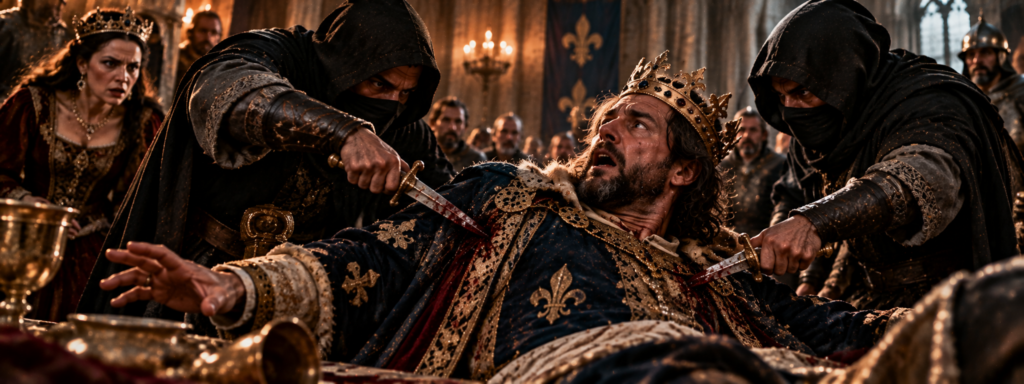
According to Gregory of Tours, our most important narrative source for the episode, the attackers had been sent by Chilperic’s formidable queen, Fredegund. They carried weapons whose blades had been smeared with poison, approached Sigebert while he was surrounded by men who had recently acclaimed him, and struck him on both sides. The king collapsed from his wounds, while the assassins were immediately killed by Sigebert’s followers. Within an astonishingly short time, a political triumph that had taken years to build was shattered by a few violent seconds.
Sigebert’s death was more than the assassination of a king. It rescued Chilperic from what may have been imminent destruction, transformed Sigebert’s widow Brunhild from victorious queen into a vulnerable prisoner, endangered their young son Childebert II, and ensured that the conflict between the two royal households would continue into another generation. The murder did not end the Merovingian civil wars. It gave them new victims, new grievances, and new reasons for revenge.
The assassination also became inseparable from the terrifying reputation of Fredegund. Medieval chroniclers portrayed her as one of the most ruthless women ever to occupy a Frankish court, associating her with murders, attempted murders, conspiracies, and dynastic bloodshed. Some accusations against her are better supported than others, and Gregory of Tours was no neutral observer of the royal family he described. Yet in the case of Sigebert, Gregory explicitly places responsibility upon Fredegund, describing the two killers as men she had sent.
That accusation must be handled carefully. We do not possess an independent investigation, confession, surviving order, or contemporary judicial record proving that Fredegund organized the attack. Gregory wrote relatively close to the events and knew many of the people involved, making his testimony extraordinarily important, but his narrative still reflects political loyalties, moral judgments, and the storytelling conventions of his age. The assassination is historically secure; Fredegund’s alleged direction of it rests primarily upon the surviving narrative tradition.
What makes the murder particularly haunting is its timing. Sigebert was not assassinated when he was isolated, defeated, or fleeing from his enemies. He was killed at the moment when his victory appeared almost complete. His story is therefore not simply one of royal murder but of how quickly power could disappear in the Merovingian world, where kingdoms were divided among brothers, queens carried the grievances of murdered sisters, aristocrats changed sides when rulers weakened, and the difference between triumph and catastrophe could be measured by the length of a dagger.
Born Into the House of Clovis
Sigebert belonged to the Merovingian dynasty, the royal family that had emerged from the violent consolidation achieved by Clovis I. By the time Sigebert was born, probably around 535, the descendants of Clovis ruled an enormous portion of Gaul. Their kingdom contained Roman cities, Frankish military elites, powerful bishops, wealthy aristocrats, agricultural estates, and populations whose identities had been shaped by centuries of Roman rule and decades of political upheaval. It was a formidable inheritance, but Merovingian inheritance customs repeatedly turned that inheritance into a source of conflict.
Clovis had died in 511, leaving his kingdom divided among his sons. Those sons fought, allied, conquered, murdered, and inherited until much of the Frankish realm eventually came under the authority of Sigebert’s father, Chlothar I. Chlothar was one of the last surviving sons of Clovis and a ruler whose own career demonstrated how dangerous Merovingian family politics could become. The dynasty did not treat blood relationship as a guarantee of peace; on the contrary, royal blood created claims, and claims created rivals.
Sigebert grew up in a world where kingship was intensely personal. A king needed treasure to reward followers, military success to command respect, bishops and aristocrats willing to cooperate with him, and a family capable of producing heirs. He also needed to survive his relatives. Brothers could be allies against an outside enemy one year and competitors for territory the next.
Chlothar I had several sons who survived into adulthood, including Charibert, Guntram, Sigebert, and Chilperic. When Chlothar died in 561, his kingdom was divided among them. Such divisions were not understood simply as the permanent creation of modern states with fixed national borders. Each brother received a share of the royal inheritance, and the resulting political geography could be complicated, with territories and cities distributed across different regions.
Sigebert received the eastern kingdom conventionally known as Austrasia. Its political centers included areas along the Rhine and Moselle, and Metz became closely associated with his rule. Austrasia possessed substantial military resources and occupied a strategically important position facing Germanic peoples beyond the Frankish frontier. It was a kingdom that could produce powerful rulers, but its king remained part of a wider Merovingian family whose members regarded one another’s lands with persistent interest.
Chilperic received a western share that later became associated with Neustria. Guntram ruled a Burgundian kingdom, while Charibert received lands centered around Paris. The brothers were kings in their own right, yet the memory of a larger Frankish realm remained. Every death, marriage, rebellion, and inheritance threatened to rearrange the balance among them.
The division of 561 therefore did not produce stability. It created four powerful brothers with overlapping dynastic interests and armies capable of enforcing them. Sigebert’s greatest enemy would not come from beyond the Frankish world. He would come from inside his own family.
Sigebert and Chilperic: Brothers Who Became Enemies
Chilperic I has one of the darkest reputations of any Merovingian king, although much of that reputation comes from Gregory of Tours, who disliked him intensely. Gregory famously compared Chilperic to Nero and Herod, presenting him as greedy, cruel, irreligious, and dangerous. Modern historians must treat such characterization cautiously, but there is no doubt that Chilperic was ambitious and repeatedly involved in violent struggles with his relatives.
Sigebert and Chilperic soon found themselves competing over territory. The death of their brother Charibert in 567 without surviving sons created another opportunity for redistribution. Charibert’s lands were divided among his brothers, but the arrangements did not eliminate rivalry. Paris, in particular, carried political significance, and agreements concerning shared or restricted access to the city became part of the complicated relationship among the surviving kings.
Territorial ambition alone, however, does not explain the extraordinary bitterness that developed between Sigebert’s household and Chilperic’s. The conflict acquired a deeply personal dimension through two sisters from Visigothic Spain. Their marriages to the Frankish brothers transformed a dynastic rivalry into a feud saturated with allegations of adultery, murder, humiliation, and revenge.
Sigebert was the first to seek a prestigious foreign marriage. He married Brunhild, daughter of the Visigothic king Athanagild and Queen Goiswintha. Brunhild came from a powerful royal house and brought with her the status of a princess raised at an established Mediterranean court. Gregory praised her beauty, intelligence, and dignity, though his portrait of her would become more complicated as political circumstances changed.
The marriage was significant beyond romance. A foreign royal bride strengthened Sigebert’s international prestige and distinguished his household from those of Frankish rulers who maintained multiple relationships with women of less elevated dynastic status. Brunhild converted from Arian Christianity, associated with the Visigothic monarchy, to the Catholic Christianity practiced by her husband and much of the Gallo-Roman population. She quickly became an important political figure in Austrasia.
Chilperic apparently wanted a comparable marriage. He sought the hand of Brunhild’s sister Galswintha, another daughter of Athanagild. Yet Chilperic already had a complicated domestic life, including a relationship with the woman who would become Queen Fredegund. Galswintha’s arrival would place these women, their husbands, and their families at the center of one of the most notorious feuds of the early Middle Ages.
Brunhild and Galswintha
Galswintha crossed into the Frankish kingdom to marry Chilperic around 567 or 568. The marriage carried considerable political value and was accompanied by property arrangements appropriate to a royal bride. Gregory portrays Galswintha as unhappy almost from the beginning, particularly because of Chilperic’s continued relationship with Fredegund. According to his account, Galswintha eventually asked to return to Spain, even offering to abandon property she had brought into the marriage if she could be released.
She never returned home. Galswintha was found dead in her bed, reportedly strangled, not long after the marriage. Gregory states that Chilperic ordered her killed, although the exact circumstances of her death cannot now be reconstructed independently. What followed made suspicion even more explosive: Chilperic soon restored Fredegund to his side.
For Brunhild, Galswintha’s death was not merely a diplomatic incident. The dead queen was her sister. The alleged murderer was her husband’s brother, and the woman who benefited most visibly from Galswintha’s removal was Fredegund.
The killing became one of the central grievances behind the wars that followed. Guntram, the surviving brother who often attempted to mediate disputes within the dynasty, became involved in efforts to settle the conflict. A judgment concerning Galswintha’s marriage property was supposed to compensate Brunhild in some fashion, with cities connected to Galswintha’s dowry or morning gift becoming points of contention. Yet legal arrangements could not erase the emotional and political consequences of a queen’s suspicious death.
The relationship between Brunhild and Fredegund would later become legendary. Medieval narratives transformed them into opposing queens locked in a decades-long struggle of astonishing violence. The reality was more complicated than a simple personal vendetta between two women, because kings, nobles, bishops, heirs, territorial disputes, and military interests all drove the conflicts. Nevertheless, Galswintha’s death gave the rivalry a powerful personal core.
Sigebert now had both political and familial reasons to oppose Chilperic. His wife believed her sister had been murdered within Chilperic’s household. The dispute over Galswintha’s property added material stakes to the grievance. Every subsequent territorial confrontation could therefore reopen the wound.
Fredegund, meanwhile, became queen beside Chilperic. Her origins appear to have been far less exalted than those of Brunhild and Galswintha, but her political ability was formidable. She would survive crises that destroyed kings, princes, rivals, and enemies around her, eventually acting as regent for her young son Chlothar II. Her rise from a comparatively obscure background to the center of Merovingian power was extraordinary, and the violence attributed to her became inseparable from her reputation.
War Along the Frankish Frontiers
While tensions within the royal family worsened, Sigebert faced serious military pressures elsewhere. Austrasia bordered regions vulnerable to attacks by peoples beyond the eastern frontier, including the Avars, a formidable steppe power that expanded into central Europe during the sixth century. Sigebert fought against them more than once, and his eastern responsibilities sometimes created opportunities for Chilperic to move against him in the west.
This pattern intensified the brothers’ hostility. A king occupied with an external invasion could discover that a relative had exploited his absence to seize territory. Frankish civil war did not pause simply because foreign enemies threatened the kingdom. The competing demands made kingship more precarious and encouraged rulers to act opportunistically.
Sigebert proved capable of recovering from setbacks. He developed a reputation as a successful military ruler and maintained the loyalty of powerful Austrasian elites. His kingdom had access to formidable manpower, although his use of forces from beyond the Rhine later horrified contemporaries when those warriors devastated regions inside Gaul. Victory in Merovingian warfare could be almost as destructive to civilians as defeat.
Chilperic was equally unwilling to abandon his ambitions. The two brothers exchanged territorial blows, sometimes while Guntram attempted to prevent the conflict from consuming the entire Frankish realm. Alliances shifted repeatedly. A king who supported one brother in one campaign might seek accommodation with the other later.
This instability makes the wars difficult to reduce to a simple sequence of good and evil. Gregory favored Sigebert over Chilperic in many respects, but Sigebert’s forces could also commit serious devastation. Neither side conducted war according to modern humanitarian expectations. Cities, estates, churches, and rural communities could suffer because royal brothers disagreed over inheritance and authority.
The personal feud nevertheless remained unusually intense. Galswintha’s death ensured that the conflict was not merely about strategic territory. Brunhild had every reason to view Chilperic and Fredegund through the memory of her murdered sister. Fredegund, in turn, faced the possibility that Sigebert’s victory would destroy her husband, remove her own political position, and endanger her children.
By 575, these pressures converged. The civil war entered a phase in which Chilperic’s position became increasingly desperate. Sigebert was no longer merely defending Austrasia or disputing a few cities. He was approaching a victory that threatened the survival of his brother’s monarchy.
The Road to 575
The final campaign developed from a complex series of confrontations involving the brothers and their sons. Chilperic had sent his son Theudebert against territories connected with Sigebert. The young prince campaigned aggressively and was accused of devastating regions that he attacked. In the brutal logic of Merovingian dynastic war, royal sons were not protected spectators; they were commanders and potential victims.
Theudebert eventually confronted forces loyal to Sigebert. He was defeated and killed. Gregory reports that his body was treated with a degree of respect by Duke Gundovald, one of Sigebert’s commanders, but the death of Chilperic’s son was another escalation in a conflict already saturated with family blood. A father had lost an heir in a war against his own brother.
Sigebert pressed his advantage. Chilperic’s ability to maintain loyalty began to deteriorate as the military situation worsened. This was one of the fundamental dangers of early medieval kingship: aristocratic support often depended partly upon a ruler’s capacity to protect and reward his followers. Once a king appeared doomed, men who had served him could begin considering whether their interests would be safer under the victor.
Sigebert moved westward and gained support in territories that had belonged to Chilperic. The situation became so serious that Chilperic withdrew toward Tournai with Fredegund and their family. What had begun as rivalry between two Merovingian kings was becoming a struggle for political survival. If Sigebert succeeded completely, Chilperic might lose not only disputed lands but his crown and perhaps his life.
The aristocracy of Chilperic’s kingdom now faced a choice. They could remain loyal to a weakening king or acknowledge the brother who appeared capable of replacing him. Gregory describes leading men turning toward Sigebert. The momentum of the war was visibly shifting.
Sigebert advanced to the area of Paris and then farther north. His position strengthened as more of Chilperic’s former supporters recognized him. The possibility emerged that he could take over his brother’s realm with the cooperation of the very elites who had once served Chilperic. A military victory was becoming a political transfer of allegiance.
For Fredegund, the danger could hardly have been greater. Her husband was cornered, her son’s future was threatened, and the victorious brother of the woman whose sister had died in Chilperic’s household was being accepted as king. If Sigebert completed his takeover, Fredegund could expect little security. The assassination Gregory attributes to her must be understood against that desperate background.
Sigebert at the Edge of Triumph
Sigebert arrived at Vitry, generally identified with Vitry-en-Artois, where men from Chilperic’s kingdom gathered around him. The exact details of the acclamation are filtered through Gregory’s narrative, but the political meaning is clear. Sigebert was being recognized by leading men from the territory he was conquering. His brother’s kingdom was beginning to pass into his hands.
Merovingian kingship depended upon more than simple hereditary succession. Royal blood was indispensable, but recognition by powerful followers mattered enormously. A king who could not command aristocratic support might possess a legitimate pedigree yet still lose his kingdom. Sigebert’s reception demonstrated that Chilperic’s political base was cracking.
The symbolism of the moment was powerful. Sigebert had survived years of conflict, external invasions, territorial disputes, and family tragedy. Chilperic’s son Theudebert was dead. Chilperic himself had retreated, and his nobles were defecting. The Austrasian king seemed poised to emerge as the dominant surviving son of Chlothar I.
Yet triumph created vulnerability. Sigebert was now surrounded not only by his long-standing Austrasian supporters but also by men whose loyalty had recently belonged to his enemy. Crowds, ceremonies, petitions, and acts of submission brought strangers into proximity with the king. The very process of accepting a conquered political community required him to make himself accessible.
Security in such circumstances depended upon followers recognizing threats before they reached the royal body. There were no modern protective details, metal detectors, controlled perimeters, or reliable intelligence systems. A determined attacker willing to die could exploit confusion around a public royal gathering. Two attackers were about to do exactly that.
Gregory says Fredegund selected or sent two men to kill Sigebert. They are often described in modern retellings as slaves, servants, or retainers. The Latin terminology and social categories of the period do not always map neatly onto modern English, but the essential point in Gregory’s narrative is that they were agents dispatched from Fredegund’s side. Their mission was not to survive.
Their weapons were small enough to carry close to the king. Gregory describes them as strong knives or scramasaxes, and he states that they were smeared with poison. The assassins needed only to approach within striking distance. Against an army, two men were meaningless; against the exposed body of a king, they could change the future of the Frankish kingdoms.
Fredegund’s Desperate Gamble
Fredegund’s alleged decision makes sense only when the military situation is understood. Chilperic could no longer reliably defeat Sigebert through conventional warfare. His support was collapsing, his son had been killed, and he had been forced into a defensive position. If Sigebert survived long enough to consolidate the allegiance of Chilperic’s former nobles, the war might be over.
Assassination offered a radically different solution. Sigebert’s military strength depended upon Sigebert being alive. His kingdom had an heir, but Childebert II was still a child. Brunhild was politically capable, yet queens faced severe constraints when attempting to exercise authority for young sons amid armed aristocratic factions. Killing the adult king could transform a victorious invasion into a succession crisis overnight.
Fredegund had every reason to understand that calculation. Her own position depended upon Chilperic’s survival and the prospects of her children. A victorious Sigebert, influenced by Brunhild, might seek vengeance for Galswintha’s death. Even if Fredegund escaped execution, she could lose royal status, property, access to her children, or freedom.
The murder therefore required no irrational bloodlust to explain it. If Gregory’s accusation is correct, it was an act of extreme political desperation carried out with chilling strategic intelligence. Two expendable assassins could accomplish what Chilperic’s armies had failed to do. Their deaths would not matter if Sigebert died with them.
Gregory places the initiative specifically with Fredegund, not merely with Chilperic. That attribution became foundational to her later reputation. She appears not as a passive royal wife waiting for her husband’s fate but as an independent political actor capable of identifying the one vulnerable point in Sigebert’s otherwise overwhelming advantage. Whether every detail reflects reality or hostile tradition, the narrative preserves the perception that Fredegund could be more dangerous than an army.
There is an additional layer of irony. Sigebert’s marriage to Brunhild had helped intensify the rivalry between the royal households, while Chilperic’s relationship with Fredegund had helped create the conditions surrounding Galswintha’s death. Now the two queens stood behind opposing dynastic futures. Brunhild’s husband was on the verge of victory, while Fredegund’s husband appeared on the verge of ruin.
The war would be decided not by another great battle but by access to Sigebert’s body. Fredegund’s alleged plan accepted that the assassins themselves would probably be killed. Their only requirement was to strike first. In the political arithmetic of 575, two dead servants in exchange for one dead king was an extraordinary bargain.
The Poisoned Blades
The detail that has made Sigebert’s assassination especially notorious is Gregory’s statement that the attackers used poisoned weapons. Poisoned blades occupy a dramatic place in historical imagination, but claims involving poison always deserve careful handling. Medieval writers sometimes attributed mysterious or rapid deaths to poison when modern forensic confirmation is impossible.
In Sigebert’s case, however, the poison is not a much later romantic embellishment. Gregory himself describes the weapons as poisoned. That makes the tradition early and important, although it still does not allow us to identify the substance, concentration, or physiological effect involved. No surviving medical examination tells us whether Sigebert died from poison, blood loss, organ damage, infection, or some combination of injuries.
Modern retellings sometimes imagine elaborate toxic preparations without evidence. There is no basis for confidently naming a specific poison. The assassins may have coated their blades with a toxic substance believed capable of making even a nonfatal wound deadly, but exactly what they used is unknown. The safest description is simply the one supported by the source: Gregory reports that the blades were poisoned.
The use of poison would have provided insurance. An assassin approaching a guarded king could not count on having time to deliver repeated blows. If the weapon carried a toxin, even a wound that failed to kill immediately might prove fatal afterward. The plan therefore increased the likelihood that a brief attack would succeed.
The attackers also appear to have coordinated their assault. Gregory describes Sigebert being struck from both sides. This suggests a deliberate attempt to overwhelm him before guards could intervene. Two men attacking simultaneously would be far more difficult to stop than a single assailant.
They were effectively sacrificing themselves. Anyone who stabbed a king in the middle of his armed followers had little realistic chance of escaping. The assassins’ deaths immediately after the attack confirm the danger. Their mission was successful only because Sigebert died too.
The poisoned blades therefore became the perfect weapon for an assassination born from desperation. They required no army, siege, or extended campaign. They turned physical proximity into strategic power. Sigebert could command thousands of warriors and still be killed by two men standing within arm’s reach.
The Assassination at Vitry
The exact visual details of the assassination cannot be reconstructed with cinematic certainty. We do not know precisely how Sigebert was dressed, where every noble stood, what words were spoken, or whether the attackers approached under a particular pretext. Any detailed recreation of those elements would cross the line from historical narrative into invention. What Gregory gives us is stark enough without embellishment.
Sigebert was at Vitry among men who had accepted his rule when the two attackers reached him. They struck him with their poisoned weapons, apparently from opposite sides. The king suffered fatal wounds before his followers could prevent the attack. The assassins were then killed on the spot.
Gregory names one additional casualty, a chamberlain named Charegisel, who was killed in the confusion. Another man, Sigila, was wounded. These details reinforce the impression of a sudden violent struggle around the king rather than a clean ceremonial execution. The attackers penetrated the royal circle, struck their target, and were cut down amid the resulting chaos.
Sigebert was about forty years old, perhaps slightly younger or older depending upon the uncertain date of his birth. He had ruled Austrasia for approximately fourteen years. Only moments before the attack, his political future appeared more secure than it had ever been.
His death reversed everything. A royal army could survive the loss of ordinary soldiers, and an aristocratic faction could replace a fallen commander. Replacing the king at the center of a dynastic conquest was much harder, especially when his heir was a child. Sigebert’s followers had been united by his claim, his military reputation, and the expectation that he would rule the conquered territory.
With Sigebert dead, those expectations evaporated. The men who had defected from Chilperic suddenly had reason to reconsider their choices. The king they had abandoned was still alive. The king they had acclaimed lay dead.
Few assassinations demonstrate more clearly the disproportionate power of killing a ruler at the correct moment. Fredegund’s alleged agents did not destroy Sigebert’s army. They destroyed the political structure that gave the army its immediate purpose. The war changed direction before the blood around the king had dried.
Chilperic Saved by Murder
Chilperic’s position before the assassination had been desperate. He had withdrawn to Tournai while Sigebert absorbed support from his kingdom. Had Sigebert lived, Chilperic might have been captured, exiled, tonsured, imprisoned, or killed. The Merovingian record provided precedents for all kinds of brutal treatment of defeated royal relatives.
Sigebert’s death saved him. The momentum carrying his nobles toward the Austrasian king disappeared because there was no longer an adult conqueror to receive their allegiance. Chilperic could emerge from his defensive position and begin recovering territory. A war that appeared lost had been transformed by assassination.
The reversal was so dramatic that it helps explain why Fredegund’s alleged role seemed plausible to Gregory and later writers. No one benefited more immediately than Chilperic and his queen. Motive and consequence aligned almost perfectly. Yet benefit alone is not proof, which is why Gregory’s explicit accusation remains central to the historical case.
Chilperic moved quickly. In dynastic politics, hesitation after a rival’s death could waste the opportunity created by murder. Sigebert’s supporters needed time to organize around his young son, while Brunhild needed access to political allies and treasure. Chilperic had every incentive to prevent either.
Brunhild soon fell into his hands. The woman whose husband had been approaching victory became a prisoner of the household she regarded as responsible for her sister’s death and now, according to Gregory’s narrative, for her husband’s assassination. Her circumstances could scarcely have changed more violently.
The assassination therefore achieved several objectives simultaneously. It preserved Chilperic’s kingship, protected Fredegund’s position, disrupted the Austrasian offensive, and exposed Brunhild to capture. It also threatened the succession of Sigebert’s son. If the child could be seized as well, Sigebert’s entire branch of the dynasty might be neutralized.
That did not happen. Childebert II escaped, and his survival prevented the assassination from producing complete victory for Chilperic. The boy would become king of Austrasia and ensure that Sigebert’s dynasty remained a powerful force. The murder had saved Chilperic, but it had not ended the feud.
Brunhild: From Victorious Queen to Prisoner
For Brunhild, Sigebert’s murder was catastrophic on both personal and political levels. She had already lost her sister Galswintha under circumstances Gregory blamed on Chilperic. Now her husband had been assassinated by men Gregory attributed to Fredegund. The two deaths became inseparable from the hostility between the royal households.
Brunhild was in Paris when the political situation collapsed. Chilperic gained control of her and the treasure available to her, placing her under guard. Her daughters were also vulnerable. A queen who only recently might have expected to stand beside the dominant Frankish king had become the widow of an assassinated ruler.
Her son Childebert II was the crucial exception. Austrasian loyalists succeeded in getting the young prince away from danger. He was taken to safety and proclaimed king, preserving Sigebert’s line. The survival of the child prevented Chilperic from absorbing Austrasia as completely as Sigebert had nearly absorbed his kingdom.
The situation illustrates the importance of royal children in Merovingian politics. A boy did not need to command armies personally to matter. His blood gave adult aristocrats a legitimate figure around whom they could organize. Protecting Childebert therefore became equivalent to protecting the independence of Austrasia.
Brunhild’s own future remained extraordinary. She did not disappear into permanent captivity. Chilperic’s son Merovech later married her, creating another explosive dynastic crisis because Merovech was the son of the man Brunhild blamed for her family’s suffering. The marriage brought Merovech into conflict with Chilperic and Fredegund and ultimately contributed to another sequence of tragedy.
Brunhild would survive Sigebert by more than three decades. She became one of the most powerful political women of the Merovingian age, acting as queen mother and grandmother while attempting to preserve the interests of her descendants. Her enemies would eventually destroy her in 613 after the triumph of Fredegund’s son Chlothar II.
Sigebert’s assassination therefore did not end Brunhild’s political career. It transformed it. The queen who had entered Frankish politics as a Visigothic princess became a widow fighting to protect a dynasty in a world where her husband’s killers had demonstrated how easily royal victory could become royal death.
The Child King Childebert II
Childebert II was only a small child when his father was murdered. His age made him vulnerable, but it also made him indispensable. Austrasian magnates who wanted to preserve their kingdom from Chilperic needed a legitimate Merovingian ruler, and Sigebert’s son provided exactly that.
The boy was reportedly rescued by a loyal figure and removed from immediate danger. He was then established as king in Austrasia. Real political authority during his minority necessarily depended heavily upon aristocrats and members of the royal household, creating opportunities for factional competition.
Brunhild’s separation from her son complicated the situation. A queen mother could provide dynastic continuity and political direction, but Brunhild was initially in enemy hands. Austrasian nobles therefore had substantial freedom to shape the regency. Some undoubtedly preferred a child king precisely because he could not dominate them as his father had.
Childebert’s survival also undermined the strategic completeness of Sigebert’s assassination. Chilperic had been saved, but he had not inherited Austrasia. The eastern kingdom remained under Sigebert’s line. The rivalry would continue rather than resolve itself through one side’s extinction.
As Childebert grew older, Brunhild regained influence over him. He eventually became a major ruler in his own right and inherited Guntram’s Burgundian kingdom in 592. Sigebert’s dynasty therefore recovered from the disaster of 575 with remarkable strength. The murdered king’s descendants remained central to Frankish politics.
Yet the assassination had permanently altered their world. Childebert grew up knowing that his father had been murdered during a war with his uncle. Brunhild’s political actions unfolded under the shadow of Galswintha and Sigebert. Fredegund’s children inherited an equally dangerous conflict from their parents.
Dynastic violence had become intergenerational. The grievances of one set of siblings passed to their sons and grandsons. Sigebert’s assassination was not the conclusion of the feud but one of the events that ensured its continuation.
Fredegund and the Making of a Murderous Reputation
Few medieval queens acquired a reputation as dark as Fredegund’s. Gregory and later chroniclers associated her with a remarkable catalogue of killings and attempted killings. Some involved political rivals, some members of the royal family, and others ecclesiastical opponents. Over time she became almost an archetype of the murderous queen.
That reputation requires careful historical treatment. Powerful women in medieval narratives were often judged according to gendered expectations that could make female political aggression appear especially monstrous. Male kings routinely ordered executions and waged devastating wars without acquiring precisely the same literary image. Fredegund’s gender undoubtedly influenced how later writers framed her actions.
Yet dismissing every accusation as misogynistic invention would be equally simplistic. Fredegund operated in an exceptionally violent political environment and appears to have exercised real power. Gregory knew her world relatively closely and repeatedly presents her as an active participant rather than a passive victim of hostile rumor. Some of the actions attributed to her are consistent with the ruthless strategies used by male rulers around her.
The assassination of Sigebert became central to that image because it was spectacularly effective. A queen whose husband was nearly defeated allegedly dispatched two men who penetrated the victorious king’s entourage and killed him. The operation required nerve, intelligence, secrecy, and complete willingness to use murder as political strategy.
Gregory’s hostility toward Fredegund should therefore encourage scrutiny rather than automatic rejection. He had his own moral and political perspective, and his depiction of royal women could be shaped by personal relationships and ecclesiastical concerns. But he was not writing centuries later from pure legend. He lived through the period and interacted with major figures in the conflict.
The responsible conclusion is consequently precise. Gregory of Tours says Fredegund sent the assassins who killed Sigebert. That is our strongest surviving narrative evidence, and the political circumstances give her an obvious motive. We cannot independently prove the order through surviving documentary evidence.
Even with that qualification, the assassination remains one of the defining episodes of her career. Fredegund’s enemies would remember her not merely as a queen who survived but as a woman who could transform two obscure men carrying poisoned blades into weapons capable of reversing a war.
Brunhild and Fredegund: More Than a Personal Feud
Popular retellings often reduce the decades of Merovingian conflict to a duel between Brunhild and Fredegund. The image is irresistible: two powerful queens, one a Visigothic princess and the other a woman of comparatively humble origin, locked in a blood feud beginning with Galswintha’s murder and ending only after both women were dead. There is truth in the rivalry, but reducing everything to personal hatred oversimplifies a much larger political struggle.
Kings controlled territories that nobles wanted to influence. Aristocratic families competed for offices, land, access to royal patronage, and regional power. Bishops intervened in political disputes and sometimes sheltered fugitives. Royal children represented competing claims to kingdoms.
Brunhild and Fredegund were powerful because they stood at the center of these structures. Their marriages and children connected them to royal legitimacy. Their personal grievances mattered precisely because those grievances could mobilize kingdoms. A sister’s murder could become a territorial dispute because the sister had been a queen with valuable marriage property.
Sigebert’s assassination demonstrates the intersection perfectly. If Fredegund ordered it, she was protecting herself and her family, but she was also preserving Chilperic’s kingdom. The personal and political motives cannot be separated cleanly. Saving her husband meant saving her own position and her son’s inheritance.
Brunhild’s response after Sigebert’s death was equally dynastic. She had every personal reason to hate those she believed responsible, but she also had to preserve Childebert’s throne. Her political survival became inseparable from her child’s royal rights. Maternal protection and statecraft became the same struggle.
The feud therefore grew because every death created both emotional vengeance and practical political consequences. Galswintha’s death affected property and alliances. Sigebert’s death created a child king. Later killings generated new claimants, widows, enemies, and opportunities.
By 575, there was no simple way to separate family from kingdom. The Merovingian state was a family possession, and family conflict became public war. When Sigebert was stabbed, a husband and brother died, but an entire political order also shifted.
Gregory of Tours and the Problem of the Evidence
Almost any detailed account of Sigebert’s assassination must depend heavily upon Gregory of Tours. Born around 538 and later bishop of Tours, Gregory lived during the reigns of the kings he described. He met rulers, bishops, aristocrats, royal officials, and people connected with the events of the period. His Histories are indispensable for understanding sixth-century Gaul.
Indispensable does not mean neutral. Gregory had strong religious convictions, political preferences, personal conflicts, and moral judgments. He admired some rulers more than others and could be devastating toward those he believed threatened the Church or violated proper Christian kingship. Chilperic received particularly hostile treatment.
Gregory also wrote history according to literary conventions different from those of a modern investigative journalist. He included speeches, miracles, rumors, moral lessons, and dramatic episodes. He sometimes tells readers that he heard a report rather than witnessed an event. His work therefore requires careful source criticism.
Sigebert generally fares better in Gregory’s narrative than Chilperic. That should make us alert to possible bias when the brothers are compared. Similarly, Gregory’s presentation of Fredegund is overwhelmingly negative. His accusation that she arranged Sigebert’s assassination cannot simply be treated as the equivalent of a modern criminal conviction.
At the same time, Gregory was writing relatively close to 575. Sigebert’s murder was not an ancient legend to him. Many people who had lived through the assassination were still alive, and the political consequences remained immediate. Inventing an entirely fictitious murder conspiracy involving the reigning queen would have been a substantial claim.
The most reasonable approach is therefore neither blind acceptance nor blanket skepticism. The core facts—that Sigebert was assassinated at Vitry in 575 by two attackers using weapons Gregory describes as poisoned—are strongly embedded in the contemporary narrative tradition. Gregory’s claim that Fredegund sent them is historically significant and plausible, but it remains an attribution from the source rather than something independently demonstrated beyond doubt.
The same caution applies to every cinematic detail. We cannot know the assassins’ thoughts, Sigebert’s final words, or Fredegund’s private instructions. A compelling narrative does not require inventing them. The documented political circumstances are dramatic enough.
Poison, Daggers, and the Reality Behind the Legend
Modern summaries often describe Sigebert as being killed with “poisoned daggers.” That phrase captures Gregory’s essential account but can create misleading visual assumptions. The weapons are sometimes described more specifically as scramasaxes, single-edged blades associated with Germanic warriors. Terminology varies in translations and retellings, and absolute precision about the weapon type is difficult.
What matters is that the weapons were capable of inflicting serious stabbing wounds at close range. They were not ceremonial objects. The attackers intended to kill quickly before Sigebert’s guards could react. The reported poison made the wounds even more dangerous.
There is no evidence that Sigebert lingered for days while physicians struggled against an exotic toxin, despite the dramatic possibilities such a scene might offer. Gregory’s account does not support elaborate stories about his final hours. The assassination appears to have been rapidly fatal.
Nor do we know whether the poison itself was necessary to kill him. Deep wounds to the torso could be fatal without any toxin. If the attackers struck from opposite sides, the physical injuries alone may have been catastrophic. Poison could have been an additional safeguard or a detail emphasized because it made the treachery seem even more sinister.
The combination of secret agents and poisoned weapons carried moral meaning for medieval readers. Open battle allowed kings to display courage and divine favor. Poison and assassination suggested concealment, deception, and the inversion of honorable warfare. Fredegund’s alleged method therefore contributed to the dark image surrounding her.
Yet from a strategic perspective, the method was brutally rational. Fredegund could not defeat Sigebert’s army herself. She did not need to. She needed to stop the man around whom that army and its political coalition had formed.
Two blades accomplished what thousands of soldiers had failed to accomplish. That is the essential terror of the episode. A kingdom could be defended by fortresses and armies, but the king himself remained made of flesh.
The Collapse of Sigebert’s Victory
The speed of the reversal after Sigebert’s death demonstrates how personal Merovingian kingship remained. His campaign had not created a modern bureaucratic state capable of continuing automatically after the ruler died. Allegiance had been given to Sigebert as a king. Once he was dead, men had to calculate their loyalties again.
Chilperic recovered from the brink of destruction. The nobles who had abandoned him could reconsider their positions. The military forces assembled around Sigebert no longer had an adult ruler capable of completing the conquest. Austrasia’s immediate priority shifted from expansion to protecting Childebert II.
Brunhild’s capture removed another potential center of leadership from the field. She possessed intelligence, royal connections, and a powerful personality, but captivity restricted her ability to coordinate resistance. Chilperic had suddenly gained leverage over the widow of the man who had nearly destroyed him.
The assassination thus demonstrates why regicide could be more strategically effective than battlefield victory. Defeating an army might require months of campaigning and still leave the opposing king alive to raise another force. Killing the king could dissolve alliances immediately. Leadership itself was a military resource.
Sigebert had seemed strong precisely because so many people believed he would win. Once he died, that belief became meaningless. The political momentum that had drawn Chilperic’s followers toward him could reverse just as quickly. Survival itself became evidence of legitimacy.
Chilperic’s kingdom therefore owed its continuation, at least in part, to the assassination. Without Sigebert’s death, the history of the Merovingian realms might have unfolded very differently. Chilperic could have been eliminated, Fredegund’s political career might have ended, and Brunhild might have emerged beside Sigebert as queen of a vastly expanded realm.
Instead, Sigebert was buried while his brother continued ruling. One successful assassination erased an entire future that had seemed almost inevitable only hours earlier. History did not turn because Sigebert lost a battle; it turned because two men reached him before his guards could stop them.
The Burial of a Murdered King
Sigebert’s body was eventually buried at Soissons, traditionally in the church of Saint-Médard. The location carried associations with Frankish royal power and Christian kingship. Burial in an important church gave the murdered ruler the dignity denied to him in the chaos of his final moments.
His funeral could not restore what had been lost. Austrasia now belonged to a child. Brunhild remained caught in the dangerous politics of her enemies. The men who had acclaimed Sigebert in the west returned to a world in which Chilperic was still king.
Royal burial nevertheless mattered. Merovingian rulers understood the symbolic importance of churches, saints, and sacred spaces. A king’s tomb could preserve dynastic memory even after his political plans failed. Sigebert had not disappeared merely because his conquest collapsed.
His death also acquired a moral dimension through the manner in which it was remembered. He had been killed treacherously rather than defeated honorably in battle. That distinction could enhance sympathy for him and deepen condemnation of his enemies. Assassination turned the victorious warrior king into the victim of secret murder.
For Brunhild and Childebert, his memory became part of dynastic legitimacy. Childebert was not simply a child king; he was the son of a murdered ruler. Brunhild was not simply an ambitious widow; she was the wife of a man whose assassination had deprived her family of victory. Memory could be converted into political capital.
Yet Sigebert’s tomb also marked the limits of vengeance. No burial could undo the attack at Vitry. The political future had already moved on. The dead king could be honored, but he could no longer command.
His assassination therefore created the strange duality common to murdered monarchs. Death could make a ruler more memorable while making his political plans impossible. Sigebert became a powerful symbol at the precise moment he ceased to be a political actor.
Merovech and the Widow of His Uncle
The aftermath became even more complicated when Brunhild and Merovech, a son of Chilperic by an earlier wife, married. The union was astonishing in dynastic terms. Merovech was marrying the widow of his paternal uncle, and Brunhild was marrying the son of the man against whom Sigebert had been fighting when he died. Church law and royal politics made the match deeply controversial.
For Merovech, the marriage may have offered access to Brunhild’s prestige and connections. For Brunhild, it may have offered a path out of vulnerability and a potential ally within Chilperic’s own family. Whatever their personal feelings, the political implications were enormous. A son of Chilperic had aligned himself with the widow of Sigebert.
Chilperic reacted with hostility. Merovech eventually sought sanctuary and became embroiled in rebellion and flight. His story ended violently, with his death under circumstances that Gregory presents as a form of assisted suicide or killing by a trusted companion when capture seemed imminent. Fredegund’s possible involvement in the pressures surrounding him became part of the wider tradition of royal bloodshed.
The episode illustrates how Sigebert’s assassination continued to destabilize the dynasty. Brunhild’s widowhood created new marriage possibilities and alliances. Chilperic’s own son could become a threat by attaching himself to her. The attempt to eliminate one enemy generated new ones.
Merovech’s fate also demonstrates the danger of royal blood in this period. A prince could become a political center simply because of who his father was. Marriage to Brunhild increased that danger by linking two rival branches of the family. Chilperic could not easily tolerate such a combination.
The civil war therefore metastasized after Sigebert’s death. Instead of producing peace, the assassination redistributed hostility. Old alliances broke, new alliances formed, and younger members of the family were pulled into struggles they had inherited from their parents.
This pattern would repeat for decades. Merovingian politics after 575 remained haunted by unresolved succession disputes and memories of murdered relatives. Sigebert’s death had removed a king but not the forces that produced the conflict.
Chilperic’s Own Violent End
There is a grim symmetry in the fact that Chilperic himself would eventually be assassinated. In 584, nine years after Sigebert’s murder, Chilperic was attacked and killed after returning from hunting at Chelles. The identity of the person or faction responsible remains uncertain. Gregory did not provide a definitive solution.
Later traditions naturally attempted to connect Fredegund, Brunhild, or other political enemies to the murder. Chilperic had accumulated many enemies, and the possibilities are numerous. Modern historians cannot responsibly identify a killer with confidence. His death remains one of the great unresolved royal assassinations of the Merovingian period.
The uncertainty contrasts with Gregory’s direct accusation against Fredegund in Sigebert’s murder. In Chilperic’s case, the historian knew the king had been assassinated but could not securely attribute responsibility. That difference is worth noticing because it suggests Gregory did not automatically assign every unexplained royal death to whichever enemy made the best villain.
Chilperic’s assassination left Fredegund in a dangerous position. Their surviving son Chlothar II was an infant, creating a situation strikingly similar to the crisis Brunhild had faced after Sigebert’s death. Once again, a widowed queen had to preserve the throne of a child while aristocrats and rival kings watched for opportunities.
Fredegund proved remarkably successful. She protected Chlothar’s claim, maintained political influence, and continued participating in military and dynastic struggles until her death in 597. The infant whose future seemed precarious would eventually become one of the most powerful Merovingian kings.
The parallel is striking. Sigebert’s murder left Brunhild defending Childebert II. Chilperic’s murder left Fredegund defending Chlothar II. Both queens became political survivors after the violent deaths of their husbands.
The rivalry therefore outlived the kings who had begun it. Sigebert and Chilperic were both dead, but Brunhild and Fredegund remained. Their sons inherited not only kingdoms but memories of murder.
A Feud Passed Down to Children
Childebert II grew into kingship and eventually ruled both Austrasia and Burgundy after the death of his uncle Guntram. His position seemed to promise renewed strength for Sigebert’s descendants. Yet he died unexpectedly in 596, still relatively young. Contemporary suspicion sometimes surrounded sudden royal deaths, but certainty about his cause of death is impossible.
His sons Theudebert II and Theuderic II inherited portions of his territories. They eventually turned against one another in another brutal Merovingian fraternal war. The cycle that had consumed Sigebert and Chilperic repeated itself among later generations. Family division created rival kingdoms, and rival kingdoms created war.
Fredegund died in 597, leaving Chlothar II to continue the Neustrian branch. Brunhild remained politically active on behalf of her sons and grandsons. Her longevity made her a formidable presence, but it also meant that she accumulated enemies across generations. Aristocratic resentment toward her rule eventually became decisive.
By 613, the descendants of Sigebert had been weakened by internal conflict. Chlothar II gained support from Austrasian elites willing to abandon Brunhild and her great-grandsons. The old pattern returned: a Merovingian ruler was destroyed not only by an external rival but by betrayal from within his own political community.
Brunhild was captured. Chlothar accused her of responsibility for the deaths of numerous members of the royal family, although the charges were shaped by the politics of the victor. She was subjected to a notoriously brutal execution, traditionally described as involving torture and being bound to a horse. The woman whose husband had been assassinated nearly forty years earlier ended her life as the defeated enemy of Fredegund’s son.
The dynastic symmetry is almost too dark to ignore. Fredegund allegedly saved Chilperic’s kingdom by arranging Sigebert’s assassination. Her son ultimately destroyed Brunhild and reunited much of the Frankish realm under his authority. The consequences of the murder at Vitry stretched far beyond 575.
Yet it would be misleading to describe all later conflict as simple revenge for Sigebert. Political circumstances changed repeatedly, and later generations had ambitions of their own. What the assassination did was preserve competing dynasties long enough for those ambitions to continue colliding.
Was Sigebert a Better King Than Chilperic?
Gregory’s narrative encourages readers to prefer Sigebert. He appears more respectable, his marriage to Brunhild is portrayed more favorably than Chilperic’s domestic life, and his political behavior often receives less condemnation. Chilperic, by contrast, becomes one of Gregory’s principal royal villains. That imbalance has shaped Sigebert’s reputation ever since.
Sigebert was certainly an effective ruler in important respects. He defended Austrasia against external threats, maintained powerful aristocratic support, and nearly defeated Chilperic completely. His marriage to Brunhild was politically prestigious and produced a durable dynastic line. He was no insignificant king.
Yet his warfare could be destructive. Gregory criticized the devastation caused by forces Sigebert brought from beyond the Rhine during the civil conflicts. Those warriors ravaged territories inhabited by people who were theoretically subjects of Frankish kings. Civilians paid for royal rivalry regardless of which brother possessed the stronger moral claim.
Sigebert also pursued his own territorial ambitions. He was not merely a passive victim defending himself from Chilperic. By 575 he intended to take control of his brother’s kingdom. His willingness to continue the war after Theudebert’s death shows that he was prepared to destroy Chilperic politically if circumstances allowed.
The distinction therefore should not be between a peaceful Sigebert and a violent Chilperic. Both were Merovingian kings operating in a political system where warfare between relatives was normalized. The difference lies more in the surviving portrayal, specific actions, and alliances than in any simple division between civilized ruler and barbaric rival.
Sigebert’s assassination can still be condemned without turning him into an idealized monarch. He was a warrior king who participated fully in the brutal politics of his age. He simply became the victim of a form of violence he could not answer with an army.
That complexity makes his story more compelling. The man murdered at Vitry was neither saint nor helpless innocent. He was a successful king at the height of a civil war, killed because his enemies could no longer defeat him by ordinary political and military means.
Why Assassination Worked When Armies Failed
The most important strategic fact about Sigebert’s murder is that Chilperic’s military position was collapsing. Conventional resistance had failed to stop Sigebert’s advance. Nobles were changing sides, and royal authority was moving toward the victor. If the conflict continued according to the existing pattern, Sigebert was likely to become stronger with every passing day.
Assassination bypassed the entire problem. It did not matter how many warriors Sigebert commanded if he could be reached personally. It did not matter how many nobles had pledged allegiance if their pledge was to a man who suddenly ceased to exist. Political systems centered on individuals could be catastrophically vulnerable to individual death.
The child heir made the vulnerability even greater. Childebert II possessed legitimacy but not adult military authority. His supporters could preserve Austrasia, but completing Sigebert’s conquest of Chilperic’s kingdom was another matter. The assassination therefore changed an offensive war into a defensive succession crisis.
This explains why political murder has appeared repeatedly in monarchic history. Killing a ruler can sometimes accomplish what winning a battle cannot. It can shatter alliances, create disputed successions, release subjects from personal oaths, and give defeated enemies time to recover. The physical act may take seconds while the consequences last generations.
Fredegund, if Gregory’s account is correct, understood this perfectly. She did not need the assassins to survive or establish a new government. Their role was purely destructive. They needed to remove the one person whose continued existence held the victorious coalition together.
The plan was therefore simultaneously crude and sophisticated. The physical method required little more than concealed blades and willingness to die. The political calculation behind it required recognizing exactly where Sigebert’s strength was also most fragile.
His kingdom survived because Childebert escaped. His victory did not. That difference explains the assassination’s extraordinary effectiveness.
The Human Cost of a Royal Family at War
Royal histories can become so focused on kings, queens, and dynastic boundaries that the wider suffering disappears. The wars between Sigebert and Chilperic were not private arguments conducted inside palaces. Armies crossed populated territories, seized supplies, damaged estates, threatened churches, and exposed ordinary communities to violence. People who had no influence over Merovingian succession could lose homes, crops, relatives, and livelihoods because two brothers fought over power.
Gregory was deeply disturbed by some of this destruction. His position as a bishop made attacks upon churches and clergy particularly important to him, but his narrative also preserves the broader sense of disorder produced by civil war. The Franks were fighting one another while rulers who were supposed to protect Christian society devastated it. Royal rivalry became a public catastrophe.
Sigebert’s use of trans-Rhenish forces was especially controversial because such warriors could be difficult to control once brought into Gaul. Even a king pursuing what he considered a legitimate war could unleash violence that exceeded his intentions. Military necessity and civilian suffering were intimately connected.
The assassination at Vitry did not restore peace to these communities. It simply changed which royal faction held the advantage. Chilperic recovered, Brunhild’s household entered crisis, and the dynastic struggle continued. The population received no permanent relief from the death of one of the principal combatants.
This is important when considering the romantic image of Merovingian queens and warrior kings. Their feuds were not merely dramatic court stories. They consumed resources and lives across kingdoms. The poisoned blades that killed Sigebert belonged to a much larger landscape of violence.
His death therefore should not be remembered only as a spectacular royal assassination. It was one moment in a civil war whose victims extended far beyond the royal family. The kings and queens became famous because chroniclers recorded their names; countless others suffered anonymously beneath their armies.
The darkness of the period lies partly in that imbalance. We know the names of Sigebert, Chilperic, Brunhild, and Fredegund. We rarely know the names of the villagers whose fields their wars destroyed.
The Assassins Who Disappeared Into History
The two men who killed Sigebert achieved one of the most consequential assassinations of the sixth century, yet their individual lives remain obscure. Gregory’s interest lay primarily in the person who allegedly sent them and the king they killed. Their own motives, backgrounds, and personal histories were not preserved in meaningful detail.
They may have been servants or dependents whose position allowed them to be used for a mission from which return was unlikely. Whether they volunteered, were ordered, were rewarded in advance, or acted under some other form of pressure cannot be known. Later storytelling can easily fill such silence with invented motives, but responsible history must leave the gap visible.
What can be inferred is that they expected extreme danger. Sigebert was surrounded by followers, and an attack required close physical contact. Escape after stabbing him was improbable. Their deaths immediately afterward suggest the mission functioned effectively as a suicide attack in political terms, even though we cannot know how they personally understood it.
Their anonymity reveals something about hierarchy in the surviving sources. Kings and queens dominate because their decisions were believed to shape kingdoms. The people who physically carried out royal violence often appear only briefly. They enter history when they touch a ruler and disappear once their function is complete.
Yet without those two men, Fredegund’s alleged plan would have remained merely an intention. They were the physical bridge between conspiracy and political transformation. Their blades converted the desperation of Chilperic’s household into the death of the victorious king.
They were immediately killed, leaving no testimony. There was no interrogation from which a surviving confession could emerge. Their deaths may also have made it impossible to prove the chain of command behind the assassination even at the time. The people who might have testified about who instructed them were conveniently beyond questioning.
This silence contributes to the uncertainty surrounding Fredegund’s responsibility. Gregory tells us where the order originated, but the assassins themselves left no voice. Their identities disappeared while the consequences of their actions reshaped kingdoms.
Regicide at the Moment of Acclamation
Sigebert’s murder belongs especially well within the history of regicide because of the contrast between acclamation and assassination. He was not a forgotten king killed years after deposition. He was an active ruler being accepted by men from the territory of his defeated brother. His political authority was expanding at the exact moment his body became vulnerable.
Acclamation was supposed to display legitimacy. Nobles gathering around a king demonstrated that they accepted his authority. The event transformed conquest into political recognition. Yet the same gathering that displayed Sigebert’s power also gave his killers an opportunity to approach him.
That juxtaposition captures the fragility of personal monarchy. A ruler needed to be seen. He needed to receive followers, hear petitions, preside over ceremonies, and appear among warriors. Total physical isolation would have undermined the relationships that made kingship function. Accessibility was therefore both a political necessity and a security weakness.
The assassins exploited that weakness. They did not need to defeat the men acclaiming Sigebert. They only needed to move among them long enough to reach the center. The crowd that confirmed his kingship could not protect him quickly enough.
His death also exposes the limits of public recognition. Men could proclaim Sigebert king one moment and find themselves without him the next. Political loyalty had to attach itself somewhere else. A ceremony could not preserve authority after the royal body failed.
For that reason, Sigebert’s assassination feels almost like an inversion of coronation. Instead of a ruler emerging from public recognition strengthened, he emerged from it mortally wounded. The moment that should have marked the culmination of victory became the scene of destruction.
The assassins themselves died, but their objective did not require survival. Sigebert’s acclamation had promised a new political order. Two poisoned blades prevented that order from fully coming into existence.
The Kingdom That Might Have Been
Counterfactual history must be approached cautiously, but Sigebert’s position in 575 makes one question unavoidable: what might have happened had he survived? He appeared close to destroying Chilperic’s power. If that process had continued, Sigebert could have controlled Austrasia and much of his brother’s western kingdom while Guntram remained in Burgundy.
Such an arrangement would have dramatically altered Merovingian politics. Fredegund might have been imprisoned, exiled, or otherwise removed from power. Her young son Chlothar II might never have inherited a viable Neustrian kingdom. Brunhild, meanwhile, could have become queen beside the most powerful Frankish ruler of the generation.
Chilperic’s fate would have depended upon Sigebert’s decisions. He might have been killed, confined, forced into religious life, or permitted some reduced position. Given the history of Merovingian treatment of defeated relatives, none of those possibilities can be ruled out. What seems unlikely is that Chilperic would have remained an independent rival if Sigebert’s victory had been completed.
Childebert II would then have inherited a substantially stronger position. The later conflict between Brunhild’s descendants and Fredegund’s son might never have developed in the same form. The eventual triumph of Chlothar II in 613 would have become impossible if his branch had been politically extinguished in 575.
This does not mean Sigebert would have created permanent peace. Merovingian kingdoms had a remarkable tendency to divide among heirs and generate new rivalries. Sigebert’s descendants could easily have fought one another. A larger kingdom might simply have produced a larger inheritance dispute.
Nevertheless, the assassination clearly preserved a political branch that had been close to collapse. Chilperic survived, Fredegund remained queen, and Chlothar II eventually inherited. The future that emerged depended heavily upon Sigebert not living through 575.
That is the measure of the murder’s significance. The assassins did not merely end a reign. They preserved one dynastic future by destroying another at the moment it seemed certain to prevail.
The Long Shadow of Vitry
Sigebert’s assassination remained embedded in the political memory of the Merovingian world. Brunhild survived to pursue power for her descendants, while Fredegund continued defending her own family’s position. Their children and grandchildren inherited kingdoms shaped by the murders, marriages, and betrayals of the previous generation. The violence became part of dynastic identity.
The conflict also contributed to later portrayals of the Merovingians as exceptionally savage. Chroniclers filled their histories with assassinations, mutilations, executions, rebellious sons, murderous relatives, and queens accused of conspiracy. Some of that reputation reflects genuine political violence, while some reflects the moral priorities and dramatic storytelling of the surviving sources.
Sigebert’s death stands out even within that world because the assassination was so strategically decisive. Many royal murders created chaos without clearly benefiting the conspirators. This one immediately rescued the losing side of a civil war. If Fredegund ordered it, her gamble succeeded spectacularly.
Yet success came at enormous long-term cost. The rivalry did not disappear. Brunhild remained alive, Childebert II remained king, and hatred between the dynastic branches deepened. A murder capable of winning the immediate crisis failed to produce lasting reconciliation.
That pattern is common in political assassination. Removing an individual can solve a short-term problem while multiplying long-term grievances. The dead ruler leaves relatives, followers, heirs, and memories. Each becomes a potential source of retaliation.
Sigebert’s murder preserved Chilperic but hardened Brunhild. It saved Fredegund’s political position but ensured that the widow of the murdered king had another reason to oppose her. It prevented immediate conquest but preserved two rival dynasties whose descendants would continue fighting.
Vitry therefore solved one crisis by ensuring the survival of a larger one. The blades were effective precisely because their consequences were so much greater than the men wielding them could control.
The King Behind the Murder Story
It is easy for Sigebert himself to disappear behind the drama of his assassination. Fredegund is such a formidable historical figure, and Brunhild’s later career became so extraordinary, that the murdered king can seem merely like the victim whose death launched their famous rivalry. Yet Sigebert had ruled for more than a decade before Vitry and had shaped Frankish politics in his own right.
He was a successful military ruler who defended Austrasia against serious external threats. He contracted a prestigious marriage with Brunhild and produced an heir whose survival preserved the kingdom. He navigated the difficult politics created by the division of Chlothar I’s realm and emerged as one of the strongest Merovingian kings of his generation.
His final campaign demonstrates his political ability. He had pushed Chilperic to the edge of collapse and persuaded or compelled leading men from his brother’s kingdom to accept him. This was not merely battlefield success. It required converting military advantage into political allegiance.
His weakness lay partly in the same process. Every new supporter had to be trusted enough to approach him. A king absorbing an enemy’s political community could not know with certainty where every man’s true loyalty lay. The triumphal gathering at Vitry contained both his new subjects and his killers.
Sigebert therefore died because he had become powerful enough to threaten everything Fredegund and Chilperic possessed. A weak king would not have required such desperate action. His assassination was, paradoxically, evidence of how close he had come to total victory.
That does not make him a heroic martyr. His armies participated in destructive civil war, and his own ambitions contributed to the conflict. But it restores agency to a man sometimes remembered only for how he died. Sigebert was not simply caught in someone else’s feud.
He was one of the principal architects of the struggle. His death mattered because his life had become central to the balance of power. The poisoned blades ended a king whose enemies could no longer afford to let him win.
Two Blades Between Victory and Oblivion
Sigebert I spent his reign in a world created by family division. His grandfather Clovis had built an enormous Frankish kingdom through conquest and the elimination of rivals, but his descendants repeatedly divided that inheritance among sons. Every division created new courts, new ambitions, and new opportunities for brothers to become enemies. By the time Sigebert and Chilperic inherited their portions of Chlothar I’s realm in 561, the dynasty already possessed generations of experience in turning family relationships into political battlefields.
At first, their rivalry was familiar Merovingian competition over land and influence. Then marriage made it more dangerous. Sigebert married Brunhild, the Visigothic princess whose intelligence and political force would shape Frankish affairs for decades, while Chilperic married her sister Galswintha after maintaining an important relationship with Fredegund. When Galswintha died, reportedly strangled in her bed, Gregory of Tours blamed Chilperic and placed the tragedy within the context of his continuing attachment to Fredegund.
The dead queen left behind more than grief. She left disputed property, diplomatic humiliation, a furious sister, and a permanent stain on the relationship between two royal households. Brunhild could not regard Chilperic and Fredegund as ordinary political competitors after Galswintha’s death. Sigebert’s dynastic rivalry with his brother now intersected with his wife’s deeply personal grievance.
War followed, stopped, shifted, and began again. The brothers competed while external enemies threatened Frankish territory and while their own relatives attempted mediation. Armies crossed Gaul, cities changed hands, and civilians experienced the cost of royal ambition. The conflict was neither clean nor continuous, but it became increasingly destructive.
By 575, the balance had turned decisively toward Sigebert. Chilperic’s son Theudebert was killed. Chilperic himself retreated toward Tournai. Nobles who had served him began accepting Sigebert instead.
This was the point at which ordinary military calculation failed Chilperic. He could not rely upon another battle to reverse the situation. Every day Sigebert remained alive gave more aristocrats time to abandon the losing king. Victory had developed its own momentum.
For Fredegund, the threat was existential. If Sigebert destroyed Chilperic’s rule, she could lose everything she had spent years acquiring. Her queenship, her security, and the future of her children depended upon preventing the Austrasian king from completing his conquest. Brunhild’s position beside Sigebert made the danger even more personal.
According to Gregory of Tours, Fredegund responded not with another army but with two men. They carried weapons whose blades had been treated with poison. Their chances of surviving an attack upon a king surrounded by armed followers were negligible, but survival was not required.
Sigebert was at Vitry, surrounded by men who had accepted him as their ruler. It should have been one of the defining triumphs of his reign. The political community that had belonged to Chilperic was beginning to recognize Chilperic’s brother instead.
The two assassins reached him. Gregory says they attacked from opposite sides and stabbed him with their poisoned blades. Sigebert’s followers immediately killed the attackers, but their speed could not undo what had already happened.
A king who commanded armies had been defeated by two men.
That fact captures the extraordinary vulnerability at the center of Merovingian kingship. Sigebert could control cities, reward nobles, negotiate marriages, command warriors, and defeat rival princes. None of those powers made his body invulnerable. The entire political structure depended upon the survival of one human being who could still bleed.
The assassination’s effect was immediate. Sigebert’s western victory collapsed. Chilperic survived. Brunhild was captured.
Yet the assassins could not kill Sigebert’s dynasty as easily as they killed Sigebert. His young son Childebert II escaped and was proclaimed king in Austrasia. The kingdom remained independent, and Brunhild would eventually return to political power. Fredegund’s alleged plan saved her husband without permanently destroying her enemies.
That distinction shaped the next generation. Had Childebert been captured and eliminated, the history of the Frankish kingdoms might have been radically different. Instead, Sigebert’s son survived, and the rivalry continued through children who inherited the consequences of decisions made before they were old enough to understand them.
Brunhild also survived. Her husband’s murder joined her sister’s suspicious death in the accumulating catalogue of grievances between the royal houses. She would spend decades attempting to protect the power of her descendants, sometimes governing with remarkable effectiveness and sometimes generating intense aristocratic opposition.
Fredegund survived even longer than many of the men around her expected. Chilperic himself was assassinated in 584, leaving her to defend their infant son Chlothar II. The woman accused of creating a child king in Austrasia through Sigebert’s murder eventually found herself protecting a child king of her own after the violent death of her husband.
The symmetry was cruel. Brunhild became the widow of an assassinated king in 575. Fredegund became the widow of an assassinated king nine years later.
Neither murder ended the conflict.
Instead, the queens became guardians of rival dynastic futures. Their sons inherited kingdoms, their grandchildren inherited rivalries, and aristocratic factions learned to exploit royal minorities for their own purposes. Merovingian politics became a machine capable of converting every death into another succession problem.
The final victory would come long after Sigebert was buried. Fredegund died in 597, but her son Chlothar II survived. Brunhild remained politically active until 613, when aristocratic betrayal and dynastic collapse delivered her into Chlothar’s hands.
Her death was horrifying. The widow of Sigebert, now an elderly queen whose career had spanned generations, was condemned by the son of her old enemy. The charges against her included responsibility for numerous royal deaths, although they were produced in the political context of complete defeat. Her execution brought the long struggle between the descendants of the rival households toward its brutal conclusion.
Seen from that endpoint, Sigebert’s assassination becomes even more significant. Fredegund’s alleged intervention in 575 preserved the political line that ultimately destroyed Brunhild. Had Sigebert lived and defeated Chilperic, Chlothar II might never have possessed a kingdom from which to triumph decades later.
Two assassins therefore changed not merely one afternoon but the dynastic balance of the next generation. Their names scarcely matter in the surviving narrative, yet their actions altered the future of the Frankish monarchy. They died immediately, while the political consequences of what they had done continued for nearly forty years.
This is why Sigebert’s murder belongs among the great regicides of early medieval Europe. It was not a random act of violence, an isolated personal quarrel, or the killing of an already powerless ruler. It was a targeted political assassination carried out at the precise moment when the victim stood closest to overwhelming victory.
The poisoned weapons add another sinister layer, but they should not overshadow the political intelligence behind the attack. Whether the toxin contributed decisively to Sigebert’s death cannot now be established. What mattered was that the attackers reached him, wounded him fatally, and died before any rescue could reverse the outcome.
Gregory’s accusation against Fredegund remains central, but it must remain an accusation grounded in our principal surviving source rather than a modern forensic certainty. We possess no signed command from the queen, no confession from the assassins, and no independent judicial investigation. The men who might have testified were killed immediately after the attack.
Yet Gregory lived close enough to the events that his account cannot be dismissed casually. He knew the political world in which the assassination occurred, and the motive he attributes to Fredegund fits the desperate circumstances perfectly. Chilperic was losing everything when Sigebert died, and Chilperic’s kingdom revived because Sigebert died.
The result was so beneficial that later generations could hardly separate Fredegund from the murder. It became one of the foundational episodes of her fearsome reputation. The queen who had seemed trapped inside a collapsing kingdom emerged from the crisis with her husband alive and her enemy dead.
Sigebert received no opportunity to enjoy the victory he had created. He had survived external wars, family rivalries, and years of civil conflict only to die surrounded by men acknowledging his success. His greatest political triumph created the setting for his assassination.
That is perhaps the darkest irony of his story. Had he remained distant and cautious, he might have been safer, but kings could not conquer kingdoms from behind walls. He needed to receive the men who were transferring their allegiance to him. He needed to appear among the people whose submission confirmed his victory.
Somewhere within that political theater were two men whose allegiance belonged elsewhere.
They approached close enough to strike.
The crowd could kill them afterward, but afterward was all they needed. Sigebert’s guards could avenge him but could not restore him. His armies could remain intact but could not complete the conquest in his name.
Within moments, the apparent future of the Frankish kingdoms had vanished.
Sigebert I entered Vitry as the brother who had won. Chilperic appeared cornered, Fredegund endangered, and Brunhild poised to share in an extraordinary expansion of Austrasian power. The royal family’s long struggle seemed ready to produce a decisive victor.
Instead, Sigebert left the struggle as its most consequential corpse.
His young son inherited a throne surrounded by danger. His widow inherited a feud that would consume the remainder of her life. His brother inherited another chance to rule, and the queen accused of ordering his murder inherited one of the darkest reputations in medieval history.
The assassination did not bring peace because political murder rarely erases the world surrounding its victim. It leaves widows who remember, children who inherit, nobles who recalculate, and enemies who discover that killing can work. Every successful assassination teaches survivors something dangerous.
Vitry taught the Merovingian world that an army did not have to be defeated if its king could be reached.
Sigebert had been only a few steps away from securing what years of warfare had failed to give him. His brother’s kingdom was slipping into his hands, and the men who mattered were beginning to recognize the new reality. Everything depended upon Sigebert remaining alive long enough for victory to become permanent.
He did not.
Two men, two concealed weapons, and a few seconds of violence were enough to save one kingdom and throw another into crisis. The assassins themselves were cut down almost immediately, obscure instruments in a struggle among people far more powerful than they were. Their deaths changed nothing about the success of their mission.
Sigebert’s story therefore leaves behind a brutal lesson about the nature of personal monarchy. Power can look immense when viewed through armies, cities, treasure, and titles. It can look almost invincible when nobles crowd around a victorious king and proclaim their allegiance.
But when that power is concentrated in one mortal body, the distance between supremacy and collapse can be terrifyingly small.
For Sigebert I, it was the length of a blade.