
Mary, Queen of Scots: Betrayal, Conspiracy, and the Execution That Haunted Elizabeth I
Mary Stuart (1542–1587) | Queen of Scots, 1542–1567 | Queen Consort of France, 1559–1560 | Great-granddaughter of Henry VII of England | Forced to abdicate after the murder of her second husband and her disastrous marriage to his suspected killer | Imprisoned in England for nearly nineteen years | Executed by beheading at Fotheringhay Castle on February 8, 1587, following her conviction for involvement in a plot against Elizabeth I
The Queen Who Walked Toward the Executioner’s Axe
On the morning of February 8, 1587, Mary, Queen of Scots, walked into the great hall of Fotheringhay Castle knowing that she would never leave it alive. She had been a queen since she was six days old, a French queen before her eighteenth birthday, and a prisoner for almost nineteen years. Three marriages, a murdered husband, a disastrous rebellion, and countless political intrigues had brought her to this final room. Now, at forty-four years old, she was about to become something even more dangerous than a rival queen: a royal martyr.
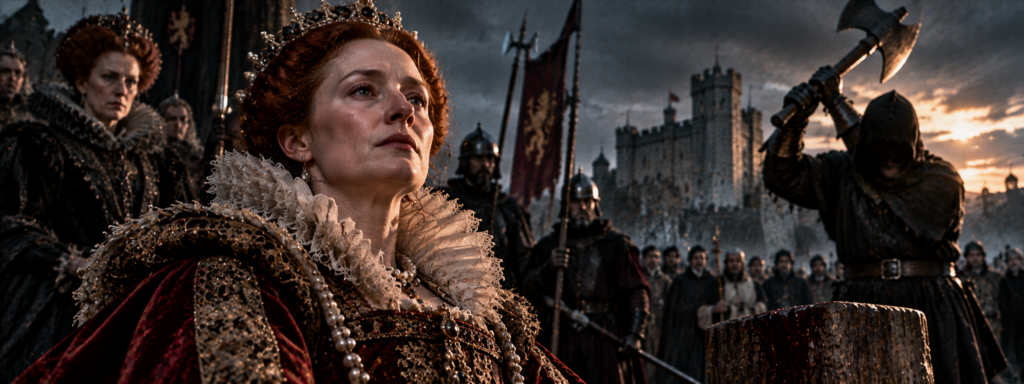
The executioners were waiting beside a wooden scaffold draped in black. English officials had gathered to witness the sentence, while Mary had been permitted a small number of attendants to accompany her. She wore dark clothing over garments that would become one of the most famous details of her death. Beneath the black lay crimson, a color later interpreted as a deliberate declaration of Catholic martyrdom.
Mary had spent years insisting that she was an anointed sovereign who could not lawfully be judged by another monarch. Elizabeth I of England, her cousin and longtime political rival, had finally authorized her execution after a conspiracy to assassinate the English queen was uncovered. Yet the decision had tormented Elizabeth’s government for months, and the English queen would later insist that she had never intended the warrant to be carried out without further authorization. Whether that explanation reflected genuine hesitation, political calculation, or an attempt to escape responsibility remains one of the enduring controversies of Elizabeth’s reign.
The execution itself was horrifying. Contemporary accounts describe an inexperienced or struggling executioner who failed to sever Mary’s head with the first blow of the axe. A second stroke followed, and further cutting was required before the head was completely separated from her body. The death of a queen had become a bloody spectacle before the officials assembled to witness it.
Then came the details that would transform the execution into legend. When the executioner lifted the severed head, the wig or false hair he grasped reportedly slipped away, revealing Mary’s short, gray natural hair. Accounts also describe a small dog emerging from beneath her clothing after the killing, refusing to leave its dead mistress. These incidents were recorded by witnesses or near-contemporary narrators, although later retellings have sometimes embellished their precise circumstances.
Mary’s execution was not an ordinary criminal punishment. She had once ruled Scotland in her own right, and she possessed a hereditary claim to the English succession that many Catholics considered stronger than Elizabeth’s. Her death therefore raised questions extending far beyond the guilt or innocence of one imprisoned woman. Could one anointed monarch lawfully execute another, and what precedent would such an act establish for every crowned ruler in Europe?
To understand how Mary reached that scaffold, it is necessary to return to a childhood shaped by dynastic ambition, religious conflict, and the dangerous expectations placed upon a queen who inherited her crown before she could speak.
A Queen Before She Could Walk
Mary Stuart was born on December 8, 1542, at Linlithgow Palace in Scotland. Her father was James V of Scotland, while her mother, Mary of Guise, belonged to one of the most powerful Catholic families in France. The infant princess entered a world in which Scotland’s independence, its relationship with England, and its alliance with France were all matters of urgent political concern. She was also born at a moment when her father’s health and political fortunes were collapsing.
James V had recently suffered a humiliating military disaster at Solway Moss, where Scottish forces were defeated by the English. He died on December 14, only six days after his daughter’s birth, leaving the newborn Mary as his successor. Later tradition attributes a despairing remark about the Scottish crown passing through a woman to James, but the famous wording is not securely established as a verbatim deathbed statement. What matters is that Scotland had inherited an infant queen at a time of serious political instability.
Mary’s sex immediately became a political issue. A female ruler could inherit the Scottish crown, but powerful nobles expected to exercise authority during her minority and hoped to influence her eventual marriage. Her future husband might gain enormous influence over Scotland, potentially drawing the kingdom toward England, France, or another European power. Mary herself was too young to participate in any of these decisions.
Her great-uncle Henry VIII of England quickly recognized the opportunity. He wanted Mary to marry his young son Edward, creating a dynastic union that might eventually bring Scotland under the influence of the Tudor monarchy. Scottish political leaders initially negotiated the possibility, but opposition grew among those who feared English domination. The proposed marriage became another source of conflict between the neighboring kingdoms.
Henry responded with military pressure in the campaign later known as the Rough Wooing. English forces attacked Scottish territory, and the conflict involved destruction, raids, and attempts to force the marriage through intimidation. The brutality of the campaign helped strengthen opposition to English influence. Rather than bringing Mary closer to the Tudor prince, Henry’s strategy contributed to Scotland’s renewed dependence upon France.
The young queen became a political prize whose marriage could determine the future of nations. Her childhood was shaped not by ordinary family decisions but by competing governments attempting to control her body, her inheritance, and her future children. The struggle would follow her throughout her life. Long before Mary understood the meaning of kingship, powerful men were prepared to fight and kill over the crown she wore.
The Little Queen Sent Across the Sea
In 1548, Scotland and France reached an agreement that transformed Mary’s future. The young queen would travel to France and eventually marry Francis, the son of King Henry II and Catherine de’ Medici. The arrangement strengthened the traditional Franco-Scottish alliance and offered Scotland protection against English pressure. It also placed Mary under the influence of one of Europe’s most powerful royal courts.
Mary was approximately five years old when she left Scotland. She traveled with a small household that included young Scottish companions who would become known as the Four Marys. Their presence helped preserve something of her Scottish identity during an upbringing that would otherwise be overwhelmingly French. Nevertheless, the court of France became the world in which she grew toward adulthood.
Her education was unusually sophisticated. Mary learned languages, music, poetry, courtly behavior, and the religious expectations of a Catholic princess. She became fluent in French and developed the elegance and confidence associated with Renaissance court culture. Her later reputation for charm, intelligence, and personal magnetism was shaped by these formative years.
The French court also exposed her to intense political competition. Catherine de’ Medici, the king’s formidable wife, navigated a world of rival noble families, religious tensions, and dynastic ambition. The Guise family, Mary’s maternal relatives, possessed considerable influence and hoped to benefit from her future queenship. Mary therefore grew up surrounded by powerful people whose affection and political interests were often inseparable.
In April 1558, Mary married Francis in a lavish ceremony at Notre-Dame Cathedral in Paris. She was fifteen, while Francis was fourteen, and their marriage represented a major diplomatic triumph for the Franco-Scottish alliance. The union also alarmed England because Mary’s descendants might eventually claim both the Scottish and English crowns. Her marriage made her an important figure in European dynastic politics.
When Henry II of France died in July 1559 after a tournament accident, Francis became King Francis II. Mary was now Queen Consort of France while remaining Queen of Scots in her own right. At sixteen, she occupied an extraordinary position within European royalty. Yet the triumph would last barely a year.
The English Crown She Was Never Supposed to Claim
Mary’s connection to the English succession came through her paternal grandmother, Margaret Tudor. Margaret was the daughter of Henry VII of England and sister of Henry VIII, making Mary a great-granddaughter of the founder of the Tudor dynasty. That ancestry gave her a plausible hereditary claim if Elizabeth I died without children. It also made her politically dangerous to the English government.
The question became especially contentious after Elizabeth succeeded her sister Mary I in November 1558. Elizabeth was Protestant, while Mary Stuart was Catholic, and many Catholic opponents of the English religious settlement challenged Elizabeth’s legitimacy. They argued that Henry VIII’s marriage to Anne Boleyn had been invalid, making Elizabeth illegitimate. Under that interpretation, Mary Stuart could be presented as the rightful queen of England.
The issue was complicated by English succession legislation and Henry VIII’s will, which had attempted to regulate the inheritance of the crown. These arrangements favored descendants of Henry’s younger sister Mary Tudor over the Scottish line descended from Margaret Tudor. Mary Stuart’s hereditary claim therefore conflicted with the legal settlement established under Henry VIII. Supporters of each position could appeal to different principles of legitimacy.
The French court made matters worse by allowing Mary and Francis to use English royal arms and titles in ways that challenged Elizabeth’s position. Elizabeth regarded the gesture as an unacceptable threat to her sovereignty. Mary later attempted to improve relations, but the dispute over her claim continued to poison their relationship. Neither queen could easily surrender the issue without appearing to weaken her own legitimacy.
The two women were cousins, but they never met in person. Their relationship developed through letters, ambassadors, rumors, political negotiations, and competing interpretations of each other’s intentions. At times they addressed one another in affectionate language associated with royal kinship. At other moments, they behaved as dangerous rivals whose interests could not be reconciled.
Mary’s English claim became the central danger of her later life. Even when she was powerless, imprisoned, or excluded from Scottish government, her bloodline remained politically valuable. Elizabeth’s enemies could use Mary’s existence to justify rebellion or foreign intervention. The claim that made her important also made her vulnerable to destruction.
A Crown Lost in France
Francis II was never a robust ruler, and his short reign was overshadowed by illness and factional conflict. The young king depended heavily upon powerful advisers, including members of Mary’s Guise family. Religious tensions between Catholics and French Protestants were becoming increasingly dangerous. Mary found herself at the center of a court where political stability was already deteriorating.
In December 1560, Francis died after a severe illness, leaving Mary a widow at eighteen. The death ended her position as Queen Consort of France and weakened the influence of her maternal relatives at court. Catherine de’ Medici assumed a more powerful role during the minority of Francis’s younger brother Charles IX. Mary no longer occupied the central position she had enjoyed as the wife of the reigning king.
Her mother’s death earlier that year had created another crisis. Mary of Guise had governed Scotland as regent and defended the French alliance against increasingly powerful Protestant opposition. She died in June 1560, during a period when Protestant reformers were challenging Catholic authority. The Scottish political world Mary had left as a child was changing dramatically.
The Scottish Reformation had transformed the religious landscape. Protestant nobles and preachers, including John Knox, opposed Catholic worship and sought to establish a reformed national church. The Scottish Parliament of 1560 adopted measures rejecting papal authority and the Mass, although Mary’s absence and the complicated constitutional situation affected the legal status of those acts. By the time she returned, Protestantism had gained a powerful political position.
Mary therefore faced a difficult choice. She could remain in France as a widowed queen with declining influence, or she could return to Scotland and attempt to govern a kingdom whose religious settlement conflicted with her own faith. Neither option promised security. She chose Scotland.
In August 1561, Mary returned to the country she had left thirteen years earlier. She was eighteen, Catholic, French-educated, and accustomed to a court culture very different from the one awaiting her. Her arrival began the most politically dangerous period of her life. Within six years, she would lose her crown.
The Catholic Queen in a Protestant Kingdom
Mary’s return placed her at the center of Scotland’s religious divisions. She remained committed to Catholicism and insisted upon maintaining private Catholic worship within her household. Many Protestant leaders feared that her presence might encourage a Catholic restoration. Others believed that political stability required accepting the queen’s personal religion while preserving the Protestant settlement.
Mary initially pursued a comparatively cautious policy. She retained several Protestant advisers and avoided an immediate attempt to reverse the religious changes introduced during her absence. Her half-brother James Stewart, later Earl of Moray, became an important figure in her government. His political experience and Protestant connections helped provide a bridge between the queen and influential reforming nobles.
The relationship with John Knox was far more confrontational. Knox regarded Catholic worship as idolatrous and believed that rulers had a duty to support true religion. He also held deeply conservative views about female political authority, although his opposition to Mary was shaped by religion as well as gender. Their meetings became famous for sharp disagreements over conscience, obedience, and the limits of royal power.
Later accounts often portray Mary as an elegant, emotional queen confronting a stern and uncompromising preacher. That contrast captures something of their public reputations but risks turning a complicated political dispute into a simple clash of personalities. Mary was capable of political calculation, while Knox possessed considerable influence through preaching and organized Protestant support. Their disagreement concerned the religious identity of the kingdom itself.
For a time, Mary managed the situation with considerable skill. She maintained enough support to govern while avoiding an immediate religious civil war. Her court attracted attention for its cultural sophistication, and she participated actively in hunting, music, and ceremonial life. Yet the central problem remained unresolved.
Mary needed an heir, and marriage was the most obvious way to secure the succession. Her choice of husband would influence Scotland’s religious balance, its relationship with England, and her own authority. A politically advantageous marriage might strengthen her throne. A disastrous one could destroy it.
Henry Stuart, Lord Darnley: The Husband Who Became a Threat
In 1565, Mary married Henry Stuart, Lord Darnley, a handsome young aristocrat with a dangerous combination of royal ancestry and personal ambition. Darnley was descended from Margaret Tudor through her second marriage, giving him his own claim to the English succession. A child of Mary and Darnley would therefore possess an especially strong hereditary connection to the Tudor dynasty. The marriage alarmed Elizabeth I, who had not approved the union.
Mary appears to have been strongly attracted to Darnley, although the precise nature of her feelings cannot be reconstructed from the surviving evidence. He was younger than she was, and his appearance and royal ancestry made him an appealing candidate. Their marriage took place in July 1565, despite opposition from several influential Scottish nobles. The decision immediately intensified political tensions.
Darnley’s character soon became a serious problem. Contemporary accounts describe arrogance, jealousy, drinking, and demands for political authority that Mary was unwilling to grant. He wanted the crown matrimonial, which could have strengthened his independent claim to rule. Mary resisted granting him the degree of power he desired.
The marriage also alienated Mary’s half-brother Moray and other Protestant nobles. Their opposition led to the rebellion known as the Chaseabout Raid, which Mary successfully suppressed. For a brief period, the queen appeared to have defeated her domestic enemies and strengthened her position. Yet the victory concealed growing instability within her own marriage.
Darnley resented the influence of Mary’s advisers, particularly her Italian secretary David Rizzio. Rumors circulated that Rizzio enjoyed an improper relationship with the queen, but the allegations were politically useful and lack convincing proof. Darnley’s jealousy became entangled with the ambitions of nobles who wanted to weaken Mary’s authority. The result was one of the most notorious murders in Scottish royal history.
The Murder of David Rizzio
On March 9, 1566, Mary was dining in her private apartments at Holyrood Palace when armed conspirators entered. She was approximately six months pregnant, and the presence of her husband among the plotters made the attack especially terrifying. David Rizzio was seized and dragged away despite his attempts to remain near the queen. He was stabbed repeatedly and left dead.
The killing was not simply an outburst of personal jealousy. Darnley had allied himself with Protestant nobles who hoped to remove Rizzio and regain political influence. The conspirators intended to intimidate Mary and force changes within her government. By murdering her secretary in her presence, they demonstrated their willingness to use violence against the queen’s household.
Mary later described the attack in a letter dictated to Elizabeth. Her account emphasized the danger to her own life and the fact that she had been held captive after the murder. She also described the physical exhaustion caused by her subsequent escape. The letter provides unusually direct evidence of how Mary represented the crisis while it was still unfolding.
Darnley’s participation shattered what remained of the marriage’s political credibility. Mary escaped from Holyrood with him after persuading him to abandon his fellow conspirators, and they reached Dunbar. She then gathered enough support to regain control. The nobles responsible for the murder faced exile or political defeat.
The episode demonstrated both Mary’s resilience and the vulnerability of her position. She had survived an armed intrusion into her private apartments while pregnant and had recovered authority through rapid political action. Yet the fact that her own husband had participated in the conspiracy made reconciliation difficult. The marriage had become a source of danger rather than security.
Three months later, on June 19, 1566, Mary gave birth to a son at Edinburgh Castle. The child was named James and would eventually become James VI of Scotland and James I of England. His birth secured the succession and strengthened Mary’s dynastic position. It did not repair her marriage.
The Birth of an Heir and the Collapse of a Marriage
James’s birth was one of the most important events of Mary’s reign. Scotland now possessed a legitimate male heir, reducing the uncertainty surrounding the succession. The child also inherited the powerful Tudor bloodline shared by both parents. His existence would eventually change the political future of England and Scotland.
Darnley, however, remained a deeply troublesome figure. His relationship with Mary deteriorated further, and he appears to have become increasingly isolated from influential nobles. Reports of his behavior varied according to the political interests of those describing him, but there is little doubt that the marriage was in serious difficulty. Mary faced the challenge of preserving royal authority while dealing with a husband whose ambitions threatened her government.
Several nobles began discussing ways to remove Darnley from Mary’s life. The precise nature of those conversations remains disputed, particularly whether they involved divorce, political separation, or more violent possibilities. Later evidence has been used to suggest that Mary knew of plans against her husband, but the surviving material is too contested to establish a simple narrative of guilt. Her personal frustration with Darnley is clear; her responsibility for his death is not.
Darnley became ill in early 1567, suffering from a condition often identified as smallpox or another serious disease. He was brought to Kirk o’ Field, a residence outside Edinburgh’s main royal complex, where he could recover. Mary visited him, and accounts suggest that their relationship had at least temporarily improved. Whether those visits reflected genuine reconciliation, political calculation, or concern for his health remains uncertain.
On the night of February 9–10, 1567, Mary attended a wedding celebration elsewhere in Edinburgh. Darnley remained at Kirk o’ Field. During the night, an explosion destroyed the building. The king consort was found dead outside, and Scotland entered another political catastrophe.
The Explosion at Kirk o’ Field
The murder of Lord Darnley remains one of the most notorious unsolved questions in Scottish royal history. Gunpowder had been placed beneath or within the building where he was staying, and the resulting explosion destroyed the residence. Yet Darnley’s body was discovered outside rather than buried beneath the wreckage. Reports suggested that he had been strangled or otherwise killed before or during his attempted escape, although the precise cause of death remains uncertain.
The circumstances immediately raised suspicions of conspiracy. The use of gunpowder indicated planning, access to resources, and the involvement of people capable of arranging a coordinated attack. Darnley’s political enemies were numerous, including nobles who resented his ambition and his participation in Rizzio’s murder. His death benefited several powerful figures.
James Hepburn, Earl of Bothwell, quickly emerged as a principal suspect. He was an influential nobleman with a reputation for military energy and political ambition. Evidence and later testimony connected him and members of his circle with the conspiracy. Although the precise degree of responsibility remains debated, Bothwell’s involvement has long been regarded as highly probable.
Mary’s own role is far more controversial. Her enemies accused her of knowing about or participating in the plot, while her defenders argued that she had been manipulated or falsely implicated. The surviving evidence does not establish that she personally ordered Darnley’s murder. Nevertheless, her subsequent actions made the accusations increasingly difficult to escape.
Elizabeth I warned Mary that her reputation was being damaged by the widespread belief that she had failed to pursue her husband’s killers vigorously. The English queen urged her to protect her honor through a credible investigation and punishment of those responsible. The correspondence demonstrates that suspicions surrounding Mary were circulating almost immediately. Her political position was becoming dangerously fragile.
The murder also left Mary’s infant son without a father. James was not yet eight months old when Darnley died. The boy’s future would soon become the justification for removing Mary from power. His mother’s enemies could claim that they were acting to protect the prince and the kingdom.
Bothwell: The Man Accused of Murdering Her Husband
Bothwell’s rise after Darnley’s death was extraordinarily rapid. He had been one of Mary’s important supporters, and his political influence increased during the crisis. Although he was widely suspected of involvement in the murder, he was acquitted at a trial in April 1567. The proceedings were criticized for their speed and circumstances, and the acquittal did little to silence suspicion.
Soon afterward, Bothwell obtained support from several nobles for a proposed marriage to Mary. The agreement commonly known as the Ainslie Tavern Bond was presented as evidence that influential men considered him a suitable husband. The circumstances of the bond and the degree of genuine support it represented remain debated. Some signatories later distanced themselves from the arrangement.
In April 1567, Bothwell intercepted Mary while she was traveling and took her to Dunbar Castle. The episode is often described as an abduction, but historians disagree about the extent to which Mary consented to the journey or the subsequent marriage. Contemporary accusations included claims of sexual coercion, while other accounts portrayed the event as a staged political maneuver. The evidence does not allow a confident reconstruction of Mary’s private experience.
Bothwell had also been married to Jean Gordon, and the dissolution of that marriage created further controversy. His union with Mary followed with extraordinary speed. On May 15, 1567, barely three months after Darnley’s murder, Mary married the man widely suspected of arranging it. The decision proved politically catastrophic.
To Mary’s enemies, the marriage appeared to confirm her involvement in Darnley’s death. To some of her defenders, it demonstrated that she had been coerced by a powerful and dangerous nobleman. Both interpretations became central to the arguments surrounding her reputation. The truth is more difficult to establish than either version suggests.
What cannot be disputed is that the marriage destroyed much of Mary’s remaining political support. Nobles who had previously tolerated her decisions now presented themselves as defenders of the infant James. Bothwell’s enemies mobilized against the royal couple. Within weeks, Mary would lose the throne she had inherited as a newborn.
The Queen Abandoned at Carberry Hill
In June 1567, a coalition of Scottish nobles confronted Mary and Bothwell near Carberry Hill. The confrontation developed into a tense standoff rather than a major pitched battle. Both sides possessed armed supporters, but negotiations and uncertainty shaped the outcome. Mary’s position weakened as it became clear that her enemies were determined to separate her from Bothwell.
Bothwell eventually left the field, while Mary surrendered to the opposing nobles. She appears to have expected that surrender would preserve her personal safety and perhaps allow a political settlement. Instead, she was taken into custody and subjected to public humiliation. The queen who had once ruled France and Scotland now found herself at the mercy of men who claimed to act in her son’s interests.
Mary was imprisoned at Lochleven Castle, situated on an island in Loch Leven. The location offered natural security and limited opportunities for escape. Her captors controlled her movements, correspondence, and access to supporters. The political consequences of her marriage to Bothwell had become irreversible.
During her imprisonment, Mary suffered a miscarriage, traditionally described as the loss of twins conceived with Bothwell. The details are preserved in accounts written amid intense political hostility and should be approached cautiously. Nevertheless, the episode illustrates the physical and emotional strain associated with her confinement. She had lost her freedom, her husband was a fugitive, and her future as queen was uncertain.
On July 24, 1567, Mary was forced to abdicate in favor of her infant son. James became James VI of Scotland, while a regency government exercised authority in his name. Mary’s half-brother Moray eventually became regent. The queen who had inherited the crown at six days old had lost it at twenty-four.
Her abdication was presented by opponents as necessary for the security of Scotland and the young king. Mary and her supporters regarded it as the product of coercion. The distinction mattered because it shaped the legitimacy of the new government. If Mary had been unlawfully forced from power, her supporters could continue to regard her as the rightful sovereign.
The Casket Letters: Evidence or Political Forgery?
The most controversial evidence used against Mary consisted of documents later known as the Casket Letters. Her enemies claimed that letters and poems discovered in a silver casket demonstrated her intimate relationship with Bothwell and implicated her in Darnley’s murder. The documents became central to attempts to justify her deposition. Their authenticity has remained disputed for centuries.
The letters were allegedly written by Mary to Bothwell, but the surviving textual history is complicated. The original documents have not survived in a form that permits modern forensic examination. What remains consists of copies, translations, summaries, and references produced in politically charged circumstances. That makes it difficult to determine whether the texts were genuine, altered, selectively presented, or fabricated.
Some historians have argued that portions may preserve authentic correspondence, while others have questioned the documents more fundamentally. Even if some letters were genuine, their interpretation would depend upon context that may have been lost. Statements of affection or political anxiety do not automatically establish participation in murder. The documents cannot be treated as an unquestionable confession.
The political usefulness of the letters was obvious. Mary’s enemies needed to justify removing an anointed queen and replacing her with her infant son. Demonstrating that she had participated in her husband’s murder would provide a powerful argument. The casket material therefore served both evidentiary and propagandistic purposes.
Mary consistently denied responsibility for Darnley’s murder. Her defenders argued that the letters had been forged or manipulated by opponents seeking to destroy her reputation. Her enemies insisted that the documents revealed a guilty relationship with Bothwell. The controversy became inseparable from the wider struggle over the legitimacy of her deposition.
The Casket Letters remain a warning against treating politically produced evidence as transparent truth. They are historically important because they influenced the fate of a queen. They are not sufficiently secure to resolve every question surrounding Darnley’s death. Mary’s guilt or innocence cannot be established simply by repeating the accusations contained within them.
Escape From Lochleven
Mary did not remain passive during her imprisonment. She continued communicating with supporters and searching for an opportunity to escape. Several attempts were reportedly made before a successful plan emerged. Her ability to inspire loyalty among servants and nobles demonstrated that her deposition had not destroyed her political influence.
On May 2, 1568, Mary escaped from Lochleven Castle with assistance from members of the household connected to her captors. Accounts describe a carefully arranged departure that allowed her to cross the water and reach supporters on the mainland. The precise details vary in later retellings, but the escape itself is well established. Mary was once again free.
She quickly gathered an army and attempted to recover her authority. Supporters rallied around her claim that the abdication had been forced and therefore lacked legitimacy. Her opponents, meanwhile, defended the regency government established in the name of James VI. Scotland was moving toward open civil war.
On May 13, 1568, Mary’s forces confronted the army of the regent Moray at Langside, near Glasgow. The battle was brief but decisive. Mary’s army was defeated, and her attempt to recover the crown collapsed. The loss left her with few realistic options.
She fled south, hoping to find safety and assistance. France remained a possible destination, but reaching it would require escaping hostile forces and navigating dangerous political circumstances. Mary instead chose to cross into England and seek help from Elizabeth I. The decision would determine the remainder of her life.
Mary apparently believed that Elizabeth, as a fellow anointed queen, would recognize the injustice of her deposition and assist her restoration. The expectation was understandable within the language of royal solidarity that both women had previously used. Yet Elizabeth had powerful reasons to fear Mary’s claim to the English throne. The refuge Mary sought became a prison.
The Cousin Who Offered Protection and Delivered Captivity
Mary entered England in May 1568 and was placed under supervision almost immediately. Elizabeth faced an extraordinary dilemma because Mary was simultaneously a foreign sovereign, a close relative, a Catholic claimant to the English succession, and a woman accused of involvement in her husband’s murder. Allowing her to move freely could encourage rebellion. Returning her to Scotland might expose her to further danger and undermine the principle of legitimate monarchy.
Elizabeth initially attempted to investigate the accusations surrounding Mary’s deposition. Proceedings involving representatives of Mary and the Scottish regency government took place at York and Westminster. The Casket Letters were introduced as evidence, but the inquiry did not produce a definitive judicial judgment establishing Mary’s guilt. Elizabeth avoided a final ruling that would either condemn another queen or require her restoration.
Mary remained in English custody. Her confinement was not always comparable to an ordinary prison sentence, because she retained attendants, possessions, and elements of royal ceremony. Nevertheless, she could not leave freely, choose her residence, or pursue political objectives without surveillance. Her life became dependent upon the decisions of a monarch who feared her claim.
Over the following years, Mary was moved among various castles and great houses. Carlisle, Bolton, Tutbury, Sheffield, and Chartley were among the places associated with her captivity. The conditions varied according to political circumstances and the officials responsible for her custody. She experienced periods of relative comfort alongside increasing restrictions.
George Talbot, Earl of Shrewsbury, and his wife Bess of Hardwick became central figures in her imprisonment for many years. Their household was required to accommodate a royal prisoner whose presence imposed considerable financial and political burdens. Bess’s relationship with Mary was complicated, and later accounts sometimes exaggerate personal hostility. The practical difficulties of guarding such a prominent captive were substantial.
Mary continued to correspond with supporters and foreign rulers. She sought recognition of her claims, opportunities for release, and assistance in recovering political influence. Her letters reveal persistence, frustration, and an unwillingness to accept permanent exclusion. The longer she remained imprisoned, the more her hopes became entangled with the ambitions of Elizabeth’s enemies.
The Prisoner Who Could Still Threaten a Throne
Mary’s imprisonment did not remove her political significance. She remained a Catholic claimant to the English succession at a time when Elizabeth’s religious settlement faced domestic and international opposition. Catholic nobles, foreign governments, and exiled English opponents could imagine replacing Elizabeth with Mary. Her existence provided a potential focus for conspiracies even when she was physically confined.
The Northern Rebellion of 1569 demonstrated the danger. Catholic nobles in northern England rose against Elizabeth’s government, hoping to alter the religious and political settlement. Mary’s name became associated with plans to replace or constrain Elizabeth, although the extent of her direct involvement in every aspect of the rebellion remains disputed. The uprising failed, and its suppression strengthened the English government’s determination to control her.
In 1570, Pope Pius V issued a bull excommunicating Elizabeth and declaring her subjects released from allegiance to her. The document intensified fears that Catholic resistance might be justified through religious authority. Elizabeth’s government increasingly viewed Mary as a potential beneficiary of foreign invasion or domestic rebellion. The distinction between religious opposition and political treason became dangerously blurred.
The Ridolfi Plot of 1571 involved plans for foreign intervention and the replacement of Elizabeth with Mary. The conspiracy was uncovered, and Thomas Howard, Duke of Norfolk, was executed for his involvement. Mary was implicated in the wider political context, but the evidence concerning her knowledge and participation requires careful interpretation. The episode nevertheless made her position more precarious.
The Throckmorton Plot of 1583 again raised the possibility of foreign military intervention to support Mary and restore Catholic influence. English intelligence uncovered the conspiracy, and its participants faced severe punishment. The government became increasingly convinced that Mary’s continued survival encouraged repeated threats. Each new plot narrowed the range of options available to Elizabeth.
Mary’s supporters regarded her as a legitimate queen unjustly imprisoned. Elizabeth’s ministers increasingly regarded her as the central figure around whom assassination and invasion schemes could develop. Both perceptions contained elements of political reality. The tragedy was that Mary’s hereditary claim remained dangerous even when she possessed no independent army or territory.
Francis Walsingham and the Machinery of Surveillance
Sir Francis Walsingham became one of the most important figures in the campaign to protect Elizabeth from conspiracy. As principal secretary, he developed an extensive network of informants, agents, intercepted correspondence, and intelligence contacts. His methods reflected the growing sophistication of Tudor state security. They also demonstrated how vulnerable political prisoners could become when their communications were controlled by their enemies.
Walsingham believed that Mary represented a serious threat. He had witnessed repeated conspiracies involving Catholic opponents of Elizabeth and feared that one might eventually succeed. His objective was not simply to gather rumors but to obtain evidence that could justify decisive action. Mary’s correspondence became a central target.
The English government employed skilled decipherers, including Thomas Phelippes, to read intercepted messages. Ciphers and secret writing were common among political conspirators, but they were not always secure. Once a code was broken, correspondence intended to remain private could become evidence in a criminal prosecution. Mary would discover this danger too late.
The surveillance surrounding her intensified during the 1580s. Her movements were restricted, her servants scrutinized, and her opportunities for communication carefully controlled. Yet complete isolation was difficult because Mary retained supporters willing to risk punishment on her behalf. Secret messages continued to move between her household and the outside world.
The most consequential correspondence developed during the Babington Plot of 1586. Mary believed she had gained access to a covert channel through which she could communicate with supporters. In reality, the channel was compromised and monitored by English intelligence. The trap was closing around her.
Anthony Babington and the Plot to Kill Elizabeth
Anthony Babington was a young Catholic gentleman involved in a conspiracy to remove Elizabeth I. The plan included the assassination of the English queen, the liberation of Mary, and the possibility of foreign military intervention. Babington and his associates believed that Elizabeth’s death could create the opportunity for a Catholic restoration. Their ambitions placed them in direct conflict with the English state.
The conspirators attempted to communicate with Mary through encrypted letters. Messages were concealed and transported through arrangements that appeared to bypass ordinary surveillance. Mary believed she was corresponding with allies capable of organizing her release. Walsingham’s agents, however, had penetrated the system.
In July 1586, Mary sent a reply that became the central evidence against her. The surviving text discusses plans for her liberation and addresses the proposed removal of Elizabeth. Historians have debated the precise wording, interpretation, and possibility of manipulation within the intercepted correspondence. Nevertheless, the government possessed material it considered sufficient to connect Mary with the assassination conspiracy.
One of the most important questions concerns whether Mary explicitly approved Elizabeth’s murder. The English government argued that her correspondence demonstrated complicity. Mary’s defenders have emphasized ambiguities in the language, the possibility of entrapment, and the circumstances under which the messages were obtained. The evidence is substantial enough to explain the prosecution but remains subject to historical debate.
Walsingham’s intelligence operation succeeded in identifying the conspirators. Babington and several associates were arrested, tried, and executed. Their punishment was brutal, reflecting the severity with which Tudor law treated treason. The discovery also gave Elizabeth’s ministers the opportunity they had long sought to bring Mary to trial.
Mary’s papers were seized, and her household was searched. The ciphers and correspondence that had sustained her hopes became evidence against her. She was no longer merely a dangerous prisoner associated with conspiracies organized by others. The government now claimed to possess proof that she had knowingly participated in a plan to assassinate Elizabeth.
The Trial of an Anointed Queen
Mary was brought to trial at Fotheringhay Castle in October 1586. The proceedings were conducted under legislation designed to protect Elizabeth against conspiracies involving rival claimants. A commission of English nobles and officials examined the evidence. Mary faced accusations that she had participated in a plot to murder the reigning queen.
Mary challenged the authority of the court. She argued that she was an independent sovereign who had never been Elizabeth’s subject and therefore could not lawfully be tried for treason against her. She also complained about her inability to consult advisers and examine evidence under conditions she considered fair. Her objections raised fundamental questions about jurisdiction and the treatment of foreign rulers.
The prosecution relied heavily upon intercepted correspondence connected with the Babington Plot. Mary denied authorizing Elizabeth’s assassination and disputed the interpretation of the letters. She maintained that seeking freedom and support for her own cause was not equivalent to approving murder. The commissioners nevertheless found her guilty.
The trial was politically charged from beginning to end. Elizabeth’s government had a legitimate security concern because conspirators had repeatedly attempted to use Mary’s claim against the English crown. At the same time, the accused was a prisoner whose correspondence had been controlled by the very government prosecuting her. The legal process cannot be separated from those circumstances.
Mary’s conviction did not automatically resolve the question of execution. Elizabeth still had to decide whether to authorize the killing of a fellow anointed queen. Parliament and influential ministers pressed for decisive action, arguing that Mary’s continued existence threatened the realm. Elizabeth hesitated.
The delay reflected more than personal sentiment. Executing Mary could provoke Catholic outrage, damage England’s international reputation, and establish a precedent for killing sovereigns. Refusing to execute her could leave Elizabeth vulnerable to another conspiracy. The English queen faced a decision with consequences for the monarchy itself.
Elizabeth I and the Burden of a Royal Death Warrant
Elizabeth’s hesitation became one of the most intensely debated aspects of Mary’s execution. She had long resisted demands for her cousin’s death, even as her ministers warned that Mary remained dangerous. Elizabeth understood the political symbolism of executing another queen. She also understood that failing to act might be interpreted as weakness.
In February 1587, Elizabeth signed the death warrant. The document authorized the execution of the sentence against Mary, but the circumstances of its delivery and implementation later became controversial. Elizabeth subsequently claimed that her officials had acted without her final approval. Her explanation has been interpreted in different ways by historians.
William Davison, one of Elizabeth’s secretaries, became the principal official blamed for the warrant’s dispatch. He had handled the document after Elizabeth signed it, and the Privy Council proceeded with arrangements for execution. When Mary was killed, Elizabeth reacted with anger and ordered proceedings against Davison. He was fined and imprisoned, becoming a convenient focus for responsibility.
Whether Elizabeth genuinely expected the warrant to remain unused is difficult to establish. She had signed it, and her ministers had repeatedly emphasized the danger of delay. Her later insistence that she had not intended immediate execution may reflect genuine ambivalence, political self-protection, or both. The surviving evidence does not allow a simple psychological explanation.
There is also evidence that Elizabeth had explored the possibility of Mary’s death through less public means. Correspondence involving Mary’s custodian, Sir Amias Paulet, reveals pressure to consider measures that might remove the prisoner without a formal execution. Paulet resisted involvement in such an act, insisting upon the limits of his duty. The episode demonstrates the uncomfortable alternatives being considered within the English government.
Elizabeth ultimately bore responsibility as the sovereign who signed the warrant. Her ministers carried out the execution through the machinery of the state, and the sentence was not an unauthorized private murder. Yet the queen’s subsequent behavior reveals how politically dangerous that responsibility remained. Mary was about to die, but Elizabeth would continue struggling with the consequences.
The Final Night at Fotheringhay
Mary was informed on February 7, 1587, that she would be executed the following morning. She had spent years fearing that such a sentence might eventually be imposed, but the announcement made the danger immediate. Accounts describe her responding with composure and religious devotion. Her final hours were spent preparing for death and arranging the affairs of her household.
She wrote farewell letters, including a message to Henry III of France. In that letter, she described her long captivity and the sentence imposed upon her by Elizabeth. She also presented her death as a consequence of her Catholic faith and royal position. The letter is one of the most important surviving expressions of how Mary wanted her final moments to be understood.
Mary made arrangements for her servants and possessions. She expressed concern about the treatment of those who had remained loyal to her and sought assurances regarding their welfare. Such requests reflected both personal attachment and the obligations expected of a royal mistress toward her household. Her attendants had shared years of confinement and uncertainty.
Religious preparation occupied much of the night. Mary remained committed to Catholicism and regarded her death through the language of sacrifice and martyrdom. English officials, however, viewed her conviction as punishment for participation in treason rather than persecution for religion. The competing interpretations would shape accounts of the execution for centuries.
Mary also faced restrictions concerning Catholic spiritual assistance. She was not permitted the full religious arrangements she desired, and Protestant clergy were involved in the official proceedings. Her refusal to accept Protestant ministrations became part of the religious confrontation surrounding her death. Even at the end, the conflict between Catholic and Protestant authority remained central.
The final night was therefore both personal and political. Mary prepared herself for death while attempting to shape how the event would be remembered. She could no longer control the actions of Elizabeth’s government, but she could control aspects of her own conduct. Her composure would become one of the defining features of her legend.
February 8, 1587: The Execution Begins
On the morning of February 8, Mary was escorted to the great hall of Fotheringhay Castle. The room had been prepared for a formal execution, with a scaffold erected for the occasion. English officials assembled to witness the sentence and ensure that the government’s orders were carried out. The event was intended to be a controlled act of state justice.
Mary entered wearing dark garments appropriate to the solemnity of the occasion. Her clothing was carefully arranged, and attendants accompanied her as far as they were permitted. She maintained the bearing expected of a queen, even though the ceremony was designed to strip her of worldly authority. The contrast between royal dignity and criminal punishment was impossible to ignore.
The sentence was read, and Mary responded through declarations of innocence and religious conviction. She did not deny that she had sought freedom or maintained political hopes, but she rejected the accusation that she had knowingly authorized Elizabeth’s murder. Her words were recorded by witnesses whose accounts differ in some details. The essential picture is of a woman determined to defend her honor before death.
A Protestant clergyman offered prayers, but Mary continued her own Catholic devotions. The religious confrontation was visible to everyone present. English officials regarded her as a convicted traitor, while Mary presented herself as a Catholic queen suffering unjustly. The scaffold became a stage upon which competing claims of legitimacy were displayed.
When her outer clothing was removed, crimson garments were revealed beneath. The color has often been interpreted as a deliberate association with Catholic martyrdom, although the precise symbolism intended by Mary cannot be established beyond dispute. The effect was nevertheless striking. Against the black-draped scaffold, the red clothing made her final appearance unforgettable.
Mary knelt beside the block and prepared to die. Her attendants were distressed, and accounts describe efforts to comfort them. The executioners then moved into position. What followed was far more brutal than the controlled ceremony the authorities had intended.
The Botched Beheading
The executioner raised his axe and struck Mary, but the first blow failed to sever her head. Contemporary descriptions indicate that the stroke landed badly, causing severe injury without completing the execution. Mary remained on the block as the executioner prepared to strike again. The failure transformed the intended swift killing into a prolonged and horrifying ordeal.
A second blow followed, but further cutting was reportedly required before the head was fully detached. Accounts differ over the precise number and nature of the final movements, and later retellings have sometimes exaggerated the details. The essential fact remains that the execution was badly performed. Mary did not receive the swift death that the ceremony was supposed to provide.
The executioner’s subsequent attempt to display the severed head produced another disturbing incident. Witnesses reported that the wig or false hair slipped away, revealing Mary’s short gray hair beneath. The head reportedly fell or moved unexpectedly, shocking those present. The episode became one of the most frequently repeated details of her death.
Accounts also describe a small dog discovered beneath Mary’s clothing after the execution. The animal reportedly refused to leave the body and became stained with blood. The incident was remembered as an expression of loyalty amid the violence of the scaffold. Later writers used it to heighten the emotional impact of the scene.
The officials responsible for the execution had intended to eliminate a political threat. Instead, the spectacle created a powerful image of suffering that Mary’s supporters could use for generations. The botched beheading made the killing appear especially cruel. It also undermined the dignity that the English government had attempted to impose upon the proceedings.
Mary’s death was complete, but the political consequences were only beginning. The execution of a crowned queen would provoke anger, diplomatic complications, and accusations of sacrilege. Elizabeth had removed her rival, yet she had also created a martyr whose memory could outlive the political danger she represented. The axe had settled the immediate question of Mary’s survival without settling the question of her legitimacy.
What Happened to Mary’s Body?
After the execution, Mary’s body was treated according to arrangements intended to prevent the creation of Catholic relics. Her clothing and personal effects associated with the scaffold were destroyed or otherwise controlled. The authorities feared that objects connected with her death might become symbols of resistance. Such precautions reveal how seriously they regarded the political power of her memory.
Her body was embalmed and remained at Fotheringhay for several months before burial arrangements were completed. In August 1587, she was buried at Peterborough Cathedral. The ceremony acknowledged her royal status while keeping the burial under English control. The contrast between the violence of her death and the dignity of her interment reflected the government’s uneasy position.
Mary’s supporters regarded her as a martyr, while Elizabeth’s government continued to justify the execution as a necessary response to treason. The competing narratives spread across Europe. Catholic writers emphasized her faith, composure, and suffering, while Protestant defenders of Elizabeth stressed the danger posed by conspiracies. Her body had been buried, but the struggle over her reputation intensified.
The execution also affected relations with France and Spain. Mary had been Queen Consort of France and possessed powerful Catholic connections, making her death an international event. Henry III of France expressed anger, although French politics were complicated by domestic religious conflict. Philip II of Spain could use the execution as further justification for hostility toward Elizabeth.
Mary’s son James VI of Scotland faced a particularly difficult situation. His mother had been executed by the ruler of the neighboring kingdom, yet his own political future depended partly upon maintaining relations with Elizabeth. He protested the execution but avoided a war that might endanger his position. His response reflected the painful calculations required of a king whose mother’s death had become an international crisis.
Mary’s remains would eventually be moved again. Her son, after inheriting the English crown, arranged for her reburial in Westminster Abbey. The woman executed as a threat to the Tudor monarchy would ultimately rest in one of England’s most prestigious royal burial places. The reversal was extraordinary.
Elizabeth’s Anger and the Search for Someone to Blame
News of Mary’s execution placed Elizabeth in a politically uncomfortable position. She had signed the death warrant, but she reacted angrily when informed that the sentence had been carried out. Her government presented the execution as the result of official action undertaken without her final authorization. The explanation allowed Elizabeth to distance herself from the killing while avoiding a direct admission of responsibility.
William Davison became the principal target of her anger. He had handled the signed warrant and participated in the process by which it reached the officials responsible for Mary’s execution. Elizabeth accused him of acting improperly, and he was punished through imprisonment and a heavy fine. His treatment demonstrated the danger of serving a monarch whose instructions could be politically ambiguous.
The Privy Council had also played an important role in the decision to proceed. Senior ministers believed that delaying the execution exposed Elizabeth to further assassination attempts. Their actions reflected genuine security concerns, but they also helped ensure that the killing occurred before the queen could reconsider. The division of responsibility remains a central historical controversy.
Elizabeth’s defenders have argued that she was genuinely reluctant to execute another sovereign and that her ministers forced the issue. Critics have suggested that she deliberately created ambiguity so that the execution could occur while she retained plausible deniability. Both interpretations draw upon elements of the surviving evidence. Neither can be established as a complete account of her private intentions.
The political consequences were immediate. Elizabeth had eliminated a dangerous claimant, but she had also offended powerful Catholic rulers and created a precedent that troubled European monarchs. Her government needed to defend the execution while controlling the impression that an anointed queen could be killed whenever another ruler found her inconvenient. The problem could not be solved by punishing Davison alone.
Mary’s death therefore haunted Elizabeth’s reign in a political rather than necessarily personal sense. The English queen had secured her immediate position but intensified the religious and diplomatic hostility surrounding her government. The execution became part of the propaganda struggle that preceded the Spanish Armada. A decision intended to protect England had also increased the dangers facing it.
Was Mary Guilty of Treason?
Mary’s guilt cannot be answered responsibly through a simple declaration of innocence or villainy. The Babington Plot was real, and its conspirators intended to assassinate Elizabeth. Mary’s correspondence was intercepted and used as evidence that she had knowledge of plans involving the English queen’s removal. The government therefore possessed a substantial basis for prosecution.
The central uncertainty concerns the extent of Mary’s approval and the reliability of the intercepted evidence. Her defenders have argued that the letters were manipulated, that Walsingham’s agents encouraged incriminating responses, and that Mary’s statements were interpreted in the most damaging possible way. Historians continue to debate aspects of the correspondence and the intelligence operation. The surviving material does not justify treating every allegation as beyond dispute.
There is also a distinction between supporting one’s own liberation and authorizing another monarch’s assassination. Mary had repeatedly sought assistance from foreign powers and Catholic supporters, sometimes in circumstances that threatened Elizabeth’s government. Such political activity could be dangerous and unlawful under English legislation. It did not automatically prove that she had personally ordered murder.
Mary’s status as a foreign sovereign complicated the legal issue further. She argued that she was not Elizabeth’s subject and therefore could not commit treason against her in the ordinary sense. The English government relied upon legislation designed to address precisely the danger posed by rival claimants and conspiracies. The trial therefore involved competing ideas of sovereignty and jurisdiction.
From Elizabeth’s perspective, Mary’s continued existence had become a recurring security problem. Plots involving her claim had emerged repeatedly, and the government feared that one might eventually succeed. From Mary’s perspective, she had been imprisoned for nearly nineteen years without recovering her freedom or receiving a definitive judgment on the accusations that originally justified her detention. Both women operated within a political world that made compromise increasingly difficult.
The execution resolved the security problem through irreversible violence. Mary could no longer serve as a living alternative to Elizabeth. Yet her death did not establish the historical truth of every accusation against her. It ended the legal proceedings while leaving the wider questions of guilt, manipulation, and political necessity open to debate.
The Queen Who Became a Catholic Martyr
Mary’s execution transformed her reputation among Catholic supporters. During her lifetime, she had been a controversial ruler associated with failed marriages, political misjudgments, and accusations surrounding Darnley’s murder. After her death, the emphasis shifted toward her religious devotion and suffering. The scaffold provided a powerful image around which a martyr narrative could develop.
Her crimson clothing, Catholic prayers, and refusal to abandon her faith became central elements of that interpretation. Catholic writers portrayed her as a queen destroyed because she would not surrender her religion. Protestant defenders of Elizabeth rejected that account, insisting that she had been executed for treason rather than Catholic belief. The disagreement reflected the religious divisions of sixteenth-century Europe.
Mary’s own final statements encouraged the martyr interpretation. She presented her death as an act of religious witness and emphasized her identity as a Catholic queen. Her supporters repeated these claims in letters, printed accounts, and later biographies. The result was a powerful narrative that sometimes minimized the political controversies of her earlier life.
The martyr image should not obscure the complexity of her career. Mary had made political decisions that contributed to her downfall, particularly her marriage to Bothwell after Darnley’s murder. Her government had faced genuine opposition from nobles whose motives were not exclusively religious. She was neither a flawless victim nor the monstrous conspirator depicted by her most hostile enemies.
Her execution nevertheless possessed undeniable religious significance. Elizabeth’s Protestant government had put a Catholic queen to death after years of conspiracies involving Catholic resistance. The act became a symbol of the conflict between rival confessions and competing dynastic claims. Mary’s personal fate was absorbed into a struggle much larger than herself.
The martyr legend also helped preserve her memory. Many defeated rulers disappeared into obscure historical records, but Mary’s death generated a continuing stream of writing, art, and political argument. Her suffering became inseparable from her identity. The queen who had lost her throne became more famous in death than many successful monarchs were in life.
The Son Who Inherited Her Enemy’s Crown
Mary’s son James VI had been an infant when she was forced to abdicate in 1567. He grew up under regents and political advisers who governed Scotland in his name. His relationship with his mother was therefore shaped by separation, competing political interests, and the circumstances of her imprisonment. They never developed the ordinary family relationship that might have existed without the succession crisis.
James became an increasingly independent ruler during the years before Mary’s execution. He understood that Elizabeth’s lack of children made him a leading candidate for the English succession. His claim came through the same Tudor ancestry that had made Mary dangerous. Maintaining good relations with Elizabeth therefore offered enormous potential rewards.
When Mary was executed, James protested but did not launch a military campaign against England. His response has sometimes been condemned as insufficiently devoted to his mother. Yet he faced serious political constraints and had to consider the survival of his own monarchy. A war with England could have jeopardized the very succession he hoped eventually to inherit.
In March 1603, Elizabeth died without children. James succeeded her as James I of England while remaining James VI of Scotland. The crowns of the two kingdoms were united in his person, although their governments and legal systems remained distinct. The dynastic union Mary had once represented as a possibility became reality through her son.
The irony was extraordinary. Elizabeth had executed Mary partly because her claim threatened the English throne. Sixteen years later, Mary’s son inherited that throne peacefully. The Stuart dynasty entered English history not through invasion or assassination but through succession. Mary’s bloodline achieved what her political ambitions had failed to secure.
James later arranged for Mary’s remains to be transferred to Westminster Abbey. Her monument stood within the royal burial landscape of the kingdom whose government had condemned her. The woman once treated as a dangerous foreign claimant was honored as the mother of an English king. Her death had not prevented her dynasty from reaching the throne.
Two Queens Who Never Met
Mary and Elizabeth have often been portrayed as personal enemies locked in a lifelong struggle. Their relationship was certainly competitive, but it was also shaped by circumstances that neither woman fully controlled. They were related through the Tudor dynasty, ruled neighboring kingdoms, and faced religious divisions that transformed questions of succession into matters of international security. Their rivalry was therefore political before it was personal.
The two queens exchanged letters and messages through ambassadors but never met face to face. That absence has encouraged later dramatists to invent confrontations in which they accuse, threaten, or plead with one another. Such scenes can be emotionally compelling, but they are fictional. The real relationship unfolded through documents, intermediaries, and decisions made at a distance.
Elizabeth had reasons to fear Mary from the beginning of her reign. Mary’s Catholic faith and hereditary claim made her attractive to opponents of the English religious settlement. Mary, meanwhile, resented Elizabeth’s refusal to recognize her position in the succession and later depended upon her cousin for assistance after losing Scotland. Their interests became increasingly incompatible.
The women also shared experiences that might have encouraged sympathy. Both had inherited dangerous political circumstances, faced criticism because of their sex, and struggled to exercise authority within male-dominated governments. Both understood that marriage could strengthen or threaten their power. Yet those similarities did not overcome the rivalry created by their claims.
Elizabeth’s long hesitation over Mary’s execution suggests that she recognized the extraordinary nature of the decision. Whether she felt personal affection, dynastic solidarity, fear of precedent, or political caution cannot be established with certainty. Mary likewise alternated between appeals to sisterly friendship and accusations of injustice. Their correspondence reveals a relationship more complicated than simple hatred.
The final outcome remains one of history’s most famous examples of royal conflict. Elizabeth survived and ruled until 1603, while Mary died on the scaffold. Yet Mary’s son inherited Elizabeth’s crown, and Mary’s memory became inseparable from the history of the Tudor monarchy. The rivalry ended with one queen’s death but continued through the dynasty that followed.
The Execution That Changed the Meaning of Royal Power
Mary’s execution raised a fundamental question about the nature of monarchy. If kings and queens ruled by hereditary right and divine authority, could one sovereign lawfully put another to death? The English government answered through the language of treason and national security. Mary’s defenders answered through the language of sacred kingship and illegitimate judgment.
The issue was not entirely unprecedented because medieval rulers had frequently killed or deposed rivals. Kings had died in battle, been murdered in captivity, or been executed following political struggles. Yet Mary’s case was distinctive because it involved a formal judicial process conducted by the government of another reigning queen. The execution was presented as lawful punishment rather than an act of battlefield violence.
That distinction made the precedent especially troubling. Mary had not been an ordinary English subject, and she had once ruled an independent kingdom. Her conviction depended upon legislation that extended English authority over conspiracies involving her claim. The legal argument was therefore inseparable from political power.
The execution also revealed the limits of royal immunity. Mary’s anointed status did not protect her once Elizabeth’s government concluded that her continued survival endangered the realm. The same sacred language used to defend monarchy could not prevent a state from killing a monarch. Political necessity had prevailed over dynastic solidarity.
Later generations would confront similar questions during the trials and executions of Charles I of England and Louis XVI of France. Those events occurred in different political circumstances and should not be treated as direct consequences of Mary’s death. Nevertheless, her execution formed part of a longer history in which rulers discovered that royal blood did not guarantee protection from judicial killing. The scaffold could become an instrument of political authority.
Mary’s fate therefore belongs among the most consequential regicides of early modern Europe. She was a former reigning queen executed by the government of another monarch after a treason conviction. Her death was deliberate, officially authorized, and carried out in public before witnesses. Whatever uncertainties surround her guilt, there is no uncertainty that the English state killed her.
The Woman Behind the Legend
Mary Stuart has been described as beautiful, charming, impulsive, courageous, politically naive, manipulative, and tragically unlucky. Many of these judgments reflect the perspectives of writers who admired or despised her. Her surviving letters and political actions reveal intelligence and determination, but they do not provide complete access to her private character. Any attempt to reduce her to a single personality trait risks repeating centuries of partisan interpretation.
Her early reign demonstrated political ability. She returned to a religiously divided Scotland and initially maintained a workable relationship with Protestant advisers. She resisted rebellion and managed a court that attracted considerable cultural attention. These achievements are sometimes overshadowed by the disasters that followed.
Her marriage to Darnley was a serious political mistake, although the extent to which she could have predicted his behavior remains uncertain. The murder of Rizzio exposed the danger created by her husband’s alliances with hostile nobles. Darnley’s own murder then placed Mary under suspicion, while her marriage to Bothwell destroyed much of her remaining support. The sequence was catastrophic.
Yet Mary was not simply the author of every misfortune that befell her. She operated within a political environment in which powerful men used marriage, religion, and military force to advance their interests. Her choices were constrained by the expectations placed upon a female sovereign and by the ambitions of nobles who could rebel when dissatisfied. Personal responsibility and political coercion were often intertwined.
Her imprisonment in England transformed her circumstances again. For nearly nineteen years, she remained a queen without a kingdom, dependent upon the decisions of her rival. Her correspondence reveals repeated efforts to recover freedom and political influence. The persistence that had helped her escape Lochleven also drew her into dangerous conspiratorial networks.
The woman who died at Fotheringhay was therefore neither the innocent heroine of romantic legend nor the calculating villain of hostile propaganda. She was a ruler whose life combined genuine political ability with disastrous decisions and extraordinary misfortune. Her final dignity does not erase the controversies of her reign. Those controversies, in turn, do not diminish the brutality of her execution.
The Crown, the Prison, and the Axe
Mary, Queen of Scots, entered the world as a royal infant whose future was already being contested by powerful men. Her father’s death made her queen before she could understand the meaning of the title. England and France competed to influence her marriage, while Scotland endured war and religious upheaval. From the beginning, her life belonged as much to dynastic politics as to herself.
Her childhood in France offered the elegance and education of a Renaissance royal court. She married the French heir, became Queen Consort of France, and appeared destined for an extraordinary political future. Yet Francis II died young, leaving her widowed before she was twenty. The loss forced her to return to a Scotland transformed by Protestant reform.
Mary initially demonstrated that she could govern amid religious division. She maintained Protestant advisers while preserving her Catholic faith and attempted to balance competing political interests. Her court offered a glimpse of the cultural sophistication she had acquired in France. Nevertheless, the unresolved questions of marriage, succession, and religion continued to threaten her authority.
Her marriage to Darnley brought those tensions into the royal household itself. His ambition and jealousy contributed to the murder of David Rizzio, an act of violence committed in Mary’s presence while she was pregnant. The marriage deteriorated further, and Darnley was murdered at Kirk o’ Field in February 1567. Mary then married Bothwell, the man widely suspected of involvement in the killing.
That decision destroyed her political position. Nobles rebelled, Bothwell fled, and Mary was imprisoned at Lochleven Castle. She was forced to abdicate in favor of her infant son James, ending her personal reign after nearly twenty-five years as queen. Her escape and military defeat at Langside failed to restore her authority.
Mary’s decision to seek refuge in England proved even more disastrous. Elizabeth I regarded her as a dangerous claimant whose existence could encourage Catholic rebellion and foreign intervention. What Mary hoped would be temporary protection became nearly nineteen years of captivity. Her freedom disappeared while her hereditary claim continued to threaten the English government.
The plots that developed around her were real, even when her personal involvement remained disputed. Catholic conspirators repeatedly imagined replacing Elizabeth with Mary, and foreign governments considered intervention. Walsingham’s intelligence network eventually intercepted correspondence connecting Mary with the Babington Plot. The English government used that evidence to bring her to trial.
Mary denied authorizing Elizabeth’s murder and challenged the jurisdiction of the English court. Her arguments raised serious questions about sovereignty, legal authority, and the treatment of a foreign queen. The commissioners nevertheless found her guilty, and Elizabeth eventually signed the death warrant. The decision transformed a long political rivalry into an irreversible act of state violence.
On February 8, 1587, Mary walked to the scaffold at Fotheringhay. She maintained her Catholic faith, defended her innocence, and prepared to die before English officials. The executioner failed to complete the beheading with the first blow, turning the ceremony into a horrifying spectacle. Her death became one of the most infamous executions in European royal history.
Elizabeth had removed a dangerous claimant, but the killing created new political problems. Catholic rulers condemned the execution, and Mary’s supporters transformed her into a martyr. Elizabeth’s government struggled to defend the decision while distancing the queen from the immediate responsibility for carrying it out. The execution had solved one problem by creating another.
Mary’s son James eventually inherited the English crown after Elizabeth’s death in 1603. The dynastic claim that had made Mary dangerous was fulfilled through the next generation. James later arranged for his mother’s remains to be transferred to Westminster Abbey, where she received a magnificent royal monument. The woman executed as a threat to England’s monarchy became the mother of its next ruling dynasty.
Her life remains difficult to judge because the surviving evidence is entangled with political propaganda, religious hostility, and romantic legend. The Casket Letters cannot resolve every question about Darnley’s murder, and the Babington correspondence continues to invite debate about Mary’s intentions. Her marriage to Bothwell was politically disastrous, but the circumstances surrounding it remain contested. Her execution, however, is an established act of deliberate royal killing.
Mary’s story reveals the fragility of monarchy in an age that claimed royal authority came from God. She inherited a crown as an infant, lost it through rebellion, and spent almost two decades imprisoned by another queen. Her royal blood made her valuable, dangerous, and ultimately disposable. The title that had defined her life could not save her from the executioner’s axe.
The final irony is that Mary’s enemies could destroy her body but not the dynastic future she represented. Elizabeth survived the conspiracy threats and ruled for another sixteen years, yet her own death without children brought Mary’s son to the English throne. The Stuart line succeeded where Mary herself had failed. Her claim outlived the queen who carried it.
Mary Stuart was neither a flawless martyr nor a simple villain. She was a woman born into extraordinary power who made consequential mistakes, suffered devastating betrayals, and became trapped in political struggles larger than herself. Her death was intended to end the danger posed by her claim to England. Instead, it secured her place among history’s most famous royal victims.
At Fotheringhay, the executioner severed the head of a woman who had once worn two crowns. The English government could confiscate her possessions, destroy objects associated with her death, and bury her under its own authority. It could not prevent her story from becoming a weapon in the religious and political struggles that followed. Nor could it prevent her descendants from inheriting the kingdom that had condemned her.
Mary had been a queen for almost her entire life, yet she spent her final nineteen years without a throne. She had married three times, lost two husbands to death, and seen her third husband disappear into exile. She had been accused of murder, implicated in conspiracies, and abandoned by men who once professed loyalty. By the end, the woman who had inherited everything possessed almost nothing except her faith, her identity, and the knowledge that her death would be remembered.
Her execution remains a defining example of the violence that could occur when hereditary monarchy collided with political survival. Elizabeth’s ministers believed that Mary’s continued existence endangered the English state, while Mary’s supporters regarded the sentence as the murder of an anointed sovereign. Both interpretations shaped the historical consequences of the event. The argument over her guilt continued long after the scaffold was dismantled.
The queen who walked into Fotheringhay’s great hall on that February morning could not know exactly how future generations would judge her. She could not know that her son would inherit Elizabeth’s throne or that her remains would eventually rest in Westminster Abbey. She could only face the sentence imposed upon her and attempt to preserve her dignity. In that final struggle, she created the image that would dominate her memory.
Mary, Queen of Scots, had been crowned before she could walk and condemned before she was old. She survived rebellion, exile, imprisonment, and years of political uncertainty, only to die by the deliberate order of another monarch. Her death ended her personal claim to power but not the dynastic struggle that had shaped her life. The axe at Fotheringhay destroyed a queen, while the crown she had coveted eventually passed to her son.