
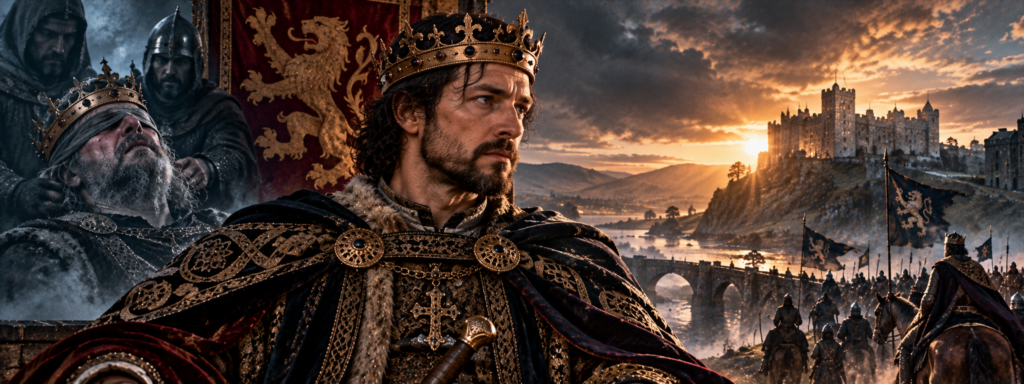
Edgar of Scotland: The Peaceable King and the Medieval Chronicle That Claimed He Was Murdered
Edgar of Scotland (c. 1074–1107) | King of Scots, 1097–1107 | Son of Malcolm III and Saint Margaret | Seized the throne from his uncle Donald III with English military assistance | Died on January 8, 1107, traditionally at Edinburgh | A contradictory medieval chronicle claimed that he was murdered by his uncle, although the accusation conflicts with the established chronology
The King Who Was Murdered After His Killer Was Already Dead
On January 8, 1107, Edgar, King of Scots, died after nearly ten years on the throne. He was only about thirty-three years old, unmarried, and without children to inherit his crown. His younger brother Alexander succeeded him, apparently without the bloody struggle that had accompanied Edgar’s own accession. After a childhood overshadowed by war and a rise to power secured through invasion, Edgar’s reign had ended with a comparatively orderly transfer of authority.
Yet one medieval chronicler told a very different story. According to Orderic Vitalis, a Norman monk writing during the twelfth century, Edgar was murdered by his uncle Donald III, the very man he had overthrown to become king. Orderic then claimed that Edgar’s brother Alexander killed Donald to avenge the murder and took the Scottish throne himself. It was a dramatic account of betrayal, assassination, and revenge, perfectly suited to the violent history of Scotland’s royal dynasty.
There was, however, a serious problem with the story. Donald III had been deposed in 1097, imprisoned, and traditionally said to have been blinded before dying around 1099 or 1100. Edgar, meanwhile, remained king until January 1107, and other historical records preserve a very different account of his succession. If the generally accepted chronology is correct, Donald had been dead for several years before the nephew he supposedly murdered reached the end of his reign.
The contradiction is more than a minor disagreement over dates. Orderic’s account rearranges the deaths and successions of several Scottish rulers, transforming a complicated dynastic struggle into a tale of one murdered brother avenged by another. It also raises an unsettling question about how medieval history was written. If a respected chronicler could turn a king who apparently died without violence into the victim of a family assassination, how many other stories of royal murder were shaped by confusion, political prejudice, or the irresistible appeal of a dramatic ending?
Edgar’s actual life provides more than enough darkness without inventing a murder. His father was killed during an invasion of England, his mother died days later, and his family was driven into exile by a rival claimant. His half-brother Duncan II seized the throne and was murdered within months, while Edgar eventually returned with an English-backed army to overthrow his uncle. The defeated Donald was reportedly blinded and imprisoned, and another of Edgar’s brothers was removed from political life.
The young king who emerged from this violence became known to later generations for his comparatively peaceful reign. That reputation was not entirely flattering, particularly among writers who believed he had surrendered too much influence to England and Norway. Edgar had won his crown through military intervention but appeared determined to avoid the conflicts that had destroyed so many members of his family. His death, therefore, presents a fascinating contrast between the violent world that created his kingship and the disputed account that later attempted to give him an equally violent ending.
A Prince Born Into a Dangerous Royal Family
Edgar was born around 1074, a son of Malcolm III of Scotland and his second wife, Margaret of Wessex. His father had become king in 1058 after defeating Macbeth and overcoming the brief resistance of Macbeth’s successor, Lulach. Malcolm’s accession had followed nearly two decades of conflict over the Scottish crown, and the violence surrounding his rise to power remained part of the family’s recent history. Edgar entered a dynasty whose members understood that royal ancestry could bring extraordinary privilege but also mortal danger.
His mother Margaret came from the displaced Anglo-Saxon royal family of England. She was the sister of Edgar Ætheling, a descendant of the old English kings who had briefly been considered for the English throne after Harold II’s death in 1066. The Norman Conquest had destroyed the family’s immediate prospects of ruling England, forcing its surviving members to seek security elsewhere. Margaret’s marriage to Malcolm connected the Scottish monarchy with one of the most politically significant families displaced by William the Conqueror.
Margaret became a powerful figure in Scottish religious and cultural life. Later accounts celebrated her devotion, charitable works, religious patronage, and efforts to influence the practices of the Scottish Church. Her biographer Turgot portrayed her as an exceptionally pious queen whose household reflected Christian discipline and learning. Although that account was written to honor her memory and should not be treated as an entirely neutral portrait, it provides valuable evidence of the ideals surrounding Edgar’s upbringing.
The royal household in which Edgar grew up was therefore influenced by several different traditions. His father belonged to the Gaelic-speaking Scottish monarchy, his mother came from the Anglo-Saxon royal world, and the kingdom maintained important connections with Norse communities and aristocratic families. Edgar’s own name reflected his mother’s English heritage, while his position depended upon his father’s Scottish royal ancestry. These overlapping identities would become politically important when he later sought the throne with English assistance.
Edgar was not Malcolm’s eldest son. His father had previously married Ingibiorg Finnsdottir, a woman connected with the powerful Norse aristocracy of Orkney, and their son Duncan was older than Margaret’s children. Edgar also had brothers from Margaret’s marriage, including Edward, Edmund, Alexander, and David, although the precise order of some siblings and the details of their early lives are not equally well documented. The number of eligible royal sons made the future succession potentially dangerous.
Malcolm’s long reign gave his children the appearance of security. He had survived challenges from powerful neighbors and established himself as one of the most formidable rulers of his generation. Yet his kingdom remained exposed to conflict with England, while succession customs did not guarantee that the crown would pass peacefully to a particular son. The stability Edgar experienced as a child depended heavily upon his father’s continued survival.
Malcolm III and the Shadow of England
Malcolm III ruled Scotland for approximately thirty-five years, from 1058 until 1093. During that period, England underwent enormous political transformation following the Norman Conquest. William the Conqueror established a new ruling dynasty, redistributed aristocratic lands, and imposed Norman authority across much of the kingdom. These changes brought the Scottish monarchy into repeated contact and conflict with an increasingly powerful southern neighbor.
Malcolm’s relationship with England was complicated by his marriage to Margaret. Her family possessed claims and connections that could make Scotland a refuge for opponents of Norman rule. At the same time, Malcolm had practical reasons to maintain diplomatic relationships with the Norman kings rather than pursue permanent war. The resulting policy alternated between negotiation, military pressure, and uneasy accommodation.
Edgar grew up in a household where the English succession was not simply a foreign political matter. His maternal uncle Edgar Ætheling had once represented an alternative to Norman kingship, and the fate of the displaced English royal family remained closely connected to Scotland. The young prince would have been surrounded by people whose lives had been transformed by conquest and exile. His later dependence upon English military assistance was therefore shaped by relationships that predated his own birth.
The northern English borderlands also remained a persistent source of conflict. Northumbria had a complex political identity and was not always easily controlled from the English royal court. Scottish kings possessed interests in the region, while English rulers sought to prevent northern instability from threatening their authority. Military expeditions across the border could therefore become instruments of negotiation as well as attempts at territorial expansion.
Malcolm’s campaigns brought prestige when successful but exposed his family to considerable danger. His sons were growing toward adulthood in a kingdom where military leadership remained central to royal authority. Edgar’s future might have involved service under his father or one of his brothers rather than kingship in his own right. Nothing in his childhood guaranteed that he would ever become king.
The disaster that changed his future came in November 1093. Malcolm invaded Northumberland during a period of renewed tension with William II of England. The campaign ended near Alnwick, where the Scottish king was killed. The consequences for Edgar and his family were immediate and devastating.
The Catastrophe at Alnwick
On November 13, 1093, Malcolm III died during his campaign in northern England. His son Edward, one of Margaret’s children, was also killed during the expedition or died shortly afterward. The loss deprived Scotland of a long-serving king and removed a prominent potential successor from the next generation. It also created an opportunity for rival claimants who had spent decades waiting for Malcolm’s death.
The precise circumstances of Malcolm’s killing became the subject of different medieval traditions. Some writers emphasized treachery, while others described military confrontation. The sources do not allow every detail of the encounter to be established beyond dispute. What matters for Edgar’s story is that the king’s death destroyed the political stability upon which his family depended.
Margaret was already seriously ill when news of the catastrophe reached her. Her final days were later described in religious accounts emphasizing her devotion and resignation. She died on November 16, only three days after her husband. Edgar had therefore lost both parents and his brother Edward within an extraordinarily short period.
The emotional consequences cannot be reconstructed from Edgar’s own testimony because none survives. He was probably around nineteen years old, an age at which he might have expected to begin assuming greater responsibilities within the royal household. Instead, he faced the collapse of his family’s political position. The throne was suddenly available, and not everyone believed it should pass to Malcolm’s sons.
Malcolm’s younger brother Donald emerged as the principal rival. Donald was an experienced adult member of the royal dynasty and could claim legitimacy through his descent from Duncan I. His position was strengthened by succession traditions that had historically allowed brothers and other adult relatives to compete for kingship. The crown was not yet governed by an uncontested rule of father-to-eldest-son inheritance.
Donald also appears to have benefited from opposition to the growing influence of English and Norman courtiers associated with Malcolm and Margaret’s household. Some accounts describe the expulsion of foreigners following his accession, although the precise extent and political meaning of these measures remain uncertain. The conflict should not be reduced to a simple struggle between native Scots and outsiders. Nevertheless, hostility toward external influence helped shape the crisis.
Edgar and his surviving siblings found themselves on the losing side of the succession. Their uncle became Donald III, King of Scots, while the children of Malcolm and Margaret were forced to seek protection and political support elsewhere. The family that had occupied the center of Scottish royal life for decades was suddenly displaced. Edgar’s path to the throne would begin not with inheritance but with exile.
Exile and the English Court
England offered refuge to the displaced Scottish princes. William II, known as William Rufus, had been Malcolm III’s opponent, but he also possessed reasons to support Malcolm’s sons against Donald. A Scottish king dependent upon English assistance might prove more cooperative than a ruler whose supporters opposed Anglo-Norman influence. Edgar’s personal misfortune therefore became an opportunity for English political intervention.
The English court was a dangerous place in its own right. William Rufus was an energetic and controversial monarch whose reign involved conflicts with aristocrats, clergy, and neighboring rulers. His government possessed substantial military resources, but royal favor could change according to political necessity. Edgar and his brothers needed assistance without becoming entirely powerless instruments of English policy.
Their maternal uncle Edgar Ætheling provided an important connection. Although he had failed to recover the English throne after the Norman Conquest, he remained a figure of considerable prestige and political experience. His relationship with the Norman monarchy had shifted over time between opposition and accommodation. For his Scottish nephews, he offered a combination of family loyalty, aristocratic standing, and practical knowledge of military affairs.
Edgar’s position was complicated by the existence of his older half-brother Duncan. Duncan had spent much of his life connected to the English court and possessed his own claim as Malcolm’s eldest surviving son. He was therefore a more immediate candidate for English-backed intervention than the younger Edgar. William Rufus initially supported Duncan’s attempt to seize the Scottish crown.
The decision would have consequences for the entire family. Duncan’s campaign demonstrated that English assistance could successfully remove Donald from power. It also revealed how difficult it would be for an English-backed ruler to maintain authority after the invading army withdrew. Edgar would eventually benefit from both lessons.
For the moment, however, Edgar remained a displaced prince watching another relative attempt to claim the throne. His future depended upon events beyond his control, including the survival of Duncan and the willingness of Scottish nobles to accept an externally supported king. The struggle had only begun. Within a year, another member of the family would be dead.
Duncan II: The Half-Brother Who Was Murdered
In 1094, Duncan entered Scotland with military support associated with William Rufus. His forces succeeded in overthrowing Donald III, and Duncan became king. The victory appeared to restore Malcolm’s descendants to the throne, but it also created immediate political difficulties. Duncan’s dependence upon foreign soldiers made his position vulnerable among Scottish elites who opposed their presence.
Pressure developed for Duncan to dismiss his Anglo-Norman supporters. He appears to have complied with demands that many of these men leave, reducing the resentment surrounding his accession. Unfortunately for Duncan, the decision also weakened the military force that had made his victory possible. Donald remained alive, and his supporters retained the ability to challenge the new king.
On November 12, 1094, Duncan was killed during the renewed struggle for the throne. The killing is associated with the Mearns, and later accounts identify Máel Petair as an important participant. Medieval sources also connect Donald and Edmund, another of Malcolm’s sons, with responsibility for the death. The exact circumstances and individual roles remain disputed.
Duncan’s murder was a warning to Edgar. His half-brother had obtained English military assistance, entered Scotland, and successfully claimed the crown. Yet none of those achievements protected him once his political support weakened. Kingship could be gained through invasion and lost through assassination or armed rebellion within months.
Donald returned to power after Duncan’s death. His restoration demonstrated that the earlier attempt to remove him had failed because he had survived and retained a political following. Edmund’s association with Donald further complicated the family conflict. One of Edgar’s own brothers was now cooperating with the uncle whom other members of the family regarded as an enemy.
The death of Duncan also left a son, William fitz Duncan, whose existence would later complicate any simplistic account of hereditary succession. Edgar could not claim to be the only surviving representative of Malcolm III’s descendants. The family contained multiple branches with plausible rights and powerful connections. His eventual kingship would therefore depend upon political success rather than an uncontested inheritance.
The Uncle Who Would Not Surrender
Donald III had already experienced an extraordinary reversal of fortune. He had become king after Malcolm’s death, been overthrown by Duncan, and returned following Duncan’s violent end. By late 1094, he was once again ruling Scotland. His restoration suggested that he possessed substantial support and that opposition to his kingship was far from unanimous.
The aging ruler also benefited from his alliance with Edmund. Medieval accounts suggest that Edmund received a significant share of authority, although the exact nature of the arrangement remains debated. Some historians have interpreted it as a division of the kingdom between different regions. The surviving evidence does not establish precise boundaries or a formal constitutional settlement.
For Edgar, the alliance created a particularly bitter situation. His uncle controlled the crown, while one of his brothers appeared to have accepted a political arrangement with him. Duncan had already been killed, and the remaining princes lacked an independent military force capable of restoring their branch of the family. The prospect of returning to Scotland depended increasingly upon English assistance.
Donald was not simply an illegitimate intruder whose authority could be dismissed. He was the son of Duncan I, the brother of Malcolm III, and a recognized king who had successfully recovered his throne. His position reflected the flexibility of Scottish succession customs and the support of powerful regional interests. Edgar’s claim was serious, but Donald’s claim was serious as well.
This distinction matters because later histories often portray Edgar’s accession as the restoration of rightful order. Such language reflects the eventual victory of Malcolm and Margaret’s descendants. At the time, however, the outcome was uncertain. Donald had already defeated one attempt to remove him permanently.
Edgar needed a strategy that would succeed where Duncan’s had failed. He required enough military strength to overthrow Donald and enough political support to prevent another restoration. He also needed to neutralize the men who might organize resistance after the invasion. The campaign of 1097 would therefore become the decisive turning point in his life.
The Invasion That Made Edgar King
By 1097, William Rufus was prepared to support another intervention in Scotland. Edgar’s maternal uncle, Edgar Ætheling, played a leading role in the expedition that brought the young claimant north. The invading force possessed the advantage of English military assistance and the political prestige of a prince descended from Malcolm III. Donald faced the most serious challenge to his restored kingship.
The precise course of the campaign is imperfectly recorded. Medieval narratives describe Edgar’s victory but do not preserve a detailed account of every movement, engagement, or negotiation. Later religious traditions also associated the expedition with the protection of St. Cuthbert. Such accounts reveal how military success could be interpreted as evidence of divine approval, but they do not provide a complete operational history.
Edgar’s campaign succeeded. Donald was overthrown for the second time, and Edmund’s political position collapsed with him. Edgar became King of Scots, beginning the reign that would last until 1107. He was probably about twenty-three years old.
The victory did not simply reverse Donald’s accession. It established a new balance of power within the royal family and strengthened the position of Margaret’s descendants. Edgar had secured the throne through a coalition that included English support, his maternal uncle’s leadership, and Scottish acceptance of his claim. His authority would depend upon maintaining that coalition after the invading army’s immediate purpose had been accomplished.
The fate of Donald demonstrated that Edgar’s supporters understood the dangers of leaving a defeated rival free. Donald had already recovered from one deposition, and his continued existence could provide a focus for renewed rebellion. This time, he was imprisoned and, according to important medieval traditions, blinded. His final years ended in captivity, with his death usually placed around 1099 or 1100.
Edmund was also removed from political competition. He became associated with monastic life at Montacute in Somerset, a fate that effectively ended his prospects of ruling Scotland. The contrast between the brothers and their uncle illustrates the different methods available for neutralizing royal claimants. A defeated rival could be imprisoned, mutilated, or confined within religious life without undergoing a public execution.
Edgar had therefore secured his kingship through the permanent exclusion of close relatives. The young king would later be remembered for peace, but his accession had been achieved through military intervention and followed by severe punishment of the defeated. His reputation cannot be understood without acknowledging that darker beginning. The peaceful reign rested upon the violent settlement of a family war.
The Peaceable King With a Violent Beginning
Edgar acquired a reputation for comparatively peaceful government. Later writers described his reign as lacking the major crises that had characterized the years immediately after Malcolm III’s death. His relationships with England were generally cooperative, and he avoided the repeated invasions associated with his father. The contrast encouraged the development of the nickname commonly rendered as Edgar the Peaceable.
That reputation was not necessarily intended as praise. Medieval rulers were expected to defend their authority and maintain the honor of their kingdoms, sometimes through military action. A king who avoided conflict could be admired for prudence or criticized for weakness. Edgar’s willingness to compromise with stronger neighbors exposed him to both interpretations.
His reign nevertheless provided Scotland with something it had desperately lacked during the preceding years. From 1093 to 1097, the kingdom had experienced repeated changes of ruler, military intervention, and the violent death of Duncan II. Edgar’s accession ended that immediate cycle. For nearly ten years, the crown remained in the hands of one king.
The absence of major recorded rebellions should not be mistaken for proof that everyone supported him. Medieval sources preserve only fragments of political life, and regional disputes may have occurred without leaving detailed accounts. Edgar still needed to manage powerful aristocrats, ecclesiastical institutions, and competing territorial interests. Stability required active government even when chronicles did not record dramatic confrontations.
His relationship with England was particularly important. William Rufus had helped him obtain the throne, and Edgar’s position remained connected to the English monarchy. Some accounts describe him as acknowledging William’s overlordship, although the precise legal implications of such arrangements are debated. Medieval kings could negotiate relationships of homage, protection, and obligation without those relationships fitting neatly into later ideas of national sovereignty.
Edgar’s cooperation may have been politically sensible. Scotland had suffered repeatedly from conflict with England, and the Norman monarchy possessed considerable military resources. Avoiding unnecessary war allowed Edgar to consolidate his authority and pursue other priorities. The same policy that critics interpreted as submission may have helped preserve his throne.
A Scottish King at the English Court
Edgar’s connection with William Rufus continued after his accession. He appears in accounts of the English court, including traditions surrounding the inauguration of Westminster Hall in 1099. Such appearances demonstrate that relations between the two monarchies involved personal contact as well as formal diplomacy. Royal courts were places where political obligations could be displayed through ceremony and hospitality.
One account associates Edgar with carrying a sword during the festivities connected with Westminster Hall. If accepted, the episode illustrates the ceremonial relationship between the Scottish king and his English counterpart. It does not, by itself, establish that Edgar had surrendered all independent authority. Medieval ceremonial roles could express honor, hierarchy, alliance, or political obligation depending upon context.
Edgar’s presence in England also reflects the unusual circumstances of his kingship. He had spent part of his youth in exile there and owed his accession to English support. He was therefore more familiar with the English royal world than many earlier Scottish kings had been. That familiarity could facilitate diplomacy while also making him vulnerable to accusations of excessive dependence.
William Rufus died in August 1100 after being struck by an arrow while hunting in the New Forest. The circumstances of his death became the subject of enduring speculation, including suggestions that the killing might not have been accidental. No convincing evidence establishes a deliberate assassination, but the sudden death created another English succession crisis. Henry I, William’s younger brother, quickly secured the throne.
Edgar now faced a change in the political relationship that had helped establish his reign. His former patron was dead, and a new English king controlled the resources that had once supported his accession. Fortunately for Edgar, family connections would soon provide another means of maintaining peaceful relations. His sister Matilda was about to become Queen of England.
Matilda: The Sister Who Became Queen of England
In November 1100, Henry I married Matilda, Edgar’s sister. She had previously been known as Edith, and her marriage connected the Norman ruling dynasty directly to the descendants of the old Anglo-Saxon royal family. The union carried considerable political significance because Matilda’s ancestry offered Henry a connection to the kings displaced by the Norman Conquest. It also strengthened the relationship between the English and Scottish royal houses.
For Edgar, the marriage created a powerful family alliance. The English king was now his brother-in-law, while the English queen was his sister. These relationships did not eliminate political disagreements, but they made cooperation easier to present as a matter of dynastic solidarity. The marriage helped reinforce the peaceful relationship that characterized Edgar’s reign.
Matilda’s position also reflected the remarkable reversal experienced by Margaret’s children. In 1093, the family had lost its father, mother, and political security within days. By 1100, Edgar ruled Scotland, while his sister occupied the English throne. The descendants of a displaced Anglo-Saxon royal family had become central figures in two neighboring monarchies.
The marriage also strengthened the prestige of Margaret’s memory. Her descendants increasingly occupied positions of authority, and her reputation for sanctity became an important element of dynastic identity. Edgar’s own religious patronage belonged within this broader family tradition. The royal household could present its legitimacy through ancestry, piety, and connections with influential ecclesiastical institutions.
Yet the relationship with England carried risks. Scottish nobles who had supported Donald partly because of opposition to foreign influence might regard the growing family alliance with suspicion. Edgar needed to maintain his own authority rather than appear merely an extension of Henry’s government. The surviving evidence does not allow us to measure the degree of resentment within Scotland.
The marriage nevertheless marked an important moment in Edgar’s reign. He had become king through English intervention, but the relationship between the kingdoms was now reinforced through marriage rather than military conquest. For a ruler whose childhood had been transformed by Anglo-Scottish conflict, that was a significant achievement. It also helped create the conditions for the relatively peaceful final years of his government.
Magnus Barefoot and the Threat From the Sea
Edgar’s reign was not free from external pressure. In the western seas, Norwegian power remained a serious challenge to Scottish claims and influence. The Hebrides, Orkney, the Isle of Man, and surrounding maritime territories formed part of a complex political world shaped by Norse settlement, Gaelic communities, and competing rulers. Control over these regions could not be reduced to simple boundaries on a modern map.
Magnus III of Norway, commonly known as Magnus Barefoot, pursued an aggressive policy of expansion in the British Isles. His campaigns brought Norwegian military power into the western maritime world and challenged the interests of local rulers. Edgar faced a difficult choice between confrontation and accommodation. A major naval war could have threatened the stability he had only recently secured.
Around 1098, Edgar reached an arrangement with Magnus concerning Norwegian and Scottish claims in the west. The agreement is generally understood as recognizing Norwegian authority over important island territories, including the Hebrides. The status of Kintyre became particularly complicated because of its geographic relationship to the islands and the traditions surrounding Magnus’s expedition. Later accounts describe dramatic methods used to justify Norwegian claims, but their details require caution.
The agreement has sometimes been portrayed as an embarrassing surrender. Critics argue that Edgar yielded territory rather than defending Scottish interests through war. Yet the political situation was more complicated than that judgment suggests. Norwegian influence in the western islands was already substantial, and Edgar may have been acknowledging realities that Scottish kings lacked the resources to reverse.
Avoiding war with Magnus also allowed Edgar to preserve stability elsewhere. Scotland had only recently emerged from a dangerous succession crisis, and another major conflict could have encouraged internal rivals. A negotiated settlement might therefore have been preferable to a military campaign with uncertain prospects. The decision illustrates Edgar’s preference for political accommodation over unnecessary confrontation.
The episode contributed to his reputation as a peaceable ruler. Whether that reputation reflected wisdom or weakness depended upon the observer’s expectations of kingship. A warrior king might have sought glory through battle, while Edgar appears to have favored an agreement that preserved his immediate position. His reign was shaped as much by the wars he avoided as by the invasion that brought him to power.
The Strange Gift Sent Across the Irish Sea
One of the most unusual episodes associated with Edgar’s reign concerns a gift sent to Muirchertach Ua Briain, the powerful Irish ruler who exercised high kingship during the early twelfth century. The Annals of Inisfallen record that the Scottish king sent an extraordinary animal to Ireland. The creature has commonly been identified as a camel, although some interpretations have suggested an elephant. Whatever its precise identity, the gift was remarkable enough to be remembered in a medieval annal.
The episode provides a rare glimpse of Edgar’s diplomatic world beyond England and Norway. Scotland maintained connections with Ireland through shared Gaelic culture, religious institutions, maritime routes, and aristocratic relationships. A gift to Muirchertach could express friendship, prestige, or political recognition. Exotic animals were valuable because they demonstrated access to distant networks and unusual resources.
The animal’s origins remain uncertain. It may have reached Britain through commercial, diplomatic, or aristocratic connections extending far beyond northern Europe. Suggestions that it was connected to the First Crusade are possible but not securely established. The surviving evidence does not identify the person who originally acquired it or the route by which it reached Edgar.
The gift nevertheless challenges the image of Edgar as an insignificant ruler concerned only with England. His government participated in a wider political world that included Irish kingship and international exchange. A monarch could exercise influence through gifts and diplomacy as well as military force. Edgar’s comparatively peaceful reign did not mean that Scotland had withdrawn from external affairs.
The episode also reveals the selective nature of medieval historical memory. Chronicles sometimes preserve a remarkable diplomatic gift while remaining almost silent about ordinary government. We know that Edgar sent an unusual animal across the Irish Sea, but we know far less about many of his domestic decisions. Such imbalances can make a reign appear less substantial than it actually was.
For Edgar, the gift may have been part of a deliberate effort to cultivate relationships without military conflict. His position required him to manage powerful neighbors in several directions, and diplomacy offered alternatives to war. The strange animal became a symbol of royal prestige rather than battlefield victory. It is one of the few vivid details that survives from an otherwise sparsely documented reign.
The Religious Legacy of Margaret’s Son
Edgar’s religious patronage reflected the influence of his mother and the ecclesiastical relationships cultivated by his family. Margaret had become associated with reform, charity, and the development of religious institutions in Scotland. Her sons inherited both the political benefits and the spiritual prestige of that reputation. Edgar’s reign included support for important religious communities.
One notable example was his patronage of Coldingham, a religious center in the southeast connected with the monks of Durham. A surviving royal charter records Edgar’s grant of Coldingham and associated lands to St. Cuthbert and the Durham community. The document also protects the monks’ rights and possessions against interference. Such grants demonstrate the practical relationship between royal government and ecclesiastical institutions.
Religious patronage served several purposes. It expressed devotion, supported prayer for the ruler and his family, and strengthened relationships with influential clerical communities. Monasteries also preserved documents, maintained networks of communication, and helped establish the public legitimacy of rulers. A king who supported religious institutions could therefore pursue spiritual and political objectives simultaneously.
Edgar also maintained connections with Dunfermline, a place closely associated with Margaret’s religious foundations and the royal family. Later accounts describe his efforts to support the religious community there and to continue aspects of his mother’s work. The precise chronology of every institutional development is complicated, and later traditions sometimes attribute achievements to particular rulers with more confidence than the surviving evidence permits. Nevertheless, Edgar’s patronage formed part of the continuing transformation of Scottish religious life.
These activities also shaped his historical reputation. Writers connected with religious communities often judged kings according to their generosity and treatment of the Church. Edgar’s comparatively peaceful government and ecclesiastical patronage encouraged favorable assessments. The same ruler who had helped destroy Donald’s political career could be remembered as benevolent by writers whose institutions benefited from his reign.
The contrast is not necessarily evidence of hypocrisy. Medieval rulers could be sincere religious patrons while using harsh measures against political enemies. Their contemporaries did not always regard those actions as incompatible. Edgar’s career demonstrates how piety, diplomacy, and dynastic violence could coexist within the same monarchy.
The King Who Never Married
Edgar’s personal life remains unusually obscure. He never married, at least according to the surviving historical record, and no legitimate children are known. His unmarried status was significant because royal marriages normally served important political purposes. They could create alliances, secure succession, and strengthen relationships with powerful aristocratic families.
The reasons for Edgar’s failure to marry are unknown. He may have considered prospective alliances without completing a marriage, or circumstances may have prevented an arrangement. It is also possible that personal or political considerations influenced his decision. The sources do not provide enough evidence to choose among these explanations.
His lack of children made the succession particularly important. Scotland had experienced repeated conflict after Malcolm III’s death, and another disputed inheritance could have revived the violence of the 1090s. Edgar therefore had strong reasons to clarify who should succeed him. His surviving brothers offered several possibilities.
Alexander was the brother who ultimately inherited the Scottish crown. David, another younger brother, also received a substantial territorial position associated with the former kingdom of Strathclyde and neighboring southern lands. The exact nature of these arrangements remains debated, particularly the relationship between Edgar’s intentions and the political negotiations that followed his death. Nevertheless, the division helped shape the government of Scotland during the following decades.
The absence of a wife or children also affects how Edgar is remembered. There is no surviving queen whose household provides an additional perspective on his reign, and no son whose later career preserves a direct dynastic memory of his father. His legacy passed through his siblings rather than his descendants. That circumstance makes his life appear even more elusive in the surviving sources.
A childless king could become a source of instability, but Edgar appears to have avoided that outcome. His brother Alexander succeeded without a recorded civil war comparable to the struggles of 1093–1097. The contrast suggests that Edgar’s arrangements and the political circumstances surrounding his death were more orderly than those following Malcolm III’s fatal campaign. It also weakens the claim that his death resulted from a dramatic struggle for the crown.
January 1107: The Death of a Young King
Edgar died in January 1107, with January 8 generally accepted as the date. The surviving sources preserve slight variations in the day, a common difficulty when comparing medieval chronicles and obituary records. The Anglo-Saxon Chronicle, John of Worcester, Symeon of Durham, and Durham obituary traditions all contribute to the chronology. Their accounts agree on the essential point that Edgar’s reign ended in January 1107.
The traditional location of his death is Edinburgh, although an older biographical account gives Dundee instead. The difference illustrates how even basic details of medieval royal deaths can vary across later sources. Modern summaries generally favor Edinburgh, often identifying Edinburgh Castle as the place of death. The exact room or circumstances cannot be reconstructed.
Edgar was approximately thirty-three years old. His early death naturally invites questions about illness, accident, and political violence, particularly given the brutal history of his family. Yet a young age at death is not evidence of murder. Medieval rulers could die from infections, disease, or other causes that left little explanation in the surviving written record.
No reliable contemporary account describes an assassination at Edinburgh in January 1107. There is no securely documented attacker, weapon, conspiracy, or immediate political upheaval associated with his death. His brother Alexander succeeded him, and the transition appears comparatively orderly. These circumstances are important when evaluating the later claim that Edgar was murdered.
The sources also do not preserve a medical diagnosis. We cannot confidently identify the disease or physical condition that caused his death. Any claim that he suffered a particular illness would require evidence that has not survived. The most responsible conclusion is that his cause of death remains unknown, while the better-supported chronology provides no convincing evidence of assassination.
His body was buried at Dunfermline, the religious center closely associated with his mother. The burial connected Edgar with the family’s spiritual legacy and the royal landscape of Fife. It also marked the end of a reign that had brought nearly a decade of relative stability after years of dynastic violence. Yet the story of his death would not remain entirely peaceful in the historical record.
The Chronicle That Turned Edgar Into a Murder Victim
The most important source behind the claim that Edgar was assassinated is Orderic Vitalis. Born in England in 1075, Orderic became a monk at Saint-Évroult in Normandy and composed an extensive ecclesiastical history during the twelfth century. His work is a major source for Norman and Anglo-Norman history, preserving valuable information about rulers, aristocrats, religious institutions, and political events. He was a serious medieval historian, but his knowledge was not equally reliable for every region or episode.
In his account of the Scottish succession, Orderic described a conflict following Malcolm III’s death. He presented Edgar as the rightful heir who faced opposition from Donald, Malcolm’s brother. According to Orderic, Donald eventually murdered Edgar, and Alexander then killed Donald in revenge. Alexander subsequently became king.
The story contains several serious chronological problems. Edgar was not Malcolm III’s eldest surviving son because Duncan II was older. Donald’s reign was interrupted by Duncan’s accession in 1094, an important event that Orderic’s compressed narrative fails to incorporate properly. Most decisively, Donald’s death is generally placed years before Edgar’s recorded death in 1107.
Orderic also portrayed Alexander’s accession as the immediate consequence of avenging Edgar’s murder. Other evidence, however, records Edgar’s reign from 1097 until 1107 and identifies Alexander as his successor after his death. The account therefore does not merely offer an alternative explanation for Edgar’s final moments. It rearranges the sequence of Scottish kings and the relationships between their deaths.
The contradiction has been recognized by historians. Benjamin Hudson, in his work on early medieval Scottish and Irish kingship, rejected Orderic’s version as historically false. The account is valuable as evidence that confused stories about Scotland’s succession circulated beyond the kingdom. It is not reliable evidence that Donald murdered Edgar.
That distinction is essential. A medieval source can be authentic without every event it describes being accurate. Orderic genuinely recorded the assassination story, but the existence of his account does not establish that the murder occurred. In this case, the wider chronology makes the accusation exceptionally difficult to sustain.
How Could a Medieval Historian Get It So Wrong?
Orderic Vitalis lived during Edgar’s lifetime and wrote within a generation of the events. That proximity might initially make his account seem persuasive. Yet geographical distance, imperfect information, and the complicated nature of Scottish succession could all contribute to error. A chronicler writing in Normandy did not necessarily possess detailed knowledge of every Scottish royal conflict.
The years between 1093 and 1097 were especially confusing. Malcolm III died violently, Donald seized the throne, Duncan II overthrew Donald, Duncan was killed, Donald returned, and Edgar eventually invaded and became king. Edmund’s involvement added another layer of family rivalry. Even a writer with access to reasonably accurate reports could struggle to reconstruct the sequence if the information reached him in fragments.
Names and relationships also created opportunities for confusion. Edgar was both the name of the Scottish prince who became king and that of his maternal uncle Edgar Ætheling. Duncan II was a son of Malcolm III by an earlier marriage, while Edmund and Edgar belonged to Margaret’s branch of the family. Donald was Malcolm’s brother rather than his son. A narrative that confused these relationships could easily assign an event to the wrong person.
The death of Duncan II provides a particularly plausible source of confusion. Duncan was indeed killed during a struggle involving Donald’s supporters, and medieval sources implicated Donald and Edmund in responsibility for his death. A story about an uncle associated with the killing of a nephew therefore had a genuine historical basis. Orderic may have transferred elements of that story to Edgar, although the precise process cannot be proven.
His account also resembles a moral narrative of crime and punishment. A rightful young prince is murdered by a cruel usurper, and his brother avenges him before becoming king. The sequence creates a satisfying explanation for political succession through righteous revenge. Medieval chroniclers often organized complicated events into narratives that emphasized moral lessons and divine justice.
None of these possibilities establishes exactly why Orderic made the error. We do not possess the report he heard or the notes from which he worked. His mistake may have arisen from confused oral information, a flawed written source, or his own misunderstanding of the Scottish succession. What can be established is that his dramatic account conflicts with stronger chronological evidence.
The Murder of Duncan II and the Confusion of Royal Names
Duncan II’s death in 1094 is one of the clearest examples of violence within Edgar’s immediate family. Duncan had overthrown Donald with English assistance but lost support after the dismissal of foreign troops. His enemies then killed him during the struggle that restored Donald to power. The event was remembered in medieval chronicles and annals.
Some annalistic material attributes responsibility to Donald and Edmund, although the wording of the surviving record creates genealogical difficulties. Donald was Duncan’s uncle, while Edmund was his half-brother. A mistaken identification of relationships in a brief annal could complicate later attempts to understand the killing. The presence of several royal men with overlapping claims made such errors more likely.
Orderic’s story about Edgar contains elements that resemble Duncan’s actual fate. A son of Malcolm is killed during conflict with Donald, and another member of the family eventually gains the throne. The narrative becomes inaccurate when it identifies Edgar as the victim and Alexander as the killer of Donald. Those changes transform a real succession crisis into a different and unsupported sequence.
The confusion matters because it shows how historical violence can migrate between individuals. A genuine murder may be remembered, but its victim or perpetrator can become distorted in later retellings. Once a dramatic version enters a respected chronicle, it can acquire authority simply because it appears in an old source. Later readers may then repeat the story without comparing it against the wider chronology.
Edgar’s case is especially vulnerable to this process because his own reign was comparatively peaceful and sparsely documented. A sensational murder provides a memorable ending to an otherwise quiet kingship. The fact that the account is dramatic does not make it impossible, but it increases the importance of checking its details. Here, the details fail.
The murder of Duncan II therefore belongs at the center of any responsible discussion of Edgar’s supposed assassination. It offers a genuine example of the family violence that Orderic appears to have confused. It also explains why a story about Donald killing one of Malcolm’s sons could circulate without being entirely invented from nothing. The historical crime was real, but Edgar was not its established victim.
The Prophecy That Seemed to Foretell Another Murder
Another intriguing source associated with the period is the Prophecy of Berchán, a medieval Gaelic prophetic text containing passages that have been interpreted as references to Scottish rulers. Its language is deliberately obscure, using symbolic descriptions rather than straightforward historical names. Such texts could present events as predictions even when composed or revised with knowledge of the past. They are therefore difficult sources for reconstructing specific incidents.
One passage has been interpreted as referring to a son of an English woman who would be killed by his brother. The reference to an English mother naturally suggests a connection with Margaret’s children. Yet the identification of the ruler remains uncertain, and the passage cannot simply be treated as a contemporary report of murder. Its poetic and prophetic form creates substantial interpretive difficulties.
No securely documented murder of Edgar by one of his brothers fits the established chronology. Alexander succeeded Edgar, but the sources do not provide convincing evidence that he killed him. Donald was Edgar’s uncle, not his brother, and he was probably already dead by 1107. The prophetic passage therefore cannot rescue Orderic’s contradictory narrative.
The death of Duncan II again offers a possible explanation for the confusion. Duncan was Malcolm’s son by Ingibiorg rather than Margaret, and his killing involved allegations against Edmund, one of Margaret’s sons. The relationships are complicated enough that a poetic reference might have been interpreted differently by later readers. Nevertheless, identifying the passage with Duncan remains a hypothesis rather than a certainty.
The prophecy illustrates the danger of using ambiguous literary material as evidence for a specific assassination. A few lines can appear remarkably suggestive when placed beside a known historical event. Yet the same lines may support several interpretations, particularly when names and dates are absent. Edgar’s death should not be classified as murder on the basis of such uncertainty.
The existence of the passage remains historically interesting. It reveals a world in which royal succession, family betrayal, and violent death were closely associated in political imagination. Audiences were familiar with the possibility that brothers or uncles might kill one another for a crown. Edgar’s family history provided ample reason for those fears, even if his own death was not an assassination.
Could Alexander Have Wanted His Brother Dead?
Alexander succeeded Edgar in 1107, making him an obvious figure to examine whenever allegations of a suspicious royal death arise. He possessed royal ancestry, political connections, and a direct interest in the succession. Edgar’s lack of children meant that Alexander stood to gain considerably from his brother’s death. Those circumstances might appear suspicious when considered without the wider historical evidence.
Yet benefiting from a death is not proof of causing it. Alexander’s succession was apparently recognized without the prolonged civil conflict that had followed Malcolm III’s death. Edgar seems to have accepted Alexander as his successor, while David received a substantial territorial position. The arrangements suggest that the transition had been anticipated rather than improvised after a sudden political murder.
There is no reliable contemporary accusation that Alexander assassinated Edgar. Orderic’s account actually makes Alexander the avenger of Edgar’s supposed murder, not the perpetrator. The Prophecy of Berchán has sometimes encouraged speculation about fraternal killing, but its identification with Edgar is uncertain. The surviving evidence therefore does not support a claim that Alexander murdered his brother.
Alexander’s later reputation for forcefulness cannot establish guilt either. He became known as Alexander the Fierce, a nickname associated with his willingness to defend royal authority. Such a reputation may make a murder theory seem dramatically attractive, but it belongs to a different set of events. A ruler’s later severity does not prove that he committed an earlier assassination.
The political circumstances also provide no obvious need for murder. Edgar was unmarried and childless, and Alexander had a plausible expectation of succession. Killing a reigning brother could have endangered Alexander’s legitimacy and encouraged opposition from other claimants. Waiting for an orderly inheritance may have offered greater security than organizing a conspiracy.
None of this proves that every relationship within the royal family was affectionate. Medieval sources rarely preserve the private disagreements of rulers, and Alexander may have had ambitions of his own. The important distinction is between acknowledging possible political tensions and alleging a crime. Without credible evidence of violence, Alexander should not be treated as Edgar’s murderer.
Donald III: The Impossible Assassin
Donald III occupies the central role in Orderic’s assassination story. He was Edgar’s uncle, his former rival, and the man Edgar had overthrown in 1097. His earlier association with the death of Duncan II makes him a plausible villain in a story about family murder. Yet the chronology creates an obstacle that cannot be ignored.
Donald was captured or otherwise permanently removed after Edgar’s successful invasion. Important medieval traditions describe his blinding and imprisonment, while later accounts place his death around 1099 or 1100. Although the exact date and circumstances remain uncertain, he did not continue ruling Scotland after 1097. His political career ended years before Edgar’s recorded death.
For Donald to have murdered Edgar in January 1107, the accepted account of his final years would have to be radically mistaken. He would need to have survived well beyond his generally accepted death date and somehow regained the ability to organize or commit an assassination. No reliable evidence supports such a scenario. The possibility is not a serious historical explanation merely because a later chronicler recorded it.
Orderic’s account also claims that Alexander killed Donald after Edgar’s murder. That assertion conflicts with the evidence that Donald had been defeated, imprisoned, and probably died before Alexander became king. It reverses the order of events and transforms a succession already settled in 1097 into a revenge killing supposedly occurring a decade later. The contradiction undermines the entire narrative.
Donald was certainly capable of participating in violent dynastic politics. His restoration after Duncan II’s death demonstrates the ruthless circumstances in which he operated. But a documented history of conflict does not make every later accusation credible. His association with Edgar’s murder is best understood as a confused chronicle tradition.
The irony is striking. Edgar’s enemies reportedly ensured that Donald could never again threaten the throne, possibly blinding him before his death in captivity. Years later, a chronicler transformed the defeated prisoner into the killer of the nephew who had destroyed him. In historical reality, Donald’s final defeat appears to have been permanent.
The Problem With a Convenient Murder
Royal assassinations often become attractive explanations for sudden changes of power. A king dies, another inherits, and later generations wonder whether ambition played a hidden role. The suspicion becomes stronger when the deceased ruler was young or belonged to a family with a violent history. Edgar possessed both characteristics.
His death at approximately thirty-three was certainly early. His family had experienced repeated killings, depositions, and betrayals, making another murder appear plausible within the broader pattern. His successor was a brother who gained the crown, while another brother received important lands. These circumstances provide the ingredients for speculation.
Yet historical plausibility is not the same as historical evidence. Edgar’s family background explains why a murder story could circulate, but it does not establish that the story was true. His age makes an unexplained death noteworthy, but it does not identify a killer. His brother’s succession creates a potential benefit, but it does not prove a conspiracy.
The strongest available chronology points in another direction. Edgar remained king until January 1107, died without a recorded violent crisis, and was succeeded by Alexander. His uncle Donald had already been removed from power and was probably dead. The assassination account therefore conflicts with multiple established facts rather than merely filling a gap in an otherwise silent record.
It is possible that Edgar died from an illness whose nature was never recorded. It is also possible that the circumstances involved an event now lost to history. The absence of a medical explanation does not allow us to choose confidently between every imaginable possibility. Responsible history must distinguish what cannot be known from what can reasonably be inferred.
The conclusion is therefore less sensational than Orderic’s version but more historically defensible. Edgar’s cause of death is uncertain, and no convincing evidence establishes assassination. The medieval murder account is important because it exists, not because it accurately describes his final moments. Its value lies in revealing the confusion surrounding Scotland’s violent succession history.
A Peaceful Death After a Violent Life?
Edgar’s reign stands out partly because of the contrast between his accession and his death. He became king through invasion after several years of family conflict. His half-brother Duncan had been killed, his uncle Donald was overthrown, and his brother Edmund was removed from secular politics. The crown he inherited had been fought over repeatedly.
Once established, however, Edgar avoided the major succession crises that had plagued the preceding years. He maintained cooperative relations with England, reached an accommodation with Norwegian power, and supported religious institutions. His reign was not necessarily free from local conflict, but it did not produce another recorded cycle of royal deposition and restoration. The stability was significant.
His death also differed from those of several earlier Scottish rulers. Duncan I had been killed in conflict with Macbeth, Lulach had died during the struggle for power, and Malcolm III had been killed near Alnwick. Duncan II was murdered after a reign lasting only months. Donald III died after deposition and imprisonment, with traditions describing severe mutilation.
Edgar’s end was comparatively quiet in the better-supported sources. No major battle is associated with his death, and no credible account describes a violent seizure of the throne by Alexander. His burial at Dunfermline followed the pattern of a recognized royal death. The transition suggests that Edgar had achieved a measure of dynastic stability unavailable to several of his predecessors.
That achievement should not be dismissed merely because it lacks the drama of assassination. Avoiding civil war was a major accomplishment in a kingdom that had recently endured repeated royal conflicts. Edgar’s willingness to negotiate with powerful neighbors may have contributed to that stability. His reign demonstrates that political success could involve preventing violence rather than winning battles.
The irony is that a later chronicler supplied the violent ending that the stronger evidence does not support. Edgar had spent his reign escaping the cycle of family murder, only to be drawn back into it through historical storytelling. His reputation as a peaceable king survived, but so did the contradictory accusation that his uncle killed him. The two traditions reveal different ways medieval writers understood royal power.
Alexander I and the Crown Edgar Left Behind
Alexander I succeeded Edgar in January 1107 and ruled until 1124. His accession continued the dominance of Malcolm III and Margaret’s descendants, ensuring that Donald’s branch did not regain the crown. Alexander inherited a kingdom that had experienced nearly a decade of relative stability under Edgar. He also inherited the political relationships and territorial questions that Edgar had left unresolved.
One important issue concerned David, their younger brother. Edgar’s arrangements appear to have provided David with authority over lands associated with Cumbria and parts of southern Scotland. The precise nature of this grant and the extent to which Alexander accepted it willingly remain subjects of historical debate. David’s position would become increasingly important during Alexander’s reign.
Alexander’s kingship was more forceful in reputation than Edgar’s. Later accounts associated him with vigorous defense of royal authority and a willingness to confront opposition. Yet he also continued aspects of the family’s religious patronage and relationships with England. His reign cannot be understood simply as the opposite of Edgar’s peaceful government.
The transition between the brothers was nevertheless historically significant. Scotland had experienced repeated succession crises after Malcolm III’s death, but Edgar’s death did not immediately reproduce those struggles. Alexander was recognized as king, while David maintained a substantial political position. The arrangement helped preserve the dynasty’s authority.
This relative order is another reason to question the assassination narrative. A murder committed by Donald followed by revenge at Alexander’s hands would imply a very different political situation. The surviving chronology instead suggests a transition shaped by family arrangements and established claims. There is no reliable evidence of the revenge killing described by Orderic.
Alexander’s later achievements and conflicts belong to his own reign. They should not be retroactively used to construct a murder plot surrounding Edgar’s death. The two brothers were part of a dynasty familiar with violence, but that familiarity does not make every succession criminal. Edgar’s final contribution may have been ensuring that the crown passed without another destructive family war.
David I and the Dynasty That Endured
David eventually became king in 1124 after Alexander’s death. His reign would be one of the most consequential in medieval Scottish history, associated with major changes in government, religious patronage, aristocratic settlement, and economic organization. The developments of his reign are sometimes described as a transformation of Scottish society. Their roots, however, extended into the policies and relationships established by earlier members of his family.
Edgar’s reign formed part of that longer process. His cooperation with England, support for religious institutions, and management of regional interests helped create conditions in which his brothers could govern. He did not personally introduce every later reform, and attributing David’s achievements directly to Edgar would be misleading. Nevertheless, the stability of Edgar’s kingship contributed to the continuity of the dynasty.
The family’s rise had been far from inevitable. In 1093, Donald III displaced Malcolm’s sons, and Duncan II’s attempt to recover the throne ended in murder. Edgar’s successful invasion in 1097 reversed that situation. His victory ensured that Margaret’s descendants would control the Scottish crown for generations.
The dynasty’s subsequent success also shaped how earlier events were remembered. Donald could be portrayed as an obstacle to rightful succession, while Edgar became the prince who restored his father’s line. Alexander and David inherited the legitimacy associated with that restoration. Their achievements encouraged later writers to view the family as the natural rulers of Scotland.
Yet the violence involved in establishing their position remained part of the story. Edgar’s accession had resulted in the permanent exclusion of his uncle and the removal of Edmund from political life. His own kingship was made possible by English military assistance. The dynasty that later transformed Scotland had secured its position through the same ruthless succession politics that characterized earlier generations.
Edgar’s historical significance therefore extends beyond his disputed death. He was the ruler who ended the immediate struggle following Malcolm III’s death and established the succession that allowed Alexander and David to inherit. His reign may appear quiet when compared with theirs, but its political consequences were substantial. Without Edgar’s victory, the future of Scotland’s monarchy could have been very different.
The Burial at Dunfermline
Edgar was buried at Dunfermline, the religious center closely associated with his mother Margaret. The location carried spiritual and dynastic significance, connecting his death with the family’s religious patronage. Dunfermline would become one of the most important royal burial places in medieval Scotland. Edgar’s interment helped strengthen that association.
The burial also provides a striking contrast with the violence surrounding his accession. Donald III had ended his life in captivity, while Duncan II had been killed during a succession struggle. Edgar, by contrast, was buried as a recognized king whose brother succeeded him. The ceremony belonged to the established rituals of royal death rather than a documented aftermath of assassination.
No surviving physical evidence establishes Edgar’s cause of death. The location of his burial does not reveal whether he died from illness, injury, or another cause. Nor does the existence of a royal funeral prove that every aspect of his final days was peaceful. It simply provides no support for the specific murder story recorded by Orderic.
Dunfermline also connected Edgar to Margaret’s growing reputation for sanctity. His mother would eventually be canonized, and her memory became central to the religious identity of the Scottish royal family. Edgar’s burial within that sacred landscape reinforced his place among her descendants. His reign was remembered as part of the family’s continuing Christian kingship.
The contrast between the burial tradition and Orderic’s account illustrates the difficulty of reconstructing medieval deaths. One body of evidence preserves an orderly succession and royal burial, while another writer tells a story of murder and revenge. Historians must evaluate the accounts according to chronology, proximity, consistency, and corroboration. In Edgar’s case, the assassination story performs poorly against those tests.
The king’s grave therefore does not conceal a proven murder mystery. It marks the death of a ruler whose final illness or immediate cause of death remains unknown. The real historical mystery concerns how an inaccurate account of his murder entered medieval writing. That question is more revealing than an invented reconstruction of assassins entering his chamber.
Why Edgar Belongs in the History of Royal Assassination Legends
Edgar’s inclusion in a collection devoted to assassinated rulers requires careful explanation. He is not a securely established assassination victim, and presenting him as one would distort the historical evidence. His death in January 1107 is well supported, but the claim that Donald III murdered him is contradicted by the accepted chronology. The story survives because it was recorded by a medieval chronicler, not because it has been independently verified.
That distinction does not make the case uninteresting. On the contrary, Edgar provides an unusually clear example of how a false or confused assassination narrative could become attached to a real ruler. His family history contained genuine murders, and those events created a plausible setting for another violent death. The chronicle transformed that atmosphere into a specific accusation that the evidence does not sustain.
The case also demonstrates the importance of comparing sources rather than accepting the most dramatic account. Orderic Vitalis was a significant medieval historian whose work remains valuable for many subjects. Yet his treatment of the Scottish succession confused individuals and events. His authority as a writer cannot overcome the contradictions within his narrative.
Edgar’s story therefore belongs to the history of disputed royal killings rather than the category of proven regicide. It shows how the memory of genuine dynastic violence could distort the fate of a ruler who appears to have died without an assassination. The difference between historical murder and remembered murder is central to understanding the case. Both can shape reputations, but only one establishes a crime.
The broader succession struggle also involved confirmed and strongly attested acts of political violence. Duncan II was killed in 1094, while Donald III was deposed and reportedly blinded before dying in captivity. Edgar’s accession was made possible through armed intervention and the permanent exclusion of rivals. The violence surrounding him was real even if the murder attributed to his final days was not.
That is the darker truth of Edgar’s reign. He did not need to be assassinated to belong to a brutal chapter of Scottish royal history. He had grown up amid the consequences of conquest, lost his family during a military disaster, and fought his way to the throne through foreign assistance. His apparent escape from a violent death makes the contradictory assassination legend all the more revealing.
The Murder That History Cannot Sustain
Edgar of Scotland was born into a family whose history had been shaped by bloodshed long before he became king. His grandfather Duncan I had been killed during the struggle with Macbeth, while his father Malcolm III eventually secured the crown through the defeat of Macbeth and Lulach. Edgar grew up surrounded by the consequences of those conflicts, but his father’s long reign initially offered the promise of stability. That promise ended near Alnwick in November 1093.
The death of Malcolm III shattered the royal household. Edgar lost his father and brother Edward during the campaign, while his mother Margaret died only days later. His uncle Donald III claimed the throne, forcing Malcolm’s surviving sons into a dangerous struggle for their inheritance. Edgar’s future depended upon exile, political alliances, and the willingness of England’s king to support another claimant.
His half-brother Duncan II made the first successful attempt to recover the crown. With English assistance, Duncan overthrew Donald in 1094, only to be killed within months during the conflict that restored his uncle. Edgar witnessed another royal death within his own family, one that demonstrated how quickly military victory could turn into disaster. The lesson was unmistakable: removing a rival from the throne did not necessarily remove the danger he represented.
In 1097, Edgar returned with English military support and finally achieved what Duncan had failed to secure permanently. Donald was overthrown, imprisoned, and reportedly blinded, while Edmund was removed from secular politics. Edgar became king at approximately twenty-three years old. His victory ended the immediate succession struggle and established the dominance of Margaret’s descendants.
The new king then pursued a course that contrasted sharply with the violence of his accession. He maintained cooperative relations with England, reached an accommodation with Norwegian power in the western seas, and supported religious institutions connected with his family’s spiritual legacy. His reign was not entirely free from political difficulties, but it avoided the repeated royal depositions that had characterized the preceding years. For nearly a decade, Scotland experienced a measure of dynastic stability.
Edgar’s reputation for peace was complicated by accusations of excessive submission to stronger neighbors. Some later writers viewed his diplomacy as weakness, particularly in his dealings with England and Norway. Others regarded his reign as comparatively benevolent and free from the major disturbances of earlier years. Both interpretations reflect different expectations of what a medieval king should accomplish.
His death in January 1107 brought that reign to an end. Edgar was only about thirty-three, unmarried, and without children. His brother Alexander succeeded him, while David received an important territorial position that would shape his own political future. The transition appears to have occurred without the kind of violent crisis that had followed Malcolm III’s death.
Yet Orderic Vitalis preserved a radically different account. He claimed that Donald III murdered Edgar and that Alexander then killed Donald in revenge. The story offered a dramatic conclusion to a family history already filled with betrayal and bloodshed. It also contradicted the established chronology.
Donald had been overthrown in 1097 and was traditionally believed to have died around 1099 or 1100. Edgar remained king until January 1107, years after his uncle’s political career had ended. Other sources preserve the succession without describing an assassination, while Orderic’s narrative confuses important details of the royal family. The accusation therefore cannot be accepted as a reliable account of Edgar’s death.
The most plausible explanation is that the chronicler confused elements of Scotland’s complicated succession struggles. Duncan II had genuinely been killed during conflict involving Donald’s supporters, and the memory of that murder could have influenced later stories. The names, relationships, and changing kingships were sufficiently complicated to encourage misunderstanding. Orderic’s account appears to preserve that confusion rather than an otherwise unknown assassination.
The case is a reminder that medieval chronicles were written by human beings working with imperfect information. Their authors could preserve extraordinary details while misunderstanding events beyond their immediate knowledge. A respected historian could be accurate about one subject and seriously mistaken about another. Historical authority must therefore be tested rather than simply inherited.
Edgar’s actual cause of death remains unknown. He may have died from illness or another natural cause, but the surviving evidence does not establish a diagnosis. There is no convincing proof that Donald killed him, that Alexander arranged his death, or that another conspirator intervened. The absence of a clear medical explanation should not be mistaken for evidence of murder.
What makes Edgar’s story unsettling is the contrast between his reputation and the world that produced him. He became known as a peaceable ruler, yet his crown was secured through invasion and the destruction of his uncle’s political future. His family had suffered genuine assassinations and violent deaths, while his own accession involved the permanent exclusion of defeated relatives. Peace did not erase the brutality upon which his kingship had been established.
His death may have represented one of the few relatively orderly transitions in a dynasty accustomed to bloodshed. Alexander succeeded him, and David later inherited the crown, continuing the line of Malcolm III and Margaret. The family that had once been driven into exile became the foundation of Scotland’s monarchy for generations. Edgar’s reign helped make that continuity possible.
The assassination legend nevertheless survived because it fitted the expectations created by the family’s history. An uncle murdering a nephew was entirely believable in a dynasty that had already witnessed similar violence. A brother avenging the victim and inheriting the throne offered an equally satisfying conclusion. The story was compelling precisely because it resembled events that had genuinely occurred.
But resemblance is not evidence. Donald’s association with Duncan II’s death cannot establish responsibility for Edgar’s death years later. Alexander’s succession cannot be treated as proof that he benefited from a conspiracy. The violent character of the dynasty cannot transform an unsupported accusation into historical fact.
Edgar therefore occupies an unusual position in the history of royal murder. He was a king whose life was surrounded by assassination, deposition, and mutilation, but whose own death is not convincingly shown to have been violent. A medieval chronicler made him the victim of a murder that the chronology cannot sustain. The resulting contradiction reveals as much about the creation of historical legend as it does about the king himself.
His real achievement may have been surviving the violent struggle for succession and preventing its immediate return. He inherited a kingdom divided by family rivalry and left it to a brother whose accession did not require another recorded royal killing. His reign helped establish the political continuity that allowed Alexander and David to shape Scotland’s future. That legacy deserves recognition even without a dramatic assassination.
The story of Edgar also challenges the assumption that every unexplained royal death conceals a conspiracy. Some rulers died young without leaving enough evidence to establish why. Others became victims of murder legends because later writers confused their lives with those of relatives who had genuinely been killed. Edgar belongs to the second category more convincingly than the first.
There is no need to imagine assassins creeping through Edinburgh in January 1107 or a dying king naming his murderer. No trustworthy evidence supports such scenes, and inventing them would obscure the more revealing historical problem. The real drama lies in the contradiction between a king’s recorded death and the false certainty of a later chronicle. It is a reminder that the darkest story is not always the truest one.
Edgar had witnessed the destruction of his father’s household, the murder of his half-brother, and the downfall of his uncle. He had gained his crown through military force and maintained it through diplomacy and political compromise. By the time he died, he had achieved something many of his predecessors had failed to secure: a succession that did not immediately plunge Scotland into another civil war. His comparatively peaceful ending was therefore remarkable in its own right.
Orderic Vitalis gave him a different fate, one filled with betrayal and revenge. That version endured because it transformed complicated history into a recognizable tragedy. Yet the evidence points away from the murder and toward a more ordinary, if still unexplained, death. The distinction matters because the lives of historical figures should not be rewritten simply to satisfy the expectations of a darker narrative.
Edgar of Scotland was surrounded by men who killed for crowns, and he became king after helping destroy the political future of his own uncle. He died young, leaving no children and no certain explanation for the end of his life. Centuries later, the accusation that he had been murdered still appears beside his name, even though the supposed killer was almost certainly dead before the alleged crime. His story leaves us with a final irony: the peaceable king escaped the violence that destroyed so many of his relatives, only for history itself to invent the murder that his enemies apparently never committed.