
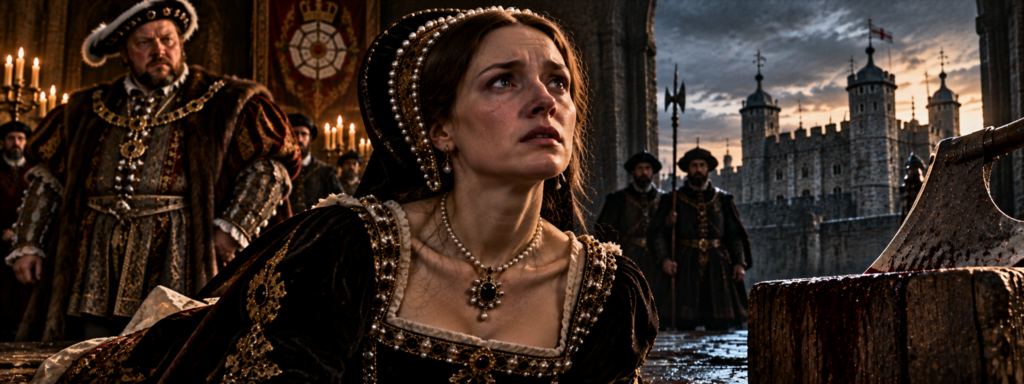
Catherine Howard: Henry VIII’s Doomed Young Queen and the Scandal That Sent Her to the Scaffold
Catherine Howard (c. 1521–1525–1542) | Queen Consort of England, 1540–1541/1542 | Fifth wife of Henry VIII | Accused of concealing premarital sexual relationships and conducting a secret relationship with Thomas Culpeper while queen | Executed at the Tower of London on February 13, 1542
The Young Queen Who Followed Her Cousin to the Scaffold
Before sunrise on February 13, 1542, another queen of England waited inside the Tower of London for the executioner. Catherine Howard had been Henry VIII’s wife for less than two years, and for much of that short marriage the aging king had treated her with conspicuous affection. He showered her with jewels, dresses, property, and attention, apparently delighted by the youthful woman who had entered his life after the humiliating collapse of his marriage to Anne of Cleves. Now Catherine was condemned, stripped of her queenship, and preparing to die in the same fortress where her cousin Anne Boleyn had been beheaded less than six years earlier.
The resemblance between their fates was impossible to ignore, but their cases were not identical. Anne Boleyn had been subjected to an extraordinarily dubious prosecution for adultery, incest, and treason, with much of the surviving evidence suggesting that the charges were constructed to remove a politically inconvenient queen. Catherine’s case contained stronger evidence of concealed premarital sexual relationships and of secret meetings with Thomas Culpeper after she became queen. Yet precisely what occurred between Catherine and Culpeper remains uncertain, and the popular statement that she was conclusively proved to have committed adultery while married to Henry goes beyond what the surviving evidence can demonstrate.
What destroyed Catherine was not simply sex. It was secrecy, royal honor, dynastic anxiety, dangerous relationships, and the terrifying legal consequences of deceiving a king who regarded his wife’s chastity as a matter of state. Investigators discovered that Catherine had concealed significant details about her sexual past before marrying Henry, and evidence emerged that she had secretly met Culpeper with the assistance of Lady Rochford. In the atmosphere of Henry VIII’s court, that combination was potentially fatal even without proof that intercourse had taken place.
Catherine’s youth makes the story especially disturbing. Her exact birth date is unknown, but she was probably born sometime between approximately 1521 and 1525, meaning she may have been only in her late teens when Henry married her in 1540. Henry was forty-nine, physically deteriorating, and already the husband of four previous wives. Catherine entered a marriage in which her husband’s personal expectations were inseparable from the power of the English state.
Her past would become evidence against her, but that past was more complicated than the traditional image of a reckless girl pursuing lovers. Catherine had spent part of her adolescence in a household where supervision was notoriously loose and where older men had access to young women. Her experiences with her music teacher Henry Manox and later Francis Dereham raise difficult questions about consent, exploitation, youthful sexuality, and the assumptions of Tudor investigators. Applying modern categories mechanically to sixteenth-century relationships can be misleading, but treating every encounter as carefree promiscuity is equally irresponsible.
By the time the investigation ended, Catherine’s former associates had been interrogated, Culpeper and Dereham had been executed, and Parliament had passed legislation that made her concealment of her sexual history and alleged misconduct politically lethal. Henry never gave Catherine the public trial Anne Boleyn had received. Instead, Parliament condemned her through attainder, and the king gave royal assent to the legislation that sent his young wife to the scaffold.
The popular legend says Catherine’s final words were that she would rather die the wife of Culpeper than the queen of England. There is no reliable contemporary evidence that she said anything of the kind. Like so many stories surrounding executed royal women, the line appears to be a later romantic invention. The documented reality was bleak enough without it.
Catherine Howard did not need invented last words to make her death tragic. She had entered Henry’s court as a teenager or very young woman, become queen with extraordinary speed, and been destroyed almost as rapidly when the king discovered that the woman he imagined as his untouched young bride had possessed a sexual past and a secret life beyond his control. Her execution reveals not merely the danger of adultery but the lethal consequences of becoming the wife of Henry VIII.
A Howard Daughter on the Margins of a Great Dynasty
Catherine Howard was born into one of the most powerful aristocratic families in Tudor England, but she did not grow up surrounded by the wealth and security that her surname might suggest. Her father, Lord Edmund Howard, was a younger son of Thomas Howard, second Duke of Norfolk. Younger sons of great noble families could possess impressive bloodlines without inheriting the enormous estates attached to the principal title. Edmund struggled financially and repeatedly sought assistance through family connections and royal service.
Catherine’s mother, Joyce Culpeper, had children from a previous marriage before marrying Edmund Howard. She died while Catherine was still young, leaving the girl’s upbringing increasingly dependent upon extended family. The exact year of Catherine’s birth is uncertain, which complicates attempts to determine her age during the events that later destroyed her. Estimates generally place her birth between 1521 and 1525, although older biographies sometimes supplied a more precise date than the evidence warrants.
Her Howard ancestry nevertheless placed Catherine close to some of the most powerful people in England. Her uncle was Thomas Howard, third Duke of Norfolk, a leading nobleman and experienced courtier. Most ominously, Catherine was a first cousin of Anne Boleyn through their Howard mothers. When Catherine eventually married Henry VIII, she became the second woman from that extended family to occupy his throne.
The connection would later appear almost cursed. Anne Boleyn had been executed in 1536 after accusations of adultery, incest, and treason. Catherine was still young when her cousin died, and there is no reason to imagine that she expected to follow the same path. Yet only six years later, Catherine would be buried near Anne inside the Tower.
Her early circumstances were therefore contradictory. Catherine belonged to an elite family but was not raised as a wealthy heiress. She possessed connections that could open doors at court but lacked the careful supervision that might have prepared her for the extraordinary scrutiny of queenship. The environment in which she spent her adolescence would eventually become central to the government’s case against her.
That environment was the household of her step-grandmother, Agnes Howard, Dowager Duchess of Norfolk. It was there that Catherine encountered the men whose names would later be dragged into the investigation of her past. Long before Henry VIII noticed her, the foundations of Catherine’s destruction were already being laid.
The Dowager Duchess’s Crowded Household
Catherine spent significant time in the household of the Dowager Duchess of Norfolk, probably at residences including Lambeth and Horsham. Large aristocratic households contained relatives, servants, attendants, wards, and young women being educated or prepared for marriage and court service. Supervision could vary enormously. In the duchess’s household, the young women appear to have enjoyed considerably more freedom than later investigators considered appropriate.
Catherine shared sleeping quarters with other girls and young women. Men could apparently gain access to these areas with disturbing ease, particularly at night. Later testimony described clandestine meetings, gifts, messages, and sexual relationships occurring within the household. What had once been treated with negligence or complicity became scandalous evidence when one of those young women became queen.
The Dowager Duchess was not necessarily deliberately operating a household of sexual misconduct. Aristocratic establishments were large and difficult to supervise, particularly when senior members traveled between residences. Yet the testimony gathered in 1541 makes clear that Catherine’s environment allowed intimate relationships to develop without effective adult oversight. That failure would have devastating consequences.
Modern discussions of Catherine sometimes describe this household as though it were a carefree dormitory filled with romantic adventures. That framing risks minimizing the vulnerability of young women living under adult authority. Catherine was probably an adolescent when some of the relevant encounters occurred, while the men involved were older. The balance of experience and power deserves attention even when the evidence does not allow modern legal categories to be imposed with certainty.
Catherine also received less formal education than some other Tudor queens. She learned music, dancing, household accomplishments, and the social skills expected of a gentlewoman, but she was not an intellectual figure comparable with Catherine of Aragon, Anne Boleyn, or Catherine Parr. Later hostile interpretations sometimes converted this difference into accusations of stupidity. The surviving evidence does not justify treating her as unintelligent.
What Catherine lacked was preparation for the political danger attached to becoming queen. A young gentlewoman could survive flirtation and secret relationships in a loosely supervised household. A queen married to Henry VIII could not. The difference between those two worlds would eventually cost her life.
Henry Manox and the First Dangerous Relationship
Henry Manox was one of the earliest men associated sexually with Catherine. He served as her music teacher while she was living in the Dowager Duchess’s household. Their relationship became known during the later investigation, when both Catherine’s past and the conduct of everyone around her were subjected to intense scrutiny. The surviving testimony suggests sexualized contact, although the exact extent of the relationship remains uncertain.
Manox himself described intimate behavior with Catherine but did not claim full sexual intercourse. His statements included details that indicate physical familiarity inappropriate between a teacher and a young gentlewoman. Catherine later acknowledged aspects of the relationship while denying some implications. The evidence reveals something compromising but does not justify embellishing it beyond the surviving testimony.
Age is crucial here. Depending upon Catherine’s uncertain birth date, she may have been very young when Manox became involved with her. He was her teacher and therefore occupied a position of authority. Modern historians have increasingly questioned older portrayals that treated Catherine as simply a sexually precocious seductress.
The relationship appears to have ended badly. Manox reportedly became jealous when Catherine’s attention shifted toward Francis Dereham. Jealousy would later prove dangerous because people who knew Catherine’s past possessed information capable of destroying her once she became queen. Secrets that seemed private during adolescence acquired enormous political value after her marriage.
There is no evidence that Henry VIII knew about Manox when he married Catherine. The king appears to have believed that his young bride had no significant sexual history. That belief became central to his idealization of her. When investigators later uncovered Manox’s testimony, the discovery contributed to the sense that Henry had been deceived.
Yet premarital sexual activity was not automatically treason. Catherine’s earlier relationship became dangerous because of what she had allegedly concealed and because investigators suspected a later relationship while she was queen. Manox was part of the story that shattered Henry’s image of his wife, but he was not the man accused of betraying the king’s marriage after the wedding.
That role would belong to Thomas Culpeper. Before Culpeper, however, there was Francis Dereham, whose relationship with Catherine became even more consequential.
Francis Dereham and the Question of a Precontract
Francis Dereham was a secretary or gentleman associated with the Dowager Duchess’s household. His relationship with Catherine was more substantial than her involvement with Manox. Testimony gathered during the investigation indicates that Catherine and Dereham engaged in a sexual relationship before she entered Henry’s court. They also used language suggesting a degree of commitment to one another.
Catherine reportedly called Dereham “husband,” while he referred to her as “wife.” In Tudor England, such language could have serious legal implications if accompanied by mutual promises of marriage and sexual consummation. A valid precontract might have complicated or even invalidated Catherine’s later marriage to Henry. Investigators therefore had strong reasons to determine exactly what had passed between them.
Catherine denied that a binding marriage contract existed. Dereham’s position was more complicated, and testimony from members of the household suggested that the pair had behaved as though they expected to marry. The legal question was never resolved through a conventional matrimonial proceeding because the investigation quickly became criminal and political. Whether a valid precontract existed remains disputed.
Ironically, proving such a contract might initially appear to have offered Catherine an escape from the accusation of adultery. If she had already been legally married to Dereham, her marriage to Henry could theoretically have been invalid. Yet that solution would also mean she had knowingly entered a royal marriage while concealing a prior marital obligation. For Henry, the deception itself would have been intolerable.
Dereham eventually left the household for Ireland. Before departing, he entrusted Catherine with money, apparently expecting that she would safeguard it. Such behavior has been interpreted as evidence of an anticipated future together, although it does not by itself prove a formal marriage agreement. When he returned, Catherine’s circumstances had changed dramatically.
She was no longer simply another young woman in the Dowager Duchess’s household. She had entered royal service and attracted the attention of the king. Dereham’s knowledge of their past suddenly became dangerous to them both.
The Court of Anne of Cleves
Catherine entered the royal household as a maid of honor to Anne of Cleves, Henry VIII’s fourth wife. Anne had arrived in England as part of a diplomatic marriage arranged largely through Thomas Cromwell. Henry’s disappointment with his new bride became notorious. Within months, he sought to end the marriage.
The traditional story that Henry was immediately repulsed by Anne of Cleves’s appearance has been exaggerated through later retellings, but his dissatisfaction was genuine. He complained that he had not found her attractive and questioned whether the marriage had been consummated. Political circumstances also changed, weakening the diplomatic rationale for the union. Cromwell, who had promoted the marriage, became vulnerable.
Catherine entered Henry’s view during this period. She was young, lively, attractive, and connected to the powerful Howard family. Compared with the king’s disappointment in Anne of Cleves, Catherine represented novelty and excitement. Henry quickly became interested in her.
The age difference was enormous. Henry was approaching fifty and had changed considerably from the athletic prince of his youth. He suffered from chronic leg problems and recurrent ulcers, had gained substantial weight, and experienced increasing physical limitations. Catherine may have been no older than her late teens.
Henry nevertheless behaved like a man rejuvenated by his new attachment. He gave Catherine gifts and spent increasing amounts of time with her. The king who had grown frustrated with his German wife now saw the possibility of another marriage. Catherine’s family had every reason to welcome the opportunity.
For the Howards, her rise promised renewed influence after Anne Boleyn’s catastrophic fall. Yet the family connection also carried an obvious warning. Another Howard niece had already been elevated by Henry and destroyed when the marriage failed. Catherine was entering a role whose dangers should have been impossible to forget.
Henry VIII Falls for Another Howard Woman
Henry’s attraction to Catherine developed while his marriage to Anne of Cleves was collapsing. By the summer of 1540, the king was determined to free himself from Anne. The marriage was annulled in July, with Anne accepting the settlement and receiving generous estates. Her cooperation probably saved her from the far more dangerous fate experienced by other royal wives.
Thomas Cromwell did not survive the political disaster. He was arrested in June and executed on July 28, 1540. On that same day, Henry married Catherine Howard. The coincidence has become one of the most dramatic symbols of Tudor politics: the minister who had helped arrange the previous marriage died while the king began another.
Catherine became Henry’s fifth wife. The precise emotional nature of her feelings toward him cannot be recovered. Later romantic retellings have sometimes portrayed her as a terrified child forced into marriage, while older accounts depicted her as an ambitious girl delighted by wealth and status. The surviving evidence supports neither extreme with certainty.
What can be established is that refusing Henry’s interest would have been extraordinarily difficult. He was not merely an older suitor. He was the king of England, head of the Church of England, and a man whose displeasure had destroyed ministers, nobles, clergy, and one previous queen. Catherine’s family also had powerful incentives to encourage the match.
The marriage elevated Catherine overnight. She received jewels, expensive clothing, estates, attendants, and ceremonial honor. Henry appeared captivated by her. He described her in affectionate terms and displayed his new wife proudly.
The young woman from the loosely supervised Howard household had become queen of England. Every aspect of her life would now be scrutinized. Unfortunately for Catherine, several people at court already knew secrets that the king did not.
The King’s “Rose Without a Thorn”
Catherine has long been associated with the phrase “rose without a thorn,” supposedly Henry’s description of his young bride. The phrase is frequently repeated, but its precise contemporary foundation is less secure than popular histories often imply. It nevertheless captures the idealized image Henry appears to have formed of Catherine. He believed he had found a youthful, affectionate wife untouched by the complications that had plagued his previous marriages.
That idealization placed Catherine in an impossible position. Henry was not simply attracted to her beauty or youth. He appears to have invested her with qualities of innocence and purity that became part of his emotional response to the marriage. Any revelation about her past would therefore strike at the image he had created.
Catherine’s queenship initially seemed successful. Henry showered her with gifts, and she participated in the ceremonial life expected of a queen. Her relatives benefited from renewed proximity to royal favor. The Howard faction appeared ascendant once again.
Yet Catherine’s political influence should not be exaggerated. She did not possess Anne Boleyn’s years of experience in religious and diplomatic politics, nor did she build an equally identifiable ideological faction. Her queenship was brief, and much of her activity involved patronage, court ceremony, and personal relationships. She was still learning how to inhabit the role when disaster struck.
The king’s happiness also depended upon ignorance. Henry did not know the full story of Manox and Dereham. He did not know how many people in Catherine’s former household possessed potentially damaging information. The queen’s past was therefore a secret shared by people who could use it.
One of those people, Francis Dereham, eventually entered Catherine’s own household. That decision would prove disastrous.
Bringing the Past Into the Queen’s Household
After Catherine became queen, Francis Dereham returned to England and obtained a position in her household. Why Catherine allowed a former sexual partner to serve near her has puzzled historians. It may have been an attempt to keep him satisfied and prevent gossip. It may also have reflected continuing affection or a sense of obligation.
Whatever the motive, the decision was extraordinarily dangerous. Dereham knew intimate details about Catherine’s past. His presence created opportunities for suspicion and blackmail even if their sexual relationship had ended. Other members of the household also knew what had happened before Catherine became queen.
Dereham reportedly behaved with a degree of familiarity that could attract attention. He boasted or spoke carelessly about his past connection with Catherine. Such behavior threatened the queen because Henry’s perception of her depended upon the assumption that she had entered their marriage sexually inexperienced. A single indiscreet remark could unravel that illusion.
Catherine’s decision to appoint Dereham has sometimes been presented as evidence that she was foolish. That judgment may be too simple. Court patronage operated through personal connections, and refusing him entirely could have created an embittered former lover with dangerous knowledge. Giving him employment may have seemed like a way to control the threat.
Instead, it brought the threat directly into the royal household. Dereham’s presence would later encourage investigators to suspect that their relationship had resumed. Catherine denied that it had. The surviving evidence does not establish that she committed adultery with Dereham after marrying Henry.
The real danger lay elsewhere. When interrogated, Dereham pointed investigators toward another man. His name was Thomas Culpeper.
Thomas Culpeper and the Secret Meetings
Thomas Culpeper was a gentleman of Henry VIII’s privy chamber and therefore a man with unusually close access to the king. He was also connected to Catherine through family and court networks. During the royal progress of 1541, evidence indicates that Catherine and Culpeper held secret meetings. Lady Rochford helped arrange or facilitate these encounters.
The nature of Catherine’s relationship with Culpeper remains one of the central unresolved questions of her story. They clearly communicated secretly, and a surviving letter from Catherine to Culpeper reveals emotional intimacy. She expressed a strong desire to see him and referred to the difficulties surrounding their meetings. The letter is genuine and deeply compromising.
Yet the letter does not prove sexual intercourse. Neither does the evidence of secret meetings. Investigators naturally suspected adultery, particularly because Catherine was queen and Culpeper was a handsome courtier close to Henry. Suspicion, however, is not the same as proof.
Culpeper’s own statements were ambiguous and damaging. He admitted that he intended to behave sexually with Catherine if circumstances permitted, or words to that general effect depending upon interpretation of the surviving record. Catherine maintained that their relationship had not become physically adulterous. The evidence leaves room for uncertainty.
Lady Rochford’s involvement was crucial because she helped Catherine and Culpeper meet privately. Jane Boleyn, Lady Rochford, was the widow of George Boleyn, Anne Boleyn’s brother. She had already survived one royal sexual scandal that ended with her husband’s execution. Now she became entangled in another.
The secrecy alone was dangerous. A queen meeting privately with another man, particularly one of the king’s servants, created the appearance of betrayal. In Henry’s court, appearance could be enough to begin an investigation whose consequences became impossible to control.
Jane Boleyn Returns to the Center of a Royal Scandal
Jane Boleyn’s presence in Catherine’s story has fascinated generations because of her connection to Anne Boleyn. She had been married to George Boleyn and became Lady Rochford through that marriage. After George’s execution in 1536, Jane survived and eventually returned to royal service. By Catherine Howard’s reign, she occupied a trusted position within the queen’s household.
Later tradition frequently blamed Jane for helping destroy Anne Boleyn and George. Some accounts claimed that she provided the incest accusation against her husband and sister-in-law. The surviving evidence does not securely support that dramatic role. Jane’s reputation as a malicious betrayer owes much to later storytelling.
Her involvement with Catherine is better documented. Jane assisted the queen in arranging private meetings with Culpeper. She appears to have guarded doors, conveyed messages, or otherwise helped create opportunities for secrecy. Why she took such risks remains uncertain.
Perhaps Jane believed she was serving Catherine’s wishes as a loyal attendant. Perhaps she underestimated the danger. Perhaps she felt unable to refuse the queen. The evidence does not reveal enough about her motives to justify turning her into a calculating architect of adultery.
What is clear is that her assistance placed her in mortal danger. Once investigators discovered the secret meetings, Jane became a crucial witness and suspected accomplice. Her previous connection to Anne Boleyn made the situation even more sensational. A woman whose husband had died in one royal sexual scandal was now implicated in another.
Jane’s story also demonstrates how service to a queen could become lethal. Household attendants were expected to obey, assist, observe, and protect their mistress. If the queen engaged in dangerous conduct, those closest to her could become accessories simply by performing their duties. Jane’s proximity to Catherine would eventually carry her to the same scaffold.
The Letter That Catherine Could Not Explain Away
Among the most important surviving pieces of evidence is Catherine’s letter to Thomas Culpeper. Written in her own hand or at least accepted as her personal communication, it expresses longing and anxiety about seeing him. The tone is intimate enough to make purely formal explanations difficult. It remains one of the strongest indications that Catherine’s relationship with Culpeper exceeded ordinary court friendship.
The letter has often been treated as proof of adultery. That conclusion goes too far. It proves emotional intimacy and a desire for private contact, but it does not document sexual intercourse. Catherine could have been engaged in an emotional affair, a developing romantic relationship, or a relationship that had become physical without leaving explicit written evidence.
For Henry’s government, such distinctions mattered less than they do to historians. A queen secretly corresponding with one of the king’s servants had already violated expectations of loyalty and discretion. The possibility that Culpeper desired sexual access to her made the situation even more dangerous. Investigators did not need a surviving eyewitness to intercourse to treat the relationship as treacherous.
The letter also undermines older portrayals of Catherine as incapable of emotional depth. Her language suggests urgency, attachment, and awareness of risk. Whatever the exact nature of the relationship, she was actively involved in maintaining it. She was not simply the passive target of Culpeper’s pursuit.
At the same time, the letter should not be read outside the environment in which Catherine lived. Courtly language could be emotionally intense, and private relationships did not always conform neatly to modern categories. The document must be combined with evidence of meetings, testimony, and behavior rather than treated as a complete confession.
Unfortunately for Catherine, nuance offered little protection once the investigation began. The letter could be placed before men already convinced that something improper had occurred. In a court dominated by Henry VIII, ambiguity tended to work against the accused.
The Royal Progress of 1541
During the summer of 1541, Henry and Catherine embarked upon a royal progress into northern England. The journey had significant political purposes. Henry sought to display royal authority in regions associated with resistance to religious change, particularly after the Pilgrimage of Grace. The progress was intended to demonstrate reconciliation and royal magnificence.
Catherine traveled beside him as queen. Outwardly, the marriage appeared secure. Henry continued to honor her, and the royal couple participated in elaborate receptions. Beneath the ceremonies, however, Catherine’s secret contacts with Culpeper continued.
Evidence suggests that several private meetings occurred during the progress, facilitated by Lady Rochford. Their clandestine nature is difficult to explain innocently. Catherine understood that Henry would not approve of her meeting Culpeper privately. The effort required to arrange those encounters demonstrates that secrecy was intentional.
Whether the meetings were sexually consummated remains uncertain. Catherine later denied adultery, while Culpeper’s testimony suggested desire and opportunity without providing an unambiguous account of completed intercourse. Historians have therefore reached different conclusions. Some believe adultery likely, while others argue that the surviving evidence proves an improper emotional relationship but not sex.
The distinction did not save either of them. For Henry, the idea that his wife had secretly met a man from his own household was humiliating enough. The king’s honor, masculinity, and dynastic security were all implicated. A queen’s possible pregnancy by another man could theoretically corrupt the royal succession.
By the time Henry returned south, the secret had not yet exploded. Catherine remained queen, and the king still appeared devoted to her. The catastrophe would begin not with Culpeper but with information about Catherine’s life before the marriage.
John Lascelles Opens the Door
The downfall began through a man named John Lascelles. His sister, Mary Hall, had lived in the Dowager Duchess of Norfolk’s household and knew about Catherine’s relationships with Manox and Dereham. Lascelles had religious and political reasons to distrust the conservative Howard family, but that does not mean his information was invented. He possessed knowledge that could be verified through witnesses.
Lascelles communicated the information to Archbishop Thomas Cranmer. The revelation placed Cranmer in an extremely delicate position. Accusing the king’s beloved young wife of sexual misconduct without evidence could be disastrous. Ignoring credible information could be equally dangerous.
Cranmer therefore proceeded cautiously. He informed Henry through a written statement placed before him at Hampton Court in early November 1541. The king initially refused to believe the accusations. His reaction suggests that Catherine’s image in his mind remained one of innocence.
Henry ordered an investigation. What began as an inquiry into premarital conduct soon uncovered the far more dangerous relationship with Culpeper. Witnesses from Catherine’s earlier life were questioned, and the secrets of the Dowager Duchess’s household emerged one after another. The queen’s past was being reconstructed by the state.
Manox admitted improper behavior. Evidence of Catherine’s sexual relationship with Dereham emerged. Dereham himself was questioned. The king’s idealized image of his wife began to collapse.
Then investigators discovered that Dereham might not be the most dangerous man in the story. Under questioning, attention turned toward Culpeper. Catherine’s past had opened the investigation, but her secret meetings while queen transformed the scandal into something potentially treasonous.
Henry VIII Learns the Truth
Henry’s emotional reaction became part of the historical drama surrounding Catherine’s fall. Reports indicate that he was devastated by the revelations. The king who had believed himself restored by a young and affectionate wife now faced evidence that she had concealed sexual relationships before marriage and secretly met another man afterward. His humiliation was both private and political.
Some later accounts describe Henry weeping or demanding a sword with which to kill Catherine himself. Such dramatic details should be treated cautiously because hostile or secondhand reports can exaggerate royal reactions. What is clear is that Henry withdrew from Catherine and allowed the investigation to proceed. He never saw her again after the scandal fully emerged.
The king’s response also reflected his own history. Anne Boleyn had been accused of adultery only five years earlier. Henry had already experienced, or claimed to experience, the humiliation of a queen betraying him with men from his court. Catherine’s case appeared to repeat the nightmare.
There was also an element of wounded vanity. Henry had presented Catherine as evidence that he remained desirable and capable of attracting a young wife despite his deteriorating health. If she preferred Culpeper, the scandal mocked the image Henry wished to project. Royal masculinity had become a matter of political importance.
Catherine was removed from court and confined. Her household was dismantled, and her associates faced interrogation. The queen who had accompanied Henry on progress only weeks earlier was suddenly isolated. Her queenship was effectively over before any formal sentence had been passed.
The speed of the collapse resembled Anne Boleyn’s downfall, but the emotional dynamics were different. Henry had actively sought Anne’s removal by the time of her arrest. With Catherine, the evidence suggests that the revelations genuinely shocked him. His affection did not translate into mercy.
Catherine’s Confession About Her Past
During interrogation, Catherine admitted significant aspects of her premarital sexual history. She acknowledged the relationship with Dereham and described earlier conduct involving Manox. Her statements provide some of the most important surviving evidence about her youth. They also reveal how carefully she attempted to distinguish past misconduct from adultery committed as queen.
Catherine denied that she and Dereham had entered a binding precontract. This was legally significant. If investigators established that she had promised to marry Dereham and consummated that agreement, her marriage to Henry might have been invalid. Yet admitting such a contract could also expose her to accusations that she had knowingly deceived the king.
She described Dereham’s sexual behavior with her in terms that demonstrate a consummated relationship. Modern readers sometimes interpret her wording as evidence of abuse or coercion, while others see a consensual adolescent relationship. The surviving testimony does not permit a simple conclusion. Catherine’s age and the unequal circumstances should nevertheless prevent casual romanticization.
She was much more defensive regarding Culpeper. Catherine acknowledged meetings but denied that they had committed adultery. That distinction remained central to her position. Premarital sexual experience could humiliate Henry, but sexual betrayal after marriage posed a far more direct threat.
Investigators were not inclined to give her the benefit of the doubt. The secrecy of the meetings and the emotional character of her correspondence appeared deeply suspicious. Culpeper’s own admissions further damaged her. Catherine’s insistence that intercourse had not occurred could not restore the king’s trust.
Her confession therefore trapped her between two narratives. She could not deny her sexual past because too many witnesses knew about it. She could deny adultery with Culpeper, but the secret meetings made that denial difficult to prove. The government increasingly treated the entire history as evidence of deception.
Dereham Tries to Save Himself
Francis Dereham faced mortal danger once his past relationship with Catherine became known. Premarital sex with a woman who later became queen was not automatically treason, but his position became precarious because of the possibility of a precontract and his later employment in Catherine’s household. Investigators suspected that he might have resumed the relationship after her marriage.
Dereham denied committing adultery with Catherine while she was queen. Under pressure, he identified Culpeper as the man who had succeeded him in Catherine’s affection. Whether he did so to tell the truth, shift suspicion, save himself, or some combination of motives cannot be established. His statement dramatically redirected the investigation.
Once Culpeper’s name emerged, Catherine’s situation worsened. He was not a figure from her distant adolescence. He was a current member of Henry’s household. Secret meetings between the queen and Culpeper could therefore be investigated as possible betrayal during the royal marriage.
Dereham’s attempt to distinguish his own role did not save him. The government treated his previous relationship with Catherine and his later presence in her household as deeply suspicious. His knowledge of the queen’s sexual history also made him politically dangerous. He had become part of a scandal threatening royal honor.
The investigation into Dereham was brutal. He was interrogated and almost certainly subjected to torture during the process. Tudor authorities were willing to use extreme methods in cases touching the security and dignity of the crown. The search for certainty occurred in an environment where physical coercion could shape testimony.
Dereham ultimately faced trial alongside Culpeper. The two men represented different stages of Catherine’s life, but the prosecution linked them within the same narrative of sexual deception. Both would die before the queen.
Culpeper’s Dangerous Admissions
Thomas Culpeper admitted meeting Catherine secretly. He also acknowledged sexual intentions toward her, although the precise interpretation of his statements has generated considerable debate. His testimony was damaging because it confirmed that the meetings were not innocent public encounters. He had desired the queen.
Catherine’s own letter strengthened the case. The combination of secret meetings, emotional correspondence, and Culpeper’s acknowledged desire made adultery seem plausible. Yet historians must still distinguish plausibility from proof. No surviving document records an unambiguous confession by Catherine that intercourse occurred.
The government’s standard was not the same as a modern criminal court’s. A queen secretly meeting a man who admitted sexual intent could be treated as having placed the succession and royal honor at risk. Intent itself could acquire treasonous significance. Henry did not need to tolerate uncertainty.
Culpeper’s position was particularly dangerous because he served the king personally. If he pursued Henry’s wife, his behavior constituted not only sexual misconduct but betrayal of his royal master. The scandal therefore attacked the intimate structure of the privy chamber. A trusted servant had apparently coveted the queen.
Later romantic narratives transformed Culpeper into Catherine’s great love. The evidence does not support such certainty. Their relationship was clearly intimate and secretive, but its emotional depth cannot be reconstructed fully. Culpeper should not automatically be turned into a tragic romantic hero.
His fate was nevertheless sealed. Whether he had committed physical adultery or merely intended it, his conduct had crossed boundaries the Tudor monarchy considered unforgivable. Henry’s trusted servant would soon be condemned as a traitor.
The Executions of Culpeper and Dereham
Thomas Culpeper and Francis Dereham were tried for treason in December 1541. Both were convicted. Their punishments reflected their differing social status and the king’s willingness to modify the horrifying penalties traditionally associated with treason. Neither received mercy sufficient to save his life.
Culpeper was beheaded at Tyburn on December 10, 1541. Beheading was a comparatively privileged form of execution, particularly when contrasted with hanging, drawing, and quartering. His proximity to the king and gentlemanly status may have influenced the method. Death remained the essential punishment.
Dereham suffered the full traditional penalty for a male traitor. He was hanged, cut down, disemboweled, beheaded, and quartered. The punishment was intentionally brutal and public. His body was transformed into a warning about the consequences of violating royal authority.
The difference between their executions is striking. Culpeper had been implicated in secret meetings with Catherine while she was queen, yet Dereham endured the more savage death. Social hierarchy continued to shape punishment even within the same scandal. Tudor justice was neither equal nor gentle.
Their heads were displayed publicly afterward. The spectacle ensured that the scandal could not remain confined to court. Londoners saw the physical consequences of involvement with the queen. Royal sexual politics had become public terror.
Catherine remained alive while the men connected to her were killed. She knew that the investigation was moving inexorably toward her. The execution of Culpeper and Dereham removed two central witnesses and left the queen increasingly isolated. The state had begun killing around her before it decided exactly how to kill her.
A Queen Without a Conventional Trial
Unlike Anne Boleyn, Catherine Howard did not receive a conventional public trial before a court of peers. Her fate was determined through a bill of attainder passed by Parliament. Attainder allowed the state to declare a person guilty of treason through legislation without the ordinary judicial process. It was a powerful political weapon.
The government faced legal complications because Catherine’s conduct did not fit neatly within existing treason statutes. Premarital sexual relations were not treason. Even concealing such relationships before marrying the king had not previously carried an automatic death sentence. Parliament therefore expanded the legal framework.
The legislation made it treason for an unchaste woman to marry the king without revealing her sexual history and criminalized certain conduct involving a queen and another man. The law was shaped around the scandal already unfolding. Catherine was effectively condemned under a legal response created to address her situation.
This raises obvious concerns about retrospective punishment. The state altered the legal landscape after the relevant conduct had occurred. Catherine’s behavior may have violated moral and marital expectations, but transforming it into capital treason required political action. Her death was therefore not simply the automatic application of an established law.
The attainder passed through Parliament in early 1542. Henry eventually gave royal assent. Catherine had no meaningful opportunity to defend herself before a jury or confront witnesses in a conventional trial. The king’s government had determined that formal prosecution was unnecessary.
Her status as queen offered no protection. Indeed, it made her more vulnerable because her sexuality was treated as a matter of national security. The woman Henry had elevated above almost every other woman in England could be legislatively condemned without appearing in court.
The Dowager Duchess and the Howard Family in Terror
The scandal spread through Catherine’s extended family. The Dowager Duchess of Norfolk’s household had provided the setting for Catherine’s early relationships, and investigators suspected that members of the family had concealed damaging information. Houses were searched, witnesses questioned, and relatives imprisoned. The Howard dynasty suddenly faced another catastrophe connected to a queen.
The Dowager Duchess was accused of interfering with evidence and attempting to conceal material relevant to the investigation. Her panic is understandable. She realized that conduct tolerated or ignored in her household years earlier had become a matter of royal treason. The king’s investigators were now examining every failure of supervision.
Several Howard relatives were imprisoned or questioned. The family’s political enemies had an opportunity to weaken one of England’s most powerful aristocratic networks. Catherine’s uncle, the Duke of Norfolk, moved quickly to distance himself from the scandal. Survival required demonstrating loyalty to Henry rather than sentimental attachment to his niece.
The spectacle revealed the brutal logic of Tudor kinship. Families rose together when one member gained royal favor, but they could also fall together when that favor disappeared. Catherine’s queenship had benefited the Howards. Her disgrace now endangered them.
Norfolk survived, but the family’s reputation suffered badly. This was the second Howard-connected queen to be destroyed by Henry VIII. Anne Boleyn’s fall had already demonstrated the danger of proximity to the king. Catherine’s fate reinforced the lesson.
For Catherine herself, the family’s retreat must have deepened her isolation. The people whose connections had helped bring her to court could not rescue her. Once Henry turned against his wife, preserving the family required abandoning the queen.
Lady Rochford’s Collapse
Jane Boleyn, Lady Rochford, was arrested because of her role in facilitating Catherine’s meetings with Culpeper. During imprisonment and interrogation, she experienced a severe mental or emotional collapse. Contemporary descriptions indicate that she became legally problematic to execute because English law traditionally protected those deemed insane from being put to death for treason. Her condition therefore created an obstacle for the government.
The solution was chilling. Parliament passed legislation allowing a person who became insane after committing treason to be executed despite that condition. The law removed the protection that might otherwise have spared Jane. Tudor government changed the rules to ensure that punishment could proceed.
Whether Jane’s breakdown was genuine has occasionally been questioned by later writers, but there is no strong reason to assume she was pretending. She had witnessed her husband destroyed in 1536, returned to court, become involved in another queen’s secret relationship, and now faced execution herself. Extreme psychological distress would hardly be surprising.
Jane’s responsibility should neither be erased nor exaggerated. She knowingly assisted Catherine in arranging clandestine meetings with Culpeper. That was extraordinarily dangerous conduct. Yet the evidence does not prove that she masterminded an adulterous affair or deliberately sought the king’s humiliation.
Her fate demonstrates the unforgiving nature of the scandal. The government was not satisfied with executing Culpeper, Dereham, and Catherine. The attendant who facilitated the meetings would also die. Royal sexual misconduct had become a network of treason extending to everyone who helped conceal it.
Jane and Catherine would ultimately share the scaffold. The widow of George Boleyn and the cousin of Anne Boleyn would die together inside the same fortress where the earlier Boleyn tragedy had unfolded. Tudor history rarely produced a darker circle.
The Legend of Catherine Running Through Hampton Court
One of the most famous stories about Catherine Howard claims that she escaped from confinement at Hampton Court and ran screaming through the palace toward the chapel, hoping to reach Henry and beg for mercy. According to the legend, guards seized her before she could enter. The gallery through which she supposedly ran later became associated with her ghost. Visitors have been told that her screams can still be heard there.
The story is wonderfully dramatic and deeply embedded in popular Tudor mythology. Unfortunately, there is no reliable contemporary evidence that the episode happened. It appears in later tradition rather than the strongest surviving records of the investigation. Historians should therefore treat it as legend.
The persistence of the story reveals something about how Catherine has been remembered. Anne Boleyn is often imagined as proud and composed before death, while Catherine is portrayed as terrified, desperate, and youthful. The screaming-gallery legend perfectly fits that contrast. It transforms her into a frightened girl racing toward a husband who refuses to hear her.
Catherine almost certainly wanted mercy. There is no reason to doubt that she experienced fear as her world collapsed. Yet inventing a dramatic escape attempt is unnecessary. The documented circumstances already demonstrate her helplessness.
Henry did not meet Catherine again once the scandal broke. Whatever pleas she made reached him through intermediaries rather than a final personal confrontation. The king who had recently showered her with affection refused to restore direct contact. The emotional separation became absolute.
The Haunted Gallery story belongs to folklore rather than established biography. It should be preserved as part of Catherine’s later legend while clearly separated from documented events. The truth of her confinement is bleak enough without ghosts.
What Exactly Was Catherine Guilty Of?
Catherine unquestionably concealed important aspects of her premarital sexual history from Henry. She had been involved with Manox and had a sexual relationship with Dereham. Whether she was legally obligated before the 1541 scandal to disclose every detail is another question. Parliament’s later legislation demonstrates that existing law did not provide a simple basis for executing her merely for that concealment.
She also unquestionably held secret meetings with Culpeper while queen. Lady Rochford assisted those meetings, and Catherine’s surviving letter demonstrates emotional intimacy. The secrecy was deliberate. Catherine knew that Henry would disapprove.
What remains uncertain is whether Catherine and Culpeper actually had sexual intercourse. The evidence makes a sexual relationship plausible, but it does not prove consummated adultery beyond doubt. Neither surviving testimony nor correspondence provides the kind of direct confirmation often assumed in popular accounts. Historians therefore differ in their conclusions.
The distinction matters because Catherine is routinely described as having been executed “for adultery.” Technically and historically, the situation was more complicated. Her attainder encompassed concealment of her premarital conduct and the treasonous implications attached to her behavior as queen. The legal framework was adjusted to make that conduct punishable by death.
This does not mean Catherine was entirely innocent of deception. She concealed relationships that Henry would certainly have considered relevant before marrying her. She secretly met Culpeper afterward and placed herself, Culpeper, and Lady Rochford in extraordinary danger. Her judgment was disastrously poor.
Poor judgment, however, is not the same as deserving execution. The punishment reflected the political status of the man she had deceived. Catherine did not die simply because Tudor society disapproved of sexual misconduct. She died because the husband involved was a king who could turn personal betrayal into treason.
The Question of Consent
Modern reassessments of Catherine Howard have increasingly focused on her age and vulnerability. Older biographies frequently portrayed her as promiscuous, frivolous, or sexually voracious. Such descriptions often accepted the moral assumptions of Tudor investigators and later male historians without examining the power relationships surrounding her adolescence. The result was a caricature.
Catherine may have been extremely young when Henry Manox became sexually involved with her. He was her music teacher, giving him authority and access. The surviving testimony suggests behavior that modern readers may reasonably find exploitative. Exactly how Catherine understood the relationship cannot be known.
Her relationship with Dereham appears to have been more mutual, but even there certainty is difficult. They used marital language and engaged in a sexual relationship, suggesting significant attachment. Yet Catherine’s age, dependence, and household environment remain relevant. The story should not be reduced to a simple tale of teenage promiscuity.
Her marriage to Henry presents an even greater imbalance of power. Henry was decades older, king of England, and already notorious for destroying people who disappointed him. Catherine’s family stood to benefit enormously from the match. Describing her simply as an ambitious young woman who freely chose an older husband ignores the realities of Tudor hierarchy.
None of this removes Catherine’s agency. She made decisions, concealed information, appointed Dereham, wrote to Culpeper, and participated in secret meetings. Treating her solely as a passive victim would be as misleading as portraying her solely as a reckless seductress. Historical people can be vulnerable and still exercise agency.
The tragedy lies partly in that combination. Catherine made dangerous choices within structures she did not control. Henry possessed the power to convert those choices into capital crimes. The imbalance between their mistakes could hardly have been greater.
Henry VIII and the Terror of Sexual Betrayal
Henry’s reaction to Catherine cannot be separated from his obsession with dynastic legitimacy. A queen’s adultery threatened more than marital pride. If she became pregnant by another man and the child was accepted as royal, the succession itself could be corrupted. For a Tudor monarch deeply concerned with heirs, that possibility was terrifying.
The king’s personal history intensified the fear. Anne Boleyn had already been accused of adultery with multiple men. Whether Henry genuinely believed every accusation against Anne remains disputed, but the official narrative of her betrayal became part of his marital experience. Catherine appeared to repeat the humiliation.
Henry’s deteriorating health may also have heightened his sensitivity. By 1541, he was no longer the athletic young king who had dazzled the court. Chronic leg ulcers, obesity, limited mobility, and recurring pain affected his daily life. Catherine’s youth created an obvious contrast.
Culpeper, meanwhile, was younger and physically active. The possibility that Catherine preferred him struck directly at Henry’s masculinity. A private sexual triangle involving an ordinary husband would have been painful. Involving the king made it politically explosive.
The scandal therefore threatened the image of Henry as powerful ruler, husband, and man. Catherine’s secret meetings could be interpreted as mocking him inside his own household. The king who controlled England could not tolerate being made ridiculous by his wife and servant.
His response was not merely emotional. He allowed the state to transform humiliation into punishment. Culpeper died, Dereham died, Catherine died, and Lady Rochford died. The king’s wounded marriage left a trail of bodies.
Catherine’s Last Journey to the Tower
In February 1542, Catherine was taken by water to the Tower of London. The journey echoed Anne Boleyn’s final imprisonment. Catherine knew what the fortress represented. Her cousin had entered it alive and never emerged.
Contemporary reports indicate that Catherine was deeply frightened. She had already seen the destruction of Culpeper and Dereham. Parliament had condemned her, and Henry had given his assent. There was no realistic expectation of rescue.
The popular image of Catherine as almost childlike in terror should nevertheless be handled carefully. She was young, but she understood the ceremonial expectations surrounding death. Her final behavior appears to have been controlled enough for the execution to proceed in the manner expected of a condemned noblewoman. Fear and composure can coexist.
Lady Rochford was also brought to the Tower. Her mental state had deteriorated, but the law had been changed so that this would not protect her. The two women were now united by the same scandal. Both had served queens, both were connected to the Boleyn family, and both were condemned by Henry’s government.
Catherine spent her final night preparing for death. Later legend claims that she requested the executioner’s block so that she could practice placing her head upon it. The story is frequently repeated but lacks strong contemporary support. It should not be presented as established fact.
What is certain is stark enough. Catherine knew that she would be beheaded the following morning. She was probably still in her teens or barely into her twenties.
February 13, 1542: The Scaffold
Catherine Howard was executed inside the Tower of London on February 13, 1542. The scaffold stood on Tower Green, the same general setting associated with Anne Boleyn’s execution. Attendance was controlled, but enough witnesses were present for reports of the event to circulate. Catherine approached death as a former queen condemned for treason.
Accounts indicate that she addressed those present in a manner consistent with Tudor execution conventions. She acknowledged that she had deserved death according to the judgment imposed upon her and asked for prayers. She did not deliver the romantic declaration about Thomas Culpeper that later legend placed in her mouth. No reliable contemporary witness records such a statement.
The famous line claiming that Catherine would rather die Culpeper’s wife than Henry’s queen is almost certainly apocryphal. It fits later romantic storytelling beautifully because it turns her execution into a final declaration of forbidden love. It does not fit the surviving evidence. A condemned woman hoping to protect her family and soul had little reason to insult Henry publicly at the moment of death.
Catherine knelt at the block. Unlike Anne Boleyn, who had been killed with a sword, Catherine was executed with an axe. The blow ended a queenship that had lasted barely eighteen months. She was probably no more than about twenty-one and may have been younger.
Lady Rochford was executed shortly afterward. Despite her recent mental collapse, she reportedly faced death with composure. The law created specifically to remove the obstacle of her insanity had achieved its purpose. Henry’s government had eliminated both women.
Their bodies were buried in the Chapel of St Peter ad Vincula. Catherine was placed near Anne Boleyn, the cousin whose rise and execution had preceded her own. Two Howard women who had married the same king now rested within the fortress where he had sent them to die.
The Mythical Last Words
Catherine’s supposed declaration that she would rather die the wife of Culpeper than queen of England has become almost inseparable from her popular image. It appears in novels, television dramas, online quotations, and romanticized biographies. The line is memorable because it provides Catherine with a final act of defiance. It also transforms Culpeper into her tragic true love.
There is no reliable contemporary evidence that she said it. Accounts closer to the execution describe a conventional penitential speech rather than a romantic challenge to Henry. The famous sentence appears to belong to later legend. It should therefore be treated in the same way as other dramatic but unsupported Tudor quotations.
The invention reveals how later generations wanted Catherine’s story to end. A young queen executed for sexual betrayal seems to demand a final declaration of passion. Without it, her death is less romantic and more disturbing. She becomes not a heroine choosing love over a crown but a frightened young woman crushed by royal power.
The real Catherine may indeed have loved Culpeper. Her letter demonstrates attachment and longing. Yet we cannot know whether she imagined marrying him, whether their relationship would have survived outside the court, or whether she regarded him as the great love of her life. Those conclusions belong to fiction unless supported by stronger evidence.
Removing the false quotation does not diminish Catherine’s humanity. It restores uncertainty where uncertainty belongs. Historical people do not need perfectly scripted final moments to deserve sympathy.
Catherine’s actual situation was more complicated than the legend. She had concealed her past, entered a dangerous marriage, developed a secret relationship, and become trapped by an investigation she could no longer control. Her silence on the scaffold may tell us more about Tudor power than an invented declaration ever could.
Buried Beside Anne Boleyn
Catherine was buried in the Chapel of St Peter ad Vincula within the Tower. Anne Boleyn had been buried there after her execution in 1536. The two cousins had followed eerily similar paths from the Howard family into Henry’s court, from royal favor into queenship, and from queenship into accusation and death. Their bodies ended in the same small chapel.
The similarities should not obscure their differences. Anne’s prosecution appears substantially fabricated, while Catherine genuinely concealed premarital sexual relationships and unquestionably engaged in secret meetings with Culpeper. Anne was politically experienced and religiously influential, while Catherine’s brief queenship left less evidence of sustained political activity. Their personalities and circumstances were distinct.
Yet both women encountered the same fundamental danger. Their status depended upon Henry’s willingness to recognize them as legitimate and faithful wives. Once he withdrew that recognition, the full machinery of monarchy turned against them. Neither possessed an independent political institution capable of protecting her.
Their executions also demonstrate the escalation of Henry’s marital politics. Catherine of Aragon had been discarded but allowed to live. Anne Boleyn was judicially executed. Anne of Cleves cooperated and survived. Catherine Howard was condemned through Parliament and beheaded.
The Tower became the physical symbol of that progression. It was a royal palace, fortress, prison, and execution site. For Anne and Catherine, it became the place where queenship was stripped away and replaced with the identity of traitor.
Henry would marry once more. Catherine Parr survived him. Catherine Howard never had the opportunity to discover what life beyond Henry might have looked like.
Did Catherine Deserve to Die Under Tudor Law?
The question is more complicated than simply asking whether Catherine behaved badly. Her premarital relationships were not, when they occurred, capital crimes. Her concealment of them became politically explosive only because she later married the king. Parliament effectively created new treason provisions in response to the scandal.
The secret relationship with Culpeper presented a stronger legal danger. A queen consort’s sexual misconduct could threaten the succession, and evidence of intent could be interpreted treasonously. Yet the government never conclusively proved physical adultery in the way modern readers often assume. Catherine was condemned without a conventional trial.
The attainder process allowed Parliament to bypass evidentiary difficulties. Political authorities did not need to place Catherine before a jury and establish each sexual allegation through witnesses. They could define her behavior as treason and legislate the punishment. Law followed political necessity.
This makes Catherine’s execution particularly revealing. She was not simply caught violating a clear statute and punished according to an established penalty. The government shaped the law around the scandal. Her death demonstrated the ability of Tudor monarchy and Parliament to cooperate in destroying a politically vulnerable individual.
Henry’s role remained decisive. Parliament did not independently decide that Catherine must die while the king pleaded for mercy. The legislation served the crown’s interests, and Henry assented to it. He possessed the authority to spare her and chose not to do so.
Catherine’s execution was therefore legal in the formal sense created by Tudor government, but legality does not settle the question of justice. The punishment was extraordinarily severe, politically constructed, and inseparable from the identity of her husband. Had Catherine deceived an ordinary nobleman, she would not have faced an axe on Tower Green.
The King Who Survived Every Marriage
Henry VIII lived for nearly five years after Catherine’s execution. He married Catherine Parr in 1543, making her his sixth and final wife. Parr was intelligent, religiously engaged, and politically capable. She survived periods of danger and remained married to Henry until his death in January 1547.
The contrast with Catherine Howard was profound. Catherine Parr carefully navigated Henry’s temper, theological interests, and political suspicions. At one point, conservative opponents attempted to use her religious views against her. She managed to reconcile with the king and avoid arrest.
Catherine Howard had possessed neither the experience nor perhaps the temperament for such navigation. She entered queenship extremely young and without the intellectual or political preparation of Henry’s final wife. Her mistakes occurred in an environment where mistakes could become treason. She learned the danger only when escape was impossible.
Henry’s marital history later became compressed into the famous mnemonic of divorced, beheaded, died; divorced, beheaded, survived. The rhyme is convenient but reduces six complicated women to the manner in which their marriages ended. Catherine Howard becomes simply the second “beheaded” wife. The human story disappears behind the pattern.
Her execution deserves more careful attention because it reveals how Henry’s monarchy operated at its most personal. The king’s household was also the government. His marriage was also a dynastic institution. His jealousy could therefore become a matter of state.
Catherine died where those worlds collided. Her private relationships became public treason because there was no meaningful boundary between the king as husband and the king as sovereign.
How Catherine Became the “Promiscuous Wife”
For centuries, Catherine Howard was frequently portrayed as the foolish, promiscuous teenager who recklessly betrayed Henry and received the predictable consequences. That interpretation was shaped partly by Tudor moral judgments and partly by later fascination with Henry’s marriages. Catherine appeared easy to categorize. She was the young adulterous wife who followed the ambitious Anne Boleyn.
This characterization ignored how little certainty surrounds crucial parts of her story. Her age remained uncertain, the nature of her earliest sexual experiences was complicated, and consummated adultery with Culpeper was never conclusively proved. Yet popular retellings often presented every allegation as fact. Repetition hardened suspicion into biography.
Gender expectations played an obvious role. Male courtiers could pursue sexual relationships without acquiring reputations that dominated their entire historical identity. Catherine’s sexual history became the defining feature of her life. Even her execution was interpreted as the natural result of uncontrolled desire.
Modern reassessments have sometimes swung too far in the opposite direction, portraying Catherine as entirely powerless and denying her meaningful agency. That approach also distorts the evidence. She made choices that carried serious risks. She secretly communicated with Culpeper and participated in clandestine meetings.
A more convincing interpretation allows both realities to exist. Catherine was a young woman navigating unequal relationships and a brutally patriarchal political system. She was also an active participant in decisions that contributed to her downfall. Vulnerability and agency are not mutually exclusive.
The central injustice was not that Catherine made no mistakes. It was that her mistakes became grounds for death because she had married a king with nearly unlimited capacity to punish perceived betrayal. The axe was not an inevitable consequence of youthful sexual behavior. It was the consequence of royal power.
A Queen Trapped by Her Own Secrets
Catherine’s story is ultimately a story about secrets becoming more dangerous as her status increased. Her relationships with Manox and Dereham occurred before she could have imagined becoming queen. Within the Dowager Duchess’s household, they were private scandals. Once Henry married her, they became matters of state.
Every person who knew the truth became a potential threat. Catherine could not erase their memories. She could attempt to manage them through patronage, employment, or silence, but the information remained alive. Dereham’s appointment to her household may have been an attempt to control exactly that problem.
Her relationship with Culpeper created a new and far greater secret. Unlike Manox and Dereham, Culpeper belonged to the period of her queenship. Meetings had to be arranged discreetly, messages transmitted, doors guarded, and attendants trusted. Every additional participant increased the possibility of exposure.
Catherine therefore became trapped within a growing network of people who knew pieces of her private life. Once Lascelles exposed the first layer, investigators pulled at the threads. Manox led to Dereham, Dereham led to Culpeper, and Culpeper led directly back to the queen’s household. The structure collapsed with extraordinary speed.
The tragedy is that Catherine may have believed she could keep different parts of her life separate. Her adolescence belonged to the Howard household, her marriage belonged to Henry, and Culpeper belonged to a secret emotional world hidden inside the court. Tudor monarchy allowed no such separation. Everything touching the queen could become political.
By November 1541, the secrets were no longer hers. Cranmer, Henry, the Privy Council, interrogators, Parliament, and eventually the executioner controlled what happened next. Catherine had lost ownership of her own story.
A Different Kind of Royal Killing
Catherine Howard was not assassinated in the conventional sense. No conspirator stabbed her in a palace corridor, no rival poisoned her cup, and no rebellious army murdered her after battle. Her death was authorized openly by the state. She was condemned by parliamentary attainder and executed under royal authority.
Yet her story belongs naturally within the broader history of royal killings and regicides because she was a crowned queen deliberately eliminated through political power. Her execution was not an ordinary criminal punishment detached from monarchy. Every stage of the case depended upon her position as Henry VIII’s wife. The same conduct by a woman married to someone else would never have produced the same machinery of state.
Her death also illustrates a form of violence more sophisticated than assassination. Henry did not need a secret murderer. He possessed councillors, interrogators, Parliament, prisons, statutes, and executioners. The legal system could accomplish publicly what an assassin would have done privately.
This distinction matters because formal legality can disguise the personal nature of political violence. Catherine’s execution was presented as punishment for treason, but the treason itself was defined through the expectations attached to the king’s marriage. Henry’s personal humiliation became a national offense. His wounded trust became a matter for Parliament.
The process gave Catherine’s death an appearance of institutional legitimacy. Yet the underlying imbalance was immense. A young queen faced a government controlled by the husband who believed she had deceived him. She possessed no comparable power with which to defend herself.
The axe that killed Catherine therefore represented more than punishment for sexual misconduct. It represented the fusion of marriage and monarchy under Henry VIII. A husband’s rage had become the judgment of the state.
The Cousins Beneath the Chapel Floor
Anne Boleyn and Catherine Howard remain permanently linked in popular memory. Both were Howard women, both attracted Henry VIII, both became queens, both were accused of sexual betrayal, and both were executed within the Tower. Their remains were buried in the same chapel. The symmetry is so striking that it can obscure the differences between them.
Anne’s rise took years and transformed English politics before she became queen. Catherine’s rise was rapid and occurred after the machinery of royal supremacy had already been established. Anne participated directly in religious and political networks. Catherine’s queenship was shorter and less politically developed.
The evidence against them also differed substantially. Anne’s alleged adultery is widely regarded as unsupported and probably fabricated. Catherine’s secret meetings with Culpeper are documented, and her premarital sexual history is not seriously disputed. Yet even Catherine’s case was less straightforward than the traditional verdict suggests.
Both women nevertheless confronted the same ultimate reality. Henry VIII could redefine them from beloved wives into dangerous traitors. Once that transformation occurred, their previous intimacy with the king offered no protection. It may even have intensified the violence of his response.
Their burial together became an accidental monument to the dangers of Tudor queenship. The chapel contained two women whose marriages had once seemed to promise dynastic renewal. Neither produced the surviving son Henry wanted from them. Both ended beneath an executioner’s blade.
Centuries later, visitors remember their names far more readily than those of many men who condemned them. The state succeeded in killing Anne and Catherine. It failed to make either woman disappear.
The Girl Behind the Scandal
Catherine Howard’s life has been buried beneath accusations for almost five centuries. She became the foolish wife, the promiscuous queen, the reckless teenager who betrayed Henry VIII despite knowing what had happened to Anne Boleyn. That version of the story is simple, memorable, and morally satisfying. It is also inadequate.
The historical Catherine was far more difficult to categorize. She was born into a great family without enjoying the security of a great heiress. She lost her mother young, grew up in a poorly supervised aristocratic household, and became sexually involved with older men while probably still an adolescent. Some of those relationships may have involved affection, some may have involved exploitation, and the surviving evidence does not allow every encounter to be placed neatly into one category.
She then entered the most dangerous marriage in England. Henry VIII was decades older, physically deteriorating, politically dominant, and already the husband of four women whose marriages had ended in annulment, death, or execution. Catherine’s family had powerful reasons to welcome his attention. Whether Catherine herself felt excitement, ambition, fear, resignation, or some mixture of them cannot be known.
For a time, the marriage appeared to transform her life completely. Henry adored his young queen and showered her with wealth. Catherine occupied magnificent apartments, wore jewels, traveled with the royal court, and stood beside one of Europe’s most formidable monarchs. The young woman from the Dowager Duchess’s household had reached a height almost no one could have predicted.
Yet queenship magnified every secret she possessed. Manox knew one part of her past. Dereham knew considerably more. Women from the duchess’s household knew what had happened there. Catherine’s new position could not erase any of it.
Then came Culpeper. The surviving evidence demonstrates that Catherine wanted contact with him, wrote to him intimately, and met him secretly. Those facts cannot responsibly be dismissed. They also do not prove every sexual allegation later attached to her name.
Whether Catherine committed physical adultery with Culpeper remains uncertain. The meetings were suspicious, the letter compromising, and Culpeper’s intentions clearly sexual. It is entirely possible that the relationship became physical. It is equally important to acknowledge that no surviving evidence conclusively proves intercourse.
That distinction mattered little once Henry learned what had happened. The king’s emotional world collapsed together with Catherine’s political security. He had believed himself loved by an innocent young wife. Investigators showed him a woman with a concealed sexual past and a secret relationship with one of his own servants.
Henry responded not merely as a betrayed husband but as a monarch. That difference determined Catherine’s fate. An ordinary husband could end a marriage, seek ecclesiastical remedies, separate from his wife, or attempt to punish her socially. Henry could redefine her conduct as treason.
Parliament helped him do exactly that. The law was altered to make concealment of premarital sexual history and certain conduct by a queen punishable with extraordinary severity. Catherine was condemned through attainder rather than a conventional trial. She never received the opportunity to defend herself before a court in the manner Anne Boleyn had, inadequate though Anne’s own trial had been.
Francis Dereham died first, subjected to one of the most brutal execution methods available under English law. Thomas Culpeper was beheaded. Their bodies became public warnings. Catherine remained alive long enough to understand what the government intended.
Lady Rochford’s fate added another layer of horror. Jane had helped arrange the secret meetings, but when she suffered a mental collapse, the law itself was changed so that her condition could not save her. She would die alongside Catherine. The government was determined that everyone considered central to the scandal would be punished.
By February 1542, Catherine had almost nothing left. Her title had effectively disappeared, her household was gone, her alleged lovers were dead, her family had distanced itself, and Henry refused to see her. The king who had once covered her in jewels would not rescue her. Royal affection had vanished as completely as it had appeared.
The Tower of London waited. Catherine entered the fortress knowing that Anne Boleyn had made the same journey six years earlier. The connection between the cousins has encouraged generations of storytellers to imagine that Catherine must have thought constantly about Anne’s fate. We cannot know her private thoughts, but the physical reality would have been impossible to ignore.
On February 13, Catherine walked to the scaffold. She did not deliver the famous romantic declaration about preferring to die Culpeper’s wife. That line belongs to legend. The real woman faced death without the benefit of a playwright scripting the perfect ending.
She was beheaded with an axe. Lady Rochford followed. Their bodies were buried within the chapel where Anne Boleyn already lay.
Henry continued living, ruling, marrying, and shaping the kingdom. Catherine became another discarded wife in the increasingly violent history of his marriages. The king survived the scandal that killed everyone else at its center.
For centuries, that imbalance was often overlooked. Historians judged Catherine’s morality more harshly than Henry’s violence. Her sexual behavior became the scandal, while the ability of a husband to use Parliament and the executioner against a teenage or very young wife became part of the familiar background of Tudor history. The spectacular nature of Henry’s reign made brutality seem almost ordinary.
It should not seem ordinary. Catherine’s decisions could be reckless without making her execution inevitable or just. She could deceive Henry without deserving death. She could desire Culpeper without becoming the caricature of uncontrolled sexuality that later writers created.
The central question is not whether Catherine was flawless. She clearly was not. The more revealing question is why the mistakes and secrets of one very young woman required the full machinery of the English state to destroy her.
The answer lies in the nature of Tudor monarchy. Catherine’s body was not regarded as entirely her own once she became queen. Her sexual history mattered because Henry believed he had a right to know it. Her sexual fidelity mattered because the legitimacy of royal heirs depended upon it. Her private meetings mattered because anything touching the king’s honor became political.
Catherine lived at the intersection of those expectations. She had been raised in an environment that had done little to prepare her for them. By the time she understood how dangerous the secrets of her youth could become, she was already trapped inside the most scrutinized marriage in England.
Her tragedy therefore began long before the investigation of 1541. It began in the gaps between aristocratic privilege and personal vulnerability, between youthful relationships and adult consequences, between a young woman’s private life and a king’s demand for absolute possession. Every stage moved her closer to a position where one revelation could destroy everything.
When that revelation came, it did not stop with embarrassment or divorce. Investigators entered homes, questioned servants, interrogated former lovers, searched memories, collected letters, and reconstructed years of Catherine’s life. Parliament changed the law. Executioners prepared their instruments.
That is what makes Catherine Howard’s story more disturbing than the familiar tale of a foolish queen caught cheating on a king. It is the story of how private history became evidence, how desire became treason, and how a marriage between radically unequal people allowed one partner’s anger to become a death sentence. The scandal was sexual, but the killing was political.
Catherine’s final resting place beside Anne Boleyn gives the story an almost unbearable ending. Two cousins from the Howard family had captured the attention of the same king. Both had worn the English crown. Both had discovered that Henry’s love offered no security once suspicion replaced desire.
Anne’s execution had not warned Catherine away from Henry because Catherine never possessed the freedom of a modern woman choosing among ordinary suitors. Henry was king, her family welcomed the match, and queenship represented unimaginable advancement. The very forces that raised her also limited her ability to escape.
The young woman who became Henry’s fifth wife has therefore survived in history largely through the accusations used to kill her. Manox, Dereham, and Culpeper dominate her biography because investigators made sexuality the lens through which her entire life was judged. Her brief experience of queenship became almost an interlude between scandal and execution.
A more careful history does not need to declare Catherine innocent of every mistake. It needs only to restore proportion. She was young, vulnerable, secretive, sometimes reckless, and capable of deception. Henry was the king of England, decades older than his wife, and possessed the power to redefine her mistakes as crimes punishable by death.
Those two realities met on Tower Green on February 13, 1542. Catherine knelt before an executioner while the husband whose government condemned her remained safely away from the spectacle. The axe descended, and another of Henry VIII’s queens became a corpse inside the Tower.
Her cousin Anne had died there accused of adultery that almost certainly never occurred. Catherine died after secret meetings that certainly did occur but whose full sexual nature remains impossible to prove. In both cases, uncertainty did nothing to restrain royal power.
That may be the darkest lesson in Catherine Howard’s story. Henry VIII did not need certainty. He needed a government willing to treat his wounded honor as a matter of treason, a Parliament willing to reshape the law, and an executioner willing to finish what the investigation had begun.
He had all three.
Catherine had only secrets, and by the winter of 1542, none of them belonged to her anymore.