
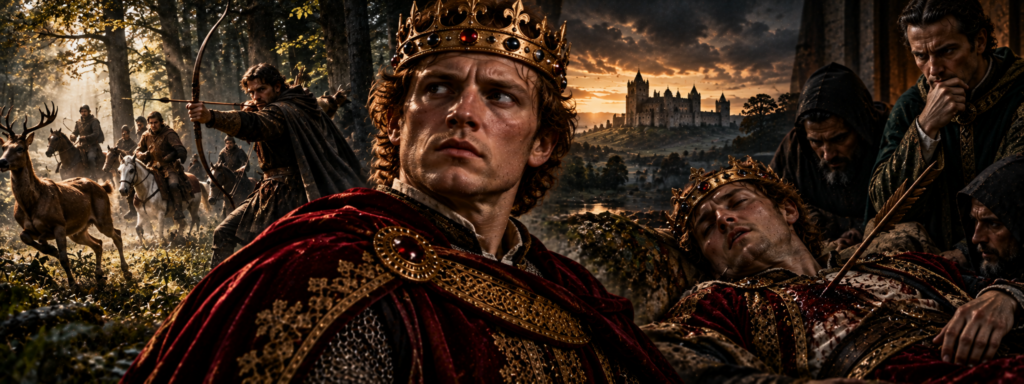
William II Rufus: The King Killed by an Arrow and the New Forest Murder Mystery
William II Rufus (c. 1056–1100) | King of England, 1087–1100 | Killed by an arrow while hunting in the New Forest on August 2, 1100; whether his death was accidental or deliberate remains unresolved
The King Who Never Returned From the Hunt
On the afternoon of August 2, 1100, King William II of England rode into the New Forest with a hunting party that included some of the most powerful men in his kingdom. He was a vigorous, experienced hunter, a formidable ruler, and a man whose enemies had spent years wishing him gone. By the time darkness settled over the forest, William was dead, an arrow having struck him during the hunt. Before his body had received a proper royal burial, his younger brother Henry was moving to seize the treasury and claim the English crown.
The official explanation was simple enough. An arrow intended for a deer had struck the king, and the unfortunate archer was identified in later accounts as Walter Tirel, a nobleman associated with the royal hunting party. Tirel supposedly fled the country after the accident, fearing the consequences of having killed England’s ruler. The death was presented as a terrible misfortune, the kind of disaster that could occur when armed men pursued frightened animals through dense woodland.
Yet almost every circumstance surrounding William’s death invited suspicion. The king had accumulated powerful enemies among the nobility and clergy, and his relationship with his brothers had been marked by rivalry, betrayal, and political maneuvering. Henry, who stood to gain enormously from William’s disappearance, acted with extraordinary speed to secure the succession. Walter Tirel’s reported flight, the absence of a formal investigation recognizable in the surviving accounts, and the haste with which the dead king was replaced all encouraged later generations to question whether the arrow had truly gone astray.
The mystery became darker because William was not the first member of his family to die while hunting in the New Forest. His elder brother Richard had died in a hunting accident years earlier, and his nephew, another Richard, had also reportedly met his death there. Medieval writers interpreted these tragedies as signs of divine punishment against the descendants of William the Conqueror, whose creation of the royal forest had displaced communities and imposed harsh restrictions upon ordinary people. The place where Rufus died consequently acquired a reputation as a landscape haunted by royal blood and supernatural vengeance.
The surviving evidence does not establish that William was assassinated. Hunting was genuinely dangerous, and accidental deaths involving arrows were entirely plausible in the eleventh and twelfth centuries. The most detailed accounts were written by chroniclers whose hostility toward the king, or whose desire to explain the triumph of his successor, shaped their narratives. Their stories provide valuable testimony, but they do not allow the circumstances of the fatal shot to be reconstructed with certainty.
Nevertheless, William’s death remains one of the most compelling royal mysteries in English history. A king who had survived rebellions, foreign threats, and bitter struggles with his own family was suddenly killed during an ordinary afternoon’s entertainment. His younger brother emerged from the forest alive and soon became King Henry I, while the man traditionally blamed for the fatal arrow disappeared into France. Whether the tragedy was an accident, an opportunistic killing, or a carefully arranged assassination remains an unanswered question more than nine centuries later.
Born Into the Family That Conquered England
William Rufus was born around 1056, a decade before his father transformed English history at the Battle of Hastings. His father was William, Duke of Normandy, later known as William the Conqueror, and his mother was Matilda of Flanders. Their marriage united two powerful aristocratic families and produced several children whose rivalries would eventually shape the political future of England and Normandy. William was among the younger sons, growing up in a household where military ambition, dynastic loyalty, and the ruthless pursuit of authority were ordinary features of life.
The Norman aristocracy into which he was born possessed a deeply martial culture. Noblemen were expected to ride, hunt, fight, command armed followers, and defend their family’s interests. Political disputes could escalate into sieges, rebellions, and campaigns against close relatives. William’s childhood therefore prepared him for a world in which the possession of power depended upon personal courage as well as inherited status.
His father was one of the most formidable rulers of the eleventh century. After defeating Harold Godwinson at Hastings in October 1066, the Conqueror established a new ruling dynasty in England. The conquest involved years of resistance, confiscations, castle building, and violent campaigns designed to secure Norman authority. The young William grew up watching his father transform a conquered kingdom into the foundation of a powerful cross-Channel monarchy.
The experience shaped the political environment that Rufus would inherit. England’s older aristocracy had been substantially displaced, and Norman nobles now controlled extensive estates across the country. Many also retained lands in Normandy, creating divided loyalties whenever the English king and Norman duke disagreed. The arrangement contained the seeds of future conflict because the interests of these landholders did not always align with those of either ruler.
William’s brothers were equally important to his future. Robert Curthose, the eldest surviving son, expected to inherit Normandy and possessed his own following among the aristocracy. Henry, the youngest, was intelligent, ambitious, and determined not to remain permanently excluded from substantial power. Their relationships were shaped by competition for territory, wealth, and their father’s favor.
Rufus developed a reputation for energy, courage, and loyalty to his father during periods when Robert rebelled against him. His willingness to support the Conqueror strengthened his position within the family. When the elder William approached death in 1087, the question of succession remained dangerously unsettled. The decision to divide his possessions would leave his sons competing over the inheritance he had created.
The Divided Inheritance of William the Conqueror
William the Conqueror died in September 1087 after suffering injuries during a campaign in France. His death created an immediate political problem because he ruled both England and Normandy, territories whose aristocracies were closely connected. The surviving accounts of his final arrangements differ in detail, but the resulting division is clear. Robert Curthose received Normandy, while William Rufus succeeded to the English throne.
Henry received money rather than a comparable territorial inheritance. This arrangement placed him in a difficult position because wealth alone did not provide the political authority associated with a duchy or kingdom. He would spend years attempting to establish an independent position between his more powerful brothers. His eventual success in 1100 would be all the more remarkable because he had begun as the son with the least substantial inheritance.
Rufus moved quickly to secure England. He crossed the Channel and was crowned at Westminster on September 26, 1087, with the support of Archbishop Lanfranc of Canterbury. The ceremony established his authority, but it did not eliminate opposition. Many Norman nobles preferred the idea of a single ruler controlling both England and Normandy, particularly because they possessed estates on both sides of the Channel.
The division created a dangerous conflict of loyalties. A nobleman might owe allegiance to Rufus for lands in England while also serving Robert as duke of Normandy. If the brothers went to war, the same aristocrat could face demands from both sides. Supporting the wrong ruler could result in confiscation, exile, or death.
The problem became acute almost immediately. Powerful nobles began organizing resistance to Rufus, hoping to replace him with Robert. Their plans threatened to undo the succession settlement before the new king had firmly established his authority. Rufus would soon demonstrate that he possessed more of his father’s determination than his enemies had anticipated.
The struggle also established a pattern that continued throughout his reign. William faced threats not only from foreign rulers but from men who had served his family for decades. His brothers remained possible rivals, while ambitious nobles calculated which claimant offered the greatest advantage. The politics of the Norman dynasty made betrayal an ever-present possibility.
The Rebellion That Nearly Destroyed His Reign
In 1088, a major rebellion broke out against William Rufus. The conspirators included some of the most prominent Norman nobles in England, among them Odo, Bishop of Bayeux, the Conqueror’s half-brother. Their objective was to remove Rufus and place Robert Curthose on the throne. The revolt demonstrated how quickly the political settlement established in 1087 had begun to unravel.
The rebels possessed castles, estates, and military resources capable of threatening the young king. Their influence extended across several regions, and they expected support from Normandy. If Robert successfully crossed the Channel, Rufus might find himself facing a coordinated uprising backed by an invading army. His position was therefore genuinely precarious.
William responded with considerable energy. He appealed to English support, mobilized forces, and moved against rebel strongholds before the opposition could fully coordinate its efforts. The campaign demonstrated his ability to exploit the divisions among his enemies. His willingness to make promises and offer concessions also helped attract support from men who might otherwise have remained neutral.
One of the most important operations involved Pevensey Castle in Sussex, held by supporters of Robert. Rufus besieged the fortress and eventually forced its defenders to surrender. The campaign helped prevent the rebels from establishing a secure landing point for the Norman duke. Without effective coordination or a successful invasion, the rebellion lost momentum.
The defeat of the uprising strengthened William’s position. He had survived a challenge that might easily have ended his reign during its first year. Yet the rebellion also taught him that powerful aristocrats could turn against him when their interests were threatened. His subsequent government reflected an increasing determination to control the nobility and prevent similar challenges.
The experience also sharpened his relationship with Robert. The brothers were no longer simply heirs who had received different portions of their father’s inheritance. They were rival rulers whose supporters had fought one another for control of England. Their competition would dominate much of the following decade.
The King With the Red Face and Dangerous Temper
William acquired the nickname Rufus, meaning red or red-haired, because of his reddish complexion or hair. Contemporary and later descriptions portray him as a physically energetic man with a forceful personality. He enjoyed hunting, military activity, and the company of his courtiers. His reputation combined personal courage with impatience, extravagance, and a willingness to confront those who challenged him.
The king’s court became notorious in clerical writing for its luxury and behavior. Chroniclers complained about fashionable clothing, elaborate hairstyles, extravagant entertainments, and conduct they regarded as morally corrupt. Their descriptions suggest a royal household that embraced display and aristocratic pleasure. Yet these accounts were written by churchmen whose moral expectations differed sharply from those of the secular nobles surrounding the king.
William never married and left no acknowledged children. This unusual circumstance for a reigning monarch encouraged speculation about his private life, both among medieval commentators and later historians. Some writers interpreted the absence of a wife and heirs as evidence of sexual relationships with men, while others emphasized his attachment to courtly pleasure. The surviving evidence does not permit confident conclusions about his sexuality or intimate relationships.
His unmarried status nevertheless had enormous political consequences. Without a legitimate son, William’s succession remained uncertain throughout his reign. Robert Curthose possessed a strong dynastic claim as the elder surviving brother, while Henry remained a potential alternative. Every year that passed without an heir preserved the possibility of another struggle over the throne.
The king’s personality also affected his relationship with the aristocracy. He could be generous to favored companions while imposing severe penalties upon those who opposed him. His government demanded substantial financial resources, and his officials developed methods of extracting revenue that generated resentment. The resulting reputation for greed and harshness would become central to the hostile accounts written after his death.
Yet Rufus was not simply an incompetent or reckless ruler. He defended his throne, expanded royal authority, and maintained control over a kingdom whose political foundations remained relatively new. His military successes demonstrated considerable ability. The contradiction between effective kingship and a deeply hostile reputation makes his life more complicated than the familiar image of a wicked monarch punished by a stray arrow.
Ranulf Flambard and the Government of Greed
One of the most controversial figures associated with William’s reign was Ranulf Flambard, a royal administrator who became notorious for his financial methods. Flambard rose through royal service and eventually became Bishop of Durham in 1099. His reputation among hostile chroniclers was exceptionally poor. He was portrayed as an ingenious official who discovered new ways to extract money from the church and aristocracy.
William’s government relied heavily upon royal revenues. Maintaining armies, rewarding supporters, financing campaigns in Normandy, and sustaining the court required substantial resources. The king therefore exploited the financial rights available to the crown with considerable determination. These included payments associated with feudal obligations, inheritances, marriages, and vacant ecclesiastical offices.
The exploitation of church vacancies became particularly controversial. When a bishop or abbot died, the king could receive revenues from the vacant institution until a successor was appointed. Delaying appointments therefore allowed the crown to retain income that would otherwise support the church. William’s critics accused him of using this power excessively.
Flambard became closely associated with these policies. Whether he personally devised every unpopular measure attributed to him is uncertain, but his administrative role made him a convenient symbol of royal financial oppression. Chroniclers portrayed him as a man who encouraged the king’s worst instincts. His later imprisonment under Henry I reinforced the contrast between the supposedly corrupt old regime and the new king’s promises of reform.
The financial policies created enemies among churchmen and nobles alike. Religious communities resented the loss of revenues, while aristocrats objected to heavy demands associated with their estates. The crown’s ability to enforce these obligations demonstrated its strength. The resentment they generated contributed to the hostile atmosphere surrounding William’s memory.
The existence of such grievances has sometimes been used to support assassination theories. A king who angered powerful men might plausibly become the target of conspiracy. Yet general unpopularity does not identify a murderer or establish that a particular killing was deliberate. The distinction between political hostility and evidence of assassination remains essential.
The Archbishop Who Challenged the King
William’s relationship with the church deteriorated dramatically after the death of Archbishop Lanfranc in 1089. Lanfranc had helped secure Rufus’s succession and provided an important source of ecclesiastical support. His death removed a respected adviser who had possessed considerable influence over the king. The archbishopric of Canterbury then remained vacant for several years.
During the vacancy, the crown received revenues associated with the archbishopric. Critics accused William of deliberately prolonging the situation for financial advantage. The absence of an archbishop also created a serious problem for the English church because Canterbury was its most important ecclesiastical office. The controversy became a symbol of the king’s strained relationship with religious authority.
In 1093, William became seriously ill and apparently feared that he might die. During this crisis, he agreed to the appointment of Anselm, the respected scholar and abbot of Bec, as Archbishop of Canterbury. The decision was widely interpreted as an act of repentance. It temporarily suggested that the king might abandon some of his most controversial policies.
The reconciliation did not last. After recovering, William resumed his forceful style of government, and disagreements with Anselm intensified. The archbishop objected to royal interference in ecclesiastical affairs and sought greater freedom to fulfill his religious responsibilities. The king regarded some of Anselm’s actions as challenges to royal authority.
The dispute was complicated by the wider conflict between the papacy and secular rulers over church appointments and obedience. Anselm wished to travel to Rome and receive recognition from the pope, while William resisted actions that appeared to diminish his control. Their relationship deteriorated until Anselm left England in 1097. He remained in exile when the king died three years later.
This conflict shaped the way clerical writers remembered Rufus. A king who had quarreled with an archbishop and profited from church vacancies could easily be portrayed as an enemy of religion. His sudden death during a hunt therefore invited interpretations involving divine judgment. Such accounts reveal genuine ecclesiastical hostility, but they do not establish that churchmen arranged his death.
A King Who Made Enemies on Every Frontier
William’s reign was dominated by military activity as well as disputes with the church. He sought to strengthen Norman control over England’s borders and intervene in the affairs of neighboring territories. His campaigns brought him into conflict with rulers and aristocrats in Scotland, Wales, and Normandy. These struggles demonstrated his determination to expand or preserve royal authority.
Relations with Scotland were particularly important. Malcolm III, king of Scots, challenged Norman influence in northern England, and the frontier remained unstable. William responded through military expeditions, diplomacy, and the construction of fortifications. His actions helped establish stronger Norman control over strategically important northern territories.
In 1092, William took control of Carlisle and the surrounding region, extending English royal authority into territory previously contested by neighboring powers. The construction of a castle there became part of a wider strategy of securing the frontier. Fortifications allowed the crown to maintain garrisons, project authority, and control important routes. The policy demonstrated the king’s understanding of military geography.
The following year brought a major confrontation with Malcolm III. The Scottish king and his son Edward were killed during fighting near Alnwick in November 1093. Their deaths created a succession crisis in Scotland and temporarily strengthened William’s position. The episode also demonstrated the deadly consequences of the frontier conflicts.
Wales presented different challenges. Norman lords had expanded into Welsh territories after the Conquest, but their advances provoked resistance from local rulers. William launched campaigns intended to restore control and support Norman interests. The mountainous terrain and political complexity of Wales limited the effectiveness of some operations.
These campaigns contributed to the king’s reputation as a formidable ruler. He was willing to confront enemies and invest substantial resources in military operations. Yet they also increased the financial demands placed upon England. The combination of military ambition and heavy taxation reinforced the hostility of those who believed the king governed primarily for his own advantage.
Three Brothers and a Kingdom Worth Killing For
The relationship between William Rufus, Robert Curthose, and Henry was one of the most important political problems of the Norman dynasty. Their father had divided his possessions in a way that encouraged competition rather than cooperation. Robert controlled Normandy, William ruled England, and Henry struggled to establish an independent territorial position. Their ambitions repeatedly brought them into conflict.
Robert’s position as eldest surviving brother gave him a plausible claim to England. Many nobles who possessed estates on both sides of the Channel preferred a single ruler who could protect their interests. William’s possession of the English crown therefore remained a source of tension. The rebellion of 1088 had already demonstrated that Robert possessed supporters willing to challenge Rufus.
Henry’s position was more complicated. He had received money from his father’s inheritance and subsequently acquired territory in western Normandy, but his brothers repeatedly threatened his independence. At different times, he cooperated with one brother against the other. His political survival depended upon flexibility, ambition, and an ability to exploit their rivalries.
In 1091, William and Robert reached an agreement that threatened Henry’s position. The brothers cooperated against him and reduced his territorial power. Henry was forced to retreat and rebuild his influence. The episode demonstrated that family loyalty offered little protection when territory and authority were at stake.
The situation changed again during the following years. Robert eventually departed on the First Crusade, leaving Normandy in William’s hands under a financial arrangement commonly described as a mortgage. Rufus thereby gained effective control over both England and Normandy for much of the remainder of his reign. His position became stronger than it had been at any previous point.
Henry remained close enough to the royal court to participate in political affairs and, according to the traditional accounts, was present during the fatal hunting expedition in 1100. His relationship with William had improved sufficiently for them to associate, but the underlying succession question remained unresolved. Robert was still alive and possessed a claim to the English throne. Henry’s opportunity would depend upon acting before his elder brother could return.
The First Crusade and Robert’s Absence
Robert Curthose’s participation in the First Crusade transformed the political balance within the Norman family. The expedition, launched in response to Pope Urban II’s call in 1095, attracted numerous European nobles seeking religious merit, military distinction, and adventure. Robert joined the movement and needed substantial funds to finance his participation. William Rufus provided money in exchange for temporary control of Normandy.
The arrangement strengthened William enormously. He could now exercise authority over the duchy that had previously been ruled by his rival brother. The acquisition reduced the danger of Norman support for rebellions against him in England. It also allowed him to pursue a more unified policy across his father’s former territories.
Robert’s absence had consequences for the succession. If William died while Robert was away, the elder brother would be unable to respond immediately. Henry, by contrast, could exploit his physical presence in England. The events of August 1100 would demonstrate how important that difference became.
The crusading armies captured Jerusalem in July 1099, and Robert eventually began the journey home. By the summer of 1100, his return was becoming a serious political consideration. His claim to Normandy remained important, and he could potentially challenge William’s authority once he returned. The relationship between the brothers therefore remained uncertain.
The possibility of Robert’s return also gave Henry reasons to consider his own future. He had spent years without a secure inheritance comparable to those of his brothers. If Robert regained Normandy and William continued ruling England, Henry might remain politically dependent upon them. The sudden death of Rufus would offer an opportunity that might never arise again.
These circumstances form an important part of the assassination theories. Henry possessed a powerful motive to benefit from William’s death before Robert could establish himself. Yet motive alone does not demonstrate that Henry arranged the fatal shot. The evidence establishes the political opportunity, not a proven conspiracy.
The New Forest: A Royal Hunting Ground Built on Resentment
The New Forest occupied a large area of southern Hampshire and became one of the most important royal hunting grounds in Norman England. William the Conqueror had established it as a royal forest after 1066, extending special legal protections over deer and the landscape in which they lived. The term forest did not simply mean continuous woodland. It described an area subject to particular royal rights and restrictions.
The creation of the forest became associated with resentment among local communities. Later chroniclers claimed that the Conqueror had destroyed churches and settlements to make room for deer, presenting the policy as an example of royal arrogance. Modern historical analysis treats some of these claims cautiously because the extent of destruction has been exaggerated in certain accounts. Nevertheless, the forest laws imposed genuine restrictions upon local people.
Royal hunting rights were closely connected with aristocratic privilege. Deer were valuable animals whose pursuit was reserved for the king and those he permitted to hunt. Unauthorized killing could attract severe penalties, and the enforcement of forest law generated hostility. The landscape therefore symbolized the power of Norman kings over ordinary inhabitants.
For William Rufus, the New Forest was also a place of pleasure. Hunting offered exercise, excitement, companionship, and an opportunity to display aristocratic skill. The king was an enthusiastic participant in the sport and regularly pursued game with members of his court. The activity was an important part of noble life rather than a casual diversion.
The forest’s geography made hunting both attractive and dangerous. Woodland, open heath, uneven ground, and moving animals created conditions in which hunters could lose sight of one another. Arrows were fired at targets that could change direction suddenly. A moment of confusion could have fatal consequences.
The dangers were not theoretical. Hunting accidents occurred among medieval aristocrats, and several members of William’s own family were associated with fatal incidents in the New Forest. These deaths contributed to the forest’s sinister reputation. They also provide an important reason not to dismiss the possibility that Rufus died accidentally.
The Forest That Had Already Taken Two Royal Lives
William’s elder brother Richard had died before the Conqueror’s death, traditionally during a hunting accident in the New Forest. The details of Richard’s death are limited, and later accounts differ in their descriptions. His death nevertheless became part of the family’s tragic association with the royal hunting ground. Medieval writers remembered him as one of several descendants of the Conqueror whose lives ended there.
Another Richard, the son of Robert Curthose and therefore William Rufus’s nephew, was also said to have died while hunting in the New Forest. The chronology and precise circumstances of this death are less securely established than the familiar accounts sometimes suggest. Later chroniclers nevertheless grouped the incidents together. The repetition encouraged the belief that the forest was somehow cursed.
For religious writers hostile to Norman forest policy, the deaths offered a powerful moral explanation. The Conqueror had supposedly devastated communities to create a hunting ground for his own pleasure. His descendants then suffered violent deaths in the very landscape established through oppression. The story presented divine justice as operating across generations.
The idea was particularly appealing because it transformed apparently accidental deaths into meaningful events. Rather than accepting that hunting was dangerous, writers could interpret the tragedies as punishment for royal wrongdoing. The forest became a place where the sins of the father were visited upon his children and grandchildren. Rufus’s death provided the most dramatic example.
Such interpretations reveal medieval religious attitudes but do not establish supernatural intervention. They also do not prove assassination. The fact that several members of a hunting family died during a dangerous sport may reflect exposure to genuine risks. The royal forest was frequently used by men who pursued animals with lethal weapons.
Nevertheless, the association influenced the memory of William’s death. A king killed by an arrow in an ordinary hunting ground might have been remembered as the victim of misfortune. A king killed in a forest already associated with the deaths of his relatives became part of a much darker story. The landscape itself seemed to demand an explanation.
August 2, 1100: The Final Morning
The morning of August 2, 1100, began without any securely documented indication that William Rufus expected to die. He was approximately forty-three or forty-four years old and had ruled England for nearly thirteen years. His position was strong, his military authority established, and his control over Normandy remained substantial. Nothing in the surviving political record suggests that he was preparing to surrender his throne.
Later chroniclers introduced stories of ominous dreams and warnings preceding the hunt. In some versions, religious figures experienced visions suggesting that the king’s death was approaching. Other accounts describe warnings that William supposedly dismissed. These stories belong to the medieval tradition of interpreting sudden deaths through supernatural signs.
Such accounts are valuable evidence of how contemporaries and later generations understood the event. They portray the king as a man who ignored warnings and continued pursuing worldly pleasures despite the danger of divine judgment. The structure resembles other medieval narratives in which a sinful ruler receives a final opportunity to repent. It does not establish that anyone genuinely predicted the fatal accident.
The hunting party included noblemen and attendants whose precise identities vary between surviving accounts. Walter Tirel became the figure most closely associated with the fatal arrow. Henry, the king’s younger brother, was also connected with the expedition in the traditional narratives. The presence of powerful men made the hunt an event with political as well as recreational significance.
William was accustomed to hunting and understood the risks involved. The participants would have carried bows and other equipment suitable for pursuing deer. The activity required coordination, but it also involved rapid movement and moments of confusion. A missed shot could endanger anyone standing beyond the intended target.
The surviving evidence does not allow the morning’s events to be reconstructed in minute-by-minute detail. The familiar image of a carefree king ignoring prophetic warnings belongs largely to later storytelling. What is certain is that William entered the New Forest alive and did not return. By the end of the day, England had lost its king.
The Arrow That Killed William Rufus
The most familiar account describes Walter Tirel firing an arrow at a deer during the hunt. The arrow supposedly missed its intended target or struck a tree before changing direction. It then hit William, causing a fatal wound. The king died in the forest, leaving his companions confronted with the sudden loss of their ruler.
The precise mechanics differ between accounts. Some describe the arrow striking William directly, while others introduce a ricochet from a tree. The location of the wound also varies in later retellings, although it is generally placed in the chest or upper body. These differences prevent a confident reconstruction of the fatal shot.
The involvement of Walter Tirel is widely repeated, but it is not beyond dispute. Tirel was a nobleman with connections to the Norman aristocracy, and his name became attached to the accident in early twelfth-century narratives. Some accounts describe him as the archer responsible, while others preserve uncertainty. His alleged role became increasingly important as suspicions of assassination developed.
One of the most intriguing complications is Tirel’s reported denial. Orderic Vitalis, writing in the twelfth century, recorded a tradition that Tirel denied having been present at the fatal hunt or having seen the king that day. This testimony cannot establish his innocence because it survives through a later chronicler. It does, however, demonstrate that the familiar identification of Tirel as the killer was contested.
The uncertainty matters because many assassination theories depend upon Tirel’s involvement. If he fired the arrow, investigators must consider whether the shot was accidental or deliberate. If he did not, the identity of the archer becomes even more uncertain. The surviving evidence does not permit a definitive answer.
The only secure conclusion is that William died after being struck by an arrow during a hunt in the New Forest. The weapon, the setting, and the sudden death are well established. The identity and intention of the person who released the arrow remain uncertain. The difference between those facts and the later narrative is the foundation of the mystery.
Walter Tirel: The Man Blamed for Killing a King
Walter Tirel, also known as Walter Tyrell, was a Norman nobleman associated with the aristocratic world surrounding the English monarchy. He held interests in France and belonged to the network of families whose political relationships crossed the Channel. His connection with the royal hunting party placed him at the center of the traditional explanation for William’s death. Over time, his name became almost inseparable from the fatal arrow.
According to the familiar account, Tirel fled after realizing that he had killed the king. He supposedly escaped from the forest and made his way to France. Such behavior has often been interpreted as evidence of guilt. Yet flight would have been understandable even if the shooting had been accidental.
Killing a king, even unintentionally, was an extraordinarily dangerous event. The person responsible could face retaliation from royal supporters, prosecution, or violence from men seeking to demonstrate loyalty to the dead ruler. Tirel may have feared that no explanation would protect him. Leaving England could therefore have been an act of self-preservation rather than proof of deliberate murder.
His reported denial complicates the accusation further. If the tradition preserved by Orderic Vitalis reflects Tirel’s actual statements, he rejected responsibility for the fatal shot. He may have been attempting to protect himself from blame. Alternatively, he may genuinely have been accused of an act committed by someone else.
The absence of a surviving trial or formal judgment leaves the question unresolved. Tirel was not conclusively convicted of murdering William, and the historical record does not establish that he acted on anyone’s orders. The later certainty with which his name was attached to the killing exceeds what the evidence can support. He remains the traditional suspect rather than a proven assassin.
His position within the story nevertheless remains fascinating. A nobleman associated with the king’s final hunt became the person upon whom generations placed responsibility for a royal death. His reported flight gave the story an atmosphere of guilt and concealment. Yet the possibility that he was innocent cannot be dismissed.
The Brother Who Rode Toward the Crown
Henry’s actions after William’s death are among the most suspicious circumstances surrounding the event. The younger brother moved rapidly to secure the royal treasury at Winchester and establish his claim to the throne. He understood that control of the treasury would provide the resources necessary to reward supporters and finance the government. Speed was essential because Robert Curthose remained a rival claimant.
The traditional accounts describe Henry hurrying away from the scene while others dealt with the dead king. The contrast between the abandoned body and the brother racing toward power became one of the most memorable elements of the story. Later writers interpreted the haste as evidence of ambition. Some modern commentators have gone further, suggesting that Henry may have known in advance that William would die.
The political circumstances explain why Henry acted quickly. Robert was the elder surviving brother and possessed a strong dynastic claim. If Henry delayed, supporters of Robert might organize resistance or secure important royal resources. By taking control of Winchester and arranging a rapid coronation, Henry could establish facts that would be difficult to reverse.
Henry was crowned at Westminster on August 5, 1100, only three days after William’s death. The speed was extraordinary but not unprecedented in a political system where succession could become contested immediately. The new king also issued a coronation charter promising to correct abuses associated with his predecessor. The document helped present his accession as the beginning of a more just government.
The charter’s promises were politically useful because William had become unpopular among important religious and aristocratic groups. Henry offered to restrain excessive financial demands, respect ecclesiastical rights, and restore better government. Such commitments could attract support from men who had resented Rufus. They also helped distinguish the new ruler from the dead king.
Yet the rapid seizure of power does not establish that Henry arranged the fatal shot. A politically ambitious man could exploit an unexpected accident just as effectively as a planned assassination. Henry’s conduct demonstrates that he recognized an extraordinary opportunity and acted decisively. Whether he helped create that opportunity remains unproven.
Was Henry I the Architect of a Royal Murder?
The theory that Henry arranged William’s death rests primarily upon motive, opportunity, and the speed of his subsequent actions. He had spent years struggling to obtain territory and authority comparable to those of his brothers. William’s death removed the reigning king, while Robert’s absence gave Henry a narrow window in which to claim England. The circumstances were undeniably favorable.
Henry may also have possessed connections with men present during the hunt. A conspiracy would not necessarily have required him to fire the arrow personally. An accomplice could have arranged the fatal shot while the younger brother prepared to secure the treasury. Such a plan is conceivable within the political culture of the Norman aristocracy.
The problem is that no surviving reliable source establishes the existence of such a conspiracy. There is no documented agreement between Henry and Walter Tirel to murder William. No contemporary confession identifies Henry as the organizer. The accusation remains an interpretation of suspicious circumstances rather than a demonstrated fact.
The risks of arranging a royal assassination would also have been considerable. If Henry’s involvement became known, his legitimacy could be destroyed before his reign was securely established. Supporters of Robert might exploit the accusation to justify rebellion. The church could condemn the murder of a reigning monarch as a grave offense.
Henry’s behavior after the death can be explained without assuming advance knowledge. He was politically experienced and understood the danger of allowing Robert’s supporters time to organize. His immediate movement toward Winchester reflected the same urgency that had characterized his family’s earlier succession struggles. William Rufus himself had acted rapidly after the Conqueror’s death in 1087.
The theory therefore remains possible but unproven. Henry benefited enormously from William’s death and responded with remarkable speed. Those facts justify examining his role. They do not justify declaring him guilty of arranging his brother’s assassination.
The Body Left Behind in the Forest
One of the most unsettling aspects of the traditional narrative concerns the treatment of William’s body. Later accounts describe the dead king being left behind while important members of the hunting party departed. A local man, sometimes identified as a charcoal burner or peasant, supposedly transported the corpse to Winchester. The image of a powerful monarch carried away in an ordinary cart became a symbol of his sudden fall.
The precise details vary between chroniclers. Some accounts emphasize the lack of ceremony, while others describe the body being taken to Winchester for burial. The stories contrast sharply with the elaborate funerals normally associated with royal dignity. Their purpose was partly to demonstrate how quickly earthly power could disappear.
William was buried in Winchester Cathedral, an important royal and ecclesiastical center. The burial occurred without the kind of prolonged ceremonial arrangements that might have followed a death in more orderly circumstances. The suddenness of the event and the urgency of the succession contributed to the atmosphere of haste. Later writers interpreted the modest treatment as a sign of divine displeasure.
The lack of elaborate mourning became part of the king’s hostile reputation. Chroniclers who disliked William portrayed his death as the fitting end of a ruler who had oppressed the church and neglected religious duties. His body was presented as abandoned by those who had once enjoyed his favor. The narrative offered a moral lesson about the emptiness of worldly power.
Yet the surviving accounts must be treated cautiously. The movement of the body may have been shaped by practical necessity, the distance to Winchester, and the sudden political crisis. The absence of a grand procession does not prove that everyone despised the dead king. It also does not establish that his death was planned.
The contrast between William’s power in life and his treatment after death remains striking. He had commanded armies, controlled enormous revenues, and ruled England with considerable authority. Within hours of the fatal shot, the political world was reorganizing itself around his successor. The king’s body had become secondary to the struggle for his crown.
Winchester Cathedral and the Unquiet Dead
Winchester was one of the most important cities in Norman England and possessed strong connections with the monarchy. Its cathedral provided an appropriate burial place for William Rufus, whose dynasty had inherited the religious and political institutions of the earlier English kingdom. The city also housed the royal treasury that Henry moved to secure. Death, burial, and succession therefore converged in the same place.
The burial became surrounded by stories of divine punishment. Some medieval writers claimed that the cathedral’s tower collapsed after William’s death because the building had been polluted by his presence. The chronology of the collapse and its relationship to the burial have been interpreted in different ways. The story’s significance lies primarily in its use as a moral judgment against the king.
For hostile churchmen, the sudden death offered confirmation of their criticisms. William had quarreled with Anselm, exploited church vacancies, and maintained a court they regarded as scandalous. His death without a prolonged period of repentance seemed especially troubling. The burial traditions reinforced the idea that divine justice had overtaken him.
Such interpretations were not neutral historical observations. They reflected the beliefs and grievances of writers who considered the king’s conduct deeply objectionable. A ruler who had challenged ecclesiastical authority could be portrayed as receiving punishment from God. The narrative transformed a hunting accident into a religious warning.
The stories also helped legitimize Henry’s accession. If William’s reign had ended through divine judgment, the new king could be presented as an opportunity for reform. Henry’s coronation charter reinforced that contrast by promising to correct abuses associated with his predecessor. The political and religious interpretations supported one another.
Nevertheless, the burial itself provides no evidence of assassination. It demonstrates that William died suddenly and that his body was brought to Winchester. The surrounding legends reveal how his enemies interpreted the event. They do not identify the person who fired the fatal arrow or establish whether the shot was deliberate.
The Churchmen Who Believed God Had Punished Him
The surviving narrative sources for William’s reign were written largely by clerics. This matters because the king’s relationship with the church had been unusually contentious. Writers who admired Anselm or condemned royal exploitation of ecclesiastical revenues possessed strong reasons to portray Rufus negatively. Their accounts often emphasized moral failure rather than administrative achievement.
Eadmer, a close associate and biographer of Anselm, provided an important perspective on the conflict between the king and archbishop. His writing reflects the concerns of the reforming church and the belief that ecclesiastical authority should be protected from excessive royal interference. William appears within that narrative as a ruler whose conduct obstructed religious reform. The account is valuable but cannot be treated as impartial.
Orderic Vitalis offered a broader history of Norman England and Normandy. His work contains important information about the royal family, aristocratic politics, and the events surrounding William’s death. He also interpreted history through a Christian moral framework. The sudden death of a controversial ruler naturally invited reflection upon divine justice.
William of Malmesbury likewise preserved influential descriptions of Rufus and his reign. His historical writing combined careful use of sources with moral commentary and literary interpretation. He recognized the king’s abilities while criticizing aspects of his conduct. His account of the death contributed to the tradition that shaped later understanding.
The Anglo-Saxon Chronicle provides another perspective. Its treatment of William reflects the concerns of an English monastic tradition living under Norman rule. It records the king’s death and the succession of Henry within a broader history of political and religious events. Its testimony is especially important because it stands closer to the period than many later retellings.
The sources therefore require comparison rather than unquestioning acceptance. Their agreement that William died during a hunt is significant. Their differences concerning the circumstances, warnings, and identity of the archer reveal uncertainty. Their moral judgments help explain the king’s reputation but cannot settle the question of assassination.
The Ominous Dreams and Warnings of Death
Medieval accounts of William’s final days frequently include supernatural warnings. Dreams, visions, and prophetic messages appear in narratives written after the event. These stories suggest that the king had been given opportunities to recognize the danger approaching him. His failure to respond appropriately became part of the moral lesson.
One tradition describes disturbing dreams involving blood or threatening images. Another associates religious figures with warnings that the king’s death was imminent. The details differ between accounts, and their historical reliability is uncertain. Such motifs were common in medieval narratives of sudden or morally significant deaths.
The stories reflect a belief that divine providence could reveal future events through dreams and signs. A ruler who ignored warnings might be portrayed as arrogant or spiritually blind. William’s reputation for impiety made him an especially suitable subject for this kind of narrative. His death during a pleasurable activity reinforced the contrast between worldly enjoyment and spiritual danger.
These accounts should not be treated as evidence that a conspiracy was known in advance. A prophetic dream recorded after a death can be created or reshaped to fit the outcome. The fact that later writers described warnings does not establish that anyone possessed genuine foreknowledge. Their value lies in revealing how the event was interpreted.
The warnings also influenced the popular image of the New Forest. The landscape became a place where supernatural danger supposedly surrounded the royal family. The king’s death appeared less like an accident and more like the fulfillment of a curse. Such interpretations contributed to the mystery without resolving it.
The distinction between omen and evidence is essential. Medieval writers often used supernatural signs to communicate moral meaning. Modern historical analysis must ask whether the accounts provide reliable information about actual events. In William’s case, the prophetic stories cannot establish that the fatal shot was deliberate.
Could the Arrow Have Been an Accident?
An accidental shooting remains a highly plausible explanation for William’s death. Medieval hunting involved armed participants moving through difficult terrain while pursuing animals that could change direction suddenly. Bows were lethal weapons, and an arrow released toward a deer could strike a person standing beyond or beside the intended target. The danger increased when visibility was limited by trees and undergrowth.
The king’s experience as a hunter did not eliminate these risks. Experienced riders and archers could still misjudge distance, movement, or the position of companions. A sudden movement by the target could cause an arrow to miss. The possibility of a fatal accident therefore requires no unusual assumptions.
The traditional account of a ricocheting arrow is more difficult to evaluate. Arrows can behave unpredictably after striking objects, but the precise mechanics described in later stories cannot be verified. Some accounts may have introduced the tree to explain how a shot aimed elsewhere struck the king. The detail should not be treated as certain.
The presence of several armed men also complicates identification of the responsible archer. In a confused hunting situation, witnesses might not immediately know whose arrow caused the fatal wound. A person accused afterward might deny responsibility or flee to avoid punishment. Such uncertainty could explain the competing traditions surrounding Walter Tirel.
Accidental deaths during aristocratic hunting were sufficiently common to make the explanation credible. William’s own family had experienced other fatal incidents associated with the New Forest. The repeated tragedies need not imply conspiracy or supernatural punishment. They may simply reflect the dangers of a sport practiced frequently by armed nobles.
The accident theory therefore deserves serious consideration. It fits the basic facts without requiring an undocumented plot. The king died during a hunt, and the fatal weapon was an arrow. The surviving evidence does not establish that anyone intended to kill him.
The Case for Assassination
The assassination theory begins with the political consequences of William’s death. Henry gained the English crown almost immediately, while Robert Curthose was absent and unable to respond. The king had no acknowledged children to inherit his throne. The circumstances created an extraordinary opportunity for a younger brother who had spent years struggling for power.
Henry’s rapid movement toward Winchester is often presented as suspicious. He appeared to prioritize the treasury and succession over the body of his dead brother. Such conduct can suggest prior preparation, particularly when viewed alongside the political advantages he gained. Yet it can also be explained as an immediate response to an unexpected crisis.
Walter Tirel’s reported flight provides another element of suspicion. If he deliberately killed the king, escaping to France would be understandable. If he killed him accidentally, the same behavior would also make sense. Flight therefore cannot distinguish murder from misfortune.
The presence of powerful men with grievances against William adds further possibilities. Nobles resented his financial demands, while churchmen condemned his treatment of ecclesiastical institutions. Some aristocrats supported Robert Curthose and might have welcomed a change of ruler. Yet these groups did not necessarily share the same interests, and no surviving evidence identifies a coordinated conspiracy.
The absence of a clear investigation has also attracted attention. A king’s death under suspicious circumstances might seem to demand an inquiry and punishment. Yet medieval political institutions did not operate like modern criminal justice systems, particularly during a sudden succession crisis. The lack of a surviving prosecution does not prove that the authorities deliberately concealed murder.
The assassination theory remains possible because the political circumstances were genuinely dangerous. William had enemies, Henry possessed a motive, and the fatal shot occurred in a setting where a deliberate attack might resemble an accident. The difficulty is that possibility cannot substitute for evidence. No surviving reliable account proves that the king was intentionally killed.
Why a Conspiracy Would Have Been Dangerous
A planned assassination would have required careful coordination and considerable risk. William was a powerful king surrounded by armed companions and servants. Anyone deliberately shooting him would need to avoid immediate detection or rely upon the cooperation of witnesses. The plan could fail if the king survived or if the attack was recognized as intentional.
The political consequences of exposure would have been severe. Henry’s claim to the throne could be destroyed by credible evidence that he had arranged his brother’s murder. Robert Curthose might use the accusation to rally supporters and justify invasion. Religious authorities could condemn the killing as a grave violation of royal and Christian order.
The uncertainty surrounding the succession made such risks particularly serious. Henry did not possess an uncontested hereditary claim superior to Robert’s. His success depended upon gaining rapid recognition from powerful nobles and churchmen. A credible murder accusation could undermine the alliances he needed.
A conspiracy involving Walter Tirel would also require explanation of the archer’s subsequent conduct. If he had acted on Henry’s orders, his flight might have been arranged in advance. Alternatively, he might have feared that Henry would eliminate him to conceal the crime. Both possibilities are imaginable, but neither is documented.
The lack of evidence does not make conspiracy impossible. Medieval political killings were sometimes carried out through small groups whose plans left few surviving records. Successful conspirators had strong reasons to conceal their involvement. Nevertheless, historical analysis cannot assume a hidden plot merely because such concealment would be convenient.
The danger of the scheme therefore forms part of the assessment. Henry had much to gain from William’s death, but he also had much to lose if his involvement became known. An unexpected accident offered him the same political opportunity without requiring him to accept those risks. The surviving evidence cannot establish which explanation is correct.
Robert Curthose: The Brother Who Lost Everything
Robert Curthose was the most obvious dynastic rival to Henry after William’s death. As the eldest surviving son of William the Conqueror, he possessed a strong claim to the family inheritance. He had ruled Normandy and participated in the First Crusade, earning a reputation for military courage. His absence in August 1100 prevented him from responding immediately to the crisis.
Henry’s rapid coronation placed Robert at a disadvantage. By the time the duke could organize a challenge, his younger brother had secured the treasury and gained recognition as king. The situation resembled the succession of 1087, when William Rufus had moved quickly to establish himself in England. The Norman family’s history demonstrated that possession could be as important as hereditary seniority.
Robert eventually challenged Henry’s authority. In 1101, he invaded England, hoping to recover the crown that had passed to his younger brother. The confrontation ended in negotiation rather than a decisive battle. Henry retained England, while Robert returned to Normandy under an agreement that temporarily settled their dispute.
The peace did not last. Henry continued to intervene in Norman affairs and gradually strengthened his position against Robert. In 1106, he defeated his brother at the Battle of Tinchebray. Robert was captured and remained imprisoned for the rest of his life.
The outcome transformed the Norman inheritance. Henry eventually controlled both England and Normandy, achieving the unity that had eluded his brothers. The death of William Rufus had opened the path to this consolidation. Robert’s defeat completed the process.
These events have sometimes encouraged retrospective suspicion. Because Henry ultimately gained everything, it is tempting to imagine that he planned the first step by arranging William’s death. Yet later success does not prove earlier conspiracy. The historical record demonstrates Henry’s ambition and political ability, not his responsibility for the fatal arrow.
Henry I and the Convenient Promise of Reform
Henry’s coronation charter of 1100 became one of the most important documents associated with his accession. It promised to correct abuses attributed to William Rufus and restore more just government. The charter addressed ecclesiastical rights, financial demands, and the treatment of royal subjects. Its language helped distinguish the new reign from the controversies of the previous one.
The promises were politically useful because Henry needed support quickly. He had seized the opportunity created by William’s death, but Robert Curthose remained a potential rival. Winning the cooperation of bishops and nobles was essential. Reform offered a means of attracting men who had resented Rufus’s government.
Henry also moved against Ranulf Flambard, the official closely associated with William’s financial policies. Flambard was imprisoned, although he later escaped and became involved in Robert’s challenge to Henry. The action reinforced the impression that the new king intended to abandon the abuses of his predecessor. It also removed a potentially troublesome figure from the center of government.
The contrast between the brothers was not as complete as royal propaganda might suggest. Henry continued to exercise strong financial and administrative authority. He could be ruthless toward political opponents and pursued his interests with considerable determination. His government represented continuity as well as change.
The reform narrative nevertheless shaped later historical memory. William became the greedy and impious ruler whose death cleared the way for a more orderly monarchy. Henry appeared as the man who restored justice after years of misgovernment. Such contrasts could make the sudden death seem providential.
This interpretation does not establish assassination. It shows how Henry benefited politically from presenting himself as different from his brother. The new king had every reason to emphasize William’s faults while promising improvement. The resulting narrative influenced how later generations remembered the dead ruler.
The Rufus Stone and the Making of a Murder Site
The New Forest eventually acquired a physical memorial associated with William’s death. The Rufus Stone, located near Minstead in Hampshire, marks a traditional site of the fatal shooting. Its inscription recounts the familiar story of an arrow striking a tree and then killing the king. The monument has become one of the best-known historical landmarks in the forest.
The stone does not provide contemporary evidence for the location of the death. It was erected many centuries after the event, and the precise place where William was struck cannot be established with certainty. The monument reflects a later tradition rather than an archaeological identification. Its importance lies in preserving the memory of the story.
The inscription also illustrates how uncertain details can become fixed in popular history. The ricocheting arrow, Walter Tirel, and the king’s sudden death are presented as a coherent sequence. Visitors encounter a narrative that appears complete because it has been carved into stone. Yet the surviving medieval sources do not justify certainty about every detail.
The forest itself has changed considerably since 1100. Woodland management, settlement, roads, and patterns of land use have altered the landscape. The modern visitor cannot simply look at the surroundings and reconstruct the original hunting scene. The memorial provides a place for remembrance rather than a verified crime scene.
The Rufus Stone nevertheless demonstrates the enduring fascination of the mystery. Few royal hunting accidents have produced such a lasting association between landscape and political suspicion. The monument invites visitors to imagine the moment when a king fell and his brother’s path to the throne opened. Its physical presence gives the legend an immediacy that written chronicles alone cannot provide.
The distinction between memorial and evidence remains essential. The stone commemorates a traditional account of William’s death. It cannot identify the archer or determine whether the shot was deliberate. The mystery survives because the monument preserves the story without resolving it.
The King’s Reputation After Death
William Rufus left behind a deeply divided reputation. His enemies remembered a ruler who exploited the church, imposed heavy financial demands, and maintained a court associated with extravagance. His supporters could point to military successes, effective government, and the preservation of Norman authority. The surviving narratives emphasize the negative aspects partly because many were written by clerics hostile to his policies.
The contrast between his achievements and reputation is striking. He defeated rebellion, secured England against major threats, expanded influence in the north, and exercised authority over Normandy. These were substantial accomplishments for a king who inherited a politically unstable settlement. His reign cannot be dismissed as thirteen years of uninterrupted misgovernment.
Yet his treatment of the church created enduring hostility. The conflict with Anselm, exploitation of ecclesiastical vacancies, and association with Ranulf Flambard supplied chroniclers with powerful examples of royal wrongdoing. His death during a hunt seemed to confirm their moral judgments. The king who had pursued worldly pleasures was struck down without warning.
Later historians inherited these narratives and often repeated their conclusions. The image of Rufus as a greedy, irreligious ruler became deeply embedded in English historical writing. His sudden death was interpreted through that reputation. The possibility of divine punishment sometimes overshadowed the practical dangers of hunting.
Modern scholarship has encouraged a more balanced assessment. William’s government possessed considerable administrative and military effectiveness, and his policies were not entirely exceptional within the political culture of Norman kingship. His conflicts with churchmen reflected broader struggles over authority rather than simple personal wickedness. The hostile sources remain valuable, but their judgments require scrutiny.
The same caution applies to the death. A chronicler who believed William deserved punishment might interpret an accident as divine justice. A later writer fascinated by political intrigue might imagine assassination. Neither interpretation can replace the limited evidence concerning the fatal arrow.
The Death That Changed the Norman Dynasty
William’s death transformed the political future of England and Normandy. Henry seized the crown, Robert remained a rival, and the balance established by their father’s inheritance collapsed. The events of August 1100 initiated a new phase of conflict within the Norman dynasty. The consequences extended far beyond the New Forest.
Henry’s eventual victory over Robert reunited England and Normandy under one ruler. The arrangement strengthened royal authority and created the foundation for a more integrated cross-Channel monarchy. It also demonstrated the extraordinary importance of Henry’s rapid actions after William’s death. Without control of the English treasury and crown, his later success would have been far less certain.
The new king’s reign lasted until 1135, making it considerably longer than William’s. Henry developed a reputation for administrative strength and legal authority, although his government could also be severe. His political achievements transformed the position he had inherited in 1100. The younger brother who once possessed little more than money became one of the most powerful rulers in western Europe.
The succession problem nevertheless returned in another form. Henry’s legitimate son William Adelin died in the White Ship disaster of 1120, leaving the king without a surviving legitimate male heir. Henry attempted to secure the succession of his daughter Matilda. After his death, the kingdom descended into the civil conflict later known as the Anarchy.
The sequence illustrates the fragility of dynastic power. William Rufus died without an heir, allowing Henry to seize the throne. Henry later lost his own heir in another sudden disaster, creating a new succession crisis. The Norman monarchy repeatedly found its political future transformed by unexpected deaths.
The New Forest incident therefore belongs to a broader history of royal vulnerability. Kings could command armies and control enormous wealth, yet their dynasties remained exposed to accidents, illness, and violence. A single death could overturn years of political planning. William’s fate became one of the most dramatic examples.
The Sources and the Problem of Certainty
The principal medieval accounts of William’s death were written by men who possessed different interests and perspectives. The Anglo-Saxon Chronicle provides a relatively concise record of the event and its political consequences. Eadmer, Orderic Vitalis, and William of Malmesbury offer more developed narratives shaped by religious concerns and historical interpretation. Their accounts must be read together rather than treated as interchangeable testimony.
The differences between them are important. Some emphasize the accidental nature of the shooting, while others preserve stories of warnings, divine punishment, or uncertainty surrounding the archer. Walter Tirel’s reported denial complicates the traditional attribution. The details of the fatal shot cannot be reconstructed with confidence.
The chroniclers also wrote within a political world shaped by Henry’s successful reign. Their knowledge of the outcome could influence how they interpreted the events of 1100. Henry’s rapid accession might appear either as evidence of admirable decisiveness or as a suspiciously convenient response. The same action could support very different narratives.
The hostility toward William also shaped the evidence. Clerical writers who condemned his treatment of the church had reasons to present his death as morally significant. Their accounts often emphasized the king’s lack of repentance and the suddenness of his punishment. Such themes reveal medieval attitudes toward kingship but do not establish murder.
The historical method requires separating established events from interpretation. William died on August 2, 1100, after being struck by an arrow during a hunt in the New Forest. Henry rapidly secured the treasury and was crowned three days later. Walter Tirel was traditionally blamed, but his responsibility remains uncertain.
Everything beyond those central facts requires qualification. The ricochet, the precise location, the identity of the archer, and the possibility of a conspiracy remain disputed or unproven. The available evidence supports several explanations. It does not justify a definitive verdict of assassination.
Why the Mystery Has Never Been Solved
The death of William Rufus remains unresolved because the surviving evidence does not answer the central question of intention. An arrow killed the king, but an arrow can be released accidentally or deliberately. The distinction depends upon circumstances that the medieval accounts do not establish. No surviving investigation provides a reliable reconstruction of the fatal shot.
The traditional suspect, Walter Tirel, may have been responsible for the accident. He may also have been wrongly blamed or involved in circumstances that were never accurately recorded. His reported flight and denial can be interpreted in different ways. Neither establishes guilt.
Henry’s conduct is equally ambiguous. His rapid seizure of the treasury demonstrates ambition and political skill. It also creates suspicion because he benefited so directly from his brother’s death. Yet the same actions would have been necessary if the death had been entirely unexpected.
The political environment made conspiracy conceivable. William possessed enemies among nobles and churchmen, while his brothers had spent years competing for power. The absence of a legitimate heir created a dangerous succession problem. Such circumstances provide possible motives but not evidence of an actual plot.
The accident explanation remains credible because medieval hunting was dangerous. Armed men pursued moving animals through woodland, and fatal mistakes were possible. The New Forest had already been associated with other hunting deaths within the royal family. Nothing about the basic circumstances requires deliberate murder.
The mystery therefore survives because the evidence permits suspicion without resolving it. Historians can identify beneficiaries, examine motives, and compare the chroniclers. They cannot determine beyond reasonable doubt who fired the arrow or what that person intended. William’s death remains a disputed royal killing rather than a proven assassination.
The Arrow That Gave England a New King
William II Rufus spent thirteen years defending a throne that powerful enemies had repeatedly attempted to take from him. He defeated rebellion, challenged rival rulers, expanded royal authority, and fought to control the inheritance left by William the Conqueror. His reign was marked by military success, financial controversy, and bitter conflict with the church. Yet none of those struggles ended his life.
Instead, the king died during a hunt in the New Forest on August 2, 1100. An arrow struck him, and the ruler who had survived so many political dangers was suddenly gone. The event occurred in a landscape already associated with the deaths of other members of his family. Medieval writers would transform that coincidence into a story of divine punishment.
Walter Tirel became the man most closely associated with the fatal shot. Later accounts described him firing at a deer, missing his target, and accidentally killing the king. His reported flight to France encouraged suspicion, while his alleged denial complicated the accusation. The surviving evidence does not establish whether he was responsible.
Henry’s actions created an even more enduring mystery. The younger brother moved rapidly to Winchester, secured the treasury, and claimed the crown before Robert Curthose could respond. His coronation took place only three days after William’s death. The speed with which he transformed his brother’s misfortune into personal triumph remains one of the most striking features of the story.
Those circumstances make assassination a possibility worth considering. Henry possessed a powerful motive, and William had accumulated enemies whose interests might have been served by his removal. A deliberate shot during a hunt could have been disguised as an accident. Yet no surviving reliable evidence establishes that such a conspiracy existed.
The accident explanation is equally credible. Hunting was dangerous, and an arrow released in confusion could kill even an experienced participant. William’s enthusiasm for the sport exposed him repeatedly to those risks. His death may have been an extraordinary misfortune rather than a calculated act of political violence.
The medieval chroniclers could not resist interpreting the event. Writers hostile to William portrayed his death as divine judgment against a king who had exploited the church and indulged in worldly pleasures. Others emphasized the ominous history of the New Forest and the deaths of his relatives. Their narratives gave the tragedy moral meaning without resolving its physical circumstances.
Henry’s successful reign further complicated the memory of his brother. The new king presented himself as a reformer who would correct the abuses of Rufus’s government. His eventual victory over Robert Curthose reunited England and Normandy under one ruler. The political achievements that followed made the sudden death of William appear even more consequential.
The treatment of the body added another disturbing element. Later traditions described the dead king being carried to Winchester without the elaborate ceremony normally associated with royal dignity. While Henry pursued the crown, William’s remains were taken for burial. The contrast between the urgency surrounding the succession and the apparent neglect of the corpse became central to the story.
The New Forest preserved the memory of the event long after the Norman dynasty had disappeared. The Rufus Stone marked a traditional location, while stories of the fatal arrow continued to circulate. Visitors could imagine the king riding beneath the trees, unaware that his final hunt had begun. The monument gave the mystery a physical setting without providing the evidence needed to solve it.
William’s death also revealed the instability of royal succession. He possessed enormous power but had no acknowledged child to inherit his throne. His brothers remained rivals, and the political settlement created by their father had never eliminated their competing ambitions. The moment William died, the struggle for his inheritance resumed.
The central question remains unanswered after more than nine centuries. Did Walter Tirel accidentally release the arrow that killed the king, or did someone deliberately arrange the shot? Did Henry simply recognize an unexpected opportunity, or had he known that his brother would not return from the forest? The surviving sources cannot establish a definitive answer.
The uncertainty should not obscure the historical importance of the event. William’s death ended a controversial but effective reign and allowed Henry to seize the English crown. It changed the balance of power between England and Normandy and shaped the future of the Norman dynasty. The consequences were enormous regardless of whether the fatal shot was accidental.
William Rufus entered the New Forest as a king whose enemies had repeatedly failed to remove him. He had survived rebellion, dynastic rivalry, and years of political conflict, yet an arrow brought his reign to an abrupt end during an ordinary afternoon’s hunt. Within days, his younger brother possessed the crown, the traditional archer had disappeared, and the dead king lay buried at Winchester while England adjusted to a new ruler. Whether the arrow was a terrible accident or the final act of a hidden conspiracy remains unknown, but the mystery endures because one fatal shot accomplished what years of rebellion and political intrigue had failed to achieve: it removed William Rufus from the throne and changed the future of England forever.