
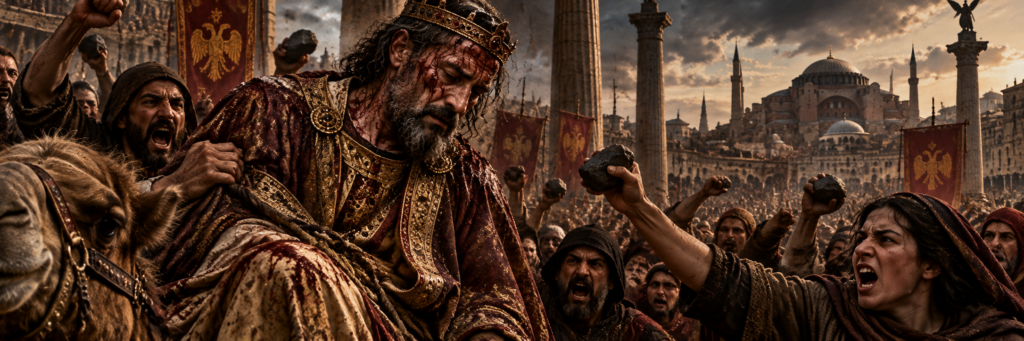
Andronikos I Komnenos: The Emperor Torn Apart by the People of Constantinople
Andronikos I Komnenos (c. 1118–1185) | Byzantine Emperor, 1183–1185 | Overthrown, publicly tortured, and killed in Constantinople in September 1185
The Day Constantinople Took Its Emperor
In September 1185, the people of Constantinople were given possession of the man who had ruled them through fear. Andronikos I Komnenos, once one of the most charismatic, dangerous, and unpredictable figures in the Byzantine world, had lost his throne with astonishing speed and fallen into the hands of his enemies. Only days earlier, an order bearing his authority could send an aristocrat to prison, confiscate a family’s fortune, or condemn a political opponent to mutilation or death. Now the emperor himself stood helpless before a population that no longer feared him, and the vengeance unleashed upon his body would become one of the most horrifying endings ever suffered by a Byzantine ruler.
The principal account of Andronikos’s final ordeal comes from the Byzantine historian Niketas Choniates, whose description is extraordinarily vivid and openly hostile to the fallen emperor. Choniates tells of mutilation, beatings, public humiliation, a grotesque procession through the streets, and prolonged torment before Andronikos finally died. Some individual details must be approached cautiously because Byzantine historians could shape the deaths of hated rulers into moral dramas, emphasizing the terrible punishment awaiting tyrants. Even after allowing for literary embellishment, however, there is no serious doubt that Andronikos was subjected to an exceptionally brutal public lynching after his overthrow.
His death was the culmination of a career that had rarely followed an ordinary path. Andronikos had been an imperial prince, military commander, prisoner, fugitive, exile, adventurer, political conspirator, notorious lover, provincial powerbroker, reformer, usurper, and emperor. He escaped dangers that would have destroyed most men and repeatedly returned from disgrace after his political career appeared finished. By the time he finally reached the Byzantine throne in his sixties, he had acquired the confidence of a man who had survived so many disasters that survival itself may have seemed almost inevitable.
Yet Andronikos’s greatest talent was also one of his greatest weaknesses. He understood how to exploit fear, resentment, family rivalries, political corruption, and popular anger, but he never fully learned how to govern those forces once he possessed supreme power. He entered Constantinople claiming to rescue a child emperor from corrupt advisers, only to eliminate the child’s mother and eventually the child himself. He attacked genuine abuses within Byzantine government while creating a regime so frightening that powerful men increasingly believed rebellion was safer than obedience.
The final reversal was almost perfect in its cruelty. Andronikos had used popular anger to reach Constantinople in 1182, when hostility toward the regency of Maria of Antioch and resentment against the city’s Latin population helped destroy the government standing between him and power. Three years later, popular anger turned upon Andronikos himself with even greater ferocity. The emperor who had learned to ride the fury of Constantinople discovered too late that no ruler could guarantee where that fury would turn next.
To understand why an emperor could be beaten, mutilated, paraded through his own capital, and eventually killed before a delighted crowd, it is necessary to understand the extraordinary man Constantinople believed it was punishing. Andronikos did not suddenly become dangerous after reaching the throne. His entire life had been a succession of scandals, escapes, betrayals, reconciliations, forbidden relationships, and political gambles, all unfolding within a dynasty whose family politics could be as dangerous as any battlefield.
Born Too Close to the Throne
Andronikos was born around 1118 into the extended Komnenian imperial family. His father, Isaac Komnenos, was a son of Emperor Alexios I Komnenos, the formidable ruler who had seized the throne in 1081 and restored a measure of stability after decades of military and political crisis. Andronikos was therefore a grandson of Alexios I and belonged from birth to one of the most powerful families in the Byzantine Empire. He grew up in a world where family relationships, military commands, marriages, estates, court titles, and access to the emperor were all part of the machinery of government.
The Komnenian system relied heavily upon imperial relatives. Alexios I had strengthened his position by distributing important offices among members of his family and connecting other great aristocratic houses to the dynasty through marriage. His son John II continued this pattern, and Manuel I would later preside over an even more elaborate network of relatives, favorites, generals, and foreign allies. The arrangement could provide remarkable stability when a strong emperor controlled it, but it also ensured that ambitious men were constantly surrounded by relatives with enough blood, wealth, and military influence to become dangerous.
Andronikos grew up close to his cousin Manuel Komnenos, the future Emperor Manuel I. Both men were intelligent, physically impressive, and comfortable within the aristocratic military culture of the dynasty, but their paths diverged dramatically. Manuel inherited the throne in 1143 after the death of his father, John II, and became the unquestioned center of the Komnenian world. Andronikos remained close enough to imperial power to matter while never possessing enough authority to satisfy an ambition that repeatedly brought him into conflict with his cousin.
Contemporary descriptions and later accounts emphasize Andronikos’s striking appearance and extraordinary personal magnetism. He was remembered as tall, athletic, handsome, vigorous, and capable of captivating people even when they had excellent reasons to distrust him. His intelligence and courage were equally important because he could perform the role of soldier, courtier, lover, political rebel, and repentant relative with remarkable effectiveness. These qualities would repeatedly save him from consequences that might have destroyed a less charismatic man.
His flaws were just as pronounced. Andronikos could be reckless, sexually impulsive, politically disloyal, and astonishingly confident in his ability to escape danger. He repeatedly crossed boundaries that other aristocrats would have regarded as too dangerous, then relied upon charm, family connections, flight, or political necessity to survive the resulting crisis. Long before he became emperor, he had already developed the habits of a man who treated politics as a contest in which rules existed primarily for people unable to evade them.
Manuel I and the Cousin Who Would Not Behave
Manuel I Komnenos became emperor in 1143 and ruled for nearly four decades. His reign was energetic, ambitious, and deeply engaged with the politics of the Mediterranean and southeastern Europe. Byzantine armies campaigned in Italy, Hungary, Anatolia, and the Balkans, while Manuel cultivated relationships with Crusader rulers and western aristocrats. Constantinople under Manuel was cosmopolitan, wealthy, politically sophisticated, and increasingly entangled with the Latin West.
Andronikos occupied an uneasy place within this world. As Manuel’s cousin, he enjoyed opportunities unavailable to ordinary aristocrats, including military commands and access to the highest levels of government. Yet his proximity to the emperor also made every hint of disloyalty more threatening. A rebellious provincial governor could be replaced, but a charismatic imperial cousin with Komnenian blood could become the center of an alternative court.
Relations between the two men repeatedly deteriorated. Andronikos was accused of political intrigue and of participating in conspiracies against Manuel, though the exact truth behind every accusation is difficult to recover. Later historians knew that Andronikos eventually seized the throne, which inevitably colored their interpretation of his earlier behavior. Even with that caution, Manuel clearly considered his cousin dangerous enough to place him under prolonged confinement.
Andronikos’s sexual relationships compounded the political problem. He became involved with Eudokia Komnene, another member of the extended imperial family, creating a scandal that enraged her relatives and further damaged his standing. Accounts of attempts by Eudokia’s family to kill him may contain embellishment, but they fit a recurring pattern in Andronikos’s life. He repeatedly chose lovers whose family connections ensured that private desire would become a public political problem.
The remarkable feature of these episodes is not merely that Andronikos created trouble but that he survived it. Manuel could be severe with political enemies, yet he repeatedly stopped short of permanently eliminating his cousin. Family affection, political calculation, and Andronikos’s ability to reinvent himself all probably played roles. Each escape from disaster strengthened a dangerous lesson: even the emperor’s anger could be survived.
The Prisoner Who Refused to Disappear
Andronikos eventually spent years imprisoned by Manuel’s government. For most members of the aristocracy, prolonged confinement would have ended any realistic hope of a major political career. Andronikos instead turned imprisonment into another chapter of his legend. Byzantine accounts describe elaborate attempts to escape and a determination that confinement never managed to extinguish.
One famous story has Andronikos exploiting or creating a hidden passage within his prison and concealing himself so successfully that his guards initially believed he had escaped. The authorities reportedly responded by imprisoning his wife, believing she might know where he had gone, only for the situation to produce further extraordinary complications. Individual details in these stories may have grown through retelling, but the central fact remains that Andronikos repeatedly escaped custody. His reputation as a man who could not be permanently contained was already firmly established.
After one successful flight, Andronikos moved beyond the empire and entered the dangerous world of international exile. He spent time among foreign rulers and courts, including territories connected with Rus’ and the Caucasus. An aristocrat of imperial blood could be a valuable guest because he possessed information, prestige, and potential usefulness against Constantinople. For Manuel, the fugitive cousin was therefore more than a family embarrassment; he could become a diplomatic and military threat.
Andronikos’s years abroad broadened his experience enormously. He encountered different courts, rulers, military systems, and political cultures, developing connections far beyond the normal world of a Byzantine provincial aristocrat. He also continued the personal behavior that had caused so many problems at home. Wherever Andronikos traveled, politics and romance seemed determined to collide.
One particularly dangerous relationship involved Philippa of Antioch, a sister of Manuel’s wife, Empress Maria of Antioch. Andronikos’s involvement with her was politically explosive because Philippa belonged to the immediate family of the empress. Manuel had every reason to regard the affair as a deliberate insult as well as a scandal. Once again, Andronikos found it safer to move on than to remain where imperial anger could reach him.
Theodora and the Wandering Prince
Andronikos later formed one of the most significant relationships of his life with Theodora Komnene, the widow of Baldwin III of Jerusalem. Theodora was herself a member of the extended Komnenian family, making their relationship problematic under the church’s rules governing prohibited degrees of kinship. Unlike some of Andronikos’s earlier affairs, however, this relationship appears to have endured for years and produced children. Whatever political calculations surrounded it, there is good reason to believe that the attachment was personally important to both of them.
Their relationship forced the couple into further wandering. Andronikos moved through territories in the Caucasus and beyond the secure reach of Manuel’s government, relying upon foreign hospitality and his own ability to negotiate protection. The life was adventurous, but it was also precarious. An imperial fugitive remained useful only while local rulers believed sheltering him was worth the diplomatic cost.
Pressure from Constantinople eventually narrowed Andronikos’s options. Members of his family were vulnerable to imperial retaliation, and the practical difficulties of permanent exile accumulated. The man who had repeatedly defied Manuel eventually sought reconciliation. It would become another remarkable reversal in a career built upon them.
Accounts of Andronikos’s return emphasize deliberate displays of submission. He presented himself as a repentant relative who acknowledged Manuel’s supremacy and begged forgiveness. Manuel accepted him back, though the emperor had ample reason not to restore him to unrestricted influence. Andronikos was permitted to live within Byzantine territory but remained away from the center of government.
He spent part of his later years at Oinaion on the Black Sea coast. Had Manuel lived another decade, Andronikos might have ended his life there as an aging aristocratic curiosity, remembered for adventures rather than emperorship. Instead, Manuel died in 1180 and left the throne to a child. The political structure that had restrained Andronikos for decades suddenly weakened at exactly the moment when he was still ambitious enough to exploit it.
A Child on the Throne
Manuel I died in September 1180, leaving his young son Alexios II Komnenos as emperor. Alexios was only about eleven years old, far too young to govern independently. His mother, Maria of Antioch, became the dominant figure within the regency. The arrangement immediately created tensions within a political culture deeply suspicious of foreign influence.
Maria was a western-born princess and therefore an easy target for anti-Latin hostility. Her close political association with the protosebastos Alexios Komnenos further damaged the regency’s reputation among rivals who believed the government had been captured by an unpopular faction. Whether every accusation made against Maria’s administration was fair is doubtful. What mattered politically was that enough influential people believed, or found it useful to claim, that the government had become corrupt and dangerously sympathetic to western interests.
Economic tensions intensified the resentment. Italian maritime powers such as Venice, Genoa, and Pisa possessed significant commercial privileges within the Byzantine Empire, and Latin merchants had established prosperous communities in Constantinople. Their advantages could provoke anger among local merchants and artisans who believed foreigners were receiving opportunities denied to Byzantines. Religious differences between eastern and western Christians added another source of hostility.
The regency therefore faced a volatile combination of problems. A child occupied the throne, his foreign-born mother was unpopular, aristocratic factions were divided, and resentment against western merchants simmered in the capital. Manuel’s commanding personality was no longer present to keep these competing forces under control. The Komnenian system still existed, but its center had disappeared.
Andronikos understood immediately what this weakness meant. He did not need to announce that he wanted the throne because doing so would unite opponents against him. Instead, he could present himself as the loyal relative coming to rescue Alexios II from corrupt advisers. The distinction between protecting the emperor and controlling him would be dealt with later.
The Savior Approaches Constantinople
Andronikos began presenting himself as the defender of the young emperor and the enemy of the unpopular regency. It was a brilliant message because it allowed people to support him without openly rejecting the legitimate dynasty. He accused Maria’s government and its allies of abusing power, endangering Byzantine interests, and surrounding Alexios with corrupt influences. In an atmosphere already filled with resentment, the message spread rapidly.
Supporters gathered as Andronikos advanced toward Constantinople in 1182. The aging prince had spent decades accumulating a reputation for charisma and defiance, and those qualities now became political assets. He was no longer merely Manuel’s troublesome cousin. To his supporters, he could appear as the experienced Komnenian prince capable of rescuing an empire governed by an unpopular regency.
The government attempted to resist, but its support eroded. Military and political defections weakened the regency while Andronikos’s movement gained momentum. Once it became clear that he might actually triumph, men who had hesitated suddenly had reasons to join him. Byzantine political loyalty could shift very quickly when people sensed that power itself was moving.
The fall of the regency unleashed violence far beyond an ordinary palace coup. Constantinople’s Latin population became the target of a horrific explosion of anti-western fury known as the Massacre of the Latins. Homes, businesses, religious institutions, and individuals associated with the Latin community were attacked. Men, women, clergy, and other vulnerable people were caught in the violence, while many survivors were reportedly sold into slavery.
Exact casualty figures cannot be established, and medieval accounts sometimes inflated numbers for dramatic or polemical purposes. Nevertheless, the massacre was unquestionably extensive and became one of the darkest episodes in Byzantine relations with western Christians. Andronikos did not personally direct every attack, and longstanding economic and religious tensions helped create the violence independently of him. Yet his political movement exploited anti-Latin resentment, and his triumph was inseparable from the collapse of authority that allowed the massacre to occur.
The man who claimed to be rescuing the empire therefore entered Constantinople amid bloodshed. Alexios II remained alive and was still nominally emperor, allowing Andronikos to preserve the appearance of loyalty. The people surrounding the boy, however, were now at the mercy of the prince who had come to save him. One by one, those people began to disappear.
Maria of Antioch Must Die
Maria of Antioch became one of the first major victims of the new order. As Alexios II’s mother and former regent, she represented both a political rival and a potential center around which opponents of Andronikos could organize. Her western origins made her especially vulnerable after the anti-Latin violence that accompanied the collapse of her government. Once Andronikos controlled Constantinople, her chances of recovering authority were minimal.
Maria was imprisoned and accused of treason, including allegations that she had sought western assistance against Andronikos. The charges cannot be evaluated as though they emerged from an impartial judicial process because the political environment had already been transformed by her enemy’s victory. She was condemned to death. Even more disturbingly, the young Alexios II was reportedly made to authorize or approve the execution of his own mother.
Maria was strangled in 1182. Her death revealed the true direction of Andronikos’s government because the supposed protector of Alexios had now eliminated the boy’s mother. Whatever threat Maria may have represented, her execution removed one of the most important people capable of defending the young emperor against the man who increasingly controlled him. Alexios remained on the throne but was becoming politically isolated.
Other opponents suffered similar fates. Some were imprisoned, exiled, blinded, dispossessed, or executed as Andronikos dismantled networks capable of resisting him. Byzantine politics had always been capable of brutality, and mutilation was a well-established means of rendering rivals politically unsuitable for emperorship. Under Andronikos, however, repression increasingly became a defining feature of the regime.
The young emperor’s court therefore became smaller and more dangerous. Men who might have protected him understood that opposition could carry terrible consequences. Andronikos gradually moved from guardian to dominant ruler while maintaining the appearance that Alexios remained legitimate. By 1183, the fiction was becoming impossible to sustain.
Andronikos was crowned co-emperor. The old adventurer who had spent decades circling imperial power finally stood beside the child whose rights had supposedly brought him to Constantinople. There was now only one significant obstacle preventing Andronikos from becoming sole emperor, and that obstacle was a teenage boy with very few protectors left.
The Murder of Alexios II
Alexios II was killed in 1183, probably by strangulation. The murder remains one of the most important crimes associated with Andronikos’s rise because it destroyed the claim that he had intervened merely to protect Manuel’s son. Although the exact mechanics and participation of individual conspirators come through hostile narrative sources, Andronikos was the overwhelming political beneficiary. Once Alexios died, there was no longer a legitimate young emperor around whom resistance could rally.
The political logic behind the murder is painfully clear. As Manuel I’s son, Alexios possessed a legitimacy Andronikos could never completely duplicate. Even if the boy remained a powerless figurehead, aristocratic opponents could use his name against the new co-emperor. Killing him eliminated that danger permanently.
Sources preserve disturbing accounts of the treatment of Alexios’s body after his death, including claims that it was thrown into the sea. Such details deserve caution because chroniclers hostile to Andronikos had every reason to emphasize desecration as proof of tyranny. The central fact requires no embellishment: a young emperor whom Andronikos had sworn to protect was deliberately killed, and Andronikos emerged as sole ruler. The political rescue mission had ended in dynastic murder.
Andronikos then married Alexios’s widow, Agnes of France, known in Byzantium as Anna. She was the daughter of King Louis VII of France and had been married to Alexios while both were still children. Andronikos was approximately sixty-five years old, while Agnes was only around twelve. The marriage was startling even in a medieval dynastic world accustomed to unions arranged for political purposes.
The reasons were probably political rather than reducible to personal desire. Agnes possessed royal prestige, and marrying her could help Andronikos absorb another element of Alexios’s position into his own regime. Yet the symbolism was disastrous. The elderly ruler had eliminated the young emperor and then married the murdered boy’s child widow.
For Andronikos’s enemies, the sequence confirmed every accusation of moral and political corruption. He had come as protector, become co-emperor, eliminated his ward, taken the throne, and married the dead emperor’s widow. No amount of administrative reform could completely erase the darkness surrounding that path to power. Andronikos had finally achieved what decades of rebellion had failed to give him, but the throne arrived stained by the blood of the dynasty he claimed to defend.
The Reformer Inside the Tyrant
Andronikos’s reign becomes more complicated when attention turns away from the palace murders. He appears to have recognized genuine problems within Byzantine government and attempted meaningful reforms. Provincial officials could exploit taxpayers, aristocratic families could use political influence to enrich themselves, and offices could become opportunities for private extraction rather than public service. These abuses were real enough that a ruler willing to confront them could attract genuine popular support.
Andronikos attempted to curb corruption among officials and strengthen accountability. He reportedly sought to ensure that administrators received sufficient salaries, reducing the excuse that extortion was necessary to support themselves. Officials who abused their positions faced severe punishment. In some areas, ordinary taxpayers may genuinely have benefited from the greater discipline imposed upon local government.
He also challenged the entrenched power of the aristocracy. The Komnenian political system had relied heavily upon great families, but this concentration of wealth and influence could undermine central authority. Andronikos knew the aristocratic world intimately because he had spent his entire life inside it. Few emperors were better positioned to understand how powerful families manipulated government for private advantage.
This reforming agenda helps explain why Andronikos cannot simply be dismissed as a bloodthirsty madman. He possessed political intelligence and understood that imperial authority depended upon more than court ceremony. He recognized grievances among people who had little affection for aristocratic privilege. His government could therefore be popular in places where stronger central control protected communities from local exploitation.
The problem was the method. Andronikos increasingly treated terror as the instrument through which reform would be enforced. Corrupt officials did not merely risk dismissal; severe physical punishment or death could await them. Aristocrats who opposed the emperor could lose property, freedom, eyesight, or life.
Administrative discipline achieved through fear can appear effective for a time. Officials behave carefully because the consequences of failure are terrifying, while potential opponents hesitate because rebellion appears suicidal. Yet such a system produces obedience without trust. The moment people believe the ruler is weakening, accumulated fear can transform into explosive vengeance.
Andronikos was building precisely that kind of government.
A Court Consumed by Suspicion
The longer Andronikos ruled, the more his government became entangled in suspicion. Some conspiracies against him were undoubtedly real because powerful families had excellent reasons to fear his policies and resent his seizure of power. Each conspiracy, however, reinforced his belief that harsher measures were necessary. Repression created resistance, and resistance then justified further repression.
Executions, mutilations, confiscations, imprisonment, and exile became increasingly associated with the regime. Byzantine politics was already violent enough that none of these punishments was unprecedented. What distinguished Andronikos was the cumulative atmosphere of insecurity. Men who had previously enjoyed enormous privilege could no longer assume that family connections would protect them.
His own life probably contributed to this mentality. Andronikos knew better than almost anyone how dangerous an ambitious aristocrat could be because he had spent decades being exactly that man. He knew how prisoners escaped, how exiles gathered foreign support, how relatives became conspirators, and how a charismatic prince could turn popular dissatisfaction against an emperor. Every potential rival could therefore look like a younger version of himself.
That knowledge became poisonous once combined with supreme power. Military commanders could rebel, aristocrats could conspire, imperial relatives could claim the throne, and popular figures could become alternatives to the emperor. Eliminating possible threats before they matured may have seemed rational. Yet every punishment created grieving relatives, dispossessed families, frightened officials, and men who believed their only hope of survival lay in overthrowing Andronikos first.
The emperor had therefore created a political trap. The more frightened he became of conspiracy, the more violently he acted. The more violently he acted, the more people had reason to conspire. By 1185, his government still possessed the machinery of coercion but had lost much of the loyalty that makes coercion sustainable.
A foreign invasion would expose the weakness.
Disaster Comes From Sicily
The Norman Kingdom of Sicily had long posed a serious threat to Byzantine interests in the Adriatic and Balkans. In 1185, King William II launched a major invasion of the Byzantine Empire. Norman forces crossed into imperial territory and captured Dyrrhachium before advancing deeper into the Balkans. Their progress immediately placed enormous pressure upon Andronikos’s government.
The greatest disaster came at Thessalonica, the empire’s second city. Its defenses proved inadequate, and Norman forces besieged the city. In August 1185, Thessalonica fell. The resulting sack brought killing, looting, humiliation, and destruction on a scale that horrified the Byzantine world.
Precise casualty figures remain uncertain, as they often do for medieval sacks and massacres. What cannot be doubted is the political effect. Andronikos had presented himself as the ruler who would restore order, defend Byzantine interests, and punish the corrupt elite responsible for weakness. Now one of the empire’s greatest cities had fallen to a western army.
The irony was especially damaging because Andronikos had risen amid intense anti-Latin sentiment. The massacre in Constantinople three years earlier had accompanied his ascent. Yet the emperor associated with resistance to western influence now appeared unable to protect Byzantine subjects from Norman invaders. The ideological foundation of his popularity was collapsing alongside his military reputation.
News from Thessalonica deepened fear in Constantinople. The Norman army seemed capable of advancing farther, perhaps even threatening the capital. A ruler who had alienated much of the aristocracy suddenly needed cooperation from the very people his government had terrorized. Instead of broad reconciliation, the regime continued searching for internal enemies.
One of those suspected enemies was Isaac Angelos.
The attempt to arrest him would destroy Andronikos faster than the Norman invasion ever could.
Isaac Angelos Draws His Sword
Isaac Angelos belonged to a prominent aristocratic family and had enough dynastic connection to appear threatening in an atmosphere of intense suspicion. He was not necessarily preparing an elaborate revolution when Andronikos’s government moved against him. The rebellion that eventually placed Isaac on the throne began instead with a desperate confrontation over his arrest. In trying to eliminate another possible rival, Andronikos’s regime created the rival who would replace him.
Stephen Hagiochristophorites, one of Andronikos’s officials, went to arrest Isaac in September 1185. Isaac resisted rather than submit to what he had every reason to believe could end in imprisonment, mutilation, or death. During the confrontation, he killed Stephen with his sword. The act made retreat impossible because killing an imperial official transformed suspicion into open rebellion.
Isaac fled to Hagia Sophia and sought sanctuary. The choice was politically powerful even if desperation rather than careful strategy dictated it. Hagia Sophia was the spiritual center of the capital and a natural gathering place where an appeal for protection could rapidly become a public demonstration. Constantinopolitans began assembling around the fugitive aristocrat.
The crowd grew as longstanding grievances converged. Aristocrats feared Andronikos’s purges, ordinary inhabitants resented his increasingly oppressive government, and news from Thessalonica had shattered confidence in his ability to defend the empire. People who might previously have remained silent began to believe that the regime could actually fall. Once that possibility became imaginable, the political atmosphere changed with breathtaking speed.
Isaac was proclaimed emperor as Isaac II Angelos. What had begun as one man’s refusal to be arrested became a full-scale transfer of imperial legitimacy. Officials, soldiers, and ordinary citizens now had an alternative ruler around whom they could organize. Andronikos’s power, so frightening only days earlier, began collapsing because the obedience upon which it depended was disappearing.
The lesson was brutal and immediate. Terror can keep people submissive while they believe resistance is hopeless. Once enough people conclude that the ruler can be defeated, the same fear that preserved his authority can become hatred powerful enough to destroy it. Andronikos was about to experience that transformation personally.
The Great Survivor Finally Runs
Andronikos recognized that Constantinople was slipping beyond his control and attempted to escape. Flight was not an unfamiliar response for him because his earlier life had been shaped by successful escapes from imprisonment, imperial anger, hostile relatives, and foreign danger. He had survived precisely because he knew when remaining in place meant destruction. Even in his sixties, the instinct that had preserved him for decades remained powerful.
He left the capital with a small group that included Agnes of France and his longtime companion Maraptike. The Black Sea offered the possibility of reaching territories where Andronikos retained connections or where foreign protection might once again be available. If he escaped Byzantine control, he could perhaps gather supporters, negotiate with foreign rulers, or simply wait for Isaac’s new regime to encounter difficulties. His history gave him ample reason to believe that a political career could be resurrected even after apparently final defeat.
This time, circumstances did not cooperate. His escape by sea failed, and forces loyal to the new regime captured him. The man who had evaded Manuel I’s prisons and crossed borders beyond the reach of Constantinople finally found himself unable to outrun his enemies. His extraordinary career of escapes ended almost within sight of the empire he had briefly ruled.
The consequences were immediate because Andronikos was far too dangerous to leave as an ordinary prisoner. Even deposed, he possessed Komnenian blood, political experience, charisma, and supporters. A living Andronikos in exile could become a rallying point for opposition to Isaac II. The new regime therefore had every reason to ensure that he would never again become emperor.
Yet what happened next went far beyond the practical neutralization of a rival. Andronikos was returned to a capital seething with hatred, and the population was allowed extraordinary access to him. The ruler who had once controlled the machinery of punishment became its victim. Political transition turned into public vengeance.
The Destruction of an Emperor
Byzantine imperial authority depended heavily upon symbolism. The emperor’s clothing, crown, ceremonies, attendants, processions, and physical position all reinforced the idea that he stood above ordinary society. To destroy an emperor politically therefore involved more than removing him from a throne. His body and appearance could be transformed in ways that announced his loss of authority.
Andronikos was stripped of imperial dignity and subjected to mutilation. Choniates reports that one of his hands was cut off, a punishment carrying obvious practical and symbolic significance. Byzantine political culture often regarded serious bodily mutilation as incompatible with emperorship because the ruler was expected to possess physical wholeness. Damaging the body could therefore make restoration politically more difficult even if the victim survived.
He was also beaten and imprisoned while already injured. The process was not designed merely to secure him until a formal sentence could be imposed. It deliberately reduced the former emperor from an object of awe into a helpless prisoner. The people who had once feared approaching him could now see him wounded and powerless.
This transformation mattered because Andronikos’s government had relied heavily upon fear. The spectacle of his helplessness demonstrated that his authority had vanished. Every insult that went unpunished encouraged another. Once the psychological barrier surrounding the emperor broke, violence became increasingly difficult to restrain.
The new regime did not provide Andronikos with the quiet confinement that had once allowed him to escape Manuel. Nor was he simply blinded and sent to a monastery, a fate suffered by many Byzantine political rivals. Instead, he was exposed to the population. Constantinople itself would participate in his punishment.
The emperor who had turned political terror into a method of government was about to become the central figure in a public spectacle of terror.
The Anti-Triumph Through Constantinople
Choniates describes Andronikos being placed upon a mangy camel and paraded through the streets of Constantinople. The image deliberately inverted the triumphal rituals associated with Byzantine emperorship. Victorious rulers normally appeared surrounded by ceremonial magnificence, guards, clergy, banners, music, and carefully orchestrated acclamations. Andronikos’s procession displayed defeat instead of victory and humiliation instead of majesty.
Crowds attacked him as the procession moved through the capital. Choniates describes people striking him, shouting abuse, throwing filth, and inflicting further physical suffering. He includes particularly gruesome details involving scalding liquid and other torments, although individual elements should be treated cautiously because his narrative clearly seeks to present the fall of a tyrant as a dramatic moral reversal. The broad reality of sustained public abuse, however, is not seriously disputed.
The violence carried powerful symbolic meaning. While emperor, Andronikos had been physically inaccessible to most ordinary Constantinopolitans. Guards, officials, walls, ritual, and social hierarchy separated his body from theirs. During the procession, those barriers disappeared completely.
Men and women who could never have approached him safely while he ruled could now insult, strike, and humiliate him. Choniates emphasizes the breadth of participation as though the entire city had united against the fallen emperor. That image may exaggerate unanimity, because Andronikos undoubtedly retained some supporters, but it captures the scale of his political isolation. No effective faction emerged to rescue him.
His physical endurance made the ordeal even more terrible. Andronikos had been celebrated throughout his life for strength and vigor, and he remained alive despite mutilation and repeated abuse. The toughness that had helped him survive campaigns, prison, flight, and exile now prolonged his suffering. His body refused to fail quickly enough to provide escape.
Choniates attributes statements of resignation and bitter endurance to the fallen emperor during these hours. Such reported words should be treated cautiously because medieval historians frequently crafted memorable final sayings that reflected the character or moral meaning they wished to convey. We cannot know exactly what Andronikos said while being tortured. What matters is that he remained conscious through enough of the ordeal for later observers to remember his endurance as part of the horror.
The procession eventually carried him toward one of Constantinople’s most politically charged public spaces. The Hippodrome had been a place where emperors received acclamations and where the population communicated approval, anger, and demands to the imperial government. For Andronikos, it would become the setting for the final destruction of the authority he had spent a lifetime pursuing.
Death in the Hippodrome
The Hippodrome had stood at the heart of Constantinopolitan public life for centuries. Emperors appeared there before enormous crowds, ceremonies unfolded within its vast arena, and popular political emotions could become dangerously visible. The space represented the relationship between ruler and ruled more dramatically than almost anywhere else in the capital. Andronikos entered it not as emperor but as a captive offered to the population.
According to Choniates, Andronikos was suspended between columns while the abuse continued. By this point he had already suffered mutilation, beating, exhaustion, and the violence of the procession. His body was exposed and almost completely defenseless. The crowd continued attacking a man whose imperial authority had disappeared so completely that harming him now carried no apparent danger.
Choniates’s account becomes particularly graphic in describing the wounds inflicted during the final stage. People struck and stabbed the former emperor, and a Latin soldier is reported to have driven a sword into him. The exact sequence cannot be independently reconstructed, and it would be irresponsible to treat every wound in the literary account as forensically documented. Nevertheless, Andronikos unquestionably died as a result of prolonged public violence after his overthrow.
His death therefore occupies an unusual position within the history of regicide. He was not secretly assassinated by a handful of conspirators, nor was he executed through an orderly judicial procedure after a formal trial. His killing combined political punishment, state acquiescence, and collective lynching. The distinction between execution and mob murder effectively disappeared.
Isaac II’s new government benefited enormously from the result. A living Andronikos could have become a threat, while a mutilated corpse could not. The crowd, meanwhile, received the satisfaction of physically destroying the ruler it blamed for years of terror and recent catastrophe. Political necessity and popular vengeance pointed toward the same outcome.
That does not mean every individual involved acted under orders from Isaac. Popular violence can develop its own momentum, particularly after a hated government collapses. The important point is that the new authorities did not preserve Andronikos for exile or conventional punishment. He was allowed to pass into the hands of people determined to kill him.
The man who had reached Constantinople through popular anger in 1182 died through popular anger in 1185. Few political careers contain a reversal so complete. The same capital that had helped raise him now participated in tearing him down.
How Much of the Horror Can We Believe?
Niketas Choniates is essential to the story of Andronikos, but he cannot be read as a neutral modern reporter. He belonged to the educated Byzantine administrative elite and lived through the period, giving him extraordinary proximity to the political world he described. His history preserves details, personalities, and events that would otherwise be lost. At the same time, he possessed strong opinions about the rulers whose reigns he recorded.
Andronikos receives especially hostile treatment. Choniates presents him as sexually immoral, manipulative, murderous, tyrannical, and ultimately destructive to the political order. The emperor’s horrific death therefore functions within the narrative as a moral reversal in which a man who inflicted suffering upon others eventually experiences suffering himself. That literary structure does not make the events fictional, but it should make readers cautious about dramatic details.
The broad sequence is secure enough. Andronikos was overthrown, attempted to escape, was captured, mutilated, publicly humiliated, exposed to mob violence, and killed in Constantinople. The uncertainty concerns the exact order of particular injuries, individual actions attributed to anonymous members of the crowd, and the precise words supposedly spoken by Andronikos during his ordeal. Those details passed through the interpretive framework of writers who wanted the emperor’s death to mean something.
Byzantine historians frequently treated the deaths of tyrants as opportunities to demonstrate the instability of worldly power. An emperor who had appeared terrifyingly powerful could be reduced to a helpless body, showing that fortune and divine judgment could overturn human arrogance. Andronikos’s life fit this moral structure exceptionally well. His extraordinary rise made his extraordinary fall almost irresistible to a literary historian.
Historical caution does not make the death less horrifying. No embellishment is necessary to create drama when the basic facts involve a deposed emperor being mutilated and publicly killed by a crowd. If anything, distinguishing secure events from literary details makes the story more powerful because it prevents legend from overwhelming reality. The reality was already savage enough.
The Question of Justice
It is tempting to interpret Andronikos’s death as poetic justice. He had been implicated in the murder of Alexios II, presided over the execution of Maria of Antioch, terrorized aristocratic opponents, and governed through punishments capable of destroying bodies as well as careers. When the political order reversed, he experienced mutilation, humiliation, and death himself. Medieval writers were naturally drawn to the symmetry.
Yet describing the lynching as justice risks simplifying what happened. The torture of Andronikos did not restore Alexios II to life. It did not resurrect Maria of Antioch, repair the suffering of political prisoners, or undo the massacre that had accompanied his rise. Violence could punish a ruler without repairing the damage created by his rule.
The crowd’s behavior also reveals something disturbing about Constantinople itself. In 1182, political collapse had helped unleash collective violence against the city’s Latin community. Three years later, another political collapse unleashed collective violence against Andronikos. The victims and circumstances differed, but both episodes demonstrated how quickly political hatred could escape institutional restraint.
Andronikos had helped create this atmosphere by exploiting resentment and governing through fear. Yet once violence became normalized as a legitimate political language, it could be directed toward almost anyone. The emperor discovered that a population encouraged to see enemies as deserving of destruction might eventually decide that the emperor himself belonged in that category. His death was therefore not simply punishment for tyranny but evidence of a political culture becoming dangerously accustomed to vengeance.
There is a deeper irony in the way Andronikos’s body became the final site of political communication. While he ruled, punishment sent messages to everyone who might oppose him. During his death, punishment sent the opposite message: the tyrant was gone, his commands no longer mattered, and the people could touch the man who had once seemed untouchable. His body became proof that the old regime had ended.
The Man Behind the Reputation
Andronikos is difficult to understand because his life encourages extreme judgments. He can easily become either a monstrous tyrant whose horrible death seems inevitable or a misunderstood reformer destroyed by aristocrats whose corruption he challenged. Both versions contain fragments of truth. Neither adequately explains the contradictions that made him so dangerous and fascinating.
His administrative reforms deserve genuine credit. He recognized that provincial corruption and aristocratic exploitation could weaken the empire. Efforts to improve official salaries, punish extortion, and restrain powerful families were not meaningless gestures. Some ordinary subjects may have experienced his government as more just than the regimes of local officials he displaced.
At the same time, his willingness to use extreme violence cannot be separated from those reforms. A ruler who punishes corruption through terror may reduce certain abuses while creating others. Officials become afraid to steal, but they also become afraid to make independent decisions. Aristocrats become less capable of exploiting the government, but they also begin plotting to remove the ruler who threatens their families.
Andronikos’s personal history made compromise particularly difficult. He had spent decades surviving by outmaneuvering people, escaping confinement, changing alliances, and exploiting weaknesses. Those skills were exceptionally useful for reaching power. They were far less useful for building a stable political order once he possessed it.
He understood people well enough to manipulate them but not always well enough to trust them. He recognized that the aristocracy could be dangerous because he himself had been a dangerous aristocrat. He knew that imperial relatives could conspire because he had spent much of his life under suspicion of conspiracy. His own biography became the lens through which he viewed everyone around him.
The result was a ruler who could identify real problems but repeatedly choose destructive solutions. He saw corruption and answered with terror. He saw aristocratic disloyalty and answered with purges. He saw dynastic competition and answered with the murder of a child emperor.
Andronikos was therefore neither merely insane nor inexplicably cruel. His actions followed a political logic, but it was a logic poisoned by fear and an extraordinary willingness to eliminate obstacles. That makes his reign more unsettling, not less. Some of history’s most destructive rulers understood exactly what problems they were trying to solve.
The Dynasty That Devoured Its Heir
The murder of Alexios II deserves special attention because it transformed Andronikos’s relationship with the Komnenian dynasty. He had risen as a member of that dynasty and justified his intervention by claiming to protect Manuel’s son. Once Alexios was killed, Andronikos could no longer plausibly portray himself merely as the guardian of legitimate succession. He had become the beneficiary of its destruction.
The Komnenian system had always depended upon family. Alexios I used relatives to stabilize his regime, while John II and Manuel I maintained networks of kinship connecting military and political power to the imperial household. This strategy worked because the emperor stood at the center and managed competing ambitions. When a child inherited the throne, the same family networks became sources of rivalry.
Andronikos understood that system from the inside. His own life demonstrated how dangerous an imperial cousin could become when given enough independence. Yet rather than restoring the system around Alexios II, he eliminated the young ruler and concentrated authority in himself. The short-term result was personal supremacy, but the long-term result was the destruction of dynastic legitimacy.
His marriage to Agnes made the political symbolism even more unsettling. The young princess had been the wife of Alexios II, and Andronikos effectively incorporated her into his own regime after the boy’s murder. Whatever practical considerations motivated the marriage, it looked like an attempt to absorb the remnants of the previous reign. The old emperor had taken not only Alexios’s throne but also his bride.
This was politically clever in one sense because Andronikos removed another potentially useful symbol from his opponents. Yet it also reinforced the impression that no relationship or institution was safe from his ambition. The man who had claimed to defend the dynasty appeared instead to be consuming it. By the time he faced serious rebellion, relatively little dynastic loyalty remained available to protect him.
The Massacre That Haunted His Reign
The Massacre of the Latins in 1182 remains one of the most consequential events associated with Andronikos’s rise. Constantinople contained substantial western communities whose commercial privileges and religious identity had long generated resentment. When the regency collapsed, that resentment erupted into violence. The result deepened hostility between Byzantines and western Christians at an already dangerous moment.
Andronikos’s responsibility requires careful wording. The massacre was not simply the personal act of one man, and the grievances producing it existed before his political movement approached Constantinople. Urban crowds, political factions, commercial rivals, and religious hostility all contributed. It would therefore be inaccurate to describe every killing as something personally ordered by Andronikos.
Yet absolving him would be equally misleading. His movement deliberately benefited from anti-Latin sentiment, and the destruction of the pro-western regency strengthened his position. He emerged as the political victor from a crisis in which Latin civilians had been attacked on a horrifying scale. His government did not represent a clean break from the forces that produced the massacre.
The event also contributed to the deterioration of Byzantine relations with western Europe. It did not single-handedly cause the Fourth Crusade or the sack of Constantinople in 1204, events that resulted from a much more complicated chain of political and financial decisions. Nevertheless, memories of atrocities mattered in medieval diplomacy and popular attitudes. The massacre became part of the accumulating history of mutual grievance.
There is an unsettling parallel between 1182 and 1185. Andronikos rose amid collective violence directed against a vulnerable population, then died amid collective violence directed against himself. In both cases, political crisis allowed accumulated resentment to become physical vengeance. The emperor who benefited from the first explosion became the victim of the second.
Why His Reforms Could Not Save Him
Andronikos’s supporters could point to real improvements in administration, but administrative reform alone cannot sustain a government. Rulers need soldiers willing to fight, officials willing to cooperate, elites willing to accept the political order, and ordinary subjects who believe obedience is preferable to revolt. Andronikos increasingly substituted fear for those relationships. The system worked until a sufficiently serious crisis tested it.
The Norman invasion provided that test. The fall of Thessalonica made the emperor appear incapable of protecting the empire despite all his claims of restoring strength. Military disaster is especially dangerous for authoritarian rulers because fear loses much of its power when the government itself appears frightened and vulnerable. People begin imagining alternatives.
Isaac Angelos provided one. His rebellion was not initially the product of a perfectly organized national conspiracy. It emerged from the regime’s attempt to arrest a man who decided that resistance offered a better chance of survival. That detail exposes the central weakness of Andronikos’s political system.
A government built on fear continually forces people to calculate whether submission or rebellion is safer. For years, Andronikos ensured that submission usually won that calculation. In September 1185, the balance changed. Once Isaac survived his confrontation and reached Hagia Sophia, people could see that resistance was possible.
The uprising then fed upon itself. Every new supporter made joining safer for the next. Every defection from Andronikos made loyalty to him more dangerous. Within a remarkably short period, the terrifying emperor discovered that almost no one was willing to risk themselves to preserve his throne.
His reforms had not created enough loyalty to compensate. Honest taxation could not save him. Punished officials could not save him. The aristocracy he had frightened certainly would not save him.
The government collapsed because too many people wanted it gone.
The Last Great Escape That Failed
Andronikos’s attempt to flee was entirely consistent with the man he had always been. He had escaped danger so many times that flight was not necessarily an admission of final defeat. For most of his life, reaching another territory had simply opened another chapter. Foreign protection, reconciliation, or changing political circumstances could turn a fugitive into a powerful man again.
Had he escaped successfully in 1185, Isaac II might have faced a serious problem. Andronikos still possessed Komnenian ancestry and enough political experience to make him valuable to foreign rulers hostile to Constantinople. A deposed emperor could become the center of rebellions or invasion plans. His mere existence would complicate the new regime’s claim to stability.
Capture therefore sealed his fate in a way that deposition alone did not. Blinding would have made him conventionally unsuitable for the throne, and monastic confinement might have removed him from ordinary political life. Yet Andronikos had already demonstrated that prisons and political conventions were not always enough to contain him. His enemies had reasons to desire something more permanent.
The mob provided that permanence. By the time the public violence ended, there could be no restoration, escape, or reconciliation. The man who had returned from political death repeatedly throughout his life finally became physically incapable of returning. Constantinople had solved the problem of Andronikos in the most irreversible way possible.
This helps explain why his death belongs so naturally within the history of regicide even though he had already been deposed. The killing was inseparable from the transfer of power. His survival would have threatened the new emperor, while his death closed the previous reign completely. Political necessity and popular hatred converged upon the same battered body.
The End of Komnenian Rule in Constantinople
Andronikos was the last emperor of the Komnenian dynasty to rule Constantinople before the Angeloi took control. The wider Komnenian family did not disappear, and branches of it would later become enormously important in the successor states that emerged after the Fourth Crusade. Yet his death marked the end of an extraordinary era at the imperial center. A dynasty that had restored Byzantine strength after the disasters of the eleventh century ended its direct rule in the capital through public bloodshed.
Alexios I had founded the Komnenian order through military success, political intelligence, and careful management of aristocratic families. John II maintained it with considerable stability, while Manuel I expanded Byzantine influence across an extraordinary diplomatic and military landscape. Andronikos inherited the prestige of that family but not its stable succession. His reign became the violent epilogue to the system his grandfather had built.
It would be unfair to blame him alone for the empire’s subsequent troubles. Isaac II and the Angeloi faced structural problems that had developed over decades, including aristocratic fragmentation, military pressures, financial difficulties, and complicated relations with western powers. The Byzantine Empire remained formidable after Andronikos’s death and would survive for centuries in different forms. History did not suddenly collapse because one emperor was killed.
Nevertheless, Andronikos accelerated instability at a dangerous moment. The murder of Alexios II broke the legitimate succession, while repression alienated powerful families and the events of 1182 deepened western hostility. His own overthrow demonstrated how fragile central authority had become. The imperial system survived, but confidence in its political order had been badly damaged.
Less than twenty years later, Constantinople would fall to the Fourth Crusade in 1204. The path between 1185 and 1204 was neither straight nor inevitable, and Andronikos should not be made responsible for events he did not cause. Even so, his reign belongs to the troubled final decades before that catastrophe. The violence of his rise and fall revealed cracks that later crises would widen.
The Emperor Who Became the Warning
Andronikos’s death quickly acquired meaning beyond the physical event itself. To hostile writers, it demonstrated the fate awaiting tyrants who believed power could protect them forever. The man who had ordered punishments became the punished, and the ruler who had terrified others experienced terror himself. Medieval historical writing found such reversals irresistible.
There was also a powerful lesson about the instability of imperial authority. Byzantine emperors surrounded themselves with elaborate ceremonial language suggesting divinely sanctioned rule and almost unimaginable prestige. Yet emperorship ultimately depended upon human institutions. Guards had to obey, officials had to administer, soldiers had to fight, and subjects had to accept the ruler’s legitimacy.
When those relationships failed, the transformation could be terrifyingly rapid. Andronikos did not cease being physically the same man when Isaac was proclaimed emperor. What changed was the willingness of everyone around him to treat him as emperor. Once that collective recognition disappeared, the ceremonial protections of monarchy vanished with it.
The same hands that would once have lowered themselves before him could strike him. The same streets prepared for imperial processions could become the route of his humiliation. The same Hippodrome where emperors received acclamations could become the place where his battered body was exposed to a murderous crowd.
That reversal explains why his death remains so memorable. It was not merely violent. It dismantled emperorship publicly, showing everyone watching that the enormous distance between ruler and subject could collapse almost overnight. The sacred emperor became a vulnerable old man.
When Fear Changed Sides
Andronikos I Komnenos spent most of his life proving that ordinary political rules did not seem to apply to him. He survived imperial suspicion, imprisonment, repeated escapes, exile, scandalous relationships, angry relatives, foreign adventures, and the hostility of one of the most powerful emperors of the twelfth century. Each survival strengthened his reputation and perhaps his own belief that there would always be another route out of danger. By the time he reached old age, Andronikos had escaped consequences often enough to mistake extraordinary luck and ability for something close to invulnerability.
His rise after Manuel I’s death seemed to confirm that belief. A man who had spent decades wandering around the edges of imperial power returned as the supposed defender of Manuel’s young son. He understood the weaknesses of the regency, the resentment directed toward Maria of Antioch, the hostility toward Latin influence, and the frustration produced by aristocratic government. He gathered those grievances around himself and turned them into a road toward Constantinople.
The road was stained with blood almost immediately. The Massacre of the Latins accompanied the collapse of the old regency, revealing how much violence lay beneath the political surface of the capital. Andronikos did not create every grievance that produced the massacre, but he benefited from the upheaval and did not prevent the forces supporting his rise from turning upon a vulnerable population. The violence of 1182 became part of the atmosphere from which his government emerged.
Maria of Antioch was then removed and killed. Political opponents were imprisoned, mutilated, dispossessed, or executed. The young Alexios II became increasingly isolated until the protector who had supposedly come to save him no longer needed him alive.
The murder of Alexios transformed Andronikos’s seizure of power into something darker than an ordinary palace revolution. A teenage emperor had been strangled so that an elderly relative could rule without competition. Andronikos then married the murdered boy’s young widow, creating a political arrangement that looked grotesque even to many contemporaries. The savior of the dynasty had become the man who destroyed its legitimate heir.
Yet Andronikos was never simply a theatrical villain. He recognized real corruption within Byzantine government and attempted to confront it. He understood that provincial officials could prey upon taxpayers and that aristocratic families could treat imperial government as a source of private enrichment. Some of his reforms may genuinely have improved conditions for ordinary subjects.
His tragedy was that he tried to cure abuse with fear. Officials would become honest because dishonesty might destroy them. Aristocrats would become obedient because rebellion could lead to mutilation or death. Potential conspirators would remain quiet because the emperor would strike first.
For a time, the method worked.
Then fear began creating the enemies it was supposed to eliminate.
Every punishment produced another frightened family. Every confiscation gave someone another reason to hate the emperor. Every execution taught surviving aristocrats that waiting quietly might not save them.
Andronikos knew better than anyone how dangerous a frightened aristocrat could become.
He had spent much of his own life as one.
The Norman invasion exposed the weakness beneath the terror. Thessalonica fell, its population suffered terribly, and the emperor who had promised strength appeared incapable of protecting one of the greatest cities in the empire. Military catastrophe turned private resentment into a broader crisis of confidence.
Then Andronikos’s government attempted to arrest Isaac Angelos.
Isaac refused to submit.
He killed the official sent against him, fled to Hagia Sophia, and appealed to a population already exhausted by fear. People gathered because the political conditions were finally right for gathering. The emperor’s reputation for cruelty, once an instrument of control, became an argument for rebellion.
Isaac was proclaimed emperor, and Andronikos discovered how quickly terror could evaporate once people believed the tyrant might lose.
Officials defected.
Citizens revolted.
The machinery of government stopped protecting its master.
Andronikos responded with the instinct that had saved him repeatedly throughout his life: he tried to escape. He took Agnes and Maraptike and fled toward the sea, hoping that another journey might once again separate him from his enemies. Had he escaped, the remarkable story of Andronikos Komnenos might have gained another chapter of exile and return.
This time, there was no escape.
He was captured and returned to Constantinople, where the political destruction of his emperorship became physical. His imperial dignity was stripped away, his body was mutilated, and the protections surrounding Byzantine monarchy vanished. The man who had once decided which bodies could be blinded or broken became a body over which others possessed complete power.
The public procession turned imperial ceremony upside down. Andronikos was not carried through Constantinople as a victorious emperor but displayed as a defeated tyrant. The crowd that had once been expected to acclaim him could now insult and attack him.
His strength prolonged the ordeal.
His age did not save him.
His imperial blood did not save him.
His reforms did not save him.
Nothing remained between Andronikos and the hatred his government had accumulated.
At the Hippodrome, the reversal reached its final form. The space where Byzantine rulers had displayed their power before the people became the setting in which the people displayed their power over a ruler. Andronikos was suspended, beaten, wounded, and ultimately killed.
There was no dignified execution.
There was no final imperial ceremony.
There was only the collapse of the distance that had once separated emperor from subject.
It would be easy to call what followed justice, but the word is too simple. Andronikos had committed or authorized terrible acts, and his government had destroyed lives. Yet torturing him did not restore his victims.
The violence simply changed direction.
That is what makes the ending more unsettling than a straightforward story of a tyrant receiving his punishment. Andronikos had governed in a political culture where mutilation, execution, and fear were accepted instruments of power. When his enemies triumphed, they used the same language against him.
His body became the final document of his reign.
It carried the consequences of the political world he had helped create.
The deepest irony lies in Andronikos’s extraordinary talent for survival. For decades, he had escaped situations that seemed impossible. He slipped from imprisonment, crossed frontiers, found foreign protectors, survived scandals, regained imperial favor, and returned from exile.
He had repeatedly transformed disaster into opportunity.
That history may have taught him the wrong lesson.
Andronikos seems to have lived as though there would always be another escape, another reconciliation, another ally, another road, another ship, or another political reversal. He had survived Manuel I’s anger, and Manuel had been one of the most powerful men in Europe. Why should Isaac Angelos or an angry Constantinopolitan crowd finally end him?
Because by September 1185, the thing Andronikos had always relied upon was gone.
There was nowhere else to run.
His enemies controlled the roads and sea.
His capital had rejected him.
His government had dissolved.
The people who once feared him had discovered that they could touch him.
That discovery was fatal.
Andronikos I Komnenos therefore belongs among the most extraordinary regicides in Byzantine history not because his death was secretive or mysterious, but because it was almost brutally public. There was no hidden poison, no assassin creeping through a palace corridor, and no disputed drowning behind closed doors. The ruler was taken, displayed, mutilated, tormented, and killed before the city he had ruled.
His death exposed the terrifying fragility beneath imperial grandeur.
An emperor could command armies and officials.
He could imprison aristocrats.
He could order executions.
He could surround himself with ceremony and guards.
Yet all of that authority depended upon people continuing to obey.
Andronikos spent his reign making obedience synonymous with fear. For a while, that made him seem powerful. In the end, it ensured that when fear finally broke, very little loyalty remained beneath it.
The population did not merely abandon him.
It turned upon him.
The final image of Andronikos is therefore not simply that of a tyrant dying badly. It is the image of a political system violently reversing itself, with the emperor transformed from the source of punishment into its helpless object. The body that had embodied imperial authority became the surface upon which Constantinople expressed its rage.
Andronikos I Komnenos had survived prisons, conspiracies, exile, forbidden romances, imperial fury, foreign courts, and decades of political danger before finally winning the throne he had circled for most of his life. Yet the survivor who could escape almost anything never learned the one lesson his reign demanded: fear can force people to obey, but it cannot make them loyal. When Constantinople finally ceased to fear him, his empire disappeared with astonishing speed, and the ruler who had made others tremble was left defenseless before the people he had ruled. His final defeat was not simply that he lost the throne, but that he lived long enough to see imperial power stripped away until nothing remained between Andronikos and the fury he had spent years creating.