
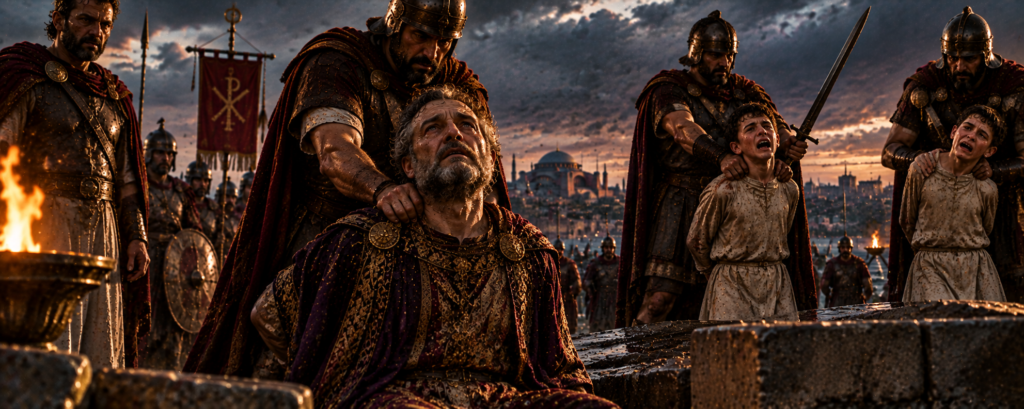
Maurice: The Byzantine Emperor Forced to Watch His Sons Executed Before His Own Murder
Flavius Mauricius Tiberius (c. 539–602 CE) | Eastern Roman Emperor, 582–602 CE | Overthrown by Phocas and Executed on November 27, 602
The Emperor Who Was Forced to Watch His Dynasty Die
On November 27, 602 CE, a deposed Roman emperor was brought to his execution near Chalcedon, across the water from Constantinople. For twenty years, Maurice had ruled the Eastern Roman Empire, commanded armies, negotiated with kings, and struggled to defend territories stretching from the Balkans to the borders of Persia. Now he was a prisoner of the soldiers who had overthrown him, and the empire he had spent two decades trying to preserve belonged to a military rebel named Phocas. His final punishment would become one of the most horrifying episodes in Byzantine imperial history.
According to the surviving Byzantine historical tradition, Maurice was forced to witness the execution of his young sons before he himself was killed. The children represented the future of his dynasty, and their deaths were intended to eliminate the possibility that loyalists might someday restore the family to power. The emperor reportedly watched as his sons were killed one after another, powerless to intervene. Only after this deliberate destruction of his heirs did the executioners turn their attention to him.
Later accounts portray Maurice enduring the ordeal with extraordinary religious resignation. He is said to have repeated words acknowledging divine justice as his children were murdered before him. The precise words and gestures cannot be independently verified, and the descriptions were shaped by writers who regarded his death as a profound moral tragedy. Nevertheless, the central event—the execution of Maurice and his sons following Phocas’s seizure of power—is firmly established.
The killing was more than the execution of a defeated political opponent. It was a calculated act of dynastic destruction, intended to extinguish the ruling family and discourage resistance to the new regime. Maurice’s wife, Constantina, and his surviving daughters would also become targets of the usurper’s government. The overthrow that began with a military mutiny developed into a campaign against the entire imperial household.
What makes the story especially tragic is that Maurice was not a ruler who had inherited a peaceful and prosperous empire only to squander it through incompetence. He had spent much of his reign confronting serious military, financial, and political difficulties. His armies had fought the Persians in the east, struggled against Avars and Slavs in the Balkans, and attempted to defend an empire whose resources were stretched dangerously thin. Many of his policies were designed to preserve Roman strength, but the burdens he placed upon his soldiers helped destroy their loyalty.
The final rebellion emerged from a decision that Maurice probably regarded as financially and strategically necessary. He ordered troops campaigning along the Danube to remain beyond the river during the winter rather than return to more comfortable quarters. The soldiers, already resentful of previous hardships and reductions in military expenditure, refused to obey. Their anger became mutiny, and the mutiny produced a new emperor.
Within weeks, Maurice had lost his army, his capital, his throne, and almost his entire family. Phocas entered Constantinople as the victorious claimant, while the legitimate emperor fled with his wife and children. The fugitive family was captured before it could find safety. The man who had commanded the Roman Empire was reduced to a prisoner awaiting execution.
Maurice’s death marked a turning point in Eastern Roman history. His overthrow ended a period of relative dynastic continuity and unleashed political instability at a moment when the empire could least afford it. Persia would exploit the crisis, the Balkans would face renewed pressure, and the Roman state would enter one of the most destructive periods in its history. The murder of Maurice was therefore both a family catastrophe and the beginning of a much larger imperial disaster.
A Soldier From Cappadocia Who Rose to the Throne
Maurice was born around 539 CE in Arabissus, a town in Cappadocia in central Anatolia. His family was not part of the old Roman imperial aristocracy, but he received an education and entered a world in which capable men could rise through military and administrative service. The Eastern Roman Empire remained a vast and sophisticated state, with an elaborate bureaucracy and a professional military establishment. Ambitious individuals could advance through service to powerful officials and eventually attract the attention of the emperor.
The empire of Maurice’s youth was still recovering from the enormous ambitions of Justinian I. Justinian had attempted to restore Roman control over former western territories, including Italy and North Africa. His armies achieved spectacular victories, but the campaigns imposed tremendous financial and military burdens. The empire also suffered devastating outbreaks of plague, which disrupted populations, taxation, and military recruitment.
By the time Maurice entered imperial service, the government faced difficulties on several fronts. Persian armies threatened the eastern provinces, while Lombard forces had invaded much of Italy. In the Balkans, Avar power was growing, and Slavic groups increasingly crossed the Danube. The empire possessed formidable resources, but defending its extensive frontiers required constant expenditure.
Maurice entered the service of the future emperor Tiberius II Constantine, who became a leading figure under Justin II. His abilities brought him into positions of increasing responsibility. He eventually became commander of Roman forces fighting Persia, one of the most important military appointments in the empire. His career developed during a period when military success could transform an officer’s political prospects.
The surviving sources portray Maurice as intelligent, disciplined, and capable of strategic planning. They also suggest that he could be cautious and deeply concerned with financial matters. Such characteristics would later become central to assessments of his reign. The same qualities that helped him manage an overstretched empire could make him appear inflexible to soldiers who wanted immediate rewards.
Maurice’s rise was therefore the product of military experience rather than hereditary succession. He had seen the consequences of prolonged warfare and understood the importance of maintaining imperial resources. His later policies reflected that background. Unfortunately, experience did not guarantee that his soldiers would accept the sacrifices he demanded.
The Persian War That Made His Reputation
Maurice’s military career developed during the long struggle between the Eastern Roman Empire and Sasanian Persia. The two powers had competed for centuries over territories, fortresses, trade routes, and political influence in the Near East. Their wars were expensive, often inconclusive, and capable of devastating frontier communities. Even major victories rarely eliminated the underlying rivalry.
As commander in the east, Maurice directed Roman operations against Persian forces during the late 570s and early 580s. He participated in campaigns that demonstrated his ability to manage substantial armies. The surviving narratives describe military successes as well as setbacks. His reputation grew through the responsibilities he carried rather than through an uninterrupted series of victories.
The conflict required more than battlefield courage. Roman commanders had to coordinate supplies, maintain fortified positions, negotiate with local allies, and operate across difficult terrain. Military decisions could affect the finances of entire provinces. Maurice gained practical experience with the relationship between strategy and imperial resources.
The Persian frontier also exposed him to the consequences of political instability. Both empires depended upon powerful aristocratic families and military commanders whose loyalties could change. Rebellions and succession disputes could quickly alter the course of war. Maurice would later exploit such instability in Persia to achieve one of the greatest diplomatic successes of his reign.
His service brought him to the attention of Tiberius II Constantine. The emperor needed a successor capable of defending the empire and managing its growing difficulties. Maurice possessed the military credentials necessary for the role. His marriage into the imperial family would soon complete his transformation from commander to ruler.
The future emperor therefore entered the throne with substantial military experience. He understood the dangers facing the empire and the costs of maintaining its defenses. Yet he also inherited a political system in which soldiers expected emperors to reward their service. Balancing those expectations against limited financial resources would become his greatest challenge.
The Marriage That Made Maurice an Emperor
Tiberius II Constantine became emperor in 578 after the death of Justin II. His reign was marked by military pressures and substantial expenditure, particularly on the army. He sought to maintain stability while confronting threats on multiple frontiers. As his health declined, the question of succession became increasingly urgent.
Maurice emerged as the preferred successor. He possessed military experience and had demonstrated his value in the eastern campaigns. Tiberius strengthened his position by arranging his marriage to his daughter Constantina. The union connected Maurice directly to the ruling family and provided dynastic legitimacy.
On August 13, 582, Maurice became emperor following Tiberius’s death. His accession was comparatively orderly, especially when measured against the violent succession crises that had periodically shaken Roman history. He inherited an established imperial government and a prominent marriage alliance. The new emperor could reasonably hope to create a lasting dynasty.
Constantina became empress and an important figure within the imperial household. Their marriage produced several children, including sons who could eventually succeed Maurice. The birth of legitimate heirs offered the prospect of dynastic stability. For an empire repeatedly threatened by military rebellion, a secure succession was politically valuable.
Maurice’s family life would become increasingly visible through public ceremonies and imperial representation. His eldest son, Theodosius, was eventually elevated to the rank of Augustus, formally identifying him as a future ruler. Other sons also became important to plans for the dynasty’s continuation. The imperial household appeared to possess a promising future.
Yet the family that strengthened Maurice’s legitimacy would eventually become his greatest vulnerability. A ruler with numerous sons offered potential successors around whom loyalists could rally. A usurper determined to secure his throne might therefore regard the entire family as a threat. The dynastic arrangements intended to preserve Maurice’s government would help explain the brutality of its destruction.
An Empire Too Large for Its Treasury
Maurice inherited an empire whose military responsibilities exceeded the resources comfortably available to sustain them. The government had to defend the Persian frontier, maintain armies in the Balkans, protect Italy against the Lombards, and preserve authority in North Africa. Each theater required troops, fortifications, supplies, and money. The combined burden placed enormous pressure upon imperial finances.
The situation was worsened by the legacy of earlier wars. Justinian’s reconquests had restored Roman authority over important territories, but they had also created expensive defensive commitments. Italy remained contested, and the empire could not simply abandon its western possessions without political consequences. Maintaining the appearance of Roman universal authority required substantial practical expenditure.
Maurice responded with policies designed to reduce costs and improve military efficiency. He attempted to control expenditure, regulate payments, and ensure that armies operated economically. These measures were not necessarily irrational or unusually cruel by the standards of the period. They reflected the financial difficulties facing a government responsible for several distant fronts.
Nevertheless, soldiers often experienced such policies as attacks upon their livelihoods. Military pay was not merely a salary but part of a wider relationship between ruler and army. Emperors were expected to reward loyalty, recognize hardship, and provide opportunities for advancement. Reductions in compensation could therefore become politically dangerous.
The problem was intensified by the conditions of frontier service. Soldiers spent long periods away from their families and operated in regions exposed to enemy attacks. They endured harsh weather, inadequate supplies, and exhausting marches. Orders issued from Constantinople could appear detached from the realities of military life.
Maurice understood the strategic necessity of maintaining disciplined armies, but he struggled to preserve their affection. His financial caution became associated with severity and unwillingness to reward service. Over time, resentment accumulated. The emperor was attempting to save the state, but some of the men defending it increasingly regarded him as their enemy.
The Emperor Who Made Peace With Persia
One of Maurice’s greatest achievements came through an unexpected crisis within the Persian Empire. In 590, the Persian king Hormizd IV was overthrown amid political and military turmoil. His son Khosrow II struggled to secure the throne against the powerful commander Bahram Chobin. The conflict created an opportunity for Roman intervention.
Khosrow sought assistance from Maurice. Supporting a Persian claimant involved considerable risks, since the two empires had been enemies for generations. Yet Maurice recognized the possibility of securing a favorable peace. A restored Persian king might reward Roman assistance with territorial concessions and diplomatic stability.
Maurice agreed to support Khosrow. Roman forces helped defeat Bahram and restore the young king to power in 591. The intervention demonstrated the emperor’s willingness to use diplomacy and military force together. It also produced one of the most favorable settlements Rome had achieved with Persia in many years.
The resulting agreement strengthened Roman positions in Armenia and parts of the eastern frontier. It also brought an end to a costly war that had consumed resources for decades. Maurice could redirect military attention toward the Balkans, where the Avars and Slavs posed serious threats. The peace offered a rare opportunity to concentrate imperial strength.
The relationship between Maurice and Khosrow became politically significant. Persian accounts and later Roman narratives emphasized the assistance Maurice had provided to the restored king. Khosrow had reason to acknowledge a debt to the emperor who helped secure his throne. That relationship would acquire tragic importance after Maurice’s murder.
The Persian settlement was arguably the high point of Maurice’s reign. It demonstrated strategic patience, diplomatic intelligence, and the ability to exploit an enemy’s internal divisions. Yet the peace also created new pressures. With the eastern frontier relatively secure, Maurice expected his armies to undertake demanding operations elsewhere.
The Balkans: The Frontier That Would Not Stay Quiet
The Balkans presented Maurice with a military problem that could not be solved through a single decisive campaign. Avar forces exerted pressure along the Danube, while Slavic groups conducted raids and established settlements across imperial territory. The geography favored mobile warfare, and the frontier was difficult to defend continuously. Roman armies had to respond to threats spread across a vast region.
The Avar Khaganate had emerged as a major power north of the Danube. Its rulers commanded forces capable of threatening Roman cities and demanding substantial payments. The empire sometimes negotiated with the Avars and sometimes fought them. Neither approach produced permanent security.
Slavic movements created additional challenges. Groups crossed the Danube and penetrated deeply into the Balkans, sometimes reaching areas that had previously been relatively secure. Their activities disrupted agriculture, communications, and local administration. Roman commanders struggled to prevent repeated incursions.
Maurice believed that the empire needed a more aggressive frontier strategy. Rather than waiting for enemies to cross the Danube, Roman forces should operate beyond the river and disrupt hostile groups in their own territories. Such campaigns could reduce raids and demonstrate imperial strength. They also required soldiers to endure difficult conditions far from established bases.
The emperor’s strategy achieved some successes. Roman commanders conducted operations north of the Danube and inflicted defeats upon hostile forces. The campaigns showed that the empire retained considerable military capability. Yet the operations were exhausting and expensive.
The soldiers increasingly resented the demands placed upon them. They had already endured years of campaigning and expected opportunities for rest and reward. Maurice’s insistence upon continued operations created tension between strategic objectives and military morale. The Balkan frontier would eventually become the setting for the rebellion that destroyed him.
The First Warning: A Mutiny Over Military Pay
Maurice’s relationship with the army had already suffered a serious crisis before the final rebellion of 602. In 588, Roman troops serving on the Persian frontier mutinied after changes to military compensation. The emperor’s government had attempted to reduce expenditure, and soldiers interpreted the measures as an unacceptable loss of income. Their anger disrupted military operations at a dangerous moment.
The mutiny revealed the limits of imperial authority. Maurice could issue orders through appointed commanders, but soldiers possessed the collective power to refuse obedience. A government facing foreign enemies could not easily punish large numbers of experienced troops without weakening its defenses. Negotiation and compromise became necessary.
The episode also demonstrated that military grievances could rapidly become political. Soldiers did not necessarily reject the empire or the emperor’s legitimacy at first. They protested policies that directly affected their lives. Yet continued confrontation could transform economic resentment into broader hostility toward the government.
Maurice eventually restored discipline, and the eastern army returned to effective service. The crisis did not immediately threaten his throne. Nevertheless, it exposed a dangerous weakness in his approach to military administration. His financial policies could provoke resistance even among troops whose loyalty was essential to imperial survival.
The lesson should have been clear. Soldiers might accept hardship when they believed their emperor recognized their sacrifices. They were less willing to endure reductions in compensation while continuing dangerous campaigns. The relationship between military discipline and imperial legitimacy required careful management.
Maurice continued attempting to control expenditure. The pressures upon the treasury remained substantial, and the emperor could not simply abandon financial restraint. His policies therefore preserved the underlying sources of resentment. The mutiny of 588 became an early warning of the catastrophe that would follow fourteen years later.
The Prisoners the Emperor Was Accused of Abandoning
Another episode contributed to Maurice’s reputation for excessive financial caution. Byzantine historians report that Avar forces captured Roman soldiers and offered to release them in exchange for ransom. Maurice allegedly refused to pay the amount demanded. The prisoners were then said to have been killed.
The story became one of the most damaging accusations against his character. Soldiers could tolerate strict discipline more easily than the belief that their emperor would abandon them to save money. The alleged refusal suggested that financial calculations mattered more to Maurice than the lives of his men. Such a reputation could poison military loyalty.
Yet the details require caution. The surviving accounts differ concerning the circumstances and the amounts involved. Some narratives emphasize the emperor’s refusal in ways that appear designed to explain his later downfall. The story may have been shaped by moral judgments imposed after the rebellion.
The reported massacre cannot be reconstructed with complete confidence. It is possible that Maurice faced difficult negotiations with an enemy who used prisoners to demand money. The government may also have feared encouraging further captures through repeated ransom payments. Such considerations do not eliminate the moral problem, but they complicate the traditional portrayal.
The political consequences of the story were significant regardless of its precise details. Soldiers who believed the emperor had abandoned prisoners might question whether he valued their service. The accusation reinforced existing resentment over pay and hardship. It contributed to an image of Maurice as a ruler who demanded sacrifice without offering sufficient protection.
Later historians often treated the episode as evidence that Maurice had invited divine punishment. The massacre of prisoners became part of a moral explanation for his own family’s destruction. Such interpretations reveal how closely the emperor’s reputation became tied to his execution. The story of his reign was increasingly written backward from its terrible ending.
The Dynasty Maurice Intended to Leave Behind
Maurice and Constantina had a large family, and their children became central to plans for imperial succession. Their eldest son, Theodosius, was born in 583 and eventually elevated to the rank of Augustus. The promotion established him as a recognized imperial partner and intended successor. It also reinforced the legitimacy of the ruling household.
Other sons included Tiberius, Peter, Paul, Justin, and Justinian, according to the surviving traditions. The family also included daughters whose marriages could strengthen political alliances. The imperial household therefore possessed several possible lines of continuation. From a dynastic perspective, Maurice appeared unusually secure.
The emperor reportedly considered arrangements for distributing responsibilities among his sons. Theophylact Simocatta preserves a tradition concerning a testament that contemplated dividing imperial territories between heirs. The precise intentions remain uncertain, and the plan may never have been intended for immediate implementation. Nevertheless, it reveals the importance Maurice attached to family succession.
The existence of numerous heirs also created potential difficulties. Rival branches of a dynasty could compete for authority, particularly if military commanders supported different claimants. Maurice may have hoped that carefully arranged responsibilities would prevent conflict. His own experience with the empire’s vast administrative demands could have encouraged such thinking.
Constantina occupied an important position within this family structure. As the daughter of Tiberius II Constantine, she connected Maurice’s children to the previous imperial household. Her status strengthened their claims to legitimacy. She also represented continuity between successive generations of Roman rulers.
The dynasty’s apparent strength would become a source of danger after the coup. Phocas could not easily claim uncontested authority while Maurice’s sons remained alive. Each surviving male heir might become a rallying point for opposition. The children who were supposed to guarantee the family’s future became targets because of the legitimacy they inherited.
The Winter Order That Broke the Army
In 602, Maurice issued an order that would trigger the final crisis of his reign. Troops campaigning along the Danube were instructed to remain beyond the river during the winter. The policy was intended to maintain pressure upon hostile groups and reduce the expense of supporting the army in established winter quarters. From the emperor’s perspective, it offered strategic and financial advantages.
For the soldiers, the order was deeply unpopular. Winter campaigning north of the Danube exposed them to severe weather, difficult supply conditions, and the possibility of enemy attacks. They had already endured exhausting operations. Many expected to return to safer quarters after the campaigning season.
The command therefore touched upon grievances that had accumulated over years. Soldiers resented reductions in compensation, prolonged service, and the perception that Maurice placed financial savings above their welfare. The winter order appeared to confirm their worst suspicions. Their emperor seemed determined to demand more while providing less.
The troops refused to obey. Their resistance developed into open mutiny, and the authority of their commanders collapsed. The rebellion was not initially a carefully organized dynastic coup. It began as a military refusal to accept an order regarded as intolerable.
The situation became increasingly dangerous as soldiers sought new leadership. A mutinous army could not easily return to obedience without risking punishment. Once the troops had rejected imperial authority, they needed someone capable of representing their grievances and protecting them from retaliation. Phocas emerged within this environment.
Maurice had faced military discontent before, but the crisis of 602 was different. The army was no longer merely protesting a reduction in pay. It was moving toward the rejection of the emperor himself. A policy intended to preserve military effectiveness had instead destroyed the loyalty upon which his government depended.
Phocas: The Soldier Who Became a Usurper
Phocas was a military officer whose early life remains poorly documented. He served in the Balkan army and became prominent during the mutiny against Maurice. Later Byzantine writers portrayed him as brutal, ignorant, and morally corrupt. Those descriptions were strongly influenced by the hostility of the regime that eventually overthrew him.
His precise rank before the rebellion is debated, although he is often described as a centurion. He was not a member of the imperial family and possessed no hereditary claim to the throne. His authority emerged from the support of rebellious soldiers. The mutiny transformed him from an obscure officer into a political contender.
Phocas’s rise demonstrated the continuing power of military acclamation. Roman emperors had long depended upon the support of armies, and soldiers could proclaim new rulers when they rejected an existing government. By the early seventh century, dynastic legitimacy had become important, but it had not eliminated military usurpation. The rebellion of 602 exposed the fragility of Maurice’s position.
The soldiers initially sought alternatives to the emperor’s authority. Some accounts suggest that they considered supporting members of Maurice’s family or other prominent figures. The political situation remained fluid as the rebellion advanced. Phocas eventually emerged as the figure capable of uniting the mutineers.
His success depended upon more than personal ambition. The army’s grievances gave the rebellion momentum, while Maurice’s unpopularity weakened resistance. Political factions in Constantinople also became involved. The crisis developed into a confrontation between the emperor and a coalition of dissatisfied soldiers and urban opponents.
Phocas would later become notorious for the violence of his government. Yet his accession should not be reduced to the actions of a single villain. The rebellion succeeded because Maurice had lost the confidence of important groups whose support was necessary for survival. Phocas exploited a political collapse already underway.
The Mutiny Marches Toward Constantinople
As the rebellious army advanced, Maurice faced a rapidly deteriorating situation. The emperor could no longer rely upon the troops whose obedience he had expected. His authority in the capital was also vulnerable to unrest. The military crisis began to merge with political dissatisfaction in Constantinople.
The city possessed powerful factions associated with the circus and public entertainments. The Blues and Greens were more than groups of sporting supporters, although their precise political roles varied over time. They could mobilize crowds and become involved in urban disturbances. During moments of imperial weakness, their actions could influence the course of events.
Maurice attempted to preserve control through the institutions of government and the loyalty of his remaining supporters. Yet the rebellion gained momentum as confidence in his authority weakened. Officials and soldiers had to decide whether to defend the reigning emperor or accommodate the advancing mutineers. Such calculations could change rapidly.
The emperor’s family remained in Constantinople as the crisis developed. Constantina and the children represented the dynasty’s continuity, but they also complicated any attempt to escape. A ruler fleeing alone might move more quickly than one accompanied by a large household. Maurice faced the terrible problem of protecting both his throne and his family.
The rebellion also created uncertainty about the role of his eldest son, Theodosius. As a crowned Augustus, Theodosius possessed a legitimate claim to imperial authority. He might have become a focus for loyalist resistance. His survival would therefore matter greatly to both supporters and opponents of the dynasty.
By late November, Maurice’s position was collapsing. The rebellious army threatened the capital, and urban unrest undermined his remaining authority. The emperor who had successfully negotiated with Persia and directed campaigns across the Balkans could no longer secure obedience within his own government. The fall of Constantinople’s ruling household was approaching.
The Night Constantinople Turned Against Its Emperor
The final collapse unfolded amid unrest in Constantinople. Maurice faced hostility from crowds and political factions, while the rebellious army approached. The capital’s population had endured taxation, military demands, and the pressures of imperial government. The emperor’s unpopularity made it difficult to organize effective resistance.
Ancient accounts describe disorder spreading through the city. Public demonstrations and factional violence contributed to the breakdown of imperial authority. The precise sequence is complicated by differences among the surviving sources. Nevertheless, the government lost control of the political situation.
Maurice could no longer depend upon the capital’s defenses. Remaining in the palace risked capture, while flight offered only uncertain safety. The emperor decided to leave Constantinople with members of his family. The departure marked the effective end of his reign.
The family attempted to escape across the water toward the Asian side of the Bosporus. The journey was undertaken under dangerous circumstances, and the surviving narratives describe confusion and hardship. Maurice was reportedly suffering from illness or physical weakness. His ability to organize resistance was severely limited.
The flight was a profound reversal of imperial fortune. Maurice had ruled from Constantinople for two decades and commanded armies across the empire. Now he was leaving the capital as a fugitive, dependent upon the loyalty of a shrinking circle of attendants. The city that had celebrated his accession was preparing to accept another ruler.
The escape also exposed his family to immediate danger. The children who had grown up within the imperial palace were suddenly deprived of its protection. Their father’s enemies controlled the political initiative. The dynasty’s survival depended upon finding refuge before the new regime could capture them.
The Emperor Who Fled With His Family
Maurice’s flight brought him to the Asian shore near Chalcedon. The region lay close to Constantinople but offered no secure refuge from the forces supporting Phocas. The emperor’s party was vulnerable, and the political situation changed too quickly for an organized escape. His remaining supporters struggled to protect the family.
Theophylact Simocatta and other Byzantine writers preserve accounts of Maurice’s final movements. Their narratives emphasize the contrast between his former authority and his present helplessness. The emperor who had commanded vast military resources was reduced to seeking safety with his wife and children. The reversal became a central theme in later descriptions of his downfall.
The family reportedly sought refuge in a religious setting, hoping that sacred space might offer some protection. Such appeals were not unusual in late antique political crises. Churches and monasteries could provide temporary sanctuary, although their ability to restrain determined rulers was limited. The new regime was unlikely to allow Maurice to remain a living symbol of legitimate authority.
The fate of Theodosius became a particular concern. As the eldest son and co-emperor, he represented the most obvious successor to Maurice. Some accounts describe efforts to send him away or secure assistance through diplomatic contacts. The precise details of his movements remain uncertain.
The emperor’s other sons were younger and less capable of organizing resistance. Their political importance came from their bloodline rather than their personal actions. Even children could become dangerous to a usurper because supporters might someday use their names to justify rebellion. Their innocence offered little protection.
Maurice’s escape therefore failed to solve the central problem. He had lost the throne but remained a legitimate emperor in the eyes of potential loyalists. His sons possessed claims that could threaten Phocas. The new ruler would soon decide that the family could not be allowed to survive.
Phocas Takes the Imperial Purple
Phocas was proclaimed emperor in November 602, marking the success of the military rebellion. His elevation transformed a mutiny over winter quarters into a complete change of government. The soldiers who had rejected Maurice now possessed a ruler drawn from their own ranks. Constantinople accepted the new political reality.
The accession involved ceremonies intended to establish legitimacy. Imperial authority required more than military force, even when force had made the succession possible. The new emperor needed recognition from influential officials, religious authorities, and the population of the capital. Public ceremonies helped transform rebellion into government.
Yet Phocas’s position remained insecure. Maurice had ruled for twenty years and possessed a large family. His eldest son had been elevated as Augustus, while other sons could eventually become claimants. Loyal officers and provincial governors might refuse to recognize the usurper.
The new regime therefore faced an immediate question. Should Maurice be imprisoned, exiled, or killed? Allowing him to live might encourage resistance, but executing him would create a lasting stain upon the new emperor’s legitimacy. Phocas chose the most ruthless solution.
The decision reflected a familiar pattern in Roman political history. Usurpers often regarded surviving members of a defeated dynasty as potential threats. Even powerless prisoners could become symbols around whom opponents gathered. Killing them eliminated some immediate dangers while creating others.
For Maurice and his family, the accession of Phocas meant that escape had become almost impossible. The new emperor controlled the capital and possessed the loyalty of the victorious troops. The former imperial household had few remaining protectors. The final stage of the tragedy was approaching.
The Capture of Maurice
Maurice was captured near Chalcedon after his unsuccessful flight. The surviving accounts differ in some details, but they agree that he fell into the hands of the new regime. He was no longer treated as the reigning emperor. He had become a prisoner whose fate depended upon Phocas.
The capture removed any realistic possibility of immediate restoration. Maurice lacked an army capable of rescuing him, and the capital had accepted the new ruler. His family was also vulnerable to arrest. The political collapse had become a personal catastrophe.
Ancient narratives emphasize the emperor’s suffering during this period. He was reportedly ill, exhausted, and distressed by the danger facing his children. Some accounts portray him as turning increasingly toward prayer and religious resignation. These descriptions reflect the moral and theological interests of the writers who preserved them.
The exact conditions of his detention are uncertain. We do not possess a detailed contemporary prison record describing his treatment. Later accounts may have heightened the humiliation to emphasize the cruelty of Phocas. Nevertheless, the fundamental situation is clear.
Maurice was a deposed ruler held by the government that had overthrown him. His sons represented potential successors, and their continued existence threatened the new regime. Phocas had both the motive and the means to eliminate them. The decision to execute the family transformed the coup into an act of dynastic destruction.
The emperor’s capture also ended the last remaining distinction between political defeat and physical survival. Losing the throne did not necessarily require death, but Maurice’s enemies were unwilling to accept the risk of leaving him alive. His family would pay the same price. The executioners were preparing to destroy an entire imperial line.
The Execution Ground at Chalcedon
The executions took place on November 27, 602, according to the commonly accepted chronology. The location is traditionally associated with the area near Chalcedon, across the Bosporus from Constantinople. The former emperor was brought before the men appointed to carry out the sentence. His sons were also condemned.
The surviving narratives describe the children being killed before their father. The order of execution was central to the horror of the event. Maurice was not simply condemned to die alongside his family. He was reportedly forced to witness the destruction of his heirs before his own death.
The exact number of sons present in the execution accounts varies according to the source and the treatment of Theodosius’s separate fate. Several younger sons were killed with Maurice, while the eldest son’s movements and death are described differently in the surviving traditions. It would therefore be misleading to present every detail as uniformly established. What is certain is that multiple sons were executed as part of the purge.
The killings were intended to eliminate the dynasty’s future. Each child represented a possible claimant who might someday challenge Phocas. Their deaths served a political purpose beyond punishment for any personal action. They were killed because of their relationship to the deposed emperor.
The location added to the symbolic violence. Constantinople remained visible across the water, representing the imperial authority Maurice had lost. The execution took place close enough to the capital to demonstrate the new regime’s control. Yet the former emperor was denied the protection and dignity associated with his office.
The scene became one of the most frequently remembered atrocities of Byzantine political history. Later writers emphasized the suffering of the father and the innocence of the children. The executions were presented as evidence of Phocas’s cruelty and Maurice’s tragic endurance. The historical event was horrifying enough without the embellishments that later moralizing narratives sometimes added.
The Sons Who Were Killed Before Their Father
The murder of Maurice’s sons was the most devastating element of the execution. The children had been raised within the imperial household and represented the continuation of a dynasty that had ruled for two decades. Their political importance came from their birth, not from any demonstrated rebellion against Phocas. Yet the new emperor regarded their existence as dangerous.
Byzantine accounts describe the boys being brought forward and killed while Maurice watched. The image of a father forced to witness the deaths of his children became central to the story. It represented a deliberate reversal of the protection that imperial power was supposed to provide. Maurice could command armies and govern provinces, but he could not save his own sons.
The surviving sources do not allow every movement of the execution to be reconstructed. We cannot know precisely where each child stood or how Maurice reacted at every moment. Later writers shaped the narrative to emphasize religious endurance and divine judgment. Their dramatic descriptions should not be treated as an eyewitness transcript.
Nevertheless, the political meaning of the killings is unmistakable. Phocas intended to remove potential heirs who might threaten his rule. The children were victims of dynastic calculation. Their deaths were designed to make the restoration of Maurice’s family more difficult.
The brutality also carried a warning to the wider empire. Officials and commanders who considered supporting the old dynasty could see that the new ruler was willing to eliminate its heirs. The executions demonstrated that Phocas would not tolerate rival claims. Fear became an instrument of political consolidation.
Yet the killings also damaged the legitimacy of the new regime. Executing children could provoke horror even among people who had opposed Maurice. The destruction of the family became a lasting accusation against Phocas. His attempt to secure power through violence helped create the reputation that would eventually surround his own downfall.
The Emperor Who Reportedly Accepted Divine Judgment
One of the most famous elements of Maurice’s execution concerns his reported religious response. Later Byzantine accounts portray him repeating words acknowledging God’s justice as his sons were killed. The scene became an example of Christian endurance in the face of suffering. It also transformed the defeated emperor into a figure of moral dignity.
The precise words attributed to Maurice cannot be independently verified. Byzantine historians frequently reconstructed speeches and prayers to express the moral significance of events. Their narratives were influenced by Christian ideas about sin, punishment, repentance, and divine providence. The emperor’s reported prayer belongs within that literary tradition.
Some accounts connect his resignation with earlier decisions that had caused suffering among his soldiers. Maurice was portrayed as recognizing that his own failures had brought divine punishment upon him. Such interpretations reflect the moral framework of later writers. They should not be mistaken for proof of the emperor’s private thoughts.
The tradition nevertheless reveals how Maurice’s reputation changed after his death. During his reign, he had been criticized for financial severity and unpopular military policies. After his execution, he could be remembered as a suffering Christian ruler who accepted his fate with humility. The brutality of Phocas made Maurice appear more sympathetic.
The contrast became politically useful after Phocas was overthrown. Writers associated with the new regime of Heraclius had reasons to condemn the usurper and honor his victims. Maurice’s reported composure reinforced the image of a legitimate emperor destroyed by tyranny. The story therefore served both religious and political purposes.
The historical truth lies between the secure event and the literary interpretation. Maurice was executed after witnessing the killing of his sons, according to the surviving narrative tradition. His exact words remain uncertain. The religious meaning attached to his death reflects the values and political circumstances of those who recorded it.
The Death of Maurice
After the execution of his sons, Maurice himself was killed. The former emperor was approximately sixty-three years old and had ruled for twenty years. His death ended a reign that had included military victories, diplomatic achievements, financial crises, and increasingly bitter conflict with the army. It also completed the destruction of the dynasty’s central male line.
The execution was an act of political regicide. Maurice had been overthrown by a military rebellion and condemned by the new ruler. His death was not the result of battlefield combat or a spontaneous attack. It was a deliberate killing carried out under the authority of Phocas’s government.
The surviving sources describe the bodies being treated with little dignity. Some accounts report that the heads of Maurice and his sons were displayed publicly. Such displays were intended to demonstrate the finality of the new regime’s victory. They also served as warnings against resistance.
The exact treatment of the remains varies among the narratives. Later accounts may have emphasized mutilation and humiliation to portray Phocas as exceptionally cruel. The central fact of the executions, however, is not seriously disputed. Maurice and several of his sons were killed as part of the usurper’s consolidation of power.
The death of Maurice also represented a profound break in imperial continuity. The empire had experienced military rebellions before, but successful violent usurpation had become relatively uncommon during the preceding centuries. Phocas’s seizure of power reopened the possibility that armies could overthrow established rulers through direct force. The precedent would have serious consequences.
For the imperial family, the political meaning was overshadowed by personal devastation. Constantina had lost her husband and several sons. The surviving daughters faced an uncertain future under the government responsible for the killings. The family that had occupied the palace for twenty years had been shattered within days.
The Eldest Son Who Might Have Escaped
The fate of Theodosius, Maurice’s eldest son and designated successor, became the subject of conflicting traditions. He had been elevated to the rank of Augustus and therefore possessed a particularly strong claim to the throne. His survival would have presented a serious threat to Phocas. The new regime had every reason to ensure that he could not organize resistance.
Some accounts describe Theodosius attempting to escape or seek assistance beyond the capital. Others report that he was captured and executed. The details differ, and later traditions sometimes suggested that he had survived. These stories became politically significant during the wars that followed Maurice’s death.
The possibility of Theodosius’s survival offered a potential justification for opposition to Phocas. A living son of Maurice could claim legitimate imperial authority. Supporters might rally around him, while foreign rulers could use his name to intervene. Even an unverified rumor could become a powerful political instrument.
The Persian king Khosrow II later claimed to act in defense of Maurice’s family. Traditions concerning a surviving Theodosius became entangled with Persian political propaganda. The existence of a legitimate heir could strengthen the claim that the war against Phocas was an act of restoration rather than aggression. The historical reliability of such claims remains disputed.
Most modern reconstructions accept that Theodosius was killed during the aftermath of the coup, although the precise circumstances remain uncertain. The stories of his survival demonstrate the difficulty of eliminating dynastic legitimacy through execution alone. Even after the family was destroyed, its name could be used to challenge the new government.
Theodosius’s fate therefore extends the tragedy beyond the execution ground. He had been prepared to inherit the empire and continue his father’s rule. Instead, his life ended amid the collapse of the dynasty. His name would remain politically useful long after his death.
Constantina: The Empress Who Survived the First Massacre
Maurice’s wife Constantina survived the initial execution of her husband and sons. As the daughter of Tiberius II Constantine, she possessed an independent connection to the imperial dynasty. Her status made her a potentially important figure for opponents of Phocas. She also had surviving daughters whose marriages could support future claims.
The empress’s position was extremely dangerous. Her husband had been executed, and the new government regarded the family as a threat. She could not rely upon the protection of imperial rank. The same title that once guaranteed her prominence now made her politically vulnerable.
Constantina and her daughters were eventually associated with attempts to challenge Phocas’s rule. The surviving accounts describe conspiracies and appeals involving members of the former imperial household. Their precise roles remain difficult to reconstruct. Some narratives may exaggerate their involvement to justify the regime’s repression.
The new emperor responded with further violence. Constantina and her daughters were eventually executed, commonly dated to 605. Their deaths completed the destruction of much of Maurice’s immediate family. The purge extended the consequences of the original coup across several years.
The execution of Constantina is especially significant because she was not merely the wife of a defeated ruler. She represented continuity with the preceding dynasty through her own birth. Her survival offered a possible source of legitimacy for opposition movements. Phocas’s government therefore had reasons to regard her as dangerous.
The destruction of the imperial women reveals the full extent of the dynastic purge. The murder of Maurice and his sons had not eliminated every possible claim. The surviving empress and daughters remained potential political symbols. Their deaths demonstrated that the new regime intended to suppress the family as completely as possible.
The Emperor Who Turned Victory Into Terror
Phocas’s reign became associated with political repression and instability. Later Byzantine historians portrayed him as a tyrant whose government relied upon executions and intimidation. Their accounts must be read critically because they were written after his overthrow by Heraclius. Nevertheless, the violence directed against Maurice’s family is firmly established.
The new emperor faced serious legitimacy problems. He had seized power through military rebellion and ordered the death of his predecessor. Provincial commanders and officials could question his authority. Some continued to support the memory of Maurice or resisted the new government.
Phocas responded to opposition with harsh measures. Rebellions and suspected conspiracies were suppressed, sometimes with executions. The government struggled to maintain stability while facing external threats. The atmosphere of suspicion encouraged further conflict.
His reputation became increasingly negative in later historical writing. Authors associated with the Heraclian dynasty emphasized his cruelty, incompetence, and moral corruption. Such portrayals helped justify the rebellion that eventually removed him. The distinction between genuine brutality and political propaganda is not always easy to establish.
The murder of Maurice remained central to the accusations. It provided a powerful example of the new emperor’s willingness to destroy legitimate rulers and their families. The execution of children made the story especially effective as a moral indictment. Phocas became the embodiment of violent usurpation.
Yet the regime’s failures cannot be explained solely through the emperor’s character. The empire faced serious military and financial difficulties that had existed before his accession. The coup disrupted administrative continuity and encouraged rebellion. The resulting instability created opportunities for foreign enemies.
Khosrow II and the Murder That Became an Excuse for War
The Persian king Khosrow II had been restored to his throne with Maurice’s assistance in 591. The relationship between the two rulers had produced a favorable peace and a period of relative stability along the eastern frontier. Maurice’s murder therefore created a diplomatic crisis. The king who had benefited from Roman intervention could now present himself as the defender of his former benefactor.
Khosrow used the overthrow of Maurice as a justification for renewed war against the Roman Empire. He claimed to avenge the murdered emperor and challenge the legitimacy of Phocas. The appeal had considerable political value. It allowed Persian expansion to be presented as an act of justice.
The sincerity of Khosrow’s motives remains uncertain. Persia had strategic interests that extended far beyond personal loyalty to Maurice. The Roman Empire’s internal instability created opportunities for territorial conquest. The murder offered a convenient explanation for pursuing those ambitions.
Persian forces advanced against Roman positions in the east. The conflict gradually expanded into one of the most destructive wars between the two empires. Fortresses, cities, and provinces became battlegrounds. The military balance that Maurice had helped establish collapsed.
The war continued beyond the reign of Phocas. Under Heraclius, the Roman Empire would face devastating Persian advances before eventually recovering through extraordinary military campaigns. The conflict exhausted both powers and transformed the political landscape of the Near East. Its consequences would extend into the period of the early Islamic conquests.
Maurice’s murder therefore had effects far beyond Constantinople. It provided a diplomatic pretext for a war that consumed enormous resources and devastated imperial territories. The emperor who had secured peace with Persia became, through his death, a central figure in the justification for renewed conflict. The irony was profound.
The Balkans After Maurice
Maurice’s Balkan campaigns had attempted to restore Roman control along the Danube. His armies conducted operations against Avars and Slavs and sought to prevent repeated incursions into imperial territory. The strategy required sustained military effort and considerable resources. It also contributed directly to the mutiny that overthrew him.
After the coup, the empire’s military priorities changed. Political instability and renewed war with Persia demanded attention. The government could no longer sustain the same level of offensive activity in the Balkans. The frontier became increasingly vulnerable.
Avar and Slavic pressure continued during the early seventh century. Raids, settlements, and military campaigns altered the political geography of the region. Roman authority weakened in many areas. The precise chronology and scale of these changes remain subjects of historical debate.
It would be misleading to attribute every Balkan development to Maurice’s death. The empire had faced serious difficulties in the region for decades. Population movements, military pressures, and local political conditions were complex. Nevertheless, the collapse of Maurice’s government disrupted an active frontier strategy.
The irony is that the policy intended to strengthen the Balkan defenses helped provoke the rebellion that weakened them. Maurice demanded that soldiers remain beyond the Danube to maintain pressure upon enemies. Their refusal destroyed his authority. The resulting political crisis made sustained frontier operations more difficult.
The emperor’s strategic judgment may therefore have been sound in broad terms but disastrous in execution. He recognized the importance of controlling the Danube frontier. He failed to preserve the loyalty of the soldiers required to carry out his plans. The consequences exposed the limits of military strategy when political legitimacy collapses.
The Emperor Who Tried to Save Money and Lost Everything
Maurice’s reputation for financial severity remains one of the most important explanations for his downfall. He inherited an empire with extensive military commitments and limited resources. His attempts to reduce expenditure were intended to preserve the state’s long-term strength. Yet those policies repeatedly angered the soldiers upon whom the empire depended.
The mutiny of 588 demonstrated the danger of reducing military compensation. The controversy over prisoners allegedly abandoned to the Avars further damaged his reputation. The winter order of 602 finally pushed the Balkan army into open rebellion. Each episode contributed to an image of a ruler who demanded too much and rewarded too little.
Maurice was not necessarily motivated by personal greed. The empire’s financial problems were genuine, and military expenditure consumed enormous resources. A ruler who ignored those pressures risked undermining the government. His policies were therefore rooted in practical concerns.
The failure lay partly in political judgment. Soldiers expected emperors to recognize their hardships and provide tangible rewards. Maurice’s repeated insistence upon economy created resentment that eventually overwhelmed discipline. His strategic calculations did not adequately account for the emotional and political consequences of military service.
The emperor also lacked the personal military loyalty enjoyed by some successful rulers. He had commanded armies earlier in his career, but prolonged government from Constantinople could distance him from the soldiers. Officers responsible for enforcing unpopular orders became targets of resentment. The relationship between emperor and army deteriorated.
His downfall demonstrates that financial necessity does not guarantee political acceptance. Maurice may have been correct that the empire needed to reduce expenditure. He was disastrously wrong about how much hardship his soldiers would tolerate. The attempt to preserve the treasury ultimately cost him the throne.
Was Maurice a Good Emperor?
Assessing Maurice’s reign requires separating his achievements from the circumstances of his death. He was an experienced military commander who understood the empire’s strategic difficulties. His intervention in Persia produced a favorable peace, while his Balkan campaigns demonstrated determination to defend the Danube frontier. These were substantial accomplishments.
His government also attempted administrative and military reforms. The creation or development of arrangements associated with the exarchates of Italy and Africa reflected the need to coordinate civilian and military authority in distant territories. The precise evolution of these institutions remains debated. Nevertheless, Maurice’s reign was part of a broader transformation in imperial administration.
The emperor was also associated with military literature, particularly the Strategikon, a manual of military practice traditionally attributed to him. The authorship remains disputed, and the work should not automatically be treated as Maurice’s personal composition. Its association with his reign nevertheless reflects the period’s emphasis upon disciplined military organization. The text provides valuable insight into late Roman military thinking.
His weaknesses were equally significant. He struggled to maintain the loyalty of soldiers and repeatedly imposed unpopular financial measures. His relationship with military commanders became strained, and the final rebellion revealed the fragility of his authority. The emperor’s practical intelligence did not always translate into effective political management.
Maurice’s reign therefore resists simple judgment. He was neither an incompetent tyrant whose fall was inevitable nor an entirely blameless victim of military treachery. He made difficult decisions under serious pressure, achieved important successes, and committed errors with catastrophic consequences. His execution should not erase either side of that record.
The tragedy lies partly in the contrast between his intentions and the outcome. Maurice attempted to preserve the empire’s resources and strengthen its defenses. His policies helped provoke a rebellion that destroyed his government. The ruler who sought long-term stability became the victim of one of the most destabilizing coups in Byzantine history.
The Historian Who Preserved Maurice’s Tragedy
Much of the detailed narrative of Maurice’s reign and downfall comes from Theophylact Simocatta. Writing in the seventh century, Theophylact produced a history that covered the emperor’s military campaigns and political struggles. His work is among the most important surviving sources for the period. It also shaped later interpretations of Maurice’s character and death.
Theophylact wrote after the overthrow of Phocas and during the reign of Heraclius. This political context matters because Heraclius’s government sought to distance itself from the usurper. Honoring Maurice and condemning Phocas helped establish the legitimacy of the new dynasty. The historian’s narrative reflects that environment.
His work also follows classical literary conventions. Speeches, dramatic scenes, and moral reflections appear throughout the history. Such elements can communicate historical meaning without preserving exact words or actions. Readers must therefore distinguish between the underlying events and their literary presentation.
Theophylact’s account of Maurice’s execution emphasizes suffering, religious resignation, and the destruction of the imperial family. These themes fit the broader moral framework of Byzantine historical writing. The emperor becomes a tragic figure whose death illustrates the instability of worldly power. Phocas becomes the violent usurper responsible for the catastrophe.
Other sources, including the Chronicon Paschale and later chronicles, provide additional information. Their agreements strengthen confidence in the central events, while their differences reveal uncertainty about particular details. The executions themselves are secure. The exact choreography and reported speeches require greater caution.
The surviving record therefore allows a compelling narrative without pretending to know everything. Maurice was overthrown by mutinous troops, captured after fleeing Constantinople, and executed with several sons. His family suffered further persecution under Phocas. The dramatic details surrounding his final moments must remain identified as ancient traditions rather than independently verified facts.
The Fall of Phocas
Phocas remained emperor until 610, when a rebellion led by Heraclius challenged his authority. The revolt emerged from the empire’s western territories, particularly the powerful administration in North Africa. Heraclius’s father, also named Heraclius, held an important military position there. The rebellion gradually developed into a serious threat to the regime.
The younger Heraclius advanced toward Constantinople with naval forces. Phocas’s government had become increasingly unpopular, and the capital’s political factions shifted their loyalties. The emperor who had seized power through rebellion now faced the same danger. His military support proved insufficient to preserve his throne.
In October 610, Heraclius entered Constantinople and became emperor. Phocas was captured and executed. Later accounts describe humiliations and mutilations associated with his death, although the details vary. The overthrow ended the regime established through Maurice’s murder.
The new emperor presented himself as a restorer of legitimate government. Condemning Phocas helped justify the rebellion and strengthen the new dynasty’s authority. Maurice’s memory became useful within that political narrative. The murdered emperor could be honored as a victim of tyranny.
Yet Heraclius inherited an empire facing extraordinary dangers. Persian armies had made substantial advances, and the Balkans remained unstable. The civil conflicts of the previous decade had weakened the government. The consequences of Maurice’s overthrow could not be reversed simply by killing Phocas.
The cycle of violence also revealed a disturbing continuity. Maurice had been overthrown by soldiers, and Phocas had been overthrown by another rebellion. Both rulers died after losing control of the forces upon which their authority depended. The imperial throne remained vulnerable to military power.
The Murder That Opened an Age of Catastrophe
Maurice’s execution occurred at a moment when the Eastern Roman Empire was already under severe pressure. The state faced expensive frontier defenses, political instability, and the continuing threat of foreign invasion. His government had attempted to manage those challenges through military discipline and financial restraint. The coup destroyed the continuity necessary for long-term strategy.
The renewed Persian war became one of the most destructive conflicts in Roman history. Persian armies eventually occupied major eastern territories, including Syria, Palestine, and Egypt. Heraclius later launched a remarkable counteroffensive that restored Roman fortunes. Yet the struggle exhausted both empires.
The Balkans also underwent profound changes during the seventh century. Roman authority weakened across extensive areas, while Avar and Slavic activity reshaped the region. The empire’s ability to maintain continuous frontier defense declined. These developments reflected complex processes extending beyond any single ruler’s policies.
The political consequences were equally serious. The murder of Maurice demonstrated that a reigning emperor and his family could be destroyed through military rebellion. Dynastic legitimacy offered limited protection when soldiers withdrew their support. The precedent weakened confidence in orderly succession.
The empire survived these crises, but it emerged transformed. The wars of the early seventh century contributed to changes in administration, military organization, and territorial control. The Roman state became increasingly concentrated in the eastern Mediterranean and Anatolia. Its later history would differ significantly from the empire Maurice had inherited.
It would be an exaggeration to claim that Maurice’s murder alone caused these transformations. The empire faced structural pressures that no single ruler could eliminate. Nevertheless, the coup accelerated instability at a dangerous moment. The destruction of the imperial family became one of the events marking the beginning of a new and more precarious era.
The Emperor Who Could Not Protect His Children
The most enduring image of Maurice is not that of a general commanding armies or an emperor negotiating with Persia. It is the image preserved by Byzantine historians of a father forced to watch his sons executed. The scene concentrates the political violence of the coup into a deeply personal tragedy. It reveals how dynastic ambition could destroy people whose only crime was belonging to the defeated family.
The children were not responsible for the financial policies that angered the army. They had not ordered soldiers to remain beyond the Danube during winter. They had not negotiated with Persia or directed campaigns against the Avars. Their deaths were determined by the political significance of their birth.
Phocas regarded them as potential threats because they were Maurice’s sons. Their legitimacy made them dangerous, even while they remained powerless prisoners. The executioners were therefore destroying possible futures rather than punishing demonstrated crimes. The killings were intended to prevent restoration before it could begin.
The horror of the event also exposes the limits of imperial authority. Maurice had commanded vast resources and possessed the highest political office in the Roman world. Yet once his soldiers abandoned him, his power disappeared with astonishing speed. He could no longer protect his throne, his wife, or his children.
The surviving narratives portray his final moments through religious resignation. Whether he actually spoke the words attributed to him cannot be known. The image nevertheless became central to his posthumous reputation. The emperor who had been criticized for severity was remembered as a suffering father.
The contrast between power and helplessness gives the story its enduring force. Maurice had spent twenty years attempting to preserve the empire. In the end, he could not preserve his own household. His execution became a reminder that imperial authority could disappear in a moment, leaving its former possessor exposed to the violence of his enemies.
Regicide, Dynastic Destruction, and the Politics of Fear
Maurice’s death belongs firmly within the history of regicide. He was a reigning emperor overthrown by military rebellion and deliberately executed by the new regime. His killing was not an accidental consequence of battle. It was a political decision intended to secure the authority of a usurper.
The execution of his sons made the crime particularly significant. Phocas was not content to eliminate the former ruler. He sought to remove the dynasty’s potential successors. The murders therefore formed part of a broader strategy of dynastic destruction.
Such violence had precedents in Roman history. Emperors and usurpers had repeatedly eliminated relatives of defeated rivals. The logic was brutally practical: surviving heirs could attract support and provoke rebellion. Killing them reduced some immediate risks.
Yet the strategy often produced lasting political damage. Executing children could provoke outrage and strengthen the reputation of the defeated ruler. The violence might also encourage surviving relatives and supporters to seek revenge. Phocas’s treatment of Maurice’s family became a central accusation against his government.
The purge also demonstrated the relationship between fear and legitimacy. Phocas possessed military power but lacked the dynastic authority of Maurice’s household. He attempted to remove that problem through executions. The resulting brutality made his own claim to legitimate rule more difficult to defend.
Maurice’s death therefore illustrates a recurring paradox of political assassination. Murder can eliminate a rival, but it cannot automatically create stable authority. The usurper must still govern, command armies, and secure public acceptance. Phocas destroyed the family he feared, yet his own regime eventually collapsed through rebellion.
The Emperor Who Lost His Throne, His Sons, and His Empire
Maurice rose from a military career in Cappadocia to become emperor of the Eastern Roman Empire. He inherited a state burdened by expensive wars, difficult frontiers, and financial pressures. His reign produced important achievements, particularly the favorable peace with Persia and determined campaigns in the Balkans. Yet his efforts to preserve imperial resources created resentment among the soldiers responsible for defending the empire.
The mutiny of 602 emerged from those accumulated grievances. Maurice ordered troops to remain beyond the Danube during winter, believing that the policy served strategic and financial interests. The soldiers refused, and their rebellion quickly became a challenge to his authority. Phocas emerged as the leader of the mutineers and advanced toward Constantinople.
The emperor’s government collapsed with extraordinary speed. Urban unrest weakened his position, while the rebellious army threatened the capital. Maurice fled with his family, hoping to find safety beyond the Bosporus. The attempt failed, and the former ruler was captured.
Phocas secured the throne and ordered the destruction of the defeated dynasty. Maurice and several of his sons were executed on November 27, 602. According to the surviving Byzantine tradition, the emperor was forced to watch his children killed before his own death. The scene became one of the most horrifying accounts of dynastic violence in Roman history.
The precise words attributed to Maurice during the execution cannot be verified. Later historians portrayed him accepting divine judgment with extraordinary religious composure. Their descriptions were shaped by the political and theological concerns of the age. Yet the underlying tragedy requires no embellishment.
The children were killed because they represented possible successors. Their deaths were intended to prevent loyalists from restoring the dynasty. Constantina and the surviving daughters would later become victims of further repression. The coup developed into an attempt to eliminate the entire imperial household.
Phocas’s victory did not bring lasting stability. His government faced rebellion, political suspicion, and renewed war with Persia. Khosrow II used Maurice’s murder as a justification for attacking Roman territories. The empire entered a period of conflict that would devastate its resources and transform its future.
In 610, Phocas himself was overthrown and executed by Heraclius. The usurper who had destroyed Maurice’s family became another victim of violent succession. His death ended his government but could not reverse the damage caused by years of instability. The cycle of rebellion and execution had consumed another emperor.
Maurice’s reputation changed after his death. During his reign, soldiers had criticized his financial severity and demanding military policies. Later writers remembered his achievements and emphasized the brutality of his execution. His suffering became a moral contrast to the cruelty attributed to Phocas.
The historical judgment remains complicated. Maurice was an intelligent and experienced ruler who achieved significant military and diplomatic successes. He also made political mistakes that contributed to the loss of his army’s loyalty. His death was the result of a military rebellion that exploited genuine grievances. None of those failures justified the murder of his children.
The tragedy reveals how quickly imperial power could become meaningless. Maurice had commanded armies, appointed officials, negotiated with foreign kings, and planned the future of his dynasty. Yet once the soldiers abandoned him, he could not protect even those closest to him. The authority that had seemed permanent disappeared within days.
His sons represented the future he had spent years preparing. Theodosius had been elevated as Augustus, while the younger children offered further possibilities for dynastic continuity. Their deaths destroyed those plans. The family that had occupied the imperial palace was reduced to victims of a usurper’s fear.
The murder of Maurice also demonstrates the dangers of political systems dependent upon military loyalty. An emperor could possess legal legitimacy and extensive administrative authority, yet remain vulnerable if soldiers rejected his commands. The same armies that defended the empire could overthrow its ruler. The distinction between protector and executioner could disappear during a rebellion.
More than fourteen centuries later, Maurice remains one of the most tragic figures in Byzantine imperial history. His reign was marked by efforts to preserve a threatened empire, but his downfall exposed the limits of discipline, financial caution, and dynastic planning. He lost his throne because his soldiers would no longer obey him. He lost his family because the usurper who replaced him feared that his children might someday reclaim what had been taken.
Maurice had spent twenty years fighting to preserve the Roman Empire, but his final battle was one he could not fight. He stood powerless as the dynasty he had built was destroyed before his eyes, and the soldiers who had once served his government became the instruments of its annihilation. His execution remains a terrible reminder that the most devastating consequence of a stolen throne is not always the death of the ruler who loses it, but the destruction of everyone whose future depended upon his survival.