
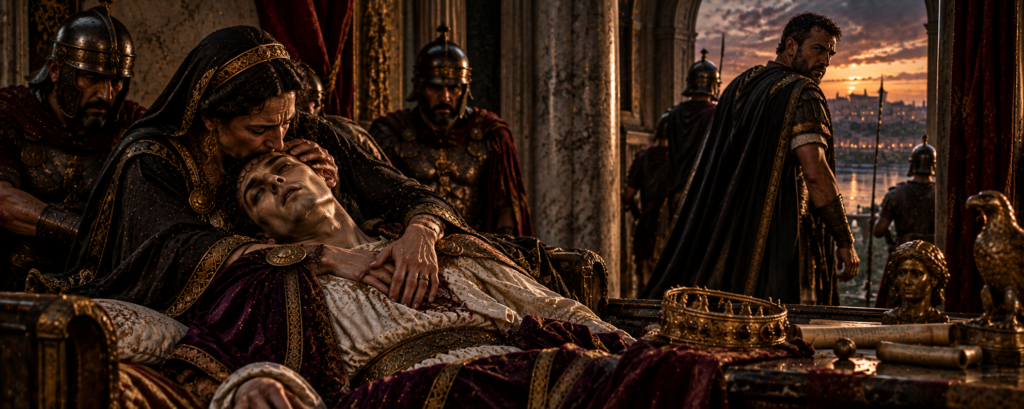
Valentinian II: The Young Emperor Found Hanged and the Murder Mystery That Haunted Rome
Flavius Valentinianus (371–392 CE) | Western Roman Emperor, 375–392 CE | Found Dead at Vienne on May 15, 392 | Suspected Murder or Suicide
The Emperor Found Hanging in His Own Residence
On May 15, 392 CE, the twenty-one-year-old Roman emperor Valentinian II was found dead in his imperial residence at Vienne, in southeastern Gaul. His body was reportedly discovered hanging, and the explanation that circulated was suicide. Yet almost immediately, suspicion fell upon the powerful military commander who had effectively taken control of his government. The young emperor had spent the final months of his life struggling to escape that commander’s influence, and now he was dead before he could regain his independence.
The man at the center of the controversy was Arbogast, a Frankish-born general who commanded the western Roman armies. Although Valentinian wore the imperial purple, Arbogast controlled much of the military power upon which his authority depended. Their relationship had deteriorated into open hostility, and ancient writers describe a confrontation in which the emperor attempted to dismiss his general. Arbogast allegedly refused to recognize the order, leaving Valentinian with the humiliating realization that his own commander might be more powerful than he was.
The circumstances of the emperor’s death were immediately troubling. He was young, politically isolated, and increasingly desperate to establish his authority. He had reportedly appealed for assistance from the eastern emperor Theodosius I and sought the support of Ambrose, the influential bishop of Milan. Before either could secure his position, Valentinian was found dead.
Was the emperor driven to suicide by the unbearable humiliation of being powerless within his own government? Had Arbogast arranged his murder and disguised the killing as suicide? Or had another faction within the imperial household exploited the conflict between emperor and general?
The surviving evidence offers no definitive answer. Ancient writers disagreed about what happened, and later accounts often reflected the political interests of those who benefited from Valentinian’s death. Some explicitly accused Arbogast of murder, while others acknowledged the possibility that the emperor had taken his own life. Even the accounts describing homicide differed concerning how the killing was carried out.
What makes the case especially disturbing is that Valentinian’s death was followed by an extraordinary political transformation. Arbogast did not immediately claim the imperial throne for himself, but he eventually supported the elevation of Eugenius, a civilian official who became emperor in the west. Theodosius refused to accept the new political arrangement, and the Roman Empire descended into another civil war. Two years after Valentinian’s death, Arbogast and Eugenius were destroyed at the Battle of the Frigidus.
The young emperor’s fate became entangled with competing narratives of loyalty, betrayal, religion, and imperial legitimacy. Christian writers remembered him as a promising ruler whose life had ended before he could receive baptism from Ambrose. Political historians examined the possibility that his powerful general had removed him. Others questioned whether the murder accusation had been strengthened after the fact to justify Theodosius’s war against Arbogast.
Valentinian II had occupied the imperial throne since he was four years old, yet he died before he could fully control the government that supposedly belonged to him. His reign had been shaped by guardians, generals, bishops, and rival emperors who repeatedly made decisions on his behalf. In the end, his death became another struggle over authority, with the truth obscured by the ambitions of the men who survived him.
A Child Born Into the Imperial Purple
Valentinian II was born in 371 CE, the son of the western Roman emperor Valentinian I and his second wife, Justina. His father was a formidable military ruler who had come to power in 364 and devoted much of his reign to defending the empire’s frontiers. His older half-brother Gratian had already been elevated to the rank of Augustus. The young Valentinian therefore entered a household in which imperial succession was both a family matter and a question of military security.
The Roman Empire of his childhood was no longer governed from Rome alone. Imperial courts moved between strategically important cities, particularly those near threatened frontiers. Military commanders exercised enormous influence, while emperors depended upon armies stationed across widely separated territories. The empire remained powerful, but governing it required constant negotiation between political authority and military force.
Valentinian I had divided imperial responsibilities with his younger brother Valens, who ruled the eastern provinces. The arrangement allowed each emperor to respond more effectively to threats within his region. It also established a precedent for multiple members of the same family holding imperial authority simultaneously. Gratian’s elevation further strengthened the dynasty’s succession arrangements.
Justina, Valentinian II’s mother, came from a distinguished aristocratic background and had previously been married to the usurper Magnentius. Her position within the imperial household gave her considerable importance after her son’s accession. She would become one of the principal figures responsible for protecting his interests during his childhood. Her religious commitments would also bring her into conflict with one of the most influential bishops of the age.
The young prince’s early life was therefore surrounded by powerful personalities. His father was an experienced military commander, his brother was already an emperor, and his mother possessed valuable political connections. Yet the stability of the dynasty depended heavily upon Valentinian I’s continued authority. His sudden death would expose how quickly military officers could reshape the succession.
For Valentinian II, the throne would arrive long before he could understand its dangers. He would become emperor not because he had demonstrated political ability or military leadership, but because influential men believed his name could serve their interests. The distinction would haunt his entire reign. From childhood onward, he possessed the highest title in the Roman world without necessarily controlling the people who governed in his name.
The Emperor Who Died in a Fit of Rage
Valentinian I died suddenly on November 17, 375, while dealing with diplomatic tensions along the Danube frontier. Ancient accounts describe the emperor becoming furious during an audience with representatives of the Quadi, a people involved in conflict with Rome. His anger reportedly became so intense that he suffered a fatal medical crisis. Modern descriptions often identify the event as a cerebral hemorrhage, although the precise diagnosis cannot be established.
The emperor’s death created an immediate political problem. Gratian, his elder son, was already Augustus and possessed an established claim to western imperial authority. Valens continued ruling the east. In principle, the empire already had legitimate rulers capable of maintaining the succession.
Yet senior officers near the dead emperor’s headquarters acted independently. Within days, they elevated the four-year-old Valentinian II to the rank of Augustus. The proclamation occurred at Aquincum, near modern Budapest, and was supported by influential military and court officials. The decision was made without first obtaining the approval of Gratian or Valens.
The reasons remain debated. Some officers may have feared that the emperor’s death would produce instability among the troops. Others may have wanted to prevent rival commanders from seizing power. Elevating a young member of the imperial family could preserve dynastic legitimacy while allowing experienced officials to retain practical control.
The arrangement also benefited men who preferred a ruler too young to challenge their authority. A four-year-old emperor could not personally direct military campaigns or supervise senior appointments. Those responsibilities would fall to guardians, ministers, and commanders. The imperial title offered legitimacy, while actual power remained elsewhere.
Gratian ultimately accepted his younger brother’s elevation. Open opposition could have divided the dynasty and encouraged military rebellion. The brothers therefore became joint western emperors, although Gratian exercised the effective authority appropriate to his age and experience. Valentinian II began a reign that would last nearly seventeen years, much of it under the control of others.
A Crown Too Heavy for a Child
The elevation of Valentinian II illustrates a fundamental change in Roman imperial government. Earlier emperors had generally been expected to demonstrate military leadership or political experience before acquiring supreme authority. By the late fourth century, dynastic legitimacy increasingly allowed children to inherit imperial titles. The government could continue functioning through officials who acted on their behalf.
This development offered certain advantages. A child emperor could provide continuity during a dangerous succession crisis. His name could unite factions that might otherwise support competing adult claimants. Military commanders could claim to defend the legitimate dynasty rather than pursue personal ambition.
The disadvantages were equally serious. A young ruler could not independently judge the loyalty of his advisers or commanders. He depended upon adults whose interests might conflict with his own. By the time he reached maturity, those officials might have accumulated enough power to resist his attempts at independence.
Valentinian II’s childhood government was shaped by precisely these tensions. His mother Justina exercised influence within the court, while Gratian remained the senior western emperor. Military officers managed frontier affairs, and religious leaders increasingly participated in political disputes. The young ruler’s personal authority remained limited.
The arrangement also created uncertainty about the meaning of imperial power. Valentinian possessed the title Augustus, appeared in official ceremonies, and was represented on imperial coinage. Yet he could not make independent decisions while still a child. The distinction between ceremonial legitimacy and practical authority became a defining feature of his reign.
As Valentinian grew older, that distinction became increasingly difficult to sustain. He would eventually expect to exercise the powers associated with his title. The commanders who had governed during his childhood might not willingly surrender their influence. The conflict that ended his life had roots in the political system that placed him on the throne at four years old.
The Shadow of Gratian
For much of Valentinian’s childhood, his older half-brother Gratian remained the dominant western emperor. Gratian had been elevated by their father in 367 and possessed greater experience in military and political affairs. He inherited the principal responsibilities of government after Valentinian I’s death. The younger brother remained an imperial partner whose authority was largely exercised through others.
Gratian faced substantial challenges. The Rhine and Danube frontiers required constant attention, while the eastern empire suffered a catastrophic defeat against the Goths at Adrianople in 378. Emperor Valens was killed during that battle, leaving the eastern government in crisis. Gratian responded by elevating Theodosius to imperial authority in the east in 379.
The appointment would have enormous consequences for Valentinian II. Theodosius became one of the most powerful rulers of the late Roman Empire and eventually played a decisive role in the young emperor’s restoration. He also became connected to Valentinian’s family through marriage. Their relationship would combine dynastic obligation with political rivalry.
Gratian’s religious policies further reshaped the imperial court. He increasingly supported Nicene Christianity and distanced the government from certain traditional religious institutions. His relationship with Ambrose of Milan strengthened the bishop’s political influence. Religious disputes became inseparable from imperial administration.
Valentinian’s mother Justina held different theological views. She supported the Homoian form of Christianity often described by hostile Nicene writers as Arianism. The distinction would later produce serious conflict between her court and Ambrose. The young emperor became involved in religious controversies before he had fully established his own political identity.
Gratian’s reign appeared to provide continuity for the dynasty, but military loyalty remained unstable. In 383, a rebellion in Britain produced a new imperial claimant. The consequences would destroy Gratian and transform Valentinian’s position. The younger brother would soon discover that possessing an imperial title offered little protection against a successful usurper.
The Usurper Who Murdered His Brother
In 383, Roman troops in Britain proclaimed their commander Magnus Maximus emperor. Maximus crossed into Gaul and challenged Gratian’s authority. The western emperor attempted to resist, but his forces deserted or abandoned him. Gratian fled and was eventually killed near Lyon.
Valentinian II was approximately twelve years old when his older brother died. The murder removed the most experienced member of the western branch of the dynasty. It also demonstrated that an emperor could be destroyed when his soldiers transferred their loyalty to another commander. The lesson would become painfully relevant to Valentinian’s final years.
Magnus Maximus established control over Britain, Gaul, and Spain. He possessed substantial military resources and could not easily be removed. Valentinian II remained in Italy under the protection of his mother and loyal officials. The western empire was effectively divided between a usurper and a young dynastic emperor.
The situation required careful diplomacy. Justina and her advisers sought to preserve Valentinian’s position without provoking a military confrontation they were unlikely to win. Maximus, meanwhile, attempted to secure recognition of his authority. The eastern emperor Theodosius faced the difficult task of balancing dynastic loyalty against political realities.
Ambrose became involved in negotiations with Maximus. His religious authority and political experience made him a valuable intermediary. He traveled on diplomatic missions and attempted to protect the interests of Valentinian’s government. His role demonstrated the growing influence of bishops within imperial politics.
For Valentinian, the crisis was another reminder of his dependence upon others. His brother had been murdered, his territories were threatened, and his government survived through diplomacy rather than military strength. The young emperor could claim legitimate authority, but Maximus possessed armies capable of enforcing his demands. The distinction between right and power remained dangerously clear.
Justina and the Bishop Who Would Not Yield
During Valentinian’s adolescence, his mother’s religious policies brought the imperial court into direct conflict with Ambrose of Milan. Justina supported Homoian Christianity, while Ambrose defended Nicene orthodoxy. The dispute concerned theological differences about the relationship between the Father and the Son. Yet it also became a struggle over who possessed authority within the Christian community.
In 385 and 386, the imperial court sought access to church buildings in Milan for worship associated with Justina’s theological position. Ambrose resisted the demands, arguing that sacred buildings could not simply be transferred by imperial command. The confrontation escalated as officials attempted to enforce the government’s wishes. Supporters of Ambrose gathered to defend the churches.
Valentinian II was still a young teenager, and the extent of his independent involvement is uncertain. Ancient Christian writers frequently attributed the court’s policies to Justina. Nevertheless, the orders were issued under the authority of the imperial government. The conflict therefore placed the emperor’s name against that of a powerful bishop.
Ambrose’s resistance became famous. He refused to surrender the churches and presented himself as defending religious principle against imperial interference. His supporters maintained vigils and occupied sacred spaces. The confrontation ended without the government achieving its original objective.
The episode revealed a significant limitation upon imperial authority. Even an emperor’s commands could be resisted when a bishop possessed sufficient public support. Ambrose emerged with enhanced prestige, while the court suffered a political embarrassment. Valentinian’s government appeared unable to enforce its wishes within one of its own principal cities.
The conflict also created a complicated personal relationship between Valentinian and Ambrose. The bishop had once opposed policies issued in the young emperor’s name. Years later, Valentinian would seek his spiritual guidance and reportedly request baptism. The transformation would become central to the story of his death.
The Fall of Italy and the Flight From Milan
In 387, Magnus Maximus advanced into Italy, ending the uneasy political arrangement that had preserved Valentinian’s government. The young emperor and his mother were unable to resist the invasion effectively. They fled from Milan and sought refuge in the eastern territories. The legitimate western emperor had been driven from his own court.
The flight was a profound humiliation. Valentinian had already lost his brother to Maximus’s rebellion, and now the same usurper threatened to eliminate him. His imperial title could not protect him without an army willing to fight. Survival depended upon persuading Theodosius to intervene.
Theodosius had reasons to support Valentinian. The young emperor represented the legitimate western dynasty, and allowing Maximus to control the entire west could threaten the balance of imperial power. Dynastic relationships also encouraged intervention. Yet a military campaign against Maximus would require substantial resources.
Justina played an important role in the negotiations. Her daughter Galla, Valentinian’s sister, married Theodosius after the death of his first wife. The marriage strengthened the alliance between the eastern emperor and Valentinian’s family. It also gave Theodosius a personal connection to the displaced western ruler.
In 388, Theodosius launched a campaign against Maximus. His armies defeated the usurper’s forces, and Maximus was captured and executed at Aquileia. The victory restored Valentinian II to imperial authority in the west. It also established Theodosius as the dominant military power in the Roman world.
Valentinian returned to a throne that had been recovered through another emperor’s armies. The restoration preserved his legitimacy but did not guarantee independence. Theodosius possessed the military prestige and political influence that Valentinian lacked. The young emperor’s future would depend upon the arrangements made by his powerful protector.
The General Who Became Indispensable
Among the commanders associated with the restoration of western imperial authority was Arbogast. He was a military officer of Frankish origin who had risen within the Roman army. By the late 380s, he possessed considerable influence and commanded forces essential to the western government. His career illustrates the growing importance of officers from beyond the empire’s traditional Italian aristocracy.
Arbogast was not an outsider commanding a foreign army against Rome. He served within the Roman military establishment and operated as a senior imperial officer. Men of diverse regional and ethnic backgrounds had long served in Roman armies. By the fourth century, such commanders occupied some of the highest military positions.
His military abilities appear to have been substantial. Theodosius trusted him with important responsibilities, and Arbogast became a central figure in western affairs after Maximus’s defeat. He helped maintain security in Gaul and exercised authority over troops stationed near the Rhine frontier. His position made him indispensable to the restored government.
The problem was that military authority did not automatically translate into obedience to Valentinian. Arbogast possessed the loyalty of experienced soldiers and controlled important appointments. The young emperor depended upon those forces to defend his territories. Removing the general could therefore threaten the security of the entire western government.
At first, the arrangement may have appeared practical. Valentinian provided dynastic legitimacy, while Arbogast supplied military experience. Theodosius could rely upon a trusted commander to maintain stability in the west. Such arrangements were increasingly common in the late Roman Empire.
Yet the balance was inherently unstable. As Valentinian matured, he wanted to exercise the authority associated with his imperial title. Arbogast had little reason to surrender the influence he had accumulated. Their relationship gradually became a struggle over who actually governed the western empire.
The Emperor Who Could Not Command His Own Army
By the early 390s, Valentinian II was no longer a child. He had spent most of his life as emperor and had experienced rebellion, exile, religious conflict, and restoration. He understood the dangers of military politics more intimately than many older rulers. Yet his ability to govern independently remained severely restricted.
Arbogast controlled much of the western military establishment. His influence extended over senior officers and the troops upon whom the emperor depended. Valentinian possessed the legal authority to appoint and dismiss commanders, but enforcing those decisions required military cooperation. Without it, imperial orders could become meaningless.
Ancient accounts describe the emperor growing increasingly resentful of his general’s dominance. Valentinian wanted greater control over appointments and military affairs. Arbogast reportedly resisted attempts to reduce his influence. The conflict became a direct challenge to the emperor’s personal authority.
The situation was especially humiliating because Valentinian had never enjoyed an extended period of independent rule. During childhood, his mother and brother had exercised influence. During the crisis with Maximus, he had depended upon diplomacy and eastern military intervention. After his restoration, Arbogast became the dominant figure.
Valentinian’s frustration was therefore understandable. He had inherited the throne at four years old and spent nearly seventeen years waiting to exercise its powers. By twenty-one, he might reasonably have expected to govern without a military guardian. Instead, his authority remained dependent upon a commander who increasingly behaved as though he could ignore the emperor.
The conflict also reflected a broader transformation in Roman politics. Military commanders were becoming capable of controlling governments while leaving emperors as ceremonial figures. Valentinian’s struggle with Arbogast anticipated later relationships between western emperors and powerful generals. His death would reveal how dangerous that imbalance could become.
The Confrontation That Destroyed Their Relationship
One of the most famous stories about Valentinian’s final months concerns his attempt to dismiss Arbogast. Ancient writers describe the emperor presenting the general with a document removing him from office. Arbogast allegedly rejected the order and declared that his authority did not depend upon Valentinian. The confrontation became a symbol of the emperor’s political helplessness.
The story is preserved in later historical narratives, and its exact details cannot be independently verified. The wording of the exchange should not be treated as a verbatim record. Nevertheless, it reflects the broader reality that Arbogast possessed military power sufficient to resist the emperor’s wishes. Their relationship had deteriorated into open hostility.
According to some versions, Arbogast tore up or discarded the dismissal document. The gesture was intended to demonstrate that the emperor lacked the power to remove him. If the incident occurred substantially as described, it represented an extraordinary public humiliation. A Roman emperor had attempted to dismiss his own general and been openly defied.
The confrontation also exposed the weakness of Valentinian’s position. He could issue an order, but he could not compel obedience without soldiers willing to enforce it. Arbogast controlled precisely those forces. The emperor’s legal authority had become separated from practical power.
Ancient writers also describe Valentinian reacting with intense anger. Some accounts suggest that he attempted to seize a weapon during the dispute. Such details may have been dramatized to emphasize his frustration and loss of control. They cannot be reconstructed with certainty.
The significance of the episode lies in the political relationship it reveals. Valentinian and Arbogast had reached a point where cooperation was becoming impossible. The emperor wanted independence, while the general refused to surrender authority. Within a short time, Valentinian would be dead.
A Court Filled With Fear and Suspicion
The final months of Valentinian’s life unfolded in an atmosphere of growing political tension. His court was located at Vienne in Gaul, where Arbogast’s military influence remained strong. The emperor reportedly feared that he could not trust the officers surrounding him. His attempts to establish independent authority had failed.
The surviving sources suggest that Valentinian sought assistance from Theodosius. The eastern emperor possessed the military strength necessary to challenge Arbogast. He had previously restored Valentinian after the rebellion of Magnus Maximus. Another intervention might have allowed the young ruler to regain control.
Yet appealing to Theodosius presented difficulties. The eastern emperor had his own political responsibilities and could not immediately resolve every western dispute. A direct confrontation with Arbogast might provoke military rebellion. Valentinian needed help without creating another civil war.
He also turned toward Ambrose of Milan. Their relationship had changed considerably since the religious conflicts of his adolescence. Valentinian now showed sympathy toward Nicene Christianity and sought the bishop’s spiritual guidance. Ambrose later described the young emperor’s religious development with considerable affection.
The emperor reportedly wished to receive baptism from Ambrose. The request carried profound personal and political significance. Baptism would mark his full incorporation into the Nicene Christian community that had once opposed his mother’s religious policies. It would also strengthen his relationship with an influential figure outside Arbogast’s immediate military control.
The combination of political and religious appeals suggests a ruler searching for support. Valentinian was no longer content to remain under the general’s dominance. He wanted recognition as an independent emperor and sought allies capable of helping him. His death occurred before those efforts could succeed.
The Final Days at Vienne
Valentinian spent his final days at Vienne, an important city in southeastern Gaul. The location placed him within the western territories where Arbogast exercised substantial military influence. The imperial residence provided the setting for the final stage of their conflict. Yet the surviving evidence offers surprisingly little reliable detail about the emperor’s last hours.
Ancient accounts agree that Valentinian died on May 15, 392. He was approximately twenty-one years old and had held the imperial title since childhood. His death occurred after months of political tension with Arbogast. The circumstances were immediately controversial.
The emperor’s body was reportedly found hanging within his residence. Some accounts present the death as suicide, while others accuse Arbogast or his associates of arranging murder. The precise location within the residence and the identities of those who discovered the body are not securely established. Later narratives differ in their descriptions.
The absence of reliable eyewitness testimony is crucial. We do not possess an official investigation establishing how Valentinian died. No surviving medical examination can determine whether he was alive when suspended. The physical evidence necessary to distinguish suicide from staged hanging has disappeared.
The political circumstances made suspicion inevitable. Valentinian had attempted to dismiss Arbogast, and the general had allegedly refused. The emperor had sought assistance from outside the western military command. His death removed the principal figure challenging Arbogast’s authority.
Yet suspicion does not establish murder. Valentinian may have experienced severe despair because of his political isolation and humiliation. He may have died by suicide, as some ancient accounts maintained. The evidence is insufficient to exclude either possibility.
The Hanging That Became an Imperial Mystery
The discovery of Valentinian’s body transformed a political confrontation into a historical mystery. Hanging could indicate suicide, but it could also be used to disguise homicide. Ancient observers lacked the investigative methods available to modern forensic specialists. Even a suspicious death within the imperial residence could remain unresolved.
Some later accounts described Valentinian as having been strangled and then suspended to create the appearance of suicide. Others suggested that attendants or members of the imperial household participated in the killing. These accusations were not uniform, and they cannot be independently confirmed. Their differences reveal how uncertain the circumstances remained.
The allegation of staged hanging was politically explosive. If Valentinian had been murdered, the crime would constitute the deliberate elimination of a reigning Roman emperor. Arbogast would become the obvious suspect because of his recent conflict with the victim. His control over the military establishment would also raise questions about whether anyone could investigate him safely.
The suicide explanation carried different implications. It suggested that Valentinian’s frustration and isolation had become unbearable. His death would still reflect the political environment created by Arbogast’s dominance, but it would not establish direct responsibility for murder. The distinction mattered enormously to those competing for power after his death.
Later historians sometimes treated the two possibilities as if one must be obvious. The surviving evidence does not justify such certainty. The accounts were shaped by political and religious interests, and the physical circumstances cannot be reconstructed. Valentinian’s death remains one of the most disputed imperial deaths of late antiquity.
The mystery is intensified by the emperor’s age. Valentinian had spent nearly his entire life under the control of older political figures. At twenty-one, he was attempting to establish himself as an independent ruler. Whether he was killed or died by suicide, his death ended that struggle before it could reach a political resolution.
Arbogast: The General With Everything to Gain
Arbogast became the principal suspect because he possessed both a possible motive and the means to influence events at Vienne. His authority depended upon controlling the western military establishment. Valentinian’s attempts to dismiss him threatened that position. The emperor’s death removed the most immediate challenge to his power.
The general also had access to soldiers and officials who could potentially carry out an assassination. His command placed him at the center of the imperial government’s security arrangements. If he wished to eliminate Valentinian, he may have possessed the resources necessary to do so. Yet the surviving sources do not establish that he issued such an order.
The motive is more complicated than it first appears. Valentinian’s death also created serious dangers for Arbogast. Theodosius might interpret the event as murder and intervene militarily. The general could lose the legitimacy provided by governing in the name of a recognized emperor.
Keeping Valentinian alive might therefore have served Arbogast’s interests. A politically weak emperor offered a useful source of legal authority. The general could continue directing military affairs while presenting his actions as service to the dynasty. Murdering Valentinian risked destroying that arrangement.
This difficulty has encouraged some historians to question the assassination theory. Arbogast had already demonstrated that he could resist the emperor’s orders. He did not necessarily need to kill Valentinian to maintain control. The murder accusation may have become more useful to his enemies after the succession crisis developed.
Nevertheless, the argument does not establish his innocence. Political relationships can deteriorate beyond repair, and a commander who fears dismissal may resort to violence. Arbogast may have believed that Valentinian was preparing to remove him with Theodosius’s assistance. If so, eliminating the emperor could have appeared preferable to waiting for a military confrontation.
Could Valentinian Have Taken His Own Life?
The suicide interpretation has a substantial place in modern historical discussion. Valentinian was politically isolated, humiliated by his inability to dismiss Arbogast, and uncertain whether Theodosius would intervene. His attempts to regain authority had failed. Such circumstances could have produced profound distress.
Yet historical explanations of suicide require caution. We cannot diagnose Valentinian’s mental state from hostile political narratives or brief descriptions of his final months. His frustration does not establish suicidal intent. Many rulers experienced humiliation without taking their own lives.
The evidence that he was found hanging is consistent with suicide, but it does not prove it. A body can be suspended after death, and ancient sources explicitly raised that possibility. Without reliable physical evidence, the distinction cannot be resolved. The circumstances remain open to competing interpretations.
The emperor’s reported plans also complicate the picture. He had sought assistance from Theodosius and requested baptism from Ambrose. These actions suggest that he was considering future political and religious developments. They do not make suicide impossible, but they prevent a simplistic portrayal of a man who had entirely abandoned hope.
The religious context is also important. Suicide was strongly condemned within the Christian tradition increasingly embraced by Valentinian. Yet religious belief does not eliminate the possibility of suicide. The surviving evidence cannot establish how the emperor understood his situation in his final hours.
The most responsible conclusion is that suicide remains plausible but unproven. Valentinian’s political circumstances provide a possible explanation for despair, while the reported method of death is compatible with self-inflicted hanging. Neither establishes certainty. The case cannot be resolved by assuming that a distressed ruler must have taken his own life.
The Murder Theory and the Problem of Evidence
The assassination theory rests upon the political conflict between Valentinian and Arbogast, the suspicious circumstances of the death, and accusations preserved by ancient writers. The emperor had attempted to assert authority over his general. Arbogast had reportedly refused to obey. Valentinian then died before he could secure outside assistance.
The sequence creates a compelling motive for murder. A powerful commander might fear that the emperor would eventually succeed in removing him. Killing Valentinian would eliminate the immediate threat. If the death could be presented as suicide, the general might hope to avoid responsibility.
Some ancient writers explicitly accused Arbogast of arranging the killing. Jerome referred to Valentinian as murdered and described his body being displayed in a manner intended to conceal the crime. Sozomen later reported competing traditions, including allegations that members of the imperial household killed the emperor at Arbogast’s instigation. These accounts demonstrate that murder accusations circulated in antiquity.
Yet the accusations were not based upon surviving forensic evidence. They were transmitted through writers whose political and religious perspectives influenced their interpretations. Theodosius eventually fought a civil war against the government supported by Arbogast. After his victory, portraying the general as a murderer helped justify the conflict.
The murder theory also faces practical questions. We do not know who supposedly carried out the killing, how they gained access to the emperor, or whether the body was deliberately staged. The surviving narratives offer different explanations. Their inconsistencies prevent a confident reconstruction.
The possibility of murder remains serious. Arbogast possessed a plausible motive and substantial military power, and Valentinian’s death was politically convenient for him. But historical suspicion must not be mistaken for proof. The identity of any murderer remains unknown.
The Bishop Who Was Coming Too Late
Ambrose of Milan occupies a particularly important place in the story because he had developed a personal relationship with Valentinian. Their earlier conflict over church buildings had gradually given way to cooperation. The young emperor had moved toward Nicene Christianity and reportedly wished to receive baptism from the bishop. Ambrose later described his attachment to Valentinian with considerable emotion.
The bishop was preparing to travel to Vienne when news of the emperor’s death reached him. His intended visit demonstrates that Valentinian was seeking religious guidance during the final stage of his reign. It also suggests that the emperor was attempting to strengthen relationships beyond Arbogast’s immediate circle. Ambrose represented a form of authority that the general could not simply command through military rank.
The timing became central to the tragedy. Valentinian died before receiving the baptism he had requested. For a Christian ruler in the late fourth century, the absence of baptism raised difficult theological questions. Ambrose would later address those concerns directly in his funeral oration.
The bishop’s grief appears genuine, although his writings also served political and religious purposes. He had known Valentinian since childhood and had witnessed his development from a ruler associated with Homoian Christianity into a supporter of Nicene orthodoxy. The transformation carried considerable significance for Ambrose. The emperor’s death interrupted what the bishop regarded as a promising spiritual journey.
Ambrose’s testimony is valuable because he was closely connected to the events. Yet he was not present when Valentinian died. His knowledge of the circumstances depended upon information received from others. His funeral speech cannot be treated as an eyewitness account of the death.
The bishop’s role therefore illustrates both the value and limitations of contemporary evidence. Ambrose provides important information about Valentinian’s religious intentions and personal relationships. He also reveals how the emperor’s death was interpreted within Christian political culture. But he cannot resolve the central question of murder or suicide.
The Funeral That Became a Political Statement
After Valentinian’s death, arrangements were made to bring his body to Milan. The process involved communication between Ambrose and Theodosius. The emperor’s remains reportedly remained unburied for a considerable period while the necessary arrangements were completed. The delay added another unsettling element to the aftermath.
Ambrose eventually delivered a funeral oration known as De obitu Valentiniani. The speech commemorated the young emperor and sought to console those mourning him. It also addressed the religious difficulties created by his death before baptism. The oration became one of the most important surviving sources for Valentinian’s final reputation.
Ambrose emphasized the emperor’s desire for baptism. He argued that Valentinian’s sincere intention and faith should not be disregarded merely because death prevented the ceremony. The bishop’s treatment of the issue reflected broader Christian debates about salvation, intention, and sacramental practice. His words offered reassurance to those troubled by the emperor’s unbaptized state.
The speech also presented Valentinian as a promising young ruler whose life had ended prematurely. Ambrose emphasized his virtues, religious development, and relationship with the church. Such praise was conventional in imperial funeral orations, but it also served a political purpose. The young emperor became a symbol of legitimate authority interrupted by tragedy.
The funeral did not provide a clear investigation of the death. Ambrose’s language was emotionally powerful but often indirect concerning the precise circumstances. His treatment of the emperor’s fate has encouraged different interpretations among modern scholars. Some see evidence that he believed Valentinian was murdered, while others emphasize his careful avoidance of a definitive accusation.
The funeral therefore became part of the historical mystery. It preserved the grief surrounding Valentinian’s death while leaving the central question unresolved. The bishop who had hoped to baptize the emperor instead stood before his body. His words shaped how later generations remembered a ruler whose life had ended before he could fully exercise his authority.
Theodosius Receives the News
Theodosius I was the most powerful surviving Roman emperor when news of Valentinian’s death reached the eastern court. He had previously restored the young ruler after defeating Magnus Maximus. He was also connected to Valentinian through marriage to his sister Galla. The death therefore involved both dynastic obligations and major political interests.
Theodosius had reasons to be suspicious of Arbogast. The general had controlled the western army and resisted Valentinian’s attempts to assert independence. The emperor’s death removed a legitimate ruler whose authority Theodosius had helped preserve. Any successor supported by Arbogast would require careful scrutiny.
Yet Theodosius did not immediately launch a military campaign. The political situation was complex, and the eastern government faced its own responsibilities. A war against the western army would require substantial preparation. Theodosius also needed to determine how the succession would be handled.
The delay is important because it demonstrates that the death did not automatically produce an immediate military response. Arbogast remained influential in the west, while the eastern court considered its options. The eventual civil war emerged through a developing political confrontation. It was not simply the immediate consequence of a proven murder.
Theodosius’s personal relationship with Valentinian also shaped the situation. He had supported the young emperor’s restoration and become his brother-in-law. His wife Galla had lost a brother under suspicious circumstances. The emotional dimensions of the crisis were intertwined with imperial politics.
Nevertheless, the surviving evidence does not establish exactly what Theodosius believed about the death when he first learned of it. Later accounts were influenced by the war that followed. His eventual opposition to Arbogast cannot be treated as independent proof that the general committed murder. Political hostility and historical guilt are not the same thing.
The General Who Did Not Take the Crown
One of the most intriguing aspects of the aftermath is that Arbogast did not immediately proclaim himself emperor. If he had murdered Valentinian to seize the throne, direct usurpation might have seemed the obvious next step. Instead, the western government experienced a period of uncertainty. Arbogast continued exercising military influence without immediately assuming the imperial title.
His decision may have reflected political realities. A commander of Frankish origin might have faced difficulties gaining recognition as emperor, particularly among traditional Roman elites. The surviving sources do not establish that his ancestry legally prevented him from ruling. Nevertheless, questions of legitimacy and aristocratic acceptance could influence political calculations.
Arbogast also needed a ruler whose authority could be recognized by the Senate, provincial officials, and military forces. The Roman state depended upon imperial titles and administrative continuity. Governing indefinitely without an emperor would create practical difficulties. A civilian figure acceptable to influential groups might provide a solution.
The delay between Valentinian’s death and the elevation of Eugenius is therefore significant. It suggests that the succession was not necessarily settled before the emperor died. Arbogast may have been responding to an unexpected crisis rather than executing a fully prepared plan. This possibility has been used to support the suicide interpretation.
Yet the same evidence can be read differently. A conspirator might delay proclaiming a successor to avoid immediate suspicion. Arbogast may have needed time to secure military and political support. The absence of an immediate usurpation does not establish innocence.
The question remains unresolved. Arbogast benefited from Valentinian’s disappearance, but he also lost the legitimacy provided by serving a recognized emperor. His subsequent actions reveal political ambition and practical calculation. They do not conclusively establish whether he caused the death.
Eugenius: The Emperor Chosen After the Mystery
On August 22, 392, Eugenius was elevated to imperial authority in the west. He was a civilian official associated with the imperial administration and had connections to influential Roman political circles. Arbogast supported his accession and remained the dominant military figure. The arrangement created a government in which formal imperial authority and practical military power were divided.
Eugenius was not simply a puppet without political abilities. Ancient accounts describe him as educated and experienced in administrative affairs. His background made him more acceptable to certain civilian elites than a purely military claimant might have been. He could provide the legal and ceremonial authority necessary for government.
Nevertheless, his dependence upon Arbogast was substantial. The general controlled the military forces essential to the regime’s survival. Without that support, Eugenius would have struggled to establish his position. Their partnership reflected the same imbalance between emperor and commander that had troubled Valentinian’s reign.
Theodosius did not recognize Eugenius as the legitimate western emperor. The eastern court maintained its opposition, and the political division deepened. The question of Valentinian’s death became increasingly important to the legitimacy of the new government. If Arbogast had murdered the previous emperor, Eugenius’s accession could be portrayed as the product of treachery.
The regime also became associated with religious controversy. Eugenius was a Christian, but his government received support from members of the traditional Roman aristocracy who favored older religious practices. Later accounts sometimes portrayed the conflict with Theodosius as a simple struggle between Christianity and paganism. Modern scholarship recognizes a more complicated political and religious situation.
The elevation of Eugenius therefore transformed Valentinian’s mysterious death into a succession crisis with enormous consequences. The western army supported one emperor, while Theodosius refused to accept him. The empire was moving toward civil war. The question of whether Valentinian had been murdered became inseparable from the struggle over who possessed legitimate authority.
The Religious War That Was More Complicated Than It Appeared
The conflict between Theodosius and Eugenius has often been described as a final confrontation between Christianity and traditional Roman religion. Theodosius supported Nicene Christianity and had issued measures restricting certain traditional religious practices. Eugenius’s government attracted support from aristocrats who favored the restoration of older religious customs. The contrast became central to later historical narratives.
Yet the political reality was more complicated. Eugenius himself was a Christian, and his supporters were not united by a single religious identity. Arbogast’s personal religious beliefs are also difficult to reconstruct with certainty. The conflict involved military authority, dynastic legitimacy, and control of the western government as well as religious policy.
The memory of Valentinian II became useful within this struggle. He had moved toward Nicene Christianity and sought baptism from Ambrose. His death could be portrayed as the destruction of a legitimate Christian emperor by a rebellious military commander. Such a narrative strengthened Theodosius’s claim to be restoring rightful authority.
The opposing government could emphasize different considerations. Arbogast and Eugenius controlled substantial western territories and possessed military support. They could present their regime as a practical response to the sudden death of an emperor. Theodosius’s refusal to recognize them could be interpreted as an attempt to dominate the entire Roman world.
The religious dimension nevertheless intensified the conflict. Christian writers interpreted events through ideas of divine favor, legitimate rule, and the punishment of impiety. Political victories could become evidence of God’s judgment. Defeated opponents were often portrayed in moral and religious terms.
These interpretations complicate the evidence surrounding Valentinian’s death. Writers who supported Theodosius had reasons to condemn Arbogast. Their accusations may preserve genuine information, but they also served political purposes. The historian must separate the circumstances of the death from the propaganda generated by the war that followed.
The Battle That Destroyed Arbogast
The final confrontation occurred in September 394 at the Battle of the Frigidus, in the region of the eastern Alps. Theodosius advanced westward with a large army to challenge Eugenius and Arbogast. The opposing forces met in difficult terrain near the river from which the battle takes its name. The struggle became one of the most important civil wars of the late fourth century.
The fighting was fierce, and the first day’s events appear to have been costly for Theodosius. His army included Gothic troops serving under Roman command, and ancient accounts describe heavy casualties among them. The western forces resisted strongly. Victory was far from assured.
On the following day, the battle turned in Theodosius’s favor. Later Christian writers emphasized a powerful wind that supposedly helped his army and hindered the enemy. The story became part of the religious interpretation of the victory. The precise military significance of the weather remains debated.
Eugenius was captured and executed after the defeat. Arbogast escaped temporarily but soon died by suicide, according to the surviving accounts. His death ended the career of the general who had dominated Valentinian’s final years. The western regime established after the young emperor’s death collapsed.
Theodosius emerged as the undisputed ruler of the Roman Empire. His victory was celebrated as a restoration of legitimate authority and, in some accounts, a triumph of Christianity. Yet the war had consumed enormous military resources and inflicted serious losses upon Roman forces. The empire had once again weakened itself through internal conflict.
Arbogast’s death also ensured that he would never provide a surviving explanation of Valentinian’s final days. Whether he had arranged the emperor’s murder or merely benefited from an unexpected suicide remained unanswered. His defeat settled the political struggle but not the historical mystery. The truth disappeared further into the competing narratives of victors and defeated enemies.
The Emperor Who Was Buried Beside His Brother
Valentinian’s remains were brought to Milan, where arrangements were made for an imperial funeral. Ambrose delivered the oration commemorating his life and religious development. The burial associated him with the dynasty whose authority he had inherited as a child. His death closed another tragic chapter in the history of Valentinian I’s family.
The location of his burial has been discussed by historians studying the imperial monuments of Milan. Ancient testimony suggests an association with his older brother Gratian, who had been murdered in 383. The precise archaeological identification of their resting places remains debated. Nevertheless, the tradition of their burial together carries powerful historical meaning.
Both brothers had inherited imperial authority through their father. Both had spent their lives navigating military politics and the ambitions of powerful commanders. Gratian was killed after losing the support of his troops during Magnus Maximus’s rebellion. Valentinian died under mysterious circumstances while struggling against Arbogast’s dominance.
Their deaths reveal the fragility of dynastic legitimacy in the late Roman Empire. Imperial birth could provide a title but could not guarantee military loyalty. Generals possessed the resources necessary to challenge or replace emperors. The sons of Valentinian I became victims of a political system their father had helped shape.
The funeral also transformed Valentinian from a politically frustrated young ruler into an object of public mourning. Ambrose emphasized his religious intentions and personal virtues. The political failures of his reign became secondary to the tragedy of his premature death. His reputation was increasingly shaped by what he might have become.
The emperor who had struggled to command his own army was finally honored through ceremonies appropriate to his rank. Yet those honors could not restore the authority he had been denied in life. His death had already created the conditions for another civil war. The dynasty’s losses continued to shape the empire long after his burial.
The Ancient Writers Who Could Not Agree
The surviving accounts of Valentinian’s death reveal a striking lack of agreement. Some writers describe suicide, while others accuse Arbogast of arranging murder. Still others preserve multiple possibilities without reaching a definitive conclusion. The disagreement is one of the strongest reasons the case remains unresolved.
Ambrose was close to Valentinian and wrote shortly after his death, but his funeral oration does not provide a straightforward forensic explanation. His primary purpose was to commemorate the emperor and address religious concerns surrounding his death before baptism. The speech is emotionally significant but historically indirect. Its ambiguity has generated extensive modern discussion.
Jerome, writing within the Christian intellectual world of the late fourth century, described Valentinian as murdered. His account reflects a tradition in which the emperor’s death was attributed to hostile action. Yet Jerome was not an eyewitness to the final events at Vienne. His testimony must be evaluated within the political environment that followed.
Sozomen, writing later, explicitly acknowledged competing explanations. He reported that some believed Valentinian had been killed by members of the imperial household acting at Arbogast’s instigation. Others maintained that the emperor had taken his own life. The preservation of both traditions demonstrates that uncertainty survived into later generations.
Other ecclesiastical historians and chroniclers repeated accusations against Arbogast or described the emperor’s death in terms suggesting suicide. Their accounts were often shaped by the political and religious significance of Theodosius’s victory. The general’s later rebellion made him an attractive villain. His defeat encouraged narratives that presented the war as punishment for earlier crimes.
Modern historians therefore cannot simply count ancient accusations and declare the majority correct. The sources were not independent witnesses, and some drew upon shared traditions. Their political interests also differed. The central question must be evaluated through chronology, motive, opportunity, and the limitations of the surviving evidence.
The Problem With Calling It Murder
The assassination interpretation has undeniable dramatic force. Valentinian had attempted to dismiss Arbogast, and the general had reportedly defied him. The emperor sought outside assistance and died before it could arrive. His body was found hanging, and later writers accused Arbogast of arranging the death.
Yet a compelling sequence is not the same as proof. The surviving accounts do not identify a securely established assassin. They do not preserve reliable evidence that Valentinian was strangled before being suspended. Nor do they provide a documented confession or investigation establishing Arbogast’s responsibility.
The general’s political interests were also complicated. Valentinian’s continued existence provided legitimacy for the western government. Arbogast could exercise considerable power while serving a recognized emperor. Removing him created uncertainty and invited intervention by Theodosius.
The subsequent elevation of Eugenius does not automatically prove a prior conspiracy. The western government needed an emperor after Valentinian’s death, regardless of how he died. Arbogast’s support for a successor could reflect political necessity. It could also reflect ambition, but the distinction cannot be established conclusively.
The murder accusation became particularly useful after Theodosius decided to oppose Eugenius. Presenting Arbogast as the killer of a legitimate emperor strengthened the moral justification for war. The victorious eastern government had little incentive to preserve interpretations favorable to the defeated general. Later narratives may therefore have been influenced by the outcome.
None of these considerations establishes that Valentinian was not murdered. They simply demonstrate why the accusation requires caution. Arbogast remains a plausible suspect, but the evidence does not support a definitive verdict. The case belongs among suspected political assassinations rather than proven murders.
The Problem With Calling It Suicide
The suicide interpretation faces its own difficulties. Valentinian was reportedly seeking assistance from Theodosius and baptism from Ambrose. He had not abandoned all efforts to change his political situation. His death occurred at a moment when he was actively attempting to build support beyond Arbogast’s control.
These circumstances do not make suicide impossible. People can pursue future plans while experiencing profound distress. Historical observers cannot reliably infer an individual’s intentions from a small number of recorded actions. The emperor’s political ambitions do not establish his state of mind.
Nevertheless, the suicide explanation cannot be accepted merely because his body was found hanging. Ancient sources raised the possibility that the scene had been staged. The emperor’s residence was controlled by officials and guards whose loyalties may have been divided. The surviving evidence does not establish who had access to him during his final hours.
The political consequences also make the death suspicious. Valentinian’s disappearance removed the one figure who could legitimately dismiss Arbogast. The general remained influential and eventually supported a new emperor. Those outcomes provide a reason to investigate the possibility of murder. They do not prove it.
The absence of a reliable investigation is especially frustrating. We do not know whether the body displayed injuries inconsistent with suicide. We do not know whether witnesses reported unusual activity before the death. The evidence necessary to distinguish competing explanations has not survived.
Suicide therefore remains a plausible interpretation, but not a demonstrated fact. The same uncertainties that weaken the murder accusation also prevent certainty about self-inflicted death. Valentinian’s final moments remain inaccessible. His case resists the neat conclusion that later political narratives often demanded.
The Young Emperor Who Wanted to Rule
Valentinian II’s tragedy is intensified by the unusual length of his reign. He occupied the imperial throne for nearly seventeen years, yet much of that time was spent under the authority of others. He became emperor as a child and grew up surrounded by powerful guardians and commanders. His struggle for independence was therefore not a sudden act of youthful rebellion but the culmination of years of limited authority.
His early government had depended upon Gratian and Justina. The rebellion of Magnus Maximus forced him into exile, and Theodosius restored him through military intervention. Arbogast then became the dominant commander in the west. Each stage of Valentinian’s life reinforced the distinction between imperial title and practical power.
By 392, the emperor had reached an age at which independent rule was a reasonable expectation. He had experienced enough political crises to understand the dangers of military dependence. His attempts to dismiss Arbogast may therefore have reflected a genuine determination to govern. They also threatened the interests of a general accustomed to exercising authority.
The confrontation reveals a broader problem in the late Roman state. Emperors increasingly relied upon powerful military commanders who could become difficult to control. The arrangement could provide stability when rulers were young or inexperienced. It could also create situations in which the emperor became dependent upon the very men he was supposed to command.
Valentinian’s death anticipated later conflicts between western emperors and dominant generals. The fifth century would witness repeated struggles involving rulers whose military commanders exercised extraordinary influence. The distinction between ceremonial sovereignty and practical power became increasingly important. Valentinian’s fate was an early and dramatic example.
His story therefore deserves attention beyond the mystery of the hanging. He represents a generation of emperors whose titles were inherited before their authority could be exercised. His attempt to escape military domination ended in death. Whether that death was murder or suicide, the political system surrounding him had failed.
The Death That Helped Reshape the Western Empire
The consequences of Valentinian’s death extended far beyond the court at Vienne. His disappearance created a succession crisis that divided the Roman Empire. Arbogast and Eugenius controlled the west, while Theodosius refused to recognize their authority. The resulting civil war consumed military resources that might otherwise have defended the frontiers.
The Battle of the Frigidus in 394 destroyed the western regime and established Theodosius as sole emperor. Yet the victory was costly, and the Roman state suffered substantial losses. Theodosius died only a few months later, in January 395. His sons Arcadius and Honorius inherited the eastern and western governments.
The division between eastern and western imperial administrations became increasingly permanent after his death. Although the Roman Empire continued to be understood as a single political entity, its governments developed separate priorities and military structures. The western empire faced growing pressures during the fifth century. Its eventual collapse in 476 would become one of the defining events of European history.
It would be misleading to claim that Valentinian’s death caused the fall of the western empire. The transformation resulted from many political, military, economic, and social developments. Nevertheless, the civil war that followed his death formed part of the instability weakening imperial institutions. The conflict demonstrated how succession disputes could consume resources needed for frontier defense.
The rise of Arbogast also illustrated the increasing influence of military commanders whose authority did not depend upon imperial birth. Such figures would remain central to western politics. Some defended the empire effectively, while others became involved in violent struggles for control. Their relationships with emperors could determine the survival of governments.
Valentinian’s death therefore belongs to the broader history of late Roman political transformation. It exposed the weakness of child-emperor arrangements and the dangers of military dominance. It also contributed to a civil war that reshaped the imperial balance of power. The mystery of his final moments cannot be separated from these larger consequences.
A Historical Mystery Without a Verdict
The case of Valentinian II remains unresolved because the surviving evidence cannot establish the cause of death beyond reasonable doubt. The emperor was found dead at Vienne on May 15, 392, and hanging was reported as the apparent mechanism. He had recently experienced serious political conflict with Arbogast. The general remained powerful after the death and later supported the elevation of Eugenius.
These facts create a strong basis for suspicion. Arbogast possessed a plausible motive, considerable military authority, and the ability to influence events within the western government. Ancient writers accused him of arranging the murder. Yet no surviving evidence conclusively establishes that he did so.
The suicide interpretation is also plausible. Valentinian was politically isolated and humiliated by his inability to control his own commander. Some ancient traditions explicitly described his death as self-inflicted. Yet the surviving accounts do not provide reliable evidence of his final intentions.
The possibility of a staged hanging cannot be excluded. Neither can the possibility that the emperor died by suicide without direct interference. The lack of physical evidence prevents modern investigators from distinguishing these explanations. The political circumstances make both interpretations possible.
The case is therefore best classified as a suspicious imperial death with a longstanding murder allegation. It belongs within the history of assassinated rulers because ancient writers treated homicide as a serious possibility. Yet the uncertainty must remain central to the narrative. Presenting Arbogast as a proven murderer would go beyond the evidence.
Valentinian’s death also demonstrates how political outcomes shape historical memory. Theodosius defeated Arbogast and Eugenius, and later writers often interpreted the events through the legitimacy of his victory. Accusations against the defeated general became part of the accepted narrative. The historian must examine those accusations without assuming that victory establishes truth.
The Emperor Who Ruled for Seventeen Years but Never Held Power
Valentinian II became emperor at four years old because powerful military officers believed his name could preserve political stability. His father had died suddenly, and the western empire needed a legitimate ruler. The child possessed imperial ancestry, but he lacked the experience and authority necessary to govern. From the beginning, his reign depended upon adults who exercised power in his name.
His childhood was shaped by his mother Justina and his older brother Gratian. Religious disputes brought the court into conflict with Ambrose of Milan, while military rebellions threatened the dynasty. Gratian was murdered in 383, leaving Valentinian exposed to the ambitions of Magnus Maximus. The young emperor survived through diplomacy and eventually fled when the usurper invaded Italy.
Theodosius restored him in 388, but the victory did not create lasting independence. Arbogast emerged as the dominant military commander in the west. His control over soldiers and appointments limited Valentinian’s ability to govern. The emperor possessed the title Augustus while his general exercised much of the practical authority.
As Valentinian approached adulthood, he attempted to change that arrangement. Ancient accounts describe his growing resentment and his unsuccessful effort to dismiss Arbogast. The general allegedly rejected the order, demonstrating that the emperor could not enforce his own decisions. The confrontation exposed the weakness of a ruler whose military establishment no longer obeyed him.
Valentinian sought assistance from Theodosius and spiritual guidance from Ambrose. He reportedly wished to receive baptism and had begun developing a closer relationship with Nicene Christianity. These efforts suggest a young ruler attempting to establish a new political and religious identity. His death occurred before those plans could be fulfilled.
On May 15, 392, Valentinian was found dead at Vienne. His body was reportedly hanging, and suicide was one explanation offered for the tragedy. Other accounts accused Arbogast of arranging murder and disguising the crime. The surviving evidence cannot determine which interpretation is correct.
The political consequences were immediate and profound. Arbogast remained influential, and Eugenius eventually became emperor with his support. Theodosius refused to recognize the new regime, and the empire entered another civil war. The conflict ended with the defeat of Eugenius and Arbogast at the Battle of the Frigidus in 394.
The victory settled the succession but did not resolve Valentinian’s death. Arbogast died without leaving a surviving explanation of the emperor’s final hours. Ancient writers continued repeating conflicting accounts. The murder accusation became intertwined with the political and religious narratives surrounding Theodosius’s triumph.
Ambrose’s funeral oration preserved a different aspect of the tragedy. The bishop mourned a young ruler who had sought baptism and whose life ended before the ceremony could occur. His words emphasized Valentinian’s religious intentions and the grief caused by his death. They also demonstrated how the emperor’s memory could be transformed into a symbol of lost promise.
The historical record leaves many questions unanswered. Did Valentinian take his own life because he believed he could never escape Arbogast’s control? Did the general arrange his murder to prevent dismissal? Did someone else within the imperial household exploit the confrontation? The surviving evidence offers no definitive solution.
What can be established is that Valentinian’s political position had become intolerably weak. He was a reigning emperor whose authority depended upon a commander he could not remove. His attempts to assert independence brought him into direct conflict with the military establishment. His death ended that struggle before its outcome could be determined.
The tragedy is particularly striking because Valentinian had spent almost his entire life as emperor. Few Roman rulers possessed the imperial title for so long while exercising so little independent authority. He survived childhood succession politics, religious conflict, the murder of his brother, exile, and restoration. Yet he died at twenty-one without securing control over the government he had inherited.
His fate also exposes the danger of confusing imperial legitimacy with political power. Valentinian possessed the legal authority to rule, but Arbogast commanded the soldiers necessary to enforce decisions. When those two forms of authority came into conflict, the emperor proved vulnerable. The Roman state could proclaim a child emperor, but it could not guarantee that he would ever become an independent ruler.
More than sixteen centuries later, Valentinian II remains suspended between competing explanations of his death. The hanging suggests suicide, the political circumstances invite suspicion of murder, and the ancient sources preserve both possibilities. No surviving witness can establish what happened inside the imperial residence at Vienne. The truth disappeared with the people who controlled the emperor’s final hours.
Valentinian II wore the imperial purple for nearly seventeen years, yet his greatest struggle was to become master of the throne he already possessed. He survived usurpers, exile, and the murder of his brother, only to die within his own residence while fighting for independence from his general. Whether he was murdered or took his own life, his death revealed a terrifying truth about the late Roman Empire: a man could be emperor of the Roman world and still be powerless to protect himself.