
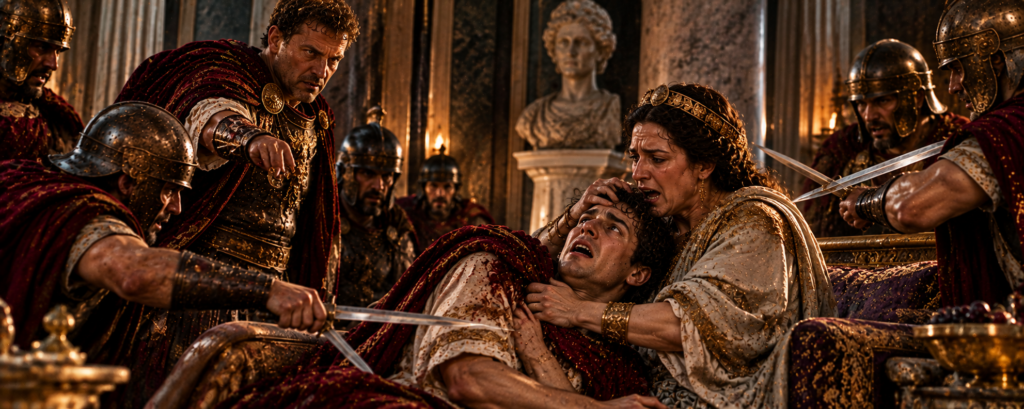
Geta: The Emperor Murdered in His Mother’s Arms by His Own Brother
Publius Septimius Geta (189–211 CE) | Roman Emperor, 209–211 CE | Assassinated in Rome on the Orders of His Brother Caracalla
A Mother’s Embrace Could Not Save an Emperor
In December 211 CE, a young Roman emperor entered his mother’s private apartments believing that a meeting had been arranged to end the bitter feud threatening to destroy his family. His older brother had apparently agreed to discuss reconciliation, and their mother, Julia Domna, would be present to help settle their differences. For months, the two imperial brothers had lived in an atmosphere of suspicion, surrounded by guards and terrified that the other was plotting murder. Now, within the supposed safety of their mother’s rooms, the rivalry was about to reach its horrifying conclusion.
According to the Roman historian Cassius Dio, the meeting was a trap. Caracalla had arranged for armed men to enter the apartments and murder his younger brother, Geta, before he could escape. When the assassins appeared, Geta reportedly rushed toward his mother, desperately seeking protection from the soldiers sent to kill him. Julia Domna attempted to shield her son, but the attackers struck him down while he clung to her.
The ancient accounts describe an appalling scene in which the empress was unable to save her child. Her efforts to protect Geta reportedly left her injured, and she was forced to witness his death at close range. The murder was not committed on a battlefield or during a public rebellion, but inside the imperial household, where the victim had been persuaded to trust his own family. The brother who had shared his childhood, his father’s victories, and the Roman throne had become the architect of his destruction.
Geta was only twenty-two years old. He had been an emperor for approximately two years, although his period of independent joint rule with Caracalla lasted less than a year after their father’s death. His murder eliminated the last obstacle standing between Caracalla and sole control of the Roman Empire. Yet the assassination was only the beginning of the violence.
Caracalla reportedly ordered a sweeping purge of people associated with his brother. Senators, officials, soldiers, servants, and members of the imperial household could become targets if they were suspected of supporting Geta. Ancient writers claimed that thousands were killed, although their enormous casualty figures cannot be independently verified. The surviving accounts nevertheless leave little doubt that the murder was followed by substantial political repression.
Even death was not enough to satisfy Caracalla. Geta’s name was removed from inscriptions, his portraits were attacked, and his public memory was systematically condemned. Images that once displayed the imperial family together were altered to remove the murdered brother. The surviving physical evidence of this destruction remains among the most haunting reminders of the assassination.
The story of Geta is therefore more than another Roman succession dispute. It is the history of a dynasty that survived civil wars and foreign enemies but could not survive the hatred between two brothers. It is also the story of a mother whose political influence could not prevent the destruction of her own family. Above all, it reveals how imperial power could transform an ordinary sibling rivalry into murder, mass repression, and an attempt to erase a human being from history.
The Dynasty Built by a Ruthless Father
Geta was born on March 7, 189 CE, into a family that would soon become one of the most powerful in the Roman world. His father, Septimius Severus, was a distinguished Roman senator and military commander originally from Lepcis Magna in North Africa. His mother, Julia Domna, came from an influential priestly family in Emesa, in Roman Syria. Their marriage united two prominent provincial families whose ambitions would eventually reshape the empire.
At the time of Geta’s birth, Severus had not yet become emperor. He was advancing through the political and military offices available to successful Roman aristocrats, while the empire remained under the increasingly unstable rule of Commodus. Geta’s older brother, Lucius Septimius Bassianus, had been born the previous year. The brothers were separated by less than twelve months, a small difference in age that would eventually carry enormous political consequences.
The Roman Empire entered a succession crisis following the assassination of Commodus on December 31, 192. His death ended the direct ruling line of the Antonine dynasty and opened a struggle among ambitious military commanders. Pertinax briefly occupied the throne before being murdered by the Praetorian Guard. Didius Julianus then secured imperial power through the notorious bidding contest associated with the guardsmen.
Severus, commanding troops in Pannonia, refused to accept the new ruler. His soldiers proclaimed him emperor in 193, and he marched toward Rome with a powerful army. Julianus was abandoned and executed before Severus entered the capital. Yet the struggle for the empire was far from over.
Other commanders claimed the throne, including Pescennius Niger in the east and Clodius Albinus in the west. Severus defeated Niger after a series of campaigns and eventually destroyed Albinus’s forces at the Battle of Lugdunum in 197. His victories secured the throne through military force and established the Severan dynasty. The empire’s new ruling family had been created through civil war, executions, and the defeat of political rivals.
Geta spent his earliest years surrounded by the consequences of these struggles. His father had learned that Roman imperial power depended upon military loyalty and the ruthless elimination of competitors. These lessons would shape the political environment in which both brothers were raised. Tragically, they would also help explain the methods Caracalla later used against Geta.
Two Princes Raised Beneath the Same Crown
Geta and Caracalla grew up within an imperial household that was wealthy, politically influential, and increasingly dangerous. Their father controlled the Roman Empire, while their mother occupied a prominent position within the court. The brothers received the privileges and education expected of imperial princes. Yet their future responsibilities were never entirely equal.
Caracalla was the elder son and therefore enjoyed an early advantage in the succession. Severus promoted him as the principal heir, giving him titles and honors that established his position before Geta received comparable recognition. In 195, Caracalla was renamed Marcus Aurelius Antoninus, linking the new dynasty symbolically with the respected Antonine emperors. The change strengthened the family’s claims to legitimacy.
In 198, following Severus’s victories in the east, Caracalla was elevated to the rank of Augustus. This made him an emperor alongside his father, although Severus remained the dominant ruler. Geta received the junior title Caesar, identifying him as a member of the ruling dynasty and a potential successor. The arrangement placed both sons within the imperial government but established a clear hierarchy between them.
For Geta, the distinction must have been politically significant. His brother possessed the senior imperial title while he remained a junior partner. Public ceremonies, official documents, and military honors reinforced their different positions. The structure encouraged competition even while presenting the family as united.
The brothers’ relationship became the subject of increasingly hostile stories. Ancient writers claimed that they quarreled over games, entertainments, companions, and personal preferences. Some accounts portray their rivalry as beginning in childhood and becoming progressively more bitter. These anecdotes may preserve genuine memories, but they also reflect the tendency of historians to interpret childhood behavior through the knowledge of later tragedy.
It is impossible to know whether the brothers were always enemies. Their eventual conflict encouraged ancient writers to portray every disagreement as evidence of a lifelong hatred. Ordinary sibling rivalry may have been exaggerated into a story of inevitable destruction. What can be established is that their political positions eventually became incompatible.
Julia Domna: The Mother at the Center of the Empire
Julia Domna was far more than a ceremonial imperial wife. Born into an influential family in Emesa, she possessed connections, education, and political intelligence that helped her navigate the Roman court. Her marriage to Septimius Severus placed her at the center of imperial government. As the mother of two potential successors, she also became essential to the dynasty’s future.
Roman imperial women could exercise considerable influence without holding formal military commands. They managed household relationships, supported political alliances, received petitions, and helped shape the public image of the ruling family. Julia Domna became particularly prominent in these roles. Her titles and public appearances emphasized her importance to the dynasty.
She was associated with the title Mater Castrorum, meaning Mother of the Camps, connecting her symbolically with the army. The designation reinforced the relationship between the imperial family and the soldiers upon whom Severus depended. It also reflected Julia’s unusual visibility during military campaigns. She accompanied her husband and sons during important periods of imperial activity.
Ancient sources portray her as intelligent, influential, and deeply involved in the political life of the court. She was also associated with intellectual and philosophical circles, although the details of those relationships are not always clear. Her reputation suggests a woman capable of exercising authority in a political environment dominated by powerful men. Yet her influence had limits.
Those limits became painfully apparent in her attempts to manage the relationship between her sons. Julia had every reason to preserve cooperation between Caracalla and Geta. Their rivalry threatened the dynasty her husband had spent years establishing. If either brother destroyed the other, the entire family would suffer.
The tragedy of Julia Domna lies partly in this contradiction. She possessed enough influence to participate in imperial government, but not enough to control the ambitions of her children. Her political skills could negotiate appointments and manage court relationships. They could not overcome the increasingly dangerous struggle for the throne.
The Rivalry That Became a Family Curse
Ancient historians describe Caracalla and Geta as fundamentally incompatible personalities. Caracalla was portrayed as aggressive, suspicious, and increasingly attracted to military life. Geta was sometimes described as more sociable or restrained, although the surviving accounts also criticize his behavior. The contrast became a convenient way to explain their eventual conflict.
Herodian, writing in the third century, emphasizes their mutual hostility. He describes the brothers competing over companions, entertainments, and political influence. Their disagreements reportedly became so intense that members of the imperial household divided into rival groups. Courtiers and officials had to consider which prince might eventually control the empire.
Such competition was particularly dangerous because the brothers were not merely private individuals. Their personal preferences could influence appointments, patronage, and access to imperial favor. Supporting one prince might bring advancement if he became sole ruler. It could also mean destruction if the other prevailed.
The court therefore had incentives to encourage rivalry. Ambitious officials could attach themselves to one brother and portray the other as dangerous. Personal disagreements became entangled with political calculations. Every argument potentially affected the future distribution of power.
Severus appears to have recognized the problem. He attempted to maintain the appearance of family unity while gradually elevating Geta’s position. Yet his solution was to give both sons a share in imperial authority. That arrangement increased Geta’s legitimacy but also intensified the possibility of competition.
The brothers were growing toward a future in which both possessed imperial titles, supporters, and expectations. Neither could easily surrender his position without becoming vulnerable. Their father’s desire to preserve the dynasty through shared rule would ultimately place them in direct conflict. The imperial household was becoming a political battlefield.
The Fall of Plautianus and the Violence of Court Politics
One of the most revealing episodes of the brothers’ youth involved Gaius Fulvius Plautianus, the powerful Praetorian prefect and close associate of Septimius Severus. Plautianus accumulated extraordinary influence within the imperial government. His daughter, Fulvia Plautilla, married Caracalla in 202, strengthening the prefect’s connection to the ruling family. The marriage was politically advantageous but personally disastrous.
Caracalla reportedly despised Plautilla and resented the arrangement. Ancient writers describe an unhappy marriage marked by hostility and suspicion. The relationship placed the young prince under the influence of a powerful official whose ambitions he may have regarded as threatening. Plautianus’s position also complicated the balance of power within the imperial household.
In 205, Plautianus was accused of plotting against Severus and Caracalla. The circumstances remain disputed, and ancient accounts differ concerning the reliability of the allegations. He was killed after being summoned to the palace, and his political influence collapsed. His family suffered the consequences.
Plautilla was exiled, and Caracalla’s marriage effectively ended. She was later killed during Caracalla’s reign, according to the surviving sources. The episode demonstrated how quickly members of the imperial family could be destroyed when political alliances failed. Marriage offered no protection against accusations of treason.
Geta witnessed these events as a young prince. The destruction of Plautianus revealed the dangers of court intrigue and the importance of controlling access to the emperor. It also demonstrated that Caracalla could benefit from the removal of powerful individuals he disliked. Whether Geta interpreted the episode as a warning cannot be known.
The broader lesson was unmistakable. Within the Severan court, political disputes could end in execution, exile, and the destruction of entire households. The brothers were being prepared to govern an empire in which violence remained a familiar instrument of power. Their eventual conflict would follow the same pattern on a far more devastating scale.
The British Campaign That Was Supposed to Unite Them
By 208, Septimius Severus was an aging emperor facing renewed military challenges in Britain. Roman authority remained secure in much of the province, but northern campaigns demanded attention. Severus decided to travel to Britain and personally direct military operations. Both of his sons accompanied him.
Ancient writers suggest that Severus hoped military service would improve the brothers’ relationship. Their behavior in Rome had reportedly become increasingly troublesome, and the emperor wanted them to gain experience away from the temptations of the capital. Campaigning together might encourage cooperation and discipline. It would also prepare them for the responsibilities of imperial government.
The expedition took the family to the northern edge of the Roman world. The army operated from established bases in Britain and conducted campaigns beyond Hadrian’s Wall. Difficult terrain, harsh weather, and determined resistance made the operations demanding. The campaign exposed the princes to the realities of military command.
Caracalla accompanied his father during important military activities. Geta appears to have been entrusted with administrative responsibilities, although the precise division of duties is not entirely clear. The arrangement may have reflected their different interests or Severus’s desire to prepare both sons for government. It also reinforced their separate political roles.
In 209, Geta was elevated to the rank of Augustus. He now possessed the same senior imperial title as his father and brother. The promotion formally established three emperors within the Severan dynasty. It was intended to strengthen succession arrangements and preserve family authority.
Yet the elevation did not resolve the rivalry. If anything, it increased the stakes. Geta was no longer merely a junior prince who could be excluded from power without serious political consequences. He had become a recognized emperor with an independent claim to authority.
The Emperor Who Feared His Own Son
The British campaign became associated with disturbing stories about Caracalla’s ambitions. Cassius Dio and Herodian report that Caracalla became impatient for his father’s death and attempted to accelerate his accession. Some accounts describe an alleged attempt to attack Severus during a military movement. Others suggest that Caracalla sought to influence the emperor’s physicians.
These stories must be treated cautiously. The surviving historians were hostile toward Caracalla, and their narratives often emphasized his cruelty and ambition. The details may have been exaggerated to portray him as a man willing to murder his own father. Nevertheless, the accusations reveal how deeply suspicion surrounded the imperial family.
Dio preserves a dramatic account in which Severus confronted Caracalla after an alleged attempt upon his life. The emperor supposedly challenged his son to kill him openly rather than rely upon treachery. The scene is memorable, but its precise dialogue cannot be verified. It should be understood as an ancient report rather than a documented conversation.
If Severus genuinely feared Caracalla’s ambition, the situation was extraordinarily dangerous. The emperor had elevated his eldest son to share the throne, yet that same son might have viewed his continued life as an obstacle. Geta’s presence created an additional complication. Caracalla could not become sole ruler while either his father or brother remained alive.
The campaign therefore failed to create the unity Severus had hoped for. The brothers continued to distrust each other, and the aging emperor’s health deteriorated. His efforts to establish a stable succession had produced two powerful heirs who could not cooperate. The dynasty approached its greatest crisis.
The final months of Severus’s life were overshadowed by illness and the uncertainty of succession. His military achievements had secured the empire, but he could not guarantee peace within his household. The danger was no longer simply that foreign enemies might defeat Rome. It was that his own sons might destroy one another.
The Death of Septimius Severus
Septimius Severus died at Eboracum, modern York, on February 4, 211. He had ruled the Roman Empire for nearly eighteen years and survived numerous military and political challenges. His death ended the career of a ruler who had established his dynasty through civil war and maintained it through military strength. It also removed the only figure capable of imposing authority upon both brothers.
Ancient tradition attributes memorable final advice to Severus. He supposedly urged his sons to remain united, reward the soldiers, and disregard other concerns. The wording survives through literary sources and cannot be treated as a verbatim deathbed statement. Nevertheless, the sentiment reflects the political realities of his reign.
The emperor understood the importance of military loyalty. His own accession had depended upon soldiers, and his victories had established the dynasty. He also understood the danger posed by divided leadership. His sons would need to cooperate if they hoped to preserve the empire.
Caracalla and Geta inherited the throne together. Both were already Augusti, and neither needed a new proclamation to establish his imperial status. Their father’s death therefore created a joint reign rather than a conventional succession from one emperor to another. The arrangement was legally possible but politically unstable.
The brothers organized their father’s funeral and returned toward Rome. Severus was honored through the ceremonies appropriate to a deceased emperor, and his memory became part of the dynasty’s legitimacy. Publicly, the family could still present itself as united in grief. Privately, the rivalry had entered a far more dangerous phase.
Without their father, neither brother possessed an unquestioned superior. Caracalla was older and had held the title Augustus longer, but Geta was also a legitimate emperor. Each had supporters and access to political influence. Their relationship had become a struggle between two men who could not easily accept subordination.
Two Emperors, One Throne
The joint reign of Caracalla and Geta began with an unresolved question. Could two brothers who reportedly despised one another govern the Roman Empire together? Shared imperial rule was not unprecedented, and earlier emperors had successfully delegated responsibilities. Yet cooperation required trust, and trust was precisely what the brothers lacked.
Marcus Aurelius and Lucius Verus had ruled jointly during the second century. Their arrangement demonstrated that multiple emperors could coexist when responsibilities and authority were carefully managed. Severus may have hoped his sons would follow a similar model. The comparison, however, concealed important differences.
Caracalla and Geta were close in age and had grown up competing for influence. Neither possessed the overwhelming prestige that Marcus Aurelius had enjoyed over Lucius Verus. Their personal rivalry had become entangled with political factions. Each feared that the other might eventually seize complete control.
Herodian describes their government as increasingly dysfunctional. Decisions concerning appointments, administration, and court affairs reportedly became subjects of bitter disagreement. The brothers struggled to cooperate even when the interests of the empire demanded it. Their personal hostility threatened the functioning of the imperial household.
The danger extended beyond ordinary political disagreement. An emperor possessed access to guards, officials, and military resources. If either brother believed the other was planning murder, defensive precautions could quickly become preparations for assassination. Mutual suspicion created a situation in which violence appeared increasingly likely.
The joint reign therefore became a contest for survival. Each brother needed to preserve his supporters and prevent the other from gaining an overwhelming advantage. Compromise could appear dangerous because it required trusting an enemy. The throne that Severus had intended them to share became the prize neither was willing to divide.
The Palace Divided Against Itself
According to Herodian, the imperial palace became physically divided between the brothers. Separate areas were assigned to their households, and access between them was restricted. Guards watched entrances, and the brothers reportedly avoided unnecessary contact. The residence of the Roman emperors had become a fortified environment of mutual suspicion.
The arrangement reflected the extraordinary breakdown of trust. Members of the same family lived within the same palace but feared assassination from one another. Servants, attendants, and officials had to navigate competing loyalties. Ordinary household activities could acquire political significance.
Ancient writers claimed that the brothers feared poisoning. They reportedly avoided sharing meals and became suspicious of food prepared by people associated with the other household. Such fears were common in Roman accounts of imperial intrigue. Whether every detail is accurate remains uncertain, but the general atmosphere of distrust is well attested.
The palace division also created practical difficulties. Imperial administration depended upon communication between officials and the rulers they served. If the emperors refused to cooperate, appointments and decisions could become contested. Rival households might issue conflicting instructions or attempt to influence the same officials.
Julia Domna tried to mediate between her sons. Her position as their mother gave her a personal connection to both, while her experience in government made her an important political intermediary. She had spent years supporting the dynasty and understood the consequences of a violent succession struggle. Yet neither brother was willing to surrender his ambitions.
The palace increasingly resembled a court awaiting a coup. The guards who were supposed to protect the imperial family also possessed the means to kill its members. Each brother had reason to fear betrayal. The physical barriers separating them could delay violence, but they could not resolve the conflict.
The Empire That Almost Became Two
One of the most extraordinary stories surrounding the brothers concerns a proposal to divide the Roman Empire between them. Herodian reports that Caracalla and Geta considered separating the eastern and western provinces. One brother would govern from Rome, while the other would establish his authority in the east. The arrangement would have transformed their personal rivalry into a territorial division.
The proposal is historically significant because it anticipated later developments in Roman government. The empire was vast, and administering its distant provinces presented serious challenges. Dividing responsibilities between rulers could offer practical advantages. Yet the alleged plan of 211 arose from hostility rather than a carefully developed administrative system.
Herodian presents the division as a desperate attempt to prevent violence. The brothers could not cooperate within a single government, so separating their territories appeared to offer an alternative. Such an arrangement might have reduced direct contact. It would not necessarily have ended their rivalry.
The proposed division raised difficult questions. Military forces, financial resources, and frontier responsibilities would need to be allocated between the two governments. Each brother might fear that the other was preparing for war. Rival courts could encourage provincial loyalties that threatened imperial unity.
Julia Domna reportedly opposed the proposal. Herodian describes her warning that the empire could not be divided without destroying the family and the unity of Roman power. The precise words attributed to her are literary reconstruction rather than a verified speech. Nevertheless, her opposition fits the political position she occupied.
The proposal was not implemented. Whether it was seriously considered or exaggerated by Herodian remains uncertain. The episode nevertheless illustrates how far the brothers’ relationship had deteriorated. They were contemplating the division of the Roman world because they could not tolerate sharing its government.
The Dangerous Politics of Choosing Sides
As the rivalry intensified, officials throughout the imperial household faced an increasingly dangerous choice. Supporting Caracalla might bring rewards if he became sole emperor. Supporting Geta offered similar opportunities but carried equally serious risks. Remaining neutral could become difficult when both brothers demanded loyalty.
The Roman Senate had reasons to fear the conflict. Senators depended upon imperial favor for appointments, honors, and personal security. A violent succession could expose them to accusations of supporting the losing side. The memory of earlier civil wars made the danger familiar.
Military commanders faced even greater pressure. Soldiers could determine which emperor survived, and the brothers needed their support. Caracalla had developed a strong association with military life, particularly through his father’s campaigns. Geta’s supporters could not ignore the possibility that the army might favor his brother.
The Praetorian Guard occupied a particularly important position. Its soldiers protected the imperial household and controlled access to the rulers. In previous succession crises, the guards had murdered emperors and elevated new ones. Their loyalty could therefore decide the brothers’ struggle.
Court officials also possessed dangerous knowledge. They understood the brothers’ movements, personal routines, and security arrangements. Such information could be used to protect an emperor or facilitate an assassination. The distinction depended upon loyalty.
The rivalry therefore spread beyond the family. It created factions within the institutions responsible for governing and defending the empire. The brothers’ inability to cooperate threatened the safety of everyone associated with them. A private feud had become a political crisis affecting the entire Roman state.
Caracalla Decides That One Brother Must Die
By late 211, Caracalla appears to have concluded that joint rule could not continue. Ancient sources portray him as determined to eliminate Geta and become sole emperor. His motives were political as well as personal. Geta possessed a legitimate claim to the throne and could attract support from officials dissatisfied with Caracalla.
The existence of two emperors created a permanent threat. Even if Geta agreed to surrender authority, his imperial status and family connections would remain. Supporters could later encourage him to reclaim power. Caracalla may have believed that only death could remove the danger completely.
Cassius Dio reports that Caracalla initially attempted to arrange his brother’s murder during the Saturnalia festivities. The festival occurred in December and was associated with feasting, social relaxation, and temporary reversals of ordinary customs. An assassination during such celebrations would have exploited a moment when security arrangements might be less rigid. According to Dio, the attempt failed.
The precise circumstances of this alleged first attempt remain uncertain. Dio’s account is important but does not provide a complete independent record. It is possible that later writers organized several rumors into a sequence leading toward the final murder. Nevertheless, the tradition suggests that Caracalla was actively seeking an opportunity to kill Geta.
A direct attack within the palace carried risks. Geta possessed guards and supporters, and an unsuccessful attempt could provoke retaliation. Caracalla therefore needed a situation in which his brother would lower his defenses. Their mother offered the ideal means of creating such an opportunity.
Julia Domna had repeatedly attempted to reconcile her sons. A meeting arranged through her could appear safer than a private encounter between the brothers. Geta might believe that Caracalla would hesitate to commit violence in their mother’s presence. If so, that confidence proved tragically misplaced.
The Reconciliation That Was Never Meant to Happen
The final meeting was presented as an opportunity to restore peace within the imperial family. According to the ancient accounts, Caracalla arranged for Geta to come to Julia Domna’s apartments. Their mother would be present, and the brothers would supposedly discuss reconciliation. The setting offered an appearance of safety that a formal political gathering might not have provided.
Geta had reason to be suspicious. The brothers had spent months fearing one another, and earlier attempts at cooperation had failed. Ancient writers suggest that he understood the danger of assassination. Nevertheless, he attended the meeting.
The surviving sources do not establish exactly what assurances persuaded him to enter the apartments. It is possible that Julia genuinely believed reconciliation remained achievable. She had devoted considerable effort to preserving cooperation between her sons. Her presence may have been intended to guarantee that the meeting would remain peaceful.
Caracalla, however, had reportedly prepared a different outcome. Armed men were positioned to attack Geta once he entered the private rooms. The precise number of assassins and their identities are not securely established. The accounts agree that the murder was carried out by men acting on Caracalla’s orders.
The choice of location was particularly cruel. Julia Domna’s apartments were not a battlefield or a public place of execution. They belonged to the private world of the imperial family. Geta was entering a space associated with his mother rather than an enemy commander.
The trap exploited the last remaining connection between the brothers. Their shared mother was the one person who had continued attempting to preserve their relationship. Caracalla used that relationship to bring Geta within reach. The attempted reconciliation became the instrument of murder.
The Murder in Julia Domna’s Arms
The assassination took place in December 211, although the precise day remains uncertain. Geta entered his mother’s apartments expecting a meeting with Caracalla. Armed men then attacked him, apparently before he could organize any effective defense. The emperor who had shared the Roman throne with his brother found himself trapped within the imperial household.
Cassius Dio describes Geta rushing toward Julia Domna and seeking protection in her arms. Herodian preserves a similar account of the murder, emphasizing the mother’s helplessness as her son was attacked. The image became one of the most famous scenes in Roman imperial history. It captured the horror of political violence invading the most intimate relationships of a family.
According to Dio, Julia attempted to protect Geta and was wounded during the struggle. The assassins nevertheless killed him while he clung to her. The exact movements of the participants cannot be reconstructed with certainty. The surviving descriptions were written as historical narratives rather than eyewitness transcripts of every action.
The central fact is not seriously disputed. Geta was murdered on Caracalla’s orders, and the killing occurred in circumstances that implicated the imperial household itself. The ancient accounts consistently portray Julia Domna as present and unable to prevent the assassination. Their agreement gives the broad outline considerable historical weight, even though the most dramatic details remain dependent upon literary testimony.
The murder was an act of deliberate political elimination. Geta was not killed during a spontaneous quarrel or an open military confrontation. He was lured into a meeting and attacked by armed men. His brother had arranged the circumstances that made the killing possible.
For Julia Domna, the event was a personal catastrophe. One son had ordered the death of the other, and she had reportedly witnessed the killing at close range. Her efforts to preserve the dynasty had failed in the most devastating possible way. The Roman Empire now belonged to the surviving brother.
A Mother Ordered Not to Mourn
The aftermath of Geta’s murder placed Julia Domna in an almost unbearable position. She had lost one son through the actions of the other, yet the surviving son controlled the empire. Her personal grief could become politically dangerous if it appeared to challenge Caracalla’s authority. Ancient accounts suggest that she was forced to conceal her sorrow.
Cassius Dio reports that Caracalla forbade his mother from openly mourning Geta. The detail is difficult to verify independently, but it reflects the atmosphere of repression that followed the assassination. Public grief could be interpreted as sympathy for the murdered emperor. Sympathy, in turn, could become evidence of political disloyalty.
Julia’s position was complicated by her continued importance to the government. She remained the mother of the reigning emperor and retained substantial influence within the imperial administration. Caracalla relied upon her experience and political abilities, particularly during periods when he was absent from Rome. Her survival therefore served his interests.
The relationship between mother and surviving son became one of the most disturbing aspects of the Severan dynasty. Julia had reportedly witnessed Caracalla’s men murder Geta, yet she continued to occupy a prominent place within his government. Whether she did so from necessity, political calculation, family loyalty, or a combination of motives cannot be known. The surviving evidence does not reveal her private thoughts.
It would be misleading to assume that continued service meant she had accepted the murder. Roman imperial women faced severe constraints when political violence occurred within their families. Open resistance could endanger their lives and the lives of their supporters. Remaining within the government might offer the only practical means of preserving influence.
Julia Domna’s later career demonstrates both her resilience and the limits of her power. She continued handling administrative responsibilities under Caracalla. Yet nothing she accomplished could reverse Geta’s death. The woman who had attempted to hold the dynasty together was forced to live within the political order created by its destruction.
The Emperor Who Claimed Self-Defense
Caracalla needed to justify the murder of his brother. Geta had been a legitimate Augustus, recognized by the Senate and the army. Killing him was not merely a family crime but the elimination of a reigning emperor. The surviving brother therefore faced the danger that officials and soldiers might regard him as a murderer and usurper.
His response was to claim that he had acted in self-defense. Ancient accounts describe Caracalla presenting Geta as the aggressor and portraying the killing as necessary for his own survival. The explanation transformed a planned assassination into an alleged response to conspiracy. It also provided a justification for punishing Geta’s supporters.
The argument exploited the brothers’ well-known rivalry. Both had reportedly feared assassination, and both maintained separate security arrangements. Caracalla could therefore claim that Geta had been plotting against him. The existence of mutual suspicion made the accusation superficially plausible.
Yet the circumstances of the murder undermine the official explanation. Geta was attacked during a meeting arranged through their mother, and the surviving sources identify Caracalla as the organizer. There is no convincing evidence that Geta was preparing an immediate attack during the encounter. The self-defense claim appears primarily as a political justification.
Caracalla also needed the support of the Praetorian Guard and the wider army. Soldiers might accept a single emperor more readily than a divided government, particularly if their loyalty was rewarded. The surviving sources describe financial inducements and promises used to secure military backing. Caracalla understood the importance of controlling the armed forces.
The murder therefore required more than the removal of Geta. It demanded the creation of an official narrative in which Caracalla was the threatened survivor rather than the aggressor. Those who challenged that narrative risked being identified as enemies of the emperor. The struggle over the meaning of Geta’s death began almost immediately.
The Purge That Followed the Murder
Geta’s assassination was followed by a wave of political repression. Ancient writers describe arrests, executions, and the elimination of individuals associated with the murdered emperor. The victims reportedly included members of the Senate, military officers, household servants, and people connected to Geta’s personal circle. The purge transformed a family murder into a broader campaign of political violence.
Cassius Dio gives an enormous figure of approximately twenty thousand people killed. The number has frequently been repeated in modern accounts, but it cannot be independently verified. Ancient historians sometimes used large casualty figures to emphasize the cruelty of rulers they disliked. The scale of the repression was substantial, but its exact numerical extent remains uncertain.
The purpose of the purge was clear. Geta had possessed supporters who might challenge Caracalla’s authority or seek revenge. Eliminating them reduced the possibility of rebellion. It also warned others against expressing sympathy for the dead emperor.
The repression created a climate of fear. People who had served Geta could become suspects simply because of their previous associations. Officials might denounce rivals to demonstrate loyalty to Caracalla. Personal grievances could be disguised as accusations of political conspiracy.
The violence also helped Caracalla consolidate control over the imperial administration. Positions held by Geta’s supporters could be redistributed to men loyal to the surviving emperor. Military commands and court appointments became instruments of political security. The government was reorganized around the authority of one ruler.
The consequences extended far beyond the immediate murder. Geta’s death destroyed his own life, but the purge threatened anyone whose career had depended upon him. The assassination became the beginning of a campaign to remove his political existence. The Roman state was being forced to behave as though one of its emperors had never legitimately ruled.
Papinian and the Price of Refusing to Justify Murder
Among the most famous victims associated with Caracalla’s repression was the jurist Aemilius Papinianus. Papinian had served as Praetorian prefect under Septimius Severus and was renowned for his legal expertise. His reputation made him one of the most respected figures in Roman jurisprudence. Later generations remembered him as a symbol of legal integrity.
Ancient traditions connect Papinian’s death with Geta’s murder. Some accounts claim that Caracalla demanded that the jurist provide a legal justification for killing his brother. Papinian supposedly refused, declaring that murder was easier to commit than to defend. The memorable saying became an enduring part of his reputation.
The exact circumstances are uncertain. The surviving accounts differ, and the famous statement may be a later moralizing invention. Papinian may have been killed because of political associations, personal hostility, or broader suspicions following Geta’s death. His refusal to justify fratricide cannot be established as a verbatim historical event.
Nevertheless, the tradition reveals how the murder was understood by later Romans. Papinian represented law and justice, while Caracalla represented arbitrary imperial violence. The jurist’s supposed refusal became a moral judgment upon the emperor’s actions. It suggested that no legal argument could transform the assassination into a legitimate act.
Papinian’s death also demonstrated the danger faced by prominent officials. Service under Severus did not guarantee safety under his son. Even men who had helped administer the dynasty could become victims when political loyalties shifted. The murder of Geta destabilized the entire governing elite.
The association between Papinian and the assassination therefore became historically powerful. Whether every detail is accurate or not, the episode captures the conflict between imperial command and legal principle. Caracalla could order executions, but he could not necessarily compel respected jurists to make those executions appear just. The memory of Papinian’s death became part of the moral indictment of his reign.
The Destruction of Geta’s Memory
Caracalla’s campaign against his brother did not end with the killing of Geta and his supporters. The surviving emperor also attempted to destroy Geta’s public memory. His name was removed from inscriptions, portraits were damaged, and official representations of the dynasty were altered. The policy is commonly described through the modern expression damnatio memoriae, or condemnation of memory.
The Romans possessed a long tradition of attacking the public honors of disgraced political figures. Statues could be removed, inscriptions altered, and names excluded from official records. Such measures were intended to signal that a person had lost public legitimacy. In Geta’s case, the condemnation was especially dramatic because he had been a recognized emperor.
His name was erased from numerous inscriptions across the empire. The physical removal sometimes left visible gaps where the letters had once appeared. These damaged surfaces remain valuable historical evidence. They reveal both the attempt to suppress his memory and the impossibility of eliminating every trace.
Portraits of Geta were also targeted. Some were destroyed, while others were altered or reused. Images showing the imperial family together could be modified to remove the murdered brother. The surviving examples provide a striking visual record of political repression.
The purpose was not simply to punish Geta after death. Erasing his honors helped Caracalla reshape the history of the dynasty. If Geta could be presented as a criminal or traitor, his murder might appear justified. Removing his public presence also discouraged expressions of loyalty.
Yet the campaign contained a fundamental contradiction. The very effort to erase Geta demonstrated how important he had been. His name had appeared widely because he was a legitimate member of the imperial government. Destroying those references could not undo the fact that he had ruled. Instead, the damaged monuments became enduring evidence of the violence committed against him.
The Family Portrait With a Missing Face
One of the most famous surviving images associated with Geta’s condemnation is the painted imperial family portrait commonly known as the Severan Tondo. The painting depicts Septimius Severus, Julia Domna, Caracalla, and a fourth figure whose face has been deliberately removed. The damaged figure is generally identified as Geta. The image offers a rare and unsettling glimpse of imperial family propaganda transformed by political violence.
The portrait originally presented the dynasty as a united household. Severus appeared with his wife and sons, emphasizing continuity and legitimate succession. Such images helped communicate stability to people throughout the empire. They were intended to make the ruling family recognizable and authoritative.
After Geta’s murder, the portrait was altered. His face was erased while the other family members remained visible. The result is visually disturbing because the absence is so obvious. The missing face becomes the most striking feature of the painting.
The image demonstrates the practical difficulty of suppressing memory. Removing Geta’s portrait did not make the family appear naturally complete. Instead, it left a visible wound in the composition. Anyone examining the altered image could recognize that something had been destroyed.
The surviving painting is especially valuable because many ancient portraits were made from materials that have not survived. Its preservation allows modern viewers to observe the consequences of political condemnation directly. The erased face is not merely a literary description. It is physical evidence of an attempt to remove a person from public representation.
The portrait also captures the tragedy of the Severan family. Severus had spent years establishing his sons as legitimate heirs. Julia Domna had attempted to preserve their cooperation. Caracalla ultimately destroyed his brother and ordered the removal of his image. The family portrait became a record of the dynasty’s collapse.
The Emperor Whose Name Became Dangerous
Ancient accounts suggest that mentioning Geta’s name could become politically dangerous under Caracalla. His condemnation extended beyond the removal of statues and inscriptions. Expressions of sympathy or continued loyalty might be interpreted as opposition to the surviving emperor. The result was an atmosphere in which memory itself could become suspicious.
The precise legal restrictions are difficult to reconstruct. Ancient writers sometimes dramatized the severity of imperial repression, and not every claim can be independently confirmed. Nevertheless, the destruction of Geta’s official honors is well documented. It demonstrates that his memory was subjected to systematic political attack.
The policy placed ordinary people in a difficult position. Geta had been an emperor whose name appeared on coins, inscriptions, and public monuments. Officials who had previously honored him could now be expected to remove those honors. Public loyalty had to change with the political fortunes of the ruling family.
The same problem affected soldiers. Men who had served under Geta or accepted his imperial authority could become vulnerable to suspicion. Their previous loyalty had been legitimate while he lived. After his murder, that loyalty might be reinterpreted as treason.
The condemnation also affected historical memory. Official records could be altered to minimize Geta’s role, while public representations emphasized Caracalla’s sole authority. Later historians therefore had to reconstruct the murdered emperor’s life from incomplete and politically damaged evidence. The surviving gaps are part of the story.
Caracalla’s attempt to suppress his brother’s name ultimately failed. Geta remains known precisely because ancient writers recorded the murder and because damaged monuments preserved evidence of the erasure. The effort to destroy his memory became one of the most memorable aspects of his reign. In attempting to make Geta disappear, Caracalla ensured that his brother’s absence would remain visible.
Was Geta Really the Innocent Brother?
The traditional narrative often presents Geta as the innocent victim of Caracalla’s cruelty. His murder was undoubtedly deliberate, and the surviving evidence strongly supports Caracalla’s responsibility. Yet the broader question of Geta’s character is more complicated. Ancient writers were not neutral observers, and their portraits of the brothers were shaped by the outcome.
Geta may have participated in political intrigue against Caracalla. Both brothers possessed imperial authority, and both had reasons to fear the other’s ambitions. Herodian describes mutual hostility rather than a simple conflict between an aggressor and a passive victim. The possibility that Geta sought greater power should not be dismissed.
The ancient accounts also contain criticisms of Geta’s behavior. Some portray him as indulgent, competitive, or attracted to the pleasures of court life. Such accusations may reflect conventional literary stereotypes about young princes. They provide little secure evidence of his actual personality.
The important distinction is between political rivalry and responsibility for murder. Geta may have distrusted his brother, cultivated supporters, and resisted subordination. None of those actions justified his assassination. The evidence identifies Caracalla as the ruler who arranged the fatal attack.
The surviving sources also give us limited access to Geta’s independent policies. His reign was brief, and his authority was shared with his father and brother. Much of his public activity occurred within the larger Severan government. It is therefore impossible to determine whether he would have become an effective long-term emperor.
Geta should not be transformed into an idealized ruler simply because he was murdered. He was a young imperial prince raised within a violent political system, and he may have shared some of its ambitions and assumptions. His tragedy lies in the deliberate destruction of his life and public existence. Historical sympathy does not require pretending that his character is fully known.
Caracalla’s Reign After the Murder
With Geta dead, Caracalla became the sole ruler of the Roman Empire. He no longer needed to negotiate with a brother who possessed equal imperial rank. The administration could issue commands through one emperor, and military loyalty could be directed toward a single figure. Yet the stability achieved through murder came at a terrible cost.
Caracalla devoted considerable attention to the army. He cultivated soldiers through financial rewards, military campaigns, and personal identification with military life. His policies reflected the lessons of his father’s reign. The support of the armed forces remained essential to his survival.
In 212, Caracalla issued the Constitutio Antoniniana, a major decree extending Roman citizenship to most free inhabitants of the empire. The measure transformed the legal status of enormous numbers of people. Its motives remain debated, including questions about taxation, imperial ideology, and administrative integration. The decree became one of the most consequential acts of his reign.
The reform demonstrates that Caracalla’s government cannot be understood solely through the murder of Geta. He exercised imperial authority on a vast scale and made decisions with long-term consequences. Yet the assassination remained central to his reputation. Ancient historians repeatedly returned to his cruelty and suspicion.
Caracalla also pursued military operations along the frontiers and later traveled east. His campaigns and administrative decisions required extensive resources. The army remained a central concern, and financial demands placed pressure upon the empire. His rule continued the military emphasis established by Severus.
The emperor’s political insecurity did not disappear after Geta’s death. Removing one rival could not eliminate every potential conspiracy. His reliance upon soldiers and willingness to punish perceived enemies reflected the dangerous environment in which he ruled. The murder that secured his throne also became part of the atmosphere of fear surrounding his government.
The Brother Who Became a Murder Victim Himself
Caracalla’s reign ended violently on April 8, 217. While traveling in the eastern provinces during preparations for operations against Parthia, he was assassinated by a soldier named Julius Martialis. The attack occurred near Carrhae after the emperor had stopped during his journey. The surviving accounts differ in details, but the assassination itself is well established.
The Praetorian prefect Macrinus was widely suspected of involvement. Ancient sources suggest that he feared Caracalla’s hostility and may have organized the murder to protect himself. The precise extent of his responsibility remains debated. He nevertheless benefited from the assassination and soon became emperor.
The circumstances created an extraordinary historical parallel. Caracalla had secured sole power by arranging the murder of his brother. Six years later, he was killed through a conspiracy associated with men within his own military entourage. The emperor who had relied upon violence to eliminate a rival ultimately fell victim to political violence himself.
It would be misleading to present his death as proof of divine punishment. Roman politics frequently produced assassinations, and Caracalla’s murder arose from specific military and political circumstances. Nevertheless, ancient writers often interpreted the event through the moral framework of his earlier crimes. His death seemed to complete a story of ambition and retribution.
Julia Domna survived both sons’ deaths. She was in the eastern provinces when news of Caracalla’s assassination reached her. Her political position collapsed with the end of his reign, and she died later in 217. Ancient accounts associate her death with illness and despair, although the precise circumstances remain uncertain.
The Severan dynasty did not disappear entirely. Julia Domna’s relatives later helped elevate Elagabalus and restore a branch of the family to imperial power. Yet the immediate household of Septimius Severus had been destroyed. Both sons were dead, and the succession their father had carefully arranged had ended in assassination.
The Mother Who Lost Everything
Julia Domna’s life offers one of the most tragic perspectives on Geta’s murder. She had married Septimius Severus before his rise to imperial power and supported him through civil wars and military campaigns. She became one of the most prominent empresses of the Roman world. Her sons were intended to continue the dynasty after their father’s death.
Instead, their rivalry destroyed the family. Geta was murdered in circumstances that ancient writers placed directly before her eyes. Caracalla became sole emperor through the killing and subjected his brother’s supporters to repression. Julia remained within the government despite the catastrophe.
Her continued political activity has sometimes been interpreted as evidence of extraordinary ambition or emotional restraint. Such interpretations are difficult to prove. The surviving sources reveal her public responsibilities more clearly than her private grief. Her decisions must be understood within the dangerous constraints of imperial politics.
Julia could not simply abandon her position without consequences. Her status, family connections, and political influence were tied to the ruling dynasty. Caracalla remained her son, regardless of his actions. Continuing to serve may have been both a practical necessity and an attempt to preserve what remained of the family’s authority.
After Caracalla’s assassination, the political world she had helped build collapsed. She had outlived her husband and both sons. The dynasty’s immediate succession had ended in violence, and a new ruler controlled the empire. Her death later in 217 closed the final chapter of the original Severan household.
The tragedy is especially striking because Julia had attempted to prevent the brothers’ conflict from becoming fatal. Her influence could shape government policy and court relationships, but it could not overcome the struggle for absolute power. The murder of Geta demonstrated the limits of even an exceptionally powerful empress. The imperial throne had become more important to Caracalla than the survival of his own family.
The Political Meaning of Fratricide
Geta’s murder belongs to a long history of rulers eliminating relatives who threatened their authority. Dynastic politics frequently created situations in which brothers, sons, uncles, and cousins possessed competing claims to power. Family relationships could strengthen legitimacy, but they could also produce dangerous rivalries. The Roman Empire was no exception.
The assassination was particularly shocking because Geta was not merely a potential claimant. He was already a reigning Augustus, recognized within the imperial government. His murder therefore constituted the deliberate elimination of a co-emperor. It was an act of fratricide and political assassination committed within the ruling dynasty.
Caracalla’s motives combined personal hostility with political calculation. He had grown up competing with Geta and increasingly feared sharing authority. Their joint reign created opportunities for factional conflict and possible civil war. Killing Geta removed the immediate rival but did not eliminate the underlying instability of Roman imperial politics.
The murder also exposed the weakness of hereditary succession. Septimius Severus had attempted to secure the dynasty by elevating both sons. He believed that shared authority could preserve family unity and prevent disputes after his death. Instead, the arrangement created two legitimate emperors who could not coexist.
The consequences extended beyond the family. The purge of Geta’s supporters affected senators, officials, soldiers, and members of the imperial household. The condemnation of his memory altered public monuments and official records. The entire Roman state became involved in the aftermath of the murder.
Geta’s assassination therefore illustrates how personal ambition could become institutional violence. A brother’s decision to eliminate a rival transformed the government, threatened thousands of lives, and reshaped historical memory. The crime was committed within a private family setting, but its consequences reached across the empire. Few Roman dynastic murders reveal the connection between household rivalry and political power so clearly.
The Sources Behind the Bloodstained Story
Much of what is known about Geta’s murder comes from Cassius Dio and Herodian. Both wrote relatively close to the events, although their perspectives and methods differed. Dio was a senator who lived through the Severan period and possessed considerable knowledge of Roman political life. Herodian produced a narrative history emphasizing the behavior of emperors and the consequences of political conflict.
Their accounts are invaluable but not beyond criticism. Dio was deeply hostile toward Caracalla and often emphasized his cruelty. Herodian favored dramatic storytelling and sometimes reconstructed conversations or motives that cannot be independently verified. Both writers interpreted events through moral and political assumptions.
The assassination itself is securely established. Geta died in December 211, and Caracalla was responsible for arranging his murder. The subsequent condemnation of Geta’s memory is supported by surviving inscriptions, portraits, and other material evidence. These facts do not depend solely upon literary descriptions.
The famous account of Geta dying in Julia Domna’s arms rests primarily upon ancient narrative testimony. It is consistent with the broader circumstances of the murder and appears in important surviving accounts. Nevertheless, no independent eyewitness record allows every movement or expression to be verified. The scene should therefore be presented as the ancient historians describe it, rather than as a fully documented reconstruction.
The same caution applies to the purge. Ancient writers report extensive executions, and the repression was undoubtedly serious. Yet the frequently repeated figure of twenty thousand deaths cannot be established with precision. It should be treated as an ancient claim rather than a verified count.
The surviving evidence also reveals the limitations of Geta’s biography. His own political views, personal relationships, and administrative decisions remain poorly documented. Much of his historical identity has been shaped by the circumstances of his death. The challenge is to recover the young emperor without allowing the murder narrative to become his entire life.
The Emperor Rome Tried to Forget
Geta’s historical legacy is unusual because the attempt to erase him became one of the strongest reasons he is remembered. Caracalla ordered the destruction of his public honors, but the process left visible traces. Damaged inscriptions, altered portraits, and surviving coins reveal the existence of the condemned emperor. The evidence preserves both his authority and the violence directed against his memory.
The surviving coins are particularly important. They show that Geta was publicly recognized as a member of the imperial government and later as Augustus. His image circulated across the empire, reaching people who may never have seen him in person. Such objects helped establish his legitimacy while he lived.
The inscriptions tell a different story. Where his name was removed, the damaged surfaces reveal the political consequences of his murder. The erasures were intended to deny him honor and legitimacy. Instead, they became evidence of the campaign against him.
The Severan Tondo offers an especially powerful example. The imperial family was originally represented together, but Geta’s face was later destroyed. The painting still preserves the other members of the household. Its damaged composition makes the absent brother impossible to ignore.
This contradiction lies at the heart of the condemnation of memory. Destroying a name or image can suppress public recognition, but it can also preserve evidence of the destruction. The gaps left behind become historical testimony. Geta’s absence speaks as clearly as his surviving portraits.
Caracalla succeeded in eliminating his brother from political life. He became sole emperor and controlled the government until his own assassination in 217. Yet he failed to eliminate Geta from history. The murder and the attempt at erasure ensured that the younger brother would remain permanently associated with one of Rome’s most notorious acts of dynastic violence.
The Brother Who Was Erased but Never Forgotten
Geta was born into a family that rose to power through military strength and political ambition. His father, Septimius Severus, survived civil wars, defeated rival claimants, and established a dynasty intended to govern the Roman Empire for generations. His mother, Julia Domna, became one of the most influential women of the imperial age. Geta and Caracalla were raised to inherit a throne their parents had fought to secure.
Yet the dynasty contained a fatal weakness. The brothers grew up competing for position and influence, and their rivalry intensified as they received imperial titles. Severus attempted to preserve stability by making both sons emperors. Instead, his death left them sharing an authority neither was willing to surrender.
The joint reign became a struggle defined by suspicion. Ancient writers describe separate households, guarded entrances, fears of poisoning, and constant disagreements over government. Julia Domna attempted to mediate, but the brothers increasingly regarded one another as threats. The imperial palace became a place where family loyalty offered little protection.
Caracalla eventually chose murder. He arranged a meeting through their mother and reportedly placed armed men in position to attack Geta. The younger emperor entered the apartments believing that reconciliation might still be possible. Instead, he encountered assassins acting on his brother’s orders.
According to the ancient accounts, Geta sought protection in Julia Domna’s arms as the attackers closed in. His mother attempted to shield him but could not prevent the killing. The precise details remain dependent upon literary testimony, yet the essential crime is clear. Caracalla arranged the assassination of his brother and fellow emperor.
The murder destroyed more than Geta’s life. Caracalla followed it with a purge of people associated with the dead ruler, while claiming that he had acted in self-defense. Ancient writers describe extensive executions and an atmosphere of fear. The surviving emperor then attempted to remove Geta’s name and image from public memory.
The physical evidence of that campaign remains extraordinary. Inscriptions bear the marks of deliberate erasure, and portraits reveal the destruction of a condemned emperor’s image. The Severan Tondo preserves the imperial family with Geta’s face removed. The painting has become a lasting symbol of political violence directed against memory itself.
Julia Domna survived the murder and continued serving within Caracalla’s government. Her position was one of terrible contradiction, combining political influence with personal loss. She had attempted to preserve cooperation between her sons, yet one had killed the other. Her continued public role could not undo the destruction of the family.
Caracalla’s own reign ended through assassination in 217. The emperor who had murdered his brother was killed by a soldier during a military journey in the east. His death did not restore Geta or reverse the purge. It merely added another violent succession to the history of the Severan dynasty.
Geta’s character remains difficult to reconstruct. Ancient writers portrayed him through the rivalry that ended his life, leaving little secure evidence of his independent political ambitions. He may have been competitive, suspicious, and deeply involved in court intrigue. None of those possibilities changes the nature of his murder.
His death reveals the dangers of a political system in which personal relationships and imperial authority became inseparable. A disagreement between brothers could threaten the government of an enormous empire. A mother’s private apartments could become the setting for a political execution. A surviving ruler could attempt to rewrite the public record by destroying the memory of his victim.
The tragedy is intensified by the fact that Geta was not an outsider attempting to seize power. He was a legitimate emperor, elevated by his father and recognized within the Roman state. He had shared the dynasty’s honors, ceremonies, and responsibilities. His brother killed him because that legitimacy made him dangerous.
Caracalla’s attempt to erase Geta ultimately produced the opposite of what he intended. The damaged inscriptions and altered portraits became enduring reminders of the crime. Historians continued recording the murder, and later generations remembered the young emperor whose life ended within his mother’s embrace. The effort to destroy his memory became inseparable from the story of his death.
More than eighteen centuries later, Geta remains one of the most haunting victims of Roman imperial politics. His assassination was not the result of a foreign invasion or a rebellion against the state. It was arranged by the person who should have been his closest political ally and protector. The empire’s most powerful family was destroyed by the struggle to possess power without sharing it.
Septimius Severus had built a dynasty through war and intended his sons to preserve it together. Instead, one son murdered the other, their mother was left to endure the consequences, and the surviving brother eventually fell to an assassin himself. The throne survived, but the family did not. Caracalla could command the destruction of Geta’s portraits, remove his name from monuments, and punish those who remembered him, but he could never erase the truth that Rome had once possessed two imperial brothers—and that one had murdered the other in their mother’s arms.