
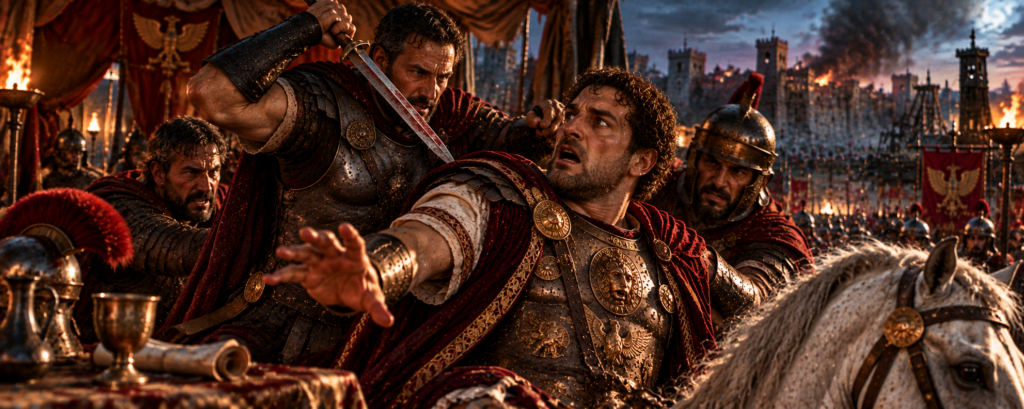
Gallienus: The Emperor Betrayed and Murdered by His Own Officers During the Siege of Milan
Publius Licinius Egnatius Gallienus (c. 213–268 CE) | Roman Emperor, 253–268 CE | Assassinated Near Mediolanum (Milan), September or October 268 CE
The Emperor Who Rode Into His Own Assassination
In the autumn of 268 CE, the Roman emperor Gallienus was preparing to destroy yet another rebellion when a warning reached him that appeared to demand his immediate attention. He was outside Mediolanum, modern Milan, where his army had surrounded the forces of Aureolus, a military commander who had betrayed him and challenged his authority. The emperor had spent years fighting foreign invaders, suppressing ambitious generals, and struggling to hold together an empire that seemed determined to tear itself apart. Now, with another enemy trapped and victory apparently within reach, the danger came not from the rebels behind Milan’s defenses but from the officers standing within his own camp.
According to one ancient account, Gallienus was interrupted during a meal by news that Aureolus had launched a sudden attack. The warning was urgent enough to send the emperor rushing for his weapons and horse before his attendants could properly accompany him. He rode out expecting to confront an enemy force, unaware that the alarm had been arranged by men who wanted him dead. In the confusion that followed, an officer attacked and killed him, bringing one of the longest and most troubled reigns of the third century to a violent end.
Other surviving accounts describe the assassination differently, and the precise sequence cannot be reconstructed with certainty. Some implicate senior commanders who feared the emperor’s authority, while others suggest a broader conspiracy involving men who would benefit from his removal. The names of Heraclianus, Cecropius, and Claudius appear in different traditions, although their exact roles remain disputed. What is clear is that Gallienus was murdered through treachery within his own military command while campaigning against Aureolus near Milan.
His death was a bitter conclusion to an extraordinary reign. Gallienus had survived the capture of his father by the Persians, the murder of one of his sons, repeated invasions, devastating epidemics, and the effective fragmentation of the Roman Empire into competing centers of power. He had fought enemies along the Rhine and Danube, confronted usurpers who claimed the imperial title, and attempted to reorganize Roman military power for an age of almost constant emergency. For fifteen years, including eight as sole emperor, he had remained alive while other rulers disappeared into the violence of the Crisis of the Third Century.
Yet the emperor who survived so many external threats could not survive the ambitions of his own officers. The assassination at Milan was not simply the removal of an unpopular ruler, nor can it be explained as the inevitable punishment of an incompetent emperor. Gallienus was a complicated figure whose failures were real, whose achievements were considerable, and whose reputation was badly damaged by hostile ancient writers. His murder helped open the way for a new generation of military emperors who would eventually restore much of Rome’s fractured authority.
To understand why Gallienus died, it is necessary to understand the empire he inherited, the family tragedies that marked his reign, and the increasingly dangerous relationship between Roman emperors and the soldiers who served them. His assassination was the final act in a struggle that had consumed nearly every part of his adult life. By the time his own officers turned against him, Gallienus had become both the defender of Roman imperial authority and a prisoner of the military system upon which that authority depended.
Born Into a World That Still Remembered Stability
Gallienus was probably born around 213 CE, although the precise date and place of his birth remain uncertain. His father was Publius Licinius Valerianus, the future Emperor Valerian, a distinguished Roman senator whose family belonged to the empire’s governing elite. His mother is generally identified as Egnatia Mariniana, although relatively little is securely known about her life. Unlike several third-century emperors who rose from comparatively obscure military backgrounds, Gallienus came from a family with established political standing.
His upbringing took place during the later years of the Severan dynasty, when Rome still possessed many of the outward appearances of imperial stability. The empire remained enormous, stretching from Britain and the Atlantic coast to the eastern Mediterranean and the frontiers of Mesopotamia. Its cities flourished, its roads connected distant provinces, and its armies defended borders that had been maintained for generations. Yet beneath that impressive structure, political instability was already becoming increasingly dangerous.
The reign of Caracalla had demonstrated how easily imperial family relationships could descend into murder. Caracalla had ordered the killing of his brother Geta in 211, eliminating a co-emperor whose existence threatened his control of the throne. Caracalla himself was assassinated in 217, and the following years witnessed further coups and violent changes of government. The imperial title offered extraordinary power, but it did not guarantee safety.
Gallienus was still a young man when the Severan dynasty finally collapsed. In 235, Emperor Alexander Severus and his mother, Julia Mamaea, were murdered by mutinous troops on the German frontier. The soldiers proclaimed Maximinus Thrax emperor, beginning the period conventionally known as the Crisis of the Third Century. Over the following years, Roman rulers would increasingly depend upon military acclamation, battlefield success, and the uncertain loyalty of their commanders.
Gallienus therefore entered adulthood in a political environment where assassination had become a familiar instrument of succession. He would have known that emperors could be destroyed by the very soldiers entrusted with defending them. His father’s senatorial standing offered opportunities for advancement, but it also placed the family within a dangerous world of political competition. By the time Gallienus reached the throne, he had already witnessed the destruction of several imperial governments.
The Bloody Road to His Father’s Throne
The years preceding Valerian’s accession were marked by extraordinary violence. Maximinus Thrax was murdered by his soldiers in 238 after a disastrous siege of Aquileia. The same year witnessed the brief reigns and violent deaths of Gordian I, Gordian II, Pupienus, and Balbinus. The young Gordian III eventually emerged as emperor, but even his longer reign ended under uncertain circumstances during a Persian campaign in 244.
Philip the Arab succeeded Gordian III and ruled until 249, when Decius challenged his authority. Decius had been sent to restore order along the Danubian frontier, but his soldiers proclaimed him emperor. Philip was defeated and killed during the resulting civil war. Once again, the army had transformed a commander into a rival claimant.
Decius himself died in 251 during a disastrous battle against the Goths at Abrittus. His successor, Trebonianus Gallus, inherited an empire threatened by foreign invasion, disease, and military unrest. Gallus attempted to stabilize the situation, but his authority was weakened by renewed Gothic pressure and the growing ambitions of provincial commanders. In 253, the general Aemilian achieved military success against the Goths and was proclaimed emperor by his troops.
Aemilian marched toward Italy, where Gallus and his son Volusian were murdered by their own soldiers. The victorious commander received recognition as emperor, but his triumph lasted only a few months. Valerian, who commanded forces in the northern provinces, was proclaimed emperor by his own army and advanced against Aemilian. Rather than fight, Aemilian’s soldiers murdered their ruler and accepted Valerian.
Gallienus’s father had therefore acquired the throne through another military succession crisis. The new emperor possessed considerable senatorial experience, but his accession depended upon armed support. He understood that the empire’s problems were too extensive for one ruler to manage easily. Almost immediately, he brought his son into the imperial government.
In 253, Gallienus was elevated to the rank of Augustus, becoming co-emperor alongside Valerian. The arrangement gave Rome two adult rulers capable of supervising military operations in different regions. It also created a dynastic partnership intended to provide continuity after years of violent succession. For Gallienus, however, the elevation marked the beginning of a reign that would be dominated by war, rebellion, and personal tragedy.
Father and Son Divide a Fracturing Empire
The decision to establish two emperors was a practical response to the empire’s military problems. Rome faced serious threats along the Rhine and Danube, while the Sasanian Persian Empire challenged its eastern territories. Communications were slow, armies required personal leadership, and successful commanders could become politically dangerous if left without imperial supervision. Valerian and Gallienus attempted to divide their responsibilities so that both major theaters could receive direct attention.
Valerian concentrated primarily upon the eastern provinces, where Persian aggression threatened important Roman territories. Gallienus took responsibility for much of the western empire, including the Rhine and Danubian frontiers. The arrangement allowed each emperor to respond to regional emergencies without waiting for instructions from the other. It also meant that father and son would spend much of their joint reign separated by enormous distances.
Their partnership was unusual but not entirely unprecedented. Earlier emperors had shared power with sons, brothers, or adopted colleagues, although such arrangements sometimes ended in rivalry. The Severan dynasty had demonstrated the dangers when Caracalla and Geta became joint rulers and one brother murdered the other. Valerian and Gallienus appear to have maintained a functioning political partnership rather than descending into open conflict.
Gallienus quickly became involved in military operations along the northern frontiers. Germanic groups threatened Roman territory, and the emperor needed to demonstrate that the new dynasty could defend the provinces. His campaigns brought victories and imperial titles celebrating success against foreign enemies. These achievements helped establish his reputation among the troops.
Yet the scale of the crisis was already overwhelming. The empire’s borders extended across thousands of miles, and enemies could attack several regions simultaneously. Moving an army to defend one province might expose another to invasion. Every military success therefore risked being overshadowed by disaster elsewhere.
The joint government survived for approximately seven years, but it never achieved lasting stability. Valerian’s eastern campaigns would eventually end in one of the most humiliating defeats in Roman history. Gallienus would then inherit sole responsibility for an empire whose authority had been shattered by the capture of its senior ruler.
Cornelia Salonina: The Empress Beside a Troubled Emperor
Gallienus was married to Cornelia Salonina, an empress whose historical presence is better documented through coins and official imagery than through detailed personal accounts. Her family background and early life remain uncertain, although her name suggests connections with the Roman elite. She received the title Augusta during her husband’s reign and appeared prominently in imperial coinage. Her image helped present the ruling household as a stable dynasty during an exceptionally unstable period.
The marriage produced several sons, including Valerian II, Saloninus, and Marinianus. Their positions within the imperial family carried enormous political significance because succession remained one of Rome’s most dangerous problems. A son elevated to imperial rank could provide continuity, but he could also become a target for rivals. The family would discover this danger repeatedly.
Salonina’s coinage often associated her with traditional virtues and divine protection. Such imagery was common for Roman empresses, but it acquired particular importance during the crisis. The imperial household needed to project permanence while armies rebelled and provinces faced invasion. A stable family image could reassure supporters that the government possessed a future.
Ancient sources provide little reliable information about Salonina’s private relationship with Gallienus. Later writers sometimes emphasized the emperor’s alleged sexual excesses, but those accounts belong to a hostile literary tradition and cannot be accepted uncritically. The surviving evidence does not justify inventing marital scandals or presenting accusations as established fact. Much of the couple’s private life remains unknown.
Salonina nevertheless occupied a position of extraordinary danger. Her husband spent much of his reign campaigning against enemies, while their sons were drawn into the political and military responsibilities of the dynasty. The imperial household became a symbol of legitimacy and therefore a potential target for rebellion. By the time Gallienus was murdered, the family had already endured devastating losses.
The empress’s own fate after the assassination is uncertain. Some modern reconstructions suggest that she may have died around the same time as her husband, but the evidence is not conclusive. What can be said is that her public prominence largely disappears with the collapse of Gallienus’s regime. Like many imperial women of the third century, she remains visible in official portraits while much of her personal experience has vanished from history.
The First Son Lost to the Crisis
Gallienus’s family tragedies began before his father’s capture. His eldest son, Valerian II, was elevated to the rank of Caesar while still young. The appointment was intended to strengthen the dynasty and provide another visible representative of imperial authority. The boy was associated with the military command structure in the Danubian region, where experienced officers supervised frontier operations.
Valerian II died around 258, although the precise circumstances remain uncertain. Some ancient traditions connect his death with military intrigue, while others provide little explanation. The surviving evidence does not allow a confident conclusion that he was murdered. His death nevertheless removed an important dynastic heir at a dangerous moment.
The loss exposed the vulnerability of imperial children who were placed near military centers. Their titles made them politically valuable, but their youth prevented them from exercising independent control. They depended upon senior officers whose loyalty could change. In a period of frequent rebellion, that dependence was dangerous.
Gallienus responded by continuing to establish his family within the imperial system. Another son, Saloninus, was elevated to the rank of Caesar and associated with the western frontier. The intention was to maintain dynastic authority in regions where the emperor could not always be present. Yet the arrangement would produce an even more devastating tragedy.
The death of Valerian II also demonstrates the personal cost of the empire’s political instability. Gallienus was not merely defending distant provinces or issuing military orders. He was attempting to preserve a ruling family whose members were exposed to the same dangers as the state itself. Every succession arrangement created another possible target.
The emperor would eventually lose his father to Persian captivity and Saloninus to rebellion. These disasters occurred while Gallienus was struggling to maintain military control over the western provinces. His family history became inseparable from the wider collapse of Roman authority.
The Catastrophe at Edessa
In 260 CE, Emperor Valerian suffered a disaster that shocked the Roman world. During a campaign against the Sasanian Persian Empire, he was captured by the forces of King Shapur I near Edessa. The precise circumstances of the capture remain disputed, but the central fact is firmly established. A reigning Roman emperor had fallen alive into the hands of a foreign enemy.
The humiliation was extraordinary. Roman emperors presented themselves as victorious commanders whose authority was supported by divine favor and military strength. Valerian’s capture shattered that image. Persian royal inscriptions celebrated the achievement, while Roman writers struggled to explain the catastrophe.
Later accounts described Valerian’s treatment in increasingly sensational terms. Some Christian writers portrayed him as subjected to grotesque humiliation, including stories that Shapur used him as a human mounting block. Such claims cannot be independently verified and may reflect hostile religious or political storytelling. The evidence establishes his captivity but does not securely reconstruct every detail of his subsequent life or death.
For Gallienus, the disaster created an immediate political emergency. His father was alive but imprisoned, and the empire could not simply wait for his return. Gallienus became the sole effective ruler while Valerian remained in Persian hands. The arrangement was unprecedented in its humiliation and uncertainty.
The eastern provinces were especially vulnerable. Persian forces had demonstrated their ability to defeat Roman armies and threaten major cities. Local commanders and provincial elites faced difficult choices about how to organize defense. Some began to support alternative rulers rather than depend upon an emperor whose authority appeared weakened.
Gallienus inherited responsibility for an empire whose senior ruler had been captured and whose enemies were advancing. His political opponents could portray the disaster as evidence that the ruling dynasty had lost divine favor. Soldiers might question whether the remaining emperor could protect them. The capture of Valerian therefore became the turning point of Gallienus’s reign.
The Son Murdered at Cologne
The disaster of 260 was compounded by rebellion along the Rhine. Postumus, a Roman military commander operating in the western provinces, became involved in a conflict with the imperial authorities at Cologne. The immediate dispute appears to have involved control over military spoils and the distribution of rewards. The situation escalated into a struggle for political authority.
Gallienus’s young son Saloninus was stationed at Cologne under the supervision of the official Silvanus. The boy’s presence represented the imperial dynasty in a strategically important region. When Postumus’s forces challenged the local government, Saloninus became trapped inside the city. The conflict quickly turned into a siege.
The defenders eventually surrendered Saloninus and Silvanus. Both were killed, although the precise circumstances and responsibility for the executions are described differently in the surviving sources. Postumus emerged as ruler of a breakaway western regime. Gallienus had lost another son to the political violence consuming his empire.
The murder of Saloninus was particularly devastating because it transformed a military rebellion into an attack upon the emperor’s family. The young Caesar had been placed in the region to strengthen imperial authority. Instead, his presence made him a target. His death demonstrated that dynastic titles offered little protection when provincial armies changed allegiance.
Postumus established what modern historians call the Gallic Empire. His government controlled substantial western territories, including Gaul and Britain, with influence extending into parts of Spain at various times. It possessed its own imperial administration, coinage, and military structure. Although its rulers continued to present themselves in Roman terms, they operated independently of Gallienus.
For Gallienus, the rebellion created an impossible dilemma. He could attempt to recover the western provinces through military force, but doing so required troops needed elsewhere. He could tolerate Postumus temporarily, but that meant accepting the effective loss of major territories. The murder of Saloninus added a personal desire for revenge to an already difficult strategic problem.
The emperor’s response would shape the remaining years of his reign. He could not simply ignore the Gallic Empire, yet he lacked the resources to destroy every enemy simultaneously. The division of Roman authority became one of the defining features of his government.
The Empire Splits Apart
By the early 260s, Gallienus faced a Roman world divided into competing centers of power. Postumus controlled much of the western empire, while the eastern provinces increasingly depended upon local military leadership. The central government retained Italy, Africa, and substantial Balkan territories, but its authority was under severe pressure. The empire had not formally ceased to exist, yet its political unity had been badly damaged.
The western breakaway regime was particularly troubling because it was not simply a temporary army of rebels. Postumus established a functioning imperial government that issued coins, appointed officials, and defended its territories. His authority rested partly upon his ability to protect the Rhine frontier against Germanic attacks. Local populations might therefore regard his rule as more useful than distant claims from Rome.
Gallienus attempted to challenge Postumus militarily, but the campaigns did not restore the western provinces. Ancient accounts describe fighting and suggest that Gallienus was wounded during one operation, although the details are uncertain. The emperor remained unable to eliminate the rival regime. Postumus continued ruling independently until 269.
The eastern situation developed differently. There, the city of Palmyra became increasingly important as a center of Roman-aligned military power. Its leading figure, Odaenathus, helped organize resistance against the Persians and restored a measure of security to threatened provinces. His success made him indispensable to the wider Roman defense effort.
Gallienus appears to have accepted Odaenathus’s exceptional authority because the alternative was worse. The emperor could not personally supervise every eastern campaign while fighting enemies elsewhere. Allowing a powerful regional commander to defend Roman interests offered a practical solution. Yet the arrangement also created another center of military power beyond direct imperial control.
The resulting political structure was precarious. Rome’s territories were defended by men who did not all answer directly to Gallienus. Some remained loyal in principle while exercising extensive independence. Others openly claimed the imperial title. The emperor’s task was no longer simply to govern a unified empire but to prevent its remaining institutions from collapsing completely.
Odaenathus and the Rise of Palmyra
Palmyra was a wealthy city situated along important trade routes in the Syrian desert. Its prosperity depended upon commercial connections linking the Roman world with regions farther east. By the third century, its local elites possessed considerable wealth and influence. The Persian threat transformed that influence into military importance.
Odaenathus emerged as a leading defender of the eastern provinces after Valerian’s capture. He organized forces against Persian armies and challenged the political instability created by rival Roman claimants. His campaigns helped restore Roman influence in territories threatened by the Sasanians. His military success gave him extraordinary regional prestige.
Gallienus’s relationship with Odaenathus has been interpreted in different ways. Some ancient accounts emphasize imperial recognition of the Palmyrene leader’s authority, while modern historians debate the precise titles and constitutional arrangements involved. What is clear is that Odaenathus exercised extensive military power while continuing to operate within a broadly Roman political framework. He was not simply an independent foreign monarch hostile to Rome.
The arrangement benefited Gallienus because it allowed eastern defense to continue without requiring the emperor’s personal presence. Odaenathus could confront Persian threats while Gallienus focused upon Italy, the Danube, and western rebellions. Yet the solution depended heavily upon the abilities and loyalty of one regional leader. It was effective but potentially unstable.
Odaenathus was murdered in 267, along with his son Hairan or Herodian, under circumstances that remain disputed. Ancient accounts offer different explanations involving family rivalry and political intrigue. The precise motives and participants cannot be established securely. His death created another dangerous succession problem.
Power in Palmyra increasingly passed into the hands of Zenobia, who governed in the name of her young son Vaballathus. Her regime would later expand its independence and challenge Roman authority more openly. Gallienus did not live to witness the full development of that conflict. Nevertheless, the foundations of Palmyra’s later prominence were laid during his reign.
The Emperor Who Was Accused of Doing Nothing
Ancient writers frequently portrayed Gallienus as a negligent ruler who abandoned the empire to its enemies while indulging in luxury. The historian Eutropius described his reign in strongly negative terms, and the Historia Augusta presented an even more hostile portrait. These accounts accused him of excessive pleasure-seeking, political weakness, and indifference to military disaster. Such allegations shaped his reputation for centuries.
The problem is that the surviving evidence does not support the image of an emperor who simply refused to fight. Gallienus spent much of his reign conducting military operations against foreign invaders and domestic rivals. He confronted Germanic threats, challenged usurpers, and attempted to recover lost territories. His government also introduced or accelerated important military changes.
The hostility of ancient writers must therefore be examined carefully. Gallienus’s relationship with the senatorial aristocracy deteriorated, and later authors often judged emperors according to their treatment of the Senate. A ruler who reduced senatorial influence over military commands could attract particularly bitter criticism. Gallienus’s policies threatened established assumptions about who should exercise authority.
The Historia Augusta is especially problematic. It contains fabricated documents, invented anecdotes, and sensational material designed to entertain or moralize. Its stories about Gallienus’s private excesses cannot simply be accepted as historical fact. They require corroboration that is frequently unavailable.
This does not mean Gallienus was an ideal emperor. He failed to recover the Gallic provinces, could not prevent repeated rebellions, and presided over a period of severe territorial fragmentation. His government sometimes relied upon brutal repression. The suffering experienced across the empire was enormous.
Yet failure must be evaluated against circumstances. Gallienus inherited an empire whose eastern emperor had been captured, whose western provinces had rebelled, and whose frontiers were under simultaneous attack. No single ruler could easily resolve every crisis. His survival for eight years as sole emperor suggests political and military abilities that hostile narratives often obscure.
The Emperor Who Changed Rome’s Army
One of Gallienus’s most important achievements was his contribution to the transformation of Roman military organization. The empire’s traditional frontier defenses had been designed for a relatively stable strategic environment. Legions and auxiliary forces guarded particular regions, while emperors could move additional troops when major campaigns required them. The third-century crisis exposed the limitations of that system.
Enemies increasingly penetrated deep into Roman territory before local forces could stop them. Rebellions also required rapid military responses, sometimes far from the frontiers where armies were stationed. Gallienus needed forces capable of moving quickly between threatened regions. His government therefore placed greater emphasis upon mobile military formations and cavalry units.
The precise extent of his reforms remains debated. Older historical accounts sometimes describe him as creating an entirely new centralized cavalry army, but modern scholarship has treated that interpretation more cautiously. Roman cavalry had existed for centuries, and the development of mobile forces was gradual. Nevertheless, Gallienus clearly recognized the importance of flexible military command.
Aureolus, the officer who would eventually rebel against him, became associated with cavalry forces stationed in northern Italy. These troops occupied a strategically important position because they could respond to threats along the northern approaches to the peninsula. Their commander therefore possessed considerable military power. The very organization intended to strengthen imperial defense created another potential rival.
Gallienus also appears to have reduced the traditional role of senators in major military commands. Increasingly, experienced officers from the equestrian order and professional military backgrounds received important responsibilities. This development reflected the need for practical military expertise during constant warfare. It also challenged the privileges of the senatorial aristocracy.
The political consequences were significant. Senators who had long regarded military command as part of their natural sphere of authority could interpret the changes as an attack upon their status. Later writers from elite backgrounds had reasons to portray Gallienus unfavorably. His reforms therefore became entangled with the hostile reputation that followed his death.
The Cavalry Commander Who Would Become His Enemy
Aureolus emerged as one of the most important military figures of Gallienus’s later reign. His origins are uncertain, although ancient traditions associate him with the Danubian or Balkan military world. He rose through military service and became a trusted commander. His position gave him authority over forces capable of rapid movement across northern Italy.
Gallienus relied upon such commanders because he could not personally supervise every military emergency. Aureolus participated in operations against rival claimants and appears to have enjoyed considerable responsibility. His career demonstrates the opportunities available to capable officers during the crisis. Military success could bring extraordinary advancement.
Yet the same advancement made Aureolus dangerous. A commander who controlled experienced troops possessed the means to challenge the emperor. If his soldiers believed he deserved greater authority, they might support rebellion. Gallienus had already witnessed similar developments throughout his reign.
The relationship between emperor and commander eventually deteriorated. The surviving accounts do not provide a fully reliable explanation for the breakdown. Some suggest personal ambition, while others imply dissatisfaction among the troops or connections with the Gallic ruler Postumus. The precise motives remain uncertain.
By 268, Aureolus had openly challenged Gallienus’s authority. His forces were associated with Milan, a strategically important city in northern Italy. He appears to have supported or sought support from Postumus, although the nature of their relationship remains debated. The rebellion threatened the emperor at a moment when he was already engaged in major military operations.
Gallienus could not safely ignore Aureolus. Northern Italy was too important, and a hostile cavalry commander could threaten communications between Rome and the Danubian provinces. The emperor therefore moved to confront him. The campaign would bring Gallienus to the place where his own officers would eventually murder him.
The Gothic Invasion That Nearly Overwhelmed the Balkans
The final years of Gallienus’s reign were dominated by renewed Gothic and related attacks upon Roman territory. Large groups crossed the Danube and threatened the Balkan provinces, while maritime expeditions attacked cities around the Black Sea and eastern Mediterranean. Ancient writers often used broad labels such as Scythians for these enemies. The terminology does not always correspond neatly to modern ethnic classifications.
The invasions placed enormous pressure upon Roman defenses. Cities that had long considered themselves secure faced sudden attack. Coastal settlements were vulnerable to raiding fleets, while inland communities suffered from advancing armies. The destruction could be severe, although ancient casualty figures and descriptions of enemy numbers are frequently exaggerated.
Gallienus responded through military campaigning. He moved against invading forces and achieved successes that helped stabilize the situation. The chronology of these campaigns is complicated because ancient sources sometimes assign victories to different emperors. In particular, the relationship between Gallienus’s operations and the later celebrated victory of Claudius II at Naissus remains debated.
Some reconstructions credit Gallienus with an important victory over Gothic forces before his assassination. Others place greater emphasis upon the campaigns completed under Claudius. The surviving evidence does not justify treating every later victory as Gallienus’s achievement, but neither does it support excluding him from the military successes of 268. His role in confronting the invasion was substantial.
The emperor’s ability to respond demonstrated that his military government remained effective in important respects. Despite years of rebellion and territorial loss, he could still assemble forces and challenge major external threats. His campaigns also brought him into contact with senior officers whose ambitions would shape the succession. Military victory and political danger remained inseparable.
While Gallienus was occupied with the Gothic threat, news arrived that Aureolus had rebelled in northern Italy. The emperor now faced another choice between competing emergencies. He could continue pursuing foreign enemies or move against a commander threatening the imperial heartland. He chose to confront Aureolus.
Milan: The City Where the Empire Turned Against Its Ruler
Mediolanum occupied a strategically important position in northern Italy. Its location connected routes leading toward the Alpine passes, the Po Valley, and the wider Italian peninsula. By the third century, its military significance was growing as emperors increasingly needed to respond to threats approaching from the north. Control of the city could influence movement between Italy and the frontier provinces.
Aureolus’s presence there made his rebellion especially dangerous. He was not operating in a distant province where Gallienus might temporarily tolerate an independent commander. He controlled forces near one of the most important approaches to Italy. His position threatened the emperor’s ability to move troops and maintain communications.
Gallienus advanced against Aureolus and defeated his forces in battle near Milan, according to the broad surviving tradition. Aureolus withdrew into the city, where he was besieged. The emperor appeared to have gained the advantage. Another rebellion seemed close to destruction.
The siege required Gallienus to remain near the city with his army. Military camps gathered officers, soldiers, messengers, servants, and political advisers in close proximity. Such environments were ideal for the exchange of information, but they also allowed conspirators to coordinate their actions. An emperor campaigning with his troops was surrounded by armed men whose loyalty could not always be guaranteed.
Gallienus had survived numerous military crises, but his success may have increased resentment among powerful officers. A ruler who repeatedly defeated rebels could become threatening to commanders with ambitions of their own. The surviving sources suggest that senior figures within the army began considering his removal. Their exact motives remain uncertain.
The emperor’s apparent victory over Aureolus therefore concealed a second danger. The rebel commander was trapped, but the imperial command structure itself had become unstable. Gallienus was preparing to eliminate one rival while others may already have been planning to eliminate him. The siege of Milan became the setting for a conspiracy that would change the empire’s leadership.
The Officers Who Wanted Gallienus Dead
The conspiracy against Gallienus is one of the most disputed episodes of his reign. Ancient sources agree that he was murdered through treachery involving military officers, but they differ over the identities and responsibilities of the participants. Some name Heraclianus, a senior official associated with the imperial court or military administration. Others refer to Cecropius, sometimes described as a commander of Dalmatian troops.
Claudius, the future Emperor Claudius II, also appears in certain accounts of the conspiracy. The historian Zosimus presents him as involved in the planning, although the extent of his participation remains debated. Later traditions favorable to Claudius had strong reasons to minimize any connection between the new emperor and the murder of his predecessor. The evidence does not permit a simple verdict.
The possible involvement of Aurelian has also been discussed in historical scholarship, although the surviving traditions are confused and cannot securely establish his role. Aurelian would later become one of Rome’s most successful military emperors. His prominence among the officers of this period makes him relevant to the political environment surrounding the assassination. Yet prominence alone is not proof of participation.
The motives of the conspirators are equally uncertain. Some may have feared punishment or loss of influence under Gallienus. Others may have believed that a different commander would govern more effectively. Personal ambition, rivalry, and dissatisfaction with imperial policy could all have contributed.
It is also possible that the conspiracy reflected tensions within the military leadership created by Gallienus’s reforms. The emperor had elevated professional officers and relied heavily upon military specialists. Such men possessed the practical power necessary to organize a coup. The system that strengthened the army also placed dangerous authority in the hands of ambitious commanders.
What can be said with confidence is that the plot developed within the emperor’s own military environment. Gallienus was not murdered by a foreign assassin or an enemy who had penetrated the camp from outside. The threat came from men connected to the forces responsible for defending him. His assassination was therefore both a political conspiracy and a betrayal of military command.
The False Alarm That Drew the Emperor Out
One of the most vivid accounts of Gallienus’s death appears in the history of Zosimus, writing centuries after the events. According to this version, conspirators arranged for the emperor to receive a false warning that Aureolus and his forces were approaching. The message reached Gallienus while he was eating. Believing that immediate action was necessary, he rushed to arm himself and mounted his horse.
The story emphasizes the emperor’s military instincts. Gallienus did not remain safely inside his quarters waiting for others to investigate. He responded as a commander who expected to lead his troops personally. That urgency made him vulnerable because he moved before his normal escort could assemble.
The conspirators allegedly exploited the confusion. A commander associated with Dalmatian troops approached the emperor and killed him. The account presents the murder as a carefully arranged ambush disguised as an emergency. Its dramatic structure is compelling, but the details cannot be independently verified.
Other ancient traditions provide different descriptions of the assassination. Some suggest that Gallienus was attacked while moving toward the supposed danger, while others place greater emphasis upon the involvement of senior officers. The surviving accounts agree more securely upon the existence of a conspiracy than upon the exact sequence of the killing. Historians must therefore distinguish the probable event from the literary details surrounding it.
The false-alarm story nevertheless reveals how contemporaries and later writers understood the murder. Gallienus was portrayed as an emperor whose readiness to confront danger became the weakness exploited by his enemies. He was not defeated through an open military challenge. He was drawn into a trap by men who understood his habits and responsibilities.
The irony is severe. Gallienus had spent years responding to urgent reports of invasion, rebellion, and military disaster. His ability to act quickly had helped preserve his authority. At Milan, according to the tradition, that same instinct carried him toward death.
The Assassination Outside Milan
Gallienus was murdered near Milan in September or October 268 CE, although the precise date remains uncertain. His death occurred while his forces were engaged against Aureolus, whose rebellion had threatened northern Italy. The emperor was killed by members of his own military command rather than by the besieged enemy. His assassination ended a reign that had lasted approximately fifteen years from his elevation as co-emperor in 253.
The exact physical circumstances are obscure. Ancient accounts do not agree upon every participant or detail of the attack. Some identify a specific officer as the killer, while others emphasize a group of conspirators. There is no secure evidence allowing historians to reconstruct every movement of the emperor’s final moments.
The murder was nevertheless unmistakably political. Gallienus was removed at a moment when senior officers were competing for influence over the imperial succession. His continued rule stood in the way of men who believed another emperor should take power. The conspiracy therefore targeted the ruler himself rather than merely seeking to alter a military decision.
The assassination also demonstrated the extraordinary vulnerability of emperors during active campaigns. Gallienus commanded armies and possessed the formal authority of the Roman state. Yet his security depended upon officers and soldiers whose loyalty could change. Once those men turned against him, the imperial title offered little protection.
His death did not result from a decisive defeat in battle. Aureolus remained trapped at Milan, and Gallienus’s military position was not necessarily hopeless. The emperor was killed while attempting to complete a campaign that appeared to be progressing in his favor. The assassination therefore interrupted his rule rather than ending it through conventional military defeat.
The immediate consequences were profound. Gallienus’s government collapsed, and Claudius emerged as his successor. The army had once again determined the imperial succession through violence. The ruler who had survived so many rebellions became another victim of the military system he had struggled to control.
Did Claudius II Help Murder His Predecessor?
The possible involvement of Claudius II remains one of the most important unresolved questions surrounding Gallienus’s assassination. Claudius was a senior military commander who became emperor immediately after Gallienus’s death. His accession naturally created suspicion that he had benefited from, or participated in, the conspiracy. Some ancient sources explicitly associate him with the plot.
Zosimus presents Claudius as connected with Heraclianus in the planning of the murder. Other traditions are less direct or attempt to distance the future emperor from responsibility. The differences reflect both uncertainty and the political importance of Claudius’s later reputation. He became celebrated as a successful military ruler, making accusations of regicide particularly sensitive.
Claudius’s supporters had reasons to portray his accession as legitimate. A new emperor who had murdered his predecessor might face accusations of treachery and usurpation. Presenting Gallienus’s death as the work of other officers could protect Claudius’s standing. Conversely, hostile writers might exaggerate his involvement to undermine his reputation.
The surviving evidence does not allow historians to establish precisely what Claudius knew before the assassination. He may have participated directly, approved the plot, learned of it without intervening, or simply benefited from events arranged by others. Each possibility has different implications. None can be treated as certain without stronger evidence.
What is beyond dispute is that Claudius became emperor after Gallienus was killed. His accession was accepted by the army and subsequently recognized by the Senate. The transition followed a familiar third-century pattern in which military power determined the practical outcome. Whether Claudius had personally ordered the murder or not, he inherited the throne created by it.
The uncertainty surrounding his role is itself revealing. Roman imperial assassinations frequently produced conflicting accounts because the new regime controlled much of the political narrative. The men who benefited from a ruler’s death had little incentive to preserve evidence that might implicate them. Gallienus’s murder therefore remains partly concealed behind the success of his successor.
Aureolus: The Rebel Who Outlived His Emperor Only Briefly
The assassination of Gallienus did not save Aureolus. The rebel commander remained besieged at Milan after the emperor’s death, and the new government still needed to eliminate him. Claudius could not safely tolerate an armed rival controlling a strategically important city. The rebellion therefore continued to threaten imperial authority even after Gallienus was gone.
Aureolus eventually surrendered or was captured, depending upon the account followed. He was killed soon afterward, although the exact circumstances remain uncertain. Some traditions attribute his death to the soldiers rather than a direct order from Claudius. The distinction may reflect attempts to protect the new emperor from responsibility.
His fate was a grim illustration of the dangers facing successful military commanders. Aureolus had risen through service under Gallienus and acquired control over important cavalry forces. His position made him powerful enough to challenge the emperor. Yet rebellion exposed him to destruction once his military support failed.
The irony was particularly sharp because Aureolus’s revolt helped create the circumstances in which Gallienus was murdered. The emperor had been drawn to Milan to suppress him. The siege placed senior officers together and created opportunities for conspiracy. Yet Aureolus did not emerge as the beneficiary of Gallienus’s death.
Instead, Claudius inherited the throne, and Aureolus was eliminated. The rebellion that had threatened Gallienus became a problem for his successor. Military politics continued to operate according to the same brutal logic. A commander who could not secure sufficient support became expendable.
Aureolus’s death also prevented the emergence of another prolonged civil war in northern Italy. The new emperor consolidated control over the region and redirected attention toward external threats. Yet the elimination of the rebel did not erase the circumstances of Gallienus’s murder. The imperial army had removed its own commander during a campaign against a rival, and the precedent remained.
The Senate Celebrates the Fall of a Hated Emperor
Gallienus’s relationship with the Roman Senate had deteriorated during his reign, and his death appears to have provoked hostility among some members of the aristocracy. Ancient accounts describe senatorial anger and attempts to condemn his memory. The exact sequence of events is difficult to reconstruct because the sources are colored by political prejudice. Nevertheless, the emperor’s policies had created powerful enemies.
His restriction of senatorial military commands was especially controversial. The traditional elite had long regarded high office and military leadership as central components of aristocratic status. Gallienus’s reliance upon professional officers threatened that expectation. Senators who lost influence could interpret the changes as personal humiliation.
Later writers often portrayed Gallienus as a decadent ruler who had neglected the empire. Such descriptions fit the interests of an aristocratic tradition that resented his policies. They also made it easier to justify his assassination retrospectively. A murdered emperor could be presented as a tyrant whose removal benefited the state.
Yet the immediate political situation was more complicated. Gallienus had supporters among the army, and his death did not necessarily produce universal celebration. Claudius needed to stabilize the succession and prevent further disorder. An uncontrolled campaign against the dead emperor’s memory could alienate soldiers who had served him loyally.
The new government therefore had reasons to moderate hostility toward Gallienus. Ancient traditions report that Claudius intervened to protect the imperial family and support honors for his predecessor. The details vary, but Gallienus was ultimately deified. His official memory survived despite the hostility of many literary accounts.
This contrast is striking. The emperor could be condemned in hostile histories while receiving divine honors through the political institutions of Rome. His reputation became a battleground between competing interpretations of his reign. The man murdered at Milan was transformed into both a failed ruler and a deified predecessor.
The Fate of Gallienus’s Family
The assassination placed Gallienus’s surviving family in immediate danger. His wife Salonina had held the title Augusta for years, and his children represented the continuation of the ruling dynasty. A new emperor might regard them as potential centers of opposition. The history of Roman succession offered numerous examples of imperial relatives being killed to prevent future rebellion.
Gallienus had already lost Valerian II and Saloninus. His father remained a symbol of the catastrophic Persian defeat, and his own assassination destroyed the family’s effective hold upon power. The surviving household therefore faced an uncertain future. The sources do not provide a complete account of what happened to every member.
Salonina’s fate is particularly obscure. Some evidence has been interpreted as suggesting that she died around the time of Gallienus’s assassination, possibly through violence. Other reconstructions remain more cautious. The surviving record does not establish a detailed narrative of her death.
Marinianus, another son of Gallienus, also disappears from the political record around this period. Ancient accounts suggest that members of the imperial family may have been killed during the succession crisis. The exact circumstances remain uncertain, and not every later claim can be verified. The dynasty nevertheless ceased to function as a ruling family.
Claudius’s government had little incentive to preserve a rival dynastic claim. Even if the new emperor wished to avoid unnecessary bloodshed, soldiers and political factions might act independently. Imperial relatives could become targets simply because their names carried legitimacy. The danger was structural rather than merely personal.
Gallienus’s assassination therefore ended more than an individual reign. It destroyed the political future of a family that had ruled Rome for fifteen years. Valerian’s capture, the deaths of his grandsons, and Gallienus’s murder formed a sequence of disasters from which the dynasty never recovered.
The Emperor Who Protected Christians After His Father’s Persecution
One of the most important aspects of Gallienus’s reign was his change in imperial policy toward Christians. His father Valerian had issued measures against Christian communities during the 250s, leading to arrests, executions, and confiscations. Prominent Christian figures, including Cyprian of Carthage, suffered during the persecution. The policy reflected tensions between imperial religious expectations and communities that refused certain traditional practices.
After Valerian’s capture in 260, Gallienus adopted a different approach. He ended the persecution and issued measures restoring Christian property and permitting communities to resume religious activities. The surviving evidence is preserved partly through Christian historical sources, particularly Eusebius. The policy represented a significant change from the previous government’s actions.
Gallienus’s motives remain uncertain. He may have concluded that persecution was politically counterproductive during a period of severe military crisis. He may also have preferred a more pragmatic approach to religious diversity. The evidence does not justify claiming that he personally embraced Christianity.
The change nevertheless had lasting consequences. Christian communities experienced a period of relative peace under his government and subsequent rulers. This allowed institutions, leadership networks, and communal life to develop with less immediate threat of state persecution. The policy became an important episode in the history of Christianity within the Roman Empire.
Ancient Christian writers naturally viewed the change favorably. Their accounts provide valuable evidence but must still be interpreted within their religious perspective. Gallienus’s broader religious beliefs were rooted in the traditional Roman world, and he participated in established cultic practices. His toleration did not require abandonment of those traditions.
The policy demonstrates that Gallienus was capable of pragmatic government despite the military crises surrounding him. He recognized that the empire could not easily afford additional internal conflict. His decision reduced one source of tension at a moment when Rome faced enormous external and political threats. It was one of the more constructive achievements of his reign.
The Emperor and the Philosopher
Gallienus’s reign was also associated with intellectual and cultural activity. The philosopher Plotinus lived and taught in Rome during this period, attracting students and influential supporters. Ancient tradition connects Gallienus and Salonina with an interest in Plotinus’s philosophical circle. The relationship is described most notably by Porphyry, a student and biographer of Plotinus.
Porphyry reports that Plotinus proposed establishing a community modeled upon philosophical principles, sometimes called Platonopolis. According to the account, Gallienus and Salonina were favorably disposed toward the idea, although opposition prevented the project from being realized. The story is intriguing but cannot be independently verified in every detail. It should be treated as evidence of a remembered association rather than proof of a fully developed imperial plan.
The connection nevertheless complicates the hostile image of Gallienus as a ruler interested only in pleasure. He appears to have moved within a cultural environment that valued philosophy, religion, and intellectual discussion. Such interests were not incompatible with military leadership. Roman emperors had long combined warfare with patronage of literature and philosophy.
Gallienus also participated in traditional religious practices, including associations with Greek cults and mysteries. His coinage employed a wide range of divine imagery, reflecting the religious language of imperial legitimacy. These practices belonged to a world in which military success, divine favor, and political authority were closely connected. Religion remained central to how emperors presented their rule.
The emperor’s cultural interests may have irritated critics who believed that military crisis demanded constant martial severity. Yet intellectual activity did not necessarily prevent effective command. Gallienus spent considerable time campaigning and responding to emergencies. The suggestion that philosophy caused him to neglect the empire is not supported by the broader record.
His association with Plotinus therefore reveals another side of a ruler too often reduced to caricature. Gallienus was not simply a soldier or a decadent aristocrat. He belonged to a complex imperial culture in which military power, religious practice, philosophical inquiry, and political ambition existed together. His reign cannot be understood through battlefield events alone.
Was Gallienus Responsible for the Empire’s Fragmentation?
Gallienus is frequently blamed for allowing the Roman Empire to fragment into separate political entities. During his reign, Postumus established the Gallic Empire, while Odaenathus exercised extensive authority in the east. The central government struggled to maintain direct control over territories that had previously answered to Rome. These developments were unquestionably serious.
Yet assigning sole responsibility to Gallienus oversimplifies the crisis. The empire had already experienced repeated civil wars, frontier defeats, and military rebellions before he became sole ruler. His father’s capture created an unprecedented shock to imperial legitimacy. External enemies exploited weaknesses that had developed over decades.
Gallienus also faced impossible strategic choices. Recovering Gaul required military resources that might be needed against Germanic invasions. Reasserting direct control over the east could weaken defenses against Persia. Every major campaign risked leaving another frontier exposed. The emperor could not be everywhere at once.
His willingness to tolerate Odaenathus’s regional authority may therefore have been pragmatic rather than negligent. The Palmyrene leader successfully defended Roman interests against Persia when the central government lacked sufficient resources. Allowing him considerable autonomy preserved security in a threatened region. The arrangement was imperfect but potentially necessary.
The Gallic Empire presented a more direct challenge because Postumus openly claimed imperial authority. Gallienus attempted to defeat him but failed to restore the western provinces. That failure damaged his prestige and left a rival government operating within Roman territory. It was one of the most significant limitations of his reign.
Nevertheless, the empire survived. Italy remained under central control, major armies continued operating, and Roman institutions persisted across much of the Mediterranean world. Gallienus did not restore complete unity, but he prevented total collapse during an extraordinarily dangerous period. His successors would benefit from the military structures and political continuity that survived his government.
The Military Reforms That Outlived Their Creator
Gallienus’s military policies became part of a longer transformation of Roman warfare. The third-century crisis demonstrated that traditional frontier deployments could not always respond quickly enough to invasions and rebellions. Emperors increasingly needed mobile forces capable of operating across different regions. Cavalry and experienced professional officers became particularly important.
Gallienus contributed to this development by strengthening mobile military capabilities and placing greater responsibility in the hands of commanders selected for practical experience. The process was not a single revolutionary reform completed overnight. It involved adjustments that continued under later emperors. Nevertheless, his reign marked an important stage in the evolution of Roman military organization.
The political consequences were complicated. Professional commanders could respond more effectively to emergencies, but they also possessed troops capable of supporting rebellion. Aureolus demonstrated the danger directly. The cavalry forces associated with his command became the basis of his challenge to Gallienus.
The emperor therefore faced a contradiction that could not easily be resolved. Rome needed strong commanders to defend its territory. Strong commanders could become rival emperors. Restricting their power might weaken the army, while granting them authority could threaten the throne.
Later emperors continued developing more flexible military systems. Aurelian would eventually reunify much of the empire through aggressive campaigning, while Diocletian and his successors introduced further administrative and military changes. These reforms did not emerge from nothing. They built upon experiences accumulated during the crisis, including the reign of Gallienus.
His assassination therefore did not erase his influence. The officers who succeeded him inherited an army shaped partly by his policies. The military system that made his murder possible also provided tools for Rome’s eventual recovery. His legacy was both dangerous and constructive.
Claudius II and the Beginning of a New Military Dynasty
Claudius II emerged from the assassination as emperor and quickly faced the same problems that had consumed Gallienus. Gothic forces remained dangerous, the Gallic Empire continued to exist, and the eastern provinces operated under powerful regional leadership. The new ruler needed military victories to secure his authority. His accession alone could not restore the empire.
Claudius achieved important successes against invading forces, particularly in the Balkans. His victory over Gothic groups near Naissus became one of the defining achievements of his reign. The exact chronology of the campaigns and their relationship to Gallienus’s earlier operations remains debated. Nevertheless, Claudius acquired a reputation as a capable military commander.
He received the title Gothicus, celebrating his success against the Goths. Later imperial propaganda elevated his memory and presented him as a model ruler. His reign was comparatively short, ending in 270 when he died during an epidemic. Unlike Gallienus, he appears to have died from disease rather than assassination.
Claudius’s death produced another succession crisis. His brother Quintillus briefly claimed the throne, but Aurelian emerged as the stronger military candidate. The transition demonstrated that the problem of military succession had not disappeared. Even successful emperors struggled to establish stable dynastic arrangements.
Aurelian would eventually become one of the most important rulers of the third century. He defeated the Palmyrene regime and recovered the Gallic provinces, restoring much of the empire’s territorial unity. His achievements earned him the title Restitutor Orbis, Restorer of the World. Yet he too would eventually be assassinated by members of his own military or administrative circle.
The pattern was relentless. Gallienus was murdered by officers, Claudius died of disease, Quintillus failed to secure the succession, and Aurelian later fell to conspiracy. Military success could restore territory, but it did not guarantee personal safety. The imperial throne remained a dangerous prize.
The Assassination as a Military Coup
Gallienus’s death belongs squarely within the history of political assassination and regicide. He was a reigning emperor deliberately killed by men connected to his own military command. The murder was intended to remove him from power and facilitate a change of government. It was not an accidental battlefield death or an execution following lawful judgment.
The distinction matters because Roman emperors were often killed under very different circumstances. Decius died fighting foreign enemies. Gordian II was killed during a civil war battle. Aemilian was murdered by his soldiers when they refused to fight for him. Gallienus was eliminated through a conspiracy while commanding an active siege.
His assassination also differs from palace murders such as those of Domitian or Commodus. Gallienus was not killed inside an imperial residence by domestic conspirators. He died in a military environment where officers controlled armed men and could manipulate battlefield information. The conspiracy exploited the practical routines of command.
The murder therefore reveals a particular weakness of military monarchy. An emperor depended upon trusted officers to transmit information, organize troops, and protect his person. If those officers became conspirators, they could use the machinery of command against him. Gallienus’s readiness to respond to an apparent attack made him vulnerable to deception.
The assassination was also a form of political succession. Removing Gallienus created the opportunity for Claudius to become emperor. The Senate’s later recognition formalized the outcome, but the decisive act occurred within the army. Military violence once again preceded constitutional legitimacy.
Gallienus’s death therefore illustrates the dangerous relationship between imperial authority and military obedience. He possessed the title Augustus, commanded armies, and represented the Roman state. Yet those powers depended upon men who could decide that another ruler would better serve their interests. His assassination exposed the fragility beneath the grandeur of imperial government.
The Emperor Who Survived Everything Except His Own Officers
Gallienus’s survival until 268 was remarkable. He had become emperor during a period when rulers frequently lasted only months or a few years. He endured the capture of his father, the deaths of his sons, repeated invasions, and the emergence of rival imperial governments. He also survived numerous rebellions by commanders who believed they deserved the throne.
His ability to remain in power suggests considerable political skill. He maintained the loyalty of important military forces, adapted to changing strategic circumstances, and responded personally to major threats. He was not always successful, but he repeatedly prevented disasters from ending his reign. In an age of extraordinary instability, endurance was itself an achievement.
The emperor’s enemies nevertheless multiplied. Every defeated usurper created supporters who might resent him. Every military reform threatened established interests. Every decision to concentrate troops in one region exposed another to danger. Gallienus could not satisfy every constituency within the empire.
His assassination demonstrates how survival could become increasingly difficult as a reign continued. A ruler who had defeated numerous rivals might inspire fear among ambitious officers. Men who believed they could not safely challenge him openly might turn to conspiracy. Military success could therefore encourage assassination rather than prevent it.
The siege of Milan brought these dangers together. Gallienus was confronting Aureolus, a commander whose rise had been made possible by the emperor’s own military system. Senior officers gathered around the imperial camp, and some apparently decided that Gallienus should be removed. The emperor’s military strength did not protect him from betrayal within his command.
His death was therefore not simply the result of weakness. It occurred while he was actively suppressing a rebellion and maintaining control over substantial military forces. The conspiracy succeeded because the threat came from inside the organization responsible for his security. Gallienus survived the enemies he could see and fell to the men he trusted.
The Reputation His Enemies Left Behind
For centuries, Gallienus was remembered primarily as an emperor who presided over disaster. Ancient writers emphasized territorial losses, invasions, and alleged personal decadence. His military achievements were often minimized, while his failures were presented as evidence of incompetence. The resulting portrait was deeply unfavorable.
Modern historical interpretation has become more cautious. Scholars recognize that many surviving accounts were shaped by senatorial hostility and later political propaganda. Gallienus’s exclusion of senators from certain military commands created powerful enemies among the elite. His successors also had reasons to portray his removal as beneficial.
The emperor’s military record complicates the traditional judgment. He defeated foreign enemies, suppressed rebellions, and maintained central authority through years of extraordinary pressure. His policies contributed to the development of more flexible military structures. He also ended the persecution of Christians and supported a relatively tolerant religious policy.
These achievements do not erase his failures. The Gallic Empire remained independent, Palmyra exercised extensive autonomy, and major provinces suffered from invasion and instability. Gallienus could not restore the unity that Rome had previously enjoyed. His reign was marked by suffering on an enormous scale.
Yet historical responsibility must be measured against the circumstances inherited. The empire was already in crisis before Gallienus became sole ruler. His father’s capture created a political catastrophe that no emperor had previously faced. The simultaneous emergence of multiple threats made comprehensive victory almost impossible.
Gallienus therefore deserves neither uncritical praise nor the caricature preserved by hostile writers. He was a capable but limited ruler struggling against structural problems larger than himself. His assassination ended an imperfect reign that had nevertheless prevented the empire from collapsing entirely. The men who killed him inherited the world he had managed to preserve.
Could Gallienus Have Prevented His Murder?
The question is tempting because Gallienus had survived so many previous threats. He understood the danger of military rebellion and had personally confronted numerous usurpers. His own policies emphasized professional command and mobile forces. Yet the conspiracy at Milan succeeded despite his experience.
One possibility is that the emperor placed too much trust in senior officers. Military government required delegation, and Gallienus could not personally supervise every commander. Men such as Aureolus possessed extensive responsibilities because the empire needed capable military leaders. That dependence created opportunities for ambition and betrayal.
Another possibility is that his reforms generated resentment among officers who feared losing influence. The surviving evidence does not establish a single motive for the assassination, but political rivalry was clearly present. Gallienus may have underestimated the willingness of powerful men to remove him. Alternatively, he may have understood the danger but lacked reliable means to prevent it.
The false-alarm account suggests a more immediate vulnerability. If the story is substantially accurate, Gallienus responded too quickly to a warning without waiting for his escort. His military instincts carried him into a trap. Yet it would be unfair to treat such a response as simple recklessness when emperors were expected to react decisively to battlefield emergencies.
The deeper problem was structural. An emperor whose officers controlled information and armed troops could never be completely secure. Even elaborate precautions might fail if trusted commanders joined a conspiracy. Gallienus’s experience could not eliminate the danger because the threat arose from the system of military command itself.
His murder therefore cannot be reduced to one mistake. It resulted from political ambition, military power, and the vulnerability of an emperor surrounded by armed men. The circumstances were particular to Milan, but the underlying danger affected every third-century ruler. Gallienus’s assassination was another expression of a crisis that no individual emperor could easily solve.
The Empire After Gallienus
Gallienus’s death did not immediately restore Roman unity. The Gallic Empire continued under Postumus and his successors, while Palmyra remained a powerful regional center. Gothic and Germanic threats persisted, and the empire’s financial and administrative problems remained severe. Claudius inherited many of the same challenges that had burdened his predecessor.
Yet the following years would produce significant military recovery. Claudius achieved important victories against Gothic forces, and Aurelian later restored much of the empire’s territorial integrity. The central government gradually reasserted authority over regions that had broken away. These achievements helped prevent the permanent fragmentation of the Roman world.
The recovery was not simply the work of Gallienus’s successors acting without precedent. They inherited armies, officers, and military practices developed during his reign. The emphasis upon mobile forces and professional command continued to influence Roman strategy. Gallienus’s government had preserved enough institutional continuity for later rulers to rebuild.
His assassination also marked a shift toward the prominence of military emperors associated with the Balkan and Danubian regions. Claudius and Aurelian belonged to a generation of commanders shaped by constant warfare. Their authority rested heavily upon military achievement. The political world that produced them had been transformed during Gallienus’s reign.
The empire would continue experiencing assassination and rebellion for years. Aurelian himself was murdered in 275, demonstrating that military recovery did not immediately produce secure succession. Only later reforms under Diocletian and his successors would attempt more systematic solutions to the problem. Even those arrangements could not eliminate civil war.
Gallienus therefore stands at an important turning point. His reign witnessed some of the worst fragmentation of the third-century crisis, but it also contributed to the military changes that made recovery possible. His murder removed a ruler who had struggled to hold the empire together. His successors inherited both the disasters and the foundations of survival.
The Human Tragedy Behind the Imperial Collapse
It is easy to describe Gallienus’s reign through maps, battles, and lists of usurpers. The Gallic Empire separated from central authority, Palmyra gained power in the east, and foreign armies penetrated Roman territory. Such events appear as political developments when viewed from a distance. For the people living through them, they meant fear, displacement, violence, and uncertainty.
Cities faced attacks that could destroy homes, temples, markets, and public buildings. Agricultural communities suffered when armies seized food or raiders carried away livestock. Families lost relatives to war and disease. The consequences extended far beyond the imperial court.
Gallienus himself experienced the crisis through devastating personal losses. His father was captured by the Persians and never returned to rule. His sons Valerian II and Saloninus died while still young. His wife lived under the constant uncertainty surrounding an imperial household whose political survival depended upon military success.
The emperor also had to confront the deaths of soldiers who served him. Every campaign required men to fight and die for a government that might be challenged by another army within months. Victories brought temporary security, but new threats soon appeared. The human cost of maintaining imperial authority was enormous.
The assassination at Milan was therefore the final personal catastrophe in a reign already marked by grief. Gallienus had spent years defending a state that seemed to demand more than any ruler could provide. He had watched his family and empire suffer repeated blows. His death came not from the foreign enemies he fought but from officers within his own command.
That distinction gives the murder its particular darkness. Gallienus was not simply another emperor killed during a civil war. He was a ruler whose entire reign had been devoted to preventing the empire’s destruction, only to be destroyed by the military institution upon which that effort depended. His assassination was both a personal betrayal and a symptom of Rome’s deeper political sickness.
The Emperor Who Held Rome Together Until His Own Men Tore Him Down
Gallienus inherited an empire already moving toward catastrophe. His father had become emperor through military rebellion, the frontiers were under pressure, and disease weakened communities across the Roman world. When Valerian was captured by the Persians in 260, Gallienus became the sole effective ruler of a state whose authority had been shaken to its foundations. The following years would test him more severely than almost any emperor before him.
He lost his father to captivity and his sons to the dangers of imperial politics. He watched the western provinces fall under the authority of Postumus and the eastern territories depend increasingly upon the power of Odaenathus. He confronted Germanic invasions, Gothic raids, military usurpers, and repeated threats to Italy itself. Every victory seemed to reveal another crisis waiting beyond the horizon.
His enemies later portrayed him as weak, decadent, and indifferent to the suffering of the empire. Yet the surviving evidence reveals a ruler who spent much of his reign campaigning and attempting to preserve Roman authority. He adapted military organization, relied upon experienced officers, and maintained control over substantial territories despite extraordinary pressure. His failures were serious, but his endurance was remarkable.
The very policies that helped him survive also created new dangers. Professional commanders acquired extensive military authority, and mobile forces became increasingly important to imperial defense. Men such as Aureolus rose through the system and gained control over troops capable of challenging the emperor. Gallienus needed powerful officers to defend Rome, but powerful officers could become his enemies.
By 268, Aureolus had rebelled and established himself at Milan. Gallienus moved against him, defeated his forces, and began a siege that appeared likely to end the rebellion. After years of fighting enemies across the empire, the emperor seemed close to eliminating another dangerous rival. His military position was strong enough that his enemies apparently chose conspiracy rather than open confrontation.
The plot developed within his own command. According to one ancient account, a false warning of an enemy attack drew Gallienus from his meal and sent him rushing toward what he believed was an immediate military emergency. He armed himself, mounted his horse, and moved before his attendants could properly accompany him. The emperor who had survived so many genuine emergencies was allegedly lured into a fabricated one.
The surviving sources disagree over the precise details, and the responsibility of individual officers remains disputed. Claudius, the future emperor, appears in some accounts of the conspiracy, while other traditions place greater emphasis upon Heraclianus or Cecropius. The uncertainty should not be concealed behind a dramatic but unsupported reconstruction. What remains clear is that Gallienus was deliberately murdered by men connected to his own military leadership.
His death ended a reign of approximately fifteen years. It also destroyed the political future of a dynasty already devastated by captivity, rebellion, and the deaths of imperial children. Claudius emerged as the new emperor, Aureolus was eliminated, and the army continued its struggle to defend the empire. The state survived, but the ruler who had carried it through some of its darkest years was gone.
Gallienus’s assassination was especially bitter because he had not been defeated by the enemies surrounding Rome. The Persians had captured his father but not him. The Goths had devastated provinces but had not destroyed his government. Postumus had taken the western territories, yet Gallienus continued ruling. Numerous usurpers had challenged him, and still he remained emperor.
His own officers accomplished what those enemies had failed to achieve. They understood the routines of his command, the urgency of military warnings, and the vulnerabilities created by his responsibilities. They did not need to defeat his army because they operated within it. The emperor’s greatest source of strength became the instrument of his destruction.
His death also reveals the cruel contradiction at the heart of the third-century Roman Empire. Rome needed capable military leaders to survive, but every successful commander possessed the potential to become a rival. Emperors depended upon officers whose loyalty could be influenced by ambition, fear, or political calculation. The same army that preserved imperial authority could destroy the man who held it.
Gallienus was neither the helpless failure described by some ancient writers nor an unblemished hero whose every decision deserves praise. He was a complicated ruler confronting an almost impossible political and military situation. His government suffered enormous losses, but it also preserved institutions and developed practices that helped make later recovery possible. The empire that Claudius and Aurelian would defend had not disappeared because Gallienus had managed to keep much of it alive.
The assassination at Milan therefore deserves to be remembered as more than another entry in the long catalogue of murdered Roman emperors. It was the destruction of a ruler who had survived fifteen years of extraordinary danger and who appeared close to suppressing yet another rebellion. His death demonstrated that even military competence, political endurance, and years of experience could not protect an emperor from betrayal within his own command.
There is something profoundly unsettling about the image preserved by the ancient tradition. Gallienus hears that the enemy is approaching, rises from his meal, reaches for his weapons, and hurries to defend the army that has followed him through years of war. He believes he is riding toward another confrontation with the forces threatening his empire. Instead, he rides toward men who have already decided that Rome will be better served by his death.
For fifteen years, Gallienus had struggled to hold together a world that seemed determined to collapse around him. He survived foreign invasions, military rebellions, dynastic tragedy, and the humiliation of his father’s capture. Yet the emperor who had endured nearly everything the third-century crisis could inflict upon him finally encountered an enemy he could not defeat, because that enemy stood within his own ranks. Gallienus spent his reign fighting to prevent Rome from being torn apart, only to discover at Milan that the men entrusted with defending the empire were prepared to tear down its emperor instead.