
Alexander Severus: The Young Emperor Murdered by His Own Soldiers at the Dawn of Rome’s Great Crisis
Marcus Aurelius Severus Alexander (208–235 CE) | Roman Emperor, 222–235 CE | Murdered March 235 CE
The Emperor Who Heard His Own Soldiers Coming
In the spring of 235 CE, somewhere on Rome’s troubled German frontier, Emperor Alexander Severus discovered that the army he had come north to command no longer wanted him. The soldiers were angry, frightened, and increasingly contemptuous of a ruler they believed lacked the hardness required for war. They had found another man to follow, a gigantic career soldier named Maximinus, whose rough military background could hardly have been more different from Alexander’s carefully managed imperial upbringing. Once the troops proclaimed Maximinus emperor, Alexander’s titles, ancestry, palace ceremonies, and thirteen years of rule suddenly meant very little.
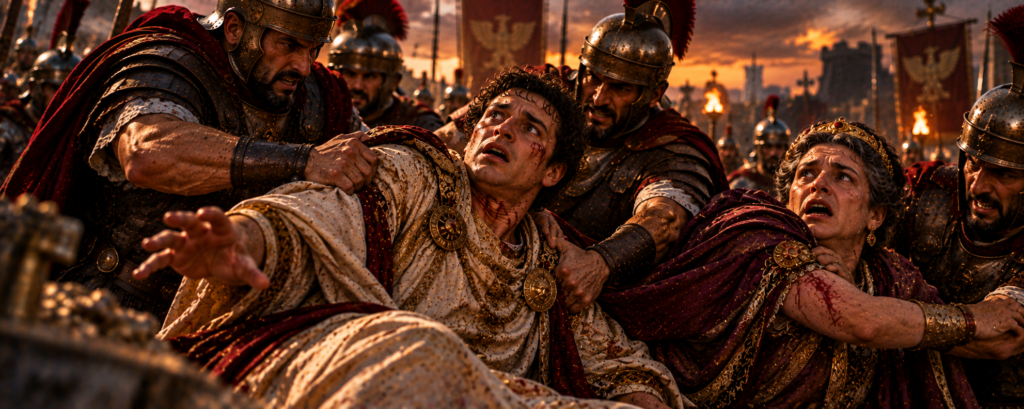
Alexander was staying with his mother, Julia Mamaea, when the rebellion reached its violent conclusion. Ancient accounts place mother and son together during the final attack, just as Elagabalus and Julia Soaemias had been together when Praetorian Guards murdered them thirteen years earlier. The resemblance was grim enough to make the history of the Severan dynasty seem almost trapped in a cycle. Once again, a young emperor and the powerful woman closest to him were about to die at the hands of Roman soldiers.
The precise circumstances are obscured by contradictory and sometimes unreliable sources. Herodian, the most important narrative historian for the episode, describes mutinous troops advancing against Alexander while he remained in his quarters, terrified and increasingly aware that his supporters were disappearing. The much less reliable Historia Augusta adds dramatic details that cannot safely be accepted without qualification. What emerges securely from the evidence is that Alexander’s military position collapsed rapidly and that soldiers murdered both him and Julia Mamaea in March 235.
There was no grand trial and no formal abdication. Alexander did not lose the throne after a long civil war fought across the empire, nor did a foreign enemy capture him in battle. His own troops decided that he was no longer the emperor they wanted and killed him. The man they preferred became emperor because armed soldiers were willing to enforce their choice.
Alexander was approximately twenty-six years old. He had spent roughly half his life as ruler of the Roman Empire and had survived political crises, Persian invasion, frontier warfare, and the dangerous expectations attached to being the last surviving male representative of the Severan dynasty. His government had attempted to present itself as disciplined, consultative, and respectable after the scandal-ridden reign of his cousin Elagabalus. Yet none of those qualities could protect him once the army concluded that he was weak.
His murder did more than end a reign. It extinguished the Severan dynasty that Septimius Severus had founded through civil war more than forty years earlier. It also opened a period of extraordinary instability in which emperors would rise and fall with alarming speed, provincial armies would repeatedly elevate their own commanders, foreign enemies would exploit Rome’s internal weakness, and the empire would come dangerously close to political fragmentation. Historians conventionally call the decades that followed the Crisis of the Third Century.
It would be too simple to claim that Alexander’s murder single-handedly caused that crisis. The empire already faced structural pressures involving military expenditure, frontier defense, succession, taxation, and increasingly powerful regional armies. Nevertheless, his assassination exposed those problems with terrifying clarity. Rome had reached a point at which soldiers on a distant frontier could murder a reigning emperor, choose one of their own commanders, and force the rest of the empire to confront the consequences.
The Severan dynasty had begun when Septimius Severus marched on Rome at the head of an army. It ended when another army decided that his last descendant was no longer worth obeying. Between those two moments lay the murders of brothers, cousins, mothers, emperors, rivals, and soldiers. Alexander Severus inherited that violent system, attempted to govern it through moderation, and ultimately discovered that moderation could be as dangerous as cruelty when the men holding the swords wanted war.
Born Into the Most Dangerous Family in Rome
Alexander was born on October 1, 208 CE, probably at Arca Caesarea in the Roman province of Syria Phoenice. His original name was Marcus Julius Gessius Bassianus Alexianus, although his identity would change substantially as his family’s political ambitions developed. His mother was Julia Avita Mamaea, usually known simply as Julia Mamaea. Through her, Alexander belonged to one of the most remarkable imperial families of the early third century.
Julia Mamaea was the daughter of Julia Maesa, whose sister Julia Domna had married Septimius Severus. That connection placed Mamaea and her son within the extended Severan dynasty. Alexander’s cousin was the future emperor Elagabalus, whose mother Julia Soaemias was Mamaea’s sister. The two boys therefore belonged to rival branches of the same ambitious family.
Alexander’s father, Marcus Julius Gessius Marcianus, is a much less prominent figure in the surviving narrative. His son’s political identity would ultimately be defined far more by the maternal Severan connection. This was not unusual within the dynasty. Julia Domna, Julia Maesa, Julia Soaemias, and Julia Mamaea all exercised substantial influence over imperial politics.
Alexander’s childhood unfolded against a background of extraordinary dynastic violence. Septimius Severus had died in 211, leaving his sons Caracalla and Geta as joint emperors. Caracalla soon arranged Geta’s murder and ruled alone until his own assassination in 217. The praetorian prefect Macrinus then seized power, apparently ending the Severan dynasty.
Julia Maesa refused to accept that outcome. Possessing enormous wealth and important connections in Syria, she promoted her older grandson Elagabalus as an alleged illegitimate son of Caracalla. The biological claim cannot be verified and was almost certainly politically convenient. What mattered was that soldiers who admired Caracalla found the story attractive.
Elagabalus was proclaimed emperor in 218 after a military rebellion against Macrinus. He was only about fourteen years old. Maesa had successfully restored her family to imperial power through a combination of money, dynastic propaganda, and military dissatisfaction. Alexander, still a child, suddenly became a member of the ruling household.
The restoration gave him extraordinary opportunities, but it also placed him in danger. Imperial families rarely provided secure environments for potential heirs. A young male relative of the emperor could become valuable precisely because he might replace the ruler. Alexander would soon become that alternative.
The Cousin of Rome’s Most Controversial Emperor
Elagabalus arrived in Rome carrying a religious identity deeply connected with the Syrian god Elagabal. His attempts to elevate that deity within Roman state religion generated significant controversy. He also married the Vestal Virgin Aquilia Severa, promoted unconventional court figures, and acquired a reputation for behavior that scandalized Roman aristocratic writers. Some accusations against him are well supported, while many of the most lurid stories come from hostile or unreliable sources and should be treated cautiously.
Julia Mamaea carefully positioned her son as a contrast to Elagabalus. Alexander was presented as serious, disciplined, properly educated, and respectful of Roman traditions. Ancient writers emphasize his conventional upbringing and intellectual training. The comparison was politically valuable regardless of how much later historians sharpened it.
Julia Maesa increasingly recognized Alexander’s usefulness. Elagabalus was becoming politically difficult, and the dynasty needed an alternative capable of retaining military support. Alexander belonged to the same family and could therefore replace his cousin without ending Severan rule. His youth also made him easier for older relatives to manage.
In 221 CE, Elagabalus adopted Alexander and granted him the title Caesar. The arrangement was unusual because the emperor himself was still only a teenager. Alexander nevertheless became the officially designated successor. The decision strengthened his legitimacy while simultaneously making him dangerous to the reigning emperor.
The soldiers, particularly the Praetorian Guard, began showing increasing affection for Alexander. His supporters encouraged the image of a modest young prince who represented stability after the controversies of Elagabalus. The more popular Alexander became, the more threatening he appeared to his cousin. Adoption had transformed a family member into a rival.
Ancient sources describe Elagabalus attempting to remove Alexander and perhaps arranging attempts against his life. The precise details are difficult to verify because later writers had strong reasons to portray Elagabalus as murderous and Alexander as innocent. Nevertheless, there is little doubt that relations between the cousins deteriorated severely. The succession arrangement had become unsustainable.
Julia Mamaea protected her son while Julia Soaemias defended Elagabalus. Their mother Julia Maesa stood between two daughters whose political futures depended upon competing sons. The Severan household became a battlefield before actual weapons appeared. The family that had restored itself through military rebellion was now preparing for another violent transfer of power.
The Murder That Made Alexander Emperor
The crisis exploded in March 222 CE. Elagabalus became increasingly alarmed by Alexander’s popularity with the Praetorian Guard and attempted to determine how deeply the soldiers’ loyalty had shifted. According to Herodian, a rumor circulated suggesting that Alexander was seriously ill or dead. The Praetorians reacted with immediate anger and demanded proof that the young Caesar was alive.
Elagabalus eventually brought Alexander to the Praetorian camp. The soldiers greeted Alexander enthusiastically while showing far less enthusiasm for the reigning emperor. Their behavior publicly revealed what had previously been a dangerous suspicion. The military had begun to prefer the successor to the ruler.
Elagabalus reportedly ordered punishment for guardsmen whose behavior offended him. That decision turned the confrontation into open mutiny. The Praetorians attacked and killed Elagabalus together with his mother Julia Soaemias. Their bodies were subjected to humiliating abuse, and the emperor’s remains were ultimately thrown into the Tiber.
Alexander survived because the soldiers had chosen him. He was approximately thirteen years old when he became emperor. The Praetorians who had murdered his cousin now acclaimed him as Augustus. His reign therefore began with the same uncomfortable truth that would eventually destroy it: imperial authority rested upon soldiers capable of transferring their loyalty through violence.
Julia Mamaea emerged from the massacre as the mother of the emperor. Julia Maesa, who had helped elevate Elagabalus, survived the destruction of her older daughter and grandson. The dynasty continued through its remaining branch. The political transition was successful, but the family had paid for it in blood.
The new regime immediately sought to distance itself from Elagabalus. Religious innovations associated with the previous emperor were reversed, the sacred stone of Elagabal returned to Emesa, and traditional Roman cults recovered their established positions. Officials associated with the former government lost influence. Alexander was presented as the beginning of a more orderly age.
The contrast served a clear political purpose. If Elagabalus could be portrayed as chaotic, irreligious, and morally corrupt, Alexander could appear as disciplined, respectful, and legitimate. Ancient historians largely accepted this framework. It remains important, however, to recognize that Alexander’s favorable reputation was partly constructed against the deliberate blackening of his predecessor’s memory.
A Child Emperor Governed by Adults
Alexander inherited supreme power at an age when most Roman aristocrats had barely begun their public careers. He could not realistically govern the empire independently. Experienced adults therefore exercised enormous influence over the administration. The most important of them was his mother.
Julia Mamaea had survived the murderous politics of the Severan family by protecting her son with extraordinary determination. Once he became emperor, she acquired titles and honors reflecting her position. Ancient sources portray her as deeply involved in government. Her influence would remain one of the defining characteristics of Alexander’s reign.
Julia Maesa also retained authority during the early years. She had orchestrated the family’s restoration and understood imperial politics better than almost anyone around the teenage emperor. Her death, probably around 224 or 225, removed one of the dynasty’s most experienced figures. Mamaea thereafter became even more central.
The government attempted to restore cooperation with the Senate. Alexander’s advisers included respected senators and legal experts. The famous jurist Ulpian became praetorian prefect and exercised significant influence. His presence reflected the regime’s desire to emphasize lawful, orderly administration.
This approach appealed to senatorial writers. After the hostility surrounding Caracalla and Elagabalus, a ruler who respected aristocratic institutions appeared refreshingly moderate. Alexander therefore received a relatively favorable treatment in several ancient traditions. His virtues were emphasized while his weaknesses were often attributed to youth or excessive maternal influence.
Yet the reliance upon advisers created another problem. Roman emperors were expected to demonstrate personal authority. A ruler perceived as controlled by his mother, lawyers, or palace officials could appear weak. That perception became especially dangerous among soldiers.
Alexander’s youth initially excused dependence upon older advisers. As he grew into adulthood, however, expectations changed. Soldiers wanted an emperor capable of commanding armies and making decisive military choices. The qualities admired by senators were not necessarily those admired by frontier troops.
The tension would eventually become fatal. Alexander’s government was designed to restrain arbitrary imperial power and restore orderly administration. The army increasingly wanted something else. Rome had placed a cautious young ruler at the head of a political system that rewarded military aggression.
Julia Mamaea: The Mother Behind the Throne
Julia Mamaea has often been described as the true power behind Alexander’s throne. Ancient sources emphasize her control over appointments, finances, court access, and her son’s personal life. Some of these claims probably reflect genuine influence. Others may exaggerate her role because Roman authors were uncomfortable with politically powerful women.
Mamaea’s position was nevertheless extraordinary. She had watched her sister and nephew die during the coup that elevated Alexander. She knew how quickly military loyalty could disappear. Her determination to control the government may therefore have reflected both ambition and fear.
She surrounded Alexander with advisers intended to guide him toward responsible government. The regime emphasized legal administration, financial discipline, and respect for established institutions. These policies helped repair relations with the Senate. They also strengthened Mamaea’s reputation as a cautious and controlling figure.
Ancient writers accuse her of excessive frugality or even greed. Herodian, for example, suggests that she accumulated wealth and restricted Alexander’s generosity. Such accusations should be treated cautiously because criticism of powerful imperial women frequently centered upon money. Nevertheless, financial restraint appears to have been an important feature of the government.
That restraint had political consequences. Roman soldiers had become accustomed to substantial rewards under Septimius Severus and Caracalla. Caracalla in particular had cultivated military loyalty through increased pay and personal identification with the troops. Attempts to control expenditure could therefore appear as hostility toward the army.
Mamaea also became involved in Alexander’s marriage. In 225, the emperor married Sallustia Orbiana, whose father Seius Sallustius received considerable honors. The marriage initially appeared to strengthen the regime. It soon became another source of court conflict.
Herodian claims that Mamaea became jealous of Orbiana’s position and treated her harshly. The details may reflect literary stereotypes about domineering mothers-in-law, but the political outcome is clear. Orbiana was eventually exiled, and her father was executed after being accused of plotting against the emperor. The episode reinforced the impression that Mamaea would tolerate no rival influence over her son.
Alexander never escaped her shadow. To sympathetic observers, she was the experienced mother protecting a young ruler from dangerous courtiers. To critics, she was an overbearing woman who prevented the emperor from developing independent authority. To the soldiers who eventually rebelled, the distinction mattered less than the perception that their emperor was governed by his mother.
The Death of Ulpian and a Warning From the Praetorians
The regime’s relationship with the military showed dangerous weaknesses long before Alexander’s final campaign. One of the clearest warnings involved the jurist Domitius Ulpianus, better known as Ulpian. He was one of the most distinguished legal thinkers of the Roman world and became praetorian prefect under Alexander. His appointment placed an administrator and jurist in command of an institution defined by armed power.
Ulpian attempted to impose discipline upon the Praetorian Guard. The effort generated fierce hostility. According to Cassius Dio, conflict erupted between the Praetorians and the urban population of Rome, producing days of violence. The capital itself became a battlefield.
The crisis eventually reached the imperial palace. In 223 or 224, Praetorian soldiers attacked Ulpian. He fled toward Alexander and Julia Mamaea seeking protection. Even the physical presence of the emperor could not save him.
The guards killed Ulpian in front of the imperial household. The episode was an extraordinary humiliation for Alexander. Soldiers had murdered one of his highest officials despite his attempts to intervene. The emperor remained on the throne, but his inability to protect his own prefect exposed the limits of his authority.
The murder should have served as a terrifying warning. Alexander owed his throne to soldiers who had killed Elagabalus, and now those soldiers demonstrated that they could kill another powerful figure without losing control of the situation. Military violence had become an accepted method of political negotiation. The emperor’s survival depended upon maintaining a balance he did not fully control.
Later accounts describe punishment eventually falling upon some of those responsible. Yet the fundamental problem remained unresolved. The Praetorian Guard had demonstrated that it could defy imperial authority. Alexander had learned that moderation and legalism meant little when armed men refused obedience.
The pattern foreshadowed his own death. In 235, the mutineers would not merely kill an adviser while the emperor watched. They would decide that Alexander himself was the obstacle. The violence that had once occurred around his throne would finally reach the throne directly.
An Emperor Who Wanted to Rule Respectably
Alexander’s government acquired a reputation for administrative moderation. The Senate enjoyed greater respect than under several preceding emperors. Experienced officials participated in decision-making. Legal scholarship flourished within the broader Severan period.
The emperor also engaged in substantial building and restoration projects. The Aqua Alexandrina, an aqueduct associated with his reign, supplied water to the rebuilt Baths of Nero, which were thereafter sometimes known as the Baths of Alexander. Other structures were repaired or improved. Such projects helped reinforce the image of a ruler concerned with civic welfare.
His government also attempted to maintain financial stability. Military expenditure remained enormous, but the court was less openly associated with extravagance than that of Elagabalus. Ancient sources praise Alexander’s personal simplicity, although some of these descriptions probably belong to the idealized portrait constructed after his death. The contrast with his cousin was repeatedly emphasized.
Religious policy was comparatively accommodating. The Historia Augusta famously claims that Alexander honored numerous religious figures and maintained a private shrine containing images of revered individuals from different traditions. Some details, including claims involving Jesus, Abraham, Orpheus, and Apollonius of Tyana, come from a source too unreliable to accept uncritically. They should therefore not be treated as secure evidence of a deliberate universalist religious program.
What can be said more confidently is that Alexander reversed the aggressive religious centralization associated with Elagabalus. Traditional Roman institutions regained their position. The government did not attempt to subordinate the established pantheon to a single Syrian deity. Religious controversy therefore became far less politically explosive.
Alexander’s reputation as a “good emperor” emerged partly from these policies. Senators valued consultation, lawyers valued orderly administration, and later writers appreciated a ruler who could be contrasted with supposedly monstrous predecessors. Yet the standards of a good senator and the standards of a good soldier were not identical. The contradiction became increasingly dangerous as military pressure intensified.
A government can be administratively competent while politically vulnerable. Alexander’s reign demonstrates that distinction clearly. He could repair buildings, consult advisers, respect senators, and maintain legal institutions. None of those achievements guaranteed that frontier soldiers would follow him when they believed the empire required a warrior.
A New Enemy Rises in Persia
The eastern frontier changed dramatically during Alexander’s reign. The Parthian Empire, Rome’s great rival for centuries, collapsed under pressure from the rising Sasanian dynasty. Ardashir I defeated the last significant Parthian ruler and established a new Persian monarchy. Rome suddenly faced an energetic and ambitious eastern power.
The Sasanians presented a more centralized and aggressive challenge than the fragmented Parthian political system Rome had often confronted. Ardashir sought influence over territories that had previously belonged to Persian empires and challenged Roman control in Mesopotamia. The frontier became increasingly unstable. Alexander could no longer rely upon diplomacy alone.
Persian forces invaded Roman territory and threatened important cities. The emperor was forced to leave Rome and travel east. For a ruler whose military credentials were already uncertain, the campaign offered both danger and opportunity. A major victory could establish him as a genuine soldier-emperor.
Alexander gathered a large army and prepared operations against the Sasanians around 231 and 232 CE. Herodian describes a three-pronged Roman invasion designed to attack Persia from multiple directions. One force advanced through Armenia, another moved through southern Mesopotamia, and Alexander supposedly commanded or accompanied the central army. The plan was ambitious.
The campaign’s results are difficult to reconstruct because the sources disagree sharply. Roman imperial propaganda celebrated victory, and Alexander later received honors suggesting military success. Herodian, however, portrays the operation as badly coordinated and extremely costly. Modern historians generally treat the outcome as mixed rather than accepting either total victory or catastrophic defeat.
The northern Roman force apparently achieved some success, while another army suffered severe losses. The Sasanians were checked temporarily but not destroyed. Neither side secured a decisive long-term settlement. The eastern frontier remained contested.
Alexander returned to Rome and celebrated a triumph in 233. Officially, the campaign could be presented as successful. Yet soldiers who had endured difficult fighting may have remembered events differently. The gap between imperial propaganda and military experience could weaken confidence in the emperor.
More importantly, Alexander had not transformed himself into the kind of commanding military figure represented by his grandfather Septimius Severus or cousin Caracalla. His leadership remained associated with advisers and cautious strategy. A new crisis on the Rhine would soon expose that weakness.
The German Frontier Explodes
While Alexander was occupied in the east, pressure increased along Rome’s northern frontiers. Germanic groups crossed or threatened territories near the Rhine and Danube. The withdrawal or redeployment of Roman troops for the Persian campaign had created vulnerabilities. Communities in the frontier provinces faced raids and destruction.
The emperor could not ignore the threat. He moved north with substantial forces around 234 CE. His mother accompanied him, continuing the pattern that had defined his reign. The presence of Julia Mamaea during a major military campaign would later become politically significant.
The imperial headquarters was established somewhere in the German frontier region. Ancient sources traditionally associate Alexander’s final operations with Mogontiacum, modern Mainz, although the exact location of his death remains debated. Herodian places the crisis in the broader Rhine region. Later traditions provide more specific locations that cannot all be reconciled.
Alexander gathered troops and prepared for operations against the Germanic enemy. Yet he appears to have preferred negotiation before committing the army to a major battle. Diplomacy was not inherently cowardly. Roman emperors regularly used payments, treaties, hostages, and negotiated settlements as practical instruments of frontier management.
The soldiers saw matters differently. Many had lost property, relatives, or comrades during Germanic raids. They wanted retaliation and military victory. A negotiated settlement financed by Roman money could appear humiliating to men who expected their emperor to lead them into battle.
Herodian describes Alexander attempting to buy peace. The emperor may have believed that diplomacy would save lives and allow the army to stabilize the frontier without unnecessary losses. His soldiers interpreted the same policy as weakness. Political perception mattered more than strategic logic.
The presence of Julia Mamaea intensified the criticism. The emperor’s enemies could claim that his mother preferred financial caution and negotiation because she feared the risks of war. Whether she actually dictated the policy cannot be established. The accusation nevertheless fit an existing narrative that Alexander remained dependent upon her judgment.
The army had reached a dangerous conclusion. Its emperor was not merely cautious; he was, in their eyes, unworthy of command. Once that belief spread, a rival only needed to appear.
Maximinus Thrax: The Soldier Who Looked Like an Emperor
The man who emerged as Alexander’s rival was Gaius Julius Verus Maximinus, known to history as Maximinus Thrax. His early life is obscured by legend, especially the sensational stories preserved in the Historia Augusta. He appears to have come from relatively humble provincial origins and built his career through military service. Whatever the exact details, he represented a radically different kind of imperial candidate.
Ancient writers emphasize his enormous physical size and strength. The Historia Augusta turns him into an almost superhuman giant, preserving measurements and feats that are plainly exaggerated. Herodian also stresses his imposing appearance and military character. The basic impression of an exceptionally large and formidable soldier is probably genuine even if the legendary details are not.
Maximinus had risen through the army rather than through aristocratic education or dynastic inheritance. Soldiers could identify with him in ways they could not easily identify with Alexander. He understood military culture and projected physical toughness. On a frontier where troops believed decisive warfare was necessary, those qualities mattered enormously.
Alexander had been born into an imperial family and raised under the supervision of powerful women and learned advisers. Maximinus appeared to have earned status through service. The contrast could be presented as privilege against merit, hesitation against strength, and palace refinement against frontier experience. Such simplifications were politically powerful.
Herodian associates Maximinus with the training of recruits or newly raised forces during the German campaign. His position gave him direct contact with soldiers already dissatisfied with Alexander. They admired his military experience and commanding presence. He became the obvious focal point for opposition.
The rebellion may not initially have been a carefully organized conspiracy. Military acclamations could develop rapidly when troops gathered around a popular commander. Once soldiers proclaimed Maximinus emperor, however, there was no easy path backward. Alexander remained alive, and the Roman world could not safely contain two rival Augusti.
Maximinus now faced the same brutal choice that had defined so many imperial successions. He could reject the soldiers’ acclamation and risk their anger, or accept it and confront Alexander. The troops had already made their preference clear. The reigning emperor’s survival became incompatible with the success of the rebellion.
The Army Decides Alexander Is Weak
Alexander’s military difficulties were not simply the product of one failed negotiation. Resentment had accumulated over time. Soldiers remembered Caracalla’s generosity and aggressive military persona, while Alexander’s government emphasized financial restraint. The emperor’s relationship with the army therefore lacked the emotional bond his cousin had cultivated.
The Persian campaign had added frustration. Some Roman units had suffered severe losses during operations against the Sasanians. Herodian portrays soldiers blaming Alexander for poor coordination and inadequate leadership. Even if the historian exaggerates the criticism, the campaign clearly failed to produce an overwhelming victory capable of silencing doubts.
The German frontier crisis intensified those doubts. Soldiers expected retaliation against communities that had crossed into Roman territory. Alexander’s willingness to negotiate appeared to confirm their suspicions that he lacked courage. The emperor may have viewed diplomacy as rational statecraft, but the army interpreted it through the values of military honor.
His dependence upon Julia Mamaea became part of the attack on his legitimacy. Roman political culture expected adult male rulers to project independence and martial authority. An emperor believed to be controlled by his mother could be ridiculed as immature regardless of his actual decision-making. Alexander had never fully escaped the image of the protected child who inherited power at thirteen.
The mutineers found in Maximinus everything they believed Alexander lacked. He was physically imposing, experienced in military life, and apparently eager to fight. His background made him attractive to soldiers who resented aristocratic privilege. The comparison became devastating.
Once Maximinus was acclaimed, neutrality became difficult. Soldiers had to choose which emperor they would obey. Units that remained loyal to Alexander risked fighting other Romans. Those who defected strengthened the rebellion and encouraged further defections.
Alexander’s authority began collapsing with frightening speed. Imperial power often appeared absolute until soldiers stopped recognizing it. Titles and ceremonies depended upon collective obedience. Once that obedience vanished, the emperor was simply a young man surrounded by enemies.
The Acclamation of Maximinus
The exact circumstances of Maximinus’s acclamation are not perfectly preserved. Herodian describes troops becoming increasingly hostile toward Alexander and turning toward the veteran commander. They proclaimed Maximinus emperor, giving the rebellion a leader around whom dissatisfied soldiers could rally. The action immediately transformed military discontent into a civil conflict.
Maximinus reportedly hesitated or pretended to hesitate before accepting the imperial title. Such reluctance is a common feature of ancient accession narratives and should not automatically be taken literally. Roman political culture valued the image of a ruler compelled to accept power rather than greedily seizing it. Whether Maximinus genuinely resisted is impossible to determine.
Once he accepted, however, the consequences were unavoidable. Alexander was still the legally recognized emperor. The Senate had not removed him, and the broader empire had not chosen Maximinus. The soldiers on the Rhine had effectively declared that their decision outweighed every existing institution.
Maximinus needed Alexander dead. As long as the Severan emperor survived, loyal troops could rally around him. Provincial governors could reject the usurpation. The Senate could condemn Maximinus as a rebel.
The mutineers understood the same logic. Killing Alexander would eliminate the most obvious alternative and demonstrate that the rebellion could not be reversed. It would also bind the participants together through shared responsibility. Men who had murdered an emperor could not easily return to his service.
The rebellion therefore moved quickly toward assassination. Alexander had little time to organize a response. His support within the army was already deteriorating. The soldiers who should have defended him were increasingly unwilling to fight.
Herodian’s narrative emphasizes the speed of the collapse. Alexander initially attempted to rally loyal forces, reminding them of their obligations and denouncing the rebellion. His appeals failed as fear and uncertainty spread. The emperor’s words could not compete with the momentum of armed mutiny.
Alexander’s Final Hours
Herodian portrays Alexander’s final hours as a mixture of fear, anger, and desperate attempts to preserve authority. When news reached him that Maximinus had been proclaimed emperor, Alexander allegedly blamed his mother for his predicament. The detail fits Herodian’s broader portrayal of Mamaea’s influence and may contain a literary element. It should not be treated as a verbatim record of a private family argument.
The emperor attempted to address his troops. He reminded them of his generosity and long reign and condemned the men who had elevated Maximinus. Some soldiers initially appeared sympathetic. Yet sympathy was not enough to reverse the rebellion.
Alexander’s camp became increasingly unstable. Soldiers defected or refused to resist. The emperor reportedly offered rewards in an effort to preserve loyalty. Such promises had long been part of Roman military politics, but they came too late.
The mutineers supporting Maximinus advanced. Alexander could hear the growing disturbance and understood what it meant. His remaining defenders were unwilling or unable to stop the attack. The emperor who had ruled for thirteen years was trapped inside his own military camp.
Julia Mamaea remained with him. Her presence at the frontier had been criticized as evidence of excessive influence, but she did not abandon her son when his position collapsed. Mother and son had survived court conspiracies, Praetorian violence, and the dangerous reign of Elagabalus together. They now faced the final crisis together as well.
The ancient sources do not provide a completely reliable description of their last conversation. Later narratives supply emotional details that cannot be verified. It is safest to resist the temptation to recreate dialogue. What matters is that they were together when the killers arrived.
Alexander had been raised under his mother’s protection and governed with her influence throughout his reign. His enemies mocked that dependence. In the final moments, however, the political relationship became something more basic. A mother and son waited while armed men approached with the intention of killing them both.
Murder in the Imperial Quarters
The mutinous soldiers entered Alexander’s quarters and killed him. Julia Mamaea was murdered alongside him. The killings appear to have occurred quickly, without any meaningful judicial procedure or opportunity for escape. The rebellion had become an execution carried out by the army.
Herodian attributes the murders to soldiers acting in support of Maximinus. The emperor’s attendants and supporters were unable to protect him. Some may have fled, while others simply accepted the change of power. Alexander’s isolation was complete.
The Historia Augusta provides additional dramatic details, including specific claims about Alexander’s final words and accusations directed at his mother. Given the source’s notorious unreliability, such material should not be presented as fact. The assassination itself is secure; its theatrical embellishments are not. Historical restraint is especially important when later writers provide exactly the dramatic dialogue readers might expect.
Alexander was approximately twenty-six years old. Julia Mamaea’s age is less certain, but she had spent much of her adult life navigating the dangerous politics of the Severan dynasty. Their deaths eliminated the last ruling branch of the family. The dynasty that had dominated Roman politics since 193 was finished.
Unlike Elagabalus, Alexander was not subjected to the same notorious postmortem humiliation. His reputation remained comparatively favorable, and later political circumstances allowed elements of his memory to recover. The manner of his death nevertheless revealed the same brutal truth that had destroyed his cousin. An emperor could be murdered the moment soldiers found a more attractive candidate.
Maximinus became emperor without traveling to Rome for senatorial approval. The army had made the essential decision. The Senate eventually had to confront the reality created on the frontier. A career soldier of non-senatorial background now ruled the Roman Empire.
The assassination represented far more than a change of personnel. The Severan system of dynastic legitimacy had collapsed. Military acclamation became increasingly important as a route to imperial power. The age of the soldier-emperors was beginning.
The Mother the Soldiers Blamed
Julia Mamaea’s murder was not incidental. She had become so closely associated with Alexander’s government that the mutineers viewed her as part of the political problem. Her influence over finances, appointments, and imperial policy made her an obvious target. Killing Alexander while leaving her alive might have allowed Severan loyalists to organize around her.
Ancient writers repeatedly blamed Mamaea for the emperor’s weaknesses. Herodian accuses her of greed and suggests that her desire to conserve money shaped important decisions. Other traditions portray her as excessively controlling. These judgments reflect genuine political criticism but also familiar Roman hostility toward powerful women.
The accusation that Alexander was dominated by his mother became especially damaging among soldiers. Military culture valued toughness, independence, and visible command. An emperor who appeared to consult his mother on campaign could be mocked as childish. Whether Mamaea actually dictated strategy is less important than the fact that soldiers believed she influenced him.
Her presence during the German campaign therefore became politically dangerous. If Alexander favored negotiation, critics could attribute the policy to her caution. If soldiers felt underpaid, they could blame her financial restraint. Every unpopular decision could be interpreted through the narrative of maternal control.
Yet Mamaea had good reasons to fear military recklessness. She had seen Caracalla assassinated during a campaign and Elagabalus murdered by the Praetorians. Her own son had survived because soldiers once preferred him to another emperor. She understood better than most people how dangerous military politics could become.
Her caution ultimately failed. Attempts to control expenditure alienated troops whose loyalty depended partly upon financial reward. Efforts to avoid unnecessary warfare could be interpreted as cowardice. Protecting Alexander from danger reinforced the image that he needed protection.
Mamaea died because her political identity had become inseparable from her son’s. Like Julia Soaemias thirteen years earlier, she remained beside the emperor during a military revolt and was killed with him. The two sisters, rivals in life, met remarkably similar deaths through the violent system their family had used to obtain power.
Maximinus Takes the Empire
Maximinus’s accession represented a dramatic shift in Roman imperial politics. He was not a member of the Severan dynasty. He lacked the traditional senatorial background of many earlier emperors. His claim rested overwhelmingly upon military support.
The Senate had little practical ability to reverse the decision immediately. Maximinus controlled powerful troops, and Alexander was dead. The political establishment in Rome could either recognize the new emperor or risk civil war. Recognition therefore followed military reality.
Maximinus remained with the army rather than immediately traveling to the capital. His reign would be dominated by frontier warfare and difficult relations with the Senate. He campaigned aggressively against Germanic enemies, demonstrating precisely the military behavior soldiers had wanted from Alexander. His victories initially strengthened his position.
Yet military strength did not guarantee political stability. Maximinus imposed heavy financial demands to support the army and became deeply unpopular among many civilian elites. His relationship with the Senate deteriorated. Resistance eventually emerged in Africa and spread into a wider civil conflict.
In 238 CE, only three years after Alexander’s murder, Maximinus himself was killed by his own soldiers during the chaotic Year of the Six Emperors. His son Maximus was murdered with him. The man whose military support had destroyed Alexander discovered that military support could disappear just as quickly.
The pattern was becoming unmistakable. Soldiers elevated commanders because they expected rewards, victory, and strong leadership. When an emperor failed to satisfy those expectations, another candidate could emerge. Assassination became an increasingly common mechanism of succession.
Alexander’s murder therefore did not solve the army’s grievances. It merely transferred power to another ruler who would face the same fundamental problem. Rome’s political system lacked a secure method for transferring imperial authority. Every powerful army possessed the potential to become an electoral assembly armed with swords.
The End of the Severan Dynasty
Septimius Severus had founded his dynasty after the assassination of Pertinax in 193 CE. He marched on Rome, defeated rivals, and built a government heavily dependent upon military loyalty. His reported advice to his sons—to remain united, enrich the soldiers, and disregard everyone else—may not preserve his exact words, but it captures the political logic associated with his reign. The dynasty understood that soldiers made emperors.
The sons failed to remain united. Caracalla murdered Geta and ruled alone. Caracalla was then assassinated by a soldier during his Parthian campaign. The suspected organizer of that murder, Macrinus, briefly seized the throne.
Julia Maesa restored the Severans through Elagabalus. The young emperor was then murdered by the Praetorian Guard alongside his mother Julia Soaemias. Alexander survived because the same guards preferred him. The dynasty continued through a second teenage ruler.
Thirteen years later, soldiers killed Alexander and Julia Mamaea. Every surviving line of imperial succession had now been exhausted. The family that had ruled Rome for more than four decades disappeared from power through the same military violence that had created it.
The symmetry is difficult to ignore. Septimius Severus had risen because an army chose him during a succession crisis. Alexander fell because an army chose Maximinus during another succession crisis. Military power framed the entire history of the dynasty.
Yet Severus had been an experienced general capable of commanding armies personally. Alexander was a young dynastic ruler raised within a court dominated by advisers. The political system built by his grandfather demanded qualities he did not possess. The dynasty had created an empire increasingly dependent upon soldiers and then produced an heir whom soldiers considered insufficiently military.
Alexander’s assassination therefore represented both a personal tragedy and a dynastic failure. The Severans had never solved the problem of succession. They had merely survived it repeatedly through murder, adoption, propaganda, and military payments. In 235, there was nobody left to continue the experiment.
The Crisis of the Third Century Begins
Historians traditionally use Alexander’s death in 235 as the beginning of the Crisis of the Third Century, sometimes called the Imperial Crisis. The label describes a period extending roughly until the accession of Diocletian in 284, although the most intense phase is often associated with the decades between 235 and 284. During this era, emperors rose and fell with extraordinary frequency. Many died violently.
The crisis involved far more than unstable succession. Rome faced renewed Persian aggression under the Sasanians. Germanic confederations and other groups pressured the Rhine and Danube frontiers. Plague, economic disruption, monetary instability, and repeated civil wars compounded the problems.
Provincial armies increasingly proclaimed their own emperors. A successful general could become a political candidate simply because troops trusted him more than the existing ruler. Rival emperors then required military resolution. Civil war consumed resources needed for frontier defense.
The empire eventually fragmented temporarily. In the west, the so-called Gallic Empire emerged under Postumus and his successors. In the east, Palmyra under Odaenathus and later Zenobia developed into a powerful semi-independent state that eventually challenged central authority. Rome’s political unity came under unprecedented strain.
Not every year between 235 and 284 was equally catastrophic. The concept of a continuous fifty-year collapse can exaggerate the instability experienced in some regions. Roman institutions remained resilient, provincial economies continued functioning in many places, and emperors achieved significant military successes. The empire bent severely without disappearing.
Nevertheless, imperial succession became extraordinarily violent. Maximinus, Gordian III, Philip the Arab, Decius, Trebonianus Gallus, Aemilian, Gallienus, Claudius Gothicus, Aurelian, Probus, Carus, and others ruled within a rapidly changing political environment. Several were murdered or killed in civil conflict. Others died fighting foreign enemies or under uncertain circumstances.
Alexander’s assassination did not create every one of those problems. It did, however, demonstrate the mechanism that would repeatedly destabilize the empire. A frontier army had decided that military competence outweighed dynastic legitimacy and institutional continuity. Once that principle became normalized, every successful commander could become a potential emperor.
Was Alexander Really Too Weak to Rule?
The traditional portrait of Alexander presents him as personally decent but politically weak. He respected the Senate, listened to advisers, avoided unnecessary cruelty, and preferred negotiation when possible. Those qualities made him attractive to aristocratic historians. They also made it easy to blame his death on an inability to command soldiers.
The accusation deserves scrutiny. Negotiating with Germanic groups was not inherently foolish. Roman emperors routinely used diplomacy, subsidies, and negotiated settlements as tools of frontier policy. Even famously aggressive rulers made treaties when circumstances demanded them.
Alexander had also faced the new Sasanian Empire and emerged without losing Rome’s eastern provinces. His Persian campaign was costly and inconclusive, but it was not the complete disaster some hostile interpretations suggest. The frontier remained intact. That achievement should not be dismissed.
His greatest weakness was political rather than purely military. He failed to convince soldiers that his policies served their interests. Perception became fatal. An emperor who appears weak can become weak because others stop obeying him.
The influence of Julia Mamaea worsened that perception. Whether she truly controlled every major decision is impossible to know. The belief that she did was enough to damage Alexander’s military image. Soldiers could blame her for restraint while mocking him for accepting it.
His government also faced an impossible financial balance. The army required enormous resources, but continuously increasing military expenditure threatened the wider fiscal health of the empire. Attempts to restrain costs angered soldiers. Unlimited generosity could bankrupt the government.
Alexander therefore confronted a structural problem without an easy solution. He needed the army to survive but also needed to prevent the army from consuming the state’s resources. Septimius Severus had leaned heavily toward military generosity. Alexander attempted a more cautious balance and paid for it with his life.
The Problem With Calling Him a Coward
Ancient military criticism can easily become modern historical judgment. Because Alexander preferred negotiation on the German frontier, he is sometimes described as cowardly or incapable of war. The evidence does not justify such certainty. He had personally traveled to major military theaters and spent years dealing with serious external threats.
Traveling from Rome to the Persian frontier was itself a substantial undertaking. Alexander participated in the organization of a major campaign against the Sasanians. He later moved north when the German frontier deteriorated. Whatever his limitations as a commander, he did not simply remain hidden inside the imperial palace.
The real issue was the kind of military leadership expected by his troops. Soldiers admired emperors who appeared physically courageous, generous, and eager for battle. Caracalla had cultivated precisely that image. Maximinus embodied it naturally.
Alexander projected something different. His government valued administration, consultation, and financial caution. Those qualities could look responsible in Rome and inadequate on the Rhine. Political survival required satisfying both audiences.
His decision to negotiate may even have been strategically sensible. The empire had recently fought an exhausting Persian campaign and faced pressure on multiple frontiers. Avoiding another costly war could preserve manpower and resources. A ruler responsible for an enormous empire could not treat every frontier dispute as an opportunity for glorious battle.
The soldiers, however, experienced the problem locally. Their communities had been attacked, and they wanted retaliation. They were not evaluating the entire imperial budget. They were judging whether their emperor would avenge them.
The difference between strategy and perception became fatal. Alexander may not have been a coward at all. He was an emperor whose definition of responsible government no longer matched the expectations of the army upon which his survival depended. In Roman politics, that distinction could be deadly.
The Assassination as Regicide
Rome never officially embraced monarchy in the language later European kingdoms would use. Emperors maintained republican titles and institutions while exercising powers that were unmistakably monarchical. The murder of a Roman emperor can therefore be understood within the broader history of regicide. Alexander’s death is especially revealing because soldiers killed the sovereign specifically to replace him with another.
There was no legal process authorizing the act. The Senate had not condemned Alexander before the mutiny. No recognized constitutional mechanism transferred authority to Maximinus. The soldiers simply withdrew obedience from one emperor and offered it to another.
The murder therefore combined assassination, military coup, and regicide. Alexander was targeted because he occupied supreme power. Julia Mamaea was killed because her political influence made her inseparable from the regime. Their deaths cleared the path for a new ruler.
Unlike a secret palace assassination, the mutiny possessed a collective character. The killers did not need to hide their purpose once Maximinus had been acclaimed. Their violence represented an alternative claim to political legitimacy. The army was declaring that it possessed the right to choose the emperor.
That principle was profoundly destabilizing. If one army could elevate Maximinus because it disliked Alexander’s policies, another army could later elevate someone else. Loyalty became conditional upon military satisfaction. Imperial authority risked becoming a prize awarded by whichever force could defeat its rivals.
The Crisis of the Third Century repeatedly demonstrated the consequences. Provincial commanders became emperors because their soldiers proclaimed them. Rival claimants marched against one another while foreign enemies crossed weakened frontiers. Assassination became part of the normal political landscape.
Alexander’s death therefore belongs among Rome’s most consequential imperial murders. The immediate violence was limited to a camp on the frontier. The political message traveled throughout the empire. Dynastic legitimacy had failed, and military acclamation had taken its place.
A Mother and Son at the End of a Dynasty
Alexander and Julia Mamaea had spent almost their entire political lives together. She protected him during the dangerous final years of Elagabalus’s reign. She guided him after he became emperor at thirteen. She remained influential as he entered adulthood.
Their relationship has often been treated as evidence of Alexander’s weakness. Roman historians preferred emperors who appeared independent of female influence. A powerful mother could therefore become a convenient explanation for policies critics disliked. Mamaea’s genuine influence was filtered through those cultural assumptions.
Yet her political importance cannot simply be dismissed as misogynistic invention. She held extraordinary status and participated actively in government. Her involvement in court appointments, finances, dynastic arrangements, and military travel was substantial. Alexander’s reign was genuinely a partnership shaped by maternal authority.
The relationship created both stability and vulnerability. Mamaea provided experience during the emperor’s youth and helped surround him with capable advisers. She also prevented other political figures from gaining influence that might threaten her position. The fall of Orbiana and her father demonstrates how aggressively the court could respond to rival centers of power.
By 235, the partnership had become politically toxic among the troops. Soldiers interpreted Alexander’s reliance upon his mother as proof that he lacked independence. Negotiation with the Germans reinforced that impression. Maximinus offered the opposite image.
When the rebellion came, mother and son did not escape separately. They were killed together. The political partnership that had defined Alexander’s reign ended in the same act of violence.
Their deaths echoed those of Elagabalus and Julia Soaemias so closely that the Severan story acquired a haunting symmetry. Two sisters had each watched a teenage son become emperor. Both sons eventually faced military revolt. Both mothers died beside the rulers they had helped sustain.
The throne had given the women of the Severan family extraordinary influence unavailable to almost anyone else in the Roman world. It also made them targets. Julia Mamaea survived her sister’s downfall and placed her own son on the throne, only to die with him thirteen years later. Imperial power had preserved her family until the moment it destroyed them.
What Happened to Alexander’s Memory?
Alexander’s reputation after death was far more favorable than that of Elagabalus. The Senate had generally enjoyed better relations with his government. Aristocratic writers remembered his respect for traditional institutions. His murder by soldiers could therefore be portrayed as a tragedy rather than the deserved punishment of a tyrant.
Maximinus’s later unpopularity also helped Alexander’s memory. As relations between Maximinus and the Senate deteriorated, the murdered emperor could appear increasingly attractive by comparison. The previous reign became a lost period of moderation. Political memory changed according to the needs of the present.
Alexander was eventually deified. The honor distinguished him sharply from emperors subjected to formal condemnation. His dynasty had ended, but his personal reputation remained useful. Later writers could portray him as a virtuous ruler destroyed by military barbarism.
The Historia Augusta developed this favorable image to extraordinary lengths. It attributes numerous admirable qualities, sayings, policies, and religious practices to Alexander. Because the work is unreliable, many of these claims cannot be accepted as historical fact. Its portrait nevertheless reveals the idealized memory that grew around him.
Herodian is more critical. He respects some aspects of Alexander’s character but emphasizes his dependence upon Mamaea and his failure to satisfy the army. His narrative provides a more tragic interpretation. Alexander is not monstrous; he is inadequate to the military demands of his position.
Modern historians generally occupy a middle ground. Alexander’s reign was neither a golden age destroyed by irrational soldiers nor simply the inevitable collapse of a weak emperor. His government achieved a measure of administrative stability but struggled with unprecedented military pressures. His assassination emerged from those contradictions.
The favorable tradition should therefore be treated with the same caution applied to hostile portraits of Elagabalus. Roman historiography often divided emperors into moral categories. Alexander benefited from being remembered as the respectable successor to a condemned cousin. Historical reality was more complicated.
The Empire After Alexander
The world that followed Alexander’s death became increasingly dangerous. Maximinus devoted enormous resources to warfare along the northern frontiers. His military focus pleased some troops but imposed heavy financial demands upon provincial communities and wealthy landowners. Resistance grew.
In 238 CE, revolt erupted in Africa. The elderly Gordian I and his son Gordian II were proclaimed emperors. The Senate supported the rebellion and declared Maximinus an enemy. The conflict quickly expanded.
The Gordians died, but the Senate appointed Pupienus and Balbinus as joint emperors. The young Gordian III was also elevated as Caesar and soon became central to the succession. Maximinus marched toward Italy intending to crush the rebellion. His own soldiers murdered him and his son during the campaign.
Rome experienced six recognized or competing emperors in that single year. The instability that Alexander’s death had exposed was now impossible to ignore. Imperial power could change hands several times within months. Armies and political factions repeatedly created new rulers.
The following decades brought further upheaval. Emperor Decius died fighting the Goths in 251, becoming the first Roman emperor known to have died in battle against a foreign enemy. Valerian was captured by the Persian king Shapur I in 260, an unprecedented humiliation. Gallienus struggled to hold the empire together while rivals emerged across multiple regions.
The empire temporarily fractured. The Gallic Empire controlled substantial western territories, while Palmyra dominated much of the east under Zenobia. Central imperial authority survived but was severely weakened. A succession of soldier-emperors fought both foreign enemies and one another.
Strong rulers eventually began restoring unity. Aurelian reconquered Palmyra and the Gallic territories during the 270s. Diocletian later reorganized the imperial system on a much larger scale. Rome survived the crisis, but the empire that emerged was politically and militarily transformed.
Alexander did not live to see any of it. Yet his assassination stands at the entrance to that violent age. The soldiers who killed him could not have known that historians would later use his death to divide one period of Roman history from another. They simply wanted a different emperor.
Could the Crisis Have Been Avoided?
It is tempting to imagine that Alexander’s survival might have prevented the Crisis of the Third Century. His government had maintained relative internal stability for thirteen years. If he had defeated or peacefully settled the German threat while retaining military loyalty, the Severan dynasty might have continued. Such possibilities remain speculative.
The structural problems facing Rome were larger than one emperor. The Sasanian Empire had created a formidable new eastern enemy. Germanic pressure was increasing along the northern frontiers. Maintaining the Roman military required enormous expenditure.
Succession remained another unresolved problem. Rome possessed no universally accepted constitutional method for choosing emperors. Dynastic inheritance worked only when suitable heirs survived and retained military support. Adoption, senatorial recognition, and military acclamation all competed as sources of legitimacy.
Alexander’s death exposed the danger created by this ambiguity. Maximinus did not need to prove a blood relationship to earlier emperors. He did not need election by a civilian institution. Soldiers with sufficient force could create legitimacy after the fact.
Once that principle became widely demonstrated, ambitious commanders and frightened troops could repeat it. A general facing possible dismissal might accept imperial acclamation as a means of survival. Soldiers fearing punishment could support their commander because defeat would mean death. Rebellion generated its own momentum.
The empire therefore entered a cycle in which political insecurity encouraged further political insecurity. Emperors distrusted successful generals. Generals feared imperial suspicion. Armies worried that a change of ruler would cost them rewards or lives.
Alexander’s survival might have delayed that cycle. It could not easily have removed the underlying conditions. The Crisis of the Third Century was not waiting behind a door for one assassination to open it. The murder of 235 was instead the moment when several long-developing weaknesses became dramatically visible.
The Last Severan Emperor
Alexander Severus occupies an unusual place among Rome’s rulers. He was neither a legendary conqueror nor one of the empire’s famous monsters. His reign lasted thirteen years, making it relatively long by the standards of the violent century that followed. Much of that period was comparatively stable.
His government attempted to reconcile imperial monarchy with senatorial cooperation. It relied upon jurists, administrators, and experienced advisers. It repaired infrastructure and managed the ordinary business of an enormous empire. These achievements rarely produce the dramatic stories associated with assassination and civil war.
Yet Alexander inherited a political system increasingly dependent upon military satisfaction. His grandfather had strengthened the army’s political importance. Caracalla had deepened soldiers’ expectations through extraordinary generosity. Elagabalus had been killed when the Praetorians transferred loyalty to Alexander himself.
The warning was impossible to miss. Alexander owed his life and throne to military preference. For thirteen years, he managed to survive that reality. Eventually, the frontier army found someone it preferred.
His failure was therefore not simply that he lacked courage. He failed to maintain the particular kind of legitimacy required by an increasingly militarized empire. Senators could respect him and administrators could serve him faithfully, but those groups could not protect him when the army rebelled. Political moderation had no independent military force.
Maximinus embodied the new reality. He possessed no Severan ancestry and little connection with Rome’s traditional aristocratic establishment. His authority came from soldiers who believed he could lead them. The imperial office was becoming increasingly detached from dynastic legitimacy.
Alexander’s murder marks the moment when that transformation became unmistakable. The last Severan emperor died in a military camp rather than an imperial palace. His successor emerged from the army rather than the ruling family. Rome had entered the age of the soldier-emperors.
The Soldiers Who Created Their Own Crisis
The mutineers probably believed they were solving an immediate problem. They wanted an emperor willing to fight the Germans aggressively. Alexander seemed hesitant, financially cautious, and dominated by advisers. Maximinus promised the leadership they preferred.
In the short term, they received it. Maximinus campaigned aggressively and achieved military successes. He projected the toughness Alexander supposedly lacked. The army had chosen a warrior and obtained one.
The longer-term consequences were far less reassuring. Maximinus’s military government intensified financial pressures and alienated powerful groups. Rebellion followed within three years. The emperor created by soldiers was eventually murdered by soldiers.
That pattern would repeat throughout the third century. Military acclamation became both a path to power and a death sentence. Every emperor elevated by one army had to worry about another army producing a rival. Success in battle could make a general dangerous to the ruler he served.
The army therefore became trapped by its own political influence. Soldiers wanted strong emperors who rewarded them generously. Yet repeatedly replacing rulers destabilized the state responsible for paying and supplying those soldiers. Civil wars consumed manpower and resources needed against foreign enemies.
Alexander’s assassination captures the paradox perfectly. The troops killed him because they believed his leadership endangered Rome’s military security. Their solution contributed to a political culture that made coordinated imperial defense increasingly difficult. In trying to obtain stronger leadership, armies repeatedly weakened the state.
The men who entered Alexander’s quarters in 235 could not foresee the next fifty years. They were responding to immediate grievances and expectations. History would remember their act differently. Their mutiny became one of the defining thresholds in the transformation of the Roman Empire.
Murder Rather Than Deposition
Alexander’s fall also demonstrates how little space Roman politics offered for peaceful removal. A modern political leader who loses military or public confidence may resign, lose an election, or be removed through institutional procedures. Roman emperors possessed no comparable retirement mechanism that could reliably guarantee safety. Once a rival had been proclaimed, the defeated emperor remained dangerous simply by being alive.
Alexander could theoretically have abdicated. In practice, a living former emperor with dynastic legitimacy could become the center of a counterrevolution. Loyalists might attempt to restore him. Provincial armies could use his name against Maximinus.
The mutineers therefore had powerful incentives to kill him. The same logic applied to Julia Mamaea. Her experience, wealth, and family connections could support resistance even if her son surrendered. Leaving her alive created unnecessary risk.
Political murder thus became a practical solution to a constitutional problem. Rome had developed an imperial office without developing a safe mechanism for removing its occupant. Defeated rulers were imprisoned, executed, forced into suicide, or assassinated. Violence replaced procedure.
The Severan dynasty repeatedly suffered from this problem. Geta could not simply become a private citizen once Caracalla wanted sole power. Elagabalus could not retire when Alexander became more popular. Alexander could not safely step aside once Maximinus was acclaimed.
Each conflict therefore became existential. Losing power meant losing life. That reality encouraged rulers to fight desperately against rivals and encouraged rivals to eliminate defeated emperors completely. The political system rewarded preemptive violence.
Alexander’s murder was not an aberration within that system. It was one of its logical outcomes. The remarkable fact is not simply that Roman soldiers killed an emperor. It is that by 235, killing the emperor had become an imaginable method of correcting government.
The Young Man Behind the Imperial Portrait
It is easy to lose Alexander himself beneath the political consequences of his death. He became emperor at approximately thirteen, an age at which he had little meaningful choice over the responsibilities placed upon him. His mother, grandmother, advisers, soldiers, and senators all possessed expectations about what he should become. His childhood effectively ended when the Praetorians murdered his cousin and placed him on the throne.
For thirteen years, he lived under the threat that the same thing could happen to him. He saw his praetorian prefect Ulpian murdered despite imperial protection. He confronted a new Persian empire and traveled thousands of miles to the eastern frontier. He then moved north to face another military crisis.
His relationship with Julia Mamaea shaped nearly every stage of his life. She protected him during childhood, guided his government, influenced his marriage, and accompanied him on campaign. Her presence could be politically damaging, but it was also one of the few constants in a world where relatives routinely murdered one another. Their dependence was personal as well as political.
The sources do not allow us to reconstruct Alexander’s private emotions with confidence. We cannot know how he felt about becoming emperor after his cousin’s murder or how he experienced his mother’s influence. We cannot know whether he secretly resented her control or welcomed it. Ancient historians supply interpretations rather than private testimony.
What we can see is a ruler attempting to meet expectations that were almost impossible to reconcile. Senators wanted consultation, soldiers wanted generosity, frontier communities wanted protection, the treasury required restraint, and his family demanded survival. Success with one constituency could produce resentment in another. The emperor stood at the center of competing pressures without an institution capable of balancing them.
His final decision to negotiate on the German frontier may have been reasonable statecraft. It may also have been politically disastrous. Those possibilities can coexist. Good strategy is useless to a ruler who loses the confidence of the people required to carry it out.
Alexander died not because he lacked every quality necessary for government, but because the qualities he possessed were insufficient for the political environment he inherited. His assassination therefore feels less like the punishment of a tyrant than the destruction of a ruler overtaken by a changing empire. The Roman world was beginning to demand emperors forged in military camps rather than imperial households.
The Dynasty That Began and Ended With Soldiers
The history of the Severan dynasty forms a dark circle around the Roman army. In 193, Septimius Severus was one of several provincial commanders who responded to political chaos by claiming the throne. His Danubian legions supported him as he marched toward Rome. Military victory created the dynasty.
Severus understood the source of his authority. He increased soldiers’ pay, expanded opportunities for military families, and cultivated close relations with the army. His reforms strengthened the imperial military establishment. They also increased its expectations.
Caracalla continued the pattern. He presented himself as a soldier-emperor and increased military compensation. His popularity among troops survived even his assassination. The army became accustomed to emperors who treated its loyalty as the foundation of government.
Elagabalus inherited that political culture without possessing Caracalla’s military personality. The Praetorians eventually killed him and elevated Alexander. The soldiers had demonstrated that dynastic legitimacy depended upon their approval. Alexander’s government never escaped that lesson.
In 235, the frontier troops repeated the process on a larger scale. They decided that Maximinus represented their interests better than the Severan emperor. Alexander was murdered, and the dynasty disappeared. Soldiers had both created and destroyed the family’s imperial power.
The transformation did not mean that civilians or senators became irrelevant. Imperial government still required administrators, tax systems, provincial officials, legal institutions, and urban elites. Yet none of those groups could determine the succession when a major army refused obedience. Military force remained the ultimate political argument.
The Severans had spent four decades trying to control that reality. They rewarded soldiers, promoted family members, constructed dynastic myths, and eliminated rivals. In the end, they failed. The army they depended upon outlived them and selected someone else.
The Murder That Opened an Age of Chaos
Alexander Severus had entered imperial politics as a child whose greatest political advantage was that soldiers liked him more than his cousin. The Praetorian Guard murdered Elagabalus and Julia Soaemias, then placed Alexander on the throne while Julia Mamaea emerged as the most powerful influence around him. From the beginning, his authority rested upon an uncomfortable bargain with armed men. He survived only while enough of them believed he was worth obeying.
For thirteen years, the bargain held. Alexander governed with advisers, restored cooperation with the Senate, supported legal administration, and avoided many of the religious controversies associated with his predecessor. His reign was not devoid of violence or political failure, but it offered a degree of continuity increasingly rare in the century that followed. He seemed capable of preserving the Severan dynasty into another generation.
Then the empire’s military problems intensified. The rise of the Sasanians forced Alexander eastward into a difficult war. Germanic pressure pulled him north soon afterward. Years of campaigning placed enormous demands upon soldiers and the imperial treasury.
On the Rhine frontier, Alexander chose negotiation where many soldiers wanted battle. The decision may have been strategically rational, but it was politically catastrophic. Troops already suspicious of his leadership interpreted diplomacy as cowardice. His mother’s influence gave them an additional explanation for everything they disliked.
Maximinus offered the opposite image. He was a career soldier of imposing reputation, shaped by military service rather than palace life. The troops acclaimed him emperor because he appeared to embody the leadership they believed Alexander lacked. Once that acclamation occurred, the existing emperor became an obstacle.
Alexander tried to rally his forces, but imperial authority evaporated around him. Soldiers defected or refused to fight. The titles accumulated over thirteen years could not compel men who had decided to recognize someone else. The emperor found himself trapped within his own camp.
Julia Mamaea remained with him. She had protected him from Elagabalus, guided him through childhood, and helped govern beside him. Her influence had been one of the reasons soldiers despised his leadership, yet she did not escape when the rebellion came. The mother and son who had survived the murderous politics of the Severan court finally faced armed men who had no intention of allowing either to survive.
In March 235, mutinous soldiers entered their quarters and killed them. There was no trial, no lawful transfer of power, and no safe retirement for the last Severan emperor. Alexander’s crime, in the eyes of his killers, was that he was no longer the ruler they wanted. His mother died because she was inseparable from the regime they intended to destroy.
The assassination ended a dynasty that had ruled Rome since Septimius Severus seized power in 193. That dynasty had survived fratricide, assassination, civil war, religious upheaval, and repeated military revolt. Its members had learned again and again that soldiers could create emperors. They never discovered how to prevent those same soldiers from destroying them.
What followed was not immediate collapse, but something more unsettling: chronic instability. Generals became emperors because armies proclaimed them. Emperors died because other armies preferred someone else. Civil wars consumed resources while Persians and Germanic peoples pressed against the frontiers, and parts of the empire eventually broke away under rival governments.
Rome survived the Crisis of the Third Century, but it did so only after decades of violence and profound political transformation. Later emperors would rebuild imperial authority on more openly militarized and centralized foundations. The old assumptions of the early empire could no longer contain the forces unleashed by frontier warfare and military politics. Alexander’s death stands at the threshold of that transformation.
His murder was therefore more than the final bloody chapter of the Severan dynasty. It exposed the central weakness of Roman imperial government: the emperor commanded the armies only for as long as the armies agreed that he should command them. Alexander had inherited his throne because soldiers once preferred him to another ruler, and thirteen years later he lost it for exactly the same reason. The mechanism that had saved the boy became the mechanism that killed the man.
The tragedy is sharpened by the possibility that the policy that destroyed him was not necessarily foolish. Negotiation could save soldiers, preserve resources, and prevent an unnecessary frontier war. Yet emperors did not govern through strategy alone. They governed through reputation, expectation, fear, money, and the willingness of armed men to continue calling them emperor.
Alexander Severus was neither Rome’s greatest ruler nor one of its most monstrous. He was something perhaps more revealing: a relatively moderate emperor caught inside a political system becoming too violent for moderation to guarantee survival. His assassins wanted a stronger ruler and believed killing him would protect the empire. Instead, their swords announced the arrival of an age in which emperors themselves would become frighteningly disposable.
When the mutineers entered Alexander’s quarters in 235, they killed a young emperor and the mother who had spent her life protecting his throne. They also extinguished the Severan dynasty and demonstrated that bloodline, senatorial recognition, years of lawful rule, and imperial ceremony could all be overturned by an army willing to proclaim another man. The soldiers who murdered Alexander could not know what the next half century would bring, but their act became an ominous beginning. The last Severan emperor died because his army wanted a warrior, and from the blood spilled beside his mother on the German frontier emerged a Roman world in which the sword would choose emperors again and again, until even the empire itself seemed in danger of being cut apart.