
Pertinax: The Emperor Murdered by His Own Guards and the Auction of the Roman Empire
Publius Helvius Pertinax (126–193 CE) | Roman Emperor, January 1–March 28, 193 CE | Murdered by the Praetorian Guard
The Day Rome’s Soldiers Killed an Emperor and Sold His Throne
On March 28, 193 CE, a furious column of armed Praetorian Guards marched through Rome toward the imperial palace, carrying the weapons of men who were supposed to protect the emperor they had decided to kill. Their target was Publius Helvius Pertinax, a sixty-six-year-old former soldier, governor, senator, and administrator who had occupied the Roman throne for fewer than three months. Pertinax knew the guards were coming, and according to the ancient historian Cassius Dio, his advisers urged him to escape before the soldiers reached the palace. He refused, choosing instead to face the men whose discipline he had spent his brief reign trying to restore.
The emperor’s confidence was extraordinary, perhaps fatally so. Pertinax had spent decades dealing with soldiers, rebellions, provincial crises, and dangerous political situations, and he appears to have believed that he could reason with the mutineers. When the guards entered the palace, he confronted them rather than hiding behind locked doors or fleeing through a private exit. Ancient accounts describe him addressing the soldiers with such authority that for a moment their determination faltered, and some apparently began to retreat.
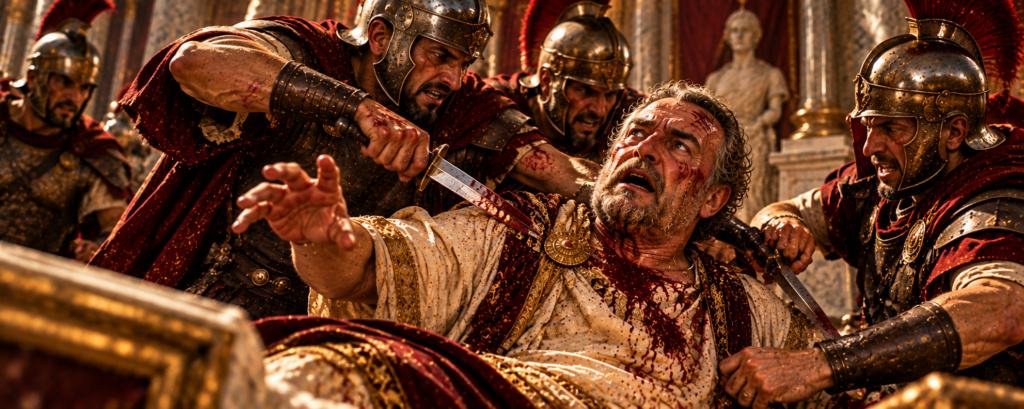
Then one soldier broke the hesitation. According to Cassius Dio, a guardsman named Tausius, identified as a Tungrian, rushed forward and struck Pertinax with a spear. Other soldiers joined the attack, and within moments the emperor was overwhelmed. The man who had survived the dangerous reign of Commodus and risen from relatively modest origins to supreme power was killed inside his own palace by the elite troops charged with protecting him.
The assassins severed his head. One of the Praetorians reportedly placed it on a spear and carried it through the streets as proof that Pertinax was dead. Rome had seen emperors assassinated before, but what followed transformed an already shocking murder into one of the most notorious episodes in imperial history. The Praetorian Guard had eliminated the ruler, and instead of waiting for the Senate or provincial armies to determine his successor, the soldiers began considering which candidate would pay them the most.
Two wealthy men soon emerged as competitors. Titus Flavius Claudius Sulpicianus, Pertinax’s father-in-law and the urban prefect of Rome, was already inside the Praetorian camp attempting to secure the soldiers’ support. Marcus Didius Julianus, an immensely wealthy senator and former provincial governor, arrived outside and began making his own promises. Ancient writers describe the two men increasing their offers as though bidding against one another for an object being sold.
The spectacle became remembered as the “auction of the Roman Empire.” That phrase captures the corruption of the moment, although it should not be imagined as a formal public auction with an auctioneer and an orderly crowd of bidders. What occurred was essentially a competitive negotiation for the loyalty of armed soldiers who had just murdered the sitting emperor and now understood that their support could determine who replaced him. Imperial power had been reduced to a question of how much money a claimant was willing to promise the men holding the gates of the Praetorian camp.
Julianus won. According to Cassius Dio, he promised each Praetorian 25,000 sesterces, an enormous payment, although ancient sources differ over the precise sums offered during the bidding. The soldiers proclaimed him emperor and escorted him toward the Senate under armed protection. Rome’s political establishment had little practical ability to resist men who had already demonstrated their willingness to murder an emperor.
Pertinax had ruled for only eighty-seven days. He had inherited a government corrupted and financially weakened under Commodus, attempted to restore discipline and fiscal order, and discovered how dangerous reform could become when the people losing privileges carried swords. His assassination was not merely the death of another Roman emperor; it exposed a terrifying truth about imperial power. The throne could be seized by soldiers, its occupant could be murdered by those assigned to protect him, and the empire itself could appear to be sold to the highest bidder before the dead emperor’s blood had dried.
The Son of a Freedman
Pertinax’s path to the throne was remarkable by the standards of Roman imperial society. He was born on August 1, 126 CE, at Alba Pompeia in northern Italy, the modern town of Alba in Piedmont. His father, Helvius Successus, was reportedly a freedman who became prosperous through the wool trade. Unlike emperors born into ancient senatorial families or imperial dynasties, Pertinax began life without an inherited claim to Rome’s highest circles.
Ancient sources emphasize his comparatively humble origins because they made his later rise extraordinary. The son of a former slave becoming emperor demonstrated the possibilities created by Roman military and administrative service. It also provided hostile aristocrats with material for social snobbery. In Rome, achievement could raise a man enormously, but ancestry remained a powerful measure of status.
Pertinax initially pursued education rather than military service. He became a teacher of grammar, a respectable profession but hardly the usual starting point for an imperial career. According to the Historia Augusta, he eventually concluded that teaching offered insufficient financial reward. He therefore sought a military appointment.
The Historia Augusta is a notoriously problematic source containing valuable material mixed with invention, exaggeration, and fictional documents. Details drawn solely from it must therefore be treated carefully. Pertinax’s broader career, however, is supported by inscriptions and other evidence. There is no doubt that he rose through an impressive series of military and administrative posts.
His entry into the army changed everything. Pertinax became an officer in an auxiliary cohort stationed in Syria, beginning a career that would take him across much of the empire. He served in regions threatened by warfare and unrest, gradually gaining experience in both command and administration. Unlike many emperors, he understood military life from years of direct service rather than ceremonial command.
His advancement reflected competence as well as opportunity. The Roman Empire required enormous numbers of administrators, officers, financial officials, and governors to manage its provinces. Men who demonstrated ability could rise, particularly under emperors willing to promote talent beyond the oldest aristocratic families. Pertinax became one of the great beneficiaries of that system.
By the time he reached middle age, the freedman’s son had become a senator. His career had carried him through offices that would have seemed almost unimaginable during his childhood. He had acquired wealth, prestige, and experience. None of it suggested that he would eventually become emperor, but it prepared him for almost every challenge except the one that would kill him.
A Soldier Forged on the Frontiers
Pertinax’s military career unfolded during an increasingly difficult period for the Roman Empire. The second century is often remembered as an age of prosperity under the so-called Five Good Emperors, but the frontiers were rarely peaceful. Rome fought wars in the east, faced pressure along the Danube, and struggled with internal revolts. Pertinax experienced many of these challenges directly.
He served during the reign of Antoninus Pius and continued advancing under Marcus Aurelius. His appointments took him to Syria, Britain, the Danubian provinces, and other regions of strategic importance. The variety of his assignments gave him experience with soldiers from different backgrounds and with the administrative problems of distant provinces. He learned how quickly military discipline could deteriorate when commanders appeared weak.
Pertinax participated in the conflicts associated with the Marcomannic Wars, the long and dangerous series of struggles along Rome’s northern frontier during the reign of Marcus Aurelius. Germanic and Sarmatian peoples placed enormous pressure on the Danubian provinces. At moments, the threat reached deep into Roman territory. The wars required extensive mobilization and tested commanders throughout the empire.
Pertinax distinguished himself sufficiently to continue receiving important responsibilities. His career eventually included command positions and governorships that placed substantial military forces under his authority. He developed a reputation for strictness. That reputation would later become central to both his elevation and his destruction.
The army Pertinax knew was not a ceremonial institution. Discipline mattered because failures could destroy entire units and expose provinces to invasion. Soldiers needed food, pay, equipment, leadership, and confidence in their commanders. Officers who tolerated disorder could endanger thousands of lives.
This background helps explain Pertinax’s later conflict with the Praetorian Guard. To him, military discipline was not an abstract virtue. It was the foundation of Roman security. Soldiers existed to obey lawful commands, not to dictate political policy or enrich themselves through intimidation.
The Praetorians, however, occupied a very different environment from frontier soldiers. Stationed in and around Rome, they enjoyed privileged status, higher pay, and proximity to imperial politics. They had repeatedly participated in succession struggles. Pertinax would eventually approach them with the instincts of a frontier commander confronting indiscipline.
That approach contained a dangerous misunderstanding. The Praetorians did not see themselves as an ordinary unit awaiting correction. They understood that their location gave them extraordinary political leverage. Pertinax believed an emperor could discipline his guards, while the guards had learned that guards could make and unmake emperors.
Britain, Mutiny, and the Problem of Discipline
One of Pertinax’s most important appointments was the governorship of Britain. The province had long presented military challenges because it contained several legions stationed far from Rome and exposed to frontier conflict. Soldiers serving there could develop strong local loyalties and resent distant political authorities. Maintaining discipline required both firmness and political skill.
Pertinax encountered serious unrest among the troops. The precise chronology and details are difficult to reconstruct, but ancient accounts portray him confronting mutinous soldiers and narrowly escaping death. At one point, he was reportedly attacked and left for dead among the bodies of others. Whether every dramatic detail is accurate, his tenure clearly involved dangerous military tension.
His experience in Britain reinforced his belief in strict discipline. Pertinax had seen what happened when soldiers challenged their commanders. He understood mutiny as a threat to the state, not merely a workplace grievance. The lesson would remain with him.
Yet Britain also demonstrated the personal danger involved in enforcing authority. A commander could be correct about discipline and still provoke soldiers into violence. Pertinax survived that lesson on the frontier. Years later, he would face a similar confrontation in Rome and would not survive it.
His governorship also enhanced his reputation as an experienced administrator. Pertinax was not merely a battlefield officer. He understood taxation, provincial government, logistics, and civilian administration. His career increasingly resembled that of the highly competent officials upon whom the empire depended.
He later governed Africa, another prestigious senatorial province. He served as urban prefect of Rome, placing him at the center of the capital’s administration. By the reign of Commodus, Pertinax had accumulated an extraordinary résumé. Few men alive possessed broader experience of Roman government.
His rise remained vulnerable to imperial politics. Service under an unstable ruler could become dangerous regardless of competence. Commodus increasingly surrounded himself with favorites, courtiers, and powerful officials whose rivalries could destroy careers. Pertinax had to survive a court very different from the military frontiers where he had built his reputation.
The man who had faced mutinous soldiers now faced another kind of battlefield. Rome under Commodus was becoming a place where accusations, executions, favoritism, and palace intrigue shaped the highest levels of government. Pertinax would survive that environment long enough to inherit it.
Commodus and the Court of Fear
Commodus became emperor in 180 CE following the death of his father, Marcus Aurelius. His accession initially offered dynastic continuity after decades of relatively stable rule. Over time, however, his relationship with the Senate deteriorated badly. Conspiracies, executions, confiscations, and increasingly extravagant displays of imperial self-presentation transformed the political atmosphere.
The assassination attempt organized by Commodus’s sister Lucilla in 182 intensified the emperor’s suspicions. The conspiracy failed, and those associated with it were punished. Commodus became increasingly dependent upon favorites and powerful palace officials. The Senate viewed the emperor with growing hostility.
Pertinax survived periods of political danger during this reign. At one point his career appears to have been interrupted, possibly because of the influence of the powerful praetorian prefect Sextus Tigidius Perennis. After Perennis fell, Pertinax returned to major office. His ability to survive repeated changes among Commodus’s favorites demonstrated considerable political caution.
The later years of Commodus’s reign became dominated by court figures such as Cleander and eventually the emperor’s chamberlain Eclectus and mistress Marcia. Commodus also developed an increasingly theatrical public persona. He appeared in the arena, identified himself with Hercules, and renamed institutions and even Rome itself in ways that shocked elite opinion.
Ancient accounts of Commodus are deeply hostile and sometimes sensationalized. His appearances in the arena and identification with Hercules are well attested, but individual stories of cruelty and madness should still be assessed critically. Senators who despised Commodus had powerful reasons to portray his reign as a grotesque collapse from the virtues of Marcus Aurelius. The reality was likely more complicated, though unquestionably violent.
Financial problems also worsened. Commodus spent heavily on games, court life, military payments, and public spectacles. Confiscations provided revenue but increased fear among wealthy Romans. The imperial treasury that Pertinax eventually inherited was in serious difficulty.
By late 192, Commodus had accumulated enemies inside his own household. The threat did not come from a foreign army or distant rebellion. It came from people who had direct access to him. The pattern would be repeated only three months later with Pertinax.
On the final night of 192, Commodus was murdered. His death opened a succession crisis that no one had fully prepared to manage. Pertinax, the aging administrator with decades of experience, suddenly found himself at the center of events.
The Murder of Commodus
The conspiracy against Commodus involved several people close to the emperor, including his chamberlain Eclectus, his mistress Marcia, and the praetorian prefect Quintus Aemilius Laetus. Ancient sources claim that they feared for their lives after discovering or believing that Commodus intended to execute them. Their solution was to kill him first. The circumstances resemble many Roman palace conspiracies in which self-preservation and political ambition became impossible to separate.
Marcia allegedly attempted to poison Commodus. When the poison failed to kill him quickly enough, a wrestler named Narcissus was brought in to finish the job. Commodus was strangled on December 31, 192 CE. The emperor’s body was then removed while conspirators moved quickly to secure the succession.
The precise involvement of Pertinax before the murder remains uncertain. Some ancient traditions imply that he knew a change was coming, while others portray him as being approached only after Commodus was dead. There is no conclusive evidence that Pertinax participated in planning the assassination. His subsequent acceptance of the throne does not prove prior involvement.
Laetus and Eclectus needed a successor who could command respect. Pertinax was an obvious candidate. He had military experience, senatorial standing, administrative competence, and no powerful dynasty of his own. At sixty-six, he also represented a mature figure who might stabilize the government.
According to the ancient accounts, Pertinax was awakened during the night and initially believed that soldiers had come to kill him. Such fear would have been entirely reasonable under Commodus. Instead, the visitors informed him that the emperor was dead and offered him supreme power. Within hours, his life had changed completely.
Pertinax did not simply walk into the palace and declare himself emperor. The Praetorian Guard had to be secured. These soldiers controlled the immediate military environment of Rome. Any claimant who ignored them risked being killed before the Senate could even meet.
The new emperor therefore went to the Praetorian camp. There he faced the first great compromise of his reign. The soldiers expected money in exchange for their support.
Buying the First Day of an Eighty-Seven-Day Reign
The Praetorian Guard had long understood the financial value of imperial succession. Emperors commonly gave soldiers donatives, particularly upon accession or after major victories. Such payments could be presented as gifts of gratitude, but they also functioned as practical incentives for loyalty. By 193 CE, the distinction between reward and political purchase had become dangerously thin.
Pertinax promised the guards a substantial donative. Ancient sources disagree over the exact amount and the circumstances in which the promise was made. Cassius Dio, who was a senator at the time and personally witnessed aspects of the reign, provides particularly valuable testimony. His account suggests that the guards were reluctant to accept Pertinax until financial assurances were offered.
The Senate then met and recognized him as emperor. Commodus’s memory was condemned, and the political elite celebrated the end of a reign many senators had experienced as oppressive. Pertinax appeared to represent restoration. The old administrator could be presented as a return to the disciplined government associated with earlier emperors.
Yet his position was fragile from the beginning. He owed his elevation partly to men involved in Commodus’s assassination and partly to soldiers who expected payment. The Senate’s enthusiasm could not substitute for military loyalty. Pertinax needed to satisfy groups whose interests often conflicted.
He also inherited severe financial problems. The treasury had been depleted by the spending of Commodus. According to ancient accounts, Pertinax discovered only a small amount of ready money available for immediate use. The precise figures may have been shaped by later moral comparisons, but the fiscal difficulty was real.
This created an immediate contradiction. The Praetorians expected a generous accession payment, while Pertinax believed the government needed austerity. He could not easily satisfy both objectives. Every coin given to the guards weakened efforts to restore finances, while every reduction in the promised payment threatened their loyalty.
Pertinax chose reform. He began selling imperial luxuries and reducing unnecessary expenditures. Items associated with Commodus’s extravagant court were placed on the market. The message was clear: the new emperor intended to govern differently.
The Senate admired such gestures. The Praetorian Guard was less impressed. Pertinax had entered office believing that discipline and financial responsibility would strengthen the empire. He was about to discover that reform can be most dangerous when it threatens armed beneficiaries of the old system.
Cleaning Up the Palace of Commodus
Pertinax moved quickly to dismantle some of the practices associated with Commodus. Imperial expenses were reduced, court extravagance was curtailed, and property accumulated through confiscation was reconsidered. The new ruler wanted to demonstrate that government would no longer operate according to the whims of the previous court. His reforms were practical, moral, and political at the same time.
The sale of Commodus’s possessions became one of the most visible symbols of the change. Ancient accounts describe luxury items, elaborate equipment, and people associated with the previous emperor’s pleasures being sold. Some descriptions are colored by moralizing hostility toward Commodus. Even so, Pertinax clearly attempted to convert unnecessary imperial property into desperately needed revenue.
He also sought to restore confidence among property owners. Land that had fallen out of cultivation could be offered under favorable conditions to people willing to develop it. Taxes and administrative burdens were reconsidered. Pertinax understood that imperial finances could not be repaired solely through confiscation.
His policies reflected the instincts of a career administrator. He had governed provinces and managed military resources for decades. Waste offended both his practical judgment and his sense of order. Rome needed revenue, but the state also needed citizens to believe their property would not simply be seized.
The emperor attempted to restore the value and integrity of the coinage as well. Commodus’s government had faced financial pressure, and monetary stability was part of the broader challenge Pertinax inherited. His reign was too short for major long-term results. The intention nevertheless demonstrates that he approached the throne as an administrative responsibility rather than merely a prize.
He also adopted a comparatively restrained public style. Ancient writers praised him for avoiding some of the excesses associated with Commodus. The Senate welcomed an emperor who appeared willing to respect its dignity. After years of tension, the political elite could imagine a return to more cooperative government.
Yet Pertinax’s reforming energy contained a serious political weakness. He was changing too much, too quickly, while lacking a secure personal power base. Commodus had been dead only weeks. Many people who benefited from the old regime remained in positions of influence.
Among the most dangerous were the Praetorians. They had grown accustomed to privilege and political importance. Pertinax’s vision of disciplined government threatened both.
The Praetorian Guard: Protectors Who Had Learned Their Own Power
The Praetorian Guard had originally developed as the elite military force associated with Roman commanders and later became the permanent imperial guard under Augustus. Stationed near Rome, the Praetorians enjoyed advantages unavailable to ordinary legionaries. They received higher pay, served shorter terms, and lived close to the center of imperial power. Their position made them both protectors of the emperor and potential kingmakers.
Their political influence had been demonstrated repeatedly. In 41 CE, after Caligula was assassinated, Praetorians discovered Claudius and proclaimed him emperor. Their support became essential to his accession. Claudius rewarded them generously.
In 68 and 69 CE, the Guard participated directly in the collapse of imperial authority. Praetorians abandoned Nero, helped elevate Galba, then turned against Galba after becoming dissatisfied with him. They murdered the emperor in the Forum and supported Otho. Their political loyalty had become negotiable.
Later emperors understood the danger. Maintaining good relations with the Guard required careful appointments, financial generosity, and personal attention. A ruler who controlled the Praetorians possessed protection against threats inside Rome. A ruler who lost their loyalty might discover that the men guarding his palace were the most immediate threat to his life.
Commodus had indulged the military and allowed palace politics to become deeply entangled with praetorian power. Pertinax inherited guards who did not consider themselves ordinary soldiers. They were accustomed to rewards and understood that emperors needed them. Attempts to impose frontier-style discipline therefore touched the most sensitive part of their identity.
Pertinax wanted them to behave like soldiers. The guards expected the emperor to behave like a patron. Neither side fully accepted the assumptions of the other. The conflict became increasingly dangerous.
The promised donative made matters worse. Pertinax struggled to produce the full amount expected by the soldiers. He reportedly paid only part of what had been promised initially. From his perspective, the treasury simply could not sustain reckless expenditure.
From the guards’ perspective, an emperor who had gained power with their support was withholding what they considered their due. The dispute was not merely about money. It was about who controlled whom.
The Emperor Who Wanted Soldiers to Behave Like Soldiers
Pertinax began enforcing discipline among the Praetorians. Men accustomed to a relatively comfortable existence discovered that the new emperor expected obedience and military standards. Privileges that had developed under Commodus could no longer be taken for granted. Resentment spread.
Ancient sources generally sympathize with Pertinax and portray the guards as spoiled and corrupt. That judgment has considerable basis, particularly given their later behavior. Nevertheless, the sources also reflect senatorial hostility toward the Praetorians. Senators had good reason to despise soldiers capable of threatening the political order.
The Guard’s dissatisfaction cannot be reduced entirely to greed. Military communities develop expectations concerning pay, promotion, leadership, and customary privileges. Pertinax altered those expectations rapidly. Even justified reforms can provoke resistance when introduced without sufficient political preparation.
The emperor’s personality also mattered. Decades of military and administrative service had made him confident in his ability to impose order. He had confronted mutiny before and survived. He may have underestimated how different the Praetorian political environment was from a provincial command.
The guards were stationed only a short distance from the palace. They could gather quickly. They could influence the Senate through intimidation. Most importantly, they possessed weapons inside the capital.
Pertinax lacked a separate military force capable of counterbalancing them. The urban cohorts and other security forces existed, but the Praetorians remained the dominant elite troops immediately available. Provincial legions were hundreds of miles away. If the Guard rebelled suddenly, the emperor would have very little time to respond.
This was the structural weakness at the heart of Pertinax’s government. His reforms may have been sensible, but he was attempting to discipline the very soldiers upon whom his immediate survival depended. Political wisdom might have required slower change. Pertinax preferred principle and order.
The result was a growing conspiracy of resentment. The emperor had survived dangerous frontiers because he commanded soldiers who understood hierarchy. In Rome, he confronted soldiers who understood that they could change the hierarchy itself.
The First Warning
The murder on March 28 was not the first sign that Pertinax was in danger. Earlier in his reign, members of the Praetorian Guard had already attempted to replace him. According to Cassius Dio and other sources, a group of soldiers tried to proclaim the senator Triarius Maternus Lascivius emperor. The attempt failed when the proposed candidate refused or escaped the situation.
Another figure, Quintus Sosius Falco, became associated with a possible conspiracy. Falco was a distinguished senator and consul whose exact role remains disputed. Pertinax appears to have resisted demands that Falco be executed. His restraint impressed senators but did little to eliminate the underlying instability.
These incidents demonstrated that the Praetorians were already considering alternatives. Pertinax had been emperor for only weeks, yet soldiers were discussing his replacement. The throne had become frighteningly insecure. The guards did not regard imperial authority as sacred.
Pertinax’s response was comparatively moderate. He did not launch a massive purge. Such restraint distinguished him from emperors who responded to conspiracy with waves of executions. It also meant that many dissatisfied men remained alive and armed.
The emperor may have believed that firmness combined with fairness would eventually restore loyalty. His career had taught him that disciplined institutions could be repaired. He appears not to have embraced terror as a means of securing himself. That decision enhanced his later reputation.
It also left him exposed. The Praetorians had learned that they could conspire without provoking indiscriminate retaliation. Some may have interpreted Pertinax’s moderation as weakness. The distinction between mercy and vulnerability can become dangerously thin during a military crisis.
By late March, the tension had not disappeared. The emperor continued his reforms, while the guards remained dissatisfied. The political system was waiting for a spark.
March 28, 193 CE
The final crisis began when a group of Praetorians gathered and decided to march against the emperor. Ancient sources differ over the exact number. Cassius Dio describes roughly two hundred soldiers, while other traditions offer somewhat different figures. Whatever the precise number, this was not the entire Guard acting through a formal decision.
The mutineers left their camp and advanced toward the imperial palace. Their intentions became known before they arrived. News spread among officials, servants, and members of the court. Pertinax therefore had at least some opportunity to escape.
His advisers urged flight. An emperor could potentially leave the palace, seek support from loyal forces, and confront the mutiny later. Pertinax refused. His decision has been interpreted as courage, stubbornness, miscalculation, or all three.
He may have believed that most of the Guard remained loyal and that the approaching soldiers represented only a dangerous minority. He may also have trusted his personal authority with military men. After decades of command, the idea that soldiers could be persuaded to return to duty was not absurd. Pertinax had spent his life giving orders to armed men.
The palace itself did not provide effective resistance. The guards encountered remarkably little opposition as they entered. Ancient accounts suggest that officials and servants withdrew rather than risk being killed. The emperor was becoming isolated before the assassins even reached him.
Laetus, the praetorian prefect who had helped place Pertinax on the throne, did not save him. Ancient sources are suspicious of his conduct and sometimes imply that he encouraged the mutiny or at least allowed it to proceed. His exact responsibility cannot be established with certainty. His failure to defend the emperor nevertheless proved decisive.
Pertinax was left with a choice between flight and confrontation. He chose confrontation. The decision brought him face-to-face with the soldiers who had come to end his reign.
Pertinax Faces His Killers
The scene described by Cassius Dio is extraordinary. Pertinax did not barricade himself behind doors or attempt to disguise himself. He walked out to meet the mutineers. Accompanying him was Eclectus, the chamberlain who had helped overthrow Commodus and had remained influential under the new regime.
Pertinax addressed the soldiers directly. The precise wording preserved by ancient writers should not be treated as a verbatim transcript. Ancient historians commonly reconstructed speeches to express what they believed appropriate to the occasion. The central claim, however, is that Pertinax confronted the guards with enough authority to make them hesitate.
He reminded them, in substance, of their duty and the shame of attacking their emperor. He appears to have emphasized that his reforms were intended to restore the state rather than punish soldiers arbitrarily. The mutineers had expected a frightened victim. Instead, they encountered an experienced commander.
For a moment, it worked. Cassius Dio says that the soldiers became ashamed and lowered their eyes. Some apparently began withdrawing. Pertinax had nearly talked his way out of an armed coup.
That moment makes his death especially tragic. Had the collective hesitation continued for another minute, the mutiny might have collapsed. Soldiers acting in a group can derive courage from one another, but they can also retreat together when confidence disappears. Pertinax had disrupted their momentum.
Then Tausius moved forward. Cassius Dio identifies him as a Tungrian, presumably a soldier originating from the region associated with the Tungri in the northwestern provinces. He shouted encouragement to the others and hurled or thrust his spear at Pertinax. The hesitation ended.
Once the first blow had been struck, the psychological barrier disappeared. The other mutineers attacked. Pertinax’s authority, which had nearly saved him, no longer mattered.
The Murder of Pertinax
The soldiers closed around the emperor. Pertinax had no body of loyal troops large enough to protect him and no realistic means of escape. Eclectus reportedly fought beside him rather than abandoning him. The chamberlain who had helped remove Commodus died attempting to defend Commodus’s successor.
Pertinax was struck repeatedly. Ancient sources do not provide the same detailed wound-by-wound reconstruction found in accounts of some other imperial assassinations. The essential facts are clear enough. The emperor was overwhelmed and killed by Praetorians inside the palace.
His death came only eighty-seven days after his accession. A man who had spent decades climbing through Roman society lost the supreme office in less than three months. His reign had barely begun. Many of his proposed reforms had no time to produce lasting results.
The mutineers then decapitated him. Severing the head of a defeated political enemy had a long and brutal history in Roman civil conflict. A head could provide unmistakable proof of death. It could also become a trophy.
Pertinax’s head was reportedly placed upon a spear and carried away by one of the soldiers. The image represented the complete inversion of the Praetorian mission. The men assigned to protect the emperor were displaying his severed head. Military guardianship had become political execution.
The Senate could do little. Senators had enthusiastically supported Pertinax, but they possessed no army capable of confronting the Guard immediately. The emperor’s reforms, reputation, and legal authority meant nothing once armed soldiers controlled the palace. Political legitimacy had been defeated by physical force.
The murderers now faced an obvious question. They had killed the emperor, but someone still had to govern the empire. Their answer would make the assassination even more infamous.
Instead of relinquishing control of the succession, the Praetorians decided to exploit it.
A Throne Without an Emperor
News of Pertinax’s murder spread through Rome. The political atmosphere must have been one of fear and uncertainty. Commodus had been killed only three months earlier, and now his successor had suffered the same fate. The imperial government appeared dangerously unstable.
The Senate had no agreed candidate ready to take control. Provincial governors and generals were too far away to intervene immediately. The Praetorians possessed the decisive advantage of physical control over the capital. They understood that advantage perfectly.
Pertinax’s father-in-law, Titus Flavius Claudius Sulpicianus, was urban prefect. He was a distinguished senator and had been connected closely to the murdered emperor. According to Cassius Dio, Sulpicianus entered the Praetorian camp and attempted to persuade the soldiers to proclaim him emperor. His presence placed him in an apparently strong position.
The guards, however, had just murdered Sulpicianus’s son-in-law. That fact created an obvious danger for them. If Sulpicianus became emperor, he might seek revenge. He therefore needed to convince the soldiers that he would not punish them.
Negotiation soon centered upon money. The Praetorians expected a massive donative from whoever gained their support. Their political leverage had become financial leverage. The throne was effectively being priced.
At this point, Didius Julianus entered the contest. Julianus was a wealthy senator with a long administrative career. He had governed provinces and held the consulship. He was not an obscure fool who suddenly wandered into politics, despite the absurd circumstances surrounding his accession.
Ancient sources disagree over what motivated him to pursue the throne. Some describe family members encouraging him, while others emphasize ambition. Whatever his motives, Julianus went to the Praetorian camp. The gates were closed to him.
He therefore began negotiating from outside.
The Auction of the Roman Empire
The scene that followed became one of the most infamous moments in Roman history. Sulpicianus negotiated with the Praetorians from inside their camp, while Julianus communicated from outside the walls. Each candidate offered money to the soldiers. The guards compared the promises.
Cassius Dio, who was in Rome at the time, describes the process with disgust. The empire was treated as though it were being offered for sale. Soldiers communicated the competing offers between the candidates. Each increase encouraged another.
The precise numbers differ among ancient sources. Cassius Dio reports that Sulpicianus reached an offer of 20,000 sesterces per soldier before Julianus dramatically raised the bid to 25,000. Other writers preserve different figures. The disagreement over exact amounts does not undermine the central event: both men promised enormous payments in exchange for Praetorian support.
Julianus also exploited the guards’ fear of Sulpicianus. He reportedly reminded them that Sulpicianus was Pertinax’s father-in-law and could seek vengeance for the murder. Julianus offered both more money and greater personal security. The combination proved effective.
The guards chose Julianus. They admitted him into the camp and proclaimed him emperor. The transaction was not a legal auction in the modern sense, but the moral reality was close enough to horrify contemporaries. Armed men had killed one emperor and selected another largely on the basis of financial promises.
The Praetorians then escorted Julianus toward the Senate. Their weapons made the political situation clear. Senators were asked to recognize a ruler already backed by the armed force controlling Rome. Refusal could be dangerous.
The Senate confirmed Julianus. Cassius Dio, himself present as a senator, later described the atmosphere of intimidation. The constitutional forms remained intact, but their substance had become almost meaningless. Soldiers had made the decision, and senators ratified it.
Rome had reached a political low point. Pertinax had attempted to restore discipline to the Guard. Hours after killing him, the guards demonstrated exactly why he had believed reform necessary.
Didius Julianus and the Poisoned Prize
Julianus had won the throne, but the victory was almost immediately hollow. The people of Rome reacted with hostility. Crowds reportedly mocked him and called for other leaders to challenge him. The manner of his accession damaged his legitimacy from the beginning.
He also faced the practical problem of paying the promised donative. Ancient accounts suggest that his wealth, though considerable, was not sufficient to produce the enormous sums as easily as the guards expected. The soldiers who had sold their support could become dangerous if payment disappointed them. Julianus had purchased a throne attached to an impossible debt.
More importantly, the provincial armies had no reason to accept the Praetorians’ decision. Governors commanding legions possessed the military strength necessary to challenge Rome. The Guard could dominate the capital, but it could not defeat every army in the empire. The auction therefore invited civil war.
Three major commanders soon emerged as rivals. Septimius Severus commanded forces in Pannonia along the Danube. Pescennius Niger possessed strong support in Syria and the eastern provinces. Clodius Albinus commanded Britain.
Each represented something Julianus lacked: a substantial provincial army. The empire was beginning another succession struggle. The assassination of Pertinax had not solved a political crisis; it had created a much larger one.
Septimius Severus moved fastest. His troops proclaimed him emperor in April 193. He understood that speed would be crucial. Rome lay within marching distance of the Danubian armies compared with the forces of Niger in the east.
Severus also understood the propaganda value of Pertinax. He presented himself as the avenger of the murdered emperor. He even adopted the name Pertinax as part of his imperial titulature. The dead ruler became a political weapon against the men who had killed him and the emperor they had purchased.
Julianus’s reign was already collapsing. The throne bought from the Praetorians had become a death sentence.
Septimius Severus Marches on Rome
Severus advanced rapidly through Italy. Communities and military units increasingly recognized him rather than resisting. Julianus attempted to organize defenses, but his authority was weak. The Praetorians had experience as palace guards, yet they were poorly positioned to confront a large, battle-hardened provincial army.
The Senate began reconsidering its allegiance. Senators who had recognized Julianus under military pressure understood that Severus would soon control the city. Political survival required adaptation. The same institution that had confirmed the purchaser of the throne now prepared to abandon him.
Severus communicated with the Praetorian Guard. Rather than immediately attacking them, he offered terms designed to separate ordinary soldiers from the assassins of Pertinax. The guards were ordered to surrender those directly responsible for the murder. Their unity began to collapse.
The Senate declared Julianus a public enemy and recognized Severus. Julianus was left inside the palace with rapidly disappearing support. His reign had lasted only about two months. The man who had offered the highest bid could no longer find soldiers willing to defend the purchase.
On June 1, 193 CE, Didius Julianus was killed. Ancient tradition preserves a final lament in which he supposedly asked what evil he had done and whom he had killed. As with many famous last words, the precise wording cannot be verified. The sentiment nevertheless captures the bewildering speed of his downfall.
Severus entered Rome as the dominant ruler. He had transformed Pertinax’s assassination into a justification for his own seizure of power. The Praetorians who had imagined themselves masters of the succession now faced a commander who intended to ensure they never repeated the performance against him.
His response was calculated and humiliating. The existing Praetorian Guard was summoned, surrounded by Severus’s loyal troops, disarmed, and dismissed. The old Guard was expelled from Rome. Severus then rebuilt the unit with soldiers loyal to him.
Pertinax had tried to discipline the Praetorians and died. Severus solved the problem by replacing them.
The Emperor Becomes a Martyr
Once Severus controlled Rome, Pertinax’s reputation underwent a dramatic transformation. The murdered emperor could now be presented as a virtuous ruler destroyed by corrupt soldiers. Severus had strong political reasons to encourage this interpretation. Honoring Pertinax justified his march on Rome and delegitimized Julianus.
Pertinax was deified. Public honors celebrated his memory. Severus adopted his name and presented himself as the dead emperor’s avenger. The connection helped frame the new regime as a restoration rather than another military seizure of power.
Cassius Dio admired Pertinax and provides one of the most important surviving accounts of his reign. Dio’s senatorial perspective strongly influenced his judgment. He viewed the Praetorians’ indiscipline with horror and regarded Pertinax as a ruler attempting to restore proper government. His testimony is invaluable, but his admiration should still be recognized.
The Historia Augusta likewise presents Pertinax favorably, though its unreliability requires caution. Later tradition increasingly transformed him into a model of the good emperor whose reforms were cut short. His short reign made such idealization easier. He had little time to accumulate the disappointments and enemies that accompany long rule.
It is impossible to know whether Pertinax would have become a great emperor. Some of his reforms were sensible. His administrative experience was extraordinary. His commitment to financial discipline addressed genuine problems.
Yet his political judgment was imperfect. He moved rapidly against privileges enjoyed by armed men who controlled his immediate security. He failed to secure the Praetorian prefect and the Guard before attempting major reforms. His courage could become stubbornness.
Pertinax therefore deserves neither romantic sainthood nor blame for his own murder. His policies threatened entrenched interests because the imperial government genuinely needed reform. The men who killed him were responsible for choosing assassination over obedience. His mistake was believing imperial authority would be enough to make them obey.
How Literal Was the “Auction”?
The phrase “auction of the empire” has become inseparable from the story of Pertinax’s death. It is memorable because it reduces a complex political crisis to a grotesque image: wealthy senators shouting higher prices while armed guards sell Rome to the best customer. Ancient writers themselves encouraged this interpretation. Cassius Dio explicitly presents the episode as a sale of sovereignty.
Yet historical accuracy requires some qualification. There was no official auction announced to the Roman public. No legal mechanism existed by which the Praetorian Guard could sell the empire. The Senate still had to recognize the successful candidate, and provincial armies remained free to reject him.
What occurred was nevertheless extraordinary. Sulpicianus and Julianus competed for the soldiers’ loyalty by offering increasingly large donatives. The guards chose between them partly on the basis of those promises. Money therefore played a direct and decisive role in determining whom the soldiers proclaimed emperor.
The event should be understood within the broader tradition of accession donatives. New emperors had long rewarded soldiers. Claudius’s accession in 41 CE had demonstrated how important Praetorian support could be. The difference in 193 was the nakedness of the transaction.
The guards had murdered Pertinax only hours earlier. They then considered alternative rulers and demanded financial promises. The speed with which assassination became negotiation made the event appear especially corrupt. There was almost no attempt to disguise the relationship between money and military support.
Julianus’s higher offer was also accompanied by political considerations. The guards feared that Sulpicianus might avenge Pertinax. Julianus could promise them greater security. The decision therefore involved both money and self-preservation.
Calling the event an auction is consequently both accurate in spirit and simplified in form. It captures the competitive bidding while obscuring the military and political calculations involved. The empire itself was not legally sold. The loyalty of the armed men controlling its capital effectively was.
That distinction hardly makes the episode less disturbing.
The Wife and Son Pertinax Tried to Keep Away From Power
Pertinax was married to Flavia Titiana, the daughter of Sulpicianus. They had at least two children, including a son also named Publius Helvius Pertinax. His family occupied an unusual position during his brief reign because Pertinax appears to have been cautious about granting them excessive imperial honors. He understood how dangerous dynastic prominence could become.
According to ancient accounts, he resisted immediately giving his wife the title Augusta and his son the title Caesar, although the exact sequence of honors is not entirely clear. The Historia Augusta claims that he wanted his son to earn distinction rather than receive everything merely through inheritance. Such moralizing anecdotes fit the idealized portrait of Pertinax and should be treated carefully. Even so, he does appear to have avoided aggressively constructing a new dynasty.
This restraint distinguished him from emperors who immediately elevated family members. Pertinax had spent his life rising through service and may genuinely have valued earned advancement. He also knew that naming an heir could provoke political rivalry. His own position was not secure enough to support ambitious dynastic planning.
His family’s survival after the assassination is notable. The Praetorians killed Pertinax but did not massacre his household. Flavia Titiana lived beyond his reign. His son also survived the immediate crisis.
Sulpicianus’s attempt to become emperor placed the family back into danger. His participation in the bidding at the Praetorian camp has often been interpreted as ambition, desperation, or an attempt to preserve himself after his son-in-law’s murder. The guards’ fear of revenge made his candidacy problematic. Julianus exploited precisely that weakness.
Sulpicianus survived the immediate contest but was later executed under Septimius Severus, apparently after becoming associated with political opposition. The consequences of 193 therefore continued haunting the family. Imperial politics rarely allowed defeated participants simply to return to private life.
Pertinax’s son eventually reached the consulship. His later fate, however, was grim. He was executed under Caracalla in 212 CE after allegedly making a joke about the emperor’s murder of his brother Geta. Whether the exact anecdote is reliable, the younger Pertinax ultimately became another victim of imperial politics.
The family story reinforces the danger surrounding the throne. Pertinax had reached the highest office in Rome but could not make that achievement safe for those connected to him. Imperial power magnified every family relationship into a political calculation.
Was Pertinax Too Good for the Rome He Inherited?
Later writers often portray Pertinax as a virtuous reformer destroyed because Rome had become too corrupt to accept discipline. The narrative is attractive. An elderly soldier inherits the wreckage left by Commodus, attempts to restore the virtues of Marcus Aurelius, and is murdered by greedy guards who then sell the empire. It reads almost like a moral tragedy written specifically to demonstrate Roman decline.
There is considerable truth behind the story. Pertinax did inherit serious financial and political problems. He did attempt austerity and military discipline. The Praetorians did resent him and eventually kill him.
Yet describing him as simply “too good” risks overlooking political reality. Successful emperors needed more than good policies. They needed to understand the interests of soldiers, senators, administrators, provincial elites, and the urban population. Reform without a secure coalition could be fatal.
Pertinax moved quickly because the problems were urgent. The treasury needed money, military discipline needed improvement, and confidence in government needed restoration. Waiting carried risks of its own. His decisions were not obviously foolish.
His failure lay partly in timing and political preparation. He had not chosen the circumstances of his accession. The men who helped place him on the throne included the same Praetorian establishment he wanted to reform. He was attempting to change the foundation upon which his government rested.
A more calculating emperor might have paid the full donative, cultivated the Guard for a year, replaced dangerous officers gradually, and introduced reforms only after establishing reliable military support. Pertinax did not have that luxury in his own mind. He approached government as a problem requiring immediate correction.
His character therefore contributed to both his reputation and his death. The qualities that had made him successful as an administrator—discipline, seriousness, economy, confidence in hierarchy—became liabilities in the political environment of Rome. He treated the Praetorians as soldiers when they had learned to behave like stakeholders in imperial succession.
The tragedy was not that Pertinax was too virtuous for Rome. It was that virtue, competence, and courage were insufficient when the emperor lacked control over the men carrying swords outside his bedroom.
The Praetorians Had Crossed a Line
The murder of Pertinax was not the first time the Praetorian Guard interfered with imperial succession. They had played roles in the accessions and deaths of earlier emperors. Yet the events of March 193 pushed their political influence to an extraordinary extreme. They killed a ruler because they disliked his discipline and then openly demanded enormous payments from his successor.
The episode damaged the Guard’s reputation permanently. Ancient historians portrayed them as greedy, undisciplined, and politically corrupt. Their conduct appeared to confirm every fear senators had about soldiers interfering in government. The auction became shorthand for the degradation of imperial authority.
Yet the Guard’s behavior did not emerge from nowhere. Emperors had spent generations teaching soldiers that accession brought financial rewards. Claimants had repeatedly relied upon military support to secure the throne. The imperial system rewarded armies for choosing winners.
The Praetorians simply pushed that logic to its most shameless conclusion. If emperors paid soldiers for loyalty, why should soldiers not demand the highest possible payment? If guards could make emperors, why should they not choose the candidate offering the best terms? The corruption was systemic as well as personal.
This does not excuse the murder. Pertinax was their lawful emperor, and their duty was to protect him. Their decision to kill him represented mutiny and political assassination. Their subsequent bidding contest made the crime more damaging.
Septimius Severus understood the danger clearly. He did not merely punish individual assassins. He dissolved the existing Guard and replaced it. The institution had demonstrated that it could not be trusted in its current form.
Even that solution did not permanently remove Praetorian influence. Future guards would participate in other imperial crises and assassinations. The structural problem remained as long as armed troops stationed in Rome possessed intimate access to the emperor.
Pertinax’s murder therefore became a warning the empire never fully solved.
A Prelude to the Year of Five Emperors
The assassination opened the political struggle traditionally known as the Year of the Five Emperors. The five were Pertinax, Didius Julianus, Pescennius Niger, Clodius Albinus, and Septimius Severus. Their competing claims plunged the empire into another period of civil war. The crisis echoed the Year of the Four Emperors in 69 CE.
Julianus controlled Rome briefly but lacked strong provincial military support. Niger became the principal claimant in the east. Albinus commanded powerful forces in Britain. Severus controlled the Danubian legions and moved most rapidly toward the capital.
Severus initially reached an agreement with Albinus, granting him the title Caesar and temporarily neutralizing him. This allowed Severus to concentrate on Niger. The eastern struggle ended after a series of battles, culminating in Niger’s defeat. Severus then turned against Albinus.
The final confrontation occurred at the Battle of Lugdunum in 197 CE. It was one of the largest battles fought between Roman armies. Severus emerged victorious. Four years after Pertinax’s murder, the succession crisis had finally been resolved through enormous bloodshed.
The connection between the assassination and these wars is direct. The Praetorians believed they could determine the succession inside Rome. Their decision ignored the political power of provincial armies. Those armies responded by proclaiming emperors of their own.
The Guard’s auction therefore did not actually decide who would rule the empire. It decided who would briefly occupy the palace while the legions prepared to decide the real contest. Julianus bought access to the throne, not the power required to keep it.
Septimius Severus learned the lesson. Imperial authority ultimately rested upon military force distributed across the provinces. Control of Rome mattered, but control of battle-hardened legions mattered more. His dynasty would emerge from the wars unleashed in 193.
Pertinax’s eighty-seven-day reign thus became the doorway into years of conflict. His killers had acted because they resented discipline. Their mutiny helped unleash a civil war far larger than anything his reforms could have threatened.
Pertinax and the Myth of the Good Emperor
Pertinax’s short reign made him unusually suitable for idealization. He never had time to experience the gradual decline in popularity that affects many long-ruling emperors. His reforms remained intentions as much as accomplishments. His murder allowed supporters to imagine what might have been.
Cassius Dio’s admiration strongly shaped later understanding. Dio had served in the Senate during Pertinax’s reign and considered him a serious, disciplined ruler. His disgust toward the Praetorians sharpened the contrast. Pertinax became the responsible statesman destroyed by corrupt soldiers.
Septimius Severus reinforced this interpretation for political reasons. Honoring Pertinax allowed Severus to present his own rebellion against Julianus as righteous vengeance. Deification transformed the murdered emperor into an official symbol of legitimacy. The dead Pertinax became politically more useful than the living emperor had ever been.
The comparison with Commodus strengthened the image further. Commodus was remembered as extravagant, theatrical, suspicious, and violent. Pertinax appeared restrained, practical, disciplined, and respectful. The contrast was almost perfectly suited to Roman moral writing.
Reality was probably less simple. Pertinax could be severe. His insistence on discipline had already caused conflict during earlier commands. His political instincts did not always match his administrative abilities.
Yet none of these qualifications erase his achievements. Rising from the son of a freedman to emperor required extraordinary ability and endurance. He had served Rome across multiple provinces and crises. His experience exceeded that of many men born into far greater privilege.
His death therefore carries genuine tragedy even after the idealization is removed. Rome lost an experienced administrator at a moment when competent government was desperately needed. The men who killed him did not replace him with a better system. They replaced reform with an auction.
Eighty-Seven Days That Exposed the Empire
Pertinax’s reign was too short to transform the Roman Empire, but it was long enough to expose several fundamental weaknesses. The first was financial. Imperial generosity, military payments, court expenditure, and political instability had placed serious pressure on the treasury. Pertinax understood that spending could not continue without consequence.
The second weakness was military discipline. The Praetorian Guard had developed political expectations incompatible with the idea of a neutral protective force. They saw themselves as participants in succession. Their proximity to the emperor made those expectations dangerous.
The third weakness was the absence of a reliable succession system. Commodus’s assassination created a vacancy that conspirators, soldiers, and senators filled through improvisation. Pertinax’s assassination repeated the problem. Rome had no constitutional mechanism capable of transferring supreme power without the consent of armed men.
The fourth weakness was the growing importance of provincial armies. The Praetorians could dominate Rome, but the legions along the Rhine, Danube, Euphrates, and in Britain possessed vastly greater military power. Any succession settlement that ignored them was unstable. Julianus learned this almost immediately.
The fifth weakness was the contradiction between reform and survival. An emperor might recognize exactly what needed to change yet lack the political strength to change it safely. Pertinax wanted financial restraint and disciplined soldiers. Both policies were reasonable.
Yet reasonable policy threatened powerful interests. The guards expected money. Courtiers and beneficiaries of Commodus’s regime expected privilege. Reform converted those expectations into hostility.
Pertinax’s eighty-seven days therefore mattered far beyond their duration. His reign revealed that the imperial system could punish a ruler for trying to correct its most dangerous habits. The assassination made those habits impossible to ignore.
The auction afterward made them impossible to disguise.
The Head on the Spear
Among all the political consequences, the image that survives most powerfully is brutally simple. Pertinax had spent approximately four decades serving the Roman state. He had commanded troops, governed provinces, administered Rome, survived court politics, and eventually become emperor. After eighty-seven days, his own guards carried his severed head through the capital.
The act was intended to prove that he was dead. It also symbolized the Praetorians’ contempt for the authority he had attempted to impose. The emperor had demanded discipline. The mutineers answered by turning his body into a trophy.
Decapitation had long possessed political meaning in Rome. Cicero’s head and hands had been displayed after his murder during the proscriptions. Galba’s head had been carried through Rome after his assassination. Severed heads made political death visible.
Pertinax joined that grim tradition. His status did not protect his remains. The ruler of the Roman world could be reduced to an object carried by soldiers. The transformation from emperor to trophy occurred within hours.
The spectacle also exposed the emptiness of imperial ceremony. Pertinax had been acclaimed, granted titles, recognized by the Senate, and surrounded by symbols of supreme authority. None of those symbols could stop a spear. Authority depended upon people continuing to believe in it.
The Praetorians had stopped believing that Pertinax possessed authority over them. They believed instead that their weapons gave them authority over him. His death was the physical expression of that reversal.
Yet their triumph lasted only briefly. Within months, Severus had disarmed and expelled them. The men who carried Pertinax’s head discovered that military power also depended upon who possessed the larger army.
The spear carrying the emperor’s head therefore represented both Praetorian power and its fatal overconfidence.
Murder, Regicide, and the Price of Reform
Pertinax belongs naturally among Rome’s assassinated rulers because his death was unmistakably political. He was not killed during battle or by a random criminal. Members of the imperial guard murdered him because his rule threatened their interests. The killing removed the head of state and immediately opened a contest over succession.
It can also be understood as a form of military regicide. Rome did not officially call its emperors kings, and Roman political culture remained deeply hostile to the title rex. In practical terms, however, Pertinax possessed monarchical power. Killing him was the violent removal of the sovereign.
Unlike tyrannicides who claimed ideological motives, Pertinax’s assassins left no grand political justification. They did not announce that they were restoring republican liberty. They were not defending the Senate from an oppressive despot. Their grievances centered largely upon discipline, privilege, and money.
That distinction makes the murder particularly ugly. Pertinax was not killed because he had become a Caligula or Commodus in the eyes of his assassins. He was killed because he was trying to make the Guard less powerful and more disciplined. His reforms directly threatened the men carrying the weapons.
The assassination therefore illustrates a recurring danger in political reform. Institutions benefiting from corruption rarely surrender those benefits voluntarily. When such institutions possess military force, reform can become physically dangerous. Pertinax discovered that principle in its most extreme form.
His courage in confronting the mutineers deserves recognition, but courage could not compensate for inadequate preparation. He nearly persuaded them to withdraw. A single soldier then shattered the moment. Political history can turn on frighteningly small acts.
Had Tausius hesitated, Pertinax might have survived the day. He might have reorganized the Guard, stabilized the treasury, and ruled for years. Or another conspiracy might have killed him weeks later. History provides no answer.
What happened is darker. One spear ended the reign, and thousands of swords began competing over what came next.
The Emperor Who Tried to Discipline the Men Who Could Kill Him
Pertinax reached the Roman throne by one of the most extraordinary routes in imperial history. Born the son of a freedman, he began as a teacher before entering military service and spending decades climbing through the army and administration. He commanded troops, governed provinces, survived mutiny, served in Britain and Africa, became urban prefect of Rome, and endured the dangerous court of Commodus. By the end of 192 CE, few men in the empire possessed broader practical experience of government.
Then Commodus was murdered, and Pertinax inherited an empire that desperately needed the skills he had spent his life developing. The treasury had been weakened, political trust had deteriorated, the Senate had been terrorized, and the Praetorian Guard had become accustomed to privilege and influence. Pertinax responded as an administrator and old soldier. He cut expenses, sold luxuries, attempted financial reform, restored confiscated property where possible, and demanded military discipline.
Those policies made sense on paper. They also threatened the men standing closest to him with weapons.
Pertinax’s fatal problem was not that he failed to understand soldiers. He understood ordinary soldiers extremely well. He had commanded them across the empire, confronted their grievances, endured their mutinies, and spent much of his life within military institutions. What he underestimated was how profoundly different the Praetorian Guard had become from the disciplined frontier army he knew.
The Praetorians had learned that they were political actors. Previous emperors had paid them for support, and previous succession crises had demonstrated their ability to influence who occupied the throne. They enjoyed privileges that distinguished them from ordinary legionaries. Pertinax wanted them to return to the role of obedient soldiers, but they had already discovered the intoxicating possibilities of being kingmakers.
His reign became a struggle between two incompatible understandings of authority. Pertinax believed the emperor commanded the Guard. The Guard increasingly believed the emperor ruled because they permitted him to do so. On March 28, 193 CE, that disagreement was settled with weapons.
The most haunting moment came before the killing. Pertinax could have fled, but he chose to confront the mutineers. He stood before armed men and attempted to remind them of discipline, duty, and the shame of attacking their ruler. For a brief moment, according to Cassius Dio, it almost worked.
The soldiers hesitated. Some lowered their eyes. The mutiny appeared ready to collapse beneath the authority of an aging commander who had spent his life facing military crises.
Then Tausius attacked, and the spell broke. Other guards joined him, Pertinax was overwhelmed, and Eclectus died attempting to defend him. The emperor’s head was cut from his body and carried through the city on a spear. Eighty-seven days after his accession, the reforming emperor was gone.
What happened next ensured that his murder would never be remembered as merely another palace assassination. The guards did not retreat in shame or surrender authority to the Senate. They recognized that killing Pertinax had left them temporarily in control of the succession, and they decided to profit from it.
Sulpicianus negotiated from inside the Praetorian camp. Didius Julianus bid from outside. The promises rose until the soldiers chose the man offering the most attractive combination of money and security. The Roman Empire had not literally become private property that could legally be purchased, but for several astonishing hours its throne was treated as though military loyalty had a price tag.
Julianus won the bidding and lost the empire. Provincial armies rejected the settlement, rival commanders were proclaimed emperor, and Septimius Severus marched toward Rome claiming to avenge Pertinax. Julianus was abandoned and killed. The Praetorian Guard that had imagined itself powerful enough to sell imperial authority was disarmed, humiliated, and expelled.
Civil war followed. Niger, Albinus, and Severus fought over the empire, and thousands of Romans paid for a succession crisis that had exploded after Pertinax’s murder. Severus eventually emerged victorious and established a new dynasty. The man who had ruled for only eighty-seven days became a deified symbol used to legitimize the victor.
Pertinax should not be romanticized into a flawless ruler. His reforms were politically risky, his handling of the Praetorians was dangerously abrupt, and his confidence in personal authority proved misplaced. A more cautious emperor might have secured the Guard before attempting to discipline it. His administrative competence did not always translate into the ruthless political calculation necessary for survival.
Yet those failures do not diminish the significance of what he attempted. Pertinax inherited a government corrupted by fear, extravagance, military privilege, and financial disorder, and he tried to repair it rather than simply enjoy it. His assassins did not kill him because he was destroying Rome. They killed him because restoring order threatened the advantages they had learned to consider their own.
That is what makes his death one of the darkest assassinations in Roman history. Caligula was murdered after years of humiliation and fear within the imperial court. Domitian was killed by a household conspiracy after increasingly bitter political repression. Pertinax was murdered after less than three months because the soldiers guarding him preferred an emperor who would pay them rather than one who would discipline them.
The final irony belongs to the Praetorians themselves. They believed killing Pertinax demonstrated their power, and auctioning their support seemed to prove that they controlled the imperial throne. In reality, their actions exposed the weakness of their position. The armies that truly determined Rome’s future were already stationed beyond Italy, commanded by generals with tens of thousands of battle-hardened troops.
The Guard could murder an emperor. It could intimidate the Senate. It could even choose a replacement inside its camp and escort him to the palace.
It could not make the rest of the Roman Empire accept the sale.
Pertinax therefore died at the exact point where imperial authority, military corruption, and political illusion collided. He believed decades of service gave him the authority to command his guards, while the guards believed their swords gave them the authority to command the succession. The emperor was legally correct, but legality offered little protection when armed men decided they no longer cared about it.
On March 28, 193 CE, Pertinax walked toward the soldiers who had come to kill him and nearly persuaded them to remember that they were soldiers rather than kingmakers. One man raised a weapon, the others followed, and within moments the emperor’s severed head was being carried through Rome while his throne stood empty. Before the day was over, the same guards who had murdered him were bargaining over the price of their loyalty to his successor. Pertinax had tried to restore discipline to the Praetorian Guard, but his death revealed something far more frightening: Rome’s imperial guards had learned that an emperor could be killed, another could be bought, and for one terrible afternoon even the Roman Empire seemed to have a price.