
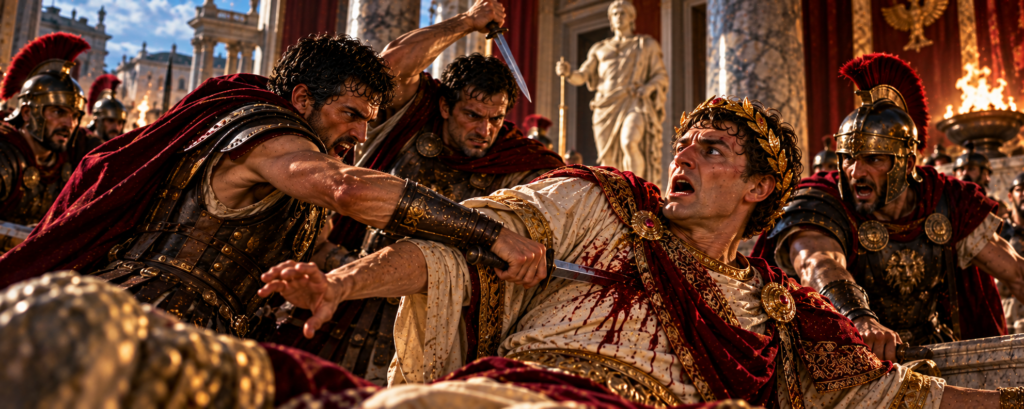
Caligula: The Emperor Murdered by His Own Guards and the Bloody End of Rome’s Most Infamous Reign
Gaius Julius Caesar Augustus Germanicus (12–41 CE) | Roman Emperor, 37–41 CE | Assassinated January 24, 41 CE
The Emperor Who Walked Into His Own Assassination
On January 24, 41 CE, the Roman emperor Caligula left a theatrical performance and entered a narrow passageway beneath the imperial palace complex. He was twenty-eight years old, had ruled the Roman Empire for less than four years, and had accumulated a reputation for cruelty, humiliation, extravagance, and terrifying unpredictability. His enemies included senators, aristocrats, military officers, and members of his own household, but the most immediate danger came from men whose duty was to protect him. Somewhere along the passage stood Cassius Chaerea, a senior officer of the Praetorian Guard who had spent years enduring the emperor’s insults and had finally decided that Caligula must die.
The assassination had been carefully planned, although the conspirators had struggled to agree upon the right moment. Caligula was attending celebrations associated with the Palatine Games, and the festivities provided an opportunity to approach him without attracting unusual suspicion. His movements were familiar to the officers responsible for his security, and the conspirators understood the palace’s corridors, entrances, and routines. They knew that the emperor’s greatest vulnerability might come not from a distant enemy but from the confidence he placed in the soldiers surrounding him.
According to the historian Josephus, Caligula turned into a relatively secluded passageway to visit the baths and observe a group of young performers who had been brought from Asia. Chaerea approached him and requested the military watchword, a routine exchange between an emperor and an officer of his guard. Caligula reportedly supplied one of the mocking responses he had used to humiliate Chaerea on previous occasions. The officer drew his sword and struck.
The first blow did not immediately kill the emperor. Ancient accounts differ over whether Chaerea struck his neck, jaw, or another part of his upper body, but they agree that Caligula was wounded and then attacked by additional conspirators. Cornelius Sabinus, another Praetorian officer, participated in the assault, while other armed men closed around their ruler. Caligula fell, and the attackers continued striking until they were certain he was dead.
Suetonius reports that the emperor received approximately thirty wounds. He also preserves the disturbing tradition that Caligula cried out that he was still alive while the conspirators continued attacking him. Josephus provides a somewhat different reconstruction, emphasizing the roles of Chaerea, Sabinus, and another attacker named Aquila. The accounts disagree on important details, but the central event is unmistakable: the emperor was killed by officers from the military organization charged with his protection.
The murder did not end with Caligula. His wife, Milonia Caesonia, and their young daughter, Julia Drusilla, were also killed in the aftermath. Their deaths transformed the assassination from the elimination of a hated ruler into the destruction of his immediate family. Whatever political principles the conspirators claimed to defend, the killing of a woman and a small child revealed how quickly the struggle for power could become indiscriminate.
The assassins believed that removing Caligula might free Rome from a dangerous emperor. Some senators hoped to restore the Republic, while others imagined a political settlement that would reduce the power of the imperial household. Yet the Praetorian Guard soon elevated Caligula’s uncle Claudius to the throne. Within days, the principal assassin would face execution under the authority of another emperor.
Caligula’s death became one of antiquity’s most notorious acts of political assassination because it exposed a fundamental weakness in the Roman imperial system. An emperor could command legions, control enormous wealth, and exercise authority over millions of people, yet his survival still depended upon the loyalty of armed men standing within reach. Caligula had spent years humiliating those around him, and in January 41 CE, some of those men decided that obedience had become more dangerous than murder.
The Golden Child of Rome’s Most Dangerous Dynasty
Caligula was born Gaius Julius Caesar Germanicus on August 31, 12 CE, into the family that had ruled Rome since Augustus established the imperial system. His father, Germanicus, was one of the most admired members of the imperial dynasty, celebrated for his military achievements, personal charm, and connection to the memory of Augustus. His mother, Agrippina the Elder, was a granddaughter of Augustus and possessed an exceptionally prestigious ancestry. From birth, Gaius belonged to a family whose private rivalries could determine the future of the Roman world.
His famous nickname originated during his childhood. While accompanying Germanicus on military campaigns along the Rhine, the young boy reportedly wore a miniature soldier’s uniform, including the distinctive military boots known as caligae. The soldiers affectionately called him Caligula, meaning something like “Little Boots.” The nickname remained attached to him throughout history, although he reportedly disliked it as an adult.
The boy’s early life unfolded among soldiers who adored his father. Germanicus enjoyed enormous popularity with the legions, and his family became a symbol of dynastic continuity. Roman troops saw the young Gaius as part of the household of a commander they admired. This early association with military loyalty would later contribute to the enthusiasm surrounding his accession.
Yet the imperial family was also a dangerous environment. Augustus had created a political system in which succession depended upon adoption, marriage, personal favor, and the ability to command military support. The emperor’s relatives competed for influence, and accusations of disloyalty could destroy entire households. Caligula’s childhood would soon become overshadowed by precisely such conflicts.
Germanicus died in Syria in 19 CE under circumstances that provoked widespread suspicion. His death was followed by accusations involving the provincial governor Gnaeus Calpurnius Piso and fears that political hostility had contributed to the tragedy. Ancient writers preserved rumors that Emperor Tiberius had somehow been involved, but those allegations cannot be established as fact. What is certain is that Germanicus’s death removed one of the most popular potential successors to the imperial throne.
For Agrippina and her children, the consequences were devastating. Their position remained prestigious, but their political security deteriorated as tensions with Tiberius intensified. The family that had once appeared destined for imperial greatness became vulnerable to accusations and persecution. Caligula grew up watching the people closest to him become targets of the political system he would eventually inherit.
A Childhood Surrounded by Death and Betrayal
After Germanicus’s death, Agrippina the Elder became increasingly involved in conflicts within the imperial family. Her position as the widow of a beloved prince gave her substantial public sympathy, but it also made her politically threatening. Tiberius’s relationship with her deteriorated, and powerful figures within the imperial administration contributed to the atmosphere of suspicion. The resulting struggle would destroy much of Caligula’s immediate family.
The Praetorian prefect Sejanus became particularly influential during the later years of Tiberius’s reign. He accumulated extraordinary authority while the emperor increasingly withdrew from public life in Rome. Sejanus’s ambitions and political maneuvering contributed to a climate in which accusations of treason became powerful weapons. Members of Germanicus’s family were among those who suffered.
Agrippina was eventually exiled, and her sons Nero Julius Caesar and Drusus Julius Caesar were subjected to political persecution. Both brothers died before Caligula became emperor, while Agrippina herself died in exile in 33 CE. Ancient sources portray these deaths as part of a systematic destruction of Germanicus’s household. Although the precise responsibility for individual decisions remains debated, the family’s suffering was real.
Caligula survived partly because he was younger and had not yet become a prominent political actor. He eventually came under the supervision of Tiberius and spent time with the emperor on Capri. The island later acquired a sinister reputation through stories of Tiberius’s alleged sexual cruelty and secret excesses. Many of those accounts are difficult to verify, but Capri undoubtedly represented the center of imperial power during Tiberius’s final years.
Living near Tiberius required considerable caution. Caligula had reason to understand that careless remarks or visible resentment could prove fatal. Later writers emphasized his ability to conceal his feelings and behave submissively toward the man associated with his family’s destruction. Whether these descriptions accurately reveal his private character is uncertain, but his survival suggests considerable political adaptability.
The experience may have shaped his later behavior, although historians should resist turning childhood trauma into a complete explanation for his reign. Ancient evidence does not allow a reliable psychological diagnosis of Caligula. His political decisions must be understood within the institutions, expectations, and conflicts of the Roman Empire. Nevertheless, he had grown up in a world where relatives disappeared, accusations destroyed families, and survival depended upon the emperor’s favor.
By the time Tiberius died in 37 CE, Caligula had lost his father, mother, and two brothers. He had also witnessed the destruction of prominent political figures who had once seemed untouchable. His accession would initially be greeted with extraordinary enthusiasm. The surviving son of Germanicus appeared to offer Rome a new beginning after years of suspicion and fear.
The Emperor Rome Welcomed With Open Arms
Tiberius died in March 37 CE, leaving a succession that involved both Caligula and his grandson Tiberius Gemellus. The precise legal arrangements were complicated, but Caligula possessed overwhelming advantages in public popularity and political support. The Praetorian prefect Macro helped secure his position, and the Senate recognized him as emperor. The young man who had survived the destruction of his family now possessed supreme authority.
Rome’s reaction was enthusiastic. Ancient writers describe celebrations, sacrifices, and widespread public rejoicing at the accession of Germanicus’s son. Caligula was young, belonged to a beloved branch of the imperial family, and appeared to represent a break with the grim final years of Tiberius. His popularity gave him an extraordinary opportunity to establish a stable reign.
His early policies encouraged optimism. He recalled some exiles, honored deceased relatives, and adopted gestures associated with generosity and reconciliation. He arranged public entertainments and sought to cultivate the affection of ordinary Romans. These measures helped strengthen the impression that a more approachable emperor had replaced the distant Tiberius.
Caligula also paid careful attention to his family’s memory. He arranged honors for Germanicus and Agrippina and emphasized his connection to Augustus. Such gestures were politically useful because they linked his authority to respected members of the dynasty. They also allowed him to present himself as the restorer of a family that had suffered under the previous reign.
The young emperor initially enjoyed substantial goodwill among senators and soldiers. His personal charm, dynastic prestige, and willingness to appear before the public contrasted with Tiberius’s increasingly secluded government. Even critics of his later reign acknowledged the enthusiasm surrounding his accession. For a brief period, Caligula seemed capable of fulfilling the hopes invested in him.
Yet the imperial system remained fundamentally unchanged. Caligula inherited enormous powers, a court filled with competing interests, and a Senate whose members depended upon imperial favor. The Praetorian Guard continued to play a crucial role in protecting the ruler and influencing succession. Beneath the celebrations lay the same political tensions that had destroyed his family.
The optimism would not last. Within months, Caligula suffered a serious illness, and his relationship with the political elite began to deteriorate. Ancient writers later portrayed this period as the turning point between a promising beginning and a reign of terror. The reality was probably more complicated, but the contrast became central to his historical reputation.
The Illness That Became a Turning Point
In the autumn of 37 CE, Caligula became seriously ill. The illness alarmed Rome because the young emperor had no secure adult successor and had only recently taken power. His death could have reopened the dangerous succession struggles that had marked the later years of Tiberius. Public concern reflected both genuine affection and fear of renewed instability.
Ancient accounts describe widespread prayers and vows for his recovery. Some individuals reportedly promised extraordinary sacrifices if the emperor survived. These stories emphasize the intensity of the public reaction. Caligula’s health had become a matter of political importance across the empire.
He eventually recovered, but later writers associated the illness with a dramatic change in his character. Suetonius described physical and psychological difficulties, while other authors emphasized increasing cruelty, arrogance, and suspicion. Some modern interpretations have suggested neurological or psychiatric explanations. Such diagnoses remain speculative because the surviving evidence is insufficient and heavily shaped by hostile literary traditions.
The illness may have influenced Caligula’s behavior, but it should not be treated as a proven cause of madness. The emperor also faced genuine political pressures, including succession uncertainty, financial demands, and conflicts within the imperial household. His decisions after recovery may reflect changes in his political strategy rather than a sudden medical transformation. Ancient authors often preferred dramatic turning points because they made moral narratives more compelling.
One immediate problem involved Tiberius Gemellus, the young grandson of Tiberius. Gemellus represented a potential alternative focus of dynastic loyalty, particularly if Caligula’s health deteriorated again. He was eventually forced to die, according to the ancient accounts, after being accused of suspicious conduct. His death eliminated a possible rival but also demonstrated the danger surrounding imperial succession.
Caligula’s relationship with Macro also deteriorated. The Praetorian prefect who had helped secure his accession lost favor and was ultimately removed, with ancient sources reporting that he and his wife were driven to suicide. The elimination of a powerful supporter suggested that Caligula was increasingly unwilling to tolerate men who possessed independent influence. It also created anxiety among officials who had previously believed themselves secure.
The emperor’s illness became a convenient dividing line in later histories. Before it, Caligula was portrayed as generous and beloved; afterward, he became suspicious and cruel. The distinction is too neat to accept without qualification. Nevertheless, the years following his recovery witnessed an unmistakable deterioration in relations between the emperor and important members of Rome’s ruling class.
Drusilla: The Sister Whose Death Shook the Palace
Caligula’s relationship with his sisters became one of the most controversial aspects of his reign. Agrippina the Younger, Julia Livilla, and Julia Drusilla were prominent members of the imperial family, and their position carried considerable political importance. Caligula initially granted them exceptional honors, emphasizing their connection to the ruling dynasty. Later writers interpreted these gestures through accusations of sexual scandal and excessive attachment.
Drusilla occupied a particularly prominent place in Caligula’s affections. Ancient sources describe him treating her with unusual distinction, and her position within the imperial household appears to have been exceptional. Some later accounts alleged an incestuous relationship between the siblings. Those accusations cannot be independently verified and may reflect hostile efforts to portray the emperor as violating every social and religious boundary.
Drusilla died in 38 CE, and Caligula responded with extraordinary mourning. He arranged exceptional honors for her and secured her deification, making her the first Roman woman formally recognized as a goddess under the imperial system. The decision was unprecedented and politically significant. It also intensified criticism from those who believed the emperor was elevating his family beyond acceptable limits.
The deification of Drusilla became part of the wider controversy surrounding Caligula’s treatment of imperial power. Roman rulers had already developed forms of divine association, particularly through the cult of Augustus after his death. Yet Caligula’s actions appeared to some observers to blur the distinction between human authority and divine status. His enemies could interpret his grief as evidence of arrogance or religious excess.
The death may also have affected the balance of influence within the palace. Drusilla had occupied a privileged position, and her disappearance altered relationships among Caligula’s relatives and advisers. Ancient writers later suggested that his conduct became increasingly erratic after her death. The evidence does not establish a direct psychological cause, but the event was clearly significant.
His remaining sisters eventually fell from favor. In 39 CE, Agrippina the Younger and Julia Livilla were implicated in a political crisis involving Marcus Aemilius Lepidus and were exiled. The accusations were connected with fears of conspiracy and succession. Whether the alleged plot existed exactly as described remains uncertain.
The episode demonstrated that family membership offered no guarantee of safety. Caligula had survived the destruction of his mother’s household, yet he now participated in the persecution of his own relatives. The imperial dynasty remained trapped in cycles of suspicion and political violence. Those tensions would eventually contribute to the conspiracy that destroyed him.
The Conspiracy of 39 CE and the Emperor’s Growing Suspicion
In 39 CE, Caligula faced a major political crisis involving prominent members of the imperial elite. Marcus Aemilius Lepidus, who had been closely associated with the emperor’s family, was accused of plotting against him. The affair also implicated Caligula’s sisters Agrippina and Livilla. Its precise circumstances remain difficult to reconstruct because the surviving accounts are incomplete and often hostile.
Lepidus was executed, while the two sisters were exiled. Other prominent figures were affected by the political upheaval, including individuals connected with military commands. The episode demonstrated that Caligula believed threats existed within his closest circle. It also gave him grounds to reorganize relationships among powerful senators and officers.
One of the most important consequences involved the military command on the Rhine. Gnaeus Cornelius Lentulus Gaetulicus, a prominent general, was executed amid accusations connected with conspiracy. His position had given him influence over substantial military forces. His removal revealed the emperor’s concern about commanders whose authority might become politically dangerous.
The crisis intensified tensions between Caligula and the senatorial aristocracy. Men who possessed distinguished ancestry, military experience, or family connections could suddenly find themselves accused of disloyalty. The emperor’s control over appointments and punishments created an atmosphere in which personal favor became essential. Fear encouraged obedience but also deepened resentment.
Ancient writers portray Caligula as increasingly suspicious and vindictive during this period. Some of their accounts may exaggerate his behavior, but the executions and exiles demonstrate genuine political conflict. His authority depended upon cooperation from the same elite whose independence he appeared determined to weaken. The relationship became increasingly unstable.
The emperor’s public humiliations of senators also became part of his reputation. Stories describe aristocrats being forced to perform degrading services, endure insults, or submit to displays of imperial superiority. Individual anecdotes require caution, but the broader pattern of conflict is credible. Caligula appears to have challenged the dignity and traditional privileges of the ruling class.
These tensions mattered because senators possessed influence beyond the Senate chamber. Their families maintained networks of clients, friends, and military connections. Humiliation could create personal enemies, while executions could inspire fear among survivors. The conspiracy of 41 CE emerged from a political world already damaged by these conflicts.
The Emperor Who Humiliated the Men Around Him
Caligula’s reputation for humiliation became one of the defining themes of ancient accounts of his reign. Suetonius, Cassius Dio, and Josephus describe a ruler who mocked senators, insulted officials, and treated powerful men as though their dignity existed only at his pleasure. Some stories are theatrical and difficult to verify, but they reflect a consistent tradition of conflict between the emperor and the elite. That conflict would eventually become deadly.
Roman aristocratic culture placed enormous importance upon public honor. Senators and military officers belonged to families whose reputations could extend across generations. Their social standing depended upon visible recognition, appropriate treatment, and the ability to exercise authority. Public humiliation could therefore be experienced as a serious political injury.
Caligula reportedly delighted in reminding senators of their dependence upon him. Ancient accounts describe forced attendance at performances, degrading assignments, and insults directed at men who expected respect. Such behavior challenged the traditional fiction that the emperor was merely the foremost citizen of the Republic. It exposed the unequal relationship beneath imperial government.
The emperor’s treatment of military officers could be especially dangerous. Soldiers were expected to obey orders, but senior commanders also possessed professional pride and personal reputations. An emperor who mocked their courage or masculinity risked undermining the loyalty upon which his security depended. Cassius Chaerea would become the most famous example.
The ancient evidence suggests that Caligula sometimes used sexualized insults to degrade opponents. Such language was particularly potent in Roman society, where accusations of effeminacy or sexual submission could damage a man’s standing. The historical reality of individual incidents cannot always be established. Nevertheless, Josephus and Suetonius independently preserve the importance of Chaerea’s humiliation.
Caligula may have regarded such mockery as harmless entertainment or as a demonstration of dominance. His targets could interpret it very differently. The emperor’s authority prevented them from responding openly without risking punishment. Resentment accumulated beneath outward obedience.
The resulting atmosphere made conspiracy increasingly attractive to men who believed they had no lawful remedy. Political assassination could appear to offer both revenge and liberation. The same guards who protected Caligula possessed the means to approach him closely. His humiliations helped turn that proximity into a mortal danger.
Cassius Chaerea: The Praetorian Officer Who Wanted Revenge
Cassius Chaerea was a tribune of the Praetorian Guard, the elite military organization responsible for protecting the emperor and maintaining security in Rome. His position gave him access to Caligula and familiarity with imperial routines. He was not an obscure outsider attempting to penetrate palace defenses. He belonged to the very institution upon which the emperor depended for survival.
Chaerea also possessed military experience and a reputation that made Caligula’s treatment of him especially humiliating. Ancient accounts describe the emperor mocking his voice and manner, implying that he lacked masculine courage. The insults reportedly occurred during routine military exchanges, including the issuing of watchwords. What should have been a formal interaction between ruler and officer became an opportunity for ridicule.
Suetonius describes Caligula assigning Chaerea embarrassing watchwords associated with feminine or sexually suggestive themes. Josephus likewise emphasizes the emperor’s repeated mockery. The precise words may have been shaped by later literary retellings, but the humiliation itself is central to both traditions. Chaerea’s resentment became a major motive attributed to the assassination.
The insults were particularly damaging because they occurred within a military environment. A senior officer’s authority depended upon the respect of subordinates and colleagues. Being mocked by the emperor could undermine that authority. Chaerea could not easily retaliate without committing treason.
Josephus adds another disturbing dimension to the relationship. He describes Chaerea being ordered to participate in the torture of a woman named Quintilia, who had been implicated in an accusation against a senator. The account portrays the officer as deeply troubled by the cruelty he was required to carry out. Josephus presents the episode as part of Chaerea’s growing disgust with the emperor’s government.
This portrayal should be read critically. Josephus wrote after the assassination and had reasons to depict Chaerea as a morally serious opponent of tyranny. His account may emphasize the officer’s conscience while minimizing his personal resentment. Yet the combination of humiliation, fear, and involvement in repression provides a plausible explanation for his hostility.
Chaerea’s position also made him unusually capable of acting. He understood guard arrangements, palace movements, and the moments when Caligula might be isolated. He could approach the emperor without immediately attracting suspicion. His professional responsibilities gave him the access necessary to carry out the murder.
The assassination would therefore emerge from a dangerous contradiction. Caligula had repeatedly insulted an officer whose duty required him to stand close enough to protect the emperor’s life. Chaerea eventually decided to use that access for the opposite purpose. The emperor’s security system became the instrument of his destruction.
The Praetorian Guard: Protectors, Power Brokers, and Future Kingmakers
The Praetorian Guard had developed into one of the most important institutions of the early Roman Empire. Augustus established a permanent force associated with protecting the emperor and maintaining security in Italy. Its members enjoyed privileges that distinguished them from ordinary legionaries. Their proximity to the ruler gave them political importance far beyond their numbers.
Under Tiberius, the Guard’s concentration in Rome increased its influence. The construction of the Praetorian camp provided a permanent military base near the capital. The prefect Sejanus demonstrated how dangerous the institution could become when its leadership acquired independent political ambitions. His rise and fall revealed the power of officers who controlled access to the emperor.
Caligula inherited this system. The Guard protected him, enforced imperial orders, and helped maintain the political settlement established after Tiberius’s death. Its officers possessed detailed knowledge of palace routines and security arrangements. They were among the few men capable of approaching the emperor while armed.
Yet the Guard was not politically uniform. Individual officers possessed different loyalties, ambitions, and grievances. Some remained devoted to Caligula, while others became involved in conspiracies against him. The assassination would expose these divisions dramatically.
Chaerea’s position as tribune gave him authority within the organization. He could communicate with other officers and exploit military procedures. His access allowed him to plan an attack that ordinary senators might have found impossible. The conspiracy depended upon the cooperation of men who understood the emperor’s movements.
The involvement of Praetorian officers also created a problem for the assassins. Not every guard supported the plot, and loyal soldiers could respond violently. German members of the imperial security forces reportedly reacted with fury after Caligula’s death. The conspirators therefore needed to act quickly and prevent immediate retaliation.
The Guard’s role in the succession would prove even more important. After Caligula was killed, soldiers elevated Claudius to the throne despite senatorial hopes of restoring republican government. The institution that had failed to protect one emperor helped create another. Its political influence would become a defining feature of later Roman history.
Caligula’s assassination therefore marked an important stage in the development of the Praetorian Guard as a political force. The soldiers were no longer merely protectors of imperial authority. They had demonstrated that they could destroy a ruler and influence the selection of his successor. The precedent would haunt future emperors.
The Other Conspirators and the Politics of Fear
Chaerea was not acting alone. Josephus describes several overlapping conspiratorial circles involving military officers, senators, and other prominent individuals. Their motives were not necessarily identical, but they shared a desire to remove Caligula. Some feared for their lives, while others resented humiliation or opposed the emperor’s political conduct.
Cornelius Sabinus was among the most important participants. Like Chaerea, he belonged to the Praetorian Guard and possessed the access necessary to approach Caligula. Ancient accounts consistently associate him with the physical attack. His involvement demonstrates that the assassination required cooperation among officers rather than the determination of a single disgruntled soldier.
Josephus also identifies Annius Vinicianus and other politically connected figures associated with opposition to the emperor. Some had personal reasons to fear Caligula because of earlier executions or family relationships. The conspiracy therefore extended beyond military resentment. It reflected broader anxiety within Rome’s governing class.
Another figure mentioned in the sources is Aemilius Regulus, who was associated with a separate plan against Caligula. Josephus presents several groups considering assassination, suggesting that opposition had become widespread. The existence of multiple plots complicates attempts to identify a single organizer. Chaerea became the decisive figure because he possessed both determination and access.
The conspirators reportedly debated timing and method. Some opportunities involved public appearances, religious ceremonies, or moments when Caligula was less heavily guarded. Each possibility carried substantial risks. Failure would almost certainly result in execution.
The conspirators also had to consider the political consequences. Killing Caligula might remove the immediate threat, but it would create a succession crisis. Some senators favored restoring the Republic, while others may have expected a new emperor. The absence of a unified plan would become apparent after the murder.
Personal fear was a powerful unifying force. Under an emperor who could order executions and humiliations, men might believe that waiting increased their danger. A conspiracy could become attractive even to individuals who disagreed about the future government. The immediate objective was survival through the removal of the ruler.
This combination of motives explains why Caligula’s assassination cannot be reduced to Chaerea’s wounded pride. Personal revenge mattered, but so did political instability, elite resentment, and fear of imperial violence. The plot emerged from a system in which power was concentrated and opposition lacked secure institutional channels. Murder became the chosen solution because the conspirators believed ordinary politics could no longer protect them.
Caligula’s Alleged Madness and the Problem of Hostile Sources
Caligula’s reputation as a mad emperor has become so familiar that it often obscures the historical evidence. Popular accounts portray him as a ruler who declared himself a god, appointed his horse consul, committed incest, and indulged in spectacular cruelty. Some of these stories originate in ancient sources, but their reliability varies considerably. The surviving record requires careful separation of documented actions, hostile allegations, and later exaggeration.
Suetonius wrote decades after Caligula’s death and organized his biography around examples of vice and scandal. Cassius Dio wrote much later and relied upon traditions that had already developed around the emperor. Josephus provides valuable information about the assassination but also presents Caligula through a strongly moralizing framework. Their accounts cannot be treated as neutral records of every incident.
Contemporary writers offer important additional perspectives. Philo of Alexandria encountered the political consequences of Caligula’s policies and described his behavior in connection with Jewish communities and imperial religious demands. Seneca, who lived during the reign, also preserved hostile judgments. These sources demonstrate that criticism of Caligula was not entirely invented by later historians.
Nevertheless, the most sensational anecdotes require caution. The story that Caligula intended to appoint his horse Incitatus as consul may reflect a mocking remark or a deliberate insult to the Senate rather than an actual appointment. The allegations of incest with his sisters are difficult to verify. Stories of extraordinary sexual behavior often served as conventional weapons against unpopular rulers.
The question of mental illness is even more uncertain. Ancient writers used terms associated with madness, arrogance, and moral corruption, but they did not employ modern diagnostic standards. Their descriptions may reflect genuine behavioral problems, political hostility, literary exaggeration, or some combination of these factors. A confident retrospective diagnosis would go beyond the evidence.
Caligula’s documented political conflicts remain serious without requiring every scandal to be accepted. He ordered executions, exiled relatives, challenged senatorial privileges, and pursued policies that provoked substantial opposition. His relationship with the Praetorian Guard deteriorated to the point that officers conspired to kill him. These facts provide sufficient material for understanding his violent end.
The historical Caligula was therefore more complicated than the familiar caricature. He may have behaved cruelly and unpredictably, but the surviving evidence also reflects the interests of those who benefited from portraying him as monstrous. His assassination was remembered as liberation partly because his enemies helped shape the narrative. Understanding the murder requires recognizing both the reality of political violence and the distortions of hostile memory.
The Emperor Who Challenged the Gods
Caligula’s relationship with religion became another source of controversy. Ancient writers describe him accepting or demanding extraordinary forms of divine honor. Some accounts portray him dressing as gods or requiring worship that seemed inappropriate for a living Roman emperor. These stories contributed to his reputation for arrogance and sacrilege.
The Roman imperial system already contained religious elements associated with the ruler. Augustus had received divine honors after death, and imperial cult practices developed differently across the provinces. In the eastern Mediterranean, ruler worship had established precedents under Hellenistic monarchies. Caligula’s behavior must be understood within this complex religious environment.
Nevertheless, his policies could provoke serious resistance. The most consequential example involved the proposed installation of an imperial statue in the Jerusalem Temple. For Jewish communities committed to the worship of one God, such an act threatened the sanctity of their most important religious institution. The resulting crisis created intense anxiety and opposition.
The governor of Syria, Publius Petronius, faced the difficult task of implementing imperial orders while avoiding widespread unrest. Ancient accounts describe negotiations, delays, and appeals intended to prevent catastrophe. The situation demonstrates how Caligula’s demands could create political instability far from Rome. His authority was enormous, but it was not unlimited in practice.
Herod Agrippa, a client king and associate of Caligula, also became involved in efforts to resolve the crisis. The surviving narratives differ in emphasis, but they agree that the proposed statue created a serious confrontation. Caligula’s death ultimately prevented the order from being carried out. The assassination therefore had consequences beyond the Roman political elite.
The religious controversy also influenced later portrayals of the emperor. Jewish and Christian writers could interpret his death as the punishment of a ruler who challenged divine authority. Such interpretations reinforced his reputation for madness and impiety. They should be distinguished from the political and military circumstances that made the assassination possible.
Caligula’s religious policies reveal another dimension of the problem facing the imperial system. The emperor possessed authority over diverse peoples whose traditions could conflict with his demands. A ruler who ignored those differences risked resistance and instability. His assassination ended a reign that had already created serious tensions across the empire.
Extravagance, Spectacle, and the Emperor’s Dangerous Reputation
Caligula’s reign became associated with extravagant spending and spectacular public displays. Ancient sources describe elaborate banquets, costly building projects, luxurious ships, and unusual entertainments. Some stories are exaggerated or designed to illustrate moral corruption. Nevertheless, the emperor clearly invested heavily in public spectacle and personal prestige.
One of the most famous episodes involved the construction of a temporary bridge of boats across the Bay of Baiae. Suetonius describes Caligula riding across the structure in elaborate military dress. The event was remembered as a display of arrogance and extravagance. Its precise purpose remains debated, but it demonstrates the importance of spectacle in the emperor’s public image.
Caligula also pursued construction projects and improvements to infrastructure. His reign was not devoid of administrative activity, despite the emphasis ancient writers placed upon scandal. Some projects were completed under his successors, while others remained unfinished. His government continued functioning even as political relations deteriorated.
The financial consequences of his spending became a major theme in hostile accounts. Suetonius claimed that Caligula exhausted enormous reserves accumulated under Tiberius. The figures are difficult to verify, and ancient authors frequently used financial extravagance as evidence of tyranny. Nevertheless, heavy expenditure could create pressure for additional revenue.
Ancient sources describe controversial financial measures, including taxes and confiscations. Some may have been exaggerated, but the emperor’s relationship with wealthy Romans clearly became strained. Confiscations could enrich the imperial treasury while creating enemies among the aristocracy. The combination of financial pressure and political humiliation was particularly dangerous.
Public entertainment also served a political purpose. Games, performances, and distributions could cultivate popular affection while demonstrating imperial generosity. Caligula’s enthusiasm for spectacle may have strengthened his relationship with some sections of the population. The same activities could appear undignified or excessive to senators who valued traditional aristocratic restraint.
The contrast between popular entertainment and elite resentment became important after his death. The conspirators could not assume that ordinary Romans shared their hostility. Caligula’s reputation among the governing class did not necessarily reflect the feelings of every citizen. The assassination therefore created a political crisis rather than an immediate consensus.
Caesonia: The Woman Who Became the Emperor’s Final Wife
Milonia Caesonia entered Caligula’s life during the later part of his reign and became his final wife. Ancient writers portrayed her as an unusual choice for an emperor, emphasizing her maturity and suggesting that she did not possess the conventional beauty expected of an imperial bride. Such descriptions reflect the hostile and often misogynistic assumptions of Roman elite literature. They tell us as much about the writers’ attitudes as about Caesonia herself.
Caligula appears to have been strongly attached to her. Suetonius describes the emperor displaying affection toward Caesonia in ways that later readers interpreted as excessive or undignified. Their relationship attracted gossip because the emperor’s private life was inseparable from public politics. Any woman close to him could become the subject of speculation.
Caesonia gave birth to a daughter, Julia Drusilla, named after Caligula’s beloved sister. The child’s birth provided the emperor with a direct descendant, although a daughter did not resolve every question surrounding succession. The imperial household remained vulnerable because Caligula lacked an established adult male heir. The young girl’s existence nevertheless carried dynastic significance.
Ancient writers accused Caesonia of influencing the emperor through love potions or other suspicious methods. Suetonius preserved the allegation that she administered a substance that contributed to his supposed madness. There is no reliable evidence establishing this story. It belongs to a broader tradition in which powerful women were blamed for the behavior of male rulers.
Josephus also records conflicting opinions about Caesonia’s influence. Some accused her of encouraging Caligula’s cruelty, while others believed she had warned him to moderate his behavior. The disagreement demonstrates how uncertain her actual political role remains. She was close to the emperor, but proximity does not prove responsibility for his decisions.
Her relationship with Caligula became tragically important after the assassination. The conspirators regarded the survival of his immediate family as a potential threat. Caesonia’s position as the emperor’s wife made her vulnerable regardless of whether she had participated in his political conduct. Her daughter was even more defenseless.
The deaths of Caesonia and Julia Drusilla would expose the brutality underlying the rhetoric of liberation. The assassins claimed to remove a dangerous ruler, but some were unwilling to leave his family alive. Their decision transformed the murder into an attack upon the imperial household itself. The consequences would become among the darkest episodes of January 41 CE.
Julia Drusilla: The Child Who Inherited Her Father’s Enemies
Julia Drusilla was still a very young child when her father was assassinated. She had been born during the later years of Caligula’s reign and possessed no political authority of her own. Her importance came entirely from her position within the imperial family. As the emperor’s daughter, she represented a possible focus of future dynastic loyalty.
Caligula reportedly displayed great affection for the child. Ancient accounts describe him presenting her publicly and associating her with his own family identity. Some anecdotes portray the girl as unusually fierce or energetic, reflecting the tendency of hostile writers to project the emperor’s alleged character onto his daughter. Such stories cannot establish anything meaningful about a child of her age.
Her name connected her to Julia Drusilla, Caligula’s deceased sister. The choice emphasized the emperor’s attachment to his family and the importance of dynastic memory. In the Roman imperial system, names could carry powerful political associations. A child born into the ruling household might become significant even before reaching adulthood.
The conspirators understood the dangers of dynastic survival. Caligula’s death did not automatically eliminate the possibility that supporters might rally around his relatives. His daughter could become a symbol of continuity, even if she could not rule independently. Her existence therefore acquired political meaning far beyond her actual age.
Yet the decision to kill her cannot be justified as an unavoidable consequence of removing Caligula. She was a small child who had committed no political offense. Her death reflected the ruthless logic of eliminating possible rivals and extinguishing a hated ruler’s immediate line. It demonstrated how political fear could erase the distinction between responsibility and ancestry.
Ancient accounts preserve the child’s murder as part of the aftermath of the assassination. Suetonius describes her being killed violently, while Josephus records the decision to eliminate both mother and daughter. The precise physical details differ, but the central fact is secure. Julia Drusilla was murdered because she belonged to Caligula’s family.
Her death is sometimes overshadowed by the more sensational stories of her father’s reign. Yet it deserves a central place in the history of the assassination. The killing of a child reveals the moral collapse that could accompany political violence. The conspirators’ claims to liberty did not prevent the destruction of someone entirely powerless.
The Palatine Games: A Festival Becomes a Murder Plot
The assassination took place during celebrations associated with the Palatine Games, a festival involving theatrical performances and public entertainment. Caligula attended the festivities as emperor, surrounded by officials, soldiers, and members of the imperial household. Such occasions allowed him to display his authority before the public. They also created predictable movements that conspirators could exploit.
The conspirators had considered different opportunities to attack. Public appearances offered access but also created risks involving crowds and loyal guards. A theater or festival could provide confusion, yet the emperor might remain protected by numerous attendants. The conspirators needed a moment when he would be separated from the larger gathering.
The passageways connecting the entertainment area with the palace offered such an opportunity. Caligula would need to move through relatively confined spaces while leaving the performance. Officers familiar with his routine could anticipate his route. Their knowledge of the setting made the attack possible.
Josephus describes the conspirators becoming increasingly impatient as the day progressed. Caligula remained at the performance longer than expected, and delays threatened the plan. Chaerea reportedly considered attacking even under less favorable circumstances. The account emphasizes his determination and frustration with hesitant associates.
The timing was critical because Caligula was expected to travel away from Rome. Josephus mentions plans involving a journey to Alexandria, although the precise arrangements remain uncertain. The conspirators feared that departure would remove their opportunity. Their urgency increased as the festival continued.
When Caligula finally rose, the conspirators moved into position. Some attempted to clear the area or prevent loyal supporters from following. Others prepared to intercept the emperor in the passageway. The operation required coordination among men who could not openly reveal their intentions.
The festival setting gave the assassination a disturbing contrast. Rome was celebrating while armed officers prepared to murder its ruler. Performers, spectators, and attendants continued their activities without understanding the danger. The emperor’s final journey began amid the ordinary rituals of public entertainment.
The Narrow Passageway and the First Blow
Caligula eventually left the performance and entered the passageway where the conspirators were waiting. Ancient accounts describe him turning aside to observe young performers and proceed toward the baths. The exact layout of the route remains uncertain, but the setting was sufficiently confined to limit his movements. The attackers had chosen a place where their weapons could be used before loyal guards intervened.
Chaerea approached and requested the military watchword. The exchange was routine in form, but it carried personal significance because Caligula had repeatedly used watchwords to mock him. According to the ancient tradition, the emperor supplied another insulting response. The officer then drew his sword.
The first blow struck Caligula but did not immediately kill him. Suetonius describes a wound to the neck, while Josephus emphasizes a severe initial strike followed by further attacks. The emperor reacted in pain and confusion. His attempt to escape or defend himself was overwhelmed by the conspirators.
Cornelius Sabinus joined the assault. Other attackers moved forward, and Caligula was forced down. Josephus describes the emperor being struck repeatedly while the conspirators urged one another to continue. The violence was intended to ensure that he could not survive.
The exact sequence of wounds remains disputed. Suetonius preserves alternative versions involving different positions and signals. Josephus attributes the decisive final blow to Aquila. These differences demonstrate that even an event of enormous political importance could produce conflicting accounts.
What is certain is that the emperor died in the passageway. His killers were not foreign invaders or soldiers from a rebellious province. They were officers and associates who possessed access because of their positions within the imperial system. Caligula’s authority had been destroyed from inside his own security apparatus.
The assassination also revealed the limits of personal power. The emperor could command armies and order executions, but he could not prevent armed men from attacking him at close range. His survival depended upon loyalty that had already collapsed. The narrow passageway became the place where Rome’s most powerful man discovered that his guards were his enemies.
Thirty Wounds and the Death of an Emperor
The ancient accounts agree that Caligula was attacked repeatedly after the first blow. Suetonius reports approximately thirty wounds, a number that became closely associated with the assassination. The repeated strikes suggest that the conspirators were determined to eliminate any possibility of survival. Their violence was collective and deliberate.
Josephus describes Chaerea initiating the attack and other conspirators completing it. His account emphasizes the officer’s role as organizer and first attacker. Suetonius preserves alternative versions involving the watchword and the positions of Chaerea and Sabinus. The differences prevent a precise reconstruction of every movement.
The physical brutality of the attack was extraordinary. Caligula was still a young man, and the conspirators needed to overcome him quickly before loyal guards could intervene. The confined setting made the struggle chaotic. The attackers continued striking until the emperor was dead.
The number of wounds also carried symbolic significance. A single fatal blow might have made the assassination appear to be the act of one disgruntled officer. Multiple attackers demonstrated a broader conspiracy. Their participation transformed personal revenge into a collective political act.
Yet the violence did not create immediate unity. Loyal soldiers reacted with anger, and the palace descended into confusion. Some guards sought the killers, while others attempted to protect members of the imperial family. The assassination had removed the emperor without establishing who controlled the armed forces.
Caligula’s body became part of the political crisis. Ancient accounts describe uncertainty over its treatment and burial. The emperor who had received extraordinary honors in life was suddenly vulnerable to humiliation in death. His reputation would be shaped by the men who survived him.
The assassination also exposed the danger of relying upon fear as a means of government. Caligula had possessed the power to punish and humiliate officers, but those same officers controlled his immediate security. Once they concluded that his survival threatened their own, the relationship became fatal. The emperor’s authority could not protect him from men who had decided that murder was the only remaining solution.
The Loyal Guards Who Turned the Palace Into a Battlefield
Not every member of Caligula’s security forces supported the assassination. Ancient accounts describe German guards reacting with fury when they learned that the emperor had been killed. These soldiers had served as part of the imperial security establishment and possessed loyalties distinct from those of the conspirators. Their response created immediate danger for everyone nearby.
Josephus describes the German guards attacking individuals they suspected of involvement. Their anger produced additional deaths and confusion. The conspirators had hoped to eliminate Caligula quickly, but they could not control the reactions of every armed group. The palace became a place of competing loyalties.
The distinction between Praetorian conspirators and loyal German guards is important. Caligula’s assassination was not a unanimous military revolt. It involved particular officers and political allies who had prepared a coordinated attack. Other soldiers remained attached to the emperor or reacted violently to his murder.
The resulting chaos complicated the conspirators’ political plans. They needed to establish authority before loyal forces could organize retaliation. Yet they lacked a unified command structure capable of controlling the entire security apparatus. The murder had created a dangerous vacuum.
Senators and palace officials faced uncertainty about which faction would prevail. Some hoped the Senate could reclaim authority, while others feared renewed civil conflict. The armed forces possessed the immediate ability to determine events. Political arguments mattered less than the question of who controlled the soldiers.
The German guards’ reaction also demonstrates that Caligula retained some personal loyalty. His reputation among hostile writers should not be mistaken for universal hatred. Different groups experienced his reign differently and had different interests in its survival. The assassination exposed those divisions.
The palace therefore became a battlefield of political possibilities. Caligula was dead, but the struggle over his successor had only begun. The conspirators had eliminated the ruler without securing the loyalty of all his guards. Their victory was immediate but dangerously incomplete.
Caesonia’s Final Hours: The Murder of an Emperor’s Wife
The killing of Caesonia was one of the most disturbing consequences of Caligula’s assassination. She had not been the target of the initial attack, which focused upon the emperor. Yet the conspirators soon decided that his immediate family should not survive. Their reasoning reflected fear of dynastic retaliation and a desire to eliminate the political legacy of the murdered ruler.
Josephus attributes the decision to Chaerea and describes the dispatch of Julius Lupus, another officer, to kill Caesonia and her daughter. The account suggests that some conspirators considered the action excessively cruel. Others argued that Caesonia had influenced Caligula’s behavior and therefore deserved punishment. These accusations were contested even within the ancient narrative.
The allegation that Caesonia caused Caligula’s cruelty through potions or manipulation should not be accepted as fact. It reflects a familiar pattern in which women close to powerful rulers were blamed for political decisions. The surviving evidence does not establish that she directed the emperor’s government. Her position as his wife made her vulnerable regardless of her actual influence.
Josephus describes Lupus finding Caesonia grieving beside Caligula’s body. The scene is emotionally powerful, but its precise details come from a literary account written after the event. According to the tradition, Caesonia understood why the officer had come and accepted that she would be killed. The narrative presents her final moments with a dignity denied to her in many hostile descriptions.
Lupus carried out the killing. The emperor’s wife, who had occupied one of the highest positions available to a Roman woman, died during the political violence following her husband’s assassination. Her death was not necessary to establish that Caligula had been removed. It reflected the conspirators’ determination to eliminate potential sources of future opposition.
The murder also reveals the contradictions within the language of liberation. Chaerea and his associates claimed to oppose tyranny and restore freedom. Yet they ordered the death of a woman whose guilt was uncertain and whose political power depended upon her husband. Their actions demonstrated that political violence could reproduce the cruelty it claimed to oppose.
Caesonia’s death deserves to be remembered as more than a footnote to Caligula’s assassination. She was killed because she belonged to the imperial household at the moment its protector was destroyed. Her final hours illustrate the vulnerability of those closest to a fallen ruler. The struggle for power had moved beyond the emperor and reached into his family.
The Murder of Julia Drusilla: A Child Destroyed by Politics
The killing of Julia Drusilla was even more difficult to reconcile with the conspirators’ claims of political necessity. She was a very young child, incapable of exercising authority or participating in her father’s decisions. Her only political significance came from her birth. She was Caligula’s daughter, and that was enough to make her a target.
Ancient sources agree that the child was killed after the emperor’s assassination. Suetonius preserves a particularly brutal account of her death, while Josephus describes the murder as part of the same operation that eliminated Caesonia. The precise physical details are not necessary to understand the horror of the event. A defenseless child was deliberately killed during a struggle over imperial power.
The decision reflected the logic of dynastic politics. A surviving child of a murdered ruler could become a symbol around which supporters might gather. Even if Julia Drusilla could not rule independently, her existence might provide legitimacy to future claimants. The conspirators sought to remove that possibility.
Yet this reasoning does not transform the killing into an unavoidable political act. It demonstrates how fear of future retaliation could lead men to murder individuals who had committed no offense. The child was punished for her ancestry rather than her actions. Her death exposed the moral emptiness that could accompany claims of liberation.
Josephus’s account suggests that some conspirators objected to killing Caesonia, but the opposition failed. The same political environment allowed the child’s murder to proceed. The desire to eliminate the imperial household overcame any distinction between adult responsibility and childhood innocence. The conspiracy became an act of family destruction.
The deaths of Caesonia and Julia Drusilla also complicated the reputation of Chaerea. He could be celebrated as the man who killed a tyrant, but his involvement in eliminating the emperor’s family made that reputation difficult to sustain without qualification. His actions reflected both political determination and extraordinary ruthlessness. The language of freedom could not erase the bloodshed.
The young girl’s life ended before she could develop a public identity beyond her father’s household. Her name survived because of the assassination, not because of anything she had done. In a story dominated by emperors, senators, and military officers, her death remains one of the clearest examples of the innocent suffering caused by struggles for power.
Claudius: The Uncle Who Survived and Became Emperor
While the conspirators attempted to control the aftermath, Caligula’s uncle Claudius found himself in extraordinary danger. Claudius had long been regarded by some members of the imperial family as physically awkward and politically insignificant. His disabilities and mannerisms made him the subject of ridicule in ancient accounts. Yet his dynastic position suddenly became crucial.
The death of Caligula created uncertainty over succession. The emperor had no surviving adult male heir, and his immediate family was being eliminated. Claudius remained a prominent member of the Julio-Claudian dynasty. His survival offered a possible solution for soldiers who wanted continuity rather than a return to republican government.
Ancient writers describe Claudius hiding during the confusion. Suetonius famously recounts that a soldier discovered him concealed behind a curtain or screen. The details may have been dramatized, but the broader event is clear: Praetorian soldiers brought Claudius under their protection. They recognized him as a potential emperor.
The Senate initially considered alternatives. Some senators hoped to restore republican government, while others favored different political arrangements. Their discussions revealed the uncertainty created by Caligula’s death. Yet they lacked the military strength necessary to impose their preferences.
The Praetorian Guard possessed the decisive advantage. Its soldiers controlled armed force in Rome and could protect Claudius while demanding recognition of his authority. Their support transformed an apparently vulnerable member of the imperial family into the new ruler. The Senate eventually accepted the settlement.
Claudius’s accession demonstrated the failure of the conspirators’ broader political ambitions. They had killed Caligula partly because they opposed his tyranny, but another emperor immediately replaced him. The imperial system survived because the military and political structures supporting it remained intact. Removing one ruler did not restore the Republic.
The succession also created danger for Chaerea and his associates. Claudius could not safely allow officers to establish the principle that emperors might be murdered without punishment. His own security depended upon discouraging future conspiracies. The men who had elevated themselves as liberators now faced the authority of a new ruler.
The Assassin Who Was Executed for Killing a Tyrant
Cassius Chaerea did not enjoy a long victory after Caligula’s death. The political settlement that elevated Claudius left him exposed. Although some Romans admired his role in eliminating the hated emperor, the new regime regarded the assassination as a dangerous precedent. Claudius eventually ordered his execution.
Josephus describes the decision as a response to the need to discourage violence against emperors. Chaerea’s act could be praised as the removal of a tyrant while still being condemned as a threat to imperial security. The distinction was politically convenient for Claudius. He could benefit from Caligula’s death without endorsing the murder of rulers.
Chaerea reportedly faced execution with composure. Josephus preserves stories of his final words and his request concerning the sword used to kill him. Such details may have been shaped by later admiration for his courage. Nevertheless, his execution is historically secure.
Julius Lupus, who had killed Caesonia and Julia Drusilla, was also executed. His death followed the same political logic, although his role in murdering the emperor’s family made his actions especially difficult to defend. The new regime sought to establish control by punishing men associated with the conspiracy. The assassins discovered that their usefulness had ended.
Cornelius Sabinus met a different fate. Josephus reports that he was permitted to retain his position but later took his own life. The account presents his suicide as an expression of loyalty to his fellow conspirators and refusal to accept the continuation of imperial rule. His death reflected the despair of men who had expected political transformation.
The executions demonstrated the limits of tyrannicide as a political strategy. Chaerea had killed Caligula because he believed the emperor’s rule was intolerable. Yet the institution of monarchy survived, and the new ruler punished the assassin. The political system absorbed the murder without surrendering its central structure.
Chaerea’s fate was therefore deeply ironic. He had been humiliated by Caligula, organized his assassination, and briefly appeared to have liberated Rome. Within a short time, he was dead by order of Caligula’s successor. The officer who had turned his sword against an emperor became a warning to anyone tempted to repeat the act.
The Senate’s Lost Chance to Restore the Republic
Caligula’s assassination created a brief moment when some senators believed the Roman Republic might be restored. The imperial system had existed for less than seventy years, and republican institutions remained visible. The Senate continued to meet, magistrates still held office, and aristocratic families preserved memories of earlier political independence. The sudden death of an emperor without an established adult heir appeared to offer an opportunity.
Yet the Senate lacked the military resources necessary to enforce its preferences. The Praetorian Guard controlled armed force in Rome, and provincial armies remained loyal to the imperial system or their commanders. Senators could debate constitutional principles, but they could not easily compel soldiers to accept a restoration. The balance of power had changed fundamentally since the Republic’s final decades.
The elevation of Claudius demonstrated this reality. The Guard selected a member of the imperial family and placed him under its protection. The Senate eventually recognized his authority because resisting could provoke renewed conflict. The political settlement preserved monarchy under another emperor.
Some senators may have genuinely desired republican government. Others may have hoped to recover privileges diminished under Caligula. Their motives were not necessarily identical, and the surviving sources do not provide a unified program for restoration. The absence of agreement weakened their position.
The assassination also failed to create broad popular support for republican change. Ordinary Romans had lived under emperors for generations, and many associated the imperial system with stability, public entertainment, and material benefits. The Senate’s traditional prestige did not guarantee popular enthusiasm. The conspirators had removed a ruler without establishing an alternative political coalition.
The result was a decisive demonstration of imperial durability. Caligula could be killed, but the institutions supporting personal rule remained intact. The army, bureaucracy, provincial administration, and dynastic traditions continued functioning. Claudius inherited a system that no longer depended upon the survival of any single emperor.
The failed restoration also revealed the limits of senatorial power. The Senate could influence imperial politics, but it could not easily reverse the military foundations of the Principate. The murder of Caligula therefore strengthened the lesson already visible after Julius Caesar’s assassination. Killing a ruler did not necessarily restore the political order that had existed before him.
Was Caligula’s Assassination an Act of Liberation or Revenge?
The motives behind Caligula’s assassination were complex. Chaerea’s personal humiliation played an important role, but the conspiracy also involved political fear, resentment of imperial violence, and opposition to the emperor’s conduct. Some participants may have sincerely believed they were saving Rome from tyranny. Others may have hoped to protect themselves or recover lost influence.
The distinction matters because ancient writers often presented tyrannicide as a noble act. Greek and Roman political traditions celebrated certain individuals who killed rulers regarded as oppressive. Such stories could transform assassination into a defense of liberty. Chaerea’s actions were interpreted within that tradition.
Yet the killing of Caesonia and Julia Drusilla complicates any simple heroic interpretation. The conspirators did not stop after eliminating the emperor. Some deliberately targeted his immediate family, including a child who posed no immediate threat. Their violence extended beyond the ruler whose actions they condemned.
The political consequences were also limited. Caligula’s death did not restore the Republic or permanently reduce imperial authority. Claudius succeeded him with the support of the Praetorian Guard. The assassins therefore achieved the removal of one emperor without transforming the system that had enabled his rule.
Nevertheless, the assassination did end Caligula’s government. His policies, personal conflicts, and threats against opponents ceased with his death. Individuals who feared further executions or humiliations may have experienced genuine relief. The immediate consequences were not identical for every group within Roman society.
The historical judgment must therefore remain complicated. Caligula’s reign involved serious political violence and conflict, but the surviving accounts also contain exaggeration and hostile propaganda. His assassins possessed legitimate grievances, yet their methods included the murder of innocent family members. Their claim to liberation cannot erase the brutality of their actions.
The assassination ultimately reveals the danger of a political system dependent upon personal authority and military loyalty. Caligula’s enemies lacked secure institutional methods for removing him. They turned to violence because they believed no other solution remained. The result was a bloody succession that preserved the imperial structure while destroying the emperor and his immediate family.
The Emperor History Turned Into a Monster
Caligula’s posthumous reputation became one of the most extreme in Roman history. Ancient writers portrayed him as a ruler who violated moral, religious, and political boundaries. His name became associated with madness, cruelty, sexual scandal, and extravagant arrogance. The assassination appeared to confirm that his government had become intolerable.
Yet his reputation was shaped by authors writing within political traditions hostile to tyranny. Suetonius organized sensational anecdotes into a biography emphasizing vice and excess. Cassius Dio wrote from a senatorial perspective that encouraged criticism of emperors who humiliated aristocrats. Josephus portrayed Caligula through the lens of political oppression and religious conflict.
Contemporary evidence complicates the picture. Philo’s writings demonstrate genuine hostility toward Caligula and preserve important information about his religious policies. Seneca also criticized the emperor’s conduct. Their testimony shows that negative judgments existed during or soon after the reign, even if later writers amplified them.
The problem is not that every accusation must be false. Caligula clearly engaged in political actions that provoked fear and resentment, and his government was associated with executions and coercion. The difficulty lies in distinguishing those actions from stories designed to portray him as an embodiment of evil. Ancient biography often preferred memorable scandal to balanced analysis.
The emperor’s alleged madness is particularly difficult to evaluate. Modern readers sometimes treat hostile descriptions as evidence of a specific psychiatric disorder. Yet the sources do not provide the clinical information necessary for diagnosis. Political arrogance, cruelty, theatrical behavior, and religious controversy cannot automatically be converted into medical conclusions.
His assassination also influenced the way his reign was remembered. Successful conspirators and their supporters had strong reasons to justify the killing. A monstrous emperor made tyrannicide appear necessary. The subsequent regime could distance itself from Caligula by emphasizing his supposed depravity.
The historical Caligula therefore remains partly hidden behind the legend created after his death. He was a young ruler shaped by dynastic violence, extraordinary power, and conflicts with the political elite. His behavior generated genuine opposition, but the most sensational stories require caution. His assassination should be understood through the political realities of his reign rather than through unquestioning acceptance of every hostile anecdote.
The Assassination That Changed the Praetorian Guard Forever
Caligula’s murder demonstrated that the Praetorian Guard could become a decisive force in imperial succession. Its officers possessed the access necessary to kill an emperor, while its soldiers could elevate a replacement. The events of January 41 CE revealed both capacities within a single political crisis. Future emperors would have reason to remember the lesson.
The Guard’s political influence had already been visible under Sejanus, but Caligula’s assassination established a particularly dramatic precedent. The emperor’s personal security depended upon men whose loyalty could be undermined by humiliation, fear, or ambition. The organization could protect the throne while also threatening the individual who occupied it. That contradiction became a recurring problem in Roman imperial history.
Claudius’s accession reinforced the Guard’s importance. Soldiers supported his claim and helped secure his authority against senatorial uncertainty. The new emperor rewarded their loyalty, recognizing the political value of military backing. The relationship between emperor and Guard became even more significant.
Later emperors would face similar dangers. Praetorian officers and soldiers participated in conspiracies, palace coups, and struggles over succession. Their influence could stabilize a regime or destroy it. The institution became both a shield and a potential weapon against the ruler.
Caligula’s death also demonstrated that personal popularity could not guarantee safety. He had entered office amid widespread celebration and retained support among some groups. Yet the resentment of influential officers proved fatal. The emperor’s relationship with his immediate protectors mattered more than distant public affection at the moment of assassination.
The killing of Caesonia and Julia Drusilla added another warning. Imperial succession could threaten entire households, not merely the ruler. Family members might become targets because of their dynastic significance. The palace was therefore a place of privilege and extraordinary vulnerability.
The assassination left a lasting mark upon Roman political culture. It showed that the emperor’s authority rested partly upon the willingness of armed men to obey him. When that willingness collapsed, even the ruler of the Roman world could be killed in a narrow corridor. The Guard had become an institution capable of making and unmaking emperors.
The Guards Who Killed Their Emperor and the Family They Destroyed
Caligula became emperor in 37 CE amid extraordinary public enthusiasm. He was the surviving son of Germanicus, a young ruler whose family had suffered persecution and whose accession seemed to promise relief from the grim final years of Tiberius. His early reign encouraged hopes of generosity, reconciliation, and renewed stability. Yet within four years, he would be dead at the hands of officers sworn to protect him.
His government became associated with political violence, humiliation, religious controversy, and conflicts with the Roman elite. Ancient writers later transformed his reign into a catalogue of monstrous behavior, although many sensational accusations remain uncertain. The executions, exiles, and political crises of his rule nevertheless demonstrate that serious tensions existed. By 41 CE, some powerful men believed that his continued survival threatened their own.
Cassius Chaerea became the central figure in the assassination. As a Praetorian tribune, he possessed access to the emperor and knowledge of his movements. Caligula’s repeated humiliations reportedly created deep personal resentment. Political fear and cooperation with other conspirators transformed that resentment into a murder plot.
The conspirators chose a moment during the Palatine Games when Caligula would pass through a relatively secluded passageway. Chaerea approached under the pretense of requesting the military watchword, then drew his sword. Other officers joined the attack, and the emperor was struck repeatedly. The man who commanded the Roman Empire died before loyal guards could save him.
Yet the violence did not end with the emperor’s death. Caesonia and their young daughter Julia Drusilla were deliberately killed in the aftermath. Their murders exposed the ruthless logic of dynastic politics, in which family members could be treated as threats simply because of their ancestry. The assassination became an act of household destruction rather than the removal of one ruler.
The political consequences were immediate and revealing. Some senators hoped to restore republican government, but the Praetorian Guard elevated Claudius to the throne. The imperial system survived because its military and administrative foundations remained intact. Caligula’s death removed the emperor without destroying the monarchy.
Chaerea’s own fate completed the irony. The officer who had killed Caligula in the name of liberation was executed under the authority of Caligula’s successor. Other conspirators met similarly violent ends or disappeared from political influence. The men who had expected to transform Rome discovered that the system they opposed could survive their victory.
Caligula’s assassination also became a lesson in the dangers of ruling through fear and humiliation. The emperor possessed enormous authority, but his survival depended upon personal loyalty. His treatment of powerful officers contributed to the resentment that made conspiracy possible. The men responsible for protecting him became the men who killed him.
The historical judgment remains complicated. Caligula was not necessarily the insane monster portrayed in every ancient anecdote, but his reign generated genuine political conflict and fear. His assassins were not simply noble liberators, because their actions included the murder of innocent family members. The violence revealed the moral dangers of both unchecked imperial authority and political assassination.
The deaths of Caesonia and Julia Drusilla remain among the darkest aspects of the story. Neither possessed the power that made Caligula dangerous to his enemies. Their murders demonstrated that the conspirators were willing to eliminate possible future threats regardless of personal responsibility. The language of liberty could not conceal the destruction of a woman and child.
The assassination also transformed the Praetorian Guard’s place in Roman politics. The soldiers had demonstrated that they could destroy an emperor and help select his successor. Their influence would continue shaping imperial government for generations. Caligula’s death revealed a weakness that no future ruler could safely ignore.
The final image is one of extraordinary vulnerability. A young emperor who controlled armies, wealth, and political institutions walked through a palace passageway surrounded by men whose duty was to protect him. He had survived the destruction of his childhood family and risen to the highest position in the Roman world. Yet he could not survive the resentment of officers standing within reach.
Caligula’s death did not restore the Republic, end imperial violence, or free Rome from personal rule. It replaced one emperor with another while leaving the foundations of the imperial system intact. The assassins achieved their immediate objective but failed to control the consequences. Their victory became another episode in the dangerous struggle between emperors and the soldiers who guarded them.
Caligula had survived the destruction of his family, inherited the Roman Empire, and ruled with powers that few men in history had possessed. Yet on January 24, 41 CE, the officers sworn to defend him turned their swords against their emperor, and the violence soon claimed his wife and infant daughter as well. His killers claimed to be freeing Rome from tyranny, but the Republic was not restored, the imperial throne survived, and the man who led the assassination was executed by the next emperor. Caligula’s reign ended in blood, but the darkest lesson of his murder was that Rome’s rulers could command the world while remaining prisoners of the armed men standing closest to them.