
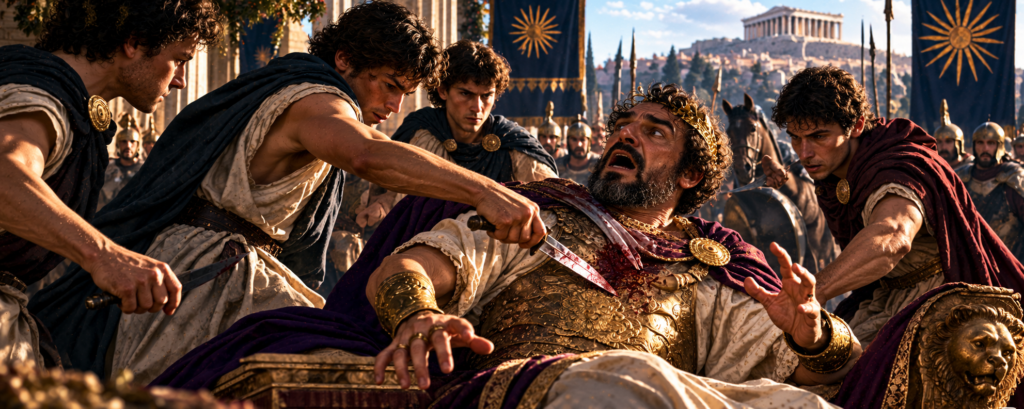
Jason of Pherae: The Tyrant Who Terrified Greece and Was Murdered by Seven Young Men
Jason of Pherae (died 370 BCE) | Ruler of Pherae and Tagos of Thessaly, c. 375–370 BCE
Seven Young Men and the Murder That Shocked Greece
The most powerful man in Thessaly was sitting before his cavalry when seven young men approached him with what appeared to be an ordinary dispute. Jason of Pherae had spent years building an army, intimidating rival cities, and transforming a divided region into a military power capable of challenging the greatest states in Greece. His ambitions had become so extensive that even the guardians of Apollo’s famous sanctuary at Delphi reportedly feared what he might do next. Yet on this particular day in 370 BCE, his attention was occupied by the familiar business of a ruler receiving petitions from those who sought his judgment.
The young men appeared to be arguing among themselves. Their behavior suggested that they wanted Jason to settle a disagreement, a routine request for a leader whose authority extended over soldiers and civilians alike. They approached while he was seated, close enough to speak to him and apparently without attracting immediate suspicion. Nothing in the surviving account suggests that Jason understood the danger until it was too late.
Then the seven attacked.
According to the historian Xenophon, the young men suddenly turned upon Jason and struck him repeatedly. The ruler was stabbed and slashed, suffering wounds that included an injury to his throat. His bodyguards rushed forward with their spears, but they could not save him. Within moments, the man who had threatened to overturn the balance of power in Greece lay dead.
The assassins had prepared an escape. Horses waited nearby, suggesting that the attack had been carefully planned rather than carried out in a sudden burst of anger. One conspirator was killed while still attacking Jason, pierced by a guard’s spear. Another was overtaken and killed as he attempted to mount his horse, but the remaining five escaped.
What happened afterward made the assassination particularly extraordinary. The surviving killers were not universally condemned as murderers or hunted as criminals. Instead, Xenophon reports that they received honors in most of the Greek cities they visited. Their attack upon Jason was celebrated as an act of liberation from a ruler whose growing power had inspired widespread fear.
The irony was that Jason had not been remembered simply as an incompetent or sadistic despot. He was a brilliant organizer, an effective commander, and a remarkably ambitious politician who had come close to making Thessaly one of the dominant powers of the Greek world. He had developed a formidable military system, negotiated with important Greek states, and demonstrated an ability to manipulate conflicts far beyond his own territory. His assassination interrupted plans whose ultimate objectives remain one of the great unanswered questions of fourth-century Greek history.
The seven young men had killed a ruler who seemed destined for extraordinary achievements. Whether they acted from genuine devotion to freedom, personal grievances, aristocratic hostility, or the encouragement of powerful conspirators remains uncertain. Their names have largely disappeared from history, but their deed survived because of the extraordinary man they destroyed. Jason’s death did not merely end a reign; it eliminated a political force that might have changed the course of Greek history.
Thessaly: The Rich and Divided Land That Produced a Tyrant
To understand Jason’s rise, it is necessary to understand the world from which he emerged. Thessaly occupied a fertile region of central Greece, surrounded by mountains and crossed by important routes connecting northern and southern territories. Its broad plains supported agriculture, horse breeding, and a powerful aristocratic society. In a world where cavalry could determine the outcome of battles, Thessaly possessed a natural military advantage.
Thessalian horses and horsemen enjoyed a formidable reputation throughout the Greek world. Wealthy landowners maintained mounted forces, and aristocratic families exercised considerable influence over local politics. Their resources made them important allies and dangerous opponents. Yet the same aristocratic independence that produced strong cavalry traditions also made regional unity difficult.
Unlike Athens or Sparta, Thessaly was not dominated by a single political center. It consisted of several important cities and regional communities, including Larissa, Pharsalus, Pherae, and others. Powerful families competed for influence, and their rivalries frequently prevented coordinated action. The region possessed considerable resources but often lacked the political unity necessary to exploit them.
Thessaly had a tradition of appointing a supreme military leader known as the tagos. The office could provide authority over the region’s military forces, particularly during periods requiring collective action. Its precise powers varied according to circumstances, and it should not be confused with an ordinary hereditary kingship. A successful tagos could nevertheless acquire extraordinary influence.
The problem was persuading rival Thessalian communities to accept common leadership. Wealthy families feared surrendering authority to competitors, while cities resisted domination by their neighbors. Regional disputes created opportunities for outside intervention. Thessaly’s military potential remained constrained by political fragmentation.
Pherae, the city from which Jason emerged, occupied an important position within this environment. Situated in southeastern Thessaly, it benefited from access to commercial routes and connections with the coast. Its location allowed ambitious rulers to combine local wealth with military influence. The city’s growing power challenged the traditional dominance of older aristocratic centers.
Jason recognized the opportunity created by Thessaly’s divisions. He understood that the region possessed the resources to support a major military power if its cities could be brought under coordinated leadership. The challenge was not simply defeating external enemies. It was overcoming the rivalries that had prevented Thessaly from acting as a unified state.
His solution would involve diplomacy, intimidation, military organization, and personal ambition. He would present himself as the leader capable of achieving what the aristocratic families had repeatedly failed to accomplish. In doing so, he would transform the ancient office of tagos into the foundation of something approaching personal monarchy. His success would eventually frighten much of Greece.
The Rise of Pherae and the Legacy of Lycophron
Jason did not create the political power of Pherae from nothing. His rise followed the achievements of Lycophron, an earlier ruler who had already challenged the established aristocratic order in Thessaly. Lycophron emerged as a powerful figure during the final years of the Peloponnesian War. His ambitions extended beyond his own city.
Around 404 BCE, Lycophron defeated opponents associated with Larissa and other Thessalian communities. Xenophon records that he sought to establish himself as ruler of the whole region. His victory demonstrated that Pherae could challenge cities traditionally regarded as more influential. It also intensified the struggles that would shape Thessalian politics for decades.
The precise relationship between Lycophron and Jason is not entirely secure. Ancient traditions often identify Jason as his successor and sometimes as his son, but the surviving evidence does not establish every genealogical detail beyond dispute. What matters is that Jason inherited or developed a political position already strengthened by Pherae’s military expansion. He operated within a tradition of ambitious local rulers seeking regional supremacy.
The power of Pherae depended partly upon its ability to mobilize soldiers outside the traditional aristocratic networks. Thessalian cavalry remained important, but cavalry alone could not guarantee victory in every situation. Infantry, mercenaries, and reliable military organization were also essential. Jason would become particularly skilled at developing these resources.
The rival city of Larissa remained a major obstacle. Its powerful aristocratic families possessed wealth, political connections, and considerable influence throughout Thessaly. They had little reason to accept domination by a ruler from Pherae. Their resistance created opportunities for alliances with outside powers.
The conflicts between Pherae and Larissa therefore became more than local disputes. They attracted the attention of major Greek states interested in influencing Thessaly. Sparta, Athens, and Thebes could all benefit from relationships with Thessalian factions. Their interventions made the region an important part of wider Greek diplomacy.
Jason entered this political environment with a clear advantage. He understood the weaknesses of his rivals and the value of a disciplined military force. He could exploit disputes among aristocratic families while presenting himself as a leader capable of restoring order. His ambition was to turn Pherae’s local supremacy into control over the entire region.
The foundations had been laid before his rise, but Jason would push them further than any previous ruler of Pherae. Under his leadership, Thessaly would briefly become a power whose future seemed almost unlimited. His achievements would also create enemies who believed that killing him was necessary for their own survival.
The Making of a Military Power
Jason’s most important achievement was the creation of a military system capable of supporting his political ambitions. Thessaly possessed excellent cavalry, but effective cavalry required coordination with infantry and reliable leadership. Jason understood that military strength depended upon organization rather than numbers alone. He therefore developed forces that could operate with discipline and flexibility.
Ancient sources emphasize his use of mercenaries. Professional soldiers could provide a ruler with troops whose loyalty depended upon regular payment and successful command. Such forces were particularly useful in regions where aristocratic families maintained independent political interests. A mercenary army could strengthen the ruler against both external enemies and domestic rivals.
Jason reportedly maintained a substantial force of professional troops. Xenophon describes his ability to train and discipline soldiers with unusual effectiveness. He rewarded capable men and encouraged competition in military excellence. His methods produced troops who were prepared for demanding campaigns.
The importance of this organization cannot be overstated. Greek warfare had traditionally relied heavily upon citizen militias, although professional and mercenary forces became increasingly important during the fourth century BCE. Jason recognized the advantages of soldiers who could train regularly and respond quickly to orders. Such troops could be more dependable than forces assembled only during emergencies.
His military strength also depended upon Thessaly’s cavalry traditions. Mounted soldiers provided speed, reconnaissance, and the ability to exploit weaknesses in opposing armies. A leader who controlled large numbers of Thessalian horsemen possessed a valuable strategic asset. Combined with disciplined infantry, these forces could threaten armies that relied primarily upon heavy hoplite formations.
Jason’s personal leadership contributed to his success. Xenophon presents him as a commander who understood deception, surprise, and the careful use of force. He could achieve objectives through direct military action or through methods that avoided unnecessary confrontation. His effectiveness made him dangerous because opponents could not easily predict his intentions.
His army was also a political instrument. Military strength allowed him to pressure rival Thessalian cities and negotiate from a position of superiority. Communities that might otherwise resist his authority had to consider the consequences of opposition. His soldiers gave substance to his diplomatic demands.
The result was a transformation in the balance of power. Pherae became the center of an expanding political system supported by organized military force. Jason’s authority increasingly extended beyond his home city. His ambitions were no longer limited to local supremacy.
The Man Xenophon Could Not Ignore
One of the most valuable sources for Jason’s career is Xenophon, the Athenian soldier, historian, and writer who lived during the same period. Xenophon had considerable military experience and understood the difficulties of commanding armies. His descriptions of Jason therefore deserve particular attention. They provide insight into the ruler’s abilities without relying entirely upon later legends.
Xenophon portrays Jason as an exceptionally capable commander. He emphasizes his understanding of military organization, discipline, and the advantages created by surprise. Jason appears as a man who rarely failed when pursuing a carefully chosen objective. His effectiveness made him formidable even before he controlled all Thessaly.
This assessment is significant because Xenophon was not simply celebrating Jason as a heroic ruler. He also recognized the dangers posed by his growing power. The same abilities that made Jason admirable as a commander made him frightening as a potential conqueror. His military talent could serve ambitions that threatened the independence of other Greek states.
Xenophon preserves important information about Jason through an account involving Polydamas of Pharsalus. Polydamas belonged to the Thessalian aristocracy and faced pressure from Jason’s expanding authority. His situation reveals how Jason combined military intimidation with political persuasion. The ruler could make resistance appear dangerous while offering attractive terms to those willing to cooperate.
Jason reportedly explained the scale of his ambitions to Polydamas. He emphasized the military resources available to a united Thessaly and the opportunities such power could create. His argument was not simply that Pherae should dominate its neighbors. He envisioned Thessaly as a force capable of influencing the entire Greek world.
The conversation, as preserved by Xenophon, should not be treated as a verbatim transcript. Ancient historians often reconstructed speeches to communicate political arguments and character. Nevertheless, the account is valuable because it reflects contemporary perceptions of Jason’s ambitions. It shows how his growing authority was understood by those who faced it.
Jason’s reputation therefore combined admiration and fear. He was recognized as a gifted military organizer and an ambitious political leader. His ability to unite Thessaly promised strength and stability, but it also threatened the autonomy of cities that valued independence. The same qualities that attracted supporters created enemies.
His assassination would later be celebrated partly because of this reputation. The young men who killed him were honored not necessarily because Jason had committed some uniquely monstrous crime. They were celebrated because his abilities made him appear capable of establishing a power that other Greeks could not resist.
Polydamas of Pharsalus and the Politics of Intimidation
The encounter between Jason and Polydamas of Pharsalus reveals the methods through which Jason extended his authority. Polydamas was a prominent Thessalian aristocrat whose position depended upon the independence of his city and the influence of its leading families. Jason’s expansion threatened that position. The conflict therefore represented a broader struggle between traditional aristocratic leadership and centralized military power.
Jason reportedly approached Polydamas with arguments designed to demonstrate the futility of resistance. He emphasized the strength of his forces and the advantages that cooperation could bring. His objective was to persuade influential opponents that joining him offered greater security than fighting him. Such diplomacy could achieve political submission without the destruction caused by war.
Polydamas faced a difficult choice. Resistance might preserve his city’s independence, but it could also bring military defeat. Cooperation could protect his position while strengthening Jason’s authority. The dilemma illustrates how ambitious rulers often expanded through calculated pressure rather than continuous conquest.
The involvement of Sparta further complicated the situation. Polydamas sought assistance from the Spartans, who had long exercised considerable influence in Greek affairs. Yet Sparta’s resources were increasingly strained, and its ability to intervene effectively in Thessaly was limited. Jason benefited from the weakening of a power that might otherwise have opposed him.
When Polydamas discovered that Sparta could not provide sufficient support, his position became more vulnerable. Jason’s military strength and diplomatic arguments carried greater weight. The resulting accommodation helped extend the ruler’s influence. It also demonstrated that the traditional balance of power in Greece was changing.
Jason understood the importance of timing. He pressed his advantages when opponents lacked effective allies. He offered cooperation when it could reduce resistance. His political methods were flexible because his ultimate objective mattered more than any single tactic.
The episode also reveals why other Greek states feared him. Jason did not need to conquer every city through open battle. He could exploit political isolation and persuade local leaders to accept his supremacy. His success depended upon understanding the weaknesses of a fragmented Greek world.
Polydamas’s accommodation became part of the process through which Jason established regional leadership. Thessaly’s divisions were gradually overcome under the authority of Pherae. Yet the resulting unity depended heavily upon Jason’s personal abilities. The system would face a severe test when he was murdered.
The Tagos of Thessaly: A Title That Concealed Extraordinary Power
Jason eventually acquired the position of tagos, the supreme military leadership associated with the Thessalian federation. The office had ancient precedents and was not inherently equivalent to tyranny. Its purpose was connected with coordinating military resources and providing leadership during periods requiring collective action. Under Jason, however, the title became associated with unprecedented personal authority.
The distinction between legitimate office and personal domination was important to Greek political thought. A leader could hold recognized authority while still exercising power in ways that alarmed other communities. Jason’s position reflected this ambiguity. He possessed a traditional title, but his military strength allowed him to influence the region far beyond ordinary constitutional expectations.
His control over Thessaly provided access to substantial manpower. Ancient estimates of the forces available to him are impressive, although exact figures should be treated cautiously. Xenophon describes a military system capable of mobilizing large numbers of infantry and cavalry. The resources of a united Thessaly were formidable by contemporary standards.
The region’s wealth also supported his ambitions. Fertile agricultural land, livestock, and commercial connections provided economic resources. Military organization required money, supplies, and reliable administration. Jason’s growing authority allowed him to draw upon a much larger base than Pherae alone could provide.
His leadership transformed Thessaly into a major factor in Greek diplomacy. Other states could no longer treat the region merely as a collection of rival cities. A unified Thessaly under Jason might intervene decisively in conflicts involving Sparta, Athens, and Thebes. Its cavalry could become especially valuable in large campaigns.
Yet this concentration of power also created internal resentment. Aristocratic families accustomed to independence had to accept a leader whose authority threatened their privileges. Cities that had resisted Pherae could feel humiliated by submission. Even those who benefited from unity might fear the consequences of Jason’s increasing ambition.
The office of tagos therefore provided legitimacy without eliminating opposition. Jason could claim to lead Thessaly through a recognized political institution. His enemies could argue that he had transformed that institution into an instrument of personal tyranny. Both interpretations reflected aspects of the political reality.
The question of whether Jason was a tyrant depends partly upon perspective. To supporters, he was the leader who had finally united Thessaly and made it powerful. To opponents, he was an ambitious autocrat whose military resources threatened traditional freedom. His assassination would be celebrated because many Greeks feared what his authority might become.
Greece After Sparta’s Decline
Jason’s rise occurred during a period of extraordinary instability in the Greek world. The Peloponnesian War had ended in 404 BCE with Sparta’s victory over Athens, but Spartan supremacy proved difficult to maintain. Other Greek states resisted Spartan interference, and repeated conflicts weakened the victorious power. The political order that had emerged after the war remained unstable.
Sparta’s military reputation had long rested upon its disciplined hoplite army. Its citizens were trained for warfare, and its institutions emphasized military service. Yet prolonged campaigns placed heavy demands upon its limited citizen population. Political tensions and changing military methods further complicated its position.
Athens had recovered some influence after its defeat, but it no longer possessed the empire that had supported its earlier power. The city remained important through diplomacy, naval activity, and alliances. Nevertheless, it could not easily dominate the Greek world as it had during the fifth century BCE. Other states increasingly challenged its influence.
Thebes emerged as a particularly formidable rival to Sparta. Its military leaders developed tactics capable of confronting Spartan hoplites effectively. The city also pursued alliances intended to weaken Spartan dominance. These developments created opportunities for ambitious regional rulers.
Jason understood that the traditional powers were divided. Sparta could no longer intervene everywhere, Athens lacked the resources for universal supremacy, and Thebes was still consolidating its position. A united Thessaly could exploit this situation. Its military strength might allow Jason to become a decisive figure in Greek politics.
His ambitions therefore extended beyond regional leadership. He recognized that the Greek world lacked a single dominant power capable of resisting him. His army could influence disputes between major states. His diplomatic relationships could shift the balance of alliances.
This political environment explains why his rise inspired such anxiety. Jason was not merely another local ruler seeking prestige. He appeared at a moment when the established powers were vulnerable. His ability to organize Thessaly threatened to introduce a new contender for supremacy.
The assassination of 370 BCE occurred just as this opportunity seemed greatest. Sparta had suffered a devastating defeat at Leuctra, and the Greek political system was undergoing rapid change. Jason possessed the resources to exploit that transformation. His death prevented anyone from discovering how far he might have gone.
Jason and the Rise of Thebes
Jason’s relationship with Thebes was one of the most important elements of his foreign policy. Thebes had become increasingly influential through its resistance to Sparta and the achievements of its military leaders. Jason recognized the advantages of cooperation with a state challenging the traditional Spartan order. Their relationship offered opportunities for both sides.
By the mid-370s BCE, Jason had established connections with Thebes. Such cooperation could strengthen his position against rival Greek powers while providing Thebes with access to Thessalian military resources. Cavalry support was especially valuable. The alliance also reflected the changing balance of power in Greece.
Thebes possessed ambitious leaders, including Epaminondas and Pelopidas, whose achievements would transform Greek warfare. Their campaigns challenged the assumptions upon which Spartan supremacy had rested. Jason’s military organization developed within the same broader environment of innovation. The fourth century BCE was becoming an age of increasingly sophisticated armies.
Yet cooperation did not mean that Jason intended to remain subordinate to Thebes. His ambitions were independent, and his resources were substantial. A strong Thessaly could become an ally one year and a rival the next. Greek states understood that relationships with powerful rulers were often temporary.
Jason’s diplomatic flexibility made him difficult to predict. He could support Theban interests when doing so weakened Sparta. He could also intervene to prevent Thebes from becoming too powerful. His objective was to preserve opportunities for Thessalian expansion.
This flexibility became particularly important after the Battle of Leuctra in 371 BCE. The Thebans achieved a stunning victory over Sparta, destroying the aura of invincibility surrounding the Spartan army. The defeat transformed the political balance of Greece. Jason suddenly possessed an opportunity to influence the aftermath.
His intervention demonstrated both his military power and his political judgment. Rather than allowing one side to exploit the victory without restraint, he positioned himself as a mediator. His conduct revealed a ruler who understood that diplomacy could produce advantages comparable to those won in battle.
The events surrounding Leuctra brought Jason to the center of Greek affairs. His role could no longer be dismissed as regional. He had become a figure capable of influencing the decisions of the strongest states in Greece. That prominence would intensify the fears surrounding his future ambitions.
Leuctra: The Battle That Opened the Door to Supremacy
The Battle of Leuctra, fought in 371 BCE, was one of the most consequential military engagements of classical Greece. The Theban army defeated Spartan forces in a battle that shattered the reputation of Spartan military superiority. The victory demonstrated the effectiveness of new tactical approaches and exposed weaknesses in the Spartan system. Its consequences extended far beyond the battlefield.
For Jason, the defeat of Sparta created an extraordinary opportunity. One of the principal obstacles to his ambitions had been weakened. Thebes had gained prestige, but its future dominance was not yet secure. The Greek world entered a period of uncertainty in which a powerful third force could become decisive.
Jason moved rapidly to influence the situation. Xenophon describes his intervention after the battle, when he approached the victorious Thebans and defeated Spartans. His military resources gave weight to his diplomatic efforts. Neither side could ignore him.
The Thebans might have wished to exploit their victory by destroying the remaining Spartan forces. Jason discouraged such an outcome, arguing that excessive ambition could create new dangers. He also helped arrange conditions allowing the Spartans to withdraw. His intervention prevented the battle from becoming an even more complete catastrophe for Sparta.
The decision was politically intelligent. A weakened Sparta remained useful as a counterweight to Thebes. If Thebes became overwhelmingly dominant, Jason’s own ambitions might be threatened. Preserving a balance among rival powers allowed him greater freedom of action.
His conduct also demonstrated that he could influence events without committing his army to a major battle. The mere presence of Thessalian forces and the reputation of their commander gave his diplomacy credibility. Jason could negotiate because others understood the military strength behind his words. His authority had become an instrument of interstate politics.
The aftermath of Leuctra therefore represented a turning point in his career. He had moved beyond the struggle to unite Thessaly and entered the highest level of Greek diplomacy. His decisions affected the future of Sparta and Thebes. His influence appeared likely to grow.
Yet his intervention also made other states more aware of the danger he represented. A ruler capable of mediating between major powers could eventually dominate them. Jason’s ambition was no longer theoretical. He had demonstrated that he possessed the resources and political intelligence to shape the Greek world.
The Ambition to Become Master of Greece
The surviving evidence suggests that Jason entertained ambitions extending far beyond Thessaly. Xenophon presents him as a ruler who recognized the extraordinary possibilities created by military unity and disciplined forces. His discussions with Polydamas emphasized the advantages Thessaly could gain through coordinated leadership. His later conduct demonstrated that these ambitions were not empty boasts.
Jason understood the weaknesses of the major Greek states. Sparta had suffered military defeat, Athens remained constrained by its resources, and Thebes faced the difficulties of maintaining its new influence. Thessaly possessed cavalry, manpower, and wealth. Under effective leadership, it could become a formidable rival.
His ambitions may also have extended toward the Persian Empire. Xenophon’s account includes arguments about the opportunities available to a powerful Greek military coalition. Persia’s vast resources offered an attractive target for ambitious commanders. Greek mercenaries had already demonstrated that Persian forces could be challenged under favorable circumstances.
The possibility of a Thessalian-led campaign against Persia is intriguing because it anticipates developments later associated with Philip II of Macedon and Alexander the Great. Yet the comparison must be handled carefully. Jason’s actual plans remain uncertain, and there is no proof that he intended to conquer the entire Persian Empire. His ambitions may have evolved according to circumstances.
What can be established is that he possessed a strategic imagination unusual among regional rulers. He did not view Thessaly merely as territory to defend. He saw its resources as the foundation of broader power. His military reforms and diplomatic activities reflected that vision.
His success also depended upon the political weakness of his rivals. A united Greece under another leader might have resisted him effectively. Instead, repeated conflicts created opportunities for intervention. Jason could present himself as an ally, mediator, or military threat according to the situation.
This flexibility made him particularly alarming. Other states could not be certain whether his next move would involve negotiation, alliance, or conquest. His army gave him the means to act quickly. His political intelligence allowed him to exploit opportunities before opponents could respond.
By 370 BCE, Jason appeared to stand at the beginning of an extraordinary career. His regional authority was secure enough to support ambitious plans, and the Greek balance of power favored bold action. The future seemed open before him. His assassins would ensure that those possibilities remained unrealized.
Delphi: The Sacred Sanctuary That Feared Jason
Among Jason’s most controversial plans was his intention to attend the Pythian festival at Delphi with a substantial Thessalian presence. Delphi was one of the most important religious centers in the Greek world, famous for the sanctuary and oracle of Apollo. Its festivals attracted visitors from numerous cities and regions. Control over the sanctuary’s affairs carried enormous prestige.
The Pythian Games were not simply athletic competitions. They formed part of a major religious celebration involving sacrifices, ceremonies, and the gathering of representatives from across Greece. The sanctuary also possessed valuable dedications and treasures accumulated over generations. Its wealth and symbolic importance made it politically sensitive.
Jason announced plans for Thessalian participation on an impressive scale. Xenophon describes preparations involving livestock and military forces, suggesting that the event would become a demonstration of regional power. Such an appearance could enhance Jason’s prestige throughout Greece. It might also intimidate communities already fearful of his ambitions.
The people of Delphi reportedly became alarmed. They feared that Jason might interfere with the sanctuary or seize its treasures. The exact basis of these suspicions is uncertain. His military strength and reputation for ambition may have been enough to provoke anxiety.
According to Xenophon, the Delphians consulted Apollo’s oracle about what would happen if Jason attempted to take the sacred wealth. The response was remembered as an assurance that the god would look after his own affairs. The story acquired particular significance because Jason was assassinated before the festival. Later readers could interpret his death as evidence of divine protection.
Yet the historical evidence does not establish that Jason intended to plunder Delphi. Xenophon explicitly acknowledges uncertainty about his intentions toward the sanctuary’s treasures. The fear itself is historically significant, but it should not be confused with proof of a planned sacrilege. The accusation may reflect the anxieties of communities confronted by a powerful outsider.
Jason may have intended to use the festival to demonstrate his authority over Thessaly and enhance his standing among the Greeks. Such a display would be consistent with his broader political methods. He understood the importance of ceremony, prestige, and public recognition. Delphi offered an extraordinary stage.
The sanctuary’s fears reveal how threatening his power had become. Even religious authorities associated with one of Greece’s most revered institutions worried about his intentions. His reputation had extended beyond military and political circles. He was becoming a figure whose ambitions appeared capable of disturbing the sacred order itself.
The Pythian Festival That Never Saw Its Most Dangerous Guest
Jason’s preparations for the Pythian festival were intended to demonstrate the resources available to a united Thessaly. The region possessed large numbers of livestock and the capacity to mobilize impressive military forces. A procession combining religious offerings with disciplined troops would advertise both wealth and power. Such a display could impress allies while alarming opponents.
The festival also offered an opportunity to cultivate legitimacy. Jason’s authority over Thessaly was relatively recent, and many Greek states remained suspicious of his ambitions. Participation in a major Panhellenic religious celebration could present him as a recognized leader within the Greek world. It might soften the image of a regional strongman seeking domination.
Yet the scale of his preparations created the opposite reaction among some observers. The possibility that he might arrive with a powerful army raised fears of coercion. His presence could place pressure upon the sanctuary and the communities responsible for its administration. Religious ceremony might become an instrument of political intimidation.
The anxiety surrounding Delphi also reflected broader Greek concerns about the relationship between military power and sacred institutions. Sanctuaries possessed treasures and enjoyed religious prestige, but they depended upon political communities for protection. A ruler with overwhelming force could threaten their independence. Jason’s reputation made such fears plausible.
His intentions remain unknown because he never reached the festival. The assassination occurred before the planned appearance. The interruption transformed speculation into legend. A ruler feared for possible sacrilege died suddenly before he could act.
The story of Apollo’s response became especially memorable in this context. If the god had promised to protect his sanctuary, Jason’s murder could be interpreted as the fulfillment of that promise. Such religious explanations were common in ancient historical writing. They gave political events a moral and divine significance that could not be independently verified.
From a modern historical perspective, the timing is striking but not proof of supernatural intervention. Jason had many possible enemies, and his assassination could have resulted from political grievances unrelated to Delphi. The surviving sources do not identify the festival as the definitive motive. Its importance lies in revealing the atmosphere of fear surrounding his final months.
The preparations nevertheless demonstrate the scale of his ambition. Jason was no longer content to dominate Thessaly quietly. He intended to appear before the Greek world as a ruler of extraordinary resources. His assassins struck before that display could occur.
The Seven Young Men Who Decided Jason Must Die
The identities of Jason’s assassins remain one of the most frustrating gaps in the historical record. Xenophon describes seven young men who approached the ruler under the pretense of a dispute. He does not preserve their names or provide a detailed account of their personal backgrounds. Their collective action is clear, but their individual motives remain obscure.
The number seven is important because it suggests a coordinated conspiracy. The attack required several participants willing to approach a heavily guarded ruler and strike simultaneously. Their behavior before the assault was calculated to avoid suspicion. They presented themselves as ordinary petitioners seeking a judgment.
The conspirators also prepared horses for their escape. This detail demonstrates planning beyond the immediate attack. They expected to flee after killing Jason and had arranged the means to do so. Their preparations suggest that the murder was not a spontaneous response to an insult or argument.
Yet the surviving evidence does not reveal who organized the conspiracy. The young men may have belonged to families hostile to Jason’s rule. They may have opposed his political ambitions or feared the consequences of his growing power. They may also have acted from personal grievances unknown to later historians.
Diodorus Siculus preserves alternative explanations for the assassination. One tradition suggested that the killers sought fame through a spectacular act of tyrannicide. Another connected the murder to Jason’s brother Polydorus, raising the possibility of a family conspiracy. Neither explanation can be established conclusively.
The possibility of aristocratic opposition is plausible. Jason’s centralization of power threatened families accustomed to political independence. Young men from such families might regard assassination as a means of restoring their influence. Yet plausibility is not proof, and the sources do not identify the conspirators’ social positions securely.
The desire for glory is also possible. Greek culture celebrated certain tyrant-killers as defenders of freedom, and the assassination of a powerful ruler could bring extraordinary fame. The surviving killers did indeed receive honors in many cities. Whether they anticipated that reception before the attack remains unknown.
The conspirators therefore occupy an unusual position in history. Their actions are described in vivid detail, but their identities and motives are largely lost. They became famous for killing Jason while remaining personally anonymous. The political significance of their deed overwhelmed the individual stories of the men who carried it out.
The Cavalry Review: A Perfect Opportunity for Murder
The assassination took place during a review of the Pheraean cavalry. Jason had assembled mounted forces for inspection, an activity consistent with his reputation as a disciplined military commander. Such reviews allowed leaders to assess readiness, maintain standards, and demonstrate authority over their troops. For Jason, they were part of the military system upon which his power depended.
After the inspection, Jason sat to receive petitions or requests. This practice brought him into contact with individuals seeking decisions from the ruler. It also created a predictable moment when people could approach him. The conspirators exploited that opportunity.
The setting is significant because Jason was surrounded by the military resources that had made him powerful. His cavalry represented one of the strongest elements of Thessalian warfare. His guards were present and capable of responding with deadly force. Yet neither the cavalry nor the guards could prevent a sudden attack at close range.
The young men approached as though they were quarreling. Their apparent disagreement provided a reason to seek Jason’s attention. A ruler accustomed to settling disputes might regard such an approach as routine. The deception allowed them to come within striking distance.
The attack required extraordinary timing. If the guards recognized the danger too early, the conspirators would be killed before reaching Jason. If they hesitated, the ruler might escape. The young men needed to strike decisively before the protective circle could close around him.
Their preparations suggest that they understood these risks. They had arranged horses nearby and apparently expected a brief opportunity for escape. Their plan combined deception, coordinated violence, and rapid withdrawal. It was a carefully designed assassination rather than a chaotic attack.
Jason’s position as a military commander may have contributed to his vulnerability. He was accustomed to exercising authority among armed men and receiving petitions in their presence. Such confidence could create openings for enemies who understood his routines. The ruler who had mastered the organization of armies could not eliminate every danger within his own camp.
The cavalry review therefore became the setting for an extraordinary reversal. Jason had assembled soldiers to demonstrate military strength. Seven young men used the occasion to destroy the man commanding them. His military system remained intact for the moment, but its central figure was dead.
The Assassination: Seven Blades Against One Ruler
Xenophon’s account of the assassination is brief but unusually vivid. Jason had completed the cavalry inspection and was seated when the seven young men approached. They appeared to be engaged in a dispute requiring his judgment. Their behavior concealed the violence they intended.
Once close enough, they attacked suddenly. Xenophon describes Jason being struck repeatedly, including wounds to his throat. The ruler was overwhelmed before his guards could intervene effectively. The attack succeeded because the conspirators reached him at the moment when he was least prepared to defend himself.
The surviving account does not identify the exact weapons carried by every attacker. Nor does it provide a reliable sequence of individual blows. Later retellings sometimes dramatize the scene with invented details, but the historical evidence is powerful enough without embellishment. Seven men attacked a seated ruler and killed him before his armed protectors could save him.
The guards reacted immediately. They rushed toward the attackers with long spears, attempting to protect Jason and prevent the conspirators from escaping. One assassin was killed while still striking at the ruler. His death demonstrates how quickly the guards entered the struggle.
Another conspirator reached the horses prepared for escape but was overtaken before he could ride away. He suffered multiple wounds and died. The remaining five succeeded in mounting their horses and fleeing. Their escape preserved the possibility that the assassination would become a celebrated political act rather than merely a failed conspiracy ending in universal execution.
Jason’s death was immediate in its political consequences. Thessaly lost the leader who had unified its military resources and projected power across Greece. The carefully constructed system depended heavily upon his personal authority. His successors would inherit substantial resources but not necessarily his abilities.
The assassination also destroyed plans that were already in motion. Jason had intended to attend the Pythian festival and demonstrate his power at Delphi. His broader ambitions remained unfinished. The Greek world would never discover how far he might have extended his influence.
The violence itself lasted only a short time. The consequences would continue for decades. A ruler who had seemed capable of dominating Greece was eliminated by seven men who approached him as petitioners.
Two Assassins Dead, Five Celebrated as Heroes
The immediate aftermath of the attack revealed the brutality of the encounter. Two conspirators were killed by Jason’s guards, while five escaped on prepared horses. The surviving men faced the possibility of pursuit, capture, and execution. Their future depended partly upon how other Greek communities interpreted the assassination.
Xenophon reports that they received honors in most of the cities they visited. This reception is one of the most remarkable details of the entire story. Rather than treating the fugitives simply as murderers, many Greeks celebrated them as men who had removed a dangerous ruler. Their act was understood as a form of tyrannicide.
The honors demonstrate the extent of fear surrounding Jason’s ambitions. His power had become alarming enough that his death was welcomed beyond Thessaly. Communities that might have faced his military pressure could regard the assassins as benefactors. The killing of one man appeared to remove a threat to many cities.
Yet the reception also raises questions about the political motives behind the celebration. Greek states had their own interests in preventing the emergence of a dominant Thessalian power. Honoring Jason’s killers could express relief at the destruction of a potential rival. It did not necessarily prove that the assassins themselves acted from noble principles.
The surviving conspirators may have benefited from a tradition that celebrated the killing of tyrants. Greek political memory included famous examples of men who attacked rulers regarded as oppressive. Such figures could receive public honors and become symbols of civic freedom. Jason’s assassins entered that tradition almost immediately.
Their personal identities, however, remained obscure. Xenophon preserves their collective deed rather than individual biographies. We do not know how long they lived after the assassination or what political careers they may have pursued. Their fame rested upon the single act that had made them fugitives.
The two men killed during the attack received no opportunity to enjoy such honors. Their deaths were the immediate price of the conspiracy. The surviving five escaped into a Greek world prepared to celebrate them. The difference between their fates was determined by moments of violence and the availability of horses.
The contrast is striking. Jason’s guards viewed the attackers as enemies to be killed. Many Greek cities viewed the survivors as liberators deserving recognition. The same act could be condemned as murder or praised as the defense of freedom. Political perspective determined the meaning assigned to the bloodshed.
Were the Assassins Really Fighting for Freedom?
The celebration of Jason’s killers invites an important question. Were the seven young men genuinely motivated by a desire to preserve Greek freedom, or did they act for reasons that later admirers found convenient to reinterpret? The surviving evidence does not provide a definitive answer. Their motives remain uncertain despite the clarity of the attack itself.
Jason had concentrated extraordinary power in his own hands. He controlled a formidable military system and exercised influence over numerous Thessalian communities. His ambitions extended beyond regional leadership, creating fears that he might dominate other Greek states. Opposition to such power could certainly be rooted in political principle.
Yet personal and aristocratic grievances were common motives for assassination in ancient Greece. Powerful rulers often displaced established families, limited local autonomy, and threatened traditional privileges. Young men from influential households might regard tyrannicide as a way to restore their own position. Their opposition could be sincere without necessarily representing the interests of all citizens.
Diodorus’s alternative traditions complicate the heroic interpretation further. The suggestion that the assassins sought fame raises the possibility that personal glory influenced their decision. The allegation involving Polydorus introduces the possibility of dynastic ambition. Neither explanation is proven, but both demonstrate that ancient writers recognized motives other than public liberation.
The political reception of the survivors also tells us more about Greek fears than about the assassins’ private intentions. Communities that honored them had strong reasons to welcome Jason’s death. His military power threatened the balance among Greek states. Celebrating his killers could express relief without requiring detailed knowledge of their motives.
Xenophon’s language is revealing. He presents the honors as evidence that Greeks feared Jason might become a tyrant. The emphasis falls upon the danger he represented rather than upon a documented record of personal cruelty. Jason was killed partly because of what others believed he might eventually do.
This distinction makes the assassination especially unsettling. The ruler’s ambitions were real, but the full extent of his future plans remained unknown. His enemies acted before those plans could unfold. The murder therefore eliminated a possible future as much as an existing political order.
The assassins became heroes because history stopped at a moment favorable to their reputation. Jason never had the opportunity to demonstrate whether his ambitions would produce conquest, reform, or catastrophe. The uncertainty allowed later admirers to imagine that the killers had prevented something terrible. It also leaves open the possibility that they destroyed a ruler whose achievements might have been extraordinary.
The Shadow of Polydorus: Was the Murder a Family Conspiracy?
One of the most intriguing alternative explanations for Jason’s assassination involves his brother Polydorus. Diodorus preserves a tradition suggesting that Polydorus may have been connected to the murder. If true, the attack would have been more than a spontaneous act of political resistance. It would have involved a struggle for power within Jason’s own family.
The possibility is plausible because Jason’s authority was extraordinarily valuable. Control over Thessaly offered military resources, wealth, and influence across Greece. A relative who expected to inherit or share that power might possess strong motives for removing him. Dynastic ambition frequently produced violence in ancient political systems.
Yet the surviving evidence does not establish Polydorus’s guilt. Diodorus reports competing explanations rather than presenting a proven conspiracy. Xenophon, whose account is closer to the events, does not identify Polydorus as the organizer of the attack. The allegation therefore remains uncertain.
The subsequent history of Jason’s family makes the possibility especially disturbing. After his death, Polydorus and another brother, Polyphron, assumed the leadership of Thessaly. Their arrangement did not produce lasting stability. Polydorus was soon killed under suspicious circumstances.
Xenophon reports that Polydorus died while traveling with Polyphron toward Larissa. The death occurred at night, and suspicion fell upon Polyphron. The circumstances suggested murder, although the historian does not present direct proof. The family that inherited Jason’s power quickly became associated with another violent death.
Polyphron then exercised authority alone. His government acquired a reputation for harshness and repression. He attacked political opponents and used his position to consolidate personal power. The instability following Jason’s assassination therefore intensified rather than disappeared.
The later killing of Polyphron by Alexander of Pherae continued the cycle. Alexander justified his action as revenge for his father’s death, according to the ancient tradition. He then established himself as ruler and became notorious for cruelty. The succession transformed into a sequence of murders within the ruling family.
This bloody aftermath does not prove that Polydorus arranged Jason’s assassination. It does, however, reveal the dangerous political environment surrounding the family. The power Jason had accumulated became an object of intense competition after his death. His successors demonstrated how easily dynastic ambition could turn into violence.
The possibility of a family conspiracy therefore cannot be dismissed, but it must remain a possibility rather than a conclusion. The seven young men may have acted independently. They may have received encouragement from powerful figures. The evidence does not allow historians to identify a hidden organizer with confidence.
The Death That Destroyed Thessaly’s Greatest Opportunity
Jason’s assassination created an immediate political vacuum. He had united Thessaly through a combination of military organization, diplomacy, and personal authority. His successors inherited the resources of that system but lacked his established reputation and political skill. The unity he had created became increasingly difficult to maintain.
The transition to Polydorus and Polyphron initially preserved the leadership of Pherae. Yet the arrangement quickly collapsed into suspicion and violence. Polydorus’s death removed one of the brothers, leaving Polyphron in control. The resulting government acquired a reputation for oppressive methods.
Polyphron’s rule further alienated important Thessalian communities. His attempts to consolidate power involved attacks upon political opponents and interference with established local interests. Such measures weakened the possibility of regional cooperation. The political unity Jason had achieved began to fracture.
Alexander of Pherae eventually killed Polyphron and assumed power. His reign became associated with extraordinary cruelty in ancient accounts. He also faced opposition from other Thessalian cities and intervention by outside powers. The instability created opportunities for Thebes and later Macedonia.
The contrast with Jason is significant. Jason had been feared because of his effectiveness and ambitions. His successors were increasingly remembered for internal violence and political mismanagement. The system that might have challenged the major Greek powers became consumed by struggles over control.
Thessaly’s military resources did not disappear. Its cavalry remained valuable, and its territory continued to possess strategic importance. Yet political fragmentation prevented those resources from being directed consistently toward a common objective. The region became vulnerable to interference by stronger neighbors.
The assassination therefore altered the balance of power in Greece. A formidable Thessalian leader had been removed at the height of his influence. The political structure he created could not survive unchanged. Other states gained opportunities that might not have existed had Jason remained alive.
His death illustrates the fragility of systems dependent upon exceptional individuals. Jason had organized military and political resources with remarkable success. Yet he had not established a succession capable of preserving his achievements. Seven assassins destroyed the central figure, and the resulting instability weakened the entire enterprise.
Polyphron: The Brother Who Turned Leadership Into Terror
Polyphron’s rise after the death of Polydorus marked a darker phase in Thessalian politics. He inherited a position created by Jason’s achievements but governed in a manner that alienated important communities. Ancient sources portray him as increasingly oppressive. His rule demonstrates how quickly concentrated authority could become associated with personal violence.
Xenophon describes Polyphron’s conduct toward prominent Thessalian opponents. He attacked influential families and interfered with established political relationships. His methods undermined the cooperation necessary for regional unity. The authority of tagos became increasingly difficult to distinguish from personal tyranny.
One particularly significant episode involved the family of Polydamas of Pharsalus. Polydamas had previously negotiated with Jason and represented an important aristocratic interest. Under Polyphron, members of his family suffered violence. The treatment of such families deepened resentment against the ruling house.
The political consequences were severe. Communities that had accepted Jason’s leadership could view Polyphron as a threat to their security. The balance between regional unity and local autonomy deteriorated. Opposition became increasingly intense.
Polyphron’s own death came through another act of family violence. Alexander of Pherae killed him, presenting the act as revenge for the death of Polydorus. The precise circumstances are preserved through ancient accounts that must be interpreted cautiously. Nevertheless, the sequence demonstrates the extraordinary instability of the succession.
Alexander then assumed power and became one of the most notorious rulers of fourth-century Thessaly. His government was associated with severe repression and conflicts involving Thebes. The reputation of the ruling family deteriorated further. The political order Jason had created became increasingly dependent upon coercion.
The succession therefore produced a bitter irony. Jason had been assassinated by men celebrated as tyrant-killers. Yet his death did not eliminate personal domination in Thessaly. Instead, it opened the way for rulers whose conduct attracted even stronger accusations of cruelty.
The assassins may have believed they were preventing tyranny. The immediate consequences were a series of violent struggles that preserved authoritarian power while weakening regional unity. Their deed removed Jason but did not create a stable alternative. The promise of liberation remained unfulfilled.
Alexander of Pherae and the Dynasty’s Descent Into Blood
Alexander of Pherae emerged from the succession struggles that followed Jason’s death. His relationship to the earlier rulers is described differently in some traditions, but he belonged to the same ruling family and acquired power through violence. His assassination of Polyphron placed him at the head of the regime. His subsequent conduct would make him one of the most notorious tyrants of the period.
Ancient writers describe Alexander as cruel, suspicious, and willing to employ extreme measures against opponents. Some accounts contain sensational details that may have been exaggerated by hostile traditions. Nevertheless, his government clearly generated substantial resistance. His authority became a source of conflict throughout Thessaly.
Thebes intervened in Thessalian affairs during his rule. Pelopidas, one of the most prominent Theban commanders, became involved in efforts to restrain Alexander’s power. The conflict reflected the importance of Thessaly within wider Greek politics. Control of the region’s cavalry and strategic routes remained valuable.
Alexander’s relationship with Pelopidas became particularly hostile. Ancient accounts describe episodes involving detention, negotiation, and military confrontation. The struggle eventually contributed to the death of Pelopidas in battle. Thessaly remained a dangerous arena of competing ambitions.
Alexander’s personal life also became the subject of dramatic stories. His wife Thebe was associated with the conspiracy that eventually led to his assassination in 358 BCE. Ancient writers described her role in arranging his murder with the assistance of her brothers. The episode became another famous example of violence within a tyrannical household.
The sequence is striking. Jason was killed by seven young men, Polydorus died under suspicious circumstances, Polyphron was murdered by Alexander, and Alexander himself was eventually assassinated. The family that had accumulated extraordinary power became trapped in repeated acts of violence. Each killing created opportunities for another struggle.
This pattern should not be treated as proof of an inevitable curse upon the dynasty. The causes of individual murders differed, and ancient writers often shaped such narratives to illustrate moral lessons. Yet the concentration of power within a small ruling family created obvious incentives for violent succession. The absence of stable institutions made personal rivalry especially dangerous.
Jason’s assassination therefore stands at the beginning of a particularly bloody sequence. His death removed a capable leader and exposed the weakness of the political system he had created. His successors inherited power without establishing durable legitimacy. The result was decades of instability.
The Macedonian Power That Eventually Replaced Jason’s Dream
The weakening of Thessaly after Jason’s death created opportunities for another ambitious ruler. Philip II of Macedon would eventually extend his influence over the region and incorporate Thessalian resources into his wider military system. His achievements transformed Macedonia into the dominant power of Greece. In some respects, he accomplished what Jason had appeared capable of attempting.
Philip understood the value of Thessalian cavalry. The region’s mounted troops became an important element of Macedonian military strength. Their effectiveness contributed to campaigns that extended Macedonian authority across Greece. The resources Jason had sought to unite were eventually employed under a different political leadership.
The comparison between Jason and Philip is revealing. Both recognized the military potential of regional unity. Both used diplomacy and force to overcome political fragmentation. Both sought influence beyond their original territories. Their ambitions developed within the same broader transformation of fourth-century Greek warfare.
Yet their careers ended differently. Jason was assassinated before he could pursue his greatest plans. Philip survived long enough to dominate Greece and prepare an invasion of Persia. He too would eventually be murdered, but his political and military system survived under his son Alexander. The contrast demonstrates the importance of succession and institutional continuity.
Jason had built a formidable military organization, but his successors failed to preserve his achievements. Philip created a system that Alexander the Great could inherit and expand. The difference was not simply personal ability. It also involved the political structures and alliances surrounding each ruler.
The rise of Macedonia therefore represents one of the most important long-term consequences of Thessaly’s instability. The region remained valuable but lacked a leader capable of sustaining independent supremacy. Macedonian intervention gradually altered its political position. Thessalian cavalry became part of a larger military machine.
It is tempting to imagine an alternative history in which Jason survived and established Thessalian dominance before Macedonia could rise. Such speculation cannot be proven, but it illustrates the significance of his assassination. His death removed a potential rival from the political landscape. The opportunities available to later rulers were shaped partly by his absence.
The seven young men who killed Jason could not have foreseen these consequences. They removed a ruler feared by many Greek cities. Decades later, another northern power would achieve a supremacy far greater than anything Jason had demonstrated. The assassination changed the direction of history without ending the struggle for domination.
Was Jason Really a Tyrant?
Jason’s reputation presents a difficult problem because ancient Greek writers used the language of tyranny in ways shaped by political circumstances. A tyrant was generally a ruler who exercised personal power outside traditional constitutional limitations. The term increasingly carried negative associations, but it did not always describe identical political arrangements. Jason’s position as tagos complicates the classification.
He possessed a recognized Thessalian office, yet his military strength gave him extraordinary authority. His influence extended over communities that had previously defended their independence. His ambitions threatened other Greek states. Such concentration of power naturally encouraged accusations of tyranny.
Yet Xenophon’s account does not portray Jason primarily through stories of spectacular cruelty. Instead, it emphasizes his military abilities, political intelligence, and expanding ambitions. The fear surrounding him appears connected largely to what he might accomplish. He was dangerous because he was capable.
This distinction separates him from rulers remembered chiefly for personal brutality. Jason’s successors, particularly Polyphron and Alexander of Pherae, acquired reputations for severe repression. Jason’s own record is more complex. His power was coercive, but his effectiveness attracted admiration even from observers who feared him.
The honors given to his assassins therefore require careful interpretation. Greek cities may have celebrated the removal of a potential conqueror rather than the overthrow of an established reign of terror. Their response reflected political self-interest as well as ideological opposition to tyranny. The assassins became liberators because Jason’s ambitions threatened the independence of others.
This does not mean his government was benign. His rise involved military pressure, the subordination of rival communities, and the concentration of authority. Opponents had legitimate reasons to fear the consequences of his power. Yet the surviving evidence does not justify inventing atrocities to explain his assassination.
The historical Jason was an ambitious ruler operating in a world where political independence was frequently defended through violence. His methods were effective, and his objectives were expansive. He represented both the possibility of regional unity and the danger of personal domination. His reputation cannot be reduced to a simple moral judgment.
The question of whether he was a tyrant therefore depends partly upon how one evaluates his authority. To supporters, he may have appeared as the leader capable of transforming Thessaly into a great power. To opponents, he was a dangerous autocrat whose ambitions threatened freedom. His assassination became famous because the second interpretation prevailed among many Greeks.
The Tyrant-Killers Who May Have Changed History
The seven young men who killed Jason became part of a long Greek tradition celebrating resistance to personal rule. Their deed was remembered because it eliminated a powerful leader at the height of his ambitions. The surviving five received honors in many cities, suggesting that their act was widely interpreted as beneficial. Yet the full consequences were far more complicated than the immediate celebrations implied.
Jason’s death weakened the political unity of Thessaly. His successors became involved in violent struggles, and the region lost much of the influence it had acquired under his leadership. Other Greek powers gained opportunities to intervene. The assassination therefore altered the balance of power beyond the immediate succession.
The killers may have intended precisely such an outcome. If they feared Thessalian domination, weakening the region could appear desirable. If they sought to restore local independence, Jason’s death might seem the first step toward that goal. Yet the surviving evidence does not establish their political program.
Their personal motives remain equally uncertain. They may have acted from ideological hostility to tyranny, aristocratic resentment, a desire for glory, or encouragement from powerful conspirators. Diodorus’s alternative traditions demonstrate that ancient writers did not possess a single uncontested explanation. The absence of reliable testimony from the assassins themselves leaves the question unresolved.
The immediate celebration of the survivors also reveals the power of political symbolism. A successful assassination could transform fugitives into heroes. The same men who had killed a ruler under false pretenses were honored because their victim inspired fear. Their reputation depended upon the political meaning assigned to the murder.
The assassination also demonstrates the limitations of heroic narratives. Killing Jason did not establish a stable constitutional order in Thessaly. His brothers inherited power, and later rulers continued the tradition of personal domination. The political system remained vulnerable to violence and rivalry.
The assassins therefore achieved a spectacular immediate victory without guaranteeing the future they may have desired. Their attack removed Jason but did not resolve the tensions that had produced his rise. Thessaly remained divided by competing interests. The struggle for power continued.
Their legacy is consequently both dramatic and ambiguous. They killed a man whose ambitions alarmed Greece and were celebrated for doing so. Yet the resulting instability contributed to the weakening of the region they had transformed. Their act changed history, but whether it made Thessaly freer is far less clear.
The Ruler Who Might Have Rewritten Greek History
Jason’s assassination is especially fascinating because it occurred before his ambitions could be fully tested. He had united Thessaly, developed a formidable military system, and demonstrated influence over major Greek states. His intervention after Leuctra showed that he could shape events beyond his own region. His preparations for Delphi suggested that he intended to display his power before the entire Greek world.
The possibilities were extraordinary. A united Thessaly possessed cavalry, agricultural wealth, and strategic access to central and northern Greece. Under an effective commander, these resources could support major campaigns. Jason had already demonstrated the political intelligence necessary to exploit rivalries among stronger states.
Yet his ultimate objectives remain uncertain. He may have intended to dominate Greece, lead a campaign against Persia, or consolidate a powerful Thessalian federation. These possibilities are not mutually exclusive, and his ambitions might have changed as opportunities emerged. The surviving evidence does not reveal a complete long-term plan.
His death therefore invites speculation while resisting definitive conclusions. Had he survived, he might have challenged Thebes, Sparta, or Athens. He might have created a political system capable of resisting Macedonia. He might also have encountered obstacles that exposed the limitations of his power.
The later achievements of Philip II and Alexander the Great make these possibilities particularly intriguing. Macedonia eventually united much of Greece and launched the Persian invasion that transformed the ancient world. Jason had recognized some of the same strategic opportunities earlier. His assassination removed a ruler who might have pursued comparable ambitions.
Yet historical comparison must not become certainty. Jason’s military resources differed from those later available to Macedonia, and his political system remained vulnerable to internal rivalry. His successors’ failures demonstrate how difficult it was to preserve Thessalian unity. His own survival would not necessarily have solved those problems.
The most defensible conclusion is that Jason represented a major unrealized possibility in Greek history. He had achieved enough to inspire admiration and fear. He died before the full consequences of his ambitions could become visible. His assassins prevented both potential conquest and potential achievement.
This uncertainty gives the story its lasting power. Jason was not merely a ruler whose death ended a familiar reign. He was a man whose career appeared to be approaching its most consequential stage. The seven young men killed him at the moment when his future seemed largest.
The Seven Blades That Ended a Dream of Empire
Jason of Pherae died in 370 BCE at the height of his power. He had transformed Thessaly from a divided region into a formidable military force, built an army admired for its organization, and established himself as a major figure in Greek diplomacy. His ambitions extended far beyond the city from which he came. The Greek world had begun to fear what he might accomplish next.
His death was sudden and brutally simple. Seven young men approached him during a cavalry review, pretending to seek his judgment in a dispute. Once close enough, they attacked with deadly force. His guards killed two conspirators, but five escaped.
The surviving assassins received honors in many Greek cities. Their deed was celebrated because Jason’s growing power had inspired widespread anxiety. To those who feared Thessalian domination, his death appeared to remove a dangerous threat. The killers became symbols of resistance to tyranny.
Yet the motives behind the assassination remain uncertain. Xenophon preserves the attack in vivid detail but does not identify the conspirators or explain their private intentions. Diodorus records alternative traditions involving the desire for fame and possible encouragement from Jason’s brother Polydorus. The evidence does not allow a definitive verdict.
The political consequences were equally complicated. Jason’s brothers inherited his authority, but their rule quickly descended into suspicion and violence. Polydorus died under circumstances that implicated Polyphron, and Polyphron was later killed by Alexander of Pherae. The ruling family became trapped in a succession of murders.
The unity Jason had created weakened under his successors. Thessaly remained rich in military resources but increasingly vulnerable to internal conflict and outside intervention. The region that had briefly threatened to become a dominant Greek power lost much of its political independence. The assassination had destroyed the leader without preserving the system he built.
Jason’s reputation also remained more complex than the celebration of his killers might suggest. He was ambitious and coercive, but he was also an exceptionally capable commander. Xenophon admired his military organization while recognizing the danger of his expanding authority. His enemies feared him partly because his abilities made conquest appear possible.
The assassination therefore raises an uncomfortable question. Were the seven young men saving Greece from a future tyrant, or were they destroying a ruler whose achievements might have transformed the Greek world? The surviving evidence cannot provide a final answer. Both interpretations reflect possibilities rather than established outcomes.
What is certain is that Jason had reached an extraordinary position. Sparta had been weakened, Thebes was rising, and Athens remained unable to dominate Greece as it once had. Thessaly possessed the resources to become a major power under effective leadership. Jason appeared capable of exploiting that opportunity.
His planned appearance at Delphi symbolized the scale of his ambitions. The sanctuary’s guardians reportedly feared that he might interfere with its sacred treasures. Whether those fears were justified remains unknown. He was assassinated before he could demonstrate his intentions.
The seven young men therefore struck at a moment when Jason’s future seemed almost unlimited. They did not defeat his army or overthrow him through open rebellion. They approached him as ordinary petitioners and killed him before his guards could react. Their success revealed the vulnerability of even the most powerful rulers.
The irony is that Jason’s death did not end tyranny in Thessaly. His successors continued exercising personal authority, and the region descended into further violence. The assassins were celebrated as liberators, but the political order remained unstable. Their victory was immediate, dramatic, and incomplete.
Decades later, Philip II of Macedon would exploit the weaknesses of the Greek world and achieve a supremacy that Jason had appeared capable of pursuing. Philip’s son Alexander would then conquer the Persian Empire and reshape the eastern Mediterranean. The military and political possibilities Jason had recognized would be realized under another dynasty. His own ambitions remained unfinished.
Jason’s assassination stands among antiquity’s most consequential examples of tyrannicide because it destroyed a ruler whose future achievements might have been enormous. His killers became heroes in the eyes of many Greeks, but their motives and the long-term value of their deed remain uncertain. The murder changed the balance of power without creating lasting freedom. It ended one man’s ambitions while opening the way for others.
The final image is almost painfully ordinary. A ruler who commanded cavalry, mercenaries, and entire cities sat down to hear what appeared to be a dispute between young men. He had survived political struggles, organized armies, and intimidated powerful states. Yet he could not recognize the danger concealed within a routine petition.
Jason of Pherae had spent years preparing to make Thessaly a power that all Greece would fear. Seven young men needed only a few moments to destroy that future, and the cities that might have trembled before his armies celebrated the men who killed him. His assassins were remembered as liberators, but the question they left behind is darker: did they save Greece from a tyrant, or did they murder the man who might have changed its history?